http://www.ijcmph.com pISSN 2394-6032 | eISSN 2394-6040
Original Research Article
Assessment of immunization coverage and associated factors among
children in Paravur Taluk of Ernakulam district, Kerala
Anuradha Kizhatil, Reshma*, Harsha Chollankil Hariharan, Alexander John,
Ann Mary Thomas, Gopalakrishnan Padmanabhan
INTRODUCTION
Immunization is the process of development of protective response in an individual’s body to a specific disease by introducing immunizing agents such as vaccines, anti-sera and immunoglobulins. Childhood vaccination is one of the most cost-effective public health interventions. Globally, 2-3 million deaths occur every year due to vaccine preventable diseases (VPDs). Approximately 1.5 million of these deaths are among children aged below five years. As a direct result of immunization, the world is closer than ever to eradicating polio, with only three
remaining polio endemic countries– Afghanistan, Nigeria and Pakistan. Deaths due to measles in children (under 5 years) declined by 85 per cent worldwide between 2000 and 2016. And as of March 2018, all but 14 countries have eliminated maternal and neonatal tetanus, a disease with a fatality rate of 70 to 100 per cent among newborns.1
In India, the universal immunization programme (UIP) targeting six VPDs (tuberculosis, diphtheria, pertussis, tetanus, poliomyelitis and measles) was launched in 1985. Although UIP has partially succeeded in reducing
ABSTRACT
Background: Immunization is one of the most cost-effective interventions averting countless childhood deaths and protecting millions of children from disability and illness. The objective of the current study was to assess the immunization coverage and associated factors among children aged 12-23 months and 5-7 years in Paravur Taluk of Ernakulam district, Kerala.
Methods: A community based cross sectional study was done. Cluster sampling method of WHO was used for evaluation of immunization coverage.300 children in the age group of 12–23 months and 300 children in the age group 5-7 years were selected from each of the 30 clusters. Crude coverage details for each vaccine were estimated using percentages. Bivariate analysis was conducted to identify independent predictors of immunization coverage.
Results: Among the children 12-23 months old, eleven (3.7%) children were partially immunized, while everybody had received at least one vaccine. The proportion of children fully immunized was 96.3%. Among the children 5-7 years old 55 (18.3%) were partially immunized. Belonging to Muslim religion, fathers’ occupation i.e. who were labourers/unskilled workers, mother’s education less than 12th standard and not possessing the mother and child protection card were found to be factors associated with partial immunization.
Conclusions: This study shows that full immunization has not reached all children.
Keywords: Immunization coverage, Children, Fully immunized, Paravur taluk
Department of Community Medicine, Sree Narayana Institute of Medical Sciences, North Paravur, Ernakulam, Kerala, India
Received: 22 May 2019
Accepted: 09 July 2019
*Correspondence:
Dr. Reshma,
E-mail: [email protected]
Copyright: © the author(s), publisher and licensee Medip Academy. This is an open-access article distributed under the terms of the Creative Commons Attribution Non-Commercial License, which permits unrestricted non-commercial use, distribution, and reproduction in any medium, provided the original work is properly cited.
the burden of VPDs, coverage of primary vaccinations in the country continues to be low, with only 62 per cent children fully vaccinated (defined as receipt of six vaccines by 12 months of age) as per the National Family Health Survey–4 (NFHS-4).2
The coverage of childhood vaccination in the State of Kerala, India, has been consistently high. As per NFHS-4, 82.1 per cent of children aged 12-23 months in the state were fully vaccinated.3
Receiving three doses of DPT is considered one of the key indicators of childhood vaccine coverage. By this metric, in 2013, India accounted for the single largest number of partially vaccinated children in the world. Of the 21.8 million children worldwide who did not receive three doses of DPT, 6.9 million were from India.4 Kerala witnessed a large number of diphtheria cases in 2016 despite traditionally achieving DPT3 coverage above 85% (as per NFHS-4 data). The recent outbreaks point towards a shift in age group from 0-6 years to 6-17 years. Drop in herd immunity is another important factor for the reemergence of the disease.
Immunization coverage refers to information on the proportion of children who have received specific vaccines or who are up to date with the recommended vaccine schedule. This information is essential for planning immunization programmes, identifying vulnerable groups or areas that require targeting of increased resources, assessing the acceptability of a programme, and predicting likely vaccine-preventable disease epidemics. Getting a correct assessment of immunization coverage would be helpful to plan further interventions to improve vaccine coverage and also form a baseline to assess effectiveness of interventions.5
The current goal as per the global vaccine action plan is to reach at least 90% of the population nationally, and at least 80% in every district.6 Therefore, this cross-sectional study was conducted to estimate the immunization coverage among children aged 12-23 months of age and 5-7 years of age in Paravur Taluk of Ernakulam district and to determine the factors associated with incomplete and non-immunization.
METHODS
This community based cross sectional study was done in Paravur Taluk of Ernakulam district from September to November 2017. Paravur Taluk has a total population of 410,571 as per the Census 2011. The population of Children of age 0-6 years is 37,799 which is 9% of the total population.7
Children aged between 12-23 months and 5-7 years who were staying in their residence for more than 6 months were included in the study. Parents/caregivers who did
available during the interview and children without valid date of birth records were excluded.
The minimum required sample size was determined using the formula n=4pq/d2. Taking the coverage of complete immunization in children 12–23 months in Ernakulam district as 76% (NFHS-4) and 10% error, minimum sample size of 126 was estimated. This was multiplied by 2.2 to account for cluster sampling and increased by 5% to obtain the final sample size of 300.
“30×10 cluster sampling technique of WHO was used.9 Cluster sampling method is recommended by WHO as a rapid, simplified and economic sampling method in evaluation of vaccination coverage. The primary sampling unit (PSU) was a ward in rural areas or a division in urban areas. A list of the PSUs in each zone was made and 30 PSUs were selected randomly from 317 PSU’s which were considered as clusters.
A map of the selected cluster was taken and the first house was selected randomly from its geographic center. In the chosen direction, all households were visited, till 10 eligible respondents in both selected age groups (12-23 months and 5-7 years) were enrolled in the study. When multiple families live together only the youngest eligible child of the combined families was included in the survey. The parent/caregiver of the child was interviewed and the information provided was corroborated with the vaccination card of the child if available. The final sample size was 600 children (300 in 12-23 months age group and 300 in 5-7 years age group).5
A pre tested semi structured questionnaire was used to collect sociodemographic details, immunization status etc. Age was confirmed by birth certificate or immunization card or delivery discharge summary details and if these were not available, by getting information from the parents/caregivers. Socioeconomic status was assessed using Kerala’s 9 point poverty scale index.10 Data collection was preceded by a training session to data collectors who conducted the interview.
A child in the age group 12-23 months was considered as fully immunized if the child has received one dose of BCG vaccine, 3 doses of DPT vaccine, 3 doses of OPV and 1 dose of measles vaccine. A child in the age group 5-7 years was considered as fully immunized if the child has received in addition to the above, 2nd doses of Measles/MMR vaccine and 2 booster doses of DPT and OPV. Child was considered partially immunized if any of above dose were missed and unimmunized if none of the above doses were received by the child.11 Dropout rate was calculated as per standard formula.12
and status of immunization coverage. A written informed consent was taken from the parent/caregiver of the child prior to the interview. Confidentiality regarding the
information was maintained. Approval was obtained from the institutional research and ethical committee.
Figure 1: Map of Ernakulam district demarcating ParavurTaluk.8
RESULTS
Among the 300 children in 12-23 months age group, 96% were fully immunized and 4% were partially immunized. Whereas among the 300 children in age group 5-7 years, only 82% were fully immunized and 18% were partially immunized. There were no children in any age group who were unimmunized.
Of the 300 children in 12-23 months age group, 279 (93%) had immunization cards, of which 258 (86%) had the government mother and child protection (MCP) cards. Of these 258 children who had MCP cards, 84% were completely filled up to the age. Of the 300 children in 5-7 year age group, 219(73%) had MCP cards. Of these 219 children who had MCP cards, 153(70%) were completely filled up to the age.
Coverage of individual vaccines among children 12-23 months were as follows: BCG 100%, OPV zero dose 99.7%, hepatitis B zero dose 99.3%, DPT1 and OPV1 100%, DPT2 and OPV2 100%, DPT3 and OPV3 100% and measles 1st dose 96.3% (Figure 2). First dose of Vitamin A was received by 90% of children. The dropout
rate for BCG to Measles was 3.7%. Figure 2: Immunization coverage among children.
96% 4%
12-23 months
Fully immunised Partially immunised
82% 18%
5-7 years
Vaccine coverage among 5-7 years children was found to be 100% for BCG at birth, OPV zero dose 99.7%, hepatitis B zero dose 98.7%, DPT1 and OPV1 99.7%, DPT2 and OPV2 99.7%, DPT3 and OPV3 99.7%,
measles 1st dose 96%,18 months DPT,OPV, Measles 94%, DPT 2 booster 84% (Figure 3). The dropout rate for BCG to DPT 2nd booster was 18.3%.
Figure 3: Distribution of children (age group 12-23 months) according to all vaccines coverage.
Figure 4: Distribution of children (age group 5-7 years) according to all vaccines coverage.
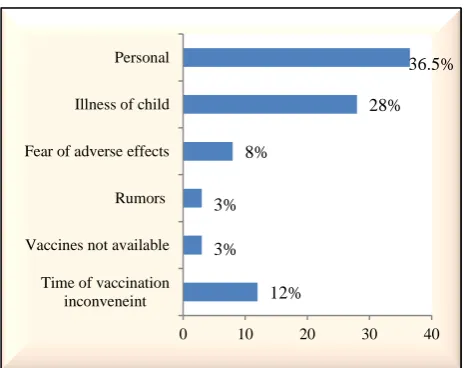
The most important source of information regarding vaccination was got from JPHN/JHI/ASHA/AWW as mentioned by parents/caregivers of the children. The various reasons cited for partial immunization were ‘personal’ in 36.5% that is they did not feel the need to immunize their child or were unaware about immunization, their busy schedule, family problems cultural and religious reasons, ‘postponement due to illness of child’ in 28%, ‘time of vaccination inconvenient’ in 12%, ‘fear of adverse effects’ in 8% (Figure 4).
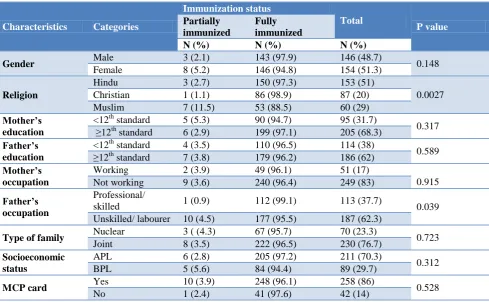
Belonging to Muslim religion and fathers’ occupational who were labourers /unskilled workers were found to be factors associated with partial immunization in children 12-23 months of age (Table 1). Belonging to Muslim religion, mother’s education less than 12th standard and not possessing an MCP card were found to be factors
100% 99.7% 99.3% 100% 100% 100% 100% 100% 100% 100% 99.7% 99.7% 96%
0% 20% 40% 60% 80% 100%
BIRTH BCG BIRTH OPV BIRTH HEP B 6 WKS DPT & OPV 6 WKSHiB 6 WKS HEP B 10 WKS DPT & OPV 10 WKS HiB 10 WKS HEP B 14 WKS DPT & OPV 14 WKS HiB 14 WKS HEP B 9 MONTHS MEASLES
Vaccine coverage
100% 99.70% 98.70% 99.70% 97.70% 99.70% 99.70% 97.70% 99.70% 99.70% 97.70% 99.70% 96% 94% 84.30%
0% 10% 20% 30% 40% 50% 60% 70% 80% 90% 100%
BIRTH BCG BIRTH OPV BIRTH HEP B 6 WKS DPT & OPV 6 WKSHiB 6 WKS HEP B 10 WKS DPT & OPV 10 WKS HiB 10 WKS HEP B 14 WKS DPT & OPV 14 WKS HiB 14 WKS HEP B 9 MONTHS MEASLES 18 MONTHS DPT & OPV, MEASLES 4-7 YEARS DPT
Vaccine coverage
12% 3% 3%
8%
28% 36.5%
0 10 20 30 40
Time of vaccination inconveneint Vaccines not available
Rumors Fear of adverse effects
Illness of child Personal
Table1: Sociodemographic factors associated with immunization status of children 12-23 months (n=300).
Characteristics Categories
Immunization status
Total
P value Partially
immunized
Fully immunized
N (%) N (%) N (%)
Gender Male 3 (2.1) 143 (97.9) 146 (48.7) 0.148
Female 8 (5.2) 146 (94.8) 154 (51.3)
Religion
Hindu 3 (2.7) 150 (97.3) 153 (51)
0.0027
Christian 1 (1.1) 86 (98.9) 87 (20)
Muslim 7 (11.5) 53 (88.5) 60 (29)
Mother’s education
<12th standard 5 (5.3) 90 (94.7) 95 (31.7)
0.317
≥12th standard 6 (2.9) 199 (97.1) 205 (68.3)
Father’s education
<12th standard 4 (3.5) 110 (96.5) 114 (38)
0.589 ≥12th
standard 7 (3.8) 179 (96.2) 186 (62)
Mother’s occupation
Working 2 (3.9) 49 (96.1) 51 (17)
0.915
Not working 9 (3.6) 240 (96.4) 249 (83)
Father’s occupation
Professional/
skilled 1 (0.9) 112 (99.1) 113 (37.7) 0.039
Unskilled/ labourer 10 (4.5) 177 (95.5) 187 (62.3)
Type of family Nuclear 3 ( (4.3) 67 (95.7) 70 (23.3) 0.723
Joint 8 (3.5) 222 (96.5) 230 (76.7)
Socioeconomic status
APL 6 (2.8) 205 (97.2) 211 (70.3)
0.312
BPL 5 (5.6) 84 (94.4) 89 (29.7)
MCP card Yes 10 (3.9) 248 (96.1) 258 (86) 0.528
No 1 (2.4) 41 (97.6) 42 (14)
Table 2: Factors associated with immunization status of children 5-7 years of age (n=300).
Characteristics Categories
Immunization status
Total
P value Partiality
immunized
Fully immunized
N (%) N (%) N (%)
Gender Male 28 (18.1) 127 (81.9) 155 (51.7) 0.901
Female 27 (18.6) 145 (81.4) 145 (48.3)
Religion
Hindu 26 (13.7) 164 (86.3) 190 (63.3)
0.000
Christian 8 (13.6) 51 (86.4) 59 (19.6)
Muslim 21 (41.2) 30 (58.8) 51 (17.1)
Mother’s education
<12th standard 32 (26.4) 89 (73.6) 121 (40.3)
0.003 ≥12th standard 23 (12.8) 156 (87.2) 179 (59.7)
Father’s education
<12th standard 39 (20.3 ) 153 (79.7 ) 192 (64)
0.152 ≥12th standard 16 (14.8) 92 (85.2) 108 (36)
Mother’s occupation
Working 14 ( 16.9) 69 ( 83.1) 83 (27.7)
0.685 Not working 41 (18.9 ) 176 ( 81.1) 217 (72.3)
Father’s occupation
Professional/
skilled 27 (19.6) 11 (80.4) 138 (46) 0.359
Unskilled/ labourer 28 (17.3) 134 (82.9) 162 (44)
Type of family Nuclear 13 ( (13.9 ) 80 (86.1) 93 (31) 0.191
Joint 42 (20.2) 165 (79.8) 207 (69)
Socioeconomic status
APL 39 ( 16.5) 198 (83.5) 237 (79)
0.114
BPL 16 (25.4) 47 (74.6) 63 (21)
MCP card Yes 30 (13.7) 189 (86.3) 219 (73) 0.000
DISCUSSION
Vaccination is the centerpiece of preventive care of the well child and vaccination coverage remains an important indicator of child health outcomes in all countries. Immunization against common childhood diseases has been an integral component of mother and child health services in India since the adoption of the primary health care approach in 1978. The UIP was introduced by the Government of India in 1985-86 to cover at least 85 per cent of the infants against the six vaccine-preventable diseases (VPDs) by 1990. It was hoped that by the turn of 20th century, the coverage of children for vaccination against the six VPDs would reach 100 per cent.13
However until recent time, a number of factors have been hindering the attainment of targets to provide complete vaccination for all individuals who are in need. Thus improving vaccination coverage has become the goal of all nations to alleviate the undesirable health outcomes of non-immunized children. In spite of observable progress in addressing immunization service globally, immunization coverage is not sufficient enough in contrast to its immense advantage. So this study tried to assess immunization coverage and factors associated with under vaccination among children aged 12 to 23 months and 5-7 years in Paravur Taluk of Ernakulam district.
Our study revealed that 96 percent of children in 12-23 months age group was fully immunized which is much higher than NFHS – 4 data of Ernakulam district (72%) and of Kerala (82.1%). Similar results have been reported in a study conducted in Kollam district of Kerala by Rakesh et al.14 Joy et al evaluated the vaccination coverage in urban areas of Ernakulam and got a lower coverage than our study.5 Various other studies acrossIndia has reported lower coverage.15-17 This could be due to regional variation.
Among the individual vaccines in children 12-23 months, coverage was highest for BCG (100%) followed by DPT/OPV and lowest for measles (96%). Similar trend was observed by Rakesh et al, Dattaet al and Gill et al.14,16,17 The immunization coverage value for all the vaccines were higher in our study when compared to coverage evaluation survey by UNICEF and NFHS-4.18 The dropout rate from BCG to measles first dose was 3.7%. This might be due to the long interval between DPT3/OPV3 and measles. Higher dropout rate was seen in other studies in India.11, 19
Complete immunization coverage among 5 to 7 year age group children were 82% in our study. The immunization coverage of all vaccines in them were above 93% till 18-24 months of age. Whereas DPT 2 booster coverage was found to be only 84%. These results contradict the findings of Joy et al.5 This may be because they have evaluated urban agglomerations of Ernakulam. The
has to be taken seriously as Kerala had witnessed outbreaks of diphtheria in adolescents and adults during previous years. The study of Joy et al conducted in urban areas of Ernakulam also shows similar results.4
Maternal education less than 12th standard was associated with partial immunization status of children 5 to 7 years. NFHS–4 data shows that 70% of children in 12-23 months whose mothers have 12 or more years of schooling have received all basic vaccinations, compared with 52 percent of children whose mothers have no schooling. There are many other studies from India and other countries reporting that education of mother increases the vaccination chance of a child. Increased education is usually expected to improve health seeking behavior positively. Mothers with lower educational status could be a group for greater care and motivation in this area.5,14,20,21
In our study children whose fathers were labourers or unskilled workers were less likely to be fully immunized than those who were skilled workers /professionals.
Having obtained a mother and child protection card during antenatal/intranatal period was found as a protective factor for full immunization in children 5 to 7 years of age. In this study 73% of children (5-7 years) had a government issued card. Possessing a government card is an indicator that the mother is registered and is being tracked.5 Vaccination cards are a critical tool in ensuring that a child receives all recommended vaccinations on schedule.2
Various studies have reported reasons for non-vaccination as lack of awareness, apprehension about adverse events, vaccine resistance (reluctance to receive the vaccine for reasons other than fear of adverse events), child travelling, parents busy and programme related gap.22 Our study also showed similar reasons for not immunizing their children.
It is felt from this study that most of these reasons for non-vaccination could be overcome through professionally–designed behaviour change commu-nication interventions. There is need to strengthen the programme management skills of the lower- and mid-level managers to address the dropout. The surveillance and referral systems in the area also need reinforcing so as to identify defaulters of immunization and reduce the drop-out rate.
Campaigns shall also include the community based organizations such as residents associations, Kudumbashree etc. to see that all the members are oriented regarding need for immunization and immunization schedule. ASHA workers, Jr. public health nurses and anganwadi workers, whose wards are fully immunized (all children in the 0-5 age group) may be given special incentives/awards every year to promote the immunization levels.
Limitations
The statement of the parents/caretaker was taken into consideration for finding immunization status for those not having vaccination card. So there can be recall bias and can overestimate the immunization coverage. We have estimated the crude vaccine coverage and did not determine the validity of the doses.
CONCLUSION
To conclude, the vaccination coverage of UIP vaccines among children aged 12–23 months in Paravur Taluk of Ernakulam was 96%. Fathers who were labourers/ unskilled workers and belonging to muslin religion were found to be factors associated with partial immunization status of children aged 12–23 months. Among children aged 5-7 years, coverage of individual vaccines till 18 months of age was above 93%, while the coverage of DPT booster at 4–5 years was only 84%. Belonging to Muslim religion, mother’s education less than 12th standard and not possessing MCP card were found to be factors associated with partial immunization status of children aged 5-7 years.
The results in the present study prove that even after thirty five years of implementation of the UIP, routine immunization has not reached all. Full immunization coverage of older children was primarily low due to low coverage with 2nd booster dose of DPT which makes them vulnerable to VPDs and the reason behind recent outbreaks of diphtheria in Kerala. So emphasis should be on continued efforts for full immunization of all age groups throughout life and its role in achieving 2030 SDGs.
ACKNOWLEDGEMENTS
We acknowledge the support received from our colleagues, interns and field staff of the department. We also place on record our gratitude to DPM, National Health Mission, Ernakulum district.
Funding: DPM, National Health Mission, Ernakulam Conflict of interest: None declared
Ethical approval: The study was approved by the Institutional Ethics Committee
REFERENCES
1. Vaccination and Immunization statistics – UNICEF DATA: Monitoring the situation of children and women. Available at: https://data.unicef.org/topic/ child-health/immunization/. Accessed on 3 January 2019.
2. National Family Health Survey-4 (NFHS-4), 2015-16, Ministry of Health and Family Welfare, Government of India, International Institute for Population Sciences, Mumbai. Available at: rchiips.org/NFHS/NFHS-4Reports/India.pdf. Accessed on 3 January 2019.
3. National Family Health Survey-4 (NFHS-4), Kerala, 2015-16, Ministry of Health and Family Welfare, Government of India, International Institute for Population Sciences, Mumbai. Available at: rchiips.org/NFHS/NFHS-4Reports/India.pdf Accessed on 3 January 2019.
4. Devasenapathy N, Ghosh Jerath S, Sharma S, Allen E, Shankar AH, Zodpey S. Determinants of childhood immunisation coverage in urban poor settlements of Delhi, India: a cross-sectional study, BMJ open August 2016:1-12.
5. Joy TM, George S, Paul N, Renjini BA, Rakesh PS, Sreedevi A. Assessment of vaccine coverage and associated factors among children in urban agglomerations of Kochi, Kerala, India. J Family Med Prim Care. 2019;8:91-6.
6. World Health Organization: Global Vaccine Action Plan 2011-2020. Available at: https://www.who.int/ immunization/global_vaccine_action_plan/GVAP_d oc_2011_2020/en/. Accessed on 3 January 2019. 7. Registrar General of India.Census India 2011.
Avalable at: https://www.censusindia.co.in/sub district/paravur-taluka-ernakulam-kerala-5659. Accessed on 3 January 2019.
8. Directorate of census operations, Kerala. District census handbook, Ernakulam. Available at: http://censusindia.gov.in/2011census/dchb/3208_PA RT_B_ERNAKULAM.pdf. Accessed on 3 January 2019.
9. World Health Organization, Vaccination Coverage Cluster Survey Reference Manual version 3 (Updated 2015). Available at: https://www.who. int/immunization/monitoring_surveillance/Vaccinati on_coverage_cluster_survey_with_annexes.pdf. Accessed on 3 January 2019.
10. Government of Kerala. Report of the task force on poverty elimination. State Planning Board. Thiruvananthapuram, 2015.
11. Goyal S, Kumar V, Garg R. Evaluation of primary immunization coverage among children in a rural block of district Rohtak, Haryana, India. Int J Community Med Public Health. 2017;4:1612-9. 12. Singh J, Deepti SS, Mahajan S, Lal M, Singh T,
13. Kadri AM, Singh A, Jain S, Mahajan RG, Trivedi A. Study on immunization coverage in urban slums of Ahmedabad city. Health and Population: Perspectives Iss. 2010;33(1):50-4.
14. Rakesh PS, Sheeja AL, Subhagan S, Salila K. Closing the Immunisation Gap: Immunisation Coverage Evaluation in Kollam Corporation, Kerala. Kerala Med J. 2015;8(4):4–8.
15. Goyal S, Kumar V, Garg R. Evaluation of primary immunization coverage among children in a rural block of district Rohtak, Haryana, India. Int J Community Med Public Health. 2017;4(5):1612-9. 16. Datta A, Mog C, Das S, Datta S. A cross-sectional
study to assess the immunization coverage and vaccine dropout rates among 12 to 23 months old children in a rural area of Tripura. Int J Med Sci Public Health. 2017;6:394-7.
17. Gill N, Singh R, Mondal A, Balaram J. Immunization coverage and its associated factors among children residing in project affected population’s resettlement colonies in urban slum of Mumbai, Maharashtra, India. Int J Community Med Public Health. 2016;3:1783-7.
18. UNICEF. Coverage evaluation survey: All India report. 2009. Available at: http://www.india environmentportal.org.in/files/National_Factsheet_3 0_August_no_logo.pdf. Accessed on 3 January 2019.
19. Chaturvedi R, Sharma RR, Martolia DS. A study on evaluation of primary immunization coverage in slums of Kanpur nagger. Int J Wellness. 2014;1:16-9.
20. Verma N, Singh JV, Kumari R, Agarwal M, Verma A, Shukla M. Effect of Socio demographic factors on age-appropriate immunization of children in slums of Lucknow, capital of Uttar Pradesh. Int J Med Sci Public Health. 2016;5(11):2264-8.
21. Awasthi A. Maternal determinants of immunization status of children aged 12–23 months in urban slums of Varanasi, India. Clinical Epidemiol Global Health. 2015;3:110-6.
22. Gurnani V, Haldar P, Aggarwal MK, Das MK, Chauhan A, Murray J, et al. Improving vaccination coverage in India: lessons from Intensified Mission Indradhanush, a cross-sectoral systems strengthening strategy. BMJ 2018;363.
23. Levine OS, Bloom DE, Cherian T, de Quadros C, Sow S, Wecker J et al. The future of immunisation policy, implementation, and financing. Lancet. 2011;378(9789):439–48.
24. Simons E, Ferrari M, Fricks J, Wannemuehler K, Anand A, Burton A, et al. Assessment of the 2010 global measles mortality reduction goal: results from a model of surveillance data. The Lancet. 2012;379(9832):2173–8.