Original Research Article
Determinants of menstrual hygiene among the adolescent girls
in a South Indian village
Swapna Budimelli, Kalyan Chebrolu*
INTRODUCTION
The World Health Organisation (WHO) has defined adolescence as the period between 10 and 19 years, a critical period of life characterised by rapid growth and development, both physiologically, psychologically and socially.1 Adolescents constitute about 22 per cent of India's population.2
Menstruation is the physiological process which starts at menarche at or before sexual maturity, in females and ceases at or near menopause. But its physiology and nature are very poorly understood among the female population due to many socio-cultural factors which make them to adapt certain practices unknowingly whether it is correct or false.3,4
Adolescent girls constitute a vulnerable group, particularly in India where female child is neglected one.
ABSTRACT
Background: Adolescent girls constitute a vulnerable group, particularly in India where female child is neglected one. Menstruation is still regarded as something unclean or dirty in Indian society. Although menstruation is a natural process, it is linked with several misconceptions and practices, which sometimes result into adverse health outcomes. Women having better knowledge regarding menstrual hygiene and safe practices are less vulnerable to reproductive tract infections and its consequences. The objective of the present study is to determine the factors affecting the existing practices of menstrual hygiene among the adolescent girls and to study the beliefs, conception and source of information regarding menstruation among the study population.
Methods: A pre-tested semi-structured schedule containing information like socio-demographic factors, perceptions
about menstruation, practice of menstrual hygiene, restrictions practiced during menstruation was administered to 200 adolescent girls by paying house to house visits. The data was entered in Microsoft Excel and analysed using Epi Info software version 7.2.3.
Results:: Nearly three-fourths of the adolescent girls attained menarche before the age of 14 years and 87% had no
knowledge about it prior to attaining menarche. Majority (86%) respondents use sanitary pads, while only 14 (7%) use new cloth pieces, 6 (3%) use reused cloth pieces. Except for attending school, many restrictions were imposed on them during menstruation including participation in religious activities, festivals, attending household chores, food restrictions, etc.
Conclusions: Various cultural practices and ignorance are affecting the menstrual hygiene of the adolescent girls and
they need to be educated in this regard.
Keywords: Adolescent girls, Menstruation, Menstrual hygiene
Department of Community Medicine, NRI Medical College, Chinakakani, Guntur district, Andhra Pradesh, India
Received: 21 June 2019
Revised: 05 August 2019
Accepted: 06 August 2019
*Correspondence: Dr. Kalyan Chebrolu, E-mail: [email protected]
Copyright: © the author(s), publisher and licensee Medip Academy. This is an open-access article distributed under
the terms of the Creative Commons Attribution Non-Commercial License, which permits unrestricted non-commercial use, distribution, and reproduction in any medium, provided the original work is properly cited.
Menstruation is still regarded as something unclean or dirty in Indian society. The manner in which a girl learns about menstruation and its associated changes may have an impact on her response to the event of menarche.5
Although menstruation is a natural process, it is linked with several misconceptions and practices, which sometimes result into adverse health outcomes. Women having better knowledge regarding menstrual hygiene and safe practices are less vulnerable to reproductive tract infections and its consequences. Therefore, increased knowledge about menstruation right from childhood may escalate safe practices and may help in mitigating the suffering of millions of women.6
Although many studies were conducted to assess the menstrual practices, the diversity of cultural practices in India, mandates to investigate on menstrual hygiene. This study was done to explore the menstrual practices, knowledge, cultural beliefs and experiences regarding menstrual practices among the adolescent female population residing in rural areas, as there are very few studies done in this part of this country.
Aim
To study the determinants of menstrual hygiene among the rural adolescent girls residing in field practice area of NRI Medical College, Guntur.
Objectives
To determine the factors affecting the existing practices of menstrual hygiene among the adolescent girls.
To study the beliefs, conception, source of information regarding menstruation among the study population.
METHODS
A cross-sectional observational study was conducted in Chinakakani village. The field practice area of NRI Medical College and General Hospital, a rural medical college in Guntur district, Andhra Pradesh. The population of Chinakakani village is 6230, consisting of a total of 1175 families residing in the village. The study village has a population of 6,230, consisting a total of 1175 families residing in the village.
Sample size
The sample size was calculated based upon the formula 4 PQ/L2, where P was assumed prevalence of unhygienic menstrual practices among adolescent girls, Q was 100-P, and L (allowable error) was taken at 15% of P. Review of different studies showed the prevalence of unhygienic menstrual practices among adolescent girls is around 48%. So, n=4 × 48 × 52/7.2 × 7.2=192.5. The sample size was rounded off to 200 adolescent girls.
Duration of study
Data collection was carried out three months from January 2019 to March 2019.
Study participants
All adolescent girls resident of the study village aged 10 to 19 years were eligible to participate in the study. All the eligible participants were listed by conducting a house to house visit by the principal investigator 200 study subjects were selected by systematic random method.
Exclusion criteria
Residents of the village aged <10 years and ≥20 years, all non- residents/visitors to the village, adolescent males, and adolescent girls of the village who would not like to participate were excluded from the study.
Study tools
General information pertaining to age, literacy status and occupation of subject, their parents, caste, religion, marital status, family income, total members in the family, number of siblings etc. was obtained by interview method and recorded on a pre-designed and pre-tested structured schedule. Informed consent of the respondent was obtained before administration of the schedule. Institutional Ethical Clearance was obtained prior to the start of the study.
Statistical analysis
The data collected was analyzed using Microsoft Excel and Epi Info statistical package. The data was then summarized in the form of tables and graphs.
RESULTS
A total of 200 adolescent girls were studied as part of the study. Here are the results of the present study.
Socio-demographic factors
Table 1: Socio-demographic profile of the study subjects (n=200).
Frequency % Age of the respondent (in years)
11 2 1.0
12 4 2.0
13 24 12.0
14 31 15.5
15 19 9.5
16 29 14.5
17 18 9.0
18 27 13.5
19 46 23.0
Education
Illiterate 5 2.5
Primary school 10 5.0
Secondary school 115 57.5 Intermediate and above 70 35.0 Religion
Christian 99 49.5
Hindu 101 50.5
Current marital status
Married 25 12.5
Single 175 87.5
Monthly household income (in rupees)
<5,000 31 15.5
5,000-10,000 82 41.0
>10,000 87 43.5
Type of family
Joint 36 18.0
Nuclear 164 82.0
Living arrangement
With father only 3 1.5
With mother only 2 1.0
Both parents 178 89.0
With relatives 17 8.5
Mother's education
Illiterate 97 48.5
Primary school 41 20.5
Secondary school 51 25.5 Intermediate and above 11 5.5 Father's education
Illiterate 82 41.0
Primary school 30 15.0
Secondary school 59 29.5 Intermediate and above 29 14.5 Type of house
Kutcha 33 16.5
Pucca 167 83.5
Functional sanitary latrine
Present 176 88.0
Absent 24 12.0
Aware of ad promoting sanitary pads usage
Yes 185 92.5
No 15 7.5
Fathers of 82 (41%) adolescent girls are illiterates, 30 (15%) completed primary education, 59 (29.50%) completed secondary education, 29 (14.50%) are above secondary education level. 167 (83.50%) respondents live in pucca houses and 33 (16.50%) live in kutcha type of houses. Most of the adolescent girls 176 (88%) had access to toilet facility at their homes. Most of the respondents 185 (92.5%) are aware of the advertisements promoting the use of sanitary pads in media (Table 1).
Menarche
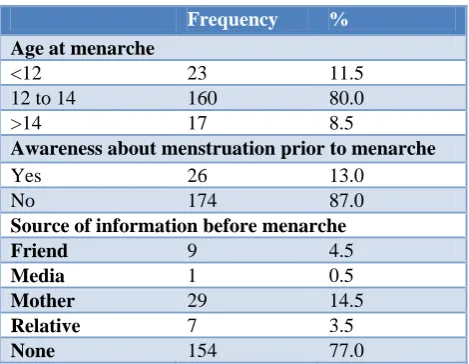
Nearly three fourths (73.5%) of the adolescent girls attained menarche before the age of 14 years. Most of the respondents 173 (87.0%) have no knowledge about menarche and 154 (77%) did not know about menstruation prior to menarche. In those who were aware about menstruation (23%), mother was the main source of information 29 (14.5%) followed by friends in case of 9 (4.50%) girls (Table 2).
Table 2: Menarche (n=200).
Frequency %
Age at menarche
<12 23 11.5
12 to 14 160 80.0
>14 17 8.5
Awareness about menstruation prior to menarche
Yes 26 13.0
No 174 87.0
Source of information before menarche
Friend 9 4.5
Media 1 0.5
Mother 29 14.5
Relative 7 3.5
None 154 77.0
Perceptions about menstruation
More than half 106 (53%) of the girls did not know about cause of menstruation.
Table 3: Awareness regarding menstruation (n=200).
Frequency %
Cause of menstruation
Curse of god 2 1.0
Physiological cause 92 46.0
Don't know 106 53.0
Organ from which menstrual blood comes
Uterus 13 6.5
Stomach 1 0.5
Don't know 186 93.0
Absorbent ideally used for menstruation
Cloth piece 15 7.5
92 (46%) of the girls believed it to be a physiological process, 2 (1%) girls believed it to be due to the curse of God. Only 13 (6.5%) girls were aware that uterus is the organ of menstruation. Many of the respondents 185 (92.5%) felt commercially made sanitary pads to be ideal absorbent during menstruation(Table 3).
Practice of menstrual hygiene
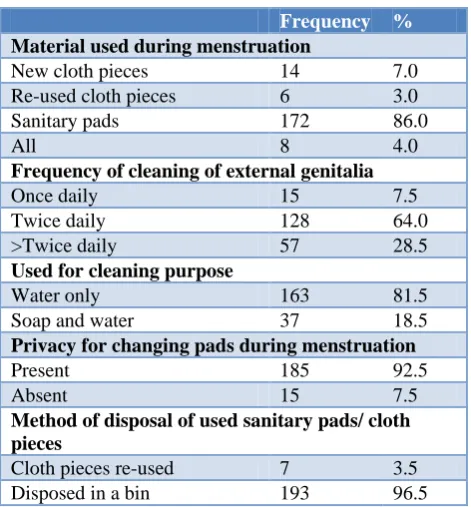
Majority (86%) respondents use sanitary pads, while only 14 (7%) use new cloth pieces, 6 (3%) use reused cloth pieces. Frequency of cleaning external genitalia is once in 15 (7.5%), twice in 128 (64%), more than 2 times in 57 (28.5%) girls during the menstrual periods. For cleaning the external genitalia, majority 163 (81.5%) use water only, while 37 (18.5%) girls use soap and water. Fifteen adolescent girls reported that they were deprived of privacy for changing sanitary pads and cleaning of external genitalia, either at school or at home. Seven (3.5%) girls re-used the cloth pieces whereas, most of them 193 (96.50%) disposed the used sanitary pads or cloth pieces properly (Table 4).
Table 4: Menstrual hygiene practices (n=200).
Frequency %
Material used during menstruation
New cloth pieces 14 7.0
Re-used cloth pieces 6 3.0
Sanitary pads 172 86.0
All 8 4.0
Frequency of cleaning of external genitalia
Once daily 15 7.5
Twice daily 128 64.0
>Twice daily 57 28.5
Used for cleaning purpose
Water only 163 81.5
Soap and water 37 18.5
Privacy for changing pads during menstruation
Present 185 92.5
Absent 15 7.5
Method of disposal of used sanitary pads/ cloth pieces
Cloth pieces re-used 7 3.5 Disposed in a bin 193 96.5
Restrictions practiced during menstruation
During menstruation, 17 (8.50%) adolescent girls were restricted in type of dressing, 105 (52.50%) did not attend any religious occasion, 100 (50%) did not attend marriage, 24 (12%) were restricted from playing, 23 (11.50%) from household work, 16 (8%) from interacting with boys, 62 (31%) from travelling alone, 48 (24%) were confined to house. Food restrictions like avoiding certain vegetables like potato, brinjal, curd were also noticed during menstruation in the present study.
However, more than 95% of the girls were not prevented from attending school during menstruation (Table 5).
Table 5: Restrictions practised during menstruation (n=200).
Restrictions Yes No
N (%) N (%)
Type of clothes worn 17 (8.5) 183 (91.5)
Attending religious
occasion 105 (52.5) 95 (47.5)
Attending marriage 100 (50.0) 100 (50.0)
Attending school 9 (4.5) 191 (95.5)
Playing with friends 24 (12.0) 176 (88.0)
Household work 23 (11.5) 177 (88.5)
Types of food 88 (44.0) 112 (56.0)
Interaction with boys 16 (8.0) 184 (92.0)
Travel 62 (31.0) 138 (69.0)
Confinement to house 48 (24.0) 152 (76.0)
DISCUSSION
Socio-demographic factors
Awareness regarding advertisements promoting sanitary pads usage in the media
More than 90% of the adolescents have seen or heard advertisements promoting sanitary pads usage in the media. In a study done on adolescent girls in Rajasthan, more than half of the girls were ignorant about the use of sanitary pads during menstruation.16 The awareness levels are better in the present study population.
Menarche
8 out of 10 adolescent girls attained menarche between 12 to 14 years of age. In Rajasthan, it was observed that the mean age at menarche to be 13.2 years.16 The age at menarche in the present study is similar to the study done in Rajasthan.
Awareness about menstruation prior to menarche
In the present study only 13% of the respondents have some knowledge regarding menarche. In rural West Bengal, awareness about menstruation prior to attainment of menarche varied from 37.52% to 67.5%, whereas it is between 42% to 55.4% in urban West Bengal.7-9 Awareness regarding menstruation prior to menarche is lacking in the present study population when compared to other studies done elsewhere in the country.
Source of information before menarche
Mother is the main source of information prior to attaining menarche in 14.5% of the adolescent girls, followed by friends (4.5%) in the current study. Teacher was found to be the main source of information (27.01%) regarding menarche in rural West Bengal,whereasmother (60.7%) or an elder sister (15.8%) was the main source of information in rural Gujarat.9,18 Mother is the main source of information regarding menarche in the present study as like in other studies done previously.
Perception about menstruation
Cause of menstruation
More than half (53%) of the girls were unaware of the cause of menstruation and 46% believed it to be a physiological process in the present study. Awareness regarding the cause of menstruation varied from 6% among adolescent girls in Nepal, 21.07% in West Bengal, 31% in rural Gujarat.8,18,19 The awareness levels regarding the cause of menstruation in the present study is better than that in other studies.
Source of blood during menstruation
Most of the adolescent girls (93%) were unaware of the source of blood during menstruation. Most of the adolescent girls were not aware of the source of menstrual blood which varied from 40% to 97.5% from
various studies done in the country.6,7,11,13,15 The level of knowledge is poor in present study reflecting the similarities from other parts of the country.
Practice of menstrual hygiene
Material that the respondents commonly use during menstruation
Majority (86%) of the respondents are using sanitary pads, 10% are using cloth pieces which are reused by 3% girls, in the present study. Indian Council of Medical Research (Annual Report 2005-06) observed that nearly 57.6% girls reused cloth during menstruation.21 Studies done elsewhere in India observed that most of the adolescent girls were reusing the cloth, where it varied from 54.88% in rural West Bengal to 74.5% in Mumbai, and 75% in rural Rajasthan.8,16,17 Only 20% adolescent girls were using sanitary napkins in Rural Rajasthan.16 Sanitary pads usage is better in the present study than in other parts of the country.
Cleaning of external genitalia
More than 92% of the study subjects clean their external genitalia two or more times per day and majority (81.5%) use only water for this purpose, soap and water were used by only 18.5% of the adolescent girls in the current study. More than half (57%) of urban adolescent girls in Chennai used only water for cleaning the external genitalia and 6% used antiseptics also.11 Both soap and water were used for cleaning purpose in 97.5% adolescent girls in rural West Bengal,whereas it is 37% among urban adolescent girls in Chennai.8,11 The level of hygiene is somewhat better in the present study when compared to adolescent girls in remaining parts of the country.
Privacy for changing sanitary pads during menstruation
Either at school or at home, majority (92.5%) of the respondents had privacy (toilet with enclosure) for changing pads during menstruation in the present study. More than half of the adolescent girls in West Bengal (51.25%)and 56.39%were deprived of toilet facility with proper enclosure at home.6,8 The adolescent girls in the present study are better than their counterparts elsewhere in the country in terms of availability of privacy (covered toilet).
Method of disposal of used sanitary pads/cloth pieces
Majority (96.5%) of the respondents disposed the sanitary pads or cloth pieces properly in the present study.
Restrictions practiced during menstruation
adolescent girls in rural West Bengal (85%) and 96% girls in rural East Delhi did not follow any restrictions during menstruation.6,22 The prevalence of restrictions on the adolescent girls during menstruation is more in the current study population when compared to other parts of the country.
Restrictions in food
44% adolescent girls were restricted their normal diet during the days of menstruation. Half of the adolescent girls in rural West Bengal, 56% rural girls in East Delhi and 80% girls in Hooghly district reported restrictions to different types of foods. Foods restricted include sour foods, oily and spicy foods. Foodstuffs restricted include banana, radish, palm, etc.6,13,22 The prevalence of dietary restrictions is few in the present study.
Restriction on religious occasions
Restrictions on religious occasions was seen in nearly half (52.5%) of the respondents in the present study. Dasgupta et al, in their study reported 96 (70.59%) girls did not attend any religious occasion.6 In West Bengal, 76.96% of urban girls did not attend any religious occasion whereas in rural girls this percentage was little higher as 78.57%.8 In rural area of East Delhi, 92% of the girls were restricted from worshipping.22 Not visiting a temple (75.6%) is the most common restriction elsewhere.13 The prevalence of restrictions on religious occasions is less in the present study.
Restriction in attending marriage
Half of the adolescent girls were not allowed to attend marriages during the days of menstruation. In rural West Bengal, 10.29% girls did not attend any marriage ceremony during the menstrual period.6 The prevalence of restrictions in attending marriages is higher in the present study.
Restriction in going to school
Only 4.5% respondents were restricted by their parents/family members from attending school during menstruation. In rural West Bengal, 16.18% girlsdid not attend school. In another comparative study done in West Bengal, 10.67% of urban girls did not attend school where as in rural area it is 17.70%.6,8 Very few families are restricting their children from going to school in the present study during menstruation.
Restriction in doing household work
More than 1 in 10 adolescent girls were restricted from doing their household work during menstruation. In rural West Bengal, 33.82% girls did not perform any household work, while in rural area of East Delhi, 70% adolescent girls were restricted from participating in household activities.6,22 The restrictions in participating in
household activities in the present study are less when compared to other studies done in the country.
Restricted in playing
12% of the adolescent girls reported restrictions being imposed from going outside to playing with friends during menstruation by their parents. In rural West Bengal, 42.65% girls were not allowed to play, whereas in another study done in the same state, 33.14% urban girls and 28.22% rural girls were restricted from playing outside during menstruation by their parents.6,8 The prevalence of restrictions imposed on the adolescent girls are few when compared with studies done else where in the country.
CONCLUSION
Female literacy rate is lagging behind in the present study population. Adult literacy rate is also poor in the present study. Presence of a functional sanitary latrine at home and their utilisation is good. Awareness due to advertisements in the media is good in the present study population. Age at menarche is around 12 to 14 years. Awareness regarding menstruation prior to menarche is poor among the rural adolescent girls. Mother, friends are the main source of information among those who know. The perception about menstruation is poor, especially the cause and source of menstrual blood among the rural adolescent girls. Even though most of the rural adolescent girls were aware of the ideal absorbent to be used during menstruation, some of them were using cloth pieces, which were commonly re-used. The maintenance of menstrual hygiene is satisfactory among the majority of the adolescent girls. The method of disposal of used sanitary pads/cloth pieces is satisfactory. Privacy for changing sanitary pads during menstruation is satisfactory, by availability of enclosed toilets at home and in schools. Nearly three- fourths of the rural adolescent girls reported restrictions imposed by family members, the most common being-attending a religious occasion, marriage, certain types of foods, avoiding travel and confinement to house, etc.
Funding: No funding sources Conflict of interest: None declared
Ethical approval: The study was approved by the Institutional Ethics Committee
REFERENCES
1. WHO: The Reproductive Health of Adolescents: A strategy for action; a joint WHO/ UNFPA/UNICEF Statement, Geneva, 1989:7
2. Census of India 2011, Ministry of Home affairs, Government of India
4. Luz AM, Berni NI, Selli L. Myths and taboos of motherhood: Focusing on the health-disease process. Rev Bras Enferm. 2007;60:42-8.
5. Bansal RD, Mehra M. Adolescent girls: An emerging priority. Indian J Public Health. 1998;42(1):1.
6. Dasgupta A, Sarkar M. Menstrual Hygiene: How hygienic is the adolescent girl? Indian J Community Med. 2008;33:77-80.
7. Yasmin S, Manna N, Mallik S, Ahmed A, Paria B. Menstrual hygiene among adolescent school students: An in-depth cross-sectional study in an urban community of West Bengal, India. Sudan J Public Health. 2013;8:60-4.
8. Paria B, Bhattacharyya A, Das S. A comparative study on menstrual hygiene among urban and rural adolescent girls of West Bengal. Indian J Fam Med Primary Care. 2014;3:413-7.
9. Deo DS, Ghattargi CH. Perceptions and practices regarding menstruation- A comparative study in urban and rural adolescent girls. Indian J Commun Med. 2005;30:33-4.
10. Pradhan A. Is menstrual hygiene and management an issue for adolescent school girls? Water Aid Report; 2009.
11. Arumugam B, Nagalingam S, Varman PM, Ravi P, Ganesan R. Menstrual hygiene practices: Is it practically impractical?. Int J Med Public Health. 2014;4:472-6.
12. Vidya GS, K Lalitha , T Hemanth, NS Murthy, S Pruthvish. Perceptions, practices and problems pertaining to menstruation among adolescent girls of rural field practice area of M.S. Ramaiah Medical College, Bangalore, Indian J Prev Soc Med. 2013;44(1-2):87-92.
13. Sudeshna R, Aparajita D. Determinants of menstrual hygiene among adolescent girls: a multivariate analysis. Nat J Commun Med. 2012;3:294-301. 14. Kamaljit K, Balwinder A, Singh GK, Neki NS.
Social beliefs and practices associated with menstrual hygiene among adolescent girls of Amritsar, Punjab, India. J Indian Med Sci Acad. 2012;25:69-70.
15. Kamath R, Ghosh D, Lena A, Chandrasekaran V. A study on knowledge and practices regarding menstrual hygiene among rural and urban adolescent girls in Udupi Taluk, Manipal, India. Glob J Med Public Health. 2013;2:1-9.
16. Khanna A, Goyal RS, Bhawsar R. Menstrual practices and reproductive problems: a study of adolescent girls in Rajasthan. J Health Manag. 2005;7:91-107.
17. Thakur H, Aronsson A, Bansode S, Lundborg CS, Dalvie S, Faxelid E. Knowledge, practices, and restrictions related to menstruation among young women from low socioeconomic community in Mumbai, India. Frontiers Public Health. 2014;2:72. 18. Tiwari H, Oza UN, Tiwari R. Knowledge, attitudes
and beliefs about menarche of adolescent girls in Anand district, Gujarat. East Mediterr Health J. 2006;12:428-33.
19. Adhikari P, Kadel B, Dhungel SI, Mandal A. Knowledge and practice regarding menstrual hygiene in rural adolescent girls of Nepal. Kathmandu Univ Med J. 2007;5:382-6.
20. Drakshayani DK, Ramaiah VP. A study on menstrual hygiene among rural adolescent girls. Indian J Med Sci. 1994;48:139-43.
21. Indian Council of Medical Research (ICMR), (2005- 2006). Knowledge and practices of adolescent girls. In Reproductive health. ICMR annual report, New Delhi, 74. Available at http://www.icmr.nic.in/annual/2005-06/hqds/rh.pdf. Accessed 15 June 2019.
22. Nair P, Vijay L Grover, AT Kannan. Awareness and practices of menstruation and pubertal changes amongst unmarried female adolescents in a rural area of East Delhi, Indian J Commun Med. 2007;32:156-7.
Cite this article as: Budimelli S, Chebrolu K.