http://www.ijcmph.com pISSN 2394-6032 | eISSN 2394-6040
Original Research Article
Prevalence of risk factors for breast cancer in women aged 30 years
and above in Mumbai
Padmavathi V. Dyavarishetty*, Shobha S. Kowli
INTRODUCTION
It is estimated that the prevalence of breast cancer in India is 92.6/lakh population with a mortality rate of 12.7/lakh population.1 Breast Cancer though on the rise in Indian women, is still not perceived by the women as a disease that they are at risk. Women feel that they are unlikely to get breast cancer. Awareness about the disease, its risk factors and the need to undergo breast cancer screening is poor.
Though both men and women can develop breast cancer, women are more at risk of breast cancer.2 Age increases
the risk of breast cancer. Most breast cancers develop after the age of 50 years.2 However in women, the age at which women get breast cancer is much lower than in developed countries, almost a decade earlier.3-5 Early onset of menarche, first live birth at the age of 30 years and above, never giving birth to a child, starting menopause after the age of 55 years, being physical inactive, being obese, having dense breasts, use of combined oral contraceptive pills, personal history of breast cancer, personal history of non-cancerous breast disease, previous radiotherapy treatment, and history of breast cancer in the first degree relatives increases the risk of breast cancer.2
ABSTRACT
Background: Even though there is an increasing trend of breast cancer, women still do not perceive themselves at risk. Poor awareness about the disease and its risk factors and the absence of population based screening contribute to delayed diagnosis. The objective of the study was to assess the prevalence of various risk factors for breast cancer in women aged 30 years and above.
Methods: The cross-sectional study using convenience sampling of all women aged 30 years and above was conducted in Mumbai. Of the 2430 women enumerated in the study area, 1158 women participated in the study. Risk factors for breast cancer assessed included age at menarche; age at first child birth; breastfeeding; use of oral contraceptive pills, age of menopause, first degree relatives with history of breast cancer, history of current and past breast cancer; history of any previous breast related abnormalities.
Results: 15.5% of the women had atleast one risk factor for breast cancer. The prevalence of individual risk factors was below 6%.
Conclusions: Prevalence of the risk factors for breast cancer is not very high, but never the less, the increasing trend of breast cancer in the country makes it imperative to introduce population based screening for all women with or without risk factor.
Keywords: Risk factors, Breast cancer, Prevalence
Department of Community Medicine, K.J. Somaiya Medical College and Research Centre Mumbai, Maharashtra, India
Received: 27 November 2017
Accepted: 11 December 2017
*Correspondence:
Dr. Padmavathi V. Dyavarishetty, E-mail: [email protected]
Copyright: © the author(s), publisher and licensee Medip Academy. This is an open-access article distributed under the terms of the Creative Commons Attribution Non-Commercial License, which permits unrestricted non-commercial use, distribution, and reproduction in any medium, provided the original work is properly cited.
There is no country wide programme that offers screening services.6 There are few projects which are implemented across India that provide clinical breast examination and mammography services. The facilities for mammogram are available in private but cost is an hindering factor. In addition the awareness about the risk factors for breast cancer and the need to undergo breast cancer screening is poor.7-11
The department of Community Medicine is implementing a five year project on breast cancer awareness and screening programme. In this project an attempt is being made to create awareness and motivate women aged 30 years and above to undergo breast cancer screening. The objective of the study was to study the prevalence of various risk factors for breast cancer in women aged 30 years and above.
METHODS
The cross-sectional study was conducted in an urban area of Maharashtra located in the F/North ward of Mumbai. The study area is a field practice area of the department of Community Medicine, where the department is intensively engaged with 2500 families belonging to the low/middle income group. Majority of the population are Hindu by religion, speak mostly Telugu and Marathi and reside in either slums or low/middle-income group buildings.
The sampling method was convenience sampling of all women aged 30 years and above in the study area. Women fulfilling the age criteria, residing in the study area, and consenting to participate in the study were interviewed by the trained out-reach worker. A pre-tested semi-structured interview tool in local language was developed and pilot tested by the authors. The three outreach workers of the project who had received comprehensive training in breast cancer were also trained for data collection over a period of two half days. The outreach workers visited the house, and briefed the household members regarding the project. All the women aged 30 years and above were enumerated. Women available at the time of the visit and consenting to participate in the project were interviewed. Subsequent two attempts were made to interview the women not available during initial visit.
In the semi-structured interview tool, information on the demographic variables like age, religion, educational status, occupation, marital status was obtained. Questions pertaining to the assessment of risk factors included age at menarche; age at first child birth; breastfeeding; use of oral contraceptive pills and its duration, age of menopause, first degree relatives with history of breast cancer, history of current and past breast cancer; history of any previous breast related abnormalities and the treatment taken for it. These questions are based on the questions that have been used in the Gail model and
Cuzick Tyrer model for assessment of breast cancer risk.12
The data was entered into excel sheet, analysis done with the help of excel functions and is presented here as mean, median and percentages.
Since the risk factor assessment is based on the verbal responses that involve recalling information of several years back, the possibility of memory recall bias cannot be ruled out.
The study was conducted between January 2014 and July 2015. The study being a component of the breast cancer awareness and screening programme that was accorded Institutional Ethics Committee approval, separate ethical committee approval for this research was not obtained
RESULTS
In the study area, totally 2430 women aged 30 years and above were enumerated by the outreach workers. Of these, 1158 (47.7%) women participated in the research study. The remaining 1272 women who did not participate in the study, were not contactable due to them being away for work, or their house was found to be locked on several occasions. Less than 5% of these women refused to participate in the study. Of the 2430, 89.9% were Hindu by religion, 8.1% did not respond and rest of the 2% population belonged to other religions like Christian, Buddhism or Islam. Percentage of women who were ever married was 95.8%.
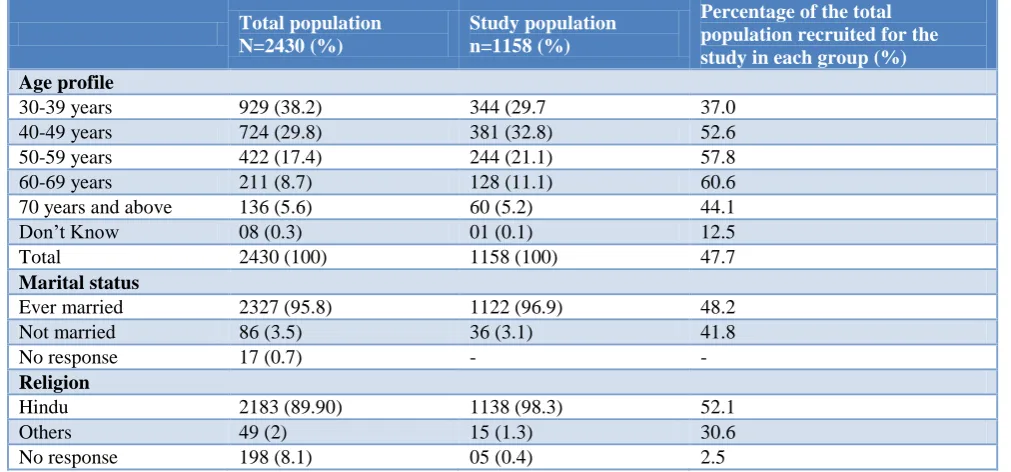
The profile of the 1158 women who participated in the study was similar to the overall profile of the women in terms of age, religion and marital status as can be seen from Table 1. The mean age of the participants is 46.54 years (95% CI is 45.89 – 47.20 years). The percentage of the study population working outside home or from home was 29.1% (338). Around 13% of the women were illiterate; 9.2% completed 1 to 4th standard; 6.6% upto 12th standard, and 2.7% studied beyond 12th standard. The percentage of women who completed studies between 5 to 7th standard was 28.3% and between 8 to 10th standard was 28.6%.
Table 1: Comparison of study population’s profile (age, marital status and religion) with the total population of women in study area.
Total population N=2430 (%)
Study population n=1158 (%)
Percentage of the total population recruited for the study in each group (%)
Age profile
30-39 years 929 (38.2) 344 (29.7 37.0
40-49 years 724 (29.8) 381 (32.8) 52.6
50-59 years 422 (17.4) 244 (21.1) 57.8
60-69 years 211 (8.7) 128 (11.1) 60.6
70 years and above 136 (5.6) 60 (5.2) 44.1
Don’t Know 08 (0.3) 01 (0.1) 12.5
Total 2430 (100) 1158 (100) 47.7
Marital status
Ever married 2327 (95.8) 1122 (96.9) 48.2
Not married 86 (3.5) 36 (3.1) 41.8
No response 17 (0.7) - -
Religion
Hindu 2183 (89.90) 1138 (98.3) 52.1
Others 49 (2) 15 (1.3) 30.6
No response 198 (8.1) 05 (0.4) 2.5
The age at first pregnancy was 30 years and above only in 4.4% women. Almost 80% of the women had their first child below 30 years of age (Table 2). The mean age at first pregnancy is 21.26 years (95% CI is 21.02 to 21.49 years). Only 17 (1.6%) women had not breast fed their child. Majority of the women, 97.7% (1069) had breast fed the child.
Oral contraceptive pills were consumed by 32 women only, of whom 2 women had consumed it for more than five years. Seven women were currently taking oral contraceptive pills. Of them only one was taking for past three years and rest six had just started about a year ago. Only 3.3% (38) women had attained menarche at the age of less than 12 years, while 45.6% (528) had attained menarche at age of 12-13 years. Around 50% (574) women attained menarche when they were 14 years and above. Eighteen women could not recall their age of menarche. The mean age of menarche is 13.62 years (95% CI is 13.54 to 13.70 years).
Number of women who were still getting menstruation is 598 (51.6%). Amongst the women who said their menses had stopped, the age was below 40 years in 63 (11.3%) women; between 40-49 years in 380 women (67.9%) and 50 years and above in 97 (17.3%) women. Twenty women could not recall their age of menopause. The women below 40 years who were not getting menses, majority reported to have had hysterectomy done. Eight women (0.7%) reported family history of breast cancer in grandmother (1), mother (4), sister (2) and aunt (1).
Twenty one women (1.8%) reported to have had a lump in breast. Ten women had a lump less than five years ago and 10 women said it occurred more than10 years ago. One woman could not recall when she was detected to have a breast lump. Nineteen (90.5%) women had taken treatment of whom 16 (84.2%) women had said their problem was resolved. One woman had history of nipple discharge several years back which resolved after treatment.
Table 2: Age at first pregnancy.
Age groups No. of women (n=1094) (%)
<20 years 366 (33.5)
20-24 years 509 (46.5)
25-29 years 156 (14.3)
30 and above 49 (4.4)
No response 14 (1.3)
Two women were in the past diagnosed as breast cancer for whom one had undergone mastectomy and one took chemotherapy.
Table 3 shows the proportion of women with specific risk factors. Amongst the 1158 women who were interviewed, 179 (15.5%) women had atleast one of the risk factors of breast cancer.
Table 3: Risk Factors for breast cancer among women aged 30 years and above.
Risk factor No. of women Percentage of
women (%)
95% confidence interval (%)
Unmarried 36/1158 3.1 2.08 to 4.12
Married and not having children 28/1122 2.5 1.57 to 3.43
Age at first pregnancy (30 years and
above) 49/1094 4.5 3.25 to 5.75
Not breastfeeding 17/1094 1.6 0.84 to 2.36
Consumed oral contraceptive pills (>5
years) 2/1158 0.2 -2.33to 14.73
Age of menarche (<12 years) 38/1158 3.3 2.25 to 4.35
Family history of breast cancer in
grandmother, mother, sister, aunt 8/1158 0.7 0.21 to 1.19
History of breast cancer diagnosis in the
past 2/1158 0.2 -0.06 to 0.46
Past history of lump in the breast 21/1158 1.8 1.02 to 2.58
Any one risk factor 179/1158 15.5 13.37 to 17.63
DISCUSSION
Nearly 48% (1158) of the women aged 30 years and above participated in the study. Majority of the women who could not be recruited for the study were not available at the time of home visits and less than 5% refused to participate in the study. Almost 98% were Hindu by religion. Percentage of ever married women was 97%. Nearly 29% of the study population was engaged in an income generating activity of whom almost 50% were working from home. Educational status was poor. Illiteracy rate was around 13% and only 2.7% studied beyond 12th standard.
Only 36 (3%) women were unmarried. The findings are similar to the study conducted by Erbil where 3.9% were unmarried.13 Proportion of married women who did not have children was 28 (2.5%).
Only in 4.4% of the women, the age at first pregnancy was 30 years and above. This finding is much lower from the study in Udupi which found that almost 56% of the women had first pregnancy at age of 30 years and above.14 This could be due to the different socio-cultural practices prevailing in the community. In the Turkish study, 7.3% of the women had given birth to the child at the age 30 years and above.13 In a case control study in Kerala they found that 9% of the women in control group had child after the age of 30 years.15
Breastfeeding is common practice in India, and therefore the present study found that only 17 (1.6%) women had not breast fed their child.
Usage of oral contraceptive pills was very low (2.8%) of whom only 2 women had consumed it for more than five years. These findings are similar to the study conducted in Udupi and Delhi study.14,16
Menarche below 12 years of age is a risk factor. However in the present study only 3.3% (38) women had started their menarche before 12 years of age. These findings are contradictory to the findings reported in Udupi wherein they found that 31% had menarche before the age of 12 years.14 However the Turkish study found only 6.1% women had attained menarche between 7-11 years of age.13
Eight women (0.7%) reported family history of breast cancer in grandmother (1), mother (4), sister (2) and aunt (1). In the Udupi study the women did not report family history of breast cancer.14 Whereas other studies have reported 1% to 6% women having family history of breast cancer in first degree relatives.13,15,16
In the present study 21 women (1.8%) reported lump in breast in the past. In the Turkish study proportion of women having biopsy was reported as 9%.13 The community based study in Udupi reported that none of the women had breast biopsy.14
The study in Udupi did not find any women diagnosed with breast cancer in the past. In the present study, however, we found two women who were diagnosed with breast cancer; around 5 and 25 years back. 16% of the women in the present study had atleast one risk factors. This figure is much lower than 79% reported in the Udupi study.14
98% of the women were interested in undergoing clinical breast examination and were keen to learn more about breast cancer. The timings suitable for awareness programmes were also suggested by the community.
ACKNOWLEDGEMENTS
Funding: Maina Foundation Conflict of interest: None declared
Ethical approval: The study was approved by the Institutional Ethics Committee
REFERENCES
1. GLOBOCAN 2012: Estimated Incidence, Mortality and Prevalence Worldwide in 2012. Available from http://globocan.iarc.fr/Pages/fact_sheets_population. aspx). Accessed on 26 November 2017.
2. Centers for Disease Control and Prevention. What are the risk factors for breast cancer. Available at https://www.cdc.gov/cancer/breast/basic_info/risk_f actors.htm. Accessed on 26 November 2017. 3. Kakarala M, Rozek L, Cote M, Liyanage S, Brenner
D. Breast cancer histology and receptor status characterization in Asian Indian and Pakistani women in the U.S. - a SEER analysis. BMC Cancer. 2010;10:191.
4. Sandhu DS, Sandhu S, Karwasra RK, Marwah S. Profile of breast cancer patients at a tertiary care hospital in north India. Indian J Cancer. 2010;47:16-22.
5. Chopra B, Kaur V, Singh K, Verma M, Singh S, Singh A. Age shift: Breast cancer is occurring younger age groups – Is it true? Clin Cancer Investig J. 2014;3:526-9.
6. Gupta S. Breast cancer: Indian experience, data, and evidence. South Asian J Cancer. 2016;5(3):85-6. 7. Singh S, Shrivastava JP, Dwivedi A. Breast cancer
screening existence in India: A non-exisitng reality. Indian J Med Paediatr Onco, 2015;36(4):207-9. 8. Gupta A, Shridhar K, Dhillon PK. A review of
breast cancer awareness among women in India: Cancer literate or awareness deficit? Eur J Cancer. 2015;51(14):2058–66.
9. Dey S, Sharma S, Mishra A, Krishnan S, Govil J, Dhillon P. Breast Cancer awareness and Prevention
Behavior among Women of Delhi, India: Identifying Barriers to early detection. Breast Cancer: Basic Clin Res. 2016:10:147–56.
10. Tripathi N, Kadam YR, Dhobale RV, Gore AD. Barriers for early detection of cancer amongst Indian rural women. South Asian J Cancer. 2014;3(2):122–7.
11. Parsa P, Kandiah M, Rahman HA, Zulkefli NAM. Barriers for Breast Cancer Screening Among Asian Women: A Mini Literature Review. Asian Pacific J Cancer Prev. 2006;7:509-14.
12. Evans DGR, Howell A. Breast cancer risk-assessment models. Breast Cancer Research : BCR. 2011;9(5):213.
13. Erbil N, Dundar N, Inan C, Bolukbas N. Breast cancer risk assessment using the Gail model: a Turkish study. Asian Pac J Cancer Prev. 2015;16(1):303-6.
14. Shadap A. Profile picture of risk factors for breast cancer among community women of Udupi, Karnataka; NUJHS. 2016;4(6):29-31.
15. Augustine P, Jose R, Amrtithlal A, Nujum ZT, Peter A, Haran JC. Usefulness of Gail Model Breast Cancer Risk Assessment Tool in Estimating the Risk for Development of Breast Cancer in Women of Kerala, India. Academic Med J India. 201;3(4):117-22.
16. Pakseresht S, Ingle GK, Bahadur AK, Ramteke VK, Singh MM, Garg S, Agarwal PN. Risk factors with breast cancer among women in Delhi. Indian J Cancer. 2009;46:132-8.
Cite this article as: Dyavarishetty PV, Kowli SS. Prevalence of risk factors for breast cancer in women aged 30 years and above in Mumbai. Int J