GROWTH PRIMES Mazurkin P.M.
Mari State Technical University, Yoshkar-Ola, e-mail: [email protected]
The growth of prime numbers was a clear indication. Increase – the number increases, the addition of something. If the number of prime numbers, fi guratively called the «ladder of Gauss-Riemann», the increase may well be likened to the steps, separated from the ladder itself. We prove that the law is obeyed in the critical line i2 = 2 of the second digit binary number system. This functional model was stable and in other quanti-ties of prime numbers (3000 and 100 000). The critical line is the Riemann column i2 = 2 binary matrix of a prime rate. Not all non-trivial zeros lie on it. There is also a line of frames, the initial rate (yields patterns of symmetry) and left the envelope binary number 1. Cryptographers cannot worry: even on the critical line growth of prime numbers
contain the irrational number π = 3,14159 ...
Keywords: prime numbers, increase, the critical line, the root of 1/2 Gauss, Riemann, and behind them and
oth-er mathematicians carried away by the relative power x/π(x) of prime numbers with a truncated start, represented in dotted decimal notation. In this case, apparently unconsciously, this fi gure has been expressed with the logarithm of the irrational basis e = 2,71 ..., and thus the transi-tion from ten degrees to its natural logarithm of false identifi cation has occurred. It is the main error of more than 150 years.
We refused to logarithms, went to the bi-nary system. It turned out that the very prime,
a(n) = {2, 3, 5, 7, 11, 13, 17, ...}, n = {1, 2, 3} is not suffi ciently effective measure. To avoid any claims to the proof, we adopt this tradi-tional range.
Algorithm building a number of prime numbers. He is widely known, has the form
(1) where p(n) – the growth of a prime number;
n – the order of (number) of a prime number. The very number of primes is given initially, it is determined by the condition of the indivis-ibility of the other numbers, except on unit and itself (the latter condition, even excessive).
Therefore, growth is always calculated by subtracting
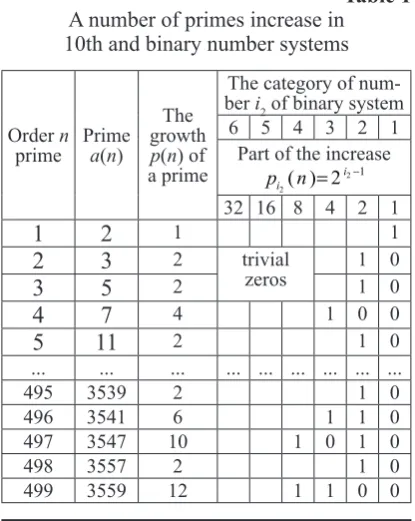
(2) In table 1 shows fragments of the growth of a number of a(n) = {2, 3, 5, ..., 3571}.
Among the 500 prime numbers was a maximum increase p(217) = 34 for a prime
a(217) = 1327 with code 100010 in binary. The fundamental difference of a number of growth of the number of primes is that in the growth (the same number – an abstract meas-ure of the amount), only one column i2 = 2 bit binary numbers is completely fi lled and criti-cal, and the fi rst class has only zeros for the set
a(n) > 2.
Full fi lling will continue to infi nity, there-fore, can be considered a proven fact the ap-pearance of the p(n) = 2 at any power a(n).
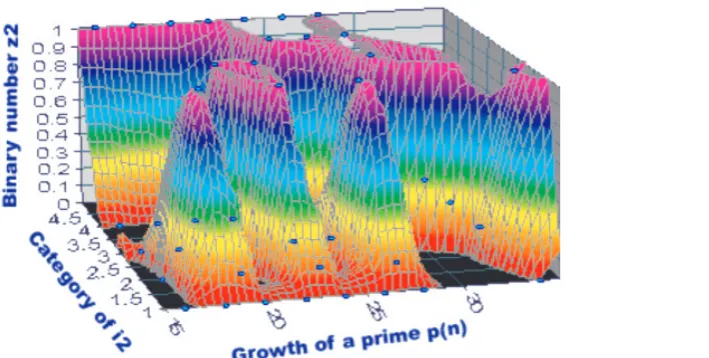
Mathematical landscape. To construct
and delete those rows in which the fi ve col-umns contains at least one trivial zero.
Table 1 A number of primes increase in 10th and binary number systems
Order n
prime Prime a(n) The growth
p(n) of a prime
The category of num-ber i2 of binary system
6 5 4 3 2 1 Part of the increase
32 16 8 4 2 1
1 2 1 1
2 3 2 trivial
zeros 1 0
3 5 2 1 0
4 7 4 1 0 0
5 11 2 1 0
... ... ... ... ... ... ... ... ... 495 3539 2 1 0 496 3541 6 1 1 0 497 3547 10 1 0 1 0 498 3557 2 1 0 499 3559 12 1 1 0 0
An indicator is a binary number z2 in the
fi eld of real numbers (0, 1).
Critical line. The fi rst line in table 1 will automatically fall out of the set. After that, at any length series of prime numbers the fi rst column i2 = 1 is zero. Then each value incre-ment from right to left starting from zero and ends with the unit. And for the unit as a wave broken lines are only trivial zeros.
All non-trivial zeros are arranged in any row between 1 (left) and 0 (fi rst column on the right). Then Riemann’s critical line in a ver-tical column i2 = 2. But it is clear that not all non-trivial zeros lie on the critical line. They are available in other binary digits, interspersed with trivial zeros.
Table 2 Gain critical primes
Order
n Primea(n) Growth p(n)
Digit number i2
6 5 4 3 2 1 part of the increase 32 16 8 4 2 1 -1 0 1
0 1 1 trivial
zeros 1
1 2 1 1
Together with table 1 critical prime num-bers give a full range of prime numnum-bers, which
this article is not considered. To accept it, you must:
a) to recognize as simple that number which shares only on unit (zero/zero indefi -nite);
b) change the order in a number N = {0, 1, 2, 3, 4, ...};
c) gain 1 is a border in the uncritical range includes non-critical prime P = {3, 5, 7, ...}.
Further detailed analysis of the growth will fulfi ll a number of non-critical primes.
Effect of discharge i2. In the software en-vironment of Excel sum over the columns in table 1 (excluding the fi rst line) and get the number of units in the ranks of the binary system.
Fig. 1. The landscape of growth in the number of 500 prime numbers
Table 3 Infl uence of discharge binary system (498 lines)
i2 Share 1 Share 0
1 1 0 0 498 1 0 0
2 2 298 0,5984 200 0,4016 596 0,3855 3 4 285 0,5723 213 0,4277 1140 0,3687 8 153 0,3072 345 0,6928 1224 0,1979 5 16 36 0,0723 462 0,9277 576 0,0466 6 32 1 0,0020 497 0,9980 32 0,0013
All 773 - 2215 - 3568
-Model should give the relative values that allow comparison between different series of growth of prime numbers.
After the identifi cation of bio-law [2] was to teach the following conclusions:
– the share of units (fi g. 2) lines of the bi-nary matrix of growth of prime numbers
(3) − the proportion of zeros in (fi g. 2) lines of the binary matrix of growth of prime numbers
In favor of computing the number of units, there are two distinctive features:
1) the number of zeros (trivial and nontrivi-al) is almost three times as many units (table 3); 2) the design of the formula (2) is easier compared with the expression (3).
Apparently, the option is 0,61623 with in-creasing number of n → ∞ will approach to the golden ratio 0,618 .... Then, on the critical line are φ–1 = 0,618... ones and 0,6182 zeros.
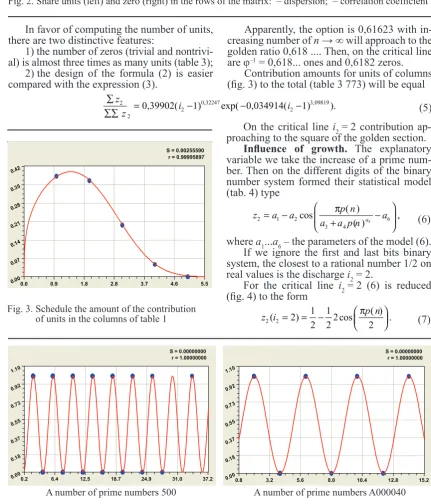
Contribution amounts for units of columns (fi g. 3) to the total (table 3 773) will be equal
(5)
Fig. 3. Schedule the amount of the contribution of units in the columns of table 1
On the critical line i2 = 2 contribution ap-proaching to the square of the golden section.
Infl uence of growth. The explanatory variable we take the increase of a prime num-ber. Then on the different digits of the binary number system formed their statistical model (tab. 4) type
(6)
where a1...a6 – the parameters of the model (6). If we ignore the fi rst and last bits binary system, the closest to a rational number 1/2 on real values is the discharge i2 = 2.
For the critical line i2 = 2 (6) is reduced (fi g. 4) to the form
(7)
hypothesis and remove the message from the Internet: «Here the famous Riemann hypoth-esis, that the real part of the root is always exactly equal to 1/2, no one has yet proven, although the proof of it would have been for the theory of prime numbers in the highest de-gree the importance. At the present time, the hypothesis is verifi ed for seven million of the roots». With increasing power of prime
num-ues, but the graphs such as fi g. 4 will be more frequent fl uctuations due to higher growth. The growth is growing much more slowly than simple numbers. This will increase the power of the series.
The binary number for non-emergency lines. Then the third category with an increase in power p(n) gets the physical meaning of the formula
(8)
as shear waves 0,78539815 almost coincides with the value of the angle of
Check the law
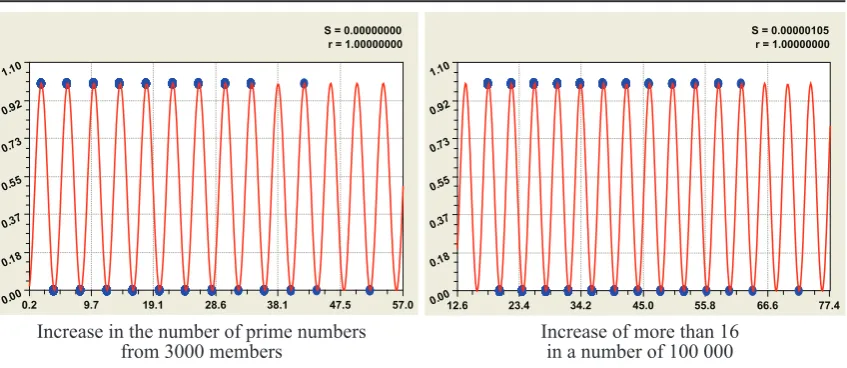
On the critical line i2 = 2 indicated this model is stable and the other quantities of prime numbers (fi g. 5).
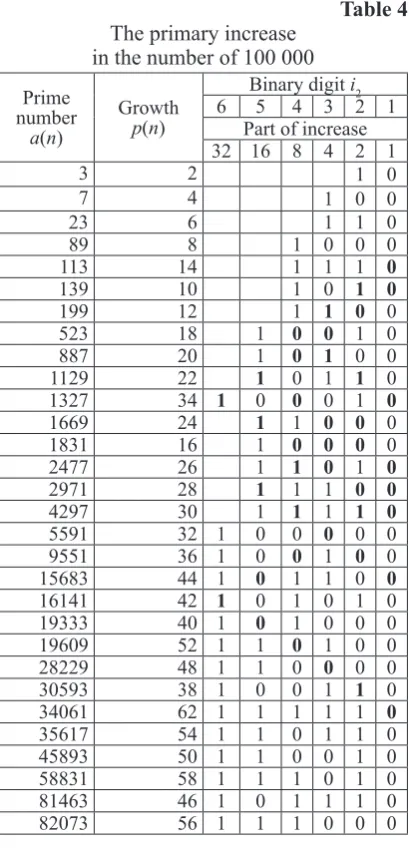
Primary growth. This – the third pa-rameter (the fi rst – a critical line 1/2), giv-ing a picture of the growth rate of prime numbers. Parameter pp(n) for a number of 100 000 prime numbers are shown in ta-ble 4, and he compiled the fi rst appear-ance of the subsequent term. Primary growth is irregular, for example, an in-crease of 14 comes after 8 and earlier values of 10 and 12.
Increase in the number of prime numbers
from 3000 members Increase of more than 16 in a number of 100 000 Fig. 5. Graphs of law the distribution of the binary digits 0 and 1:
S – dispersion; r – correlation coeffi cient
Various font allocated triangles (pat-terns of geometry) with sides (with i2 = 1 – non-trivial zeros). Then the harmoni-ous geometrical structures defi ne the
al-gorithm capacity growth, and even prime number.
Line growth varies with the initial constant «deuce», and there will be fl uctuations, the trend
(9) The envelope of the line. Increments
to the left of the asymptotic lines have trivi-al zeros. Therefore, taken into account the wave envelope line, which in different plac-es concerns a critical line i2 = 2. This – the fourth parameter of the series. Divide the in-crease in two parts .
On the envelope line by line in the table (fi g. 6) are located And in the
. The trend with unit from the formula with three fl uctuations looks like
Table 4 The primary increase
in the number of 100 000
Prime number
a(n)
Growth
p(n)
Binary digit i2
6 5 4 3 2 1 Part of increase 32 16 8 4 2 1
3 2 1 0
7 4 1 0 0 23 6 1 1 0 89 8 1 0 0 0 113 14 1 1 1 0
139 10 1 0 1 0
199 12 1 1 0 0 523 18 1 0 0 1 0 887 20 1 0 1 0 0 1129 22 1 0 1 1 0 1327 34 1 0 0 0 1 0
1669 24 1 1 0 0 0
1831 16 1 0 0 0 0
2477 26 1 1 0 1 0
2971 28 1 1 1 0 0
4297 30 1 1 1 1 0
5591 32 1 0 0 0 0 0 9551 36 1 0 0 1 0 0 15683 44 1 0 1 1 0 0
16141 42 1 0 1 0 1 0 19333 40 1 0 1 0 0 0 19609 52 1 1 0 1 0 0 28229 48 1 1 0 0 0 0 30593 38 1 0 0 1 1 0 34061 62 1 1 1 1 1 0
35617 54 1 1 0 1 1 0 45893 50 1 1 0 0 1 0 58831 58 1 1 1 0 1 0 81463 46 1 0 1 1 1 0 82073 56 1 1 1 0 0 0
Fig. 6. The graph of the envelope line growth numbers 500
At n → ∞ in the formula (10) always will be in the beginning 1.
Conclusions
The critical line Riemann is located in a vertical column i2 = 2 binary matrix of growth of number of simple. Not all non-trivial zeros lie on it. There is also a line of benchmarks, the initial rate and the bending around.
References
1. Don Zagier. The fi rst 50 million prime numbers. – URL: http://www.ega-math.narod.ru/Liv/Zagier.htm.