Original Research Article
Acute respiratory infections among under five children in a rural area
of Kancheepuram district, Tamil Nadu, India: a cross-sectional study
Savitha A. K.*,
Gopalakrishnan S., Umadevi R.
INTRODUCTION
Acute respiratory infection (ARI) is an infection of the respiratory tract that may interfere with normal breathing. They are infectious in nature and can spread from person to person.1 ARIs are the most common cause of illness and death in children belonging to the age group of 1 to 60 months (under 5 except neonatal period). The severity of the disease varies between developed and developing countries and due to differences in aetiology and risk factors. ARI such as pneumonia is one of the most fatal communicable diseases among the children worldwide.2 The burden of ARIs falls heavily on developing countries.
ARI can be classified as upper respiratory tract infections and lower respiratory tract infections. Anatomically, the upper respiratory tract extends from the nostrils to the vocal chords in larynx including the paranasal sinuses and middle ear. The lower respiratory tract covers the continuation of airways from trachea to bronchi to bronchioles and alveoli. The upper respiratory tract infections are more common and more commonly attributed to viral aetiology, namely, rhinovirus, respiratory synctial virus (RSV), parainfluenza/influenza virus, adenovirus, etc.
Most of the upper respiratory tract infections are self limiting. Acute viral infections can predispose children to
ABSTRACT
Background: Acute respiratory infection (ARI) is an infection of the respiratory tract that may interfere with normal breathing. ARI is one of the leading causes of illness and death among children worldwide. The aim of the study was to estimate the prevalence of ARI among under 5 children in the rural field practice area of a medical college in Kancheepuram district of Tamil Nadu.
Methods: This study is a community based cross–sectional study. The study population was children below five years of age and informant was the mother of the child. The sample size is 380 and simple random sampling method was used. Data was analyzed using the SPSS software, version 16, and presented as descriptive statistics.
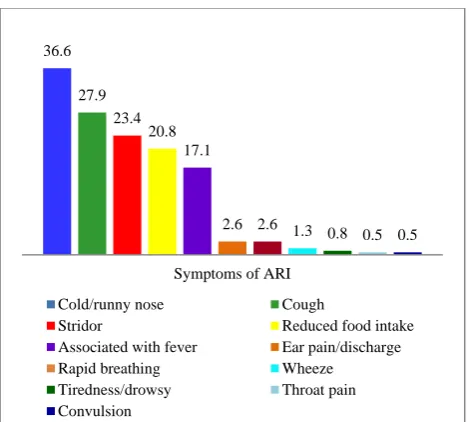
Results: The prevalence of ARI among children was 41.6%. Regarding the symptoms of ARI, 36.6% of them had either cold or runny nose, 27.9% had cough, 23.4% had stridor, 20.8% had reduced intake of food, 2.6% had either ear pain or discharge, 2.6% had rapid breathing.1.3% had wheeze, 0.8% were tired/drowsy, 0.5% had throat pain, 0.5% had convulsions and 17.1% of them had symptoms with fever.
Conclusions: This study shows the prevalence of ARI among children below 5 years of age is 41.6% which is relatively high. The symptoms of ARI reflect the non severe form of pneumonia. More hospital based studies should be done in order to know the burden of severe form of pneumonia which contributes to the morbidity and mortality of children below five years of age.
Keywords: Respiratory tract, Infectious diseases, Pneumonia, ARI
Department ofCommunity Medicine, Sree Balaji Medical College and Hospital, Chennai, Tamil Nadu, India
Received: 04 May 2018 Accepted: 05 June 2018
*Correspondence: Dr. Savitha A. K.,
E-mail: [email protected]
Copyright: © the author(s), publisher and licensee Medip Academy. This is an open-access article distributed under the terms of the Creative Commons Attribution Non-Commercial License, which permits unrestricted non-commercial use, distribution, and reproduction in any medium, provided the original work is properly cited.
bacterial infections of sinuses and middle earand can result in lower respiratory tract infection by aspiration of infected secretions and cells.3 ARIs are not confined to the respiratory tract alone and can be systemic also. The severity due to lower respiratory tract infections is worse in developing countries. This also results in higher case fatality rates.4 Majority of ARI deaths and severe illness episodes are due to acute lower respiratory tract infections especially due to pneumonia.5,6
The common signs and symptoms of ARI are blocked nose or runny nose, cough, ear ache or ear discharge, sore throat, noisy breathing such as wheeze or stridor and difficult breathing like chest in-drawing and fast breathing.7
Acute respiratory infection is one of the leading cause of illness and death among children worldwide. The state of child health as such is that, 5.9 million children below 5 years of age died in 2015, accounting to nearly 16,000 every day. Almost 83% of deaths are due to infectious diseases, neonatal or nutritional conditions.8 Among the neonatal deaths, death due to pneumonia was 2% and among the post neo natal death, deaths due to pneumonia was around 13%.9 Around 20 to 40% of all child hospitalisations were due to ARI and pneumonia alone accounts to 20% of all paediatric deaths which was around 1.6 million in 2008.10
The serial National Family Health Survey studies reported an overall prevalence of ARI as 6.5% (NFHS 1, 1992-93), 19% (NFHS 2, 1998 - 99) and 5.8% (NFHS 3, 2005 - 06) among under 5 children.11-13 In Tamil Nadu, as per NFHS 4 (2015 - 2016) the prevalence of symptoms of ARI among under five children is 2.8% (rural- 2.7%, urban- 2.9%).14 The same survey reported that in Kancheepuram, the prevalence of symptoms of ARI is 2%.15
Every day in the outpatient department of the Rural Health Training Centre (RHTC) attached to a medical college in Kancheepuram district, children with different clinical presentation of ARIs are reporting for management. On an average the centre treats about 5 to 7 under five children with ARI per day. In order to know the prevalence and further our knowledge to understand the epidemiology of ARI, this study was conducted to estimate the prevalence of ARI among the under 5 children in the field practice area of a medical college in Kancheepuram district.
METHODS
Study design
This study is a community based cross-sectional study.
Study area and study population
The study was done in Sripuram, rural field practising area of Sree Balaji Medical College and Hospital in
Kancheepuram district of Tamil Nadu. The total population of the study area was 36,830. Among this, the total number of children below five years of age is 3494. The study was done among children belonging to the age group of 1-60 months (under five) in the study area. In this study the informant was the mother of the child. The study was carried out from August 2016 to August 2017.
Sample size
According to a previous study done by Kumar et al during 2014 in a rural area of Puducherry, the prevalence of ARI among children below 5 years was 53.7%.16 This was taken as a reference value for sample size calculation. The sample size was calculated to be 341, using the formula 4pq/l2 with an allowable error of 10% of P, at 95% CI. Accounting 10% for non response, the final sample size was calculated as 375 (rounded off to 380) [N=380].
Inclusion criteria
Children belonging to the age group of 1 to 60 months irrespective of their morbidity status residing with their families for more than 3 months in Sripuram area whose parents consented for the study were included.
Exclusion criteria
Parents of children who were unwilling to participate in the study were excluded. Children belonging to the age group of 0 to 1 month were also excluded because ARI such as pneumonia is more common among post neonates compared to neonates.
Sampling method
The sampling method used was Simple Random Sampling. The list of under 5 children in this locality which is the sampling frame was obtained from RHTC. From the list consisting of 3494 children residing in the field practice area of RHTC, 380 samples were selected using lottery method.
Study tool
A semi-structured pre-tested questionnaire was used as study tool to interview the child’s mother who was the informant. The questionnaire was prepared in English and translated to the local language Tamil. The interview was conducted by the investigator herself and their responses were recorded in the questionnaire.
Consent and ethical approval
the interview and examination. The informed consent form was in Tamil, which is the local language of the study population.
Data collection method and period
The data was collected by visiting the designated houses as per the sampling frame. The availability of the mother and child at their residence was confirmed by the field staff. In case the child was admitted in an ICDS or school, a cumulative list was made and they were interviewed only during the weekends. Each participant with informant was interviewed for 5 to 6 minutes.
Statistical analysis
Data was analyzed using the software SPSS, version 16. The descriptive statistics analysed were presented as frequency distribution and percentage.
Operational definition of acute respiratory infection
A child having at least one of the following recognisable symptoms of ARI such as runny nose, cough, ear discharge, throat pain, noisy breathing and difficult breathing which might be associated with or without fever in the 2 weeks prior to the date of visit.17-19
RESULTS
Among the 380 participants, 165 (43.4%) of them belonged to the age group of 1 to 12 months, 145 (38.2%) of them belonged to the age group of 13 to 36 months and 70 (18.4%) of them belonged to the age group of 37 to 60 months. Among the study subjects, 180 (47.4%) were males and 200 were females (52.6%). Majority 322 (84.7%) of them belonged to Hindu religion, 36 (9.5%) were Christians, 22 (5.8%) were Muslims.
Majority, 202 (53.2%) of the participants were from nuclear family and 178 (46.8%) were from joint family. The overall literacy rate of mothers of study participants was 93.9%. Among them 24 (6.3%) of the mothers underwent primary education, 191 (50.3%) of them underwent secondary education, 59 (15.5%) of them underwent higher secondary education and 83 (21.8%) were graduates. 23 (6.1%) mothers are illiterate.
As per modified BG Prasad’s socio economic status classification (2016) 10.8% belonged to upper class, 40.3% belonged to upper middle class, 33.2% belonged to middles class and 15.8% belonged to lower middle class. It was observed that among the study population none of them belonged to lower class (Table 1).
Figure 1 shows the prevalence of acute respiratory infections among under five children. Among the 380 study subjects, 158 (41.6%) of them had one or more of the symptoms of ARI associated with or without fever and the remaining did not have any symptoms of ARI.
Table 1: Socio-demographic characteristics of the study population.
S.
no Characteristics
Frequency (N=380)
Percentage (%)
1. Age group (in months)
1-12 165 43.4
13-36 145 38.2
37-60 70 18.4
2. Sex
Male 180 47.4
Female 200 52.6
3. Religion
Hindu 322 84.7
Christian 36 9.5
Muslim 22 5.8
4. Type of family
Nuclear family 202 53.2
Joint family 178 46.8
5. Mother’s education
Illiterate 23 6.1
Primary school 24 6.3
Secondary 191 50.3
Higher secondary 59 15.5
Graduate 83 21.8
6. Socio-economic status (Based on Revised BG Prasad Scale– 2016)
Upper class 41 10.8
Upper middle class 153 40.3
Middle class 126 33.2
Lower middle class 60 15.8
Lower class 0 0
Figure 1: Prevalence of acute respiratory tract infections among under 5 children.
Among the study subjects, 36.6% of them had either cold or runny nose, 27.9% of them had cough, 23.4% of them had stridor, 20.8% of them had reduced intake of food, 2.6% of them had either ear pain or discharge, 2.6% of them had rapid breathing.1.3% of them had wheeze, 0.8% of them were tired/drowsy, 0.5% of them had throat pain, 0.5% of them had convulsions. It was found that none of the subjects had chest in-drawing and 17.1% of them had symptoms associated with fever (Figure 2).
41.6% 58.4%
Figure 2: Symptoms of ARI among the study participants.
DISCUSSION
The objective of this study was to estimate the prevalence of ARI among under five children in the rural field practise area of a medical college in Kancheepuram district, Tamil Nadu.
In this study the prevalence of ARI among under five children was found to be 41.6%. In a study conducted by Kumar SG et al, the prevalence of acute respiratory infection among under-five children in urban and rural areas of Puducherry, was found to be 53.7% in rural area.16 In another study conducted by Choube et al, Potential risk factors contributing to acute respiratory infections in under five age group children in Moradabad, the prevalence was 27.69%.20 In a study done by Kapil et al, on prevalence of acute respiratory infections (ARI) in under-five children of Meerut district, it was 67.1%.21 In a study carried out by Arun et al, prevalence of Acute ARI in under five Children in Lucknow district was 26.8%.22 In a study done by Sharma et al, prevalence of acute respiratory infections and their determinants in under five children in urban and rural areas of Kancheepuram district, prevalence was 62.2% in rural area.23 In a study done by Fekadu et al, the prevalence of ARI/pneumonia was found to be 16.1% in a a rural area in North West Ethiopia.24
By comparing the prevalence of ARI in this study population with that of several studies conducted outside and within India, there is a wide variation. This variation ranges from as low as 16.1% to as high as 62.2%. This study shows prevalence of 41.6%. Such variations in the prevalence between our study and other studies may be due to the relative difference in the operational definition adopted for ARI and also may be due to the geographical variations of the studies carried out.
In this study, adhering to the operational definition given by National Family Health Survey regarding the symptoms of ARI among under five children, 36.6% of them had either cold or runny nose, 27.9% had cough, 23.4% had stridor, 20.8% had reduced intake of food, 2.6% had either ear pain or discharge, 2.6% had rapid breathing.1.3% had wheeze, 0.8% was tired/drowsy, 0.5% had throat pain, 0.5% had convulsions and 17.1% of them were associated with fever. In a study carried out by Kumar et al, 52.7% had cold/running nose, 45.4% had cough, 3.3% of had sore throat, 1.2% had ear discharge, 2% had symptoms associated with fever and fast breathing, 47.5% had symptoms associated with fever.16 In a study done by Fekadu et al, 20.6% had cough, 15.7% had fast breathing, 7.7% had fever, 8.4% had wheezing, 2.1% had chest in drawing and 1.7% had stridor.24 In a study carried out by Majumdar et al, 85.7% had cough, 100% had runny nose, 1.8% had ear discharge and none had sore throat.25 Since most of the studies are community based, the results reflect the non-severe forms of pneumonia only such as no pneumonia and pneumonia when compared to severe and very severe pneumonia which is the common cause of morbidity among under five children requiring hospitalisation.
CONCLUSION
This study shows that the prevalence of ARI among children below 5 years of age was 41.6% in the rural field practising area of a medical college in Kancheepuram district which is relatively high. Clear distinction between the prevalence of acute upper and lower respiratory tract infection should be surveyed to know the actual burden of ARI, so that the terms ARI and pneumonia cannot be interchangeably used. Though such community based studies will throw light on the prevalence of non-severe forms of pneumonia and risk factors that predisposes the children to ARI, it is vital to conduct more hospital based studies to know the burden of severe form of pneumonia which contributes to the morbidity and mortality of children below five years of age.
ACKNOWLEDGEMENTS
The author acknowledges the faculty members of department of community medicine for supporting and guiding to successfully carry out this study.
Funding: No funding sources Conflict of interest: None declared
Ethical approval: The study was approved by the Institutional Ethics Committee
REFERENCES
1. The Healthline Editorial Team. Acute Respiratory Infection Causes, Symptoms and Diagnosis 2016.. Available at: http://www.healthline.com/health/ acute-respiratory-disease. Accessed on 3 February 2018.
36.6
27.9 23.4
20.8 17.1
2.6 2.6 1.3 0.8 0.5 0.5
Symptoms of ARI
Cold/runny nose Cough
Stridor Reduced food intake
Associated with fever Ear pain/discharge
Rapid breathing Wheeze
Tiredness/drowsy Throat pain
2. Prakash LK. Acute respiratory infection among children and health seeking behaviour in India. Int J Sci Res. 2014;4(11):2250-3153.
3. Berman S. Otitis media in developing countries. Pediatrics. 1995;96(1):126-31.
4. Simoes EA, Cherian T, Chow J, Shahid-Salles SA, Laxminarayan R, John TJ. Acute respiratory infections in children. Disease Control Priorities in Developing Countries. 2nd edition. 2006.
5. Rudan I, Boschi-Pinto C, Biloglav Z, Mulholland K, Campbell H. Epidemiology and etiology of childhood pneumonia. Bulletin of the World Health Organization. 2008;86(5):408-16.
6. Bellos A, Mulholland K, O'Brien KL, Qazi SA, Gayer M, Checchi F. The burden of acute respiratory infections in crisis-affected populations: A systematic review. Confl Health. 2010;4(1):1. 7. World Health Organization. Outpatient management
of young children with ARI: Program for control of acute respiratory infections; 1993.
8. Ashley S. WHO. Integrated Management of Childhood Illness. 2015. Available at: http://www.ecu.edu/csdhs/ghp/upload/101415_ WHO_Integrated_Management_of_Childhood_Illne ss.pdf. Accessed on 11 October 2016.
9. CHERG – WHO methods and data sources for child cause of death; 2000 – 2013.
10. World Lung Foundation. Acute Respiratory Infections Atlas; 2010.
11. International Institute for Population Sciences (IIPS) and Macro International. Volume I. Mumbai, India. National Family Health Survey (NFHS-3), 2005–06; 2007.
12. International Institute for Population Sciences (IIPS) and ORC Macro International. Mumbai, India. National Family Health Survey (NFHS-2), 1998–99; 2000.
13. International Institute for Population Sciences (IIPS). Bombay, India. National Family Health Survey (MCH and Family Planning), 1992–93; 1995.
14. NFHS 4 (2015 – 2016) state fact sheet, Tamil Nadu.2015. Available at: http://rchiips.org/nfhs/ nfhs4.shtml. Accessed on 11 October 2016.
15. NFHS 4 (2015–2016) district fact sheet, Kancheepuram, Tamil Nadu, 2015. Available at: http://www.rchiips.org/nfhs. Accessed on 11 October 2016.
16. Kumar SG, Majumdar A, Kumar V, Naik BN, Selvaraj K, Balajee K. Prevalence of acute respiratory infection among under-five children in
urban and rural areas of Puducherry, India. J Nat Sci Biol Med. 2015;6(1):3.
17. World Health Organization. Outpatient management of young children with ARI: Program for control of acute respiratory infections; 1993.
18. NFHS 2015-16. Interviewers manual. International Institute of Population Science. Mumbai. 2014. Available at: http://rchiips.org/NFHS/NFHS4/ manual/NFHS4%20Interviewer%20 Manual.pdf. Accessed on 11 October 2016.
19. NFHS 2015-16. Mothers Questionnaire. 2014. Available at: http://rchiips.org/NFHS/NFHS4/ schedules/NFHS-4Womans.pdf. Accessed on 11 October 2016.
20. Choube A, Kumar B, Mahmood SE, Srivastava A. Potential risk factors contributing to acute respiratory infections in under five age group children. Int J Med Sci Public Health. 2014;3(11):1385-8.
21. Goel K, Ahmad S, Agarwal G, Goel P. Vijay K. A Cross Sectional Study on Prevalence of Acute Respiratory Infections (ARI) in Under-Five Children of Meerut District. India. J Community Med Health Educ. 2012; 2(9):2161-5.
22. Arun A, Gupta P, Sachan B, Srivsatava JP. Study on Prevalence of Acute Respiratory Tract Infections (ARI) in Under Five Children in Lucknow district. Nat J of Med Research. 2014;4(4):298-302.
23. Sharma D, Kuppusamy K, Bhoorasamy A. Prevalence of acute respiratory infections (ARI) and their determinants in under five children in urban and rural areas of Kancheepuram district, South India. Ann Trop Med Public Health. 2013;6(5):513. 24. Fekadu GA, Terefe MW, Alemie GA. Prevalence of
pneumonia among under-five children in Este Town and the surrounding rural Kebeles, Northwest Ethiopia: a community based cross sectional study. Sci. 2014;2(3):150-5.
25. Majumdar A, Premarajan KC, Ganesh KS, Veerakumar AM, Ramaswamy G. Rural Urban Differentials of Treatment Seeking Behaviour for Acute Respiratory Infection among Children in Puducherry. Nat J Community Med. 2014;5(3):325-8.