www.ijatca.com 86
International Journal of Advanced Trends in
Computer Applications
www.ijatca.com
Speed Protocol for Guarantee of QoS Parameters Using
Bacterial Foraging Optimization in MANET
1
Nitika
,
2Vishal Walia, 3Dr.Rahul Malhotra1
M.Tech Student- ECE RIEIT, Ropar 2
Associate Professor (Dean Academic) RIEIT, Ropar
3
Director GTBKIET Malout
1
[email protected], [email protected], [email protected]
Abstract:
In this proposal, we present the state of the research by summarizing the work on QoS based routing protocols that has already been published and by highlighting the QoS issues that are being addressed. We present a spatiotemporal communication protocol for sensor networks, called SPEED for optimization purpose. SPEED is specifically tailored to be a localized algorithm with minimal control overhead. End-to-end soft real-time communication is achieved by maintaining a desired delivery speed across the sensor network through a novel combination of feedback control and non-deterministic geographic forwarding. SPEED is a highly efficient and scalable protocol for sensor networks where the resources of each node are scarce. Experiment results shows that SPEED protocol has been effectively applied for optimization of various parameters in MANET.Keywords:
MANET, SPEED Protocol, Qos, Optimization.I.
Introduction
The increasing concentration in concurrent QoS based routing in network has received an extensive attention from the research area. Many Quality Service based routing protocols have been surveyed but neither gives the appropriate accuracy. For enhanced functioning and a longer life span for a sensing node within the system, we require to reflect on its energy utilization as a chief factor of concern. Sensor networks consist of a number of sensing nodes which are distributed in a wide area [1]. They sense an occurrence happening in the surroundings and these sensing nodes are dispersed according to the necessities of the application. superiority of service ensures the useful communication inside the given or bounded delay time. Protocols should ensure for system stability, superfluous data should be transmitted over the network for any type of traffic sharing. It also desires to maintain positive resource preventive factors like bandwidth, memory buffer size and processing capabilities. Scalability is a significant factor in sensor networks. A network region is not always stationary, it changes depending upon the user
necessities [4]. All the nodes in the complex area must be scalable to adjust themselves to the changes in the system structure depending upon the nodes entered by the user. The sensor nodes can be mobile or static depending on the application.
www.ijatca.com 87 So in the proposed work, SPEED protocol with fusion
of BFO algorithm will be optimized [7,8]. SPEED is a real –instance QoS routing protocol which needs to deliver a data packet to the destination within a certain time period, if the packet cannot be reached within the time period, the packet is dropped back decreasing the performance of speed protocol. Node failure or congestion leads to, large amounts of dropping of the data packets, which may lead to devastating consequences [9].
Remaining paper is organized as Section II will contain the introduction to SNGF, Section III will contain the proposed work, Section IV will contain simulation flowchart, and Section V will contain results and simulation, and finally Section VII will contain the conclusion and future scope.
II. SGNF STATELESS
NON-DETERMINISTIC GEOGRAPHIC
FORWARDING(SNGF)
Before elaborating on SGNF, we tend to introduce 3 definitions [10]:
• The Neighbor Set of Node i: NSi is that the set of nodes that ar within the radio vary of node i. Note, we tend to don't assume that the communication radius may be a good circle. SPEED works with irregular radio patterns.
• The Forwarding Candidate Set of Node i: a group of nodes that belong to NSi and ar nearer to the destination. Formally, FSi (Destination)= M – M_next> 0 wherever M is that the distance from node i to the destination and M_next is that the distance from future hop forwarding candidate to the destination. We will simply get FSi (Destination) by scanning the NS set of nodes once.
• Relay Speed. Relay speed is calculated as expressed below:
SPEED Ij ( Destination) = M-M _ Next / HopDelay i
j
Since in SPEED, nodes keep the Neighbor Set (NS), but don’t keep a routing table or flow information, the memory requirements are only proportional to the number of neighbors.
III.
PROPOSED MODEL
In this section, a unique optimized SPEED routing protocol exploitation (Bacterial foraging Optimization) BFO named SPEED-BFO is given. The SPEED-BFO
extends the Spatiotemporal period communication SPEED routing protocol by fusion with BFO [11].
SPEED may be a real –time QoS routing protocol that has to deliver a knowledge packet to the destination inside a definite period of time, if the packet cannot be reached inside the period of time, the packet is born back decreasing the performance of speed protocol. Node failure or congestion results in, massive amounts of dropping of the information packets, which can cause devastating consequences. To handle these problems, this work proposes a replacement optimized SPEED protocol just in case of packet dropping by exploitation BFO [12].
Firstly, the network is deployed with a finite variety of detector nodes, at random during a fixed detector space as shown in figure.1. The source and destination nodes are designated at random for information transmission path institution. For the path establishment, nodes below the radio coverage space of supply are found. Forwarding Candidates detector nodes are chosen from the coverage-set space and euclidian distance is calculated between source and destination
.
Figure.1 MANET network with 1000* 1000 meters
www.ijatca.com 88 its goodness. The procedure continues till the fitness
criterion isn't meet and destination isn't found.
SNGF is that the routing module liable for selecting future hop candidate which will support the specified delivery speed. NFL and Backpressure Rerouting are 2 modules to cut back or divert traffic once congestion happens, in order that SNGF has obtainable candidates to settle on from. The walk method is provided to
support the 3 communication linguistics mentioned before. Delay estimation is that the mechanism by that a node determines whether or not or not congestion has occurred. And beacon exchange provides geographic location of the neighbors in order that SNGF will do geographic primarily based routing. The small print of those parts are mentioned within the resulting sections, severally.
IV.
SIMULATION FLOWCHART
Figure.2 SPEED Protocol
www.ijatca.com 89 Figure.3 Proposed Mode
V.
RESULTS AND IMPLEMENTATION
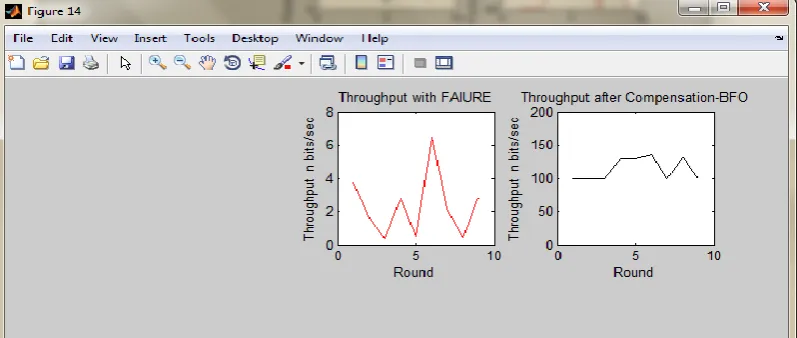
Throughput
Throughput is defined as the number of packets sent properly.
Figure. 4 Throughput
The above figure shows the throughput between the compensation with BFO and with failure which shows that the throughput with BFO is high as compared to the path failure.
End delay
End-to-End delay is expressed as the time taken to send a packet from source node to destination node.
Figure.5 End Delay
The above figure shows the End Delay between the compensation with BFO and with failure
Packet delivery ratio
www.ijatca.com 90 Figure.6 packet delivery
The above figure shows the packet delivery between the compensation with BFO and with failure
Error rate
The bit error rate (BER) is defined as the percentage of bits having errors in relation to the total number of bits successfully delivered in a transmission.
Figure.7 BER Rate
Routing overhead
www.ijatca.com 91 The above figure shows the routing overhead between the compensation with BFO and with failure
VI.
CONCLUSION AND FUTURE
SCOPE
In this work, we presented an overview of the requirements for QoS based routing protocolsand factors that are a challenge in implementing these protocols in a MANET. Through simulation, the performance of the SPEED protocol is evaluated and analyzed with respect to different combinations of network and traffic control parameters. So in the proposed work, SPEED protocol with fusion of BFO algorithm will be optimized. SPEED is a real –instance QoS routing protocol which needs to deliver a data packet to the destination within a certain time period, if the packet cannot be reached within the time period, the packet is dropped back decreasing the performance of speed protocol. Node failure or congestion leads to, large amounts of dropping of the data packets, which may lead to devastating consequences. We have also highlighted the FAR, FRR performances of these protocols.
The highly dynamic nature of a mobile ad hoc network results in frequent and unpredictable changes of network topology, adding difficulty and complexity to routing among the mobile nodes. The challenges and complexities, coupled with the critical importance of routing protocol in establishing communications among mobile nodes, make the routing area the most active research area with the MANET domain.
REFERENCES
1.Tian He, John A Stankovic, Chenyang Lu, TarekAbdelzaher, “SPEED: A Stateless Protocol forReal-Time Communication in Sensor Networks,”inproceedings of 23rd International Conference on Distributed Computing Systems, May 2003.
2.EmadFelemban, Chang-Gun Lee, EylemEkici, “MMSPEED: Multipath Multi-Speed Protocol for QoS of Reliability and Timeliness in Wireless Sensor Networks,” in IEEE Transactions on Mobile Computing, volume: 5, 2006.
3.R. Sumathi, M.G. Srinivas, “A Survey of QoS Based Routing Protocols for Wireless Sensor Networks,” in Journal of Information Processing Systems, volume: 8, December 2012.
4.K. Sohrabi, J. Pottie, “Protocols for self-organization of a wireless sensor network,” in IEEE Personal Communications 7, 2000.
5.S.R. HeikalabadH.Rasouli, F.Nematy, N.Rahman, “QEMPAR: QoS and Energy Aware Multi-Path Routing Algorithm for the Real-Time Applications in Wireless
Sensor Networks,” in International Journal of computer science Issues, Volume: 8, January 2011.
6.Deepak Verma, Amardeep Kaur,
“PerformanceComparison of QoS Based Routing Protocols MBRR, REAR and SPEED for Wireless Sensor Networks,” in International Journal of Research in Engineering and Technology, Volume: 7, September 2013.
7.Sharad N. Kumbharana, Gopal M. Pandey, “A comparative study of ACO, GA and SA for solving Travelling Salesman Problem,” in InternationalJournal of Societal Applications of Computer Science (ijsacs), Volume: 2, February 2013.
8.EmadElbeltagi, Tarek Hegazy, Donald Grierson, “Comparison among five evolutionary-based optimization algorithms,” in Advanced Engineering Informatics, January 2005.
9.Sunita S. Nandgave, “A Survey on QOS and energy efficient routing protocols in WSN,” in International Journal of Application or Innovation in Engineering and Management (IJAIEM), Volume: 1, October 2012. 10. Ali Naderi, Sayyed Majid Mazinani, Amin
ZadehShirazi, MahyaFaghihnia, “Adaptive Majority-Based Re-Routing For Differentiated Reliability In Wireless Sensor Networks,” in IEEE 17th International Conference on Engineering of Complex Computer Systems, July 2012.
11. Kee-Young Shin, JunKeun Song, JinWon Kim, Misun Yu, PyeongSooMah, “REAR: Reliable Energy Aware Routing Protocol for Wireless Sensor Networks,” in proceedings of 9th International Conference on Advanced Communication Technology (ijcat) , Volume:1, February 2007.