Infogain Publication (Infogainpublication.com) ISSN : 2454-1311
Development of a Novel Keyboard Interface Unit
for Writing Quran using Computer
Mussa A. Abudena
1, Shihab A. Hameed
2, Aisha H. Hashim
3, Othman O. Khalifa
4Department of Electrical and Computer Engineering, IIUM University, Malaysia
Abstract— There is a lot of computer keyboard layouts in
different languages were produced including Arabic keyboards. Up to date, there is no any type of keyboards which used to write holy Quran according to Uthmanic script – that is the standard script to writing Quran. In North Africa they are using special Quranic font called Al-dani. This paper focus on designing and implementing special Quranic keyboard based on Al-dani. To use this font with more accurate positioning of the diacriticals over the letters or below of them, and to achieve the optimum connectivity and kerning between the letters, distinctive type of keyboard should be used to interface with Al-dani Quranic font to facilitate Quran text writing. This paper explains the techniques used to development a keyboard interface unit for writing Quran using computer. Sample of results for using of this keyboard are presented.
Keywords— Arabic keyboards, Computer keyboards, MountFocus Keyboard Designer, Quranic fonts.
I. INTRODUCTION
The Arabic script is used for many languages and is the second most widely used script in the globe. Writing Quran requires special Arabic fonts (known as Quranic fonts) differ from the original one. There are many difficulties and problems related to writing Quran by hand, and most important are: First, the Quran written by one person may lead to delays in the writing of the Quran, especially in the case of illness or exposure to compelling circumstances prevent him from completing his work. Second, difficult to correct errors when writing the Quran handwritten on paper. Third, regardless of the accuracy of the writer, there is a clear deficiency in the consistency of words and lines. [1] However, due to the complexity of producing high quality fonts, the support for Arabic digital typography has been too weak. Open Type is currently the de facto standard font technology. It has many features to sustenance a wide variety show of scripts, still has its limitation for Arabic. The most significant restriction are probably the following two: First, the concept of alphabetic character box seat connecting together via other boxes of extension virgule is not suitable for highest quality
Arabic typesetting. Second, the limitation in using of pre-stored glyphs for different ligatures. The Arabic alphabet, although consisting of 28 letters, depends on 17 different skeletons. The dots added above or below some of these skeletons are the ways of differentiating one letter from another. [2] After a brief period of the spread of computers possible entry languages that use the Latin alphabet to the computer first. Then emerged the idea of introducing other languages after making multiple developments in the installation of computer programming, and one of these languages: Arabic language, but there were many problems relating to the composition of the Arabic font within the Computer. [3] There is a few of computer Quranic fonts, here three of them. First, AlQalam font: It is a research project carried out at the Electronics and Electrical Communications Department, Faculty of Engineering, Cairo University. AlQalam is freely available system intended for typesetting Quran (using script Al-khrraz), other traditional texts, and any publications in the languages using the Arabic script. It aims to achieve an “Naskh’’ font with quality close to that of Arabic calligraphers, by modelling the pen nip and the way it is used to draw curves as closely as possible using a font description language -METAFONT. It is based on the TEX and Metafont open source typesetting and font design systems. [2] Second, King Fahd glorious Quran printing complex font: One of the fonts of computer coding compatible with the international Unicode, assigned to write the text of the Holy Quran corresponding to the Uthmanic font of mushaf prophetic city for narration (riwayat) HAFS. [4] Third, Al-dani Quranic font: It is a research project carried out at the Electrical and Computer Department, Faculty of Engineering, IIUM University. It had designed and implemented using FontCreator software [5]. This font basically assigned to write the text of the Holy Quran corresponding to the Uthmanic font (Al-dani) of mushaf Aljmahieriah for narration (riwayat) Qaloon. [1] [6]
II. INVESTIGAION
Infogain Publication (Infogainpublication.com) ISSN : 2454-1311 development of computer keyboard layouts. We identify the
key functionalities provided through the investigation that serve as the preliminary functionality requirements for our framework.
1. Latin Keyboards
1.1. Standard Keyboard Layouts
This section describes the physical layouts found on commonly available keyboards.
1.1.1. Keyboard Sections
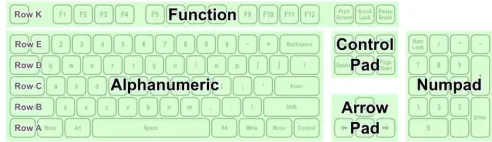
When discussing keyboard layouts, it is convenient to divide the standard keyboard into distinct sections and to label each row.
Fig. 1: The five general sections of a standard keyboard
These keyboard sections are:
-The Alphanumeric section: is the main part of the keyboard and is where most of the keyboard variation occurs. When a user selects a keyboard layout, it is the keys in this sections that are most affected.
-The Control Pad and Arrow Pad sections: contain the arrow keys and other editing keys.
-The Numpad (also known as the "numeric keypad" or "number pad"): contains number and math keys to make it easier to enter numeric data.
-Finally, the Function section: contains miscellaneous function keys and special keys like Escape. To make it easier to identify keys, the rows on the keyboard are named starting with "A" for the bottom row up to "E" for the top row. The row of keys in the Function section are considered to be in row "K". These row names are consistent with those given in [ISO9995-1]. Note that many keyboards (both modern and legacy) have extra keys that do not fit neatly into the above sections. [7]
1.1.2.Standard "101" Keyboard Layout
The standard "101" keyboard (commonly referred to as the "US layout") is the only layout that has a "Backslash" key (labelled \|) above a single-row Enter key. All the other layouts omit this key and expand the Enter key to occupy two-rows.
Fig. 2: Standard "101" keyboard layout showing unmodified US key values
Modern standard "101"-layout keyboards actually contain 104 keys: 61 keys in the alphanumeric section and 43 keys in the numpad, control pad, arrow pad and function sections. The "101" name for this keyboard layout dates to the time when this standard keyboard did in fact contain 101 keys. The two Meta keys (commonly given an OS-specific label), and the Menu key were added later to bring the total to 104 keys. 1.1.3. Standard "102" Keyboard Layout
The standard "102" keyboard is common throughout Europe and adds a key that doesn’t exist on the "101" layouts: The "IntlBackslash" key (labelled \| on a UK keyboard) next to the left shift key.
A second key is also added (labelled #~ on a UK keyboard) which is partially tucked under the Enter key. This key is encoded as "Backslash", using the same code as the \| key found on the "101" keyboard layout. According to [USB-HID], the US \| and UK #~ are actually two separate keys (named "Keyboard \ and |" and "Keyboard Non-US # and ~"), but since these two keys never co-occur on the same keyboard most platforms use the same scan code for both keys, making them difficult to distinguish. It is for this reason that the code "Backslash" is used for both of these keys.
Fig. 3: Standard "102" keyboard layout showing unmodified UK key values
Modern "102"-layout keyboards contain 105 keys: 62 keys in the alphanumeric section and 43 keys in the numpad, control pad, arrow pad and function sections. [8]
2. Arabic Keyboards
Infogain Publication (Infogainpublication.com ﻥ
ﻩ
ﻱ ). However, they have differences in allocating the other letters particularly the letters in the lower row (such as
ﺩ ﺃ ﺫ ﺇ ﻯ ﻭ ﺁ
ء ﻁ ﺭ ﺉ ). Some of the famous keyboard layouts in the late 1980s are the layouts of Microsoft Arabic Word, Apple MAC, Sakher, AMEER, ALIS, and Nafitha.
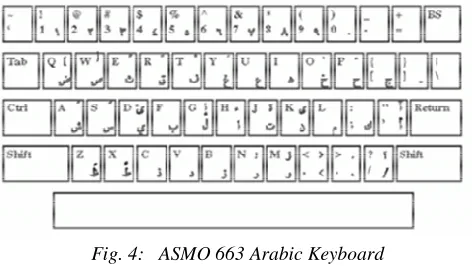
To solve this chaos created by the existence of many Arabic keyboard layouts, the Arab Standardization and Metrology Organization (ASMO) developed a standard for the Arabic keyboard layout shown in Figure4 (ASMO 1987) [
Fig. 4: ASMO 663 Arabic Keyboard
This keyboard standard supports the ASMO standard for the 7-bit Arabic characters code (ASMO 1985). However, this keyboard standard was not used by the computer industr the market adopted instead the currently used Arabic keyboard layout shown in Figure5 [10].
Fig. 5: IBM Arabic Keyboard
This keyboard layout gained wide acceptance in PCs and servers over other layouts when Microsoft adopted it for its Arabized products. Another Arabic keyboard layout currently in use is the layout shown in "Fig. 6".
Fig. 6: Apple MAC Arabic Keyboard
This layout is used in Apple MAC computers
Arabic keyboard layout is not optimized for performance and also has many obvious drawbacks. For example, Letter Thal "ﺫ" is placed in an awkward place in the top
Infogainpublication.com)
). However, they have differences in allocating the other letters particularly the letters in the lower row (such as ﻅ ﺯ ﺓ ﺅ
). Some of the famous keyboard layouts in e layouts of Microsoft Arabic Word, Apple MAC, Sakher, AMEER, ALIS, and Nafitha.
To solve this chaos created by the existence of many Arabic keyboard layouts, the Arab Standardization and Metrology Organization (ASMO) developed a standard for the Arabic
(ASMO 1987) [9].
ASMO 663 Arabic Keyboard
This keyboard standard supports the ASMO standard for the bit Arabic characters code (ASMO 1985). However, this keyboard standard was not used by the computer industry and the market adopted instead the currently used Arabic keyboard
IBM Arabic Keyboard
This keyboard layout gained wide acceptance in PCs and servers over other layouts when Microsoft adopted it for its Arabized products. Another Arabic keyboard layout currently
Apple MAC Arabic Keyboard
This layout is used in Apple MAC computers the common Arabic keyboard layout is not optimized for performance and also has many obvious drawbacks. For example, Letter Thal " is placed in an awkward place in the top-left corner of the
keyboard despite its frequent use. This letter is more frequently used than other well
Letter Ghain “ﻍ”. Moreover, the two
Alif "ﻻ" has one key dedicated for it despite the fact that it is not as frequent as other letter combi
3. Quranic Keyboards
For writing Quran using computer, we need two special Quranic computer applications,
font, and the second is Quranic computer keyboard. few of computer Quranic fonts, here three of them. 3.1. AlQalam font
It is a research project carried out at the Electronics and Electrical Communications Department, Faculty of Engineering, Cairo University. AlQalam is freely available system intended for typesetting Quran (using script Al khrraz), other traditional texts,
languages using the Arabic script. It aims to achieve an “Naskh’’ font with quality close to that of Arabic calligraphers, by modelling the pen nip and the way it is used to draw curves as closely as possible using a font descr language -METAFONT. It is based on the TEX and Metafont open source typesetting and font design systems. [
3.2. King Fahd glorious Quran printing complex font One of the fonts of computer coding compatible with the international Unicode, assigned to w
Quran corresponding to the Uthmanic font of mushaf prophetic city for narration (riwayat) HAFS. [
Al-dani Quranic font
It is a research project carried out at the Electrical and Computer Department, Faculty of Engineering, IIU University. It had designed and implemented using FontCreator software [1]. This font basically a
the text of the Holy Quran corresponding to the Uthmanic font (Al-dani) of mushaf Aljmahieriah for narration (riwayat) Qaloon. [5] [6]
Table.1: Summary of Quranic fonts
No. Font Developer and Name
Y
ea
r Technique
1 Cairo University
AlQalam
2
0
0
5 TEX and
Metafont
ISSN : 2454-1311 frequent use. This letter is more frequently used than other well-positioned letters such as Moreover, the two-letter combination Lam-" has one key dedicated for it despite the fact that it is not as frequent as other letter combinations. [11]
For writing Quran using computer, we need two special applications, first is Quranic computer font, and the second is Quranic computer keyboard. There is a few of computer Quranic fonts, here three of them.
It is a research project carried out at the Electronics and Electrical Communications Department, Faculty of Engineering, Cairo University. AlQalam is freely available system intended for typesetting Quran (using script Al-khrraz), other traditional texts, and any publications in the languages using the Arabic script. It aims to achieve an “Naskh’’ font with quality close to that of Arabic the pen nip and the way it is used to draw curves as closely as possible using a font description METAFONT. It is based on the TEX and Metafont open source typesetting and font design systems. [2]
King Fahd glorious Quran printing complex font One of the fonts of computer coding compatible with the international Unicode, assigned to write the text of the Holy Quran corresponding to the Uthmanic font of mushaf prophetic city for narration (riwayat) HAFS. [4]
It is a research project carried out at the Electrical and Department, Faculty of Engineering, IIUM It had designed and implemented using This font basically assigned to write the text of the Holy Quran corresponding to the Uthmanic of mushaf Aljmahieriah for narration (riwayat)
Summary of Quranic fonts
Technique Strong Limit
Infogain Publication (Infogainpublication.com) ISSN : 2454-1311 2 King Fahd
complex KFGQPC Uthmanic
HAFS
2
0
0
9
Unicode and FontCreator
Good quality
For Quran only (HAFS) No user interface 3 IIUM
University Al-dani Quranic font
2
0
1
5 Unicode
and FontCreator
Good quality With user
interface For Quran only (Qaloon)
However, there is no Quranic computer keyboard up to date except Al-dani Quranic Keyboard that was implemented at the Electrical and Computer Department, Faculty of Engineering, IIUM University, that is the essence of this paper.
III. AL-DANI QURANIC KEYBOARD
Fig. 7: Block Diagram for Al-dani Quranic keyboard
1. MountFocus Keyboard Designer:
The MountFocus Keyboard Designer is a tool for creating virtual keyboards on the Windows platform. Keyboards created using the MountFocus Keyboard Designer can be used with any Windows application in a touch-screen or normal environment. That makes it ideal for situations where a physical keyboard is either not available or not desired. The MountFocus Keyboard Designer was designed to allow developers or users of Windows applications to design their own on-screen virtual keyboards. The design was originally made for Point of Sale applications, but it is suitable for other uses as well. Infokiosks, remote customer terminals, or any application where you do not want the user to have a physical keyboard available, are ideal situations for the MountFocus Keyboard. Multiple "pages" allow context sensitive keyboard
layout allowing the user to press "legal" keys only. OLE support allows other applications to select pages and control the appearance of the keyboard. Easy deployment of your custom made keyboards. Single or multiple keystrokes can be sent from a single key press. Multiple objects can be placed on keys, the keyboard surface, page controls, and panels. Graphics or text can be used. Copy keys from the integrated key pool for fast and easy creation of new keyboards. The most flexible and powerful virtual keyboard designer available. Excellent for touch-screen, Point of Sale and similar applications [12]. Al-dani Quranic keyboard was designed and implemented using MountFocus Keyboard Designer.
2. The Screenshots of MountFocus Keyboard Designer appear in "Fig. 8"
Where: "Fig. 8a" is the Screenshot of MountFocus Keyboard Designer. "Fig. 8b" is the Screenshot of key design. "Fig. 8c" is the Screenshot of naming the key. "Fig. 8d" is the Screenshot of assign Unicode for the key. "Fig. 8e" is the Screenshot of complete Al-dani Quranic keyboard.
Fig. 8a: The Screenshot of MountFocus Keyboard Designer.
Infogain Publication (Infogainpublication.com
Fig. 8c: The Screenshot of naming the key
Fig. 8d: The Screenshot of assign Unicode for the key
Fig. 8e: The Screenshot of Al-dani Quranic keyboard.
3. Flowchart for design and implementation of Quranic keyboard
"Fig. 9" illustrates this flowchart.
Infogainpublication.com)
naming the key
assign Unicode for the key
dani Quranic keyboard.
design and implementation of Al-dani
Start
Design and implement the keys
Choose the right position for each key
Program each key to write its name on it
Key OK
End
Yes
Program each key by assign a Unicode code
for it
Run the Keyboard Interface Unit
Use the Keyboard Interface Unit
Fig. 9: Flowchart for Keyboard Interface Unit
ISSN : 2454-1311
Design and implement
Choose the right position for each key
Program each key to write its name on it
No
Program each key byassign a Unicode code
Run the Keyboard Interface Unit
Use the Keyboard Interface Unit
Infogain Publication (Infogainpublication.com
IV. RESULTS
Using Al-dani Quranic keyboard, we
Quranic font very well, such that the marks and diacriticals appear at the right position over or below the letters. For example, observe the marks and the diacriticals over/below these letters.
Fig. 10: Letters with diacriticals
Now, see letters how consist words when connected together.
Fig. 11: Words written by Al-dani Quranic
As a sample, these lines from Quran written by Al Quranic keyboard.
Fig. 12: Sample of Al-dani Quranic font written by Al Quranic keyboard.
V. CONCLUSIONS
In this paper, we explained the types of computer including Arabic keyboards. There are few
writing the Quran using computer, among them: AlQalam font, King Fahd glorious Quran printing complex font, and Al-dani Quranic font. These approaches
addition, we mentioned a summarized view about MountFocus Keyboard Designer. Moreover,
explanation for design and implementation of Al Quranic keyboard using MountFocus Keyboard Designer This paper the intensify the importance of
keyboard to write Quran using Al-dani
future work, a complete keyboard design technique to write the whole Quran with other narrations in
finalized.
Infogainpublication.com)
dani Quranic keyboard, we employ Al-dani Quranic font very well, such that the marks and diacriticals n over or below the letters. For example, observe the marks and the diacriticals over/below
Letters with diacriticals
Now, see letters how consist words when connected together.
dani Quranic keyboard.
As a sample, these lines from Quran written by Al-dani
dani Quranic font written by Al-dani
CONCLUSIONS
computer keyboards . There are few attempts for er, among them: AlQalam King Fahd glorious Quran printing complex font, and These approaches are discussed. In a summarized view about . Moreover, we gave a short design and implementation of Al-dani MountFocus Keyboard Designer. the importance of Al-dani Quranic Quranic font. As a design technique to write other narrations in less time will be
REFERENCES
[1] Abudena, Mussa A., and Shihab A. Hameed. "Toward a Novel
Quran’s Full-Script Writing."
[2] Ameer M. Sherif, Hossam A.H. Fahmy, “Meta designing parameterized
TUGboat, Volume 29 (2008), P 435
[3] Hussein Al-Zahrani, “How to create Arabic fonts in Computer”, 2004.
[4] King Fahd Complex for Printing the Holy Quran web site
WWW.qurancomplex.org
[5] Abudena, M. A., Hameed, S. A., Hashim, A. H., & Khalifa, O. O. (2016). Unicode Encryption and its Role in
Facilitating Writing Quran using
[6] Abudena, M. A. (2015). Proposal to encode Quranic marks used in Quran published in Libya, L2/15 329, Complete
UTC Document Register.
[7] Gary Kacmarcik; Travis Leithead.
August 2016. WD. URL:
https://www.w3.org/TR/uievents/ [8] Gary Kacmarcik; Travis Leithead.
KeyboardEvent key Values
URL: https://www.w3.org/TR/uievents
[9] Arab Standardization and Metrology Organization (ASMO). 1985. Standard 449: 7
Arab League, Cairo, Egypt.
[10]Arab Standardization and Metrology Organization (ASMO). 1987. Standard663: Arabic Keyboard Layout. Arab League,
Cairo, Egypt.
[11]Tareq M. Malas, Sinan S. Taifour, and Gheith A. Abandah, “Toward optimal Arabic keyboard layout using genetic algorithm”.
Eastern Multiconference on Simulation and Modeling (MESM 2008), Aug 26
Jordan.
[12]MountFocus Information Systems, MountFocus Keyboard
ISSN : 2454-1311 REFERENCES
Abudena, Mussa A., and Shihab A. Hameed. "Toward a Novel Module for Computerizing
Script Writing."
Ameer M. Sherif, Hossam A.H. Fahmy, “Meta-designing parameterized Arabic fonts for AlQalam”, TUGboat, Volume 29 (2008), P 435-443.
Zahrani, “How to create Arabic fonts in
ng Fahd Complex for Printing the Holy Quran web
WWW.qurancomplex.org
Abudena, M. A., Hameed, S. A., Hashim, A. H., & (2016). Unicode Encryption and its
Facilitating Writing Quran using the Computer. Abudena, M. A. (2015). Proposal to encode Quranic
Quran published in Libya,
L2/15-UTC Document Register.
Gary Kacmarcik; Travis Leithead. UI Events. 4
August 2016. WD. URL:
https://www.w3.org/TR/uievents/
Gary Kacmarcik; Travis Leithead. UI Events KeyboardEvent key Values. 24 October 2016. WD.
https://www.w3.org/TR/uievents-key/
Arab Standardization and Metrology Organization Standard 449: 7-Bit Arabic Code.
Arab Standardization and Metrology Organization Standard663: Arabic Keyboard Layout. Arab League,
Tareq M. Malas, Sinan S. Taifour, and Gheith A. Abandah, “Toward optimal Arabic keyboard layout using genetic algorithm”. In Proc. 9th Int'l Middle Eastern Multiconference on Simulation and Modeling (MESM 2008), Aug 26-28, Amman,