http://www.ijcmph.com pISSN 2394-6032 | eISSN 2394-6040
Original Research Article
A study on initiation of breastfeeding: are children in India
getting the best start?
Arvind Singh Kushwaha
1*, Anshika Kushwaha
2, Neha Kushwaha
3INTRODUCTION
Breastfeeding is traditional in our country and has been practiced through the centuries.1 The practice of breast feeding adopted by majority of mothers in developing countries offers the best possible start to newborn. The nutritional value of breast milk is far superior to any other milk. Breast feeding not only provides fundamental nutritional needs of infant, but also provides growth factors, hormones and maternal antibodies. At the same time breast feeding limits an infant’s exposure to food borne diseases present with alternative feeding methods.2 Giving colostrum has been called the “first
immunisation” of the child. Colostrum and breast milk have definite anti infective properties and have shown to have an impact on reducing specific morbidity and mortality rates among infants.3 There is a marked dose response relationship of increasing risk of neonatal mortality with increasing delay in initiation of breast feeding from one hour to day seven. Over all, late initiation (after day 1) was associated with a 2.4 fold increase in risk. Early initiation of breast feeding results in reduction in neonatal deaths significantly. It has been estimated that initiation of breast feeding within first hour could reduce neonatal deaths by 22% and initiation within 1st day can reduce neonatal deaths by 16%.4,5
ABSTRACT
Background: Giving colostrum to a newborn has been called the “first immunisation” of the child. Colostrum and breast milk have definite anti-infective properties and have shown to have an impact on reducing specific morbidity and mortality rates among infants. The objectives of the study were to determine the level of knowledge about early initiation of breast feeding amongst mothers and to study determinants of initiation of breast feeding.
Methods: Cross-sectional analytical study was carried out at a tertiary care hospital of a medical college in Pune. Systematic random sampling method was used.
Results: The subjects came predominantly from joint families, urban area, Hindu by religion and Class II Socio economic status (Kuppuswamy classification). Majority of (84.23%) mothers responded that they initiated breast feeding within 1 hour after birth. Most (95.25%) of the mothers agreed for giving colostrums. About half of the mothers interviewed believed that breast milk is more nutritious (49.5%) while 28% mothers said that feeding babies with breast milk protects them against infections.
Conclusions: All doctors and paramedical personnel in the Government and private institutions ensure that lactation begins immediately after birth and prelacteal feeds are withheld.
Keywords: Breastfeeding, Children
1Department of Community Medicine, Armed Forces Medical College, Pune, Maharashtra, India 2
Manipal College of Medical Sciences, Pokhara, Nepal
3Davao Medical School Foundation, Davao, Philippines
Received: 16 April 2018 Revised: 28 May 2018 Accepted: 29 May 2018
*Correspondence:
Dr. Arvind Singh Kushwaha, E-mail: [email protected]
Copyright: © the author(s), publisher and licensee Medip Academy. This is an open-access article distributed under the terms of the Creative Commons Attribution Non-Commercial License, which permits unrestricted non-commercial use, distribution, and reproduction in any medium, provided the original work is properly cited.
Breast feeding within an hour or two of delivery is associated with establishment of longer, more successful and exclusive breast feeding. The suckling reflex of the newborn is at its height twenty to thirty minutes after birth. If the infant is not fed then the reflex diminishes rapidly only to reappear adequately forty hours later. This may be called “the fourth stage of labour” which includes putting the baby to breast after birth and ensuring the intake of colostrum by the neonate.6,7
The exact time of initiation of breastfeeding has been suggested right from birth in the delivery room itself to within one hour after delivery. The effect of skin-to-skin and suckling contact immediately after birth increases the median duration of breastfeeding by 2½ months.8 Malnutrition, infection and the poor state of immunity form a vicious cycle affecting the health of the child. These in turn have their origins in the economic, socio-cultural and physio-biological environment of the society. Interplay of all these factors influence the breast-feeding practices.9 Since 1993, WHO’s efforts to improve nutrition of infants and young children have focused on promoting breast feeding. “Baby friendly hospital initiative” (BFHI), promoted by WHO and UNICEF has proved to be of immense value in encouraging proper infant feeding practices, starting at birth. Any hospital must meet ten criteria to be called as a Baby friendly Hospital. Initiation of breast feeding within one hour of delivery is one of the key steps of BFHI.10 Neonatal deaths contribute 38% of deaths in those younger than 5 years, and are the main barrier to attaining the MDG for child heath (MDG-4). According to WHO, in the Global Strategy for Infant and Young Child Feeding 2/3rd of under-five deaths that occur in infancy are mostly related to poor feedings practices. It calls for support to all mothers during the first hour to ensure early initiation of breastfeeding.8
METHODS
Cross-sectional analytical study was carried out at a tertiary care hospital of a medical college in Pune from Apr 2016 to Oct 2016. Only Full Term normal deliveries (FTND) were included in the study. Those who did not give informed consent for participating in the study, premature babies, stillbirth babies and women who underwent caesarean section were excluded. Sample size was determined for estimating Confidence Interval for prevalence of initiation of breast feeding with p=50% which came out to be 400. Systematic random sampling method was used. The data of previous years from the same hospital showed that on an average there were 250 deliveries per month and around 3000 per year. The first mother for interview was selected randomly from the labour room register and thereafter every 5th women was included in the study till the sample size was achieved. The data was collected and then entered in MS access and analysed using SPSS version 17.0.
RESULTS
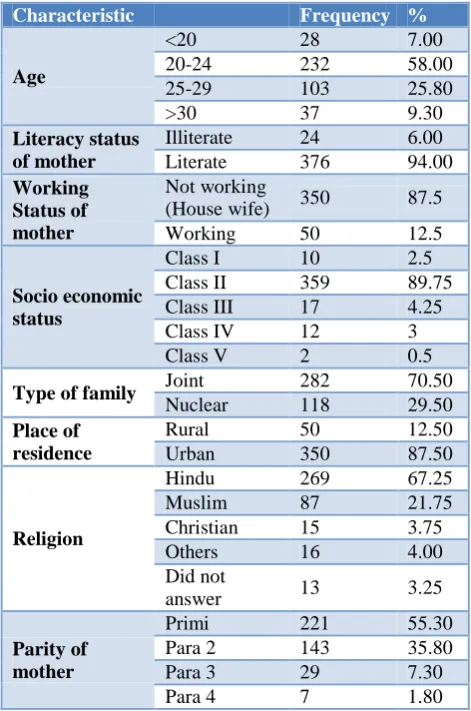
Maximum numbers of mothers were in the age group 20-24 years. The age range was 18 to 40 years and mean age of the mothers included in study was 23.91±3.72 years. 94% of mothers studied were literate, majority (87.5%) were not working (housewives). The subjects came predominantly from joint families, urban area, Hindu by religion and class II socio economic status (Kuppuswamy classification). On studying subjects according to parity it was revealed that more than half were primi (55.3%) (Table 1).
Table 1: Socio demographic characteristics of study population (n=400).
Characteristic Frequency %
Age
<20 28 7.00 20-24 232 58.00 25-29 103 25.80 >30 37 9.30 Literacy status
of mother
Illiterate 24 6.00 Literate 376 94.00 Working
Status of mother
Not working
(House wife) 350 87.5 Working 50 12.5
Socio economic status
Class I 10 2.5 Class II 359 89.75 Class III 17 4.25 Class IV 12 3 Class V 2 0.5
Type of family Joint 282 70.50 Nuclear 118 29.50 Place of
residence
Rural 50 12.50 Urban 350 87.50
Religion
Hindu 269 67.25 Muslim 87 21.75 Christian 15 3.75 Others 16 4.00 Did not
answer 13 3.25
Parity of mother
Primi 221 55.30 Para 2 143 35.80 Para 3 29 7.30 Para 4 7 1.80
Table 2: Characteristics of breast feeding practices.
Item Responses Frequency Percentage (%)
Initiation of breast feeding
Within 1 hour 326 84.23
After 24 hours 53 13.68
Did not answer 08 2.06
Colostrum feeding
Yes 381 95.25
No 5 1.25
Did not answer 14 3.50
Practice of prelacteal feeding
Yes 127 31.80
No 137 34.30
Did not answer 136 33.90
Plan of continuation of breast feeding
Yes 257 64.30
No 3 0.80
Did not answer 140 35.00
Duration of breast feeding
<6 months 16 6.40
6 months to 1 year 57 22.17
1 to 2 year 113 45.40
>2 year 71 28.50
Knowledge of benefits of breast milk
Protection against infection 112 28.00
More nutritious 198 49.50
Both 43 10.75
Did not answer 29 7.25
Dont know 18 4.50
Person who encouraged breast feeding
Doctor 185 46.25
Health care workers(ASHA, ANM, NURSE) 22 5.50 Mother/home members 146 36.50
Did not answer 47 11.75
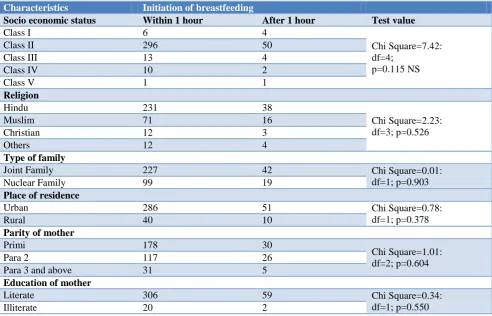
Table 3: Relationship of initiation of breast feeding and socio demographic factors.
Characteristics Initiation of breastfeeding
Socio economic status Within 1 hour After 1 hour Test value
Class I 6 4
Chi Square=7.42: df=4;
p=0.115 NS
Class II 296 50
Class III 13 4
Class IV 10 2
Class V 1 1
Religion
Hindu 231 38
Chi Square=2.23: df=3; p=0.526
Muslim 71 16
Christian 12 3
Others 12 4
Type of family
Joint Family 227 42 Chi Square=0.01:
df=1; p=0.903
Nuclear Family 99 19
Place of residence
Urban 286 51 Chi Square=0.78:
df=1; p=0.378
Rural 40 10
Parity of mother
Primi 178 30
Chi Square=1.01: df=2; p=0.604
Para 2 117 26
Para 3 and above 31 5
Education of mother
Literate 306 59 Chi Square=0.34:
df=1; p=0.550
DISCUSSION
84.2 percent mothers began breast feeding their child within 1 hour of birth, 8.26 percent of mothers initiating within 1-24 hours and another 5.42 percent initiating after 24 hours. These figures are higher compared to both national data and also studies which were published earlier. This study was undertaken in Baby Friendly Hospital Initiative (BFHI) hospital where mothers are encouraged to initiate breast feeding within half an hour which is one of the ten steps of successful breast feeding.Similar finding was seen in the study undertaken by Nayak et al, about breast feeding practices in urban community of Surat city which revealed that 70% of mothers were able to start breast feeding within first hour of life after normal delivery, 18.9% within 1-24 hours and 10.9% after 24 hours.11 As per NFHS-3, initiation of breastfeeding within 1 hour was done in only 23.4 Percent, 28.8 percent for urban and 21.5 for rural area. For Maharashtra the NFHS-3 data revealed 51.8 percent mothers initiated breast feeding within 1 hour (50.5 percent for urban and 53 percent in rural area).12 Coverage evaluation survey (CES) 2009, which was undertaken by UNICEF at the request of Govt of India to assess the impact of NRHM strategies on coverage levels of maternal, newborn and child-health services including immunization among women and children revealed that only 33.5 percent of mothers reported that they started breastfeeding the child within one hour of birth 24.2 percent within 1-2 hours, 15.4 percent within 2-23 hours, 23.9 percent within 24-72 hours and 2.3 percent after 72 hours.13 Initiation of breast feeding within 1 hour was better among mothers in the age group of 20 to 24 years, Socio economic status class II, urban area, joint family and higher parity. We didn’t find any significant association between some of the socio demographic factors studied with initiation of breast feeding.
We found that only negligible percentage of mothers (1.25%) discarded colostrums. Athavale et al, in their study in urban Health Centre of Government Medical College, Nagpur found that around 33 percent of the mothers discarded colostrums and they also found a significant positive association between practice of giving colostrum to the child and timing of early initiation of breast-feeding.14 One third of mothers (31.8%) initiated prelacteal feeding. Kumar et al, in their study in the urban slums of Chandigarh found that prelacteal feed was given in 40% cases.15 Jagzape et al, in the similar settings also revealed that 43.2% of mothers gave prelacteal feeding.16
CONCLUSION
Majority of (84.23%) mothers responded that they initiated breast feeding within 1 hour after birth. Most (95.25%) of the mothers agreed for giving colostrums. About half of the mothers interviewed believed that breast milk is more nutritious (49.5%) while 28% mothers said that feeding babies with breast milk protects them against infections.
Recommendations
All doctors and paramedical personnel in the Government and private institutions must ensure that lactation begins immediately after birth and prelacteal feeds are withheld. In case of a genuine problem (e.g. prematurity) expressed breast milk should be given to the child.
Funding: No funding sources Conflict of interest: None declared
Ethical approval: The study was approved by the Institutional Ethics Committee
REFERENCES
1. Global Strategy for Infant and Young Child Feeding. World Health Organisation (WHO), Geneva. 2003.
2. Binns C, Gilchrist D, Gracey M, Zhang M, Scott J, Lee A. Factors associated with initiation of breast feeding. Public Health Nutrition. 2004;7(7):857-61. 3. Mullany LC, Katz J, Li YM, Khatry SK, LeClerq
SC, Darmstadt GL, et al. Breast feeding patterns, time to initiation and mortality risk among newborns in southern Nepal. J Nutrition. 2008;138(3):599-603.
4. Horta BL, Bahl R, Victoria CG. Indicators for assessing breast feeding practices. J Pediatr Child Health. 2007: 643-649.
5. Lisa D, Mary R, McFadden A, McCormick F, Gill H, James T. Promotion of breast feeding: initiation and duration –Evidence into practice. National Institute for health and clinical excellence (NICE). 2006.
6. WHO collaborative study on role of breast feeding in prevention of infant mortality. Lancet. 2000: 451-455.
7. Jones G, Stekette RW, Black RE, Morris SS. Role of health care delivery in promoting early and exclusive breast feeding. Lancet. 2003: 362-365. 8. Gupta A, MD, FIAP Regional Coordinator, IBFAN
Asia. A scientific brief- Initiating breastfeeding within one hour of birth, 2007.
9. Pelletier JG. Severe malnutrition: A Global Approach. Children in the Tropics 1st ed. Paris: International children's centre, 1993: 82.
10. Protecting, promoting and supporting Breastfeeding in facilities providing maternity and newborn services: the revised Baby Friendly Hospital Initiative (BFHI). www.unicef.org. 2018
11. Nayak S, Jay P, Patel S, Gharat V, Patel S, Choksi V, et al. Breast feeding practices in urban community of Surat city. National J Community Med. 2010;1(2):111-3.
12. National Family Health Survey 3. Available at: www.nfhsindia.org. Accessed on 3 March 2018. 13. Coverage Evaluation Survey. All India report.
14. Athavale AV, Athavale SA, Deshpande SG. Zodpey SP, Sangole S. Initiation of breast-feeding by urban women. Health Population-Perspect Issues. 2004: 117-125.
15. Kumar D, Agarwal N, Swami HM. Socio-demographic correlates of breast-feeding in Urban slums of Chandigarh. Indian J Med Sci. 2006;60(11):461-6.
16. Tushar J, Lohkare A, Vagha J, Lakhkar BB. Prevalence of Prelacteal Feeding practice in Wardha
and the effect of antenatal education on it. Pediatric On call Child Health Care. 2009;6(10):1-3.