Original Research Article
Knowledge, awareness and practices regarding dengue fever among
people attending at UHTC, KBNIMS, Kalaburgi
Shahnaz Shaheen*, Kaviraj Motakpalli, N. D. Bendigeri, Deepak Jamadar
INTRODUCTION
Dengue is regarded as one of the most important arboviral infections in the world. Dengue fever (DF), including its variants, dengue haemorrhagic fever (DHF) and dengue shock syndrome (DSS), caused by four antigenically distinct but related dengue viruses (DENV-1, DENV-2, DENV-3 and DENV-4), also known as serotypes, belonging to genus flavivirus, family flaviviridae, is transmitted primarily by Aedes (Stegomyia) aegypti, and Aedes (Stegomyia) albopictus is the secondary vector. Ae. aegypti is a native of Africa
which spread to other continents through slave trade and, subsequently, by globalization of trade and commerce. Today, it is regarded as a cosmotropical species breeding in urban areas between latitude 45o N and 35o S.1
The incidence of dengue has grown dramatically around the world in recent decades. The actual numbers of dengue cases are underreported and many cases are misclassified. One recent estimate indicates 390 million dengue infections per year, of which 96 million (67–136 million) manifest clinically (with any severity of disease). The number of cases reported increased from 2.2 million
ABSTRACT
Background: Dengue fever (DF) is a rapidly spreading mosquito-borne viral illness all over the world. DF has expanded to new countries and from urban to rural areas. Rapid urbanization, environmental changes and neglected areas result in vector breeding which causes rise in dengue outbreaks. The objective of this study was to assess the knowledge, awareness and practices regarding DF among people residing in urban field practice area of KBNIMS, Kalaburagi.
Methods: A cross-sectional study was conducted among general patients attending UHTC, KBNIMS, Kalaburagi using a pre-tested questionnaire. The study population consists of 210 study subjects. Knowledge, awareness and practices of DF among study population was represented as proportions (%).
Results: Out of 210 individuals interviewed, 39.04% identified fever as a cardinal symptom of DF. The knowledge about other symptoms of DF was low among participants. 71.90% knew that DF is transmitted by mosquito bite. The correct timing of biting time was known by only 13.81%. In the present study only one third of the participants had received information about DF from health professionals. Despite low knowledge, the participants had good attitude and most of them reported good preventive practices against dengue prevention and control.
Conclusions: The knowledge of participants of our study was low and the practice was good for protection from other mosquito borne diseases. Therefore massive awareness campaigns are urgently required to protect the health of people against DF and to limit future spread of DF in this part of our country.
Keywords: Dengue fever, Knowledge, Awareness, Practice, Preventive measures Department of Community Medicine, KBNIMS, Kalaburagi, Karnataka, India
Received: 05 May 2018
Revised: 24 May 2018
Accepted: 25 May 2018
*Correspondence:
Dr. Shahnaz Shaheen,
E-mail: [email protected]
Copyright: © the author(s), publisher and licensee Medip Academy. This is an open-access article distributed under the terms of the Creative Commons Attribution Non-Commercial License, which permits unrestricted non-commercial use, distribution, and reproduction in any medium, provided the original work is properly cited.
in 2010 to 3.2 million in 2015. In 2015, Delhi, India, recorded its worst outbreak since 2006 with over 15,000 cases. An estimated 500000 people with severe dengue require hospitalization each year, and about 2.5% of those affected die.2
Typical for a subtropical climate, the intense summer heat in most parts of India is followed by heavy rains and high humidity levels, leading to monsoon related diseases. Dengue is one of the monsoon related disease transmitted principally by Ae.aegypti in India. Even with a low mosquito density, an epidemic can burst in a totally susceptible population or with the venue of a new strain, as it is probably the case with the DENV-4 in Delhi this season.3
Current dengue control measures, including the use of insecticides and water management, target the mosquito vector, but are of limited effectiveness. There are no effective antiviral treatments for dengue, and management of the disease is limited to supportive therapy. At present, there are no licensed vaccines for the prevention of dengue disease; however, a number of dengue vaccines are currently in development.4
Dengue fever which is one of the most important emerging disease of the tropical and sub-tropical regions, affecting urban and periurban areas and next to diarrhoeal disease and acute respiratory infections, dengue has become a leading cause of hospitalization and deaths, among children, proving that the current dengue control measures are insufficient in reducing the burden of the disease. Hence for increasing public health concern regarding dengue, it has become a very essential step that the general population is aware of the disease and undertake necessary precautions to minimize the risk of dengue. We therefore undertook this study to assess awareness, knowledge about signs, symptoms and preventive measures of dengue disease, and practices undertaken by them to prevent dengue. Such that necessary precautions can be taken to prevent further cases of dengue in this area.
METHODS
The cross sectional study was conducted at UHTC under the Department of Community Medicine, KBNIMS, Kalaburagi from September 2017 to November 2017. The study population included every second patient either sex of age more than or equal to 18 years. The participants were the permanent residents of field practice area of Community Medicine department of KBNIMS, Kalaburagi who were residing in the area for atleast one year.
The patients of both sex willing to participate in the study were included in the study. The patients who were seriously ill and not willing to participate in the study were excluded from the study.
Prior to the study ethical clearance was obtained by the ethical committee. The data were collected using face to face interview techniques. A pretested and predesigned Performa was used for data collection. The verbal informed consent was obtained prior to data collection. There is a paucity of data regarding dengue knowledge, awareness and practices in this area. Therefore we assumed the most statistically conservative response distribution possible 50% to capture a representative sample of the population with 80% confidence interval and a 5% of margin error, we estimated that a minimum of 165 persons were required (Raosoft Inc. sample size calculator). We interviewed 210 patients during three months of study period. Statistical Analysis SPSS software version 17 was used for data analysis. Descriptive statistics like frequency distribution and percentage were used for data analysis.
RESULTS
Overall 154 females and 56 males were interviewed. Study population largely comprised of adults and literates, out of 210 participants, 151 (71.90%) belongs to age group 18-40 years, 88 (41.90%) were in the age group of 18-30 years and 63 (30%) in the 31-40 years. 145 (69.05%) study subjects were literates and 105 (49.99%) were unemployed or housewives.
Tables 1: Sociodemographic characteristics of the respondents.
Characteristics Frequency Percentage
(%)
Age (years)
18-30 88 41.90
30-40 63 30
40-50 36 17.14
>50 23 10.96
Sex
Male 56 26.67
Female 154 73.33
Educational level
Illiterate 65 30.95 Primary education 42 20.00 Secondary education 65 30.95 Intermediate 24 11.43 Graduate/Degree 14 6.67
Employement status
Unemployed/Housewifes 105 49.99
Employed 96 45.72
Students 9 4.29
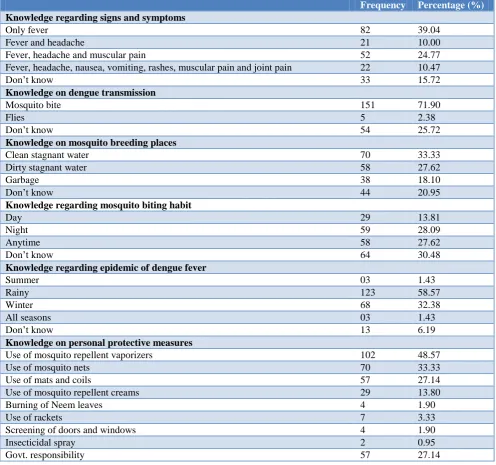
symptoms of dengue (fever, headache and muscular pain). Among 210 respondents only 127 (60.48%) respondents knew that stagnant water is the breeding places of mosquitoes, among them 58 (27.62%) and 69 (32.86%) stated dirty stagnant water and clean stagnant water as breeding places of mosquitoes respectively. Only 29 (13.81%) respondents stated day time as the mosquito biting habit. About 28.09% mentioned that such mosquitoes bite at night time and 27.62% at any time. 123 (58.57%) respondents knew rainy season as the common season for epidemic of dengue fever. Regarding
knowledge on personal protection measures against mosquito bite, majority 102 (48.57%) of respondents mentioned mosquito repellent vaporizers as common personal protective measure, followed by 70 (33.33%) as bed nets and 57 (27.14%) were relying upon Mats/coils, i.e. 159 (75.71%) respondents stated mosquito repellants as the common personal protective measure. Further, 57 (27.14%) respondents stated as it is government responsibility to give protection against mosquito bite and dengue fever.
Table 2: Knowledge of the respondents regarding dengue fever.
Frequency Percentage (%)
Knowledge regarding signs and symptoms
Only fever 82 39.04
Fever and headache 21 10.00
Fever, headache and muscular pain 52 24.77
Fever, headache, nausea, vomiting, rashes, muscular pain and joint pain 22 10.47
Don’t know 33 15.72
Knowledge on dengue transmission
Mosquito bite 151 71.90
Flies 5 2.38
Don’t know 54 25.72
Knowledge on mosquito breeding places
Clean stagnant water 70 33.33
Dirty stagnant water 58 27.62
Garbage 38 18.10
Don’t know 44 20.95
Knowledge regarding mosquito biting habit
Day 29 13.81
Night 59 28.09
Anytime 58 27.62
Don’t know 64 30.48
Knowledge regarding epidemic of dengue fever
Summer 03 1.43
Rainy 123 58.57
Winter 68 32.38
All seasons 03 1.43
Don’t know 13 6.19
Knowledge on personal protective measures
Use of mosquito repellent vaporizers 102 48.57
Use of mosquito nets 70 33.33
Use of mats and coils 57 27.14
Use of mosquito repellent creams 29 13.80
Burning of Neem leaves 4 1.90
Use of rackets 7 3.33
Screening of doors and windows 4 1.90
Insecticidal spray 2 0.95
Govt. responsibility 57 27.14
Regarding the source of information on dengue fever and its control measures, out of 210 respondents, 71 (35.24%) came to know about dengue fever through health workers, followed by 53 (25.23%) through television and/or radio, 57 (27.14%) respondents came to know
through friends and relatives and 26 (12.38%) had no source of knowledge.
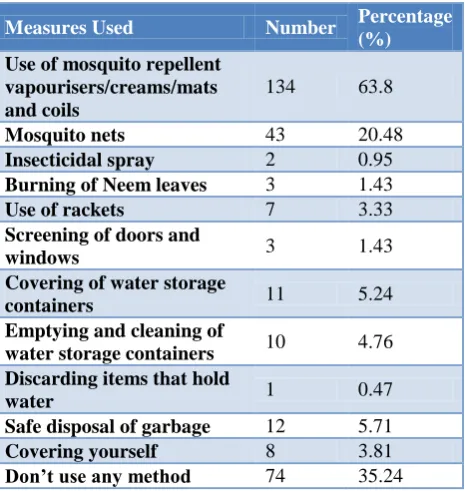
(63.8%) were using repellants like vaporizers, creams, mats and coils, followed by 43 (20.48%) used mosquito nets. Only 5.42% and 4.76% were using covering of water storage container and emptying and cleaning of water storage container as a protective measure against Dengue.
Table 3: Source of knowledge about dengue fever and their control measures.
Source of knowledge Number Percentage
(%)
TV 53 25.23
Relatives and friends 57 27.14
Health workers 74 35.24
No source of knowledge 26 12.38
Table 4: Personal protective measures used by the respondents.
Measures Used Number Percentage
(%)
Use of mosquito repellent vapourisers/creams/mats and coils
134 63.8
Mosquito nets 43 20.48
Insecticidal spray 2 0.95
Burning of Neem leaves 3 1.43
Use of rackets 7 3.33
Screening of doors and
windows 3 1.43
Covering of water storage
containers 11 5.24
Emptying and cleaning of
water storage containers 10 4.76 Discarding items that hold
water 1 0.47
Safe disposal of garbage 12 5.71
Covering yourself 8 3.81
Don’t use any method 74 35.24
DISCUSSION
In our study, out 0f 210 respondants 151 (71.90%) knew that dengue fever is transmitted by mosquito bite which is similar to a study done by Bhaumika et al who concluded that majority 145 (71.1%) of the respondents knew the mode of transmission of DF is by mosquito bite.5 Farizah et al also concluded that 77.4% knew that dengue was transmitted by mosquitoes.6
Regarding knowledge about signs and symptoms of dengue, 82 (39.04%) persons could enumerate one symptom (fever), 21 (10%) persons could enumerate 2 symptoms (fever, headache and 52 (24.77%) persons could enumerate 3 symptoms of dengue (fever, headache and muscular pain). A study done by Matta et al reported regarding knowledge about signs and symptoms of dengue, 61.8% persons could enumerate one symptom
(fever), 20.6% persons could enumerate 2 symptoms (fever, bleeding) and 11.2% persons could enumerate 3 symptoms of Dengue (fever, headache & bleeding).6,7 Another study done by Baumika et al reported that 62.3% respondents said that fever as the signs and symptoms of the dengue fever, followed by headache 104 (51.0%), joint/muscle pain 76 (37.3%), per orbital pain 75 (36.8%), back pain 57 (28.0%) and body rashes 49 (24.0%).5
Among 210 respondents only 127 (60.48%) knew that stagnant water as breeding place of mosquitoes, among them 58 (27.62%) and 69 (32.86%) stated dirty stagnant water and clean stagnant water as breeding places of mosquitoes respectively. In the present study 123 (58.57%) respondents stated rainy season as the common season for epidemic of dengue fever. Similarly a study done by Samin et al reported Seventy (70%) acknowl-edged stagnant water but 42 (42%) acknowlacknowl-edged that standing clean water as breeding place of mosquito and 74% identified rainy hot season for peak incidence.8
In present study only 13.81% of the respondents were aware that these mosquitoes bite during daytime. A field based study done by Vivek et al had similar findings, were only 13% were aware that such mosquitoes bite during day time.9
Regarding knowledge on personal protection measures against mosquito bite, majority 102 (48.57%) of respondents mentioned mosquito repellent vaporizers as personal protective measure, followed by 70 (33.33%) as bed nets and 57 (27.14%) were relying upon Mats/coils, i.e. 159 (75.71%) respondents had knowledge that mosquito repellants (vaporisers and mats/coils) as the common personal protective measure which is similar to study conducted by Acharya et al where regarding knowledge about preventive measures, majority (70.3%) knew about mosquito repellents like matt/liquid vaporizers/coils.10
In the present study multiple measures were used as personal protective measurres. 134 (63.8%) were using repellants like vaporizers, creams, mats and coils, followed by 43 (20.48%) used mosquito nets. Only 5.42% and 4.76% were using covering of water storage container and emptying and cleaning of water storage container as personal protective measure. A study done by Ahmed et al stated that 47.1% of study population used mosquito mat/coil/liquid vaporizer as common personal protective practice against dengue.12 A study conducted by Kamath et al also stated 87.9% of urban people use mosquito coil or repellents in living rooms as the common personal protective measure used by for prevention of dengue.
CONCLUSION
Dengue/DHF is widely prevalent in India. Of all the arthropod-borne viral diseases, dengue fever is the most common. Use of personal protective measures, including the use of insecticides, environmental measurements targeting the mosquito vector are of limited effectiveness. There are no effective antiviral treatments and no licensed vaccine for dengue and management of the disease is limited to supportive therapy. From the present study it can be concluded that though people have knowledge regarding the disease but still there is lack of proper information about the disease, its signs and symptoms, about the mosquito breeding places, and integrated measures for preventing dengue.
Recommendations
The information regarding different aspects of dengue and other mosquito borne diseases should be provided to the community in innovative and effective ways. And also the ecological and climatic factors influencing the seasonal prevalence of the vectors and intensity of breeding should be explained such that proper preventive measures can be taken by the community when needed by their full participation for prevention of mosquito borne diseases. As the interruption of dengue virus transmission depends upon control of the vectors, prevention of stagnation of water, control of breeding of mosquitoes through proper environmental management and prevention of human-vector contact. Health education and specific protection are the key messages to interrupt the transmission. Intensified efforts should be made towards creating public awareness and mobilizing the community regarding various preventive measures are needed on a large scale which can be achieved through proper advocacy, social mobilization and strict legislation.
Funding: No funding sources Conflict of interest: None declared
Ethical approval: The study was approved by the Institutional Ethics Committee
REFERENCES
1. Dash AP, Bhatia R, Kalra NL. Dengue in South-East Asia: an appraisal of case management and vector control. Dengue Bulletin. 2012;36:1-13. 2. Available At: http://www.who.int/mediacentre/
factsheets/fs117/en/. Accessed on 3 March 2018. 3. Daude E, Mazumdar S. Combating Dengue in India:
Challenges and Strategies. Economic Political Weekly. 2016;8:77-81.
4. Sarti E, Cox H, Lombana BS, Maruri TL. Dengue Awareness in Latin American Populations: A Questionnaire Study. Infect Dis Ther. 2015;4:199– 211.
5. Sharma B, Regmi S, Aryal B, Neupane S M, Lopchan M. Knowledge and Attitude of Dengue Fever among Clients from Dengue Prevalent Areas International Journal of Pharmaceutical & Biological Archives. 2012;3(6):1383-8.
6. Hairi F, Ong Cyril-HS, Suhaimi A, Tsung TW, Ahmad Anis bin AM, Sundaraj C. A knowledge attitude and practices (KAP) study on dengue among selected rural communities in the Kuala kangsar district. Asia pacific J Public Health. 2003;15(1):37-43.
7. Matta S, Bhalla S, Singh D, Rasania KS, Singh S. Knowledge, Attitude & Practice (KAP) on Dengue fever: A Hospital Based Study Indian J Community Med. 2006;31(3):185-6.
8. Qadir S, Ahmad I, Akhtar NM, Naeem H. Knowledge, Attitude and Practice about Dengue Fever among local population. Gomal Journal of Medical Sciences. 2015;13(2):87-90.
9. Vivek L, Dinesh C and Shiv DG. Knowledge of dengue and related preventive attitude and practices among urban slum dwellers of Jaipur city, Rajasthan, India. Dengue Bulletin. 2012;36:197-205.
10. Acharya A, Goswami K, Srinath S, Goswami A. Awareness about dengue syndrome and related preventive practices amongst residents of an urban resettlement colony of south Delhi. J Vector Borne Dis. 2005;42:122–7.
11. Keerti SJ, Pravin NY. The Community Knowledge and Practices Regarding Dengue Fever in an Urban Slum Area of South India. People’s J Scientific Res. 2013;6(1):13-5.
12. Itrat A, Khan A, Javaid S, Kamal M, Khan H, Javed S, et al. Knowledge, Awareness and Practices Regarding Dengue Fever among the Adult Population of Dengue Hit Cosmopolitan. Plos One. 2008;3(7):1-6.
13. Kamath R, Gupta R, Chandrasekaran V, Pattanshetty S. Assessment of environmental factors associated with dengue transmission in Udupi Taluk, Karnataka. J Scientific Society. 2013;40(3):159-61.