RESEARCH ARTICLE
Lane Id based Selective Emergency Message
Forwarding Scheme for VANET
Getamesay Haile
Faculty of Computing, Jimma Institute of Technology, Jimma University, Jimma, Ethiopia.
[email protected]
Dereje Yohannes
Department of Computer Engineering, Addis Ababa Science & Technology University, Ethiopia.
[email protected]
Kebebew Ababu
Faculty of Computing, Jimma Institute of Technology, Jimma University, Jimma, Ethiopia.
[email protected]
Published online: 26 August 2019
Abstract –In this paper we proposed a novel emergency message forwarding scheme for VANET (Vehicular Ad-hoc Network) which can capable of tackling broadcast storm problem by reducing unwanted network traffic. Safety application of VANET by its nature is time critical and it needs low delay and needs to be disseminated on time. So applying broadcasting technique is the best option in safety application for VANET. But applying simple broadcasting causes broadcast storm problem due to high number of unwanted network traffic. Unwanted network traffic happens when the number of nodes to rebroadcast the emergency message is increased. The numbers of forwarder node to re-transmit the emergency message have high effect on the network. So, one of the solution to reduce unwanted traffic is applying selective forwarding scheme to broadcast emergency message and minimize the number of forwarder node which rebroadcast the emergency message. The aim of this paper is to design lane Id based selective emergency message forwarding scheme (LSEMF) which can minimize the number of forwarder node without affecting the notified vehicles with high data delivery ratio and low overhead. The proposed forwarding scheme is a multi-hop selective forwarding scheme in which vehicles found in the same lane with the source of emergency message and found behind the accident can have high priority to be selected as a forwarder node. To select forwarder node we combine distance, lane id and travel direction of vehicle. To simulate this work, we use SUMO simulator for generating mobility and OMNeT++ for network simulator by using Veins framework. Finally we compare our result with counter based scheme and distance based scheme. From the simulation result the proposed scheme has better performances than the existing schemes in terms of data delivery ratio, overhead and forwarder node ratio.
Index Terms – VANET, Selective Forwarding, Emergency Message Dissemination, Forwarder Node Selection.
1. INTRODUCTION
Nowadays, Intelligent Transport System (ITS) is one of the hottest research areas due to the high number of problems in transportation. A number of people dies, a lot of properties are lost due to traffic problem in the world. So researchers investigate VANET as one of the solutions to decrease the problem. Vehicular Ad hoc Networks (VANETs) are special kind of Mobile Ad Hoc Networks (MANETs) that are formed between moving vehicles and road side unit.
RESEARCH ARTICLE
Disseminating emergency messages for Risk zone in VANET is a critical issue [2]. Due to this many researchers proposed different schemes to disseminate emergency messages. In [4] [5] [6] [10] [11] [22] currently there are flooding based, distance based, counter based, store carry forward based and probabilistic dissemination schemes. Flooding based mainly leads broadcast storm problem due to high number of collision during communication [1]. Distance based and counter based scheme are used in well-connected network. But in dense network scenario many vehicles may found with in the same distance for the source vehicle. During this the number of forwarder node is increasing. So when the number of forwarder node increases it causes high network overhead. Due to this we design forwarder node selecting scheme by considering the lane id in which the emergency message happens. In our case we minimize the number of forwarder node without affecting the number of notified vehicles.
Generally, the proposed work has the following significances:
Increase the probability of emergency message reception with less duplication.
It increases number of notified vehicle. Minimize overhead
The rest of the paper is organized as follows. Section 2 discusses related works that have been done so far. Section 3 deals with detail description about the proposed work, In Section 4, we conduct simulations to evaluate the performance of the mechanism proposed and its efficiency. Finally, Section 5 concludes the paper.
2. RELATED WORK
Currently researchers investigate different techniques for message dissemination in VANET by minimizing network overhead. But still there is no efficient way to disseminate time critical message with minimum number of duplicated message and high number of informed vehicles.
The author in [2] proposes context aware multicast protocol for emergency message dissemination which considers endangers vehicles get the emergency message. According to the author’s the vehicle that encounters the emergency situation or the accident seen as abnormal vehicle. In the protocol, the vehicle approaching to the endangered vehicle is selected as a relay node.
The protocol has high reliability and low latency. But as one of the role of VANET is to make awareness to vehicles in the road that have dynamically changed and which is difficult to make handshake with other vehicles this approach is not good option when the number of vehicles going sparse. The other thing is in terms of dense scenario when there are a lot of vehicles which approach to the abnormal vehicle, in this case the forwarder node increases and it cause overhead.
The author in [3] proposed efficient Emergency Message broadcasting scheme for VANET, by enabling the farthest vehicle behind the crushed vehicle to make the rebroadcasting of the emergency message. According to this protocol each vehicle assumed to have equipped with GPS and the vehicles broadcast beacon message to the neighbor vehicles. From the beacon message each vehicle knows the neighbor information
and stores the information including
direction, speed, location and time stamp. When the vehicle goes out of the transmission range of the vehicle each vehicle updates the neighbor information and remove from the neighbor list. Two relay nodes are selected for better performance. To select the relay node the author assumes to follow the following approach:
When there is a vehicle behind the crushed vehicle (CV) in the same direction, the crushed vehicle select the farthest vehicle (FV) as a first relay
node and the second farthest
vehicle (SFV) as a second relay node.
If there is no vehicle behind the crushed vehicle in the same direction, but if there are vehicles behind in the opposite direction, it choose the first vehicle as a first relay node and the second farthest vehicle as a second relay node.
If there is no vehicle behind the CV in both directions, but there are vehicles ahead of it in the opposite direction, it choose the nearest vehicle as a first relay node and the second nearest vehicle (SNV) as a second relay node.
If none of the above steps are working, the crushed
vehicle stores emergency message
until a new vehicle comes within its transmission range.
The above protocol minimizes danger zone latency and minimizes the beacon over head by minimizing the beacon interval due to prediction of mobility for the vehicle. But the protocol uses the crashed vehicle as relay node when there is no vehicles in the transmission range of the vehicle. When there is no vehicle in the transmission range of the crushed vehicle the emergency message would not disseminate to the endanger vehicle due to this the protocol lead high delay for safety critical message. In addition to this considering the crushed vehicle as a relay node, decrease emergency message reception rate and increase packet loss
RESEARCH ARTICLE
moving with the same speed, due to this it leads high number of forwarder node in dense network and selecting vehicle with high speed mainly cause link failure because the probability of the node to wait with in the transmission range of other vehicle is low [7].
In [12] rapid dissemination of public safety message was proposed. In this paper RSU broadcast the public safety message to vehicles going in a linear highway with its transmission range. To increase the transmission range and the network coverage the authors propose using vehicular Back bone network (VBN) structure. During the VBN structure the vehicle found in the closest to the nominal position selected as a relay node (RN).The paper focuses on a system that is subjected to relatively high vehicular traffic rate. The author got
high throughput and low end to
end delay when the number of vehicles is high in the highway.
The author assumes distance
based relay node selection scheme in addition to the RSU. As
the author presents the protocol
mainly focus on high vehicular traffic rate, there is more number of vehicles which closest to the normal position. Here when there is more number of forwarder node, the number of packet transmitted over network increases and the number of redundant message increases.
In [13] the authors propose static node assisted stochastic multi-hop emergency message broadcasting scheme which uses RSU to solve network fragmentation problem. According to the paper when RSU receives broadcast message it checks the duplication forward the emergency message by including the broadcast suppression range and minimum broadcast suppression. To select nodes which forward the message, the author use probabilistic relay node selection method. According to the authors each nod maintained its rebroadcasting probability and they compare with the minimum broadcast suspension and they forward the emergency message. From the simulation result their scheme outperforms static stochastic broadcast scheme in terms of delivery rate and when comparing to flooding, their scheme give a better delay and less network usage.
The authors in [7] design road accident prevention schema for highway scenario to disseminate emergency message to endanger vehicles that may affected by the accident with the support of vehicular back bone network. According to the author each vehicle and road side unit equipped with GPS to maintain position and location. Here the road side unit broadcast hello message periodically with its ID and position to all vehicles within the transmission ranges. The vehicle received the hello message send reply to the RSU including its speed, direction, time stamp and vehicle ID. The RSU periodically update the vehicles in its transmission range and generate status report from the vehicle information. From the information the road side unit generate emergency warning
message to other vehicles which come to the danger zone. According to the author the areas around the emergency situation count as high danger zone. The RSU sends the emergency message to all vehicles that found in high risk zone and send the other RSU to inform other vehicles outside the transmission range. For farther coverage the RSU select a relay vehicle which can re transmit to the other road side unit. But when come to the real time scenario the risk zone depends on the direction of the vehicle instead of the coverage range of the RSU and transmission of emergency message by many vehicles lead unwanted packet transmission in the network. Unwanted traffic causes overhead as they state in their future work.
In this paper, we address network overhead and data redundancy by minimizing the number of forwarder node.
3. PROPOSED SOLUTION
In this paper, we proposed new dissemination scheme which is capable of solving broadcast storm problem and network overhead. To solve the problem, we have identified and proposed direction, distance and Lane id based multi-hop broadcasting scheme. The new scheme minimizes the duplicated number of message received by the vehicles without affecting the number of informed vehicles. In the new scheme the vehicle which found in the same lane id and farther distance is selected as a forwarder node, it can reduce the number of forwarder node. Due to the reduction of forwarder node the overhead can be reduced.
3.1. Beacon Exchange
In this phase vehicles exchange information like speed, and position among neighbor vehicles. Vehicles periodically broadcast its own information to other vehicles within their transmission range. The arrangement of vehicle information can be as follow:
VEHID P Vs Lanid Timestamp
Where P=>current position
Vs=>current speed
VEHID=>unique identifier of vehicle
Lanid=>current lane id
When a new vehicle enters in to the transmission range, the neighbor list is updated and when the vehicle goes out of the transmission range the vehicle is removed from the neighbor list.
3.2. Emergency Message Generation
RESEARCH ARTICLE
to the authors, the vehicle can be abnormal if the following condition is meeting.
If the position of the vehicle remains the same in two continuous time slot.
Depending on the above condition vehicle generate emergency message.The emergency message contains:
EMID: is the unique identifier for emergency message which used to avoid duplication.
Source ID: is the identifier for which node generate the emergency message.
Block lane id: the identifier of the lane which is blocked by the emergency.
EMID VEHID Lane Id Time stamp
Where EMID=>emergency message identifier
VEHID => source id in which the vehicle generate emergency message
Lane id => the lane which is blocked due to emergency.
Time stamp=> arrival time of a message
3.3. Forwarder Node Selection
A forwarder node is anode that can retransmit the emergency
message to other vehicles which
came to the accident. Disseminating safety message in VANET heavily relay on broadcasting, so selecting best forwarder node is one of the critical issues while disseminating safety information. According to the authors in [3], [7], [15], [16], [21], there are different parameters to select forwarder node: such as speed and position, direction, distance and density. The existing mechanisms have their own significances in different scenario. But all of the existing listed in the above needs improvement to disseminate the emergency message in highway scenario by increasing the notified vehicles and by decreasing the redundant message.
In our scheme, we consider the travel direction, distance and Lane id as parameter to select the forwarder node. In order to solve the problem related to dis-connectivity, we use RSU as a forwarder node. We select the node which is found in the same side of the block road and which have far distance from the accident node, and RSU. To get the direction we use the following eq(1):
𝐷𝑖𝑟 = 𝑉𝑝𝑜𝑠(𝑡) − 𝑉𝑝𝑜𝑠(𝑡1) … … … … . (1)
Where Dir is the vehicle’s travel direction, VPos is the
vehicle’s position in the highway and t is time. If the Dir value is negative then it is concluded that the vehicle is moving towards possible accident site whereas if the Dir value is positive then it is concluded that the vehicle is moving away from possible accident site [7]. To calculate the
distance by using coordinate geometry distance between two node V1(x1, x2) and V2(y1, y2) is:
𝑆 = √(𝑥1 − 𝑥2)2+ (𝑦1 − 𝑦2)2…….(2)
Where S is the distance, (x2, y2) is the position of the receiver and (x1, y1) is the position of the sender. When vehicle detects an emergency situation, it forward to the vehicles under its transmission range. After that the receiver vehicle check the conditions whether they allowed to forward the emergency message or not.
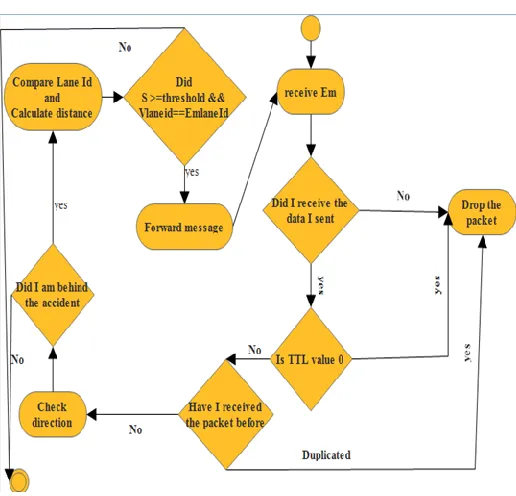
When a vehicle receives emergency message from neighbor vehicle it compares its Lane Id and the lane Id from the emergency message. Then to select forwarder node:
If lane id of the vehicle is equal with the lane id of the emergency message and the distance between sender and receiver vehicle is above the threshold value node can be selected as forwarder node.
Figure 1 Flow Chart for Forwarding Emergency Message
Generally the proposed selective emergency dissemination scheme can be represented in Figure 1. The threshold value refers to the distance limit we use from author [7] which is optimal threshold value.
RESEARCH ARTICLE
is behind the accident or not because in real scenario the vehicle which came towards the accident are more affected by the accident. Then the vehicle calculates distance from the sender node and retrieve lane id from the emergency message received from the source vehicle. Finally vehicles check its lane id and distance to re-transmit the message. The vehicle which full fill the step selected as forwarder node. For more description let’s see the following sample scenarios:
3.4. Scenarios to Select Relay Node
The following two sample scenario's shows to select forwarder node when accident happen in single Lane and multiple Lane.
Scenario 1: Assume the accidents are detected and there are
vehicles which are around the
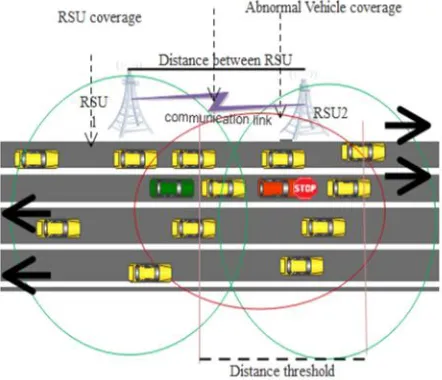
accident area. Here the accident should be disseminated to other vehicles to create awareness. Let’s see Figure 2.
Figure 2 Forwarder Node Selection Example 1
In Figure 2, the vehicles which have green color selected as forwarder node. First the vehicle which detects the accident broadcast to all vehicles in its transmission range. Then each node knows their direction and calculates its distance, check the distance to the distance threshold and check their lane Id. Depend on this as we see the greenvehicle is behind vehicle which detect the accident with the same lane id and distance is greater than the distance threshold, so by using our algorithm it is selected as a forwarder node.
Scenario 2: Assume the emergency happens in the two lanes and there are vehicles in its transmission range of the vehicle which detect the accident as shown in the Figure 3.
The vehicle which travels towards the right direction detects the emergency situation in both lanes. Then according to our algorithm the vehicle which has green color selected as forwarder node. The vehicle which have green color are
beyond the threshold value and they are traveling behind the vehicle which detect the accident, so by considering this feature in our algorithm they are selected as relay node.
Figure 3 Forwarder Node Selection Example 2
4. PERFORMANCE EVALUATION
To test our simulation we use the real map of the road in Ethiopia in Addis-to-Adama express way generated from openstreate map. There is only one express way found in our country which can support high speed vehicles that is why we select this express way. We choose this express way to check our emergency dissemination scheme. In Figure 4, the general map of the Addis Ababa to Adama is shown. We take this map from the open street map by sniping tool. After using this road we generate a network file from .osm file in Veins module. Basically we use this road architecture to support bi-directional lane id.
Figure 4 Map of Tested Area
RESEARCH ARTICLE
travel in different direction. We take this road architecture to make sure that our design can work on the complex architecture instead of street high way. After downloading the map in the form of .osm file (open street map file) the snapshot of the map is as below.
Figure 5 Map of High We Use
4.1. Simulation Setup
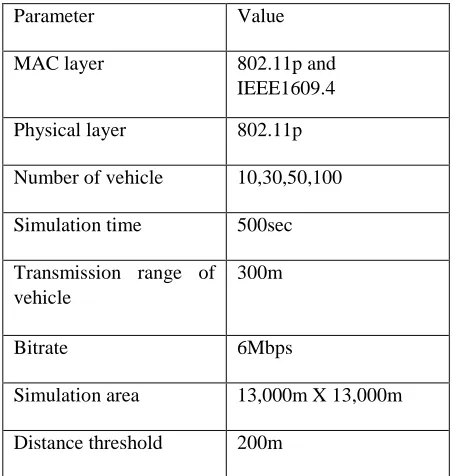
We use OMNET++ 5.0[20] for network simulation, Veins4.4 [19] to create a link between SUMO and OMNET++ and SUMO0.25.0 [18] to generate realistic simulation model from openstreate map. To set up our simulation we use vehicles by varying their number which traveling in the map we get from SUMO. We use 10, 30, 50 and 100 number of vehicles. We use 802.11p physical and MAC layer. We use 500s for simulation time because this is optimal simulation time for scenarios like the author in [7]. There are also default parameters we use in our simulation the antenna power 20Wt and the bit rate is 6 Mbps. All the simulations parameters used in the simulation are listed in Table 1.
Parameter Value
MAC layer 802.11p and
IEEE1609.4
Physical layer 802.11p
Number of vehicle 10,30,50,100
Simulation time 500sec
Transmission range of vehicle
300m
Bitrate 6Mbps
Simulation area 13,000m X 13,000m
Distance threshold 200m
Table 1Simulation Parameter
4.2. Performance Evaluation Metrics and Results
To evaluate our scheme and to compare with the existing dissemination scheme we use different metrics. Those metrics are number of notified vehicle, overhead, and packet delivery ratio, number of forwarder nodes.
4.2.1. Overhead:
This is the average number of packets transmitted at each forwarder node during the simulation. When there is high number of packet transmitted over a network there is high number of unwanted traffic. Due to this we use this metrics to measure our scheme and to compare with the existing scheme.
Figure 6 Overhead Comparison
As shown in Figure 6, the number of packet transmission during a simulation is small in our Scheme. We see that when the number of vehicle is sparse, our scheme have similar result with the distance based dissemination scheme. When the number of vehicles are increasing using counter based and Distance based scheme leads broadcast storm problem which mainly caused by unwanted traffic over a network. The new scheme is the best option by minimizing unwanted traffic over a network. Generally, the new scheme is good option to minimize overhead caused by unwanted and redundant message. Here the main reason is the proposed scheme minimizes the node which rebroadcast the emergency message.
4.2.2. Data Delivery Ratio:
Data Delivery Ratio is the metrics used to measure the percentage of data message which are successfully received by vehicles over a network. It is calculated by the number of received message (Mrcv) by the number of expected message to be received (Mexp) [24], [21]. Ideally in VANET dissemination scheme 100% data delivery are expected [24].
𝐷𝐷𝑅 =𝑀𝑟𝑐𝑣
𝑀𝑒𝑥𝑝… … … (4)
RESEARCH ARTICLE
𝑀𝑒𝑥𝑝 = 𝑁𝑉𝑥 𝑀𝑠𝑒𝑛𝑡 … (5)
Where NV refers to the total number of vehicles in the work and Msent refers to the number of sent message during simulation.
Number of notified vehicle: is the total number of vehicles which are aware of emergency message. As this is one of the main goals of VANET, the number of notified vehicle play a great roll to test the new scheme.
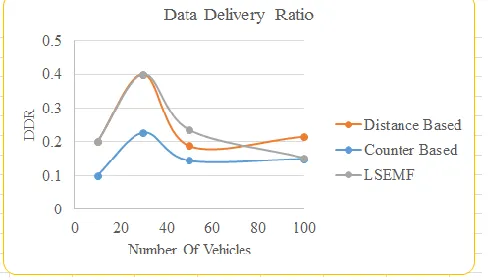
Figure 7 Data Delivery Ratio
In this metrics we compare the three emergency dissemination schemes with respect to the variation of vehicles in the network as shown X axis of Figure 7. The Y-axis represents the values in each vehicle density for the three schemes. From Figure 7, our scheme have better data delivery ratio in sparse network environment. As shown from Figure, when the number of vehicle are high distance scheme have high delivery ratio than other schemes. Therefore, as our aim is to get good data delivery ratio in highway scenario, our scheme gives better performance with less number of duplicate message and high number of notified vehicles. When the number of nodes increase the performance of distance based scheme is better because the number of received message increases with less increase in sent message. In our scheme both the sent message and received message are reduced, due to this the performance decreases.
4.2.3. Forwarder Node Ratio:
Forwarder Node Ratio measures the proportion of vehicles which rebroadcast the source data. As the author in [15], [16] describes when the number of forwarder node increases it leads high number of redundant message, due to this there is broadcast storm problem. So taking this metrics is essential to measure the performance of emergency message dissemination scheme. Mathematically as the author in [23] describes, it is the ratio of nodes which rebroadcast the message to total number of vehicle in the network.
𝐹𝑁𝑅 =𝐹𝑁
𝑁𝑉… … … . . (3)
Where FNR refers to forwarder node ration, FN is total the number of vehicle which forward the message and NV is the total number of vehicle in the network.
Figure 8 Forwarder Node Ratio
In this metrics we evaluate our work and compare with other existing dissemination schemes with the variation of vehicle density. As shown in Figure 8, our scheme has less forwarder node ratio than the two schemes. From this we understand that, our scheme performs better than the two schemes with minimum number of forwarder node. Here the point is as shown from Figure 8, our scheme have good performance to notify vehicles with less number of forwarder node. This decreases the broadcast overhead caused by the redundant flow of information by many forwarder nodes. From all the three parameters we can conclude that when the number of forwarder node decreases the number of duplicated message decreases.
5. CONCLUSION
RESEARCH ARTICLE
can be considered as future work. Our scheme assumes that nodes are willing to rebroadcast the emergency message. But the node that selected as a forwarder node may not be willing to forward the message to other vehicles; due to this the packet drop will increase. Therefore, our scheme needs future modification by adding this future.
REFERENCES
[1] Bae, Ihn-Han. "An intelligent broadcasting algorithm for early warning message dissemination in VANETs." International Conference on Computational Science and Its Applications. Springer, Cham, 2014. [2] Sebastian, Alvin, et al. "Context-aware multicast protocol for
emergency message dissemination in vehicular
networks." International Journal of Vehicular Technology (2012). [3] Dawood, Hayder Salman, and Yuming Wang. "An efficient emergency
message broadcasting scheme in vehicular ad hoc
networks." International journal of distributed sensor networks9.11 (2013): 232916.
[4] Makwana, Ravindra J., et al. "A broadcasting scheme for message dissemination in VANET." J. Eng. Res. Appl 5.2 (2015): 60-63. [5] Julio A. Sanguesa, Manuel Fogue, PiedadGarrido, Francisco
J.Martinez,Juan-Carlos Cano, andCarlos T. Calafate A Survey and Comparative Study of Broadcast Warning Message Dissemination Schemes for VANETs Hindawi Publishing Corporation Mobile Information Systems Volume 2016
[6] Vasilakos, Athanasios V., Yan Zhang, and Thrasyvoulos Spyropoulos. Delay tolerant networks: Protocols and applications. CRC press, 2016.
[7] Gokulakrishnan, P., and P. Ganeshkumar. "Road accident prevention with instant emergency warning message dissemination in vehicular ad-hoc network." PloS one 10.12 (2015): e0143383.
[8] Rubin I, Yang CY. Lane based backbone synthesis protocols for vehicular ad hoc networks. 13th annual mediterranean ad hoc networking workshop (MED-HOC NET), 2014, pp.95 – 102.doi: 10.1109/MedHocNet.2014.6849110
[9] Ni SY, Tseng YC, Chen YS, Sheu JP.“The broadcast storm problem in a mobile ad hoc network”. Proceedings of the 5th annual ACM/IEEE international conference on mobile computing and networking.1999, pp: 151–162.
[10] Md. HumayunKabir,“Research Issues on Vehicular Ad hoc Network”, International Journal of Engineering Trends and Technology (IJETT) – Volume 6 Number 4- Dec 2013
[11] Da Cunha, Felipe Domingos, et al. "Data communication in VANETs: a survey, challenges and applications." (2014).
[12] Rubin, Izhak, et al. "Rapid dissemination of public safety message flows in vehicular networks." Journal of communications 9.8 (2014): 616-626.
[13] Fan, Xing, et al. "Road side unit assisted stochastic multi-hop broadcast scheme for instant emergency message propagation." 2015 17th International Conference on Advanced Communication Technology (ICACT). IEEE, 2015.
[14] Ganeshkumar, P., and P. Gokulakrishnan. "Emergency situation prediction mechanism: a novel approach for intelligent transportation system using vehicular ad hoc networks." The scientific world journal (2015).
[15] Sanguesa, Julio A., et al. "RTAD: A real-time adaptive dissemination system for VANETs." Computer Communications 60 (2015): 53-70. [16] C.Zhang, “A New Scheme for Emergency Message Dissemination in
Vehicular Ad Hoc Network” Florida State University Libraries,2016 [17] Chaqfeh, Moumena, and Abderrahmane Lakas. "A novel approach for
scalable multi-hop data dissemination in vehicular ad hoc networks." Ad Hoc Networks 37 (2016): 228-239.
[18] Gandhi, Mallika, and M. Ayoub Khan. "Performance analysis of metrics of broadcasting protocols in VANET." 2014 Innovative
Applications of Computational Intelligence on Power, Energy and Controls with their impact on Humanity (CIPECH). IEEE, 2014.
[19] SUMO User Documentation. Available in
http://sumo.dlr.de/wiki/SUMO_User_Documentation/ 2019
[20] Veins documentation, available on:
http://veins.car2x.org/documentation/ 2019 [21] OMNeT++ documentation 2019
[22] Chaqfeh, Moumena, and Abderrahmane Lakas. "Speed adaptive probabilistic broadcast for scalable data dissemination in vehicular ad hoc networks." 2014 International Wireless Communications and Mobile Computing Conference (IWCMC). IEEE, 2014.
[23] Kumar, Rakesh, and Mayank Dave. "A review of various vanet data dissemination protocols." International Journal of u-and e-Service, Science and Technology 5.3 (2012): 27-44.
[24] Gandhi, Mallika, and M. Ayoub Khan. "Performance analysis of metrics of broadcasting protocols in VANET." 2014 Innovative Applications of Computational Intelligence on Power, Energy and Controls with their impact on Humanity (CIPECH). IEEE, 2014.
Authors
Getamesay Haile: received his BSc and MSC degree in Information Technology in 2015 and Computer Networking in 2017 from Jimma University, Ethiopia. He worked at Jimma University from 2015 in different Position start from Graduate assistant II. Currently he is working in Jimma University, faculty of computing as lecturer. His research interests include Vehicular Ad hoc Network, MANET, Internet of Things, wireless sensor networks and computer Vision.
Dereje Yohannes: received his PHD in in wireless and Mobile computing in Germany. He was working at Adama science and Technology University Adama Ethiopia till 2017 in different position. Currently he is working in Addis Ababa Science and Technology University in department of Computer Engineering as assistant professor. Dr.dereje is also Director for the Artificial Intelligence & Robotics CoE. His research interests include wireless & Mobile computing, Vehicular Ad hoc Network, MANET, Internet of Things, wireless sensor networks and computer Vision, Deep Learning and Artificial Intelligence, signal processing, satellite Communication and radio communication.