Original Research Article
Menstrual health and related problems in adolescent girls of
Lucknow district: a cross sectional study
Geeta Singh
1*, Anish Khanna
1, Monika Agarwal
1, V. K. Singh
1, Rekha Sachan
2INTRODUCTION
Adolescents (10-19 years) constitute 21.3% i.e. nearly 1/5th of total population of India.1 Adolescents are those between the ages of 10 and 19 years. Adolescence is a period when physical growth and maturation are accompanied by mental and psychological development.2 Menarche, is the more common process in the pubertal growth of a girl. The age of menarche is generally between 10-16 years; however it may vary depending on geographic variation, environmental condition, nutritional status etc.3 Menstrual problems are common in late
adolescence.4 Dysmenorrhoea is the commonest
problems, among all other menstrual problem in adolescents.5,6 Many times the menstrual irregularities can be attributed to incomplete maturation of Hypothalamic-pituitary-ovarian axis. This may take more than two years for complete maturation after menarche. This often leads to anxiety, depression and other such psychological problems among the adolescent.7,8 The prevalence of menstrual disorders has been recorded as high as 87%.9 Menstruation, and the menstrual cycle are characterized by variability in volume, pattern and regularity. Menstrual disorders include menstrual
irregularity, menorrhagia, polymenorrhea,
oligo-menorrhea, dysmenorrhoea, and other related symptoms
ABSTRACT
Background: Menstruation and related problems are difficult issues for adolescent girls and are a common reason for consulting healthcare providers. The objective of the study was to study the age of menarche, menstrual pattern, menstrual related health problems and health seeking behaviour for it.
Methods: A cross sectional study was carried out in urban as well as rural schools of Lucknow district from August 2014 to September 2015. Multistage random sampling was used to select the requisite number of girls. A total of 600 girls of age group 10-19 years were interviewed and analysed using appropriate statistical methods
Results: The mean age of menarche of the total population was 13.2±1 years. During menstruation, urban girls had significantly excessive passage of clots (26.5%) and faced more discomfort in their routine activities (78.8%) when compared to their rural counterpart (25.2% and 73.4% respectively), whereas the relation was inverse with regard to school absenteeism that was significantly higher in rural girls (44.0%) than urban girls (32.3%). The usual age of menarche as well as the pattern of pre-menstrual symptoms varied significantly between the girls of rural and urban areas.
Conclusions: With few exceptions, menstrual health related problems have an unequal distribution in girls of rural and urban origin. Hence effective management of menstrual problems will lose its chase unless health education targeting all the three groups viz.; adolescent girls, concerned parents and teachers have to be uniformly strengthened.
Keywords: Age at menarche, Menstrual problems
1
Department ofCommunity Medicine, 2Department of Obstetrics and Gynaecology, KGMU, Lucknow, Uttar Pradesh, India
Received: 22 September 2018
Revised: 02 November 2018
Accepted: 03 November 2018
*Correspondence:
Dr. Geeta Singh,
E-mail: [email protected]
Copyright: © the author(s), publisher and licensee Medip Academy. This is an open-access article distributed under the terms of the Creative Commons Attribution Non-Commercial License, which permits unrestricted non-commercial use, distribution, and reproduction in any medium, provided the original work is properly cited.
.Thus, United Nations Children’s Fund (UNICEF) and United Nation Fund for Population Activities (UNFPA) joined World Health Organization (WHO) and issued a joint statement on reproductive health of adolescents in 1989 to address to their problems.2 Although, the onset of menstruation is unique to females, menstrual disorders are common traditions do not allow adolescent girls to realize their rights in many parts of the world.10 Although menstrual irregularity can be normal during the first few years after menarche, other menstrual signs and symptoms such as amenorrhea, excessive uterine bleeding, dysmenorrhea, and premenstrual syndrome may indicate a pathological condition which requires prompt attention and referral.11 Thus, healthcare providers are of immense importance for these adolescent girls who are going through pubertal transition.12 Healthcare providers have an opportunity to discuss reproductive health issues with mothers and their daughters. Thus, a need was felt to study menstrual problems among adolescent girls in Lucknow district.
Objective
To study the age of menarche, menstrual pattern, menstrual related health problems and health seeking behaviour for it.
METHODS
According to the census 2011 the Lucknow district has a population of 45,88,4553 urban population 3037781 and
rural population 1550737 (66.2% and 33.8%)
respectively. This study was conducted in Government and Government aided schools of urban and rural areas of Lucknow from September 2014 to August 2015.
Study population
School going adolescents girls of age group 10 to 19 years who are enrolled in schools of Lucknow district during the academic year 2014-15.
Study design
Cross-sectional descriptive study
Inclusion criteria
Inclusion criteria were school going adolescent girls 2. Adolescent girls of age group 10 to 19 years 3. Adolescent girls studying in classes VIII, IX, X, XI and XII; adolescent girls who’s menarche started.
Exclusion criteria
Exclusion criteria were adolescents girls who are <10 years of age; adolescents girls who are studying VII class and below; adolescents girls with any chronic or medically diagnosed conditions; adolescents girls unable
to comprehend the study questionnaire. 5. Absentees. 6. Adolescents girls who’s menarche not started.
Sampling Sample size
The required sample size was calculated by using following formula:
n=(Zα/2)2
× p × (1-p)/d2
n=sample size
z=value of Z statistic at α/2 level of significance
p=prevalence of knowledge regarding menstruation taken as 50% (Juyal et al).13
d=allowable error=5%
z statistics: for 0.05/2 the level of significance the value is 1.96.
Based on the probability the knowledge regarding menstruation is 50%. No reliable data available.
n=(2)2×0.5×0.5/(0.05)2= 400
Since the subjects are chosen by multistage random sampling a design effect due to complex sample design comes into picture. Taking into account design effect of 1.5, the sample size will be (used to adjust design effect in multistage random sampling) the total sample size, n=400×1.5=600.
Sampling design
Multi-stage sampling technique was used to select the requisite number of sample size. Adolescent were selected from urban and rural areas in the ratio of 2:1.
First stage
At first stage, Lucknow district was divided into urban and rural areas. In urban Lucknow that has six zones, all were selected and in rural Lucknow out of 8 blocks, 3 blocks were selected randomly.
Second stage
At the second stage, from each zone two senior secondary school was selected randomly from the listed senior secondary schools.
Third stage
At the third stage, in a given school, student from classes VIII to XII of age group 10-19 years were selected. Students within the class were selected through systematic random sampling to reach the required sample size.
Tools of data collection
Data were collected using a pre designed and pre tested interview and examination schedule which consisted of five parts. The questionnaire was also translated in local language (Hindi) for the convenience of students.
Ethical consideration
Owing to ethical consideration, permission was obtained from the Institutional Ethical Committee of the King George’s Medical University UP, Lucknow before commencing of the study.
After honest explanation of the survey purpose, description of the benefits, oral consent was taken from Principal of each selected school principal to confirm willingness. Also affirmation that the students are free to withdraw if they felt any difficulty and to discontinue participation without any form of prejudice was made. Privacy and confidentiality of collected information was ensured throughout the process.
Appropriate health education was given to the respondents and teachers as well after end of session. Health education was mainly aimed at improving the knowledge of the students about the knowledge of menstruation and hygiene during menstruation.
Data collection procedure Pretested structured schedule
Data on relevant parameters was collected on appropriate predesigned and pretested questionnaires including biosocial characteristics of the adolescents girls. The schedule was pretested on a sample of 50 students in a nearby school. Something which was confusing or inconsistent in the pre-test exercise including the interview protocol was corrected before actual data collection. Result of pre-test was not included in final study.
Completed schedules were checked weekly for consistency and completeness by the supervisors. The collected information was rechecked for its completeness and consistency before entering the data into a computer. After getting permission and other documents like list of schools from the District Inspector of Schools, Shiksha Bhawan, Lucknow schools were selected as mentioned in the sampling technique. When the schools were approached, immediately consent from the Principal
in-charge of the school was obtained and also approbation of the teachers whose period was bestowed for the data collection. Verbal consent was taken from each selected participant to confirm willingness. Honest explanation of the survey purpose, description of the benefits and an offer to answer all inquiries was made to the respondents. Also affirmation that they are free to withdraw consent and to discontinue participation without any form of prejudice was made.
Later, the students were asked to gather in a separate hall and an attempt was made to convince all the students fulfilling inclusion criteria to participate in the study after informing them about the aims, objectives and likely benefits which would accrue from the study. As the questionnaire was self-administered type, caution was taken for missing values and each and every question was explained delicately even repeated if they didn't understood. Complete confidentiality and anonymity of the respondents was maintained. Furthermore, on collating the questionnaire back heedfulness was ensued to rectify missing values and if at all the repletion not possible on the same day, efforts were made for the same on the next day of visit to same school. A total of 600 students fulfilling the inclusion and exclusion criteria were enrolled for the study.
Data processing and analysis
Descriptive summary using frequencies, proportions, graphs and cross tabs were used to present study results. Probability (p) was calculated to test for statistical significance at the 5% level of significance. Association between knowledge and independent factor was determined using Chi Square test. The continuous variables were described as mean±standard deviation. The categorical variables were presented in terms of their frequencies and proportions. For comparison of means between the groups, independent t-test was used. In order to test the association between attributes, Pearson's chi-square test/Fisher's exact test were used. A p value of less than 0.05 have been considered as significant.
RESULTS
day were 22.7% (23.8% in urban and 20.5% in rural) and only 1.8% soaked 7 pads or more per day. Excessive passage of clots were present in 25.2% of the girls (26.5% of urban and 22.5% of rural) and maximum
(74.8%) had normal bleeding with contributions from urban and rural being 73.5% and 77.5% respectively, the difference being statistically significant (p<0.05).
Table 1: Menstrual pattern of the adolescent girls.
Variables Urban (n=400) Rural (n=200) Total (n=600) P value
No. % No. % No. %
Age at menarche
10-12 years 107 26.8 35 17.5 142 23.7
0.04*
13-15 years 287 71.8 162 81.0 449 74.8
≥16 years 6 1.40 3 1.50 9 1.5
Mean±SD 13.07±1.03 13.36±1.04 13.17±1.04
Menstrual pattern
Regular 258 64.5 130 65.0 388 64.7
0.90
Irregular 142 35.5 70 35.0 212 35.3
Duration of menstrual flow
<3 days 68 17.0 49 24.5 117 19.5
0.079*
4-8 days 328 82.0 150 75.0 478 79.7
≥9 days 4 1.0 1 0.5 5 0.8
Pads soaked per day
<3 pads 295 73.8 158 79.0 453 75.5
0.134
4-6 pads 95 23.8 41 20.5 136 22.7
≥7 pads 10 2.4 1 0.5 11 1.8
Passage of clots
Excessive 106 26.5 45 22.5 151 25.2
0.028*
Normal 294 73.5 155 77.5 449 74.8
Chi-square test/Fisher's exact test used; *p-values indicates significance at p<0.05.
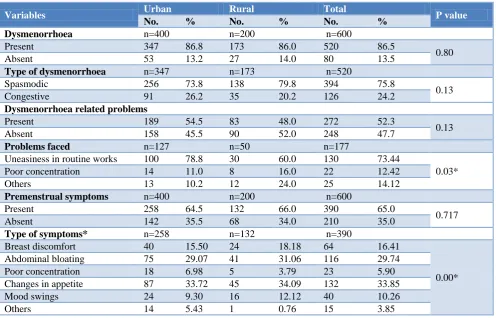
Table 2: Health problems and health seeking behaviour during menstruation.
Variables Urban Rural Total P value
No. % No. % No. %
Dysmenorrhoea n=400 n=200 n=600
Present 347 86.8 173 86.0 520 86.5
0.80
Absent 53 13.2 27 14.0 80 13.5
Type of dysmenorrhoea n=347 n=173 n=520
Spasmodic 256 73.8 138 79.8 394 75.8
0.13
Congestive 91 26.2 35 20.2 126 24.2
Dysmenorrhoea related problems
Present 189 54.5 83 48.0 272 52.3
0.13
Absent 158 45.5 90 52.0 248 47.7
Problems faced n=127 n=50 n=177
Uneasiness in routine works 100 78.8 30 60.0 130 73.44
0.03*
Poor concentration 14 11.0 8 16.0 22 12.42
Others 13 10.2 12 24.0 25 14.12
Premenstrual symptoms n=400 n=200 n=600
Present 258 64.5 132 66.0 390 65.0
0.717
Absent 142 35.5 68 34.0 210 35.0
Type of symptoms* n=258 n=132 n=390
Breast discomfort 40 15.50 24 18.18 64 16.41
0.00*
Abdominal bloating 75 29.07 41 31.06 116 29.74
Poor concentration 18 6.98 5 3.79 23 5.90
Changes in appetite 87 33.72 45 34.09 132 33.85
Mood swings 24 9.30 16 12.12 40 10.26
Others 14 5.43 1 0.76 15 3.85
Variables Urban Rural Total P value
No. % No. % No. %
Discharge per vaginum n=400 n=200 n=600
Present 124 31.0 62 31.0 186 31.0
0.99
Absent 276 69.0 138 69.0 414 69.0
Foul smelling discharge n=124 n=62 n=186
Yes 68 54.8 31 50.0 99 53.2
0.53
No 56 45.2 31 50.0 87 46.8
Other problems n=28 n=14 n=42
Body ache 17 60.71 10 71.42 27 64.28
0.30
Itching when used cloths 6 21.42 1 7.14 7 16.66
Weakness 5 17.85 0 0 5 11.90
Nausea 0 0 3 21.42 3 7.14
Remedies taken n=347 n=173 n=520
0.42
Medicine 80 23.1 30 17.3 110 21.2
Rest 61 17.6 32 18.5 93 17.9
Hot fomentation 200 57.6 106 61.3 306 58.8
Nothing 6 1.7 5 2.9 11 2.1
Chi-square test/Fisher's exact test used; *p-values indicates significance at p<0.05.
Table 3: Menstruation induced school absenteeism and health seeking behaviour.
Variables Urban (n=400) Rural (n=200) Total (n=600) P value
No % No % No %
Absenteeism in past 2 months
Yes 129 32.3 88 44.0 217 36.2
0.005*
No 271 67.8 112 56.0 383 63.8
No of days absent n=129 n=88 n=217
≤4 days 112 86.82 61 69.31 173 79.7
0.47
>4 days 17 13.17 27 30.68 44 20.2
Mean±SD 3.16±2.95 3.87±2.06 3.45±2.65
Reasons
Abdominal pain 100 77.52 70 68.4 170 63.9
0.54
Body ache 16 12.4 14 2.2 30 5.0
Others 13 10.75 4 4.54 17 7.83
Consultation sought
Yes 94 72.9 59 67.0 153 70.5
0.35
No 35 27.1 29 33.0 64 29.5
Source of consultation
Mother 62 48.06 43 48.86 105 48.38
0.43
Friend 20 15.5 20 22.72 40 18.43
Elder sister 23 17.82 15 26.13 38 17.51
Doctor 18 13.95 10 11.36 28 12.90
Others 6 4.65 0 0.0 6 2.76
Treatment sought
Rest 50 38.78 28 31.82 78 35.94
0.76
Medicine 34 26.36 25 28.40 59 28.18
Hot fomentation 45 34.88 35 39.77 80 36.86
Chi-square test/Fisher's exact test used; *p-values indicates significance at p<0.05.
The main problem observed in adolescent dysmenorrhea was present in 86.5% (86.8% of urban and 86.0% of rural girls). Spasmodic type of dysmenorrhea was explained by 75.8% of the girls while 24.2% had congestive type of dysmenorrhea (26.2% of urban and 20.2% of rural).
poor concentration, 10.2% and 24.0% for others respectively. This difference in distribution of problems faced during dysmenorrhea was statistically significant. Premenstrual symptoms were present in 65% (64.5% of urban and 66.0% of rural girls) of which changes in appetite remained the most common symptom (33.8%) followed by abdominal bloating (29.7%), breast discomfort (16.4%), mood swings (10.3%), poor concentration (5.9%) and others (3.8%) and it also had significantly different distribution between the urban and rural girls (p<0.05). overall 31% girls experienced discharge per vaginum. Overall 53.2% girls had foul smelling discharge (54.8% of urban and 50.0% of rural) girls. The remedies for menstruation related health problems (n=520), hot fomentation remained the most common 58.8% (57.6% of urban and 61.3% of rural), followed by medicine intake which was 21.2% ( 23.1% of urban and 17.3% of rural), then by adequate rest which was 17.9% (17.6% of urban and 18.5% of rural) and about 2.1% taken no treatment for the symptoms.
The menstruation induced school absenteeism and health seeking behaviours followed. 36.2% of the girls could not attend schools during menstruation in the past two months (32.3% of urban and 44.0% of rural) 56.0% of rural). This difference in distribution between urban and rural girls was statistically significant (p<0.05). Of those who were absent to school during menstruation (n=217), nearly 80% had taken leave up to 4 days (86.8% of urban and 69.3% of rural) and only 20.2% had taken leave more than 4 days (13.2% of urban and 30.6% of rural). Abdominal pain remained the most common reason (78.4% with 77.5% of urban and 79.5% of rural) for taking leave. It was followed by the body ache which was 13.8% (12.4% of urban and 15.9% of rural and other reasons (non-availability of soap 0.8%, excessive bleeding, weakness) were said by 7.8% of the girls. Of these girls, consultation was sought only 70.5% of the girls (72.9% of urban and 67.0% of rural) while it was not sought by the rest 29.5% (27.1% of urban and 33.0% of rural). Overall 48.4% mothers were the preferred source of consultation by the girls followed by the friends (18.4%, with 15.5% of urban and 22.7% of rural), elder sisters (17.5% with 17.8% of urban and 26.1% of rural) and doctors been consulted only by 12.9% of the girls (13.9% of urban and 11.4% of rural). Of the treatment sought, hot fomentation and rest remained the equally preferable choices 36.8% and 35.9% respectively followed by drug intake which was 28.2% and the difference in distribution of this between the rural and urban girls was not statistically significant (p>0.05).
DISCUSSION
In the present study it was observed that out of the total adolescent girls studied, 74.8% girls had attained menarche between the age of 13-16 years. The mean age at menarche in urban school girls was 13.07 (±1.03) years, which was significantly lower when compared with mean age at menarche in rural schools girls which as
13.36 (±1.06). The combined age of menarche was 13.17±1.04. Study conducted by Sachan et al the mean age at menarche in rural school girls was 13.19 (1.5) years, which was significantly higher when compared with mean age at menarche in urban school girls, which was 12.67 (1.4) years.14
In our study, it was observed that overall 35.3% with 35.5% in urban and 35% in rural girls had irregular cycles respectively. According to Sachan et al, it was observed that about our fourth of the school girls had irregular menstrual cycle, Verma et al revealed that irregular menstruation was 22.9% in the adolescent girls and Deo et alin adolescent school girls of urban and rural school girls in Ambohogi, had observed that menstrual cycle irregularity was more in urban school girls (7.95%) than rural school girls (2.86%).9,15
In present study, it was observed that duration of menstrual flow was normal (4-8 days) with 82.0% urban and 75.0% rural school girls respectively where study conducted by Sule et al (in turkey the menstrual flow lasting more than 8 days).16
In present study 86.8% schools girls were suffering with dysmenorrhea. Whereas 61.27 % of the girls reported dysmenorrhoea in the study conducted in Dharan and Turkey and in urban area 65% Houston et al.17 Sharma et al and Agrawal et alconcluded that 79.65 adolescent girls in Gwalior were suffering with dysmennorhoea.18,19
In present study it has been observed that overall 65.0% girls suffered from premenstrual symptoms. Similar findings of premenstrual symptoms were found in study conducted by Joseph et al.21 The most common premenstrual symptom change in appetite, backache, mood swing, breast heaviness, abdominal boating and poor concentration. Similar finding of other premenstrual symptoms was found by Sharma, et al.19 In present study 73.4% girls were unable to do routine activities due to dysmenorrhea.
In present study it was observed that out of 600 girls only 31.0% school girls complaining of foul smelling discharge per vaginum. Reason was poor hygiene and may be not changing change their pads more than three times. There is lack of knowledge about use of menstrual
absorbent and personal hygiene practices. The
contradictory findings were found in the study performed by Joseph et al.20 In their study they found that only 19.4% girls complained of discharge per vaginum.
In present study 73.4% girls were unable to do routine
activities due to dysmenorrhea. Women with
In the present study it was observed that all girls who are suffered from menstrual related problem had taken medication. About 23% urban school girls had taken medicine for dysmenorrhea.
In present study it was observed that out of total girls studied about 36.2% with 32.3% urban school girls and 44.0% rural school girls had been absent from school due to menstrual problem respectively. In this study overall 79.70% girls were absent less than 4 days due to menstrual related health problem, and about 20.2% girls were absent more than 4 days due to menstrual related health problem. The main reason for school absenteeism is abdominal pain. Similar finding was present study done by Dharampal et al in which school absenteeism from school 13.9% was effect of the menstruation related health problems on their daily routine.25 Dysmenorrhea and premenstrual symptoms were perceived as most distressing cause of school absenteeism.
In the present study it was found about 48.06% urban school girls consulted for menstrual problems with their mothers. While 48.86% rural girls consulted for menstrual problem with their mother. The contradictory finding of Thakre et al concluded that in urban 48.50% and in rural 21.20% girls consulted with their mother on the issue on menstrual problems.26 The reason for this contradictory outcome is due to higher literacy rate of urban mother in comparison to rural mothers.
CONCLUSION
There is need for education for the girls about menstruation. They did not hesitate to discuss about menstruation. There should be a programme conducted in school about menstruation and related problems and how to solve these problems during menstruation so that there is no effect on education of the girls because during menstruation some girls not attend the schools and lacking of facilities in the school.
Limitations
There are some limitations of my study are-
I have taken only those girls whom menarche started. Some girls had taken interest in filling the
questionnaire whom menarche not started.
ACKNOWLEDGEMENTS
We are grateful to all the students who participated in this study and the school staff who showed good cooperation.
Funding: No funding sources Conflict of interest: None declared
Ethical approval: The study was approved by the Institutional Ethics Committee
REFERENCES
1. Govt. of India; National Health Profile, Percent distribution of population by age and sex, Ministry of Health and Family Welfare, New Delhi, 2010. 2. World Health Organ. Physical status: The use and
interpretation of anthropometry. Report of the WHO Expert Committee. World Health Organ Tech Rep Ser. 1995;854:1‑452.
3. Thomas F, Renaud F, Benefice E, de Meeüs T, Guegan JF: International variability of ages at menarche and menopause: patterns and main determinants. Human Biol. 2001,73:271-90.
4. Ziv A, Boulet JR, Slap GB. Utilization of physician offices by adolescents in the United States. Pediatrics. 1999;104:35-42.
5. Singh A, Kiran D, Singh H, Nel B, Singh P, Tiwari P; Prevalence and severity of dysmenorrhea: a problem related to menstruation, among first and second year female medical students. Indian J Physiol Pharmacol. 2008;5:389-97.
6. Sharma P, Malhotra C, Taneja DK, Saha R;
Problems related to menstruation amongst
adolescent girls. Indian J Pediatr. 2008;75:125-9.
7. Mashankar VA. Menstrual Problems in
Adolescents. Bhave’s Textbook of Adolescent Medicine. First Edition. Jaypee Brothers Medical Publishers (P) Ltd; 2006.
8. Zegeye DT, Megabiaw B, Mulu A. Age at menarche
and the menstrual pattern of secondary school adolescents in northwest Ethiopia. BMC Women's Health. 2009;9:29.
9. Verma PB, Pandya CM, Ramanuj VA, Singh MP; Menstrual pattern of adolescent school girls of Bhavnagar, Gujarat. NJIRM. 2011;2(1):38-40. 10. Lee LK, Chen PC, Lee KK, Kaur J. Menstruation
among adolescent girls in Malaysia: A cross‑
sectional school survey. Singapore Med J. 2006;47:869‑74.
11. McEvoy M, Chang J, Coupey SM. Common
menstrual disorders in adolescence: Nursing interventions. MCN Am J Matern Child Nusr. 2004;29:41‑9.
12. Quint EH. Menstrual issues in adolescents with physical and developmental disabilities. Ann N Y Acad Sci. 2008;1135:230‑6.
13. Juyal R, Kandpal SD, Semwal J, Negi KS. Practices of menstrual hygiene among adolescent girls in a district of Uttarakhand. Ind J Comm Health. 2012;24(2):124-8.
14. Sachan B, Idris MZ, Jain S, Kumari R, Singh A. Age at menarche and menstrual problems among school-going adolescent girls of a North Indian district. J Basic Clin Reprod Sci. 2012;1:56-9. 15. Deo DS, Ghattargi CH. Menstrual problems in
16. Sule ST, Ukwenya JE. Menstrual Experiences of Adolescents in a Secondary School. J Turkish-German Gynecol Assoc. 2007;8 (1).
17. Houston AM, Abraham A, Huang Z, D'Angelo LJ.
Knowledge, attitudes, and consequences of
menstrual health in urban adolescent females. J Pediatr Adolesc Gynecol. 2006;19(4):271-5. 18. Sharma P, Malhotra C, Taneja DK, Saha R.
Problems related to menstruation amongst
adolescent girls. Indian J Pediatr. 2008;75:125-9.
19. Agarwal AK, Agarwal A. A study of dysmenorrhea
during menstruation in adolescent girls. Indian J Community Med. 2010;35:159-64.
20. Joseph GA, Bhattacharji S, Joseph A, Rao PS. General and reproductive health of adolescent girls in rural South India. Indian Pediatr. 1997;34:242-5. 21. Drife, JO, Magowan BA. Normal Menstrual Cycle.
Clinical Obstetrics Gynecol. Saunders publication; 2004; 121.
22. Dean BB, Borenstein JE. A prospective assessment investigating the relationship between work productivity and impairment with premenstrual syndrome. J Occup Environ Med. 2004;46:649-56.
23. Banikarim C, Chacko MR, Kelder SH. Prevalence and impact of dysmenorrhea on hispanic female
adolescents. Arch Pediatr Adolesc Med.
2000;154:1226-9.
24. Busch CM, Costa PT, Whitehead WE, Heller BR. Severe perimenstrual symptoms: prevalence and effects on absenteeism and health care seeking in a non clinical sample. Women Health. 1988;14:59-74.
25. Dambhare DG, Wagh SV, Dudhe JY. Age at
Menarche and Menstrual Cycle Pattern among School Adolescent Girls in Central. Indian Global J Health Sci. 2012;4.
26. Thakre SB, Thakre SS, Ughade S, Thakre AD. Urban-rural differences in menstrual problems and practices of girl students in Nagpur, India. Indian Pediatrics. 2012;49:733–6.