A Binary Choice Model of the Demand for Health Care
Services in Rural Areas of Developing Countries: Is
Zimbabwe Different?
Joe Muzurura
Midlands State University, Zimbabwe
Abstract:
The purpose of the study was to investigate the determinants of demand for health care services in developing countries using rural household data sampled from Zimbabwe. The increased access to and utilisation of health care services in rural areas have been low despite relative increase in the supply of drugs, diagnostic equipment and qualified clinical staff. The paper examined the influence of socio-demographic, economic and institutional factors on the probability of seeking of health care services. From a one- stage cluster sample of 15 rural districts which were selected for the survey, 405 households were randomly selected and interviewed using a self-administered questionnaire. The study relied on a logit model to find the factors that influence the demand for health care services based on 405 households that had reported illness of a member within the last one month before the survey. We found severity of illness, household income, age, gender, travelling distance, availability of drugs, hospital fees and proximity to the border statistically significant and therefore determinants of the demand for health care services in rural areas. The study recommends a concoction of policy strategies such as increasing health care facilities in rural areas, reducing distance to the nearest rural health care facility, introducing mobile Health to improve health information dissemination, increasing government funding to rural health facilities, improving availability of essential drugs and implementing income generating projects as well as reducing out of pocket expenses associated with the consumption of health care services.
Key Words: Demand, Health care, Developing Countries, Rural Areas, Zimbabwe, Logit
I
NTRODUCTIONA
NDB
ACKGROUNDThe demand for health care services is an issue that has been receiving intensive scrutiny in most developing countries. Health consumption and investment is a choice variable because it is a source of utility or satisfaction and it also determines income or wealth levels. Theoretically, although related health care and health are two dissimilar subject matters. Health care unlike health is tradable. People demand health as a consumption commodity that enters directly into their preference functions since sick days are a major source of disutility. People also demand heath as an investment commodity. An increase in the stock of health reduces the amount of time lost from activities like work, leisure and sickness. Good health is an important part of people’s well-being. It is also an essential component of economic growth, socio-political and economic development. Indeed, poor health and the inability to cope with illness can be detrimental to both economic and social welfare and rural development as it reduces an individual’s productivity and therefore the growth of real wealth in the economy. Poor health limits the production capabilities of the affected person. It also hinders the ability of individuals to enjoy the good things of life such as marriage, sporting activities and leisure. Most developing countries have huge rural population which are served by few health care facilities. The healthcare systems and other related infrastructure are not only poorly developed, but are also overstrained in terms of bedding capacity, availability of drugs, diagnostic equipment and qualified human capital. The rural areas are also plagued with climatically induced diseases such as malaria, yellow fever and also transboundary diseases such as anthrax and Ebola. Above all, the mutability and complexity of treating transboundary diseases places a heavy strain on existing rural health systems, especially those located near border areas. Most people demand health for two major reasons. First, health is demanded as a consumption good. A good health provides a source of utility as an individual enjoys illness free life. Second, health is also demanded as an investment good that defines the level of income and individual wealth. The demand for formal health care services, like the demand for many other essential services, depends on the out-of-pocket price, income, the prices of substitutes and complements, and time costs, along with a host of none monetary factors, such as tastes and preferences, quality of care, and the state of health (Vaughan, 2014; Kaija and Okwi, 2011, Murray et al., 1994). From a development viewpoint, the paper posits that the design of an effective and efficient rural healthcare system is critical given that the health status of the rural people is generally far below than that of people residing in urban areas.
The absence of a national health insurance systems covering rural people causes major difficulties in accessing health services especially at referral hospitals. As the out-of-pocket price of medical care services increases, most rural people reduce medical expenditures by cutting back on the number of visits to often distant referral centres. Others rely on self-treatment using tradition herbs since in most rural areas, private health care services are mainly concentrated in urban areas. As a result, the cost of health care services in most rural communities are inordinately high compared to their income levels and domestic savings. This situation undermines the access by rural folks to quality health delivery systems. Even if public health care services exists in some developing countries there are also health consumption barriers such as cultural beliefs, gender, lack of health information and high cost of travelling to health providers. These barriers negate the full utilisation of health care services by people domiciled in rural areas. UNDP (2015) reports that most rural children in developing countries are regularly exposed to water-borne diseases. The report also indicate that the underlying factor in most of the infant deaths in developing countries are poor nutrition, neonatal problems, pneumonia and diarrhoea.
areas. Rather than selecting a preferred health or ambulatory care service, the unavailability of private health providers in rural areas, implies that most people in rural areas depend on government provided health care services. However, the paper argues that the health care seeking behaviour in a rural context happens within the constraints imposed by demand-side barriers such as level of education, cultural beliefs, age and gender. Many studies on improving health utilisation indicate that health service interventions are important in the development of human resources and healthy society and contribute positively to the development of the economy (see Frankel, 1952; Mushkin, 1962; Kaija and Okwi, 2004; Becker, 1964; Fuchs, 1966). Sick time and illness reduce substantially hourly wages, with the effect being felt strongly in rural areas, where a higher proportion of the work force is engaged in hourly paid manual labour. For instance, early policy and research initiatives that were based on aggregate data focused on improving physical access to health care services through physical expansion of the health facilities (see Ehrich and Chuma, 1990; Felder and Meier, 1996b; Bloom, 2000; Hamoudi, 1999). Despite the existence of many useful studies in developed countries that focus on health care provision, petite attempts have been made in developing economies to examine the demand for medical care services by people living in rural areas. As a result, many policy and research initiatives in developing countries have been focused on improving physical access to health care services by rural folks rather than on health care utilisation. The lacuna of knowledge on the determinants of health care services utilisation by rural people reflects the urgent need to re-examine rural consumer behaviours that affect the demand for health care services. Whilst most governments in developing countries have made meaningful efforts since the 1990s to increase the provision or access of health care services to rural areas, remarkably the utilisation of health care services has remained appallingly low in many rural areas. In addition, the access to health care services in rural areas are often realised at costs which are disproportionate to the level of quality. The supply of modern drugs are often indeterminate. Diagnostic equipment are also antiquated and there is unavailability of core medical staff. As a result, a significant number of rural folks frequently substitute publicly provided health care services with self-treatment, faith based and traditional healing.
L
ITERATURER
EVIEWPerhaps the most important theoretical foundation for the demand for health care services is the Grossman (1972) model which draws heavily on human capital theory by Becker (1964, 1967), Frankel (1962), Ben-Porath (1967) and Mincer (1974). According to the human capital theory, increases in a person’s stock of knowledge or human capital raise his/her productivity in the market sector of the economy, where he/she produces money earnings, and in the nonmarket or household sector, where she/he produces commodities that enter his utility function (Becker, 1964). However, unlike the human capital theory, Grossman (1972) argued that a person’s stock of knowledge affects his market and nonmarket productivity, while his stock of health determines the total amount of time he can spend producing money earnings and commodities. Whereas Mushkin (1962), Fuchs (1966) and Becker (1964) pointed out that health capital was one component of the stock of human capital, Grossman (1972) was the first to construct a model of the demand for health capital itself. Becker (1965) in his theory of the allocation of time outlined a model where households are producers of commodities instead of solely consumers of goods and services. Becker assumed that households derive utility from the basic commodities they produce by combining their own time with market goods. Therefore, according to Becker, the utility associated with a market good is conditional on the time that is allocated to its consumption. Besides adopting the human capital approach, Grossman also used the household production function model of consumer behaviour by Becker (1965), Lancaster (1966) and Michael and Becker (1973) to account for the gap between health as an output and medical care as one of many inputs into its production. Grossman (1972) defines health broadly as including longevity and illness free days in a given year which is demanded and produced by consumers. This implies that health is a durable capital stock, however, the final product is not health as such but the services this capital good yields. The yield from the individual’s stock of health capital is defined as the total number of healthy days in each year, which generates utility directly. According to Grossman, being healthy directly yields utility and also indirectly yields income. Income from health related savings can be used to purchase goods or to produce commodities which further influence individual utility. Hence, in Grossman’s model as in general household production models, the demand for the medical care services and other market goods, is indirectly derived from the demand for the commodities that households choose to produce. Grossman argues that gross investments in a stock of health are produced by household production functions that relate an output of health to choice variables or health inputs such as medical care utilization, exercise, diet, alcohol consumption and cigarette smoking. In addition, the health production function is affected by the efficiency or productivity of a given consumer as reflected by his or her personal characteristics. Grossman defines efficiency as the amount of health obtained from a given amount of health inputs such as years of formal schooling completed. Grossman says that the length of life, however, is determined by the quantities of health capital that maximize utility subject to production and resource constraints. We disagree with Grossman’s observation and submit that the number of healthy days can be zero without death occurring (people living with HIV/AIDS). In addition, we claim that due to modern medical technologies and increased research and development in new medical knowledge, many people are living or can live for years in a constant state of illness and being more productive than healthy people. Furthermore, we argue that at the individual level, illness or sickness is a random event, which cannot be anticipated or insured against. Thus, we aver that the health capital accumulated by successful treatment of an illness in a previous period can be wiped out by a random illness in the next period. Hence, death can still occur during a period of good health.
Another theoretical foundation of the demand for healthcare services is the Anderson (1968) theoretical framework which describes the process of health care utilisation as a causal interface of three different levels that is societal, health care system or programme factors and individual factors. The societal and system factors are posited to significantly influence individual determinants which subsequently directly influence the utilisation of health care services. According to the model, societal factors comprise the current state of the community’s knowledge on health related issues, people’s attitude, values, norms as well as their cultural beliefs about health and illness. This implies that the role of the health care system is to allocate available financial and physical resources to health care institutions. According to Anderson (1968), health care utilisation determinants include structures and activities through which health care services and health education are provided. These include education, communication activities and the availability of information that educate people on health care services. The organisation component of health care services utilisation factors addresses how medical services are delivered to needy people and include distance to the nearest health facility, access to primary health care and the cost of health care services. The Anderson theoretical framework postulates that an individual’s decision to seek medical care services is a function of three sets of variables which are (1) the predisposing factors, (2) the enabling factors as well as the (3) need factors. The model posits that there are some factors that prompt or predispose people towards health care service utilisation. For instance, the basic demographic characteristics such as gender, culture, social structure, occupation, ethnicity, age, sickness experience, and trend of past illness or sick time may have a significant influence on the demand for medical health care services. The social structure is measured by a wide assortment of factors that determine an individual’s ability to cope with present health problems, the status of a person in the household or community, the ability to command resources to deal with these problems, and how healthy or unhealthy the physical environment is likely to be.
Whilst an individual may be predisposed to the use of health care services, some channels must be available to enable the individual to do so. In other words, certain financial and physical resources must be available to an individual in order for her/him to be able to utilise health care services even in the presence of predisposing factors. Enabling factors therefore include local attitudes about health care services, geographic proximity and accessibility to the source of medical care services, obtainability of health care services, and availability of health insurance coverage, individual income, existence of household resources and community level resources.
still perceive the need for health care services before seeking it. Anderson and Newman (2005) submit that perceived illness can be measured by the number of disability days, and symptoms experienced by the individual during a specified time frame. Arguably the most important need factors are health beliefs of an individual or the community (Burgard, 2004). According to Andersen (2010), health beliefs are attitudes, values, and knowledge that people have about health and health services that might influence their subsequent perceptions of need and use of health services. However, some social psychologists have been concerned that health beliefs have not been appropriately conceptualized and measured in much work employing the behavioural model (Becker and Maiman, 1983; Mechanic, 1979). The paper criticises the Anderson model for not paying adequate attention to social networks, social interactions, and culture that exists in most developing economies. Whilst the model has been able to explain the utilisation of health care in developed countries the paper suggests that the model does not consider the extent and quality of social relationships in developing countries that facilitate or impede the utilisation of health services. Nevertheless, the model provides a good theoretical framework of analysing the demand for medical care services in rural areas of developing countries.
E
MPIRICALL
ITERATURER
EVIEWAdedoyin and Watts (1989) in a study of rural Nigeria have shown that accessibility to health care services is a major determinant of greater use of health facilities and improvement in health conditions. The World Bank (2014) has shown that in most rural areas in Africa, the majority of women, live more than five kilometres from the nearest health facility. According to Okwe et al (2006), the scarcity of vehicles, especially in remote areas, and poor road conditions can make it more difficult for women to reach even relatively nearby health facilities. Grossman (1972), Berger and Leigh (1989), Rosen and Taubau (1982) have argued that education influences many decisions such as a choice of job, ability to select a healthy diet, and avoid unhealthy habits, avoid environmental pollutants, efficient use of medical care which impacts the quality of life. Tesfaye (2003) agree, an educated household will not only be healthier but also will have time and desire to use health service due to awareness of modern treatment and its benefit. Becker et al (1991) show that the higher educated people are more responsive to changes in the harmful future consequences of the consumption of addictive goods because they are more future oriented. In most developing countries a special consideration for the level of use of available health care services is the cultural context within which decisions about the use of traditional or modern services are made (Fosu, 1981; Adetunji, 1991. The cultural perspective on the demand for health care services suggests that medical need is determined not only by the presence of physical disease, but also by the cultural perception of illness (Azevedo et al, 1991). According to World Bank (2014), what constitutes a threat to health, especially among pregnant women and children, tends to be culturally relative. Azevedo et al (1991) agree, individuals may give inadequate seriousness to certain health situations because they may consider such conditions to be normal based on their cultural understanding and experience of that condition. In most rural communities in Africa, the formal health care service deliveries coexist with indigenous health care services (Orley, 1980). In the study of the response of parents to childhood diseases in the Nigerian Yoruba community, Adetunji (1991) demonstrated that mothers used alternative sources of health care rather than hospital clinics and maternity centres. Flores et al (2001) confirm that in rural communities where the influence of culture on decision making is high, individuals may seek professional care only after exhausting their own folk remedies. The other important factor associated with utilization of maternity care services is maternal education (Osariemen, 2011; Akin and Hutchinson, 1999; Addai, 2000; Celik and Hotchkiss, 2000). Women in higher socio-economic group tend to exhibit patterns of more frequent use of maternal health services than women in the lower socioeconomic groups hence factors such as education appear to be important mediators (Leslie and Gupta, 1989; Addai, 1998. Mbagaya et al (2005) in a study in rural Kenya found that parents schooling predominantly that of the mothers was likely to influence their behaviour in seeking health care services for their children. Gertler and Van der Gaag (1988) argue that poverty has remained a major factor limiting health service utilization and women remain the poorest amongst the poor in most developing countries like Zimbabwe. According to Adhikar (2011) poverty translates to the inability to afford transport to health units for both preventive and curative services. Furthermore, according to Lepine and Nestour (2011) poverty limits people’s choices and often causes delay in accessing timely health care. Cisse (2011) agree, this is especially so where other members of the household have to spend income on another member of the family who may not be well prepared for emergent illness. According to Folland et al (2006), medical care services appear to be a normal good in that the demand for medical care increases with real income. Income is reported to increase the likelihood of utilising health care service in countries such as Burkina Faso (Develay and Sauerborn, 1996), in Thailand (Raghupathy, 1996) in Thailand (Gupta, 1990), in rural Vietnam (Hong et al,2003) in rural Mozambique (Lindelow, 2000) and Hjortsber and Mwikisa (2003) in Zambia. Bosu, et al (1997) also posit that income has a positive impact on the attendance at immunization clinics in Ghana.
literature appears to suggest that higher prices reduce the demand for medical care, but, on average, significantly less than proportionately. Breyer et al (2003) indicate that consumers with a lack of medical knowledge tend to underestimate the impact of medical care on overall health and, as a result, fail to consume an appropriate amount. Poorly trained or insufficient levels of staff and inadequate drug supplies may inhibit use of care even if services are affordable (Cisse, 2011; Contoyannis and Jones, 2004). As cited by Kasirye et al (2004) a review of more than 50 user-fee experiences in rural Africa showed that use of health services increased when quality was improved and reduced when quality deteriorated. The effect of household size on the demand for healthcare services has also been found to be positive and significant in a number of rural households (Kevany, 2011; Hallman, 1999; Sarma, 2003). However, Mawuli (2011) argues that larger families could supply more adults and supplement household income. They posit that this will ease the resource constraint and may increase the demand for medical services. However, Akin et al (1995) used operational cost per capita of the health facility, the observed physical condition of the facility and percentage of the year drug available as proxy for quality of treatment.
Theoretical Model FrameworkII. The Framework
A theoretical demand for healthcare service can be specified as the following general equation;
H=H(X) (1)
Where H is a measure of individual health care services and X is a vector of aggregated determinants of the demand of health care services. We can regroup the elements of the vector X into sub-sectoral vectors representing socio-demographic, economic, and institutional and environment factors as follows:
H=H (Sd, E, I, Env) (2)
Where Sd represents a vector of socio-demographic variables that include cultural beliefs, religion, education, gender, age, illiteracy rates and levels of poverty; and E is a vector economic variables that include cost of medical health care services, income relative prices of medical services, wage rates, economic growth, health care expenditures, and I represents institutional factors such as quality of facilities, availability of personnel, drugs and ambulatory care and, Env is a vector of environmental factors such geographical location of health facility, presence of wild animals, air and water quality. We can therefore rewrite equation 2 as follows:
ℎ=ℎ(𝑠𝑑1,𝑠𝑑2,𝑠𝑑3… . .𝑠𝑑𝑛 ;𝑒1,𝑒2. .𝑒𝑚;𝑖1,𝑖2,𝑖𝑘;𝑒𝑛𝑣1,𝑒𝑛𝑣2… .𝑒𝑛𝑣𝑔) (3)
Where: n, m, k and g being the number of variables in each sub-group, respectively. h is individual’s health status proxied by life expectancy at birth. We further decompose equation (3) as shown below in order to show the number of variables in each sub category.
𝐸=𝑒1,,𝑒2,𝑒3… …𝑒𝑛 (4)
𝑆𝐷=𝑠𝑑1,𝑠𝑑2,𝑠𝑑3… …𝑠𝑑𝑛 (5)
𝐸𝑁𝑉=𝑒𝑛𝑣1,𝑒𝑛𝑣2,𝑒𝑛𝑣3… . .𝑒𝑛𝑣𝑛 (6)
Using the Cobb-Douglas production function, we further transform equations (3, 4, 5, and 6) in the following form:
ℎ=∀Σ𝑒𝜂Σ𝑠𝑑𝜌Σ𝑖∅Σ𝑒𝑛𝑣𝛽 (7)
Where:
ղ, 𝛽𝛽,𝝓𝝓𝝆𝝆 are elasticities. ∀ estimates the initial health stock and measures the health status that would have been observed had there were no health depreciation, or health improvement due to changes in socioeconomic and environmental factors used in the production system. Rational individuals will maximize utility by the optimal management of their stock of health over lifetime. Similarly, ( ∀𝛴𝑦𝜂𝛴𝑠𝜌𝛴𝑦𝛽−1)∗100 estimate the percentage change in the health status due to social, economic and environmental factors. Due to the unavailability of quality data on the necessary variables, we limit our empirical analysis to aggregated variables like GDP per capita (y1), overseas development inflows per capita (y2) and food
production (y3); variables representing social factors are limited to illiteracy rates a proxy for education (s1), under five
mortality rate (s2), life style which is represented by teenage pregnancy, (s3) mortality rate under five(s4) dependency ratio
(s5) and population density(s6) and carbon dioxide emissions per capita (e1) a variable representing environmental factors.
Taking the logarithm of equation 7 and re-arranging it yields the following linear aggregate health production function:
𝑙𝑛ℎ=𝛼0+𝜂𝑌𝑙𝑛𝐸+𝜌𝑆𝑙𝑛𝑆+𝜌𝑆𝑙𝑛𝐼+𝛽𝛽𝐸𝑙𝑛𝐸𝑁𝑉+𝜖 (8)
Where E denotes the income vectors; S is a vector of socioeconomic variables, Env is a vector of environmental variables and ϵis the classical error term.
We can expand equation 8 to a regression equation in the form of:
𝑙𝑛𝐻=𝑎0+𝜂𝑙𝑛𝐺𝐷𝑃+𝜂𝑙𝑛𝑂𝐷𝐼+𝜌𝑙𝑛𝐼𝐿𝐿𝐼𝑇+𝜌𝑙𝑛𝐷𝐸𝑃𝑅+𝜌𝑙𝑛𝑀𝑂𝑅𝑇+𝜌𝑙𝑛𝐿𝐼𝐹𝐸+𝜌𝑙𝑛𝑃𝑂𝑃+𝛽𝛽𝑙𝑛𝐶𝑂2 +𝜀 (9)
Where:
population density (an urbanisation variable), CO2- Carbon emission. Selection for variables like mortality rates of children under five years and illiteracy rates of people above 15 years who cannot read and write were biased selections. The biases inherent in ordinary least squares estimates of health production functions were first emphasized by Auster et al. (1969). They were also considered in much more detail in the context of health by Rosenzweig and Schultz (1983, 1988), and 1991), Corman et al. (1987), Grossman and Joyce (1990), and Joyce (1994). We argue that whilst equation (9) shows a log-log relationship, we recognise the fact that in real practice, the utilisation of medical care services in most rural areas is likely to be a dichotomous event. Hence, an individual can either use healthcare services or does not. We therefore define the demand for health care services as the probability of seeking health care services from a clinic or hospital conditional on illness in the household. Given this nature of dependent variable that have two distinct choices one may use some binary choice models such as linear probability model (LPM), tobit logit or probit functions in such research. The LPM has disadvantages in that there is no guarantee that the probability will fall between 0 and 1 and that probity model cannot compute marginal effects in the event of a dummy variable. Owing to these shortcomings, the paper opted for a logistic multiple regression in the form of logit model. Our model therefore takes the functional form 𝑃𝑖=𝐸(𝑌= 1𝐼𝑋𝑖) =𝜕𝑖+𝜕2𝑋𝑖 where Pi is the probability of seeking medical care services depending on a set of variables denoted by Xi. We can represent the above expression into a cumulative logistic function;
Starting from the cumulative logistic Pr(𝑦𝑖 = 1|𝑥𝑖) = 𝑒𝑥𝑖𝜕
1+𝑒𝑥𝑖𝜕=1+𝑒1−𝜕𝑥𝑖=Λ(𝑥𝑖𝜕) (10)
Where xi𝜕is just a linear function of some kind which if substituted in G: ℜ↠(0,), that G is a probability function that takes values between 0 and 1. We get the following likelihood function;
ℒ=∏𝑁 Λ
1=1 (𝑥𝑖𝜕)𝑦𝑖[1− Λ(𝑥𝑖𝜕)]1−𝑦𝑖 (11)
We can also linearize equation (11) by assuming natural logs; 𝑙𝑛ℒ=∑𝑁 (
𝑖=1 𝑦𝑖ln[Λ(𝑥𝑖𝜕)] + (1− 𝑦𝑖)ln [1− Λ(𝑥𝑖𝜕)] (12)
Substituting equation (10) into equation (12) we obtain;
𝑙𝑛ℒ=∑𝑁𝑖=1�𝑦𝑖𝑙𝑛 �1+𝑒1−𝜕𝑥𝑖�+ (1− 𝑦𝑖)𝑙𝑛 �1−1+𝑒1−𝜕𝑥𝑖�� (13)
Model Specification
The Xi in the linear predictor in equation (13) can be expanded into a more general familiar dichotomous regression equation in the form of equation (7) above as follows:
P (ℎ= 1/𝑋) =𝑓{𝑠1,𝑠2. .𝑠𝑚;𝑦1,𝑦2,𝑦3… . .𝑦𝑛 ;𝑖1,𝑖2. .𝑖𝑚;𝑒1,𝑒2… .𝑒𝑔} (14)
Where P [h = 1 / X] is the probability that a household member will seek health care services on condition of illness, given the vector of observable socio-demographic (S), economic (Y) institutional (I) and environmental (E) characteristics. Equation (14) can be further specified simply as follow;
P (demand=1/X) =α0hgen+ α1hage+ α2hedu+ α3hsize+ α4mstatus+ α5hincome+ α6avail+ α7userfs+ α8tacess+ α9AcVHW+ α10sever+ α11Wild+ α12Proxb +ɛ
Where:
α is a constant
Hgen gender of household
Hage age of the house hold member
Hedu level of education for the household head Hsize Size of the family
Mstatus Marital status Hincome Household income
Avail Availability of essential drugs and other medical services USERfS Cost of utilising health care services
Access Distance to the nearest health care facility ACVHW Access to the village health worker
Wild demand of health care due to injuries or diseases from wild animals Border Use of cross-border heath facilities
Severity Severity of illness
Ɛ is an error term
Definition and Justification of Variables Health care services utilisation (DEMAND)
The study will use a binary dependent variable which takes value of 1 when is sick or ill household member seeks treatment from formal health care facilities. 0 will be assigned in the event of self-treatment or other types of treatment.
for Zimbabwe; Cisse, 2006, 2011 for Cote d’Ivoire; Muhofah, 2010 for Uganda and Nestour, 2011 for Senegal. However, other studies have also find the family structure as not important in the demand for health care (Addai, 2000; Akin et al, 1985). Therefore on a prior we cannot determine the expected sign of the variable.
Age of household head (HAGE). The age of the household head in years is a continuous variable. When the head of the household is old the probability of seeking health care services is expected to decrease due to over-reliance on self-treatment. The greater willingness to seek care is offset by the greater ability to produce health care at home. The paper suggests that the demand for public health care services seems to decrease at old age for both males and females. We expect higher probability of utilisation of health care services in households whose heads are still young because of their inexperience in managing illness and also their predisposition to lifestyle diseases such as drug and alcohol abuse.
Level of education of head of the family (HEDU). Education is denoted a categorical variable that is measured by the level of formal education attained by the head of the household. The variable is coded thus, No education (0), Primary education (1), Secondary education (2) and Tertiary education (3). Coding education as a categorical variable enables the capturing of the incremental effects of the levels of education on demand for health care services. Improved education is presumed to increase the productivity of individuals, not only in the market domain but also in the non-market domain, maintenance of their health in particular. Higher levels of education is also associated with relatively more medical care at preventive stages and in addition, the better educated household head may provide more care for other members of their families. The variable has been widely been used in literature and the findings have generally been ambiguous (see Vaughan, 2014; Lepine and Nestour, 2011; Mawuli, 2011; Barnett et al., 2010; Kasirye et al., 2004; Mwabu et al., 2004; Lindelow, 2003; Folland et al., 2006). A priori we expect that in most developing countries the more educated the household head, the higher the probability of seeking health care services by a family member.
Size of household (HSIZE).The variable is measured by the number of family members in the household. Schultz and Tansel (1996) and Sahn et al (2003) observed that large households with high dependency ratio sought care from non-hospital facilities due to financial constraints. The effect of household size on the demand for healthcare services has also been found to be positive and significant in a number of rural households (Vaughan, 2014; Kevany, 2011; Hallman, 1999; Sarma, 2003). However, Mawuli (2011) argues that larger families could supply more adults and supplement household income and ease the resource constraint on utilisation of medical care services and may increase the demand for medical services. On the contrary, in households with many family members, the available income may not be adequate to meet the direct and indirect costs of accessing health care services. We expect higher chances of seeking non formal treatment in household with more members compared to low sized households.
Severity of Illness (SEVE).The variable is significant because the study is based on illness of a household member. Since computing severity of illness is hard, the study proxies the severity of illness with bedridden days as was done by a number of studies (for example, Flores et al., 2001; Hjortsberg, 2001; Breyer et al., 2003). A value of 1 will be assigned when the sick household member is bedridden and 0 when he/ she is not bedridden. The perception about the severity of illness is an important determinant for health care services utilisation. Hence, when the illness is observed as critical the likelihood of ignoring the illness or seeking self-treatment is extremely low. We thus anticipate a positive and significant relationship between the severity of illness and the health care services utilisation.
Hospital fees (USERFS) Hospital fees such as consultation fees and cost of drugs represent a major cost of accessing health care services. The higher the cost of consuming healthcare services, the smaller the quantity of medical services demanded. However, Osariemen (2011) finds user fees having minimal effect on the decision to seek health care. In addition, the demand for health care services was found to be inelastic with respect to user fees in cases of severe illness in Mali (Mariko, 2003). Due to adverse rural area conditions characterised by low household savings expect user fees to have a major effect on the probability of seeking health care services.
Household level of income (HINC). Monthly income is a continuous variable and represents household earnings from different sources. The relationship between income and health care services is widely studied in many early studies. Income is reported to increase the likelihood of rural people utilising health care service in countries such as Burkina Faso (Develay and Sauerborn, 1996), in Thailand (Raghupathy, 1996; Gupta, 1990), in Vietnam (Hong et al, 2003) in Mozambique (Lindelow, 2000) and Hjortsber and Mwikisa (2003) in Zambia. A higher level of income permits more access to consumption of higher quality of services and goods, better housing and medical services, all of which positively influence health status. Hence, the level income increases the likelihood of seeking both preventive and curative treatment from health care facilities. The study expects the probability of seeking health care services by a household member to increase with higher levels of household income.
Accessibility to the nearest health facility (DIST). Accessibility to the nearest health facility is a continuous variable proxied by the distance travelled, measured in kilometres. The World Bank (2014) indicate that in a rural Nigeria, accessibility is a major determinant of greater use of health facilities and improvement in health conditions. In most rural areas, the scarcity of reliable vehicles, especially in remote areas, and poor road conditions can make it more difficult for rural folks to reach even relatively nearby health facilities. There is indeed a higher probability that a household member will seek health care services during illness if the household is close to a health care facility. We therefore postulate that a negative relationship exists between distance to the nearest health care facility and the demand health care services.
Access to primary healthcare givers (ACPHG). Most developing countries have primary health care givers sometimes known as village health workers whose primary purpose is to respond early to outbreak of diseases. Access to ACPHG influences health care services utilisation by being the formal entry to formal health care utilisation. ACPHG is a dummy variable that was coded as follows: a value of 0, if a household has no access to village health workers and a value of 1 if a household has access to village health workers. Since some rural areas do not have these health practitioners, we cannot determine a priori the effect of ACPHG on the demand for health care services.
insufficient levels of staff and inadequate drug supplies inhibit the use of care even if health services are affordable (Cisse, 2011; Contoyannis and Jones, 2004). Kasirye et al (2004) show that in several rural Africa the use of health services increased when quality of drugs was improved and reduced when quality deteriorated. Most providers of health care services in rural areas are characterised by less qualified medical staff, fewer essential drugs, poorly equipped laboratories, shortage of electricity and running water. The study anticipates the probability of seeking treatment to increase with the availability of essential drugs at the nearest medical care facility.
Diseases and injuries from wild animals (INWILD). Even though most rural areas in Africa have large wild animal presence in unprotected national parks which have the potential of transmitting diseases such as anthrax to people, the variable has never been tested in similar studies done as this one. Due also to the geographical location of most rural areas where people are susceptible to malaria, yellow fever, Ebola virus, the study expect higher probability of seeking medical care services utilisation for people who live in rural areas.
Proximity to border areas (PROXB). This variable has not also been used in empirical literature on the demand for medical services in rural areas that are near border areas. Most rural areas in developing countries are located near national borders and people who live in such areas are likely to cross to neighbour countries in order to access cheaper medical care services hence increasing the demand for medical care utilisation. At the same time, out breaks of diseases in a particular country are likely to have a contagion effect on others. The variable is coded 1 for people who also rely on cross-border facilities and 0 for those who depend only on domestic health care services facilities. We expect the proximity of the district to positively influence the probability of higher demand for medical care services.
Marital status (MARIST). Is a categorical variable, 0 for single, 1 married, 2 for divorced, and 3 for widowed. Mbagaya et al (2005) in a study in rural Kenya found that marital status is likely to influence the seeking of health care services for children. In Zimbabwe, most married parents spend most of their non-market time with children unlike single or divorced parents. Hence we predict that a family with both parents are likely to demand more health care services unlike single parents who have little non-market activities.
In order to check for the robustness of the model, the study carried out the following tests; the multicollinearity test using a correlation matrix to check whether variables were not moving together systematically. Variables which were above 0.80 and -0.8 were dropped from the regression equation. In order to ensure applicability to various rural communities, the paper made severable assumptions such as: heritable or genetic factors are either reasonably constant across all individuals or do not vary systematically with the independent variables; every individual maximizes utility by optimally managing of his/her stock of health over lifetime.
Presentation and Interpretation of Findings Descriptive Statistics
Table 1 summarises main attributes of the data employed in the study. The youngest household head at the time of the study was 14 years possibly indicating the prevalence of child-headed families in most developing countries. The least distance to the nearest health care facility of 7.5 km and the furthest distance to the nearest health care facility is 30.5 km. The average household size consists of at least 6 family members. The high dependency ratio may also explain why a number of people have zero education. All the standard deviations are relatively small for all variables except for levels of income hence indicating a normal distribution.
Table 1: Descriptive statistics
Variable Observation Standard deviation Mean Min Max
hage 405 16.785 49.484 14 89
hedu 405 0.858 1.596 0 3
hgen 405 0.500 0.5012 0 1
hhsize 405 2.777 6.198 1 18
income 405 53.760 54.265 2 500
drugavail 405 0.266 0.077 0 1
userfees 405 11.971 7.686 5 100
distance 405 2.564 10.290 7.5 30.5
acvhw 405 0.402 0.798 0 1
wild 405 0.372 0.165 0 1
cbfa 405 0.458 0.701 0 1
severity 405 0.493 0.417 0 1
Marital status 405 1.029 1.938 0 4
Source: own computation
Multicollinearity Test
A Pearson’s correlation test was carried out for all the dependent variables and the table indicate that no correlation statistic is more than 0.8 or -0.8. Hence, the individual effects of independent variables on the dependent variable, demand for healthcare services can be isolated.
Interpretation of Logit Regression Output
areas. It is critical to note that socio-demographic factors, age, gender and level of education are critical in determining demand for health care. Similarly, of the economic factors user fees and the level of household income are important in influencing the demand for health care. Of institutional factors only the availability of drugs is a critical determinant for health care. Of the environmental relate factors proximity to the border is important in influencing utilisation of health care services.
Table 2: Multicollinearity Tests
hage hedu hgen hhsize Inc Drugs Ufees Dist avhw wild sev Mst
Hage 1.000
Hedu -0.09 1.0000
Hgen -0.02 0.04 1.0000
hsize 0.40 -0.14 -0.05 1.0000
Inc -0.04 0.06 -0.06 -0.01 1.0000
Drugs -0.05 0.08 -0.03 0.02 -0.09 1.0000
Ufees 0.06 0.01 0.07 -0.02 0.06 0.08 1.0000
Dist -0.06 -0.02 -0.08 -0.01 -0.09 -0.02 -0.06 1.0000
Avhw 0.05 -0.01 -0.11 0.02 0.02 0.05 -0.03 -0.22 1.0000
wild -0.05 0.05 0.01 0.09 0.09 0.08 0.02 0.03 -0.21 1.0000
sever 0.10 0.01 -0.02 0.11 0.11 0.04 0.02 -0.02 0.05 -0.04 1.000
mst -0.02 -0.05 -0.05 0.04 0.04 -0.05 -0.06 0.06 0.08 0.01 -0.08 1.0000
Source: on computation
Table 3: Logit regression output
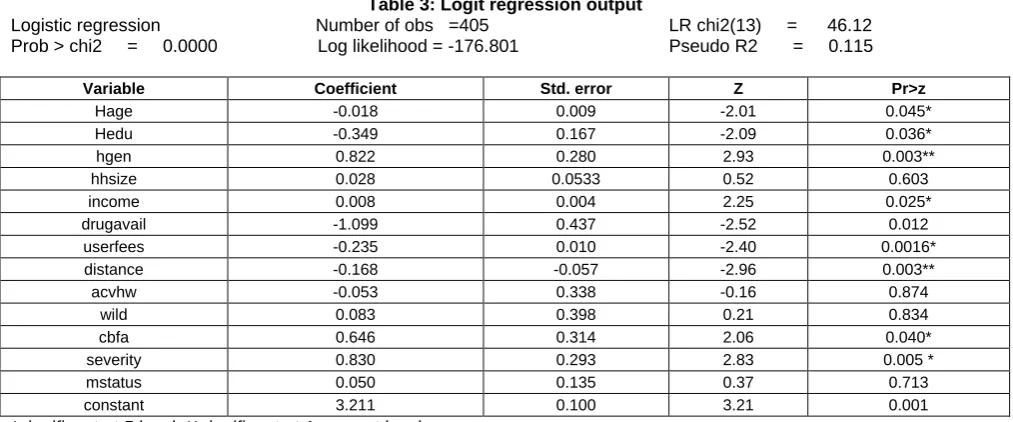
Logistic regression Number of obs =405 LR chi2(13) = 46.12 Prob > chi2 = 0.0000 Log likelihood = -176.801 Pseudo R2 = 0.115
Variable Coefficient Std. error Z Pr>z
Hage -0.018 0.009 -2.01 0.045*
Hedu -0.349 0.167 -2.09 0.036*
hgen 0.822 0.280 2.93 0.003**
hhsize 0.028 0.0533 0.52 0.603
income 0.008 0.004 2.25 0.025*
drugavail -1.099 0.437 -2.52 0.012
userfees -0.235 0.010 -2.40 0.0016*
distance -0.168 -0.057 -2.96 0.003**
acvhw -0.053 0.338 -0.16 0.874
wild 0.083 0.398 0.21 0.834
cbfa 0.646 0.314 2.06 0.040*
severity 0.830 0.293 2.83 0.005 *
mstatus 0.050 0.135 0.37 0.713
constant 3.211 0.100 3.21 0.001
*significant at 5 level, **significant at 1 percent level Source: Author’s calculations
As shown in Table 3, age (hage), level of education (Hedu), gender (hgen), household income (income), drug availability (drugavail), hospital user fees (userfees), distance to the nearest hospital facility(distance), proximity to the border (cbfa) and severity of illness were found to be statistical significant at 95% level of significance, given that all other variables like marital status (mstatus), size of household (hhsize) and presence of national parks (wild) which were found to be insignificant are in the model. The coefficient of age is negative implying that as the age increases in rural people, they are likely to demand health less. Similarly, as the level of education increases the demand for health is also likely to decrease. Gender is positive indicating that as the household head sex changes from male to female this increases the demand for health. Equally, as the income of the household increases, so is the demand for health care utilisation by the household. However, as the distance to the provider of health is negative, the demand of health care services decreases. As the severity of diseases increases so is the demand for health. However as user fees increases the more the household is less likely to demand health care services.
Log odds ratios
Table 4: Log odds ratios
Demand Odds ratio Std. error z P>IzI
Hage 0.982 0.009 -2.01 0.045
Hedu 0.705 0.118 -2.09 0.036
Hgen 2.274 0.637 2.93 0.003
Hhsize 1.028 0.055 0.52 0.603
Income 1.008 0.004 2.25 0.025
Drugavail 0.333 0.145 -2.52 0.012
Userfees 0.977 0.010 -2.40 0.016
distance 0.845 0.048 -2.96 0.003
acvhw 0.948 0.321 -0.16 0.874
wild 1.087 0.432 0.21 0.834
cbfa 1.908 0.600 2.06 0.040
severity 2.293 0.672 2.83 0.005
Maritstatus 1.051 0.146 .037 0.713
Source: own computations
The odds ratio of age is 0.982 indicating that a percentage change in the odds of demanding health decreases by 0.982 for unit increase in the age of the household head, hence older people are less likely to seek heath care services. The level of education has an odds ratio of 0.706, hence a percentage change in the odds of demanding health decreases by 0.706 as an individual acquires more education. The odds ratio of gender is 2.274, showing that a percentage change in the odds of seeking health care services increases by a factor of 2.2740 in the household is female headed. For a one dollar increase in the level of household income the odds of demanding health care services increases by a factor of 1.008.The percentage change in the odds of demanding health decreases by a factor of 0.333 for a unit increase the availability of none essential drugs. Similarly, for a unit increase in hospital user fees, the percentage change in the odds of demanding health care services decrease by 97 %. Furthermore, an increase by a kilometre in the distance travelled to the nearest health provider decreases the odds of demanding health by 85%. A percentage change in the odds of demanding health care services increases by a factor of 1.907 if an individual lives closer to the border. Similarly, a percentage change in the odds of demanding health care services increases by a factor of 2.293 if there is a unit increase in the severity of illness. In other words people with severe illness are more likely to visit a health facility.
Marginal effects
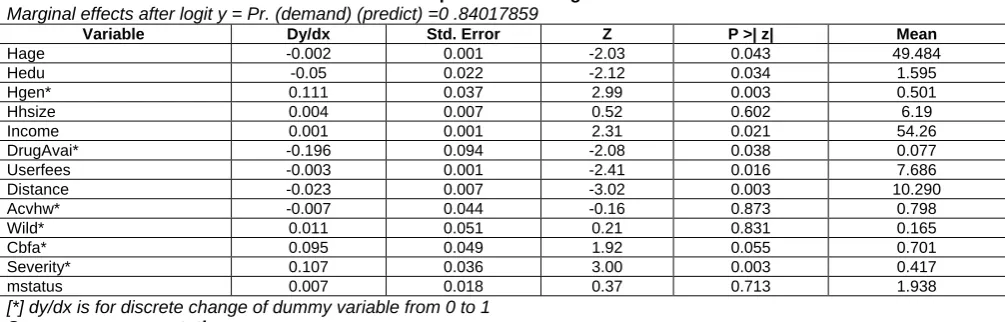
According to Cameron and Trivedi (2009) interpreting marginal effects is more important to reporting findings than both the interpretation of regression output and the odds ratio. Marginal effects indicate the magnitude of the effects of changes in the independent variables on the dependent variable. For instance marginal effects indicate by how much does the demand for the health care services likely to increase if the distance/cost to the nearest health care facility is increased by a kilometre or a dollar. The predicted probability of demanding health care service is 0.840 for most rural households. This means that 84% people in rural areas are likely to seek health care services if they have the following average characteristics; average age 49 years, have a secondary school education, average family size of 6; earning an income of $54, live within a distance of 10 km to the nearest health care facility and paying user fees (including transport costs) of $7.
Table 4: Computation of marginal effects
Marginal effects after logit y = Pr. (demand) (predict) =0 .84017859
Variable Dy/dx Std. Error Z P >| z| Mean
Hage -0.002 0.001 -2.03 0.043 49.484
Hedu -0.05 0.022 -2.12 0.034 1.595
Hgen* 0.111 0.037 2.99 0.003 0.501
Hhsize 0.004 0.007 0.52 0.602 6.19
Income 0.001 0.001 2.31 0.021 54.26
DrugAvai* -0.196 0.094 -2.08 0.038 0.077
Userfees -0.003 0.001 -2.41 0.016 7.686
Distance -0.023 0.007 -3.02 0.003 10.290
Acvhw* -0.007 0.044 -0.16 0.873 0.798
Wild* 0.011 0.051 0.21 0.831 0.165
Cbfa* 0.095 0.049 1.92 0.055 0.701
Severity* 0.107 0.036 3.00 0.003 0.417
mstatus 0.007 0.018 0.37 0.713 1.938
[*] dy/dx is for discrete change of dummy variable from 0 to 1
Source: own computation
which they can live with. Furthermore, elderly people are least likely to walk long distances to formal health care facilities given pervasive transport challenges in most rural areas. The level of education is negative indicating that as the level of education increases the probability of demanding health care services decreases by 4%. The results agree with several studies that find higher levels of education being associated with relatively with higher income and more medical care consumption at preventive (see Vaughan, 2014; Lepine and Nestour, 2011; Mawuli, 2011; Mhere, 2013). Educated people are most likely able to manage their health since education influences many decisions such as a choice of job, ability to select a healthy diet and avoid unhealthy habits. In addition, educated people are mostly likely to be future oriented and more informed, hence are likely to breach health and cultural barriers that may nurture the growth of illness. Gender a predisposing factor is positive showing that moving from male to female headed households the probability of demanding health care services by a factor of 0.1109714. Our findings agree with a number of studies in most rural areas that find the variable a major determinant of health care services utilisation (see Chiremba, 2013 for Zimbabwe; Cisse, 2006, 2011 for Cote d’Ivoire; Muhofah, 2010 for Uganda and Nestour, 2011 for Senegal. A possible explanation for our findings is that females spend a lot of non-market time with other family members, especially children and therefore, they are most likely to be the first to detect the emergence of an illness within the household. As the illness progresses to severity, females are likely to influence the demand for formal health care services than males who are normally engaged in market activities. As expected the coefficient of household income was found to be positive and significant indicating that an increase of a dollar per month increases the probability of seeking health care service by a factor of 0.002. Income is reported to increase the likelihood of rural people utilising health care service in countries such as Burkina Faso (Develay and Sauerborn, 1996), in Thailand (Raghupathy, 1996; Gupta, 1990), in Vietnam (Hong et al, 2003) in Mozambique (Lindelow, 2000) and Hjortsber and Mwikisa (2003) in Zambia. The study suggests that a higher level of income permits more access to consumption of higher quality of services and goods, better housing and medical services, all of which positively influence health status. The availability of drugs was found to be negative and significant indicating that the increase in drugs reduces the probability for the demand for health care services by 19%. Our findings indicate that a unit increase in user fees reduces the probability of seeking health care services. Our findings also differ with Okuonzi (2004) and Osariemen (2011) who show that user fees having minimal effect on the decision to seek health care. The rationale for the negative relationship emanates from a number of reasons. Due to low disposable incomes in most rural areas, most people cannot afford to pay for basic health care services such as consultations and diagnostic tests. Therefore an increase in user fees is likely to negatively affect the demand for health care services. Furthermore, in rural areas there is no medical insurance coverage in the event of an illness. Hospital user fees are out-of-pocket expenses which also competes with food requirements. An increase in user fees are likely to substitute away from health care services utilisation to maintaining food requirements within a household. Distance to the nearest health care facility was found to be negative and statistically significant, indicating that an additional kilometre to the nearest health care facility reduces the probability of seeking health care services by approximately a factor of 0.023. Our findings suggest that people who live close to health care facilities have higher probability of seeking health care services than those who live far off from the nearest health care facilities. Far off areas from health care providers are likely to have transport challenges due to poor road conditions or even absence of reliable public transport such as buses. Proximity to health facilities in the neighbouring country was found to be positive indicating that being close to the border increases the probability of seeking health care in a neighbouring country by a factor of 0.095. The severity of illness was found to have the expected sign and showed that once a family member is bedridden due to severe illness, the chances of seeking health care services are high due to high prospects of death. Being bedridden by an illness before being attended by a medical practitioner increases the probability of seeking health care services by 10%. Our findings are consistent with Flores et al (2009) who find severity of illness being a determinant of the demand for health care services in rural Mexico.
C
ONCLUSIONSA
NDR
ECOMMENDATIONSThe study used a binary choice model to investigate economic, socio-demographic and institutional factors that influence the utilisation of health care services in rural areas of developing countries. Socio-demographic factors (age, gender, level of education); economic factors (distance and level of household income), institutional factors (availability of drugs) and proximity to border areas, an environmental factor were found to be important factors that influence the demand for healthcare services. The implications are that developing countries should focus on improving education among the people in order to improve health care utilisation. Formulating policies that reduce travelling time to the nearest health care facility, strengthen rural health systems and upscale the use of modern technology increases the probability of increasing health care utilisation. The study therefore recommends the efficient and effective use of technology, including wireless and mobile technology (mHealth), to provide health information maybe an essential factor to overcoming poor state of rural roads. The study also recommends that referral health systems in developing countries must equip rural patients to effectively deliver self-care outside of the supervision of the health system especially for those people living with chronic but non-communicable diseases. The study also recommends that given low disposable incomes in most developing countries funding of essential drugs must be facilitated by a community-based health insurance or a micro-insurance strategy that improves risk pooling arrangements in order to maximize access to health systems in rural areas.
R
EFERENCESAddai, I., (2000). Determinants of use of maternal child health services in rural Ghana, Biosocial Science Vol. 32, No: 1-15.
Adedoyin, M., Watts, S. (1989). Child health and child care in Okelele: an indigenous area of the city of Ilorin, Nigeria. Social Science and Medicine. Vol 29, No. 12: 1333-1341.
Adetunji, J. A., (1991). Response of parents to five killer diseases among children in a Yoruba community Nigeria. Social Science and Medicine, Vol. 32, No. 12: 1379–1387.
Akin, J. S., Griffin, C. C., Guilkey, D.K., and Popkin, B. M., (1986).The Demand for Primary Health Care Services in the Bicol Region of Philippines: Economic Development and Cultural Change, Vol 34. No, 4: 775-782.
Andersen, R. M., (1968). Behavioural Model of Families' Use of Health Services. Research Series No. 25. Chicago, IL: Centre for Health Administration Studies, University of Chicago.
Andersen, R. M. and Newman. J. F., (2005). Societal and Individual Determinants of Medical Care Utilization in the United States. Milbank Memorial Fund Quarterly Journal 51:95-124.
Azevedo, M., Gwendolyn, J., Prater, S. and Lantum, D. N., (1991). Culture, biomedicine and child mortality in Cameroon. Social Science Medicine Vol. 32, No. 12: 1341–1349.
Becker, G. S., (1965). A theory of the allocation of time. The Economic Journal, 75(299):493-517.
Becker, M. H and Maiman L. A., (1983). Models of Health-Related Behaviour, pp. 539-68 in Handbook of Health, Health Care, and the Professions, edited by D. Mechanic. New York: The Free Press.
Berger, M. C. and Leigh, J. P., (1989). Schooling, self-selection, and health. Journal of Human Resources, 24(3): 433-455.
Bloom, D., and Canning, D., (2003). The health and poverty of nations: from theory to practice. Journal of Human Development, 4(1), pp 47-71.
Bloom, D., and Sachs, J., (1998). Geography, demography, and economic growth in Africa”. Brookings Papers on Economic Activity, 2: 207-273.
Bosu, W. K., Ahelegbe, D., Edum-Fotwe, E., Bainson K. A. and Turkson, P. K., (1997). Factors influencing attendance to immunization sessions for children in a rural district of Ghana. Acta Tropica 68: 259-267.
Breyer, F., Heineck, M. And Lorenz, N., (2003). Determinants of Health Care Utilization by German Sickness Fund Members -With Application to Risk Adjustment, Health Economics12: 367-376.
Celik, Y., and Hotchkiss, D. R. (2000). The socioeconomic determinants of Maternal Health Utilization in Turkey. Social Science & Medicine, Vol. 50, No. 12: 1797-1866.
Cisse, A., (2011). Analysis of Health Care Utilization in Côte d'Ivoire University of Cocody Abidjan, Côte d'Ivoire
Contoyannis P, Jones A.M., (2004). Socio-economic status, health and lifestyle. Journal of Health Economics23:965-995. Cropper, M. L., (1977). Health, investment in health and occupational choice, Journal of Political Economy, 85(6):1273-1294.
Ehrlich, I. and Chuma, H., (1990). A model of the demand for longevity and the value of life extension. Journal of Political Economy, 98(4):761-782.
Ensor, T., and Cooper, S., (2004). Overcoming Barriers to Health services access: Influencing the demand Side. Health Policy and Planning19(2): 69-79.
Felder, S. And Meier, M., (1999b). Ageing of Population and Health Expenditure: A Red Herring? Journal of Health Economics8: 485-496.
Fosu, G. B., (1981). Disease classification in rural Ghana: framework and implications for health behaviour. Social Science and Medicine, Vol15: 471-482.
Frankel, M., (1962): The production function in allocation and growth: a synthesis American economic review 55/3:1-25. Fuchs, V., R. (2004). Reflections on the Socioeconomic Correlates of Health. Journal of Health Economics, 23(4): 653-661.
Gertler, Paul, and van der Gaag J., (1990). The Willingness to Pay for Medical Care: Evidence from Two Developing Countries. Baltimore, Maryland: The Johns Hopkins University Press.
Grossman, M., (1972). The demand for health: A theoretical and empirical investigation, National Bureau of Economic Research, Occasional paper 11.
Grossman, M., (1972b). On the concept of health capital and the demand for health. Journal of Political Economy, 80(2): 223-255.
Grossman, M., (2000). The human capital model. In Culyer, A. J. and Newhouse, J. P., editors, Handbook of Health Economics, volume 1A of Handbooks in Economics, chapter 7, pages 347-408.
Grossman, M, and Kaestner R., (1997). Effects of Education on Health. In Behrman, J, Stacey, N. Eds.). The Social Benefits of Education, Michigan: University of Michigan Press.
Hallman, K., (1999). Child health care demand in a developing country: Unconditional estimates from Philippines, International Food Policy Research Institute, 70: 34-51.
Hamoudi, A., and Sachs, J. (1999). Economic consequences of health status: A review of the evidence. Working Paper No. 30. Harvard Centre for International Development, Cambridge,
Hong, T. K., Dibley, M. J., Tuan, T., (2003). Factors affecting utilization of health care services by mothers of children ill with diarrhoea in rural Vietnam. Southeast Asian Journal of Tropical Med Public Health, Vol 8, No.2: 56-73.
Hutchinson, P. (1999). Household Demand for Health Services in rural Uganda. World Bank Conference on Assessing Outcomes for a Comprehensive Development Framework, Kampala, Uganda.
Kaija, D.O., and Okwi, P. O., (2004). Quality and Demand for Health care in Rural Uganda: Evidence from 2002/03 Household survey Retrieved:www.case.ox.ac.uk/conferenCes/2007-EDiA-LaWBiDC/papers/428- Kaija.pdf.
Kasirye, A., (2004). Demand for health care services in Uganda: Implications for poverty Reduction, Economic Policy Research Centre, Makerere University.
Kevany, S., Murimo, O., Singh, B., Hlubinka, D., Kulich, M., Morin, S.F., and Sweat, M., (2012). Socio- economic Status and Health care Utilisation in Rural Zimbabwe:Findings from Project Accept (HPTN 043). Journal of public Health in AfricaVol. 3: 20-55.
Kirigia, J. M., Sambol, L. G., Ngandal, B., Mwabu, G. M., Chatoral, R., Mwase, T., (2005). Determinants of health insurance ownership among South African women. Journal of Bio Medical Health Research, Vol 6, No.4: 34-57.
Kwast, B. E. and Liff, J. M., (1988). Factors Associated with Maternal Mortality in Addis Ababa, Ethiopia. International Journal of Epidemiology Vol. 17, No. 1: 115 – 121.
Lawson, D. (2004). Determinants of Health Seeking Behaviour in Uganda: Is it Just Income and user fees that are Important? Development economics and Public Policy. University of Manchester.
Lavy V. and Germain J. M., (1994). Quality and Cost in Health Care Choice in Developing Countries. LSM workings Paper no 105, Washington, D.C, U.S.
Leigh, J. P., (1983). Direct and indirect effects of education on health. Social Science and Medicine, 17(4):227-234.
Lepine, A., and Nestour, A., (2011). Health Care Utilisation in Rural Senegal: The Facts before the extension of Health insurance to Farmers. Research Paper No. 2. Retrieved from http://www.ilo.org/public/english/employment/mifacility/download/repaper2.pdf. Lindelow, M., (2000). Health Care Demand in Rural Mozambique: Evidence from the 1996/97 Household Survey. FCND Discussion Paper
No.126.
Litvack, J.I., and Bodart, C. (1993). User fees plus quality equals improved access health care: Results from a field experiment in Cameroon. Social Science and Medicine, 37(3): 281-440.
Manning, W. G., Newhouse J. P. Duan N., Keeler E. B., Arleen Leibowitz A., and Marquis S. (1987). Health Insurance and the Demand for Medical Care: Evidence from a Randomized Experiment. American Economic Review 77(3): 251-77.
Mariko, M., (2003). Quality of care and the demand for health services in Bamako, Mali: The specific roles of structural, process, and outcome components, Social Science and Medicine, 56: 1183-96.
Marmot, M., and Wilkinson, R., (2006). Social Determinants of Health, Oxford: Oxford University Press.
Mawuli G., (2011). Progressivity of health care services and poverty in Ghana, National Graduate Institute for Policy Studies (GRIPS), Tokyo, Japan.
Mbagaya, M. G., Odhiambo, O. M., Oniang'o, K. R., (2005). Mother's health seeking behaviour during child illness in a rural western Kenya community. African Health Sciences, Vol. 5 No. 4: 322-327.
Mbugwa, J. K., (1993). Impact of user charges on health care utilisation patterns in rural Kenya: the case of Kibwezi division, DPhil Thesis. University of Sussex, U.K.
Michael, R. T. (1972). The effect of education on efficiency in consumption. New York: Columbia University Press for NBER. Michael, R. T. (1973). Education in nonmarket production. Journal of Political Economy 81 (2): 306-327.
Mhere, F., (2013). Health insurance determinants in Zimbabwe: Case of Gweru UrbanJournal of Applied Business and Economics vol. 14(2):1-18.
Mugilwa, L.O., (2005), Health care services in Kenya: Poverty Monitoring, Measurement and Analysis. Journal of public Health in Africa Muhofa, T., (2004).Determinants of Use of Formal Health care services in Butaleja Sub -country, Butaleja District, Uganda. Retrieved from:
http://news.mak.ac.ug/documents/MarkfiLes/theses/Muhofa_Titus.pdf.
Murray, C.J.L, Govindaraj, R., and Musgrove P., (1994) National Health Expenditure: A Global analysis. Global Comparative assessment (Ed Murray and Lopez) pp – 141-152 Geneva WHO.
Mushkin, S. J., (1962). Health as an investment, Journal of Political Economy 70: 129-157.
Muurinen, J. M., (1982). Demand for health: A generalised Grossman model, Journal of Health Economics1:5-28.
Mwabu, G. (1989). A Nonmonetary Factors in the Household Choice of Health Facilities. Economic Development and Cultural Change, 37(2): 383-392.
Mwabu, G., Ainsworth, M., and Nyamete, A., (1993). Quality of Medical Care and Choice of Medical Treatment in Kenya: An empirical analysis. Journal of Human Resources 28: 838-62.
Nocera, S. And Zweifel, P. (1998). The Demand for Health: An Empirical Test of the Grossman Model Using Panel Data, in P. Zweifel (ed.), Health, the Medical Profession, and Regulation, Kluwer Academic Publishers, Boston, MA., 35-49.
Okwe, A. O., Okurut, F. N., and Adebua, A., (2006). The determinants of Health care demand in rural Uganda: The case study of Lira District, Northern Uganda, Research Paper No. 155. African Economic Research Consortium, Nairobi.
Oliveira-Cruz V, Hanson K, Mills A., (2003). Approaches to overcoming constraints to effective health service delivery: a review of the evidence. Journal of International Development. 2003: 15:41-65.
Osariemen, G., (2011). Theoretical Issues in the Understanding of Maternal Health Services Utilisation in Lagos, Nigeria. European Journal of Social Sciences. Vol 22, No. 3.
Sachs, J., and Warner, A., (1997). Sources of slow growth in African economies. Journal of African Economics, 6: 335-337.
Sahn, D. E., Younger D. S., and Genicot G., (2003). The Demand for Health Care Services in Rural Tanzania. Oxford Bulletin of Economics and Statistics, 65(2): 241-259.
Sarma, S., (2000). Demand for Outpatient Health Care: Empirical Findings from rural India. The University of Western Ontario. Retrieved from http://publish.uwo.ca/~ssarma2/. Health Care in Thailand. Retrieved from: http://ipsr.healthrespository.org/bits.
Sunil, T.S., Zoharelli, L.K., and Rajaram, S., (2000). Do individual and Programme Factors Matter in the Utilisation of Maternal Care Services in Rural India? A Theoretical Approach, Journal of Human Resources. 28: 838-62.
UNPD (1998) World Population Projections to 2150.United Nations Department of Economic and Social Affairs, Population Division. United Nations Publications, New York UNDP (2000). Human Development Report 2000. Oxford University Press for United Nations Development Programme, New York.
Vaughan K (2014) Costing Zimbabwe’s Health Benefit: Costing Findings, Royal Institute of Amsterdam (KIT), Amsterdam Wagstaff, A., (2002). Poverty and health sector inequalities, Bulletin of the World Health Organization, Vol. 80 No. 2.
WHO (2015). Report of the Commission on Macroeconomics and Health: Investing in Health for Economic Development. Geneva
World Bank (2015). Health Expenditure Review, Zimbabwe. World Bank Group, Report No.97175