Copyright © The Author(s). All Rights Reserved. Published by American Research Institute for Policy Development DOI: 10.15640/ijhs.v7n1a3 URL: https://doi.org/10.15640/ijhs.v7n1a3
The Knowledge, Attitudes and Practices of Nurses in Relation to the Use of Physical
Restraints
Fatma Birgili
1RN, PhD & Fatmana İzan
2RN, PhD
Abstract
Objective: The current study was conducted as a cross-sectional and descriptive study to determine the
knowledge, attitudes and practices of nurses in relation to the use of physical restraints. Methods: The universe of the study consists of nurses working in emergency and intensive care clinics of a training and research hospital and the sampling of the study is comprised of 142 nurses participating on a volunteer basis. In the collection of the data, a personal information form and the “Levels of Knowledge, Attitudes and Practices of Staff Regarding Physical Restraints Questionnaire” were used. Results: The participating nurses’ knowledge mean score is 8.66±1.30 in the emergency service and 8.32±1.31 in the intensive care unit, attitude mean score is 32.73±6.84 in the emergency service and 30.72±6.31 in the intensive care unit, practice mean score is 35.92±3.96 in the emergency service and 35.67±2.16 in the intensive care unit. Conclusions: It was determined that the nurses’ knowledge about the use of physical restraints is good, that they exhibit positive attitudes towards the use of physical restraints and that they reflect their knowledge and attitudes onto their practices to a large extent.
Keywords: patient, physical restraints, nurse, knowledge, attitude, practice
1.Introduction
It is the nurse's professional responsibility to ensure the safety of the individual in the hospital environment. It is seen that the approach, which is the most commonly used, or even the only option most of the time, in order to ensure the safety of the individual patients who may harm themselves, is the application of physical restraints to the patient. [1] Physical restraint is defined as the restriction of the patient’s movements and prevention of his/her moving freely by connecting physical or mechanical devices to the patient's body or by means of a short-term physical force applied by the healthcare personnel.[2,3,4,5] Today, physical restraint is a controversial practice that leads to ethical dilemmas as it may benefit the individual within the context of patient safety while it may cause harm to the individual and limit his/her autonomy when it is not applied correctly and effectively.[2,6] For the use of physical restraint, the rules set out by the HCFA (Health Care Financing Administration) in 1989 and the JCAHO (Joint Commission on Accreditation Healthcare Organizations) in 1999 stipulate that the physician's directive for the use of physical restraints and prior informed consent from the patient and family members are required.[6] In 2011, the hospital service quality standards report prepared by the Ministry of Health Performance Management Quality Improvement Department [2,7] determined the standards for physical restraints in hospitals and health institutions were requested to implement these standards in order to ensure patient safety. It was stated that the physical restraint application can be conducted at the request of a physician. [8] In a study by Mion [2008], it was reported that physical restraints are used for 56% of the patients in the intensive care unit. [9] Physical restraints in hospitals are frequently used in intensive care units, emergency services and psychiatry units. [10] Physical restraints are frequently used in intensive care units (ICUs) to protect the patient from risks associated with temporary removal of permanent devices such as end tracheal tubes by the patient. In Europe, the prevalence and factors associated with physical restraint preference and use are not known, but both chemical and physical restraints are used.
1 MuğlaSıtkı Koçman University, Faculty of Health Sciences Nursing Department; Muğla – Turkey. E-mail: [email protected] 2 MuğlaSıtkıKoçman University Research and Training Hospital of the Reanimation and Anesthesia Intensive Care Unit; Muğla -
The application of the use of physical restraints in intensive care varies widely across the world, with different opinions on the acceptability of physical restraints. [11,12] There is little data on the scope and criteria of the use of physical restraints. A number of adverse outcomes have been identified in relation to the use of physical restraints, including suffocation, pressure and throat infection, and increased mortality and morbidity rates. It has also been reported that patients suffer from various negative psychological consequences, from denial and indifference to impairment in cognitive functioning.[13] In intensive care patients, physical restriction has been associated with increased delirium and attempted removal of devices by the patient, such as the endotracheal tube.[14] Mion et al. [2007] reported that 44% of the patients who attempted to remove the device were physically restricted at that time.[15] Nurses working in the intensive care unit and in the emergency department must know the specific policies and procedures for the proper use and monitoring of physical restraints. In some studies, it has been found that the knowledge, attitudes and practices of nurses in relation to the use of physical restraints are insufficient.[2,8]
1.1.Purpose
The current study aims to investigate the knowledge, attitudes and practices of the nurses working in the intensive care unit and emergency service in relation to the use of physical restraints.
1.2. Research Questions
In the current study, answers to the following questions were sought. 1. What is the knowledge of the nurses about physical restraints?
2. What are the attitudes of the nurses towards physical restraints? 3. What are the practices of the nurses in relation to physical restraints?
2. Materials and Methods
2.1.The Type of the Research and the Place Where It was Conducted:
The current study was conducted as a cross-sectional and descriptive study to determine the knowledge, attitudes and practices of the nurses in relation to the use of physical restraints. The data of the current study were collected from the nurses working in the intensive care unit and emergency service of Muğla Sıtkı Koçman University Training and Research Hospital between May 2014 and July 2016.
2.2.The Universe and Sampling of the Research:
The universe of the current study consists of the nurses working in Mugla Sıtkı Koçman University Training and Research Hospital and the sampling is comprised of 142 nurses working in the intensive care unit and emergency service of the same hospital. The participants were informed about the research and they participated in the current study on a volunteer basis and the required permissions were taken for their participation.
2.3.Data Collection Instruments
2.4.Limitations of the Study
The current study is limited to the nurses working in two units of the Mugla Sıktı Koçman University Training and Research Hospital. The data of the current study were collected through a self-report instrument; they are not supported with observations, which is another limitation of the current study.
2.5.Data Analysis:
In the analysis of the collected data SPSS (Statistical Package for Social Sciences) for Windows 24.0 program package was used. In the evaluation of the demographic data, frequencies and percentages were used while in the evaluation of the data related to descriptive characteristics, Croncbach alpha coefficient and independensamples t-test analysis were used. As a result of the normality t-test, the distribution was found to be normal; thus, non-parametric tests; Kruskal-Wallis and Mann Whitney-U Test were used and the results were interpreted. In this study, statistical significance level was accepted as p<0.05.[18]
3.Results
Of the nurses participating in the current study, 92.2% are females, 39.7% hold a bachelor degree, 45.7% have been working for 10 years or more, 56% work 40-48 hours a week, 64.7% work in the intensive care unit and 35.3% work in the emergency service.
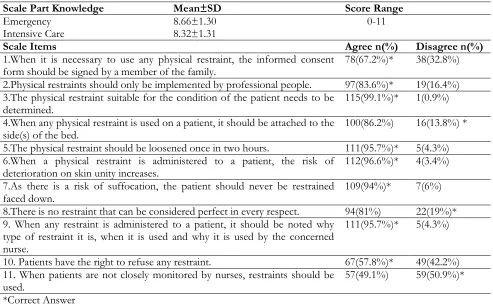
While the total physical restraint use knowledge mean score of the nurses working in the emergency service was found to be 8.66±1.30, it was found to be 8.32±1.31 for the nurses working in the intensive care unit. When the nurses’ knowledge about the use of physical restraint is examined, it is seen that 99.1% of the nurses stated that they agree with the statement “The physical restraint suitable for the condition of the patient needs to be determined”, 95.7% stated that they agree with the statement “When any physical restraint is used, it should be noted what type restraint it is, when it is used and why it is used by the concerned nurse.”, 67.2% stated that they agree with the statement “When any restraint should be used, the informed consent form should be signed by a member of the family.” while 50.9% stated that they disagree with the statement “When patients are not closely monitored by nurses, physical restraints need to be used.” (Table 1).
Table 1: The knowledge of the nurses about the use of physical restraints
Scale Part Knowledge Mean±SD Score Range
Emergency 8.66±1.30 0-11
Intensive Care 8.32±1.31
Scale Items Agree n(%) Disagree n(%)
1.When it is necessary to use any physical restraint, the informed consent
form should be signed by a member of the family. 78(67.2%)* 38(32.8%)
2.Physical restraints should only be implemented by professional people. 97(83.6%)* 19(16.4%) 3.The physical restraint suitable for the condition of the patient needs to be
determined. 115(99.1%)* 1(0.9%)
4.When any physical restraint is used on a patient, it should be attached to the
side(s) of the bed. 100(86.2%) 16(13.8%) *
5.The physical restraint should be loosened once in two hours. 111(95.7%)* 5(4.3%) 6.When a physical restraint is administered to a patient, the risk of
deterioration on skin unity increases. 112(96.6%)* 4(3.4%)
7.As there is a risk of suffocation, the patient should never be restrained
faced down. 109(94%)* 7(6%)
8.There is no restraint that can be considered perfect in every respect. 94(81%) 22(19%)* 9. When any restraint is administered to a patient, it should be noted why
type of restraint it is, when it is used and why it is used by the concerned nurse.
111(95.7%)* 5(4.3%)
10. Patients have the right to refuse any restraint. 67(57.8%)* 49(42.2%) 11. When patients are not closely monitored by nurses, restraints should be
used. 57(49.1%) 59(50.9%)*
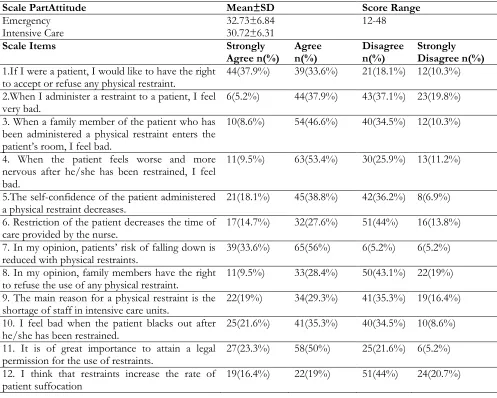
While the total physical restraint use attitude means score of the nurses working in the emergency service was found to be 32.73±6.84, it was found to be 30.72±6.31 for the nurses working in the intensive care unit. When the nurses’ attitudes towards the use of physical restraints are examined, it is seen that 71.5% of the nurses agreed with the statement “If I were a patient, I would like to have the right to accept or refuse any physical restraint.”, 89.6% agreed with the statement “In my opinion, patients’ risk of falling down is reduced with physical restraints.”, 73.3% agreed with the statement “It is of great importance to attain a legal permission for the use of restraints.”, 56.9% agreed with the statements “The self-confidence of the patient administered a physical restraint decreases.” and ”I feel bad when the patient blacks out after he/she has been restrained.”. On the other hand, it was found that 57.8% of the nurses disagreed with the statement “Restriction of the patient decreases the time of care provided by the nurse.”, 62.1% disagreed with the statement “In my opinion, family members have the right to refuse the use of any physical restraint.” and 64.7% disagreed with the statement “I think that restraints increase the rate of patient suffocation.” (Table 2).
Table 2: The attitudes of the nurses towards the use of physical restraints
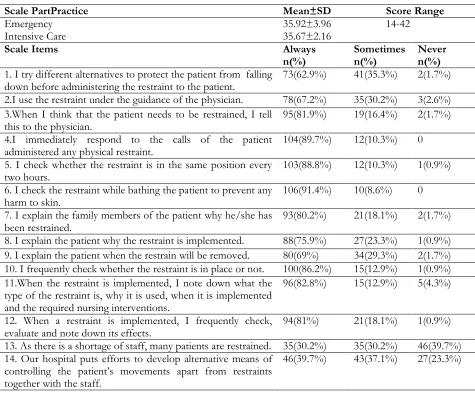
While the total physical restraint practice mean score of the nurses working in the emergency service was found to be 35.92±3.96, it was found to be 35.67±2.16 for the nurses working in the intensive care unit. When the nurses’ practices related to the use of physical restraints are examined, it is seen that while 89.7% of the patients stated that the patients administered any physical restraint respond in a short time, 91.4 stated that they check the restraint while bathing the patient to prevent any harm to skin, 88.8% of them stated that they check whether the restraint is in the same position every two hours, 39.7% of them stated that as there is a shortage of staff, they are forced to impose physical restraints on patients (Table 3).
Scale PartAttitude Mean±SD Score Range
Emergency 32.73±6.84 12-48
Intensive Care 30.72±6.31
Scale Items Strongly
Agree n(%) Agree n(%) Disagree n(%) Strongly Disagree n(%)
1.If I were a patient, I would like to have the right
to accept or refuse any physical restraint. 44(37.9%) 39(33.6%) 21(18.1%) 12(10.3%) 2.When I administer a restraint to a patient, I feel
very bad. 6(5.2%) 44(37.9%) 43(37.1%) 23(19.8%)
3. When a family member of the patient who has been administered a physical restraint enters the patient’s room, I feel bad.
10(8.6%) 54(46.6%) 40(34.5%) 12(10.3%)
4. When the patient feels worse and more nervous after he/she has been restrained, I feel bad.
11(9.5%) 63(53.4%) 30(25.9%) 13(11.2%)
5.The self-confidence of the patient administered
a physical restraint decreases. 21(18.1%) 45(38.8%) 42(36.2%) 8(6.9%) 6. Restriction of the patient decreases the time of
care provided by the nurse. 17(14.7%) 32(27.6%) 51(44%) 16(13.8%)
7. In my opinion, patients’ risk of falling down is
reduced with physical restraints. 39(33.6%) 65(56%) 6(5.2%) 6(5.2%) 8. In my opinion, family members have the right
to refuse the use of any physical restraint. 11(9.5%) 33(28.4%) 50(43.1%) 22(19%) 9. The main reason for a physical restraint is the
shortage of staff in intensive care units. 22(19%) 34(29.3%) 41(35.3%) 19(16.4%) 10. I feel bad when the patient blacks out after
he/she has been restrained. 25(21.6%) 41(35.3%) 40(34.5%) 10(8.6%)
11. It is of great importance to attain a legal
permission for the use of restraints. 27(23.3%) 58(50%) 25(21.6%) 6(5.2%) 12. I think that restraints increase the rate of
Table 3: The practices of the nurses in relation to the use of physical restraints
Scale PartPractice Mean±SD Score Range
Emergency 35.92±3.96 14-42
Intensive Care 35.67±2.16
Scale Items Always
n(%) Sometimes n(%) Never n(%)
1. I try different alternatives to protect the patient from falling
down before administering the restraint to the patient. 73(62.9%) 41(35.3%) 2(1.7%) 2.I use the restraint under the guidance of the physician. 78(67.2%) 35(30.2%) 3(2.6%) 3.When I think that the patient needs to be restrained, I tell
this to the physician. 95(81.9%) 19(16.4%) 2(1.7%)
4.I immediately respond to the calls of the patient
administered any physical restraint. 104(89.7%) 12(10.3%) 0
5. I check whether the restraint is in the same position every
two hours. 103(88.8%) 12(10.3%) 1(0.9%)
6. I check the restraint while bathing the patient to prevent any
harm to skin. 106(91.4%) 10(8.6%) 0
7. I explain the family members of the patient why he/she has
been restrained. 93(80.2%) 21(18.1%) 2(1.7%)
8. I explain the patient why the restraint is implemented. 88(75.9%) 27(23.3%) 1(0.9%) 9. I explain the patient when the restrain will be removed. 80(69%) 34(29.3%) 2(1.7%) 10. I frequently check whether the restraint is in place or not. 100(86.2%) 15(12.9%) 1(0.9%) 11.When the restraint is implemented, I note down what the
type of the restraint is, why it is used, when it is implemented and the required nursing interventions.
96(82.8%) 15(12.9%) 5(4.3%)
12. When a restraint is implemented, I frequently check,
evaluate and note down its effects. 94(81%) 21(18.1%) 1(0.9%)
13. As there is a shortage of staff, many patients are restrained. 35(30.2%) 35(30.2%) 46(39.7%) 14. Our hospital puts efforts to develop alternative means of
controlling the patient’s movements apart from restraints together with the staff.
46(39.7%) 43(37.1%) 27(23.3%)
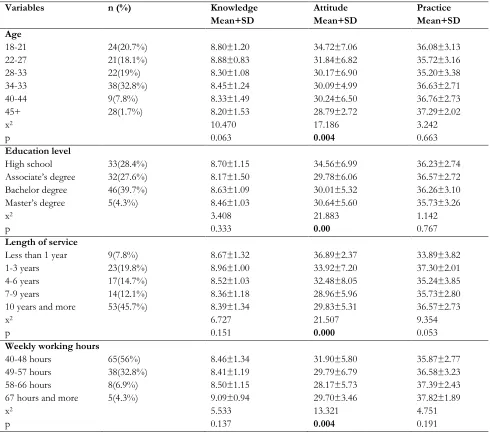
Table 4: Comparison of the nurses’ knowledge, attitudes and practices in relation to the use of physical restraints on the basis of their demographic features
Variables n (%) Knowledge
Mean+SD
Attitude Mean+SD
Practice Mean+SD Age
18-21 24(20.7%) 8.80±1.20 34.72±7.06 36.08±3.13
22-27 21(18.1%) 8.88±0.83 31.84±6.82 35.72±3.16
28-33 22(19%) 8.30±1.08 30.17±6.90 35.20±3.38
34-33 38(32.8%) 8.45±1.24 30.09±4.99 36.63±2.71
40-44 9(7.8%) 8.33±1.49 30.24±6.50 36.76±2.73
45+ 28(1.7%) 8.20±1.53 28.79±2.72 37.29±2.02
x2 10.470 17.186 3.242
p 0.063 0.004 0.663
Education level
High school 33(28.4%) 8.70±1.15 34.56±6.99 36.23±2.74
Associate’s degree 32(27.6%) 8.17±1.50 29.78±6.06 36.57±2.72
Bachelor degree 46(39.7%) 8.63±1.09 30.01±5.32 36.26±3.10
Master’s degree 5(4.3%) 8.46±1.03 30.64±5.60 35.73±3.26
x2 3.408 21.883 1.142
p 0.333 0.00 0.767
Length of service
Less than 1 year 9(7.8%) 8.67±1.32 36.89±2.37 33.89±3.82
1-3 years 23(19.8%) 8.96±1.00 33.92±7.20 37.30±2.01
4-6 years 17(14.7%) 8.52±1.03 32.48±8.05 35.24±3.85
7-9 years 14(12.1%) 8.36±1.18 28.96±5.96 35.73±2.80
10 years and more 53(45.7%) 8.39±1.34 29.83±5.31 36.57±2.73
x2 6.727 21.507 9.354
p 0.151 0.000 0.053
Weekly working hours
40-48 hours 65(56%) 8.46±1.34 31.90±5.80 35.87±2.77
49-57 hours 38(32.8%) 8.41±1.19 29.79±6.79 36.58±3.23
58-66 hours 8(6.9%) 8.50±1.15 28.17±5.73 37.39±2.43
67 hours and more 5(4.3%) 9.09±0.94 29.70±3.46 37.82±1.89
x2 5.533 13.321 4.751
p 0.137 0.004 0.191
x2, Kruskal Wallis Test – Z, Mann Whitney U
4. Discussion
In the literature, in general it seems that nurses have positive attitudes towards the use of physical restraints.[3,6,16] In the current study the physical restraint use attitude mean score was found to be 32.73±6.84 for the nurses working in the emergency service while it was found to be 30.72±6.31 for the nurses working in the intensive care unit; thus in general it can be argued that the nurses have positive attitudes. When the nurses’ responses to the related scale items were examined, it was found that they disagree with the statements “The use of physical restraint decreases the rate of the patient’s falling down and the time allocated to the care of the patient by the nurse.”, “I feel bad when the patient blacks out after the administration of a physical restraint.” and “The physical restraint increases the rate of the patient’s suffocation.” Thus, it can be concluded that the nurses have some dilemmas related to the use of physical constraints.
In the current study, the physical restraint practice mean score was found to be 35.92±3.96 for the nurses working in the emergency service while it was found to be 35.67±2.16 for the nurses working in the intensive care unit. The similar mean scores were found by Gürdoğan et al., [2016] (36.8±3.7), [21] and by Suen [1999](37.0±3.4)[16]. Mion [2008] reported that age, education level and experience are influential on the decisions made by nurses in relation to the use of physical restraints.[9]Chuang and Huang [2007] conducted a qualitative study and found that many nurses have negative feelings against physical restraints, that some of these nurses feel trapped between the autonomy of patients and physical restraint administrations. On the other hand, they also found that some other nurses “do not feel anything” or experience the “sense of security” when physical restraints are administered.[22]In the literature, it is stated that though physical restraints are widely used to prevent the patient from falling off the bed,[1,16,23] Shorr et al., (2002), [24] found that in the prevention of falls in hospitalized patients, physical restraints are not useful. In the current study, the attitude scores related to the use of physical restraints were found to be more positive among the nurses who are 18-21 years old, who are high school graduates and whose length of service is less than one year. In the hospital where the current study was conducted, high majority of the nurses working less than one year were found to be high school graduates and continuing their undergraduate education. Thus, it can be argued that the nurses continuing their education have more positive attitudes. In the current study, it was also found that nearly half of the participation nurses work 40-48 hours a week and that they have more positive attitudes towards the use of physical restraints. Thus, it can be argued that the weekly working hours affect the nurses’ attitudes towards the use of physical restraints.
5. Conclusions
As the physical restraint use attitude scores of the nurses working for less than one year, having fewer weekly working hours and continuing their undergraduate education were found to be higher in the current study, it can be suggested that nurses should be informed about up-to-date developments through in-service trainings to improve the quality of care services and to repeat these trainings at regular intervals. Moreover, the findings of the current study can contribute to filling in the knowledge gaps in nurses, development of the protocols for the use of physical constraints and creation of supportive environments by nurse administrators. In-service training programs should be organized in such a way as to include the use of physical restraints, ethical issues and ways of dealing with emotions emerging while using physical restraints.
Conflict of Interest
No conflict of interest has been declared by the authors.
Acknowledgements
We thank nurses who participated in the present study.
6. References
Tel, H.,&Tel, H. (2002). Application of physical retrain and nursing approach in patient safety-II. Journal of Intensive Care Nursing, 6(2), 69-74.
Eşer, İ., &Hakverdioğlu G. (2006). Decision making on physical retrain. Journal Cumhuriyet University School of Nursing, 10(1), 37-42.
Kaya, H., Aştı, T., Acaroğlu, R., Erol, S., &Savcı, C. (2008). The knowledge, attitude and practices of the nurses. Maltepe University J Nursing Science and Art, 1(2), 21-29.
Cotter, V.T. (2005). Restraint free care in older adults with dementia.The Keio Journal Medicine, 54(2), 80-84.
Çelik, S., Kavrazlı, S., Demircan, E., Güven, N., Durmuş, Ö., &Duran, S. (2012). Information, attitudes and practices of intensive care nurses on the use of physical restrain. Acıbadem University Journal of Health Sciences, 3(3), 176-183.
Ministry of Health Performance Management Quality Improvement Department. (2011). Hospital Service Quality Standards, Ankara: Pozitif Matbaa Ltd. Sti., p.104.
Karagözoğlu, Ş., &Özden, D. (2013). Information and practices of physical restrictions of nurses working in a university hospital. Journal of Research and Development in Nursing,15(1), 11-22.
Mion, L.C. (2008). Physical restraint in critical care settings: will they go away? Geriatric Nursing, 29, 421-23.
Kahraman, B.B., Aşiret, G.D., Yıldırım, G., Akyar, İ., Aytekin, G.K., &Öz, A. (2015). Opinions of Family Caregivers on the Use of Physical Restraints in Intensive Care Unit. Turkish J Medical & Surgical Intensive Care Medicine, 6(3), 78-83.
Bray K, Hill K, Robson W, Leaver G, Walker N, O’Leary M, Delaney, T., Walsh, D & Gager,M.(2004). British Association of Critical Care Nurses position statement on the use of restraint in adult critical care units. Nursing Critical Care, 9, 199-212.
Maccioli, G.A., Dorman, T., Brown, B.R., Mazuski, J.E., McLean, B.A., Kuszaj JM, Stanley, R.H., Lorry, F.R., John, D.W. Joseph, G.A.. Brian, S., & William,P. (2003). Clinical practice guidelines for the maintenance of patient physical safety in the intensive care unit: use of restraining therapies. American College of Critical Care Medicine Task Force 2001-2002. Critical Care Medicine, 31, 2665-76.
Benbenbishtya, J., Adamb, S., &Endacott, R. (2010). Physical restraint use in intensive care units across Europe: The PRICE study. Intensive and Critical Care Nursing, 26, 241-245.
Micek, S.T., Anand, N.J., Laible, B.R., Shana, W.D.,& Kollef, M.H. (2005).Delirium as detected by the CAM-ICU predicts restraint use among mechanically ventilated medical patients. Critical Care Medicine, 33(6), 1260-1265.
Mion, L.C., Minnick, A.F., Leipzig, R.M., Catrambone, C.D.,& Johnson, M.E. (2007). Patient-initiated device removal in intensive care units: a national prevalence study. Critical Care Medicine, 35, 2714-2720.
Suen, L.K.P. (1999). Knowledge, attitude and practice of nursing home staff towards physical restraints in Hong Kong nursing homes. Asian Journal of Nursing Studies, 5(2), 73-86.
Janelli, L.M., Scherer, Y.K., &Kuhn, M.M.(1994). Acute/Critical care nurses' knowledge of physical restraints: Implications for staff development. Journal of Nursing Staff Development, 10(1), 6-11.
Çimen, M. (2015). SPSS applied data analysis in science and health sciences. Palme Publishing, Publication Number: 905, ISBN: 978-605-355-366-3. Sıhhiye, Ankara.
19. Turgay, A.S., Sarı, D., &Genç, R.E. (2009). Physical restraint use in Turkish intensive care units. Clinical Nurse Specialist, 23(2), 68-72.
Zencirci, A.D. (2009). Attitudes, informed consent obtaining rates and feelings about physical restraint use among nurses. Türkiye Klinikleri Journal of Medical Science, 29(6), 1573-1581.
Gürdoğan, E.P., Uğur, E., Kınıcı, E., &Aksoy, B.(2016). Information, attitudes and practices of the intensive care nurses on the use of physical detection and factors affecting them. Turk Intensive Care Journal, 7(3), 83-88. Chuang, Y.H., &Huang, H.T. (2007). Nurses’ feelings and thoughts about using physical restraints on hospitalized
older patients. Journal of clinical nursing, 16(3), 486-494.
Hakverdioğlu, G., Demir, A., &Ulusoy, M.F. (2006). Evaluation of the information about the physical restriction of intensive care nurses. Türkiye Klinikleri Journal of Medical Science, 26, 634-641.