http://www.ijcmph.com pISSN 2394-6032 | eISSN 2394-6040
Original Research Article
Factors influencing gender preference for child among married women
attending ante-natal clinic in a tertiary care hospital in Delhi:
a cross sectional study
Vinoth Gnana Chellaiyan
1*, Mrinmoy Adhikary
2, Timiresh Kumar Das
3,
Neha Taneja
4, Shailaja Daral
3INTRODUCTION
The earliest evidence for male child preference and female infanticide in India was provided by Sir Jonathan Duncan in 1789.1 With the availability of new technology which can determine sex of fetus in utero, the
discrimination against females has been extended to womb as well. The male child is considered someone who will be a breadwinner, support of parents in old age, bearer of family name, heir of family legacy, and performer of last rites. The girl child, on the other hand, is a burden because dowry has to be given during her
ABSTRACT
Background: Gender discrimination is the unfair denial of opportunities and violation of their rights. Despite of discrimination laws and regulations, women are subjected to unequal treatment in all the phases of their life in India. The present study was conducted among antenatal women to determine their preference, if any, for male child and their awareness regarding technology and legality for sex determination of fetus in a tertiary care hospital.
Methods: The study was a cross sectional study conducted among pregnant women aged 18 years and above attending antenatal clinic at Vardhman Mahavir Medical College and Safdarjung Hospital, New Delhi from June 2015- May 2016. Systematic random sampling method was used to include 238 study participants. A pre-tested, semi-structured, and self-administered questionnaire was used. Data was analyzed using SPSS v.21.0. Chi-square test was applied to test significance of difference (p˂0.05).
Results: Among 238 study participants, mean age of study participants was 29 (±3.5) years. About 107 (45.0%) pregnant women had no gender preference. 88 (37%) preferred male child, the major reasons quoted for male child preference were pressure from family 29 (32.95%) and social responsibilities carried by male 25 (28.40%). Only 43 (18.0%) women preferred a female child. 187 (78.57%) study participants, were aware regarding sex determination and 72 (30.25%) said private hospital preferred place for sex determination. 36.56% women had knowledge about the legal implications associated with sex determination.
Conclusions: The present study showed the high existence of male preference in our society which is a common barrier in achieving reduced national fertility levels. So, there is every need to bring about changes in social, economic, and political structure in order to reduce gender inequality in India.
Keywords: Awareness, Gender discrimination, Sex determination, PNDT act, Women empowerment
Department of Community Medicine, 1Chettinad Hospital and Research Institute, Kelambakkam, Chennai, Tamil Nadu, 2Murshidabad Medical College and Hospital, West Bengal, 3VMMC and Safdarjung Hospital, New Delhi, 4St. Stephens Hospital, Tis hazari, Delhi, India
Received: 19 February 2018
Revised: 09 March 2018
Accepted: 10 March 2018
*Correspondence:
Dr. Vinoth Gnana Chellaiyan, E-mail: [email protected]
Copyright: © the author(s), publisher and licensee Medip Academy. This is an open-access article distributed under the terms of the Creative Commons Attribution Non-Commercial License, which permits unrestricted non-commercial use, distribution, and reproduction in any medium, provided the original work is properly cited.
marriage. These factors have led the society to ascribe a higher position to the male child than the female child and made the evil practice of female feticide common even in middle and higher socioeconomic households. On the basis of census 2001, the United Nations Children fund stated that systemic gender discrimination has resulted in up to 50 million girl and women “going missing” from India’s population.2
Sex ratio is an important social indicator of the extent of prevailing equity between males and females in society. A declining sex ratio highlights the poor socio-economic, cultural, and politico-legal framework in the society. It indicates male child preference, low status of women, prevalence of dowry, illegal sex determination of fetus in-utero, and illegal abortions. The sex ratio in India declined from 927 females per 1000 males in 2001 to 914 females per 1000 males in 2011, with more than 80% districts reporting decline and only 20% showing improvement.3
The sex ratio in Delhi, 868 females per 1000 males, is among the worst in the country. We decided to conduct a study among antenatal women in Delhi to determine their preference, if any, for male child and their awareness regarding technology and legality for sex determination of fetus.
METHODS
A cross-sectional study was conducted among pregnant women attending ante-natal clinic at Vardhman Mahavir Medical College and Safdarjung Hospital, New Delhi. All women aged 18 years or more, with USG-confirmed intra-uterine pregnancy and who were not in labor/ not admit in labor ward were eligible for the study. The sample size was calculated taking the prevalence of male child preference in pregnant women as 52%, absolute error 7%, alpha error 5%, power of study 80%, and no-response rate 10%, and came out to be 238. Systematic random sampling technique was used and every fifth newly registered ante-natal woman was selected for the purpose of the study. The study was conducted from June 2015 – May 2016.
A pre-tested, semi-structured, and self-administered questionnaire in the locally-spoken Hindi language was used for data collection. It included questions on socio-demographic profile of study participants, gender preference for child, factors determining gender preference for child, knowledge about methods for sex determination of fetus, and legal implications of determining sex of fetus. It took about 12-15 minutes for the study participant to answer the questionnaire. The questionnaire was pre-tested among 20 pregnant women attending ante-natal clinic at PHC Fathepur Beri, an outreach health centre affiliated to Department of Community Medicine, Vardhman Mahavir Medical College and Safdarjung Hospital, New Delhi. Written
informed consent was taken from each study participant before inclusion in the study.
Ethical approval for the study was taken from the Institution Ethics Committee. All personal identification information was kept confidential and used for academic purposes alone. The data was analyzed using licensed version of SPSS version 21. Univariate data is expressed as mean and proportions. Bivariate analysis was done using Chi-square test.
RESULTS
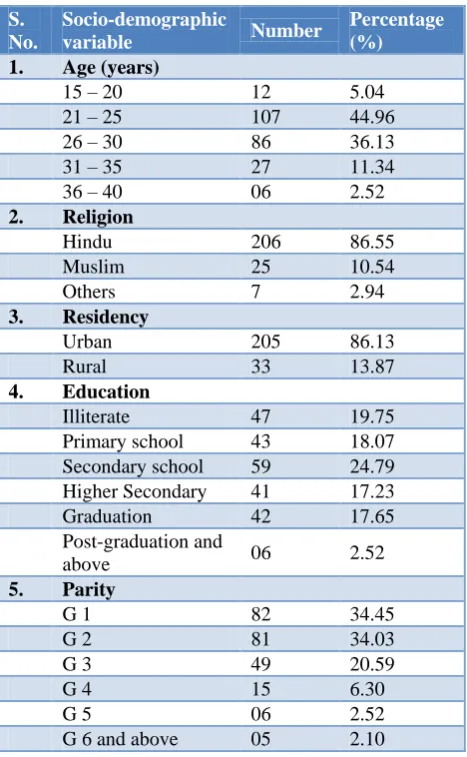
The total sample studied was 238. The mean (±SD) age of the study participants was 29 (±3.5) years (range from 15 to 40 years). Out of the 238 sample studied, 33 (13.86%) belonged to the rural area and 205 (86.13%) belonged to the urban area. A majority 191 (80.25%) were literate followed by 47 (19.75%) who were illiterate. Among the study participants, 82 (34.45%) were primigravida and 156 (65.55%) were multigravida. 206 (86.13%) Hindu, 25 (10.50%) Muslim and 7 (2.88%) were from other religion (Table 1).
Table 1: Socio demographic variables of the study participants (n=238).
S. No.
Socio-demographic
variable Number
Percentage (%)
1. Age (years)
15 – 20 12 5.04 21 – 25 107 44.96 26 – 30 86 36.13 31 – 35 27 11.34 36 – 40 06 2.52
2. Religion
Hindu 206 86.55 Muslim 25 10.54
Others 7 2.94
3. Residency
Urban 205 86.13
Rural 33 13.87
4. Education
Illiterate 47 19.75 Primary school 43 18.07 Secondary school 59 24.79 Higher Secondary 41 17.23 Graduation 42 17.65 Post-graduation and
above 06 2.52
5. Parity
G 1 82 34.45
G 2 81 34.03
G 3 49 20.59
G 4 15 6.30
G 5 06 2.52
Table 2: Factors influencing to prefer male child (n=88).
Contributing factors Frequency %
Pressure from the family 29 32.95
Social responsibilities carried
out by male 25 28.40
Propagation of family name 16 18.18
Dependability in old age 9 10.23
Perform cremation 5 5.69
Dowry 4 4.55
Table 3: Factors influencing to prefer female child (n=43).
Contributing factors Frequency %
Already have male child 16 37.22
More responsible 6 13.95
Girls bring good luck 4 9.30
Did not mention any reason 17 39.53
Table 4: Awareness of study participants regarding sex determination (n=238).
S.
no. Variables Number %
1. Awareness regarding sex determination tests
Aware 187 78.57
Not aware 51 21.43
2. Place where sex determination can be done Private hospital 72 30.25 Public hospital 08 03.36
Both 14 05.88
Not aware 144 60.50
3. Method of sex determination
Ultrasonogram 126 52.94 Other methods 2 0.84 Not aware 110 46.22
4. Fetal sex determination is a criminal act
Aware 124 52.10
Not aware 114 47.90
5. Existence of PNDT act
Aware 5 02.10
Not aware 233 97.90
6. Punishment given to parents for violation
Fine 25 10.50
Jail 39 16.39
Both 23 09.66
Not aware 151 63.45
7. Punishment given to doctor for violation
Cancellation of registration 34 14.29
Fine 10 04.20
Jail 25 10.50
More than one 48 19.17 Not aware 121 50.84
Out of 238 women studied, about half 107 (45.0%) of the pregnant women did not show any gender preference, followed by male preference 88 (37%) and female preference 43 (18.0%). Among the 88 women who preferred male child, the reasons told were pressure from family 29 (32.95%), social responsibilities are carried out by males 25 (28.40%), for propagation of family name 16 (18.18%), dependable in the old age 9 (10.23%), to perform cremation rituals 5 (5.69%) and dowry 4 (4.55%) (Table 2).
Among the 43 women who preferred a female child, 16 (37.22%) told that they already have male children and now desiring female child. Other reasons cited were girls bring good luck to family 4 (9.30%), girls will be more responsible 6 (13.95%) and 17 (39.53%) women did not give any reason for their preference (Table 3).
Among the study participants, 187 (78.57%) were aware regarding sex determination. Enquiring about the facility for sex determination, 72 (30.25%) mentioned private hospital, 8 (03.36%) mentioned Govt. and 14 (05.88%) mentioned both and 144 (60.05%) were not aware of the place of sex determination. About the method, 126 (52.94%) mentioned ultrasonogram, 2 (0.84%) mentioned others. 124 (52.10%) women were aware that fetal sex determination is a criminal act as per Indian constitutional law but only 5 (02.10%) knew prenatal diagnostic test act (Table 4).
DISCUSSION
Parents preference for sons is still very common in India and is one of the most common barrier in achieving reduced national fertility levels. People in India exhibit a strong gender preference for male child and this discrimination or prejudice continues in spite of socioeconomic development and higher growth rates.4,5
Dey et al found son preference to be 39.2%.6 Also, in the study conducted at Surat by Thakkar et al, 22.2% women expressed their desire for a male child and 14.4% for a female child.7 Karmali et al in a study from Goa showed that 23.1% women had a male child preference.8 In a study from Agartala 40.8% had son preference and 29.7% preferred daughter.9 These findings corroborated with our study where37% pregnant women had preference for a male child and 18% had a female child preference. This could be due to two child norm imposed by government of India. One male and one female child are preferred as the family is considered complete.
But Puri et al and Vadera et al found higher son preferences, 57.8% and 58.5% respectively also in a study from South India male and female child preference was reported by 55.7% and 44.3% of the mothers respectively.10-12
Africa.13 There are various reasons cited for the disparity among gender preference. Sons are preferred because they have a higher wage-earning capacity, they continue the family line and they usually take responsibility for care of parents in illness and old age.14 Deep rooted Confucian values and patriarchal family systems are reasons for son preference in South Korea and China.15
There are specific local reasons responsible for male child preference in India. The major reasons in the present study were pressure from family (32.95%), social responsibilities are carried out by males (28.40%), for propagation of family name (18.18%), dependable in the old age (10.23%), to perform cremation (5.69%) and dowry (4.55%). This was similar with the report of Registrar General and Census Commissioner of India, 2003.16
Vadera et al also reported similar findings such as social responsibilities are carried out by males (42.5%), for propagation of family name (23%), dependable in the old age (16%), pressure from family (11%) and for more than one reason (10%).11 In another study from Agartala reasons for son preference were better security in old age 39.1%: generation continuation 31.1%: status symbol 18.8% and better earning 11.1%. Reasons for daughter preference were daughters are more trustworthy 55.1%, daughters help in household work 19.67%, daughters are lax of family 15% and non-specific reasons 10.23%.9
Inclination towards a child of specific sex during pregnancy is not a rarity.5 Higher interest in fetal sex determination in antenatal women reflect the strong bias toward a particular gender. The present study showed that 39.50% subjects had knowledge where sex determination can be done and 52.10% agreed to the fact that it is a crime. Knowledge about the legal punishment and penalty for sex determination was seen in 36.56% women as compared to a study by Puri et al which showed only 11.66% of married women had knowledge where sex determination can be done and 65.5% agreed to the fact that it is a Crime.10 In another study by Nitin et al it was seen the 91.7% married women knew that prenatal sex determination was possible and 74.4% women knew that it was a punishable offense. 67.4% were willing to educate people about PCPNDT act. 90% women knew that ultrasonography was the technique used for sex determination.12 This is contrary to this study where 52.94% women knew USG as a method of sex determination. Studies conducted at Mumbai, Maharashtra and Uttar Pradesh have shown that 73.5% and 80% of the women respectively had an updated information regarding possibility of prenatal sex determination.17,18
Globally, 36 countries have adopted national laws or policies on sex selection.19 In India, to tackle the problem of sex determination and sex selection PNDT Act was introduced in 1994 which was amended later in 2004 as PCPNDT Act. In spite of improvement in literacy rate
Child Sex ratio has declined in the country from 927 in 2001 to 914 in 2011,emphasizing on the fact that society is still groped with the issues of female foeticide and female infanticide as is evident from many studies.3,14 A skewed child sex ratio indicates that in future the number of females per 1000 males will be even less which is detrimental to society and country as whole.
It requires a multifaceted approach to address the issue of son preference in order to benefit the next generation. Evidence from areas outside Asia strongly supports the notion that higher status for women leads to less-traditional gender attitudes and lower levels of son preference.20 An integrated approach by government and NGOs is desired. Strict enforcement of PCPNDT act and guaranteeing equal rights for women in education, work, culture politics, property rights and marriage together with socio economic developments and modernization will lead to improvements in women status and gradually change biased gender attitude.
The deep roots of discrimination against women and male domination can be attributed to a social system known as Patriarchy. Girls are considered more of an economic liability as expensive dowry is required at the time of marriage which leads to resentment towards a daughter. Govt. of India has done substantial work throwing considerable light on subjects of girl child through implementation of various programs to restore the rights and dignities of girl child, giving her a world where she can live, live and dream and enrich our lives. However it will take several decades and efforts to tackle with the problem of gender discrimination and bring child sex ratio within normal limits.
CONCLUSION
The present study shows a clear picture of factors affecting the present sex ratio. The existence of son preference at an alarmingly high rate in our society is the root cause of imbalanced sex ratio. Socio-demographic factors do play a role.
Limitations
Because of time constraints, small sample size was achieved. Since the study was sensitive, patient was reluctant to answer and lastly everyone could not be taken into isolation due to accompanying relatives and high patient load of the OPD.
Funding: No funding sources Conflict of interest: None declared
Ethical approval: The study was approved by the Institutional Ethics Committee
REFERENCES
2. Female foeticide in India. C2007. Available from http://www.unicef.org/india/media_3285.htm. Accessed on 25 November 2017.
3. Census Figures of 2001. Office of the Registrar General and Census Commissioner, New Delhi, India.
4. Bharadwaj P, Nelson LK. Discrimination begins in the womb: Evidence of sex-selective prenatal investments. Available at: http://dss.ucsd.edu/∼ prbharadwaj/index/Papers_files/Bharadwaj_Nelson_ Oct24_2010.pdf. Accessed on 25 November 2017. 5. Dasgupta S. Son Preference and Gender Gaps in
Child Nutrition: Does the Level of Female Autonomy Matter? Available at: http://i.pacdev.ucdavis.edu/files/conferenceschedule /session/papers/Dasgupta_SonPrefAutonomyAbstra ct.pdf. Accessed on 24 January 2018.
6. Dey I, Chaudhuri RN. Gender Preference and its Implications on Reproductive Behavior of Mothers in a Rural Area of West Bengal. Indian J Community Med. 2009;34(1):65-7.
7. Dhwanee T, Hiral V, Nawal S, Bansal RK, Dhara S, Shashank S. Male child preference for the first child decreasing among women in Surat city. National J Comm Med. 2011;2(1):163-5.
8. Karmali DB, Pednekar G, Valaulikar R, Kamat US. A descriptive study of gender preference and its relation to willingness for sterilization in pregnant women in a tertiary hospital in Goa. Int J Reprod Contracept Obstet Gynecol. 2016;5:886-9.
9. Bhattacharjya H, Das S, Mog C. Gender preference and factors affecting gender preference of mothers attending Antenatal Clinic of Agartala Government Medical College. Int J Med Sci Public Health. 2014;3:137-9.
10. Puri S, Bhatia V, Swami HM. Gender preference and awareness regarding sex determination among married women in slums of Chandigarh. Indian J Community Med. 2007;32:60-2.
11. Vadera BN, Joshi UK, Unadakat SV, Yadav BS, Yadav S. Study on knowledge, attitude and practices regarding gender preference and female feticide among pregnant women. Indian J Community Med. 2007;32:300-1.
12. Nithin K, Tanuj K, Unnikrishnan B, Rekha T, Prasanna M, Vaman K, et al. Gender preferences
among antenatal women: a cross-sectional study from coastal South India. Afr Health Sci. 2015;15(2):560-7.
13. Hesketh T, Lu L, Xing ZW. The consequences of son preference and sex-selective abortion in China and other Asian countries. CMAJ. 2011;183(12):1374-7.
14. Hesketh T, Zhu WX. Abnormal sex ratios in human populations: causes and consequences. Proc Natl Acad Sci U S A. 2006;103:13271-5.
15. Das Gupta M, Zhenghua J, Bohua L, Zhenmeng X, Chung W, Hwa-Ok B. Why is son preference so per- sistent in East and South Asia? A cross-country study of China, India and the Republic of Korea. J Dev Stud. 2003;40:153-87.
16. UNFPA. Office of the Registrar General and Census Commissioner. Ministry of Health and Family Welfare. Government of India Missing: mapping the adverse child sex ratio in India. UN Population Fund, Office of the Registrar General and Census Commissioner, and Ministry of Health and Family Welfare, Government of India; New Delhi: 2003. 2005.
17. Fuse K. Variations in attitudinal gender preferences for children across 50 less-developed countries. Demographic Res. 2010;23(36):1031–48.
18. Chhetri UD, Ansari I, Bandary S, Adhikari N. Sex preferences among mothers delivering at Patan Hospital. Kathmandu Univ Med J. 2011;9(36):229– 32.
19. Işeri E, Gürhan N, Ozbaş AA, Sari BA. Preferences for sex of firstborn child among primiparous Turkish women. Psychol Rep. 2012;111(1):165–72. 20. Bolezendahl C, Myers D. Feminist attitudes and
support for gender equality: opinion change in women and men, 1974–1998. Soc Forces. 2004;83:759–90.