PARENTAL BACKGROUND AND ITS INFLUENCE ON STUDENTS’ CAREER ASPIRATIONS IN
KUMBA I SUB-DIVISION OF THE SOUTH WEST REGION OF CAMEROON
Roland K. BAMA
1Faculty of Education, University of Bamenda, Cameroon
A R T I C L E I N F O
INTRODUCTION
Career counselling is designed to help individuals with choosing, changing, or leaving a career and is available at any stage in life. One’s career is often one of the
aspects of adulthood and embarking on a new career whether for the first time, the second time, or any time thereafter, can be a stressful event, especially when economic difficulties abound. Career counselling helps in the process of outlin and discussing one’s potential career options. Choosing a career is an important task, but it may also be a herculean one, it may not be easy to decide what type of job would be the best fit when some factors come to play a significant role by influencing career aspiration such as interest, skills,
psychological, economic, social and parental factors. This paper focuses on the incidence of parental factors on adolescent career aspirations.
The mean of career counselling changed over the last 20thcentury, depending on the social and economic context, and in 1922, the distribution of youth between businesses and occupations was as judicious as possible. In 1943, under occupation, the definition given by the management of the vocational counselling centre dealt with three aspects, the distribution of juvenile labour, the production and development of the individual, then in 1968, the same organism distanced itself from this definition and indicated
that the purpose of vocational counselling was to place the child when the time came for him to decide on
International Journal of Current Advanced Research
ISSN: O: 2319-6475, ISSN: P: 2319-6505,
Available Online at www.journalijcar.org
Volume 8; Issue 12 (B); December 2019
DOI: http://dx.doi.org/10.24327/ijcar.2019
Copyright©2019 Roland K. BAMA and Marie Barbar
Attribution License, which permits unrestricted use, distribution, and reproduction in any medium, provided the original work Article History:
Received 6th September, 2019 Received in revised form 15th October, 2019
Accepted 12th November, 2019 Published online 28th December, 2019
Key words:
Career aspirations, Parental background, parental career, parental economic status, parental level of education.
*Corresponding author: Roland K. BAMA
Faculty of Education, University of Bamenda, Cameroon
PARENTAL BACKGROUND AND ITS INFLUENCE ON STUDENTS’ CAREER ASPIRATIONS IN
DIVISION OF THE SOUTH WEST REGION OF CAMEROON
Roland K. BAMA
1and Marie Barbare NNANGA
2Faculty of Education, University of Bamenda, Cameroon 2University of Buea
A B S T R A C T
This study investigated parental background and its influence on students’ career aspiration in Kumba I Sub-Division of the South West Region of Cameroon.The cross sectional survey design was used for the study. The sample comprised 80 upper sixth secondar school students. The simple random sampling and purposive sampling techniques were used to determine the sample. A five-point Likert scale type questionnaire was used for data collection. Data were analysed using differential and inferential statistics.
findings revealed that parental career, parental economic status, and parents’ level of education significantly influenced students’ carer aspiration. It was thus recommended that parents should give kids the possibility to choose their careers, t
increasingly assist parents in providing career related modelling for kids, and parents should improve on their educational level because it significantly impacted the career aspiration of their kids.
Career counselling is designed to help individuals with choosing, changing, or leaving a career and is available at any stage in life. One’s career is often one of the most important aspects of adulthood and embarking on a new career whether for the first time, the second time, or any time thereafter, can be a stressful event, especially when economic difficulties in the process of outlining and discussing one’s potential career options. Choosing a career is an important task, but it may also be a herculean one, it may not be easy to decide what type of job would be the best fit when some factors come to play a significant role by ing career aspiration such as interest, skills, cultural, psychological, economic, social and parental factors. This paper focuses on the incidence of parental factors on
The mean of career counselling changed over the last century, depending on the social and economic context, and in 1922, the distribution of youth between businesses and occupations was as judicious as possible. In 1943, under occupation, the definition given by the management of the ng centre dealt with three aspects, the distribution of juvenile labour, the production and development of the individual, then in 1968, the same organism distanced itself from this definition and indicated
that the purpose of vocational counselling was to place the child when the time came for him to decide on the choice of a
career. The history of educational and career counselling in France has not yet been written.
psychological, social and economic determinants of the orientation of school youth has been increasing everywhere for more than 20 years (Danvers, 1988). Practitioners since the beginning have been interested in the evolution of businesses and the role of professional representation of students in determining their future. However, career counselling appeared in France and other cou
the World War I (Danvers, 1988).
Student career aspirations are a crucial investigative subject for understanding the educational and professional trajectories of individuals. Career aspirations underlie the educational choice made by students and indication of their future professional status. However, studies have shown that parental background influences career aspirations. Parents are an important source of influence for the young person when it comes to thinking about their future and choosing their career (Schulenberg, Vondracek & Crouter, 1984). For this purpose, we can evaluate the negative or positive influence of parenting on students’ career choice. Here, it is necessary to understand the career aspiration of an individual and personal choice, and to help him/her choose according to external criteria concerning future, and then determine his/herowncriteria. The professional world is not free from prejudices against many professions or career, some parents may convey t
about certain professions, and this could encourage their child to exclude certain career opportunities that could very well suit him/her.
International Journal of Current Advanced Research
6505, Impact Factor: 6.614
www.journalijcar.org
2019; Page No. 20652-20661
//dx.doi.org/10.24327/ijcar.2019. 20661.4044
and Marie Barbare NNANGA. This is an open access article distributed under the Creative Commons Attribution License, which permits unrestricted use, distribution, and reproduction in any medium, provided the original work
Faculty of Education, University of Bamenda, Cameroon
PARENTAL BACKGROUND AND ITS INFLUENCE ON STUDENTS’ CAREER ASPIRATIONS IN
DIVISION OF THE SOUTH WEST REGION OF CAMEROON
This study investigated parental background and its influence on students’ career aspiration Division of the South West Region of Cameroon.The cross sectional survey design was used for the study. The sample comprised 80 upper sixth secondary school students. The simple random sampling and purposive sampling techniques were point Likert scale type questionnaire was used for data collection. Data were analysed using differential and inferential statistics. The main findings revealed that parental career, parental economic status, and parents’ level of education significantly influenced students’ carer aspiration. It was thus recommended that parents should give kids the possibility to choose their careers, the school counsellor should increasingly assist parents in providing career related modelling for kids, and parents should improve on their educational level because it significantly impacted the career
The history of educational and career counselling in has not yet been written. Research on the psychological, social and economic determinants of the orientation of school youth has been increasing everywhere for 0 years (Danvers, 1988). Practitioners since the beginning have been interested in the evolution of businesses and the role of professional representation of students in determining their future. However, career counselling appeared in France and other countries immediately following the World War I (Danvers, 1988).
Student career aspirations are a crucial investigative subject for understanding the educational and professional trajectories of individuals. Career aspirations underlie the educational choices made by students and indication of their future professional studies have shown that parental background influences career aspirations. Parents are an important source of influence for the young person when it comes to thinking ir future and choosing their career (Schulenberg, Crouter, 1984). For this purpose, we can evaluate the negative or positive influence of parenting on students’ career choice. Here, it is necessary to understand the vidual and personal choice, and to help him/her choose according to external criteria concerning future, and then determine his/herowncriteria. The professional world is not free from prejudices against many professions or career, some parents may convey their preconceived ideas about certain professions, and this could encourage their child to exclude certain career opportunities that could very well suit
Research Article
Career guidance and counselling in the western world, most notably in the United States (USA), has developed a comprehensive system of theories and intervention strategies in its more than 100 years history. It began in the years of Frank Parsons as a trait-factor approach in the early twentieth century (Betz, Fitzgerald, &Hill, 1989). Zunker (2002) opined that vocational counselling has slowly evolved to become a rather mature discipline today in the twenty-first century with a strong theoretical and empirical base, with the potential to further develop into a more “global” discipline in the years
ahead. The theoretical underpinnings of career counselling
were initially documented around 360 B.C. when Plato observed in The Republic that diverse jobs require diverse types of workers for ideal performance. Nowadays, we consider this as evident; the jobs of basic/primary school teacher, truck driver, lawyer, blacksmith, nurse, opera singer, and accountant each necessitate a different set of knowledge,
skills, and interests.Indeed, vocational and career related issues
are salient across different cultures and nationalities (Hesketh& Rounds, 1995; Leung, 2004). In an age of economic globalisation, all individuals are affected by an array of work related concerns, some of these concerns are unique to certain cultures, but others are common to many cultural groups.
Apparently, the concept and goals behind guidance counselling (and career guidance counselling which is a part of the service) has become so attractive that many nations around the world and Cameroon in particular, have now integrated the concept into their educational systems. By so doing, they have included the program into their educational curriculum and view it as one of the very important activities students have to benefit from. The place of guidance counselling in Cameroon schools is portrayed in the Law on Orientation of Education in Cameroon (Law No. 98/004 of 14 April 1998) which states that “educational counselling and psychological activities shall be carried during the child’s period of schooling at all levels of education’’. This implies that the Cameroonian educational authorities are of the conviction that the guidance and counselling program is crucial to the education and development of its learners. Therefore, as a way of reminding stakeholders of the importance of the program to education, the second Friday of October each year has been set aside as the National Day for Guidance and Counselling in Cameroon. In as much as the day is intended to commemorate the introduction of the guidance and counselling program in schools, it is also set aside as a day to sensitize the students and the general public of its significance on every aspect surrounding the learners’ education and their career development in particular (10th edition for the National Day of Guidance Counselling-Cameroon Minister of Secondary Education, LouisBapesBapes, 2015).
Guidance and counselling has in various forms, existed in Cameroon and other African countries for many years. However, according to UNESCO (2000), guidance and counselling formally started and became integrated into the education system in most African societies only during the late fifties (1950s). This started as a result of numerous social and economic plights of the youths (girls in particular). This plight emerged in part with the breakdown of extended family ties; extended family members (uncles, aunties, cousins) hitherto acted as counsellors to their young ones. The former taught the latter about various professions and trades practiced within
their communities and about their local values, rules and norms. Consequently, African education ministers were resolute that their educational system would be a key player to addressing the ills faced by youths and in enhancing their growth and development. As a result, in April 1997, a Board of Governors consisting of education ministers from various African countries was formed to see to and run the affairs of the guidance and counselling program (UNESCO, 2000) in Africa.
The development of career guidance and development into a global discipline requires a set of theoretical frameworks with universal validity and applications, as well as culture-specific models that could be used to explain career development
issues and phenomenon at a local level. UrieBronfenbrenner
(1917-2005) was a Russian-born American psychologist who developed an ecological systems theory that looks at how young people's development is affected by the bigger picture. It identified five environmental systems with which a young person interacts. The ecological systems theory holds that we encounter different environments throughout our lifespan that may influence our behaviour in varying degrees. These systems include the micro system, the mesosystem, the exosystem, the macro system, and the chronosystem.
Despite the fact that children are not expected to continue on their parent’s footsteps, the influence of parents’ has survived. This influence is undoubtedly perceived from the very high level of commitment that Cameroonian parents have towards their children. Today parents are both directly and indirectly influential in what careers their children pursue. This influence starts at a very tender age, when parents, at times indirectly, model a particular behaviour and attitudes in relation to their work in front of their children. This influence goes on to the type of schools parents choose for their children, what options their children choose to study at a secondary school level, and whether or not their children should continue school. This paper explores these factors and establishes what kinds of influence the parents have on their children.
Super (1969) emphasized the role of individual characteristics (interest, aptitude, and personality) during career development which help develop student self-knowledge as well asconsider the influence of environmental factors such as the significant role parents play in the career development of their children (professional preferences, satisfaction and professional success, value of work as well as related to the economic situation, the cost of the studies). Among the many theories of career choice and development, the theory by Super has received much attention in the USA as well as in other parts of the world. Super (1969, 1980, 1990) suggested that career choice and development was essentially a process of developing and implementing a person’s self-concept. According to Super (1990), self-concept is a product of complex interactions among a number of factors, including physical and mental growth, personal experiences, and environmental characteristics and stimulation. Whereas Super presumed that there is an organic mechanism acting behind the process of development and maturation, recent articulations (e.g., Herr, 1997; Savickas, 2002) of Super’s theory have called for a stronger emphasis on the effects of social context and the reciprocal influence between the person and the environment.
Cameroon
are often referred to as role models. Due to the diverse occupations that exist today, children are confronted with different role models. As Sharf (2002; p.168) argued, “Adults are important role models for children in learning about the world of work”. Key adult figures that serve the best example to the child in learning about the work life are parents. Children whose parents work, see, hear and observe their parents talk about the jobs they have. Due to this, children acquire knowledge, values, perceptions and aspirations in correlation to their parent’s jobs. Moreover, Trice and Tillapaughs (1991, cited in Sharf, 2002; p.168) found “that children’s aspirations to their parent’s occupations are influenced by their perception of how satisfied their parents are with their own work”. In other words, parents influence what career their children choose by the way they talk about work at home, their overall satisfaction and pride in their work, and one must not forget also the position and payment of their work, which in the long run affect the family status. According to Berk (2007; p.455), “higher SES (Socio-Economic Status) parents are more likely to give their children important information about the world of work and to have connections with people which can help the young persons obtain a high-status position”. Apart from this, highly educated parents would have higher expectations on their child’s future careers. Generally, learners whose parents work in sectors that are considered to be of a low status, aspire for less professional jobs than those whose parents, work in highly skilled professional areas.
The inspiration of parents on adolescence career choice moves on from the choice of school to the choice of subjects that they are expected to choose at the secondary school level. Many parents are quite aware that these choices will mostly determine what career their children might pursue in the future. Once these choices are made, it is impossible to turn back and start again on a different path. Students who have set very high goals will persevere towards these goals and those whose goals are low will not perform well or will not even bother if they fail; and this in turn affects their choice of occupation (Bama, 2018).At the time when adolescents are to choose their optional subjects, they are at the phase of development. Part of this development “involves striving for autonomy- a sense of oneself as a separate self-governing individual. Teenagers strive to rely more on themselves and less on parents for decision making” (Berk, 2007; p.413).
Statement of the Problem
Students’ career aspiration is often influenced by many environmental factors, such as age; skills; aptitude; ambition, dreams, exploration and this is observable during their middle childhood (6 to 12 years). However, during the child’s development his/her career aspiration from adolescence to early adulthood could change (14 to 20 years).At these later ages, the child could opt more for mature career, because he/she is now in touch with other environmental factors like parents, friends, school, counsellors/mentors, the media and society. However, note that the student lives in a closed and protected system from which he/she comes, in which most of his/her choices are influenced by the parents. The parental background includes so many variables for most of the time such as; parents’ economic status, parents’ educational level and parental career, which more of teninfluence students’ career choices. At this point it could be interesting to
investigate and understand the impact of parental background on the career aspirations of secondary school learners in Cameroon.
Goals of the Study
This study aimed at investigating the influence of parental background on the career aspiration of students. On this basis, it sought to examine the influence of parental career on students’ career aspiration, find out the influence of parental economic status on students’ career aspiration as well as establish the influence of parental level of education on students’ career aspiration.
With these goals in mind, the study then went for pursuit of answers to three specific questions - how does parental career influence students’ career aspiration? How does parents’ economic status influence students’ career aspiration? And to what extent does parents’ level of education influence students’ career aspiration?
Specific Hypotheses
There is no significant relationship between parental career and career aspiration of students.
There is not significant relationship between parent’s economic status and career aspiration of student.
There is no significant relationship between parent’s level of education and career aspiration of students.
Theoretical Framework
Bronfenbrenner's ecological model of human development is used as a framework for examining the research on the career development of adolescents. The examination of the five contexts - the microsystem, the mesosystem, the exosystem, macrosystem and the chronosystem provides an additional perspective to the ontogenic (individual) approach that has predominated the research literature in this field. Among the five contexts examined, some research on the influence of microsystem, including family, school, peer group, and workplace is identified. The amount of developmentally based research drops off quickly for the other systems, although there are other pertinent research and social issues for each system. Research and intervention implications of this perspective are indicated.
planning behaviours. It has been noted that social class strongly influenced occupational aspirations and attainment, and that by middle school; students' occupational choices were already limited by their socioeconomic status (Young, 1983). Social class has been found to relate to career choice among students (Tang, Shimizu, Dube&Rampon, 1999).
The Ecological Systems Theory of UrieBronfenbrenner (1979) was the main theory that inspired this study. The theory assumes that development is best understood by examining one’s context. It stresses that career development depends on the heterogeneity of individuals and is influenced by the context in which they live. The theory holds that a person’s ability to reach their potential is dependent on the presence of real life opportunities in the environment. It contends that people adjust better and are more satisfied in environments that match their attitudes, values, goals and experiences, that is, they are more gratified when there is a fit between themselves and their environment (Schutheiss, Kress, Manzi&Glasscock, 2001). Being congruent with one’s parents on career matters reflects a fit which is likely to foster career development (Duffy &Dik,2009). Incongruity or lack of fit on the other hand is a potential external barrier to career development (Schultheiss, Palma & Manzi, 2001). Duffy and Dik (2009) hold that parents influence development of their children through their interactions, relationships and expectations. The more encouraging and nurturing the environments are, the better the child will be able to develop.
The Ecological Systems Theory describes how the inherent qualities of a child and his/her environment interact to influence how he/she grows and develops. Through the theory, Bronfenbrenner stressed the importance of studying a child in the context of multiple environments, also known as ecological systems in the attempt to understand his/her development. This theory claims that human development is influenced by the different types of environmental systems. It could then be clear why we may behave differently when we compare our behaviour in the presence of our family and our behaviour when we are in school or at work.
Therefore, this Bronfenbrenner’s (1979) ecological systems theory as the theoretical framework of the research to highlight the various internal influences that often shape the career development goals of students. It’s worth noting that socio-cultural and other environmental variables such as parental involvement, school culture, and teacher expectation may influence student academic and career development goals. This implies that young people's development is affected by 'the bigger picture'. Each environment exerts an influence upon the other because of interrelatedness. In this case, the family background (parental career, parent’s economic status and parent’s level of education) could be an important determinant of young peoples’ career aspirations.
RESEARCH METHODOLOGY
Research Design
The research design used in this study was the Cross sectional survey method. This cross sectional survey method was chosen because it had the advantage of providing a large amount of valuable data in a very short time. Moreover, this design was appropriate because the study involved collecting the opinions of students and their preferences, attitudes or interests in
relation to the variables under consideration by the use of questionnaire.
Study Area
The study was carried out in Kumba I Sub-Division, Meme Division in the South West Region of Cameroon. This study site is illustrated on figure one below.
Figure 1 Meme Division Kumba and its Surrounding Neighbourhood Areas
(Source: Remote Sensing Unit, University of Buea, 2018).
Figure 1 presents the geographical location of the study site. From the map it could be seen that Kumba is the administrative headquarters of Meme Division of the South West Region of Cameroon.
Population and Sample
The target population of this study comprised the students of the upper sixth form in government secondary schools in Kumba I. The choice was influenced by students who were at the centre of the study and equally because of their psychological, physical and intellectual maturity. This population was chosen based on the fact that they were readily available and mature enough to respond to items on the questionnaire with information.
Sample and Sampling Techniques
For convenience the researchers selected only government secondary schools. Two government secondary schools were selected (Government Bilingual High SchoolKumba and Cameroon College of Arts and ScienceKumba).
Table 1 showed that the accessible population comprised 100 students from which a sample of 80 was drawn. A sample of two schools was selected out of the public secondary schools in KumbaI Municipality. The simple random sampling technique was used to determine the schools and select the students while purposive sampling was used to determine the class. Purposive sampling was used to determine the class (upper sixth) because this class was of interest to the researchers. The sample was made up of 80 upper sixth students chosen from the two selected public secondary schools.
Table 1 Distribution of Sample
S/N School Classes Accessible
Population Sample
1 GBHS
Kumba UpperSixth 52 45 2 CCAS
Kumba UpperSixth 48 35
Cameroon
Table 2 Representative Sample
48≤52 52-7=45
48-13=35
45+35=80
participants 52+48=100%
100-20%=80% 80*100/100= 80% of participants
Table 2 showed the procedure of the simple random sampling technique to get a representative sample of 80 participants drawn from two secondary schools.
Instrument for Data Collection
The five-point Likert type scale questionnaire was structured in two parts. Part one focused on personal data, phase two concerned with collecting information in relation to three independent variables, the items were closed ended requiring the respondent to tick either strongly disagree (SD), Disagree (DA) Agree (A) Strongly Agree (SA), Neutral (N).
Administration of the Instrument
The direct delivery technique was used to administer the instrument to respondents. This was meant to save time and reduce the risk of questionnaire getting lost or delayed while in transit if posted or sent through another person. The researchers visited the schools involved in the study. With the assistance of the discipline masters, eighty copies of questionnaire were distributed to the respondents after 20 minutes duration at the end each participant gave his or her copy. Before administering the instrument the researchers prepared psychologically the participants to try to remain calm and to build a positive mental attitude think positively. Of the 80 copies of questionnaire distributed, 73 were completed and returned while seven were missing, giving a return rate of 79.2%.
Method of Data Analysis
The descriptive and inferential statistics were used to evaluate the responses obtained and to verify hypotheses. For the descriptive statistics, tables, charts and percentage were used while for inferential the chi square test was applied. A spread sheet was establish to record all data collected in the aggregate form to protect anonymity from where it was imported to software. The software that was used in analysing the data was the Statistical Package for Social Sciences (SPSS) version 21.0.
Statistical Procedure Used
In order to measure the correlation between the two variables, the Chi-test for independence of two variables was used. Statistics solution (2019) state that the chi square is commonly used for testing relationship between categorical variables.
The formula used was:
X2=∑( )
Where: ∑= Sum
fe = expected or theoretical frequency fo =Observed frequency
The degree of freedom is described as E = ×
Where: E =Expected frequency Fr =Frequency of rows Fc =Frequency of columns N = Number of frequency
After the frequencies were obtained, they were squared and divided by the expected frequency after which they were summed up. Our error margin or level of significance was 5% or an alpha of 0.05. To calculate the degree of freedom, the following formula was used:
df= (r-1) (c-1)
Where: df = degree of freedom r = total number of rows c = total number of columns
Ethical Issues
First, permission was sought and obtained prior to administering the questionnaire in the different schools concerned. Participants were guaranteed confidentiality and anonymity, as well as voluntary participation.
Presentation of Results
Research Question One: To what extent does parent’s economic status influence students’ career aspiration?
Table 3 above shows respondents’ appreciation ofthe extent to which their parental career influences their career aspirations. In response to item one, 21% of the respondents agreed that their parents had a good occupation, 14% strongly agreed, 34% disagreed, 27% strongly disagreed while the remaining 4% remained neutral. In response to item two, a large majority (68%)affirmed that they loved their parents’ career and it inspired them, only 30% were negative, while a meagre 1% remained neutral. In response to item six, only 37% of them would want to have anything to do with their parents’ career because their parents always struggled financially, 54% were negative while 4% were indifferent. Therefore, most kids preferred to follow the career of their parents rather than their dreamed careers. This appreciation means that the occupations of parents would have significant impact on children’s career aspirations. It also applies that other factors (counselling, peer influence, parents’ education, and parents’ economic status) play a determinant role. Therefore, most kids preferred to follow the career of their parents rather than their dreamed careers.
Table 3 Respondents’ Appreciation of Parental Career
No Items
Frequency of Responses
A SA D SD N Total
Fi % Fi % Fi % Fi % Fi % Fi %
1 My parents have a good occupation 15 21 10 14 25 34 20 27 3 4 73 100 2 I love my parents’ career and my parents’ career inspires me. 20 27 30 41 20 27 2 3 1 1 73 100 3 I have more admiration for the career of my Father 20 27 15 21 10 14 15 21 13 18 73 100 4 I have more admiration for the career of my mother 20 27 15 21 11 15 14 19 13 18 73 100 5 My parents’ career influences my career aspiration 20 27 40 55 4 5 6 8 0 0 70 95 6 I decided never to have anything to do with the career of my parents
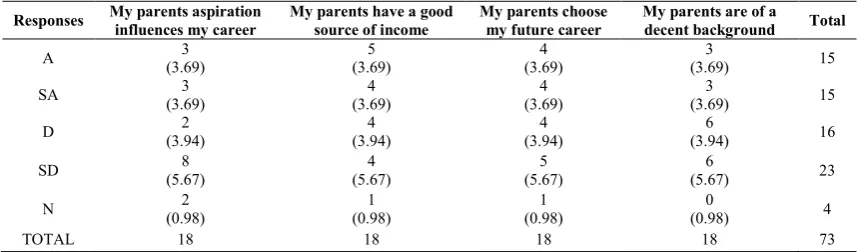
Table 6 Chi Square Test
Responses
My parents aspiration influences my
career
My parents have a good source of
income
My parents choose my future career
My parents are of a decent background
Total
A 3 5 4 3 15
SA 3 4 4 3 15
D 2 4 4 6 16
SD 8 4 5 6 23
N 2 1 1 0 4
TOTAL 18 18 18 18 73
Degree of freedom=(column-1)(row-1)=(5-1)(4.1)=12 Level of significance=5%
Research Question Two: To what extent does parental economic status influence students’ career aspiration?
Table 4 shows respondents’ appreciation of the extent to which parental economic status influences their career aspiration. Only 34 % of the respondents affirmed that their parents had a good source of income, while most respondents (54%) sounded negative and 12% were indifferent as to whether their parents had a good source of income. A majority (57%) were of the opinion that the higher economic status of their parents influences their career aspirations.
This implies that parents with high economic standards influenced the career aspiration of their kids. This is because with a high economic status, the parents could most commonly afford to influence their kids’ career aspiration.
Research Question Three: To what extent does parental level of education influence students’ career aspiration?
Table 5 above shows respondents’ appreciation of their parents’ level of education and how it influenced their career inspiration.
For the first item, 27% agreed that their parents approved of their career aspiration and encouraged them to ask questions about it, a greater majority (55%) strongly agreed, 14% disagreed, and no one was neutral. For item two, 27% of the respondents agreed that their parents assisted them to develop their career needs and encouragedthem in their career aspirationto reach high, a significant majority of 41% strongly agreed, 14% disagreed, only 12% strongly disagreed while just 4% remained neutral. When asked whether their parents chose careers for them, 48% responded in the affirmative, while another 48% disagreed and 4% remained neutral. When asked whether their parents knew the importance of career goals, 14% agreed while 32% strongly agreed, 14% disagreed, 25% Table 4 Respondents’ Appreciation of Parental Economic Status
No Items
Frequency of Responses
A SA D SD N TOTAL
Fi % Fi % Fi % Fi % Fi % Fi %
1 My parents have a good source of income 13 18 12 16 9 12 30 42 9 12 73 100 2 My parents provide me with all my basic needs 12 16 30 42 13 18 9 12 9 12 73 100 3 The higher economic status of my parents influences my career aspirations 20 27 22 30 9 12 18 25 4 6 73 100 4 The career which I inspire is expensive 15 21 27 37 8 11 17 23 6 8 73 100 5 My parents economic status can support my career aspirations 27 37 14 19 9 13 16 22 8 11
6 My parents want me to stop school and begin a job to earn my own income
without considering my career aspiration and skills 10 14 10 14 30 41 20 27 3 4 73 100
Table 5 Respondents’ Appreciation of Parent’s Level of Education
No Items
Frequency of Responses
A SA D SD N TOTAL
Fi % Fi % Fi % Fi % Fi % Fi %
1 My parents approve of my career aspiration and encourage
me to ask questions about that. 20 27 40 55 10 14 3 4 0 0 73 100 2 My parents assist me to develop my career needs and
encourage me in my career aspirationto reach high. 20 27 30 41 10 14 10 14 3 4 73 100 3 My parents chose my future career 15 21 20 27 20 27 15 21 3 4 73 100
4
My parents know the importance of my career goals and the role of the career counsellor, and they want what is best for me
10 14 23 32 10 14 20 27 3 4 73 100
5 My parents want that I lead the family company as my future
career. 5 7 10 14 30 41 23 32 5 7 73 100 6 There is a relationship between my chosen study series with
my career goals 20 27 33 45 10 14 5 7 5 7 73 100
Table 7 Computation of Chi Square
Responses My parents aspiration
influences my career
My parents have a good source of income
My parents choose my future career
My parents are of a
decent background Total
A 3
(3.69)
5 (3.69)
4 (3.69)
3
(3.69) 15
SA 3
(3.69)
4 (3.69)
4 (3.69)
3
(3.69) 15
D 2
(3.94)
4 (3.94)
4 (3.94)
6
(3.94) 16
SD 8
(5.67)
4 (5.67)
5 (5.67)
6
(5.67) 23
N 2
(0.98)
1 (0.98)
1 (0.98)
0
(0.98) 4
Cameroon
strongly disagreed and 5% remained neutral. This means that with a higher level of education, given high awareness on the part of parents, children could better be assisted in their choice of future career.
Hypothesis Testing
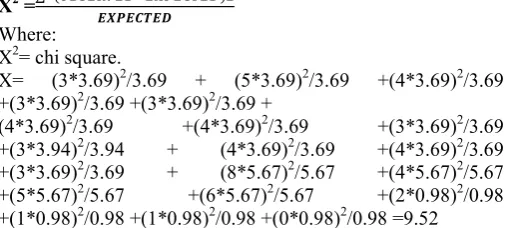
This section makes use of an inferential tool of analysing the data from the field. The tool used was the Chi square (X2) test. The Chi square test made use of average responses obtained from the field. This study took into consideration the variables of the study; this enabled the derivation of the degree of freedom. Thus Chi Square was given as:
X2 =∑ ( )
Where: X2= chi square.
X= (3*3.69)2/3.69 + (5*3.69)2/3.69 +(4*3.69)2/3.69 +(3*3.69)2/3.69 +(3*3.69)2/3.69 +
(4*3.69)2/3.69 +(4*3.69)2/3.69 +(3*3.69)2/3.69 +(3*3.94)2/3.94 + (4*3.69)2/3.69 +(4*3.69)2/3.69 +(3*3.69)2/3.69 + (8*5.67)2/5.67 +(4*5.67)2/5.67 +(5*5.67)2/5.67 +(6*5.67)2/5.67 +(2*0.98)2/0.98 +(1*0.98)2/0.98 +(1*0.98)2/0.98 +(0*0.98)2/0.98 =9.52
From table 7, the Chi Square calculated value (X2) calculated was 9.52 at 5% level of significance and the value X2 from the table at 5% level of significance and 12 degree of freedom as read from the Chi Square distribution table was 9.1.
Since, X2 calculated was greater than the value read from the table at 5% level of significance, X2 calculated was 9.52 falling outside the critical region, the null hypothesis was rejected. Therefore, there was 95% confidence that there was a significant relationship between parental background and career aspiration of students.
Since, X2 calculated was greater than the value read from the table at 5% level of significance, X2 calculated was 9.52 falling outside the critical region, the null hypothesis was rejected. Therefore, there was 95% confidence that there was a significant relationship between parental career and career aspiration of students.
This study found that majority of the students found in the Kumba I municipality had parents who had a good source of capital and that majority of the parents provided the basic needs of their kids. With high economic status of parents in the Kumba I municipality, the study found that parents with high economic standards influenced the career aspiration of their kids. Most careers aspired for were expensive and hence influenced the career aspiration of kids because most parents could not afford it. It was also, found that parental career influenced the career aspiration of their kids. Most kids preferred to follow the career of their parents rather than their dreamed careers. The study showed that some kids did not want to have anything to do with their parent’s career as their parents always struggled financially.
DISCUSSIONS
The study found out that majority of the students in the KumbaI municipality had parents with a good source of capital and that majority of the parents provided the basic needs of their kids. With high economic status of parents in the Kumba I municipality, the study found that parents with high
economic standards influenced positively the career aspiration of their students.
The study showed that most of the careers aspired for were expensive and hence, influencing the career aspiration of kids because most parents could not afford it. Also, findings of the study showed that parental career influenced the career aspiration of the students. Most students preferred to follow the career of their parents rather than their dreamed careers. The study showed that some kids do not want to have anything to do with their parent’s career as their parents always struggle financially.
The Influence of Parental Career on Students’ Career Aspiration
The findings of the study showed that parental career influences the career aspiration of their kids. Most kids preferred to follow the career of their parents rather than their dreamed careers. The study showed that some kids do not want to have anything to do with their parent’s career as their parents always struggle financially. Apparently, this is because the children do not want to enter careers wherein they live struggling lives. Also, most of the student boys prefer the father’s job. So the question which one can pose at this level is if the students of Kumba have their own personal career aspiration. The findings of this study are in conformity with McQuerry (2012) who stated that many children grew up idealizing the professions of their parents. In this same thinking, Trice and Tillapaugh’s (1991) found that children’s aspiration to their parent’s occupations is influenced by their perception of how satisfied their parents are with their own work.
The Influence of Parental Economic Status on Students’ Career Aspiration
The study found out that majority of the students in the Kumba I municipality had parents who had a good source of capital and that majority of the parents provide children’s basic needs. With high economic status of parents in the Kumba I municipality, the study found that parents with high economic standards influence the career aspiration of their students. The findings of this study showed that most career aspirations were expensive and hence influenced the career aspiration of students because most parents cannot afford it. Also, there is already a different background from poor parents and rich parents. In this light, Vondracek, Lerner and Schulenberg (1986) stated that what will influence a student career surely would be the socio-economic status of that individual’s family orientation. This statement is based on the view that parents from different social classes develop their own social and cultural values based on their current social class.
The Influence of Parental Level of Education on Students’ Career Aspiration
This study found that most parents do not ask their students to stop school and open a business of their own. But the parental level of education is still not very clear because the research noted that there is not a true parental follow up in student career aspiration. The educated parents positively influence their students by encouraging them, and the other parents do not talk about it. Twenty-seven (27%) of respondents strongly agreed that their parents chose their future career; one could interpret this to mean that some of the parents impose their own choice on the students. This confirms the view that the attitude of parents and the influence of the home environment influences a child's career path. Similarly, parents’ education has been proven as a factor influencing career choice. The parents’ education level is a very important factor in students’ career aspiration. In this same vein, Nucci (1996) found that parents impose their own goals on their children or see their child’s accomplishment as a reflection on themselves.
CONCLUSIONS
At this point one can say that, no matter the background of parents it is unlikely to be considered as the only determinant factor in career aspiration of students. However, parental career have an influence on the career aspiration of students. Since students grow by their parents they have a direct link with what their parents do on a daily basis, so it is just but normal that parents’ occupation affect their children’s career aspiration. Parents’ economic status also has a direct bearing on the future choice of career of children. Thus students with parents of a relatively high economic status will definitely seek to be like their parents in future hence having a direct influence on their career aspiration. The educational level of parents relatively influences the career aspiration of students. Many respondents of the study strongly held that the educational level of their parents is elementary or higher degree owned doesn’t influence their career aspiration. It is worth noting that there is significant difference between the African context and European context about the career counselling. There is great implication of the European parents on the students’ career aspiration compared to African parents.
Recommendations
The school counsellors, should seek to advice students to as much as possible follow their dreams with respect to the career they seek to have, they should advice the students and inform them about the careers they can have if they focus on what they can do best. They should therefore, provide adequate career information to learners to enable them make informed choices.
School counsellors should assist parents in providing career related modelling for their adolescents by showing them how to talk to their adolescents about their own occupations as well as about other occupations available in the world of work.
Parents should give their children the opportunity to freely choose and engage in the career which they want, they should give out more advice on what is best for the student than to impose on them to take over family business or restrict their career
opportunities just to what the parents themselves go through.
The competency based counselling approach should be reinforced in our schools so that children leave school with knowledge, skills and abilities to become fully operation once they leave school. Policy makes should provide an environment that can enable this to take.
School authorities should not force students to either do arts, sciences or commercial, they should have the opportunity to freely choose what they want, but they most well be informed on the various career opportunities they can get when engaging into any of the fields.
References
Araújo, A. M., &Taveira, M. C. (2009).Study of career development in children from a developmental-contextual perspective.European Journal of Education
and Psychology, 2(1), 49-67.
Azmitia, M., & Cooper, C. R. (2001). Good or bad? Peer influences on Latino and EuropeanAmerican adolescents’ pathways through school. Journal of Education for Students Placedat Risk, 6, 45-71.
Azmitia, M., Cooper, C. R., & Brown, J. R. (2009).Support and Guidance from Families, Friends, and Teachers in Latino Early Adolescents’ Math Pathways.The Journal
of Early Adolescence, 29, 141-169.
Bama, R.K. (2018). Educational Aspirations of Secondary School Girls in Rural Areas and their incidence on Academic Achievement. Journal of Education and
Practice, 9(14), 77-90.
Beng, S.D. (2016). Guidance counselling and career development in Cameroon: post-secondary school student’s experiences, Master Thesis, Cameroon.
Berk, L. E. (2007).Development through the lifespan. Boston, MA: Allyn and Bacon.
Betz, N. E., Fitzgerald, L. F., & Hill, R. E. (1989). Trait-factor theories: Traditional cornerstone of career theory. In B. Michael, D. T. Hall, & B. S. Lawrence (Eds.),
Handbook of career theory (pp. 26–40). New York:
Cambridge University Press.
Bregman, G., & Killen, M. (1999).Adolescents and young adults’ reasoning about career choice and the role of parental influence.Article in journal of research on
adolescence, 9(3), 253-275. DOI:
10.1207/s15327795jra0903_2.
Bronfenbrenner, U. (1979). Theecological of human
development. Harvard University Press
Bronfenbrenner, U., & Morris, P. A. (1998).The ecology of developmental process. In W. Damon (Series Ed.) & R. M Lerner (Volume Ed.), Handbook of child psychology:
Theoretical models of human development (5th ed., Vol.
1, pp. 993-1028). New York: Wiley.
Cameroon. (1998). Law N°98/004 of 14 April 1998, orientation law on Cameroon education. http://portail.unesco.org/education/en/files/12704/10434 093270cameroun1.doc/cameroun1.doc.
Danvers, F. (1988). Pour une histoire de l’orientation professionnelle. Spirale - Revue de recherches en
Cameroon
Dhesi, A. (2001). Expectations and post-schoolchoice-some data fromIndia, 3(1), 14-24.
Dik, B. J., & Duffy, R. D. (2009). Calling and vocation at work: Definitions and prospects for research and practice. The Counselling Psychologist, 37, 424–450. doi:10.1177/0011000008316430,
doi:10.1177/0011000008316430.
Duncan, O. D. David L., Featherman, D. L., & Duncan, B. (1972).Socioeconomic background and achievement. New York: 0127851747, 9780127851747, Seminar Press.284 + xxiii pp.
Fraenkel, W., & Hyun (2012).Review of literature and
studies-sampling. https://www.academia.edu/4671319/.
Hazanovitz-Jordan, S. (1982). Occupational choice and early family relationships: A study of sexual symbolism.
Genetic Psychology Monographs, 105(2), 309-362.
Herbart, J. F. (2005).Urvater of social psychology. History
of the Human Sciences, 19 (1), 19-38.
Herr, E. L. (1997). Super’s life-span, life-space approach and its outlook for refinement. The Career Development
Quarterly, 45, 238–245.
Hesketh, B., & Rounds, J. (1995).International cross-cultural approaches to career development. In W. B. Walsh & S. H. Osipow (Eds.), Handbook of vocational psychology:
Theory, research, and practice (2nd ed., pp. 367–390).
Mahwah, NJ: Erlbaum.
Holland, J. L. (1962). Some explorations of a theory of vocational choice: One- and two-year longitudinal studies. Psychological Monographs,76(26), 49.
Holland, J. L. (1985). Making vocational choices: A theory
of vocational personalities and work environments (2nd
ed.). Englewood Cliffs, NJ: Prentice-Hall.
Hoover-Dempsey, K. V., & Sandler, H. M. (2005). Final performance report for OERI: The social context of parental involvement: A path to enhanced achievement.
Project Monitor, Institute of Education Sciences, US
Department of Education.
Kazi, A. S., &Akhlaq, A. (2017).Factors Affecting Students' Career Choice. Journal of Research and Reflections in
Education, 11(2), 187-196.
Kohn, M. (1969).Class and conformity: A study in values.
Chicago: Chicago University Press.
Kracke, B. (2002). The role of personality, parents and peers in adolescents’ career exploration.Journal of
Adolescence, 25(1), 19-30.
Krumboltz, J. D., Mitchell, A. M., &Brian Jones,G. (1976).A social learning theory of career selection. The Counselling Psychologist, 6(1), 71-81.
Leung, S. A. (1995). Career counselling and development: A multicultural perspective. In J. G. Ponterotto, J. M. Casas, L. A. Suzuki, & C. M. Alexander (Eds.),
Handbook of multicultural counselling (pp. 549–566).
Thousand Oaks, CA: Sage.
Leung, S. A. (2004, August). Methodological issues in conducting vocational psychology research in Chinese
communities. Paper presented at the 28th International
Congress of Psychology, Beijing, China.
McQuerry, L. (2012).Family factors influencing career choices. https://work.chron.com/family-factor.
Middleton, E.B., &Loughead, T. A. (1993).Parental influence on career development: An integrative framework for adolescent career counselling. Journal of
career development, 19(3),
161-173.http://dx.doi.org/10.1007/BF01353275.
Ngesi, M.J. (2003). A Study of Systematic Processes Influencing Educational Change in a Sample of IsiZulu Medium Schools.PhD Thesis, Unpublished. University of Natal, Pietermaritzburg, South Africa.
Nucci, L., & Smetana (1996).Mother’s concepts of young children areas of personal freedom. Vol. 67, No.4 published by: Wiley on behalf of the society for research in child development. DOI: 10.2307/113137 https://www.jstor-org/stable/1131737.
Savickas, M. L. (2002). Career construction: A developmental theory of vocational behavior. In D. Brown & Associate (Eds.), Career choice and
development (4th ed., pp. 149–205). San Francisco, CA:
Jossey-Bass.
Schulenberg, J. E., Vondracek, F. W., & Crouter, A. (1984). The influence of the family on vocational development.
Journal of Marriage and the Family, 46, 129-143.
Schultheiss, D., Palma, T., &Manzi, A. (2005). Career development in middle childhood: A qualitative inquiry.
The Career Development Quarterly, 53, 246-252.
doi:10.1002/j.2161-0045.2005.tb00994.x.
Sewell, W. H., &Armer, M. J. (1966).Neighborhood context and college plans. American Sociological Review, 31(2), 159-86.
Sharf, R. S. (2002). Applying career development theory to counselling (6th Ed.). Belmont, CA: Brooks/Cole. Shultheiss, D., Kress, H. M., Manzi, A., &Glassock, J. E. M.
(2001). Relational Influences in Career Development: A Qualitative Inquiry. The Counseling Psychologist,
29(2), 216-241.
Shumba1, A., &Naong, M. (2012).Factors influencing students’ career choice and aspirations in South Africa.Journal of Social Science, 33(2), 169-178. Sukovieff, H. M. (1991). An investigation of influences on
career decisions of High school graduates: A follow-up
study. The University of Regina.
Super, D. E. (1990).A life-span, life-space approach to career development. In D. Brown & L. Brooks (Eds.),
Career choice and development: Applying
contemporary approaches to practice (2nd ed., pp. 197–
261). San Francisco, CA: Jossey-Bass.
Super, D. W. (1969). Vocational development theory. The Counselling Psychologist, 1, 2-30.
Super, D. W. (1980). A life-span, life-space approach to career development.Journal of Vocational Behaviour, 16, 282–298.
Tang, Y-P., Shimizu, E. Dube, G., &Rampon, C. (1999). Genetic enhancement of learning and memory in mice. Nature, 401(6748):63-69 .
Trice, A. D., &Tillapaugh (1991).Children’s estimates of
their parents’ job satisfaction, research
articlehttps://DOI.org/10.2466/pro.1991.69.1.63.
UNESCO.(2000). Regional training seminar on guidance and counselling. Module 4: Behaviour modification; Uganda.
Avaliaçãopsicológicaemorientação escolar e
profissional(pp. 429-451).Coimbra: Quarteto.
Vondracek, F. W., Lerner, R. M., &Schulenberg, J. E. (1986). Career development: A life-span developmental
approach. Hillsdale, NJ: Erlbaum Associates.
Werts, C. E., &Watley, D.J. (1972). Paternal influence on talent development. Journal Of Counselling
Development. Google scolar/Grossrelf/SI.
Wigfield, A., &Eccles, J. S. (1992). The development of achievement task values: A theoretical analysis.
Developmental Review, 12(3), 265-310.
http://dx.doi.org/10.1016/0273-2297(92)90011-P. Young, R. A. (1983). Career development of adolescents:
An ecological perspective. Journal of Youth and
Adolescence, 12, 401-417.
doi:10.1007/BF02088723Zunker, V. G. (2002). Career
counselling: Applied concepts of life planning (6th ed.).
Pacific Grove, CA: Brooks/Cole.
How to cite this article:
Roland K. BAMA and Marie Barbare NNANGA (2019) ' Parental Background And Its Influence on Students’ Career Aspirations In Kumba I Sub-Division of The South West Region of Cameroon', International Journal of Current Advanced
Research, 08(12), pp. 20652-20661. DOI: http://dx.doi.org/10.24327/ijcar.2019. 20661.4044