e-ISSN: 2278-7461, p-ISSN: 2319-6491
Volume 8, Issue 4 [April 2019] PP: 07-17
Effect of Coolant Temperature on Diesel Engine Performance
and Emission Characteristics
S. Anwar
Automotive Technology Department,Faculty of Industrial Education, Helwan University, Cairo,Egypt. Corresponding author:S. Anwar
ABSTRACT: This study aims to analyze engine performance and emission characteristics according to coolant temperature for diesel engine designed to work with an open cooling system. A single cylinder CI engine of 663 cc loaded with an electric dynamometer. Engine performance, emission, noise and vibration were measured at different operating conditions such as; engine loadsfrom 15 to 90% and variable rotation speeds from 900 to1500 rpm at different coolant temperature from 50 to 90 °C.
All the measured results are compared with that measured at 50°C, which represent the normal operating condition of open cooling engine. It has been found that Increasing the cooling temperature increase the engine brake power and brake thermal efficiency while it reduces the brake specific fuel consumption. Also it reduces HC, PM and CO emissions and inversely increase NOx and CO2 emissions. It has been also found that engine vibration and noise are increased with the increasing of the temperature of cooling temperature.The optimum working temperature was shown at 70 °C.
KEYWORDS: Diesel engine;Emission, Cooling temperature, engine performance, Engine noise, and vibrations.
--- --- Date of Submission: 15-12-2019 Date of acceptance: 27-12-2019 ---
---I. INTRODUCTION
Modern diesel engines are widely used for transportation, automotive, agricultural applications and industrial sectors because of their high performance, thermal efficiency, fuel economy, relatively easy operation, and durability [1].
The cooling system of a diesel engine has been regarded as an auxiliary system of lesser importance to engine performance, but necessary for its operation. Conventional systems for cooling the engine are simply designed to keep the engine temperature acceptable for a wide range of operation and operating conditions. With the introduction of Mechatronic Technology, conventional mechanical systems are being replaced by manual controlled systems.A manual controlled cooling system of diesel engine should provide improvements in performance through their effects on the engine, improved friction loss, improvement in fuel economy, reduced emissions and increased durability, especially because diesel engine operation depends on temperature. The basic design of automotive cooling system has remained essentially unchanged for a long time; for example, drive the pump water from the cooling system of the motor is accomplished by rotating the engine. Thus, the coolant flow rate is determined by engine speed, which is not ideal for most cases [2-6].
The engine coolant temperature affects engine performance, efficiency, and emissions. Lower coolant temperature increases heat transfer and reduces temperatures of the metal of cylinder head, cylinder, and piston. However, this lowers the average gas temperature and pressure, increases frictional losses, and reduces the work per cycle transferred to the piston. Thermal stresses due to temperature gradients increase with lower coolant temperatures. Changes in gas temperature due to the change in coolant temperature influence the emission formation of nitrogen oxides, carbon monoxide, carbon dioxide, and unburned hydrocarbons [5].
Saber et.al. [7] studied the effect of increase of the ambient air temperature beforeentering the naturally aspirated diesel engine on specific fuel consumption. Theexperimental investigation was carried out on a diesel engine four strokes, water cooledand indirect injection. The experiments covered all tests. The tests included heating of the inlet air temperature by designing an electric heater then increasing the air temperature entering into the diesel engine. The results showed that brake specific fuel consumption increased with increasing inlet air temperature. Also the results showed that the brake specific fuel consumption decreased with increasing the brake meaneffective pressure. Experimental data obtained in this work were compared with other references were found to be in good agreement with experimental results
life and power consumption by better regulating the combustion process. Different techniques have been adopted to drive electrical pumps and fans independent of the engine speed. Heat transfer haveimproved by precision cooling and coolant flow requirements can be reduced by 90 %. A suitable control strategy is always required for TMS
K. Arunachalam, P. MannarJawahar Presently, engine-cooling pump is driven by toothed belt. Therefore, the pump speed is dependent on engine speed, which varies their output. At normal engine operating conditions (Higher RPM and low load, Higher RPM and high load), mechanical water pumps in existing engines are inevitably oversized and so the use of an electric water pump together with state-of-the-art thermal management of the combustion engine has measurable advantages. Demand-driven cooling, particularly in the cold-start phase, saves fuel (approx 3 percent) and leads to a corresponding reduction in emissions. The lack of dependence on a mechanical drive also results in considerable flexibility in component packaging within the engine compartment [3].
Miqdam [4] has investigated the effect of injection timing and coolant temperatures of DI diesel engine on cold and hot engine start ability and emissions. Four-injection timing were chosen (12, 15, 20 & 23o BTDC) to operate the engine, and their results were compared with engine operation at 17o BTDC (factory specification). Tests were conducted at four engine coolant temperatures (-10, 0, 25 & 50 oC) to evaluate injection timing effect. The study results indicated that increasing test temperature led to reducing starting time apparently. Combustion instability was significant mainly during starting at cold temperatures (-10 & 0 oC). Extremely high levels of HC, CO and opacity were experienced in the exhaust gas, mainly during cold starting. Combustion noise increased highly due to low starting temperature.
Waleed Abdelghaffar, et. al. [5]presented experiments on a four-cylinder, four-stroke, direct-injected diesel engine to study the effects of engine coolant temperature on both performance parameters and exhaust emissions. The energy balance is discussed on the bases of first-law analysis and second-law analysis. The range of speed investigated was 1000–2000 RPM for the torque range of 25–152 N.m. The coolant temperature was varied from 50 to 95 °C. Their results show that the coolant temperature has a significant effect on the volumetric efficiency. It also shows that increasing coolant temperature decreases the mass flow rate of fuel consumption and the cooling losses. As a result, the brake specific fuel consumption decreases and the brake thermal efficiency increases. Based on their results, the coolant temperature has a significant effect on NOx emissions and minor effects on the volumetric percentages of oxygen, carbon dioxide, and carbon monoxide. The unburned hydrocarbons show insignificant variation. This work also shows that increasing coolant temperature slightly increases the availability of the coolant and decreases the total availability losses.
Waleed A. Abdelghaffar. et.al. [6] studied the effect of coolant temperature from 50 to 95 °C on the performance of diesel engine. It shows that increasing coolant temperature decreases the mass flow rate of fuel consumption and the cooling losses, the brake specific fuel consumption decreases and the brake thermal efficiency increases. A chart was developed for showing the relationship between the coolant temperature, equivalence ratio, brake torque, and brake specific fuel consumption. The study shows that the coolant temperature has a significant effect on NOx emissions and minor effects on the volumetric percentages of oxygen, carbon dioxide, and carbon monoxide. The unburned hydrocarbons show insignificant variation. This work also shows that increasing coolant temperature slightly increases the availability of the coolant and decreases the total availability losses.
Choi, K. et. al. [7] investigated the new cooling strategies such as high coolant temperature control, fast warm-up and post cooling using an automotive cooling system controlled by electronic actuators on engine performance and emission. The engine experiment was carried out on a new european drive cycle, the conventional water pump was decoupled from the engine and electronically controlled by a BLDC motor, valves were installed at the coolant pathways between the engine and cooling components. This modification led to a reduction in both fuel consumption and exhaust gas emissions (e.g. THC, CO). The reduction was particularly considerable at the low speed and low load-drive conditions by controlling high temperature of the coolant. In addition, independent operation of the water pump along with the coolant flow control using valves reduced warm-up time during cold start which contributed to a decrease in harmful emissions and fuel consumption.
An important topic from the viewpoint of internal combustion engines is exhaust emissions have been studded by Kumar [8]. It has been stated that the increased in combustion chamber temperature of ceramic-coated internal combustion engines causes a decrease in soot and carbon monoxide emissions. When increased exhaust gases temperature considered, it is obvious that turbocharging and consequently total thermal efficiency of the engine is increased.
reducing the power supplied to engine accessories. Moreover, experimental results found in literature and observed in tests already conducted, show that NOx can be reduced by controlling the temperature of engine coolant, and which additionally show a reduction of CO and HC. They also stated that more investigation about this control system is in course and will be reported later.
Nalin Kumar Sharma and B.K. Roy [10]Advanced thermal management systems of internal combustion engine offer enhanced coolant temperaturetracking during transient and steady-state operation. servomotor controlled cooling mechanism have the potential toreduce parasitic losses, to allow higher operating temperature, to reduce component temperature fluctuations, tolower emissions and thus shows an improvement of 1%-3% fuel economy .it has been reported that shiftingfrom mechanical to electrical cooling system shows a reduction of 5% in engine fuel consumption, 10% in COand 20% in HC tailpipe emissions. Further, there is a reduction of 13.5% in nitrogen oxides (NOx).
Patterson and Henein [11]showed that increasing the coolant temperature increases NO emissions as it also reduces heat lossesleading to an increase in peak cycle temperature. Scharnweber and Hoppie [12] showed that preheating the fuel prior to direct cylinder injection in diesel engines reduces particulate and NOx emissions.Murayama et al. [13] showed that higher fuel temperatures significantly reduce the brake specific fuel consumption and smokeemissions. Kaplan and Heywood [14] found that a reduction in piston thermal capacity would reduce the total amount of unburned hydrocarbons during warm up due to the piston/liner crevice region. Miyamoto et al. [15] found that HC emissions decrease with increasing the wall temperature, while NO~ increased slightly with increases in piston wall temperature during the load increase.
II. EXPERIMENTAL PROCEDURE AND ASSUMPTIONS
Figures 1 and 2 show the schematic and photograph of the test rig. The engine emissions; carbon monoxide (CO), carbon dioxide (CO2), hydrocarbons (HC), particulate matter (PM) and the oxides of nitrogen (NOx) were measured using a Brain Bee S.P.A, AGS-688 Gas analyzer as shown in Fig. 1 No.3, while PM was measured using a Lucas smoke.
Figure. 2 Photograph of the test rig.
1-Diesel Engine 2-Electric Generator 3-Fuel System 4- Data acquisition system 5-Loading switch 6-gag temperature water, exhaust, air and multimeter 7-somk mater 8- particulate matters 9- Manu meter
The vibrations were measured in the piston movement direction on the cylinder head by ICP accelerometer (model 333B32) which has a frequency range from 0 to 10000 Hz. The accelerometer signals are post-processed by LMS pimento a multichannel device (Model ASP H24). All the measured data were directly collected to PC computer and analyzed using the MATLAB [2014] and Excel. The engine speed was measured using digital tachometer, and the tailpipe noise was measured using the RO-line precision sound level meter type (QA-1350) fixed at 1 meter with 45˚ to the tail pipe outlet as shown in Figure 1.
The Engine performance was measured at different engine loads from 0 to 90% with an increment of 15% and at 1400 rpm engine speed (from total engine load of 6.5 hp), and speeds from 900 to 1400 rpm and at no load with an increment of 100 rpm. The data were recorded after 30 minutes working when the engine reached to steady state at constant water cooling temperature. [Temperature from less than 50 to 90 oC]
The backpressure across the air filter was determined with the help of an inclined manometer. during these measurements with the help of the acoustic border, four different assumptions have been addressed: 1) ambient temperature variations do not affect the reading to a large extent, 2) inlet water cooling temperature variations (± 5 º C) do not affect the reading to a large extent, 3) the engine performance and noise remained constant for a particular load and speed and 4) the measured tail pipe noise level was measured outside the lab. In the free field, the background noise was canceled out, which means that any variation in the recorded noise is due to the exhaust noise variation only.
III. RESULTS AND DISCUSSION.
3.1 Engine Power
Figure (3) shows the average percentage of variation in engine brake power with different cooling temperature for diesel engine at different loads and speeds. In Figure (3-a), the average variation is calculated using the mean value at different speeds and constant load, while it is calculated using the mean value at different loads and constant speed in Figure (3-b).
It can be noticed that the engine BP increases with the increase of cooling temperature as well as the increase of the engine loads and speeds. However, the BP increased is almost 17.4% at 90 ºC for constant loads
7
8
6
3
1
5
2
4
and constant speeds. This increase can be due to reduction in the engine oilviscosity, which helps to reduce engine fraction power as well as it improves the thermal efficiency.
(a) Constant speed with an average speed of 1150 rpm
(b) Constant load with an average load of 2.5Kw
Figure 3. Percentage of variation of engine brake power with different cooling temperature at with different engine loads and speeds.
3.2 Brake Specific Fuel Consumption
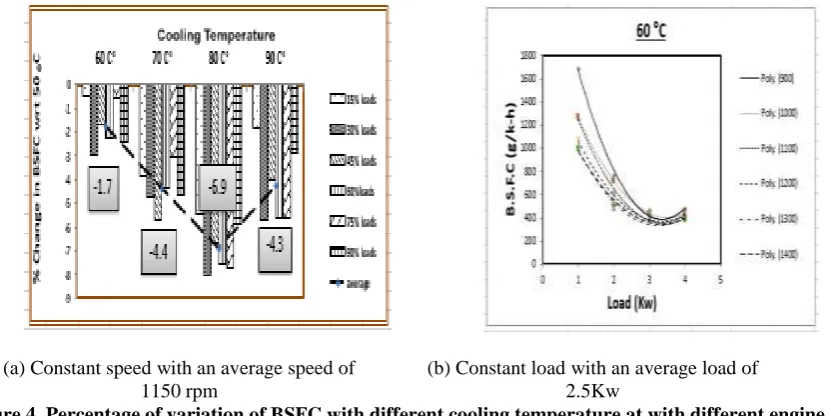
The variation of BSFC with different cooling temperature with different engine loads and speeds are shown in Figure (4). It can be seen from these results that, the BSFC decreases with the increasing of cooling temperature except 90 ºC. It can also notice that the BSFC decreases with the increasing of engine loads and speeds.
The lowest value can be found at 80 ºC, which decreases the BSFC about 7%. This decrease can be due to improving of BP as well as the thermal efficiency. At 90 ºC the air intake temperature to the combustion room is high, which decrease the air quantity inside the combustion room and that is make the BSFC is decreased comparing with 80 ºC.
(a) Constant speed with an average speed of 1150 rpm
(b) Constant load with an average load of 2.5Kw
Figure 4. Percentage of variation of BSFC with different cooling temperature at with different engine loads and speeds.
3.3 Brake Thermal Efficiency
(a) Constant speed with an average speed of(1150) rpm
(b) Constant load with an average load of 2.5Kw
Figure 5. Percentage of variation of BTE with different cooling temperature at with different engine loads and speeds.
3.4 Exhaust Gas Temperature
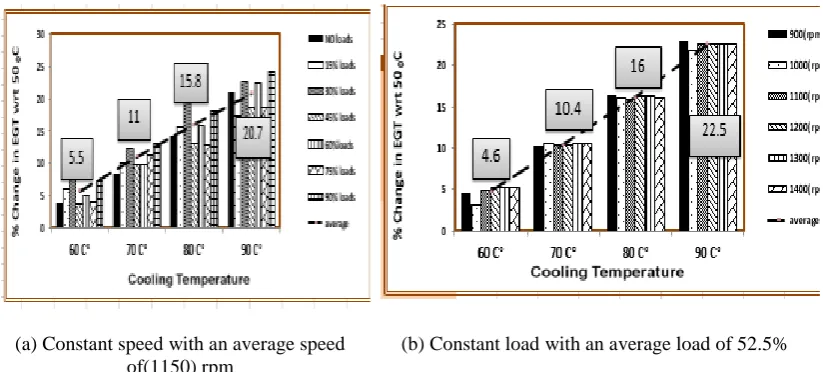
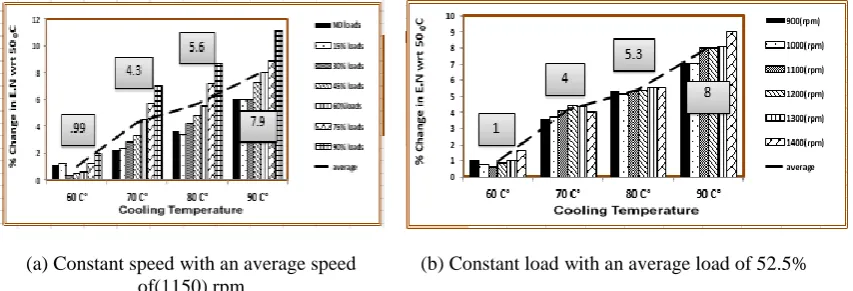
The percent of the variation of EGT using different cooling temperature with different engine loads and speeds are shown in Figure 6. The increase of cooling temperature led to complete combustion, and complete combustion produce more heat inside the cylinder. Also, EGT increases with the increase of engine loads and speeds due to the increase in heat release values of diesel fuel.
(a) Constant speed with an average speed of(1150) rpm
(b) Constant load with an average load of 52.5%
Figure 6. Percentage of variation of EGT with different cooling temperature at with different engine loads and speeds.
3.5 Carbon Monoxide
Carbon monoxide (CO) is formed as an intermediate step in the formation of carbon dioxide. Failure of oxidizing CO into CO2 can depend on either lack of oxygen or too low temperatures. These two reasons lead to
(a) Constant speed with an average speed of(1150) rpm (b) Constant load with an average load of 52.5%
Figure 7. Variation of CO emission with different cooling temperature at with different engine loads and speeds.
3.6 Carbon Dioxide CO2
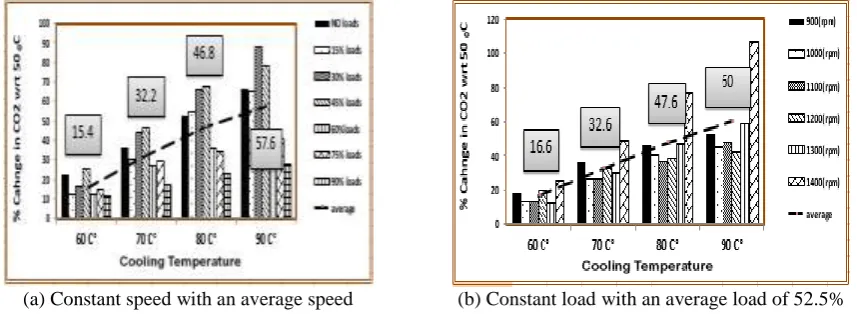
The percent of the variation of CO2 using different cooling temperature with different engine loads and
speeds are shown in Figure 8. The increase of cooling temperature led to complete combustion, and complete combustion produce more heat inside the cylinder. Also, CO2 increases with the increase of engine loads and
speeds due to the increase in heat release values of diesel fuel.
(a) Constant speed with an average speed of(1150) rpm
(b) Constant load with an average load of 52.5%
Figure 8. Percentage of Variation of CO2 emission with different cooling temperature at with different engine loads and speeds.
3.7 Oxygen O2
The percent of the variation of oxygen O2 using different cooling temperature with different engine
loads and speeds are shown in Figure 9. The decrease of cooling temperature led to complete combustion, and complete combustion produce more heat inside the cylinder. Also, O2 decrease with the increase of engine loads
(a) Constant speed with an average speed of(1150) rpm
(b) Constant load with an average load of 52.5%
Figure 9. Percentage of Variation of oxygen O2 emission with different cooling temperature at with different engine loads and speeds.
3.8 Total Hydrocarbons
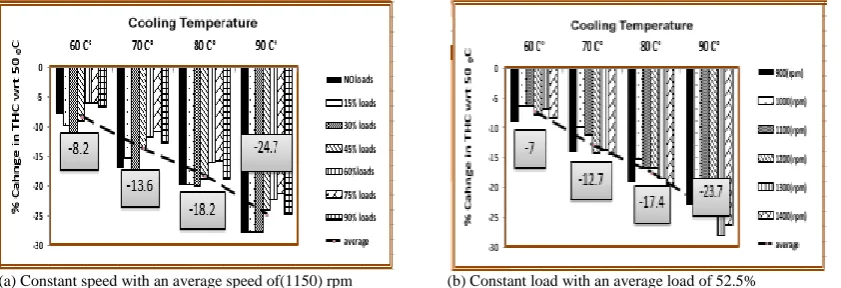
Unburned hydrocarbons (HC) are mainly a problem in combustion of premixed mixtures, and the contribution of diesel combustion to HC emissions is significantly lower. The THC emissions for various cooling temperature at different loads and speeds are shown in Figure 10. It can be seen that THC decreased with the increase of cooling temperature for all engine loads and speeds. The increasing in cooling temperature is work on improve the premixed mixture inside the combustion chamber.
(a) Constant speed with an average speed of(1150) rpm (b) Constant load with an average load of 52.5%
Figure.10 Percentage of variation of THC versus emission with different cooling temperature at with different engine loads and speeds.
3.9 Oxides of Nitrogen (NOx).
Oxides of nitrogen (NOx) are formed when temperatures in the combustion chamber get too hot. At
high temperature, nitrogen and oxygen will combine to from oxides of nitrogen at rich fuel/air ratio mixture.The formation of NOx is highly dependent on in-cylinder temperature, ignition timing and the oxygen content. The
experimental results show the increase of NOx with the increase of cooling temperature at different engine loads and speeds as shown in Figure 11. The lowest increase in NOx by 4.4% has been observed at 70 ºC At all engine
loads and speeds, the NOxincrease with increasing the engine coolant temperature due to the increase in the
(a) Constant speed with an average speed of(1150) rpm
(b) Constant load with an average load of 52.5%
Figure 11. Percentage of variation of NOx versus emission with different cooling temperature at with different engine loads and speeds.
3.10 Particulate Matter
The variation of PM emission for various tested cooling temperature at different engine loads and speeds are shown in Figure 12. It can be seen that the PM slightly reduced with an increase in tested cooling temperature and the margin reduction is shown at 90% engine load and 1400 rpm. PM consists mainly of soot produced in fuel-rich conditions in the engine. the soot is formed through the growth of polyaromatic hydrocarbons, it usually formed in rich conditions when small hydrocarbons are broken down from the fuel.The highest reduction at 90 ºC is 4.3%, this may be simply attributed towards the decrease of THC which discussed above.
(a) Constant speed with an average speed of(1150) rpm
(b) Constant load with an average load of 52.5%
Figure 12. Percentage of variation of PM versus emission with different cooling temperature at with different engine loads and speeds.
3.11 Engine Noise
As shown in Figure 13, the engine noise increases with the increase of the engine loads and speeds. The results can be explained by the changes in the combustion process, which was caused by increasing the temperature of cooling system and the increase in mechanical noise due to low lubricant ability.
(a) Constant speed with an average speed of(1150) rpm
(b) Constant load with an average load of 52.5%
3.12 Tailpipe Noise (T.N).
Figure 14 shows the variation of the engine tail pipe noise using different cooling temperature at different engine loads and speeds. The increase in tail pipe noise can be due to the increase of the exhaust gas temperature. It can be seen that it increases at certain cooling temperature with the engine load and speed due to the same reason and the flow generated noise as well.
(a) Constant speed with an average speed of(1150) rpm
(b) Constant load with an average load of 52.5%
Figure 14. Percentage of variation of tailpipe noise emission with different cooling temperature at with different engine loads and speeds.
3.13 Engine vibration
Figure 15 exhibit higher values at 90 ºC with an increase of engine loads and speeds, and this is due to uneven engine vibration and the changing of combustion process that may occur while the temperature of cooling system increased. The reason that caused these results is probably for the complete combustion. The relative reason of increasing the cooling temperature and the Engine design is not optimized to run at high cooling temperature.
(a) Constant speed with an average speed of(1150) rpm
(b) Constant load with an average load of 52.5%
Figure 15. Percentage of variation of engine vibration emission with different cooling temperature at with different engine loads and speeds.
IV.CONCLUSION.
In this study, different cooling temperature opportunities of diesel fuel in agriculture dieselengine were investigated. For this purpose, a four stroke, single cylinder, compression ignition diesel engine was utilized. Experiments were performed at different operating condition for attaining performance and exhaust emission values.
The main results are summarized as follows:
1. Increasing the cooling temperature increase the Engine power and brake thermal efficiency, while it reduces the brake specific fuel consumption at different engine speeds and loads.
2. Also the increasing in cooling temperature resulted in a reduction in HC, PM and CO emissions, while it increases NOx and CO2 emissions.
4. Tailpipe noise is also increased with increased with in cooling temperature at different loads and speeds due tothe high exhaust temperature and flow generated noise.
5. The cooling temperature system (70 ºC) can be used in agriculture diesel engine with increasing in NOx of 4.4%. This can reduce improve the performance and emissions.
Conflict of Interests None.
ACKNOWLEDGMENTS
The technical supports from Prof. Dr. S. Allam andDr. A Yosef from Automotive Technology Department, Faculty of Industrial Education, Helwan University, Cairo, Egyptare acknowledged and beyond my estimation.
REFERENCE
[1] Sabry Allam, Mohammed Abdo, M Rabie. Diesel Engine Fault Detection Using Vibration and Acoustic Emission Signals. International Journal of Advances in Scientific Research and Engineering, 2018, Volume 4, Issue 12, pp 86-93.
[2] Robinson K, N., Campbell, J., Hawley. (1999) and D. Tilley (1999),"A Review of Precision Engine Cooling". SAE paper 1999-01-0578.
[3] Borman, G. and K. Nishiwaki (1987), "International Combustion Engine Heat Transfer," Proceedings of Energy Combustion Sci., 13, p. 1 - 46.
[4] Waleed A. Abdelghaffar, Mohsen M. Osman, Mohamed N. Saeed, Abdelfattah I. Abdelfatteh, Effects of Coolant Temperature on the Performance and Emissions of a Diesel Engine. ASME 2002 Internal Combustion Engine Division Spring Technical Conference.
[5] Heywood, J.B., 1988, "Internal Combustion Engine Fundamentals," McGraw-Hill Book Company, New York.
[6] Waleed A. Abdelghaffar Mohsen M. Osman, Mohamed N. Saeed Abdelfattah I. Abdelfattah "EFFECTS OF COOLANT TEMPERATURE ON THE PERFORMANCE AND EMISSIONS OF A DIESEL ENGINE" Proceedings of ICES2002, Technical Conference of the ASME Internal Combustion Engine Division April 14-17, 2002, Rockford, Illinois, USA
[7] Hindren A. Saber,Ramzi R. Ibraheem Al-Barwari, Ziyad J. Talaban" EFFECT OF AMBIENT AIR TEMPERATURE ON SPECIFIC FUEL CONSUMPTION OF NATURALLY ASPIRATED DIESEL ENGINE " Journal of Science and Engineering Vol. 1 (1), 2013, 1-7.
[8] Nalin Kumar Sharma and B.K. Roy. CONTROL STRATEGIES FOR ADVANCED THERMAL MANAGEMENT SYSTEM IN IC ENGINE AN OVERVIEW. INTERNATIONAL JOURNAL OF ENGINEERING RESEARCH & TECHNOLOGY ISSN: 0974 –3154 Volume 6, Number 3 (2013), pp. 225 –231.
[8] Pawan Kumar "Significance of the Ratio of Exhaust Temperature to Coolant Temperature and Its Effect on Various Engine Working Parameters"Proceedings of the World Congress on Engineering 2009 Vol II WCE 2009, July 1 - 3, 2009, London, U.K. [9] Miqdam Tariq Chaichan"Effect of Injection Timing and Coolant Temperatures of DI Diesel Engine on Cold and Hot Engine
Startability and Emissions "IOSR Journal of Mechanical and Civil Engineering (IOSR-JMCE) e-ISSN: 2278-1684,p-ISSN: 2320-334X, Volume 13, Issue 3 Ver. VI (May- Jun. 2016), PP 62-70.
[10] NajafiG.,Yusaf T.F (2009). Experimental investigation of using methanol-diesel blended fuels in diesel engine. Proceedings of the Fourth International Conference on Thermal Engineering: Theory and Applications January 12-14, Abu Dhabi, UAE.
[11] Patterson, D.J., and Henein, N.A., 1979, "Emissions from Combustion Engines and Their Control," Ann Arbor Science Publishers Inc., Ann Arbor, 7th Edition.
[12] Scharnweber, D.H., and Hoppie, L.O., 1985 " Hybergolic Combustion in an Internal Combustion Engine," SAE Paper No 850089. [13] Murayama, T., Miyamoto, N., Chikahisa, T., and Tosaka, S., 1988, "Efficient and Low-Smoke Combustion of Various Low- Grade
Fuels in High-Speed Small Diesel Engines," Transactions of the ASME, Journal of Engineering for Gas Turbines and [14] Power, Vol. I 10, PP.385-392.
[15] Kaplan, J.A., and Heywood, J.B., 1991, "Modeling the Spark-