FPGA Based Analysis of Non-Deterministic PWM in Induction Motor Drives
Prof.T.Jarin
1and Prof.X.Z.Gao
21Associate Professor, Department of EEE, Jyothi Engineering College, Under KTU, Kerala, India. 2Machine Vision and Pattern Recognition Laboratory, Lappeenranta University of Technology, Finland.
Article Received: 30 August 2017 Article Accepted: 17 September 2017 Article Published: 22 September 2017
1.INTRODUCTION
Pulse-Width Modulated (PWM) centered Voltage Source Inverters (VSIs) plays a leading role in industry nowadays [1]-[3].A vast number of PWM switching pattern generators were technologically advanced over prolong years to meet the necessities for distortion with free output waveforms of sinusoidal in nature. Mechanical vibrations and acoustic noise are caused by the conservative, deterministic PWM approaches like Sinusoidal PWM (SPWM), once it is castoff in drives. A significant benefit of non-deterministic modulation methods is non-repetitive, thus spectral structures of the output waveforms effects short of liveliness attention at different harmonics [4]-[7]. Also this retro was unsettled owing to the uprising of technical potentials in the arena of numerical electric switch by micro controller, Digital Signal Processor (DSP), Complex Programmable Logic Devices (CPLD), Field Programmable Gate Array (FPGA) and Application Specific Integrated Circuit (ASIC) technologies. Among all these prospects, FPGA is a noble area needing the benefit of the mobility of a programming resolution and the productivity of an exact style with great addition compactness, in its fast quickness. The Field Programmable Gate Array (FPGA) knowledge offers Programmable System-On-Chip (PSoC) settings for scheming contemporary numerical ASIC controllers for precise assertions.
In engineering drives, Random Pulse Width Modulation (RPWM) realizes the moving of harmonic control from the separate range of the output voltage to the constant range. And proposals about the rewards, that are the action permitted after an unfriendly acoustic noise leads to an automatic vibration [8]-[9].The present Random Carrier PWM (RCPWM) arrangements outcome in poor non-deterministic features. They essentially use a
single-frequency triangular carrier and it is upturned to manufacture the chance carrier by a Pseudo-Random Binary Sequence (PRBS) bit chooser. In MCBRCPWM arrangement, it uses the Non-deterministic features [10]. They substitute in an accidental method which is focused on an unchanging prospect of compactness purpose. The arbitrarily controlled carrier is linked through position waveform to produce the RPWM pulses. The Space Vector Modulation algorithm for a three-level inverter is used for fundamental space vector place and it is the approach for choosing and exchanging orders to make regular PWM output waves. The customary plan drive of FPGA application and the useful figure of FPGA and its parameters are assumed. The Five-phase sinusoidal PWM signal at high-speed selection occurrence by means of one-chip programmable gate array (FPGA) is completely recognized that the cohort of sinusoidal PWM expending FPGA can achieve the switching frequency of the inverter at 40 kHz switching frequency that might increase probably for intense drive performances [11]-[12]. The sinusoidal PWM is appreciated on one FPGA chip from Xilinx Inc. to offer supervisory by substituting pulses for inverter side. Even though the industrial community has unstated the PWM unfair torque ripples besides acoustic noises, the deficiency of systematic assessment of standing PWM systems break the supplementary findings. Furthermore, the similarity to non-deterministic PWM devices is as their nature. A flexible, reprogrammable numeral stage might resolve this matter. A systematic learning on recital features such as harmonic spectrum, Total Harmonic Distortion (THD), Harmonic Spread Factor (HSF) and power density spectrum, are existing for equally conformist sinusoidal PWM (SPWM) and RPWM. A FPGA based operation and validation of A B S T R A C T
The foremost privilege of non-deterministic pulse width modulation methods is reduction in the dominant harmonics. There is also a spread out of harmonics in the output voltage at a notable amount. This reduction in dominant harmonics will project in weakening of acoustic noise leading to decrease in torque ripples among the drives. In this article, a Field-Programmable Gate Array (FPGA) based service and corroboration of Pseudo Random Binary Sequence (PRBS) centered Random Carrier PWM (RPWM) for the three-phase Voltage Source Inverter (VSI) fed induction motor drive, are obtainable. First, a full imitation on recital characteristics such as harmonic spectrum, Total Harmonic Distortion (THD), Harmonic Spread Factor (HSF) and power density spectrum, are projected for traditional Sinusoidal PWM (SPWM), RCPWM and RPWM. Furthermore, a hardware prototype has been developed and tested the results with FPGA Sparton-6. The results offer a modest and actual explanation for high-performance AC drives.
Pseudo Random Binary Sequence (PRBS) bit grounded Random Carrier PWM (RPWM) for the three-phase voltage Source Inverter (VSI) fed induction motor drive, are accessible.
2. RANDOM CARRIER RPWM
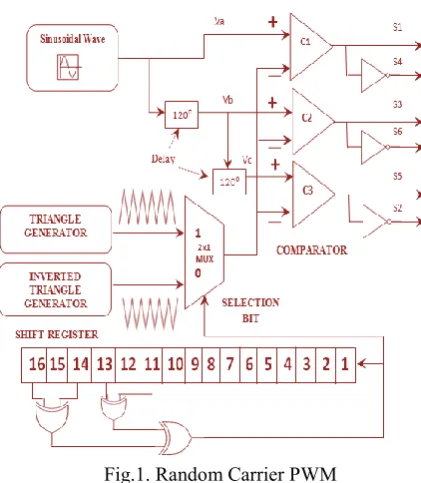
Fig.1. Random Carrier PWM
Fig. 1 illustrates the randomized triangular carrier‟s cohort. As exposed in Fig.1, the triangular carriers with immovable frequency „fc+‟ and the triangular carriers with fixed frequency but opposite phase „fc-‟ are given as input to the 2×1 multiplexer. Together, these frequencies (fc+ and fc-) are same. The randomized triangular carriers „R‟ can be found erratically choosing the fc + and fc- by the PRBS output bits 0 or 1 of the chance bit maker. In command to find the arbitrary bit quantity for picking the charming triangle, a success progressive digital circuit with great quantity of different situations (bigger repetition cycle) is mandatory. Since, the unpredictability does not depend only on two distinct carriers but also on the successive form used for mixture. LFSR is the finest key to suggestion the beyond condition (moral chance). The theory of LFSR is built on the logical action of some bits of a digital amount and is normally known as pseudo PWM code producer in communiqué methods [14]. In this paper, 16 bits LFSR through a feedback of four tapings is cast-off besides the comment sources the inventory to loop over tedious systems of pseudo-random worth. The special taps regulates how many standards there are in an agreed sorting previously in the arrangement recurrences. The finest tapping bit figures are used for logical XOR operation (Bits 4, 5 and
software. A three-phase VSI inverter by three-phase Squirrel Cage Induction Motor (0.75 kW and 2.5 A load) is measured. The input dc voltage (Vdc) is 415V besides the output frequency is reserved as 50 Hz. The switching frequency of SPWM is 3 kHz, although the RPWM employs ±3kHz. The line voltage and current waveforms caused from SPWM are illustrated in Fig.2 and Fig.3 correspondingly for modulation index, Ma=0.8.
Fig. 2. Simulated line-line voltage waveform for Ma=0.8
Table 1. Performance of SPWM Simulation Results
Modulation Index (Ma)
Output Voltage
(V0)
THD (%)
HSF
0.2 75.26 240.66 4.8808
0.4 136.75 168.02 4.6210
0.6 211.05 122.01 4.5554
0.8 293.75 89.10 4.0572
1.0 367.25 66.07 3.6786
1.2 395.15 58.16 3.4591
Table 2. Performance of RCPWM Simulation Results
Modulati on Index
(Ma)
Output Voltage (V0)
THD (%)
HSF
0.2 49.00 257.92 8.262
0.4 75.81 164.26 6.092
0.6 113.95 121.05 5.83
0.8 153.25 90.55 5.516
0.9 170.25 80.67 5.112
1.0 190.85 68.37 4.902
Fig. 3. Simulated line current waveform for Ma=0.8
Fig. 4. Spectrum of output voltage
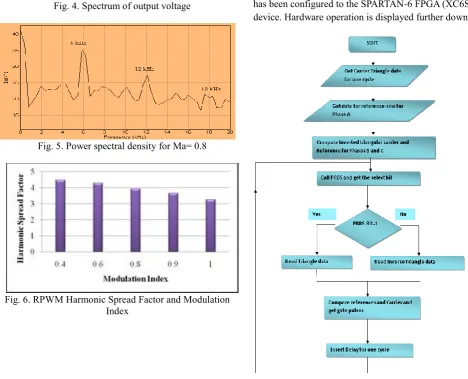
Fig. 5. Power spectral density for Ma= 0.8
Fig. 6. RPWM Harmonic Spread Factor and Modulation Index
Fig. 7. Hardware implementation
4. HARDWARE IMPLEMENTATION
The planned Random Carrier PWM construction has an intended function using the VHDL language. The useful simulation of the architecture has remained out by means of the tool Modelsim 6.3. The Register Transfer Level (RTL) level corroboration after execution stand ended with the make tool Xilinx ISE 13.2. Then the designed architecture has been configured to the SPARTAN-6 FPGA (XC6SLX45) device. Hardware operation is displayed further down.
0.01 0.02 0.03 0.04 0.05 0.06 0.07 0.08 0.09 0.1
-100 0 100
ia
(A
)
0.01 0.02 0.03 0.04 0.05 0.06 0.07 0.08 0.09 0.1
-100 0 100
ib(
A
)
0.01 0.02 0.03 0.04 0.05 0.06 0.07 0.08 0.09 0.1
-100 0 100
ic
(A
)
Device Utilization Summary (estimated values)
Logic Utilization Used Available Utilization
Number of Slice Registers 325 30064 1%
Number of Slice LUTs 793 15032 5%
Number of fully used
LUT-FF pairs 228 890 25%
Number of bonded IOBs 10 186 5%
Number of BUFG / BUFG
CTRLs 5 16 31%
Number of DSP48A1s 3 38 7%
The algorithm elaborate in the RCPWM operation is diagramed in Fig.7. The triangular data is primed first and inverse triangular data is resulting from it. From the fed sine reference data of „A‟ phase, data from „B‟ and „C‟ phases are derived. Now the entitled LSFR sequence, choice amongst the carriers and its evaluation by means of the reference results in vital pulses intended for the VSI. The replicated VHDL Design of the RCPWM architecture is synthesized using Xilinx ISE software. The RTL verification and logic implementation of the design are carried out of here. The agreeing production outcomes are revealed in Fig10. The power approximation for the considered architecture has been ready to consuming the Xilinx control estimator tool (Xpower Estimator (XPE)-14.1).
Fig. 8. MATLAB Simulation Results
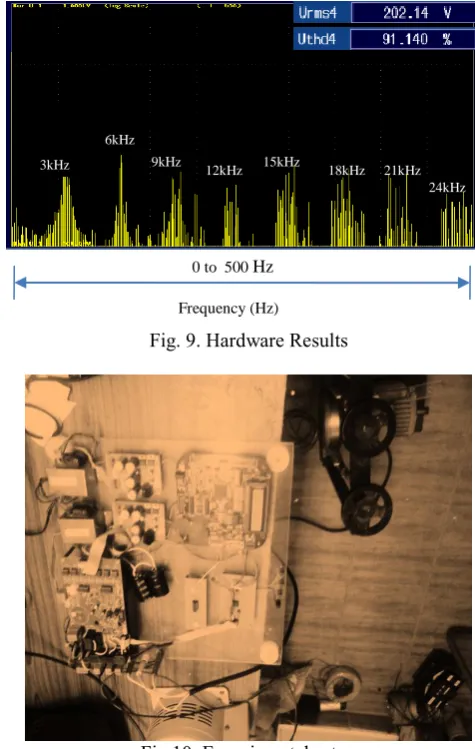
The generated design of RCPWM architecture is relocated to the FPGA Spartan 6 device (XC6SLX45) with the support of device programming software “DIGILENT ADEPT”. The
depicted in Fig.10.
Fig. 9. Hardware Results
Fig.10. Experimental setup
Table 3. Comparison of Simulation and Hardware Results-RCPWM
Simulation Results
Hardware Results Modulatio
n Index (Ma)
o/p Voltage
(V)
THD (%)
o/p Voltage
(V)
THD (%)
0.2 49.13 255.68 47.51 246.89 0.4 103.47 161.54 103.89 101.88 0.6 151.34 122.19 151.63 120.88 0.8 203.92 91.27 202.63 91.47 0.9 227.21 80.56 228.08 79.339 1.0 253.58 69.08 255.17 67.02
5. CONCLUSION
Induction motors are mostly used in manufacturing 3kHz
6kHz
9kHz 12kHz
15kHz 18kHz
21kHz 24kHz Vrms = 202.86 V
3kHz 6kHz
9kHz
12kHz 15kHz 18kHz 21kHz
24kHz
0 to 500 Hz
process immediate, power assessment in addition to temperature dependency are most beneficial for the behavior of numerical equipment to castoff for the controller resolution. The capability of the RPWM for harmonic power scattering is authorized by the replication training although the precise simulation of the RPWM in FPGA podium is proven by the hardware outcomes. The RCPWM offers higher output voltage, minor THD and slight HSF than the SPWM for the total rewarded generous.
APPENDIX
Power (P)………0.75kW Line- Line Voltage (VL)…….……..415 V Frequency (f)……….…..….50 Hz Stator Resistance (Rs) ………….…435O Stator Inductance (Ls) .………5839H Rotor Resistance (Rr)………...1.395O Rotor Inductance (Lr)………...0.005839H Inertia (J)….………….…….……....0.0131Kgm2 Friction factor………...0.0029Nms Pole Pairs……….….2
REFERENCES
[1] VikramKaura and Vladimir Blasko, “A new method to extend linearity of a sinusoidal PWM in the over modulation region,” IEEE Transaction on Industry Applications, vol.32, no.5, pp.1115-1121, Sep./Oct., 1996.
[2] Ahmet M. Hava, Russel J. Kerkman, and Thomas A. Lipo, “Carrier-Based PWM-VSI Over modulation Strategies: Analysis, Comparison, and Design,” IEEE Transactions on Power Electronics, vol. 13, no. 4, pp.674-689, July 1998.
[3] Michael A. Boost, and Phoivos D. Ziogas, “State -of -Art– Carrier PWM Techniques: A Critical Evaluation,”
IEEE Transactions Industry Applications, Vol.24, No.2, pp.271-280 March/April 1998.
[4] Jarin T, Subburaj P “Behaviour of Non- deterministic PWM Methods and Influence of DC Link Fluctuation in Harmonic Spreading Effect of VSI Output Voltage Spectrum” International Journal of Applied Engineering Research, Vol. 10 No.20., pp. 2110-2115, (2015).
[5] V.G. Agelidis, and D. Vincenti, "Optimum Non-Deterministic Pulse Width Modulation for Three-phase Inverters," in Conf. Rec. IEEE IECON 1993.
[6] Jarin T, Subburaj P “Comprehensive Investigation on Harmonic Spreading Effects of SPWM and RPWM Methods” European Journal of Scientific Research. Vol. 103 No 2 June, 2013, pp.296 – 303.
[7] A. M. Trzynadlowski, S. Legowski, and R. L. Kirlin, “Random pulse width modulation technique for voltage controlled power inverters,” in Conf. Rec. IEEE—IAS Annu. Meeting, 1987, pp. 863–868.
[8] Jarin T. , P. Subburaj and Shibu J V Bright “A Ripple Rejection Inherited RPWM for VSI Working with Fluctuating DC Link Voltage” Journal of Electrical Engineering & Technology.2015; 10(5): 709-718.
[9] Jarin T., P. Subburaj and Shibu J V “Performance Evaluation and Experimental Validation of Random Pulse Position Pwm for Industrial Drives” African Journal of Basic & Applied Sciences vol.7, no.3, pp.137-146, 2015.
[10] Sivarani T.S., Joseph Jawhar S., Agees Kumar C. “Intensive random carrier pulse width modulation for induction motor drives based on hopping between discrete carrier frequencies”, IET Power Electronics.
[11] Yun Wan and Jianguo Jiang, “The study of FPGA-based three-level SVM NPC inverter”, Proceedings of IEEE 6th International Power Electronics and Motion Control Conference (IPEMC '09), pp.- 1470 - 1474 , 2009. Wuhan.
[12] Sutikno, T.et. al., “FPGA based five-phase sinusoidal PWM generator”, Proceedings of IEEE International Conference on Power and Energy (PECon-2012), pp.314 – 318, 2012, Kota Kinabalu.
[13] Alfonso Carlosena, Wing-Yee Chu, Bertan Bakkaloglu, and SayfeKiaei,” Randomized Carrier PWM With Exponential Frequency Mapping”, IEEE Transactions on Power Electronics, Vol.22, no.3, pp-960-966May 2007.