Abstract—
At present work, an experiment to dissolve titanium from Indonesian Ilmenite into the sulfuric acid solutions was carried out through a decomposition process using aqueous KOH solutions, and it was followed with titanium dissolution from decomposed Ilmenite into the aqueous sulfuric acid solutions. Ilmenite decomposition process was done by using 10 mol/liter aqueous potassium hydroxide at temperature 150 o C for 4 hours in the autoclave and titanium dissolution from decomposed Ilmenite into the aqueous sulfuric acid solutions was carried out in the three neck glass reactor. The variable used for dissolution process were covering: dissolution temperature from 50 0 C up to 125 0 C, sulfuric acid concentrations from 50 % up to 75 % and dissolution time from 30 minutes up to 360 minutes. The effect of all those variables were observed on the titanium and iron dissolution from decomposed Ilmenite, whereas the titanium and iron dissolved into the aqueous sulfuric acid solutions were represented as a fraction of titanium [XTi] and a fraction of iron [XFe] dissolved
from decomposed Ilmenite. The result of the dissolution experiments show that [XTi] increased when the dissolution
temperature were increased from 50 o C to 125 o C and sulfuric acid concentration were increased from 50 % to 75 %. In case of iron, at dissolution temperature 50oC, [XFe] increased when the
sulfuric acid concentration were increased from 50 % to 75 % , however at dissolution temperature 75 0 C, [XFe] was slightly
decreased when the sulfuric acid concentration were increased from 50 % to 75%. Almost 85 % of titanium and 30 % of iron were dissolved into the aqueous sulfuric acid solution when the decomposed ilmenite were dissolve into 75 % sulfuric acid solutions at dissolution temperature 125 o C and dissolution time 2 hours. From the kinetical study, the titanium dissolution from decomposed ilmenite follows the diffusion control model, with activated energy 59 Kj/mole.
Index Term-- Decomposed Ilmenite, sulfuric acid, titanium dissolution
I. INTRODUCTION
Ilmenite is a name of mineral that has a chemical formula
This work was supported by the competitive research program of the Indonesian Institute of Sciences.
Rudi Subagja is with Research Centre for Metallurgy, Indonesian Institute of Sciences (LIPI), Gedung 470, Kawasan Puspiptek Serpong, Tangerang Selatan, Banten, Indonesia (e-mail: [email protected]).
Lia Andriyah is with Research Centre for Metallurgy, Indonesian Institute of Sciences (LIPI), Gedung 470, Kawasan Puspiptek Serpong, Tangerang Selatan, Banten, Indonesia (e-mail: [email protected]).
Latifa Hanum Lalasari is with Research Centre for Metallurgy – Indonesian Institute of Sciences (LIPI), and now She is a PhD Candidate at Department of Metallurgy and Material, University of Indonesia (e-mail:
FeTiO3. The potential used of Ilmenite is for TiO2, titanium metal and iron productions, but in the world, almost 95 % of titanium containing in titanium feedstock are for TiO2 production and only 5 % in feedstock were converted to titanium metal [1]. TiO2 is one of common used material in the chemical Industries, it is widely used in many applications such as a pigment for paint production, additive for paper manufacturing, ceramic industries, pharmaceuticals industries and recently for photo catalyst application[2-5].
Indonesia has a potential resources for Ilmenite, but those ilmenite are not well utilized due to the appropriate technology for processing it is un available. Therefore, there are some research activities are being developed at the Research Centre for Metallurgy-Indonesian Institute of sciences (RCM-LIPI) to find an appropriate processing technology for recovering TiO2 from Indonesian Ilmenite, and the current research work is one of those research activities.
In the world, there are many research activities to utilize Ilmenite for TiO2 production. Those processes are categorized into pyro metallurgical process, hydrometallurgical process or the combination of both those processes. In the pyro metallurgical process, Ilmenite is reduced by reducing agent such as anthracite, then it was melt to produce molten iron and slag containing TiO2 [6-9] . Another alternative process are through a hydrometallurgical ways which uses sulfuric
acid[10-13] or hydrochloric acid[14-17]. Beside those processes,
recently a process for separation of iron from ilmenite through the decomposition process which is followed by the dissolution process by using acid was developed by Xue et all[18]. At this process, the TiO2 containing slag was reacted with NaOH at temperatures 400 o C up to 475 o C in the atmospheric pressure. The decomposed Ilmenite was then washed by water and reacted with hydro chloric acid to dissolve titanium. Their result of experiment shows that almost 95-98 % of titanium was extracted from slag.
Another process is Ilmenite leaching by using NaOH at temperature 200 o C and pressure 6 bars [19]. Their result of experiment show that almost 90 % of titanium were extracted from sodium titanate.
As an alternative process to decompose Ilmenite by alkaline, KOH based decomposition process were developed by Liu et all [20] , Tong et all [21] , A.A. Nayl et all [22], and Rudi Subagja et all which studied the decomposition of
Titanium Dissolution from Indonesian Ilmenite
Rudi Subagja
1), Lia Andriyah
2), Latifa Hanum Lalasari
3)1)2)3)
Ilmenite with aqueous KOH solution by using autoclave[23] . Reffering to those research activities there is no research concern with kinetic study of titanium dissolution from Indonesian decomposed Ilmenite, therefore, at present work a kinetical study for the dissolution of titanium from Indonesian decomposed Ilmenite are studied.
II. METHODEOF EXPERIMENT
A. The Raw material for experiment
The raw material Ilmenite used for experiment was received from Bangka Island Indonesia. Another raw material for experiment were an analytical grade potassium hydroxide (KOH), analytical grade sulfuric acid (H2SO4), and aqua de mineral water.
B. The Equipment for experiment
Two equipments were used at this experiment, i.e. the equipment for Ilmenite decomposition process and the equipment for titanium dissolution from decomposed Ilmenite. The Ilmenite decomposition process was carried out in 2 liter capacities autoclave that was completed with a Teflon lining stirrer, and the inner side of the autoclave was lined with Teflon. This equipment can be operated up to 200 0 C and heated by using electrical heater, and it was completed with temperature controller. The titanium dissolution from decomposed Ilmenite was carried out in the 3 neck Erlenmeyer glass reactor that has a capacities 0,5 liter, and it was heated by using oil bath heater, and in order to prevent the excessive evaporation of the solution, the 3 neck Erlenmeyer glass reactor was equipped with condenser, and agitation of the solution in the reactor was done by magnetic stirrer.
C. Procedure for experiment
i. Procedure for Ilmenite decomposition
Ilmenite decomposition was carried out by reacting the -100 mesh particle size of Ilmenite with 10 mol/liter aqueous KOH solution at 150 0 C for 4 hours in the autoclave. After decomposition finished, the mixed solution and solid were flowed out from the autoclave and it was filtered to separate solid from solution. The solid was then used for dissolution experiment.
ii. The procedure for dissolution experiment
The dissolution experiment to dissolve titanium from decomposed ilmenite was carried out by using an aqueous sulfuric acid solutions, in 500 ml capacities of the 3 neck Erlenmeyer glass reactor. At the dissolution experiment, 300 ml of aqueous sulfuric acid solutions with certainties concentration were fed in to the glasses reactor. The solution was then heated by using oil bath heater until the desired temperature was reached. After the desired temperature was reached, 50 gram of decomposed Ilmenite was fed into the glass reactor. The experiment was carried out at certainties period of time and temperature. After the experiment finished, the mixed solution and solid were flowed out from the reactor, and then it were filtered. The solution after filtering process
was then analyzed by using Atomic Absorption
Spectrophotometer (AAS) to determine the titanium and iron content in the solutions.
III. THERESULTOF EXPERIMENT
A. The Characteristic of Bangka Ilmenite
A chemical composition of Bangka Ilmenite before decomposition process was analyzed by using X-Ray Fluorescence (XRF). The result is presented at Table 1, which shows that the dominant compound exist in Bangka Ilmenite are Fe2O3 and TiO2. Another compound which also exist in Bangka Ilmenite areMgO, CaO, K2O, P2O5, Cr2O3, SnO2 but their quantities are lower than Fe2O3 and TiO2. This result of chemical analysis are in a good coorelation with the result of phase identification by using X-Ray diffraction (XRD) at figure 1, which shows that the dominant phase exist in Bangka Ilmenite are (FeTiO3) and SnO2. Another phases could not be detected due to their quantities are relatively lower as we observe from the result of analysis by using XRF at Table I.
Table I
Chemical composition of Bangka Ilmenite
Compound Wt %
Fe2O3 49,44
TiO2 38,30
SiO2 1,76
Al2O3 1,78
MnO 2,00
MgO 1,44
CaO 0,08
K2O 0,03
P2O5 0,17
Cr2O3 2,66
SnO2 1,16
B. The micro structure of decomposed Ilmenite
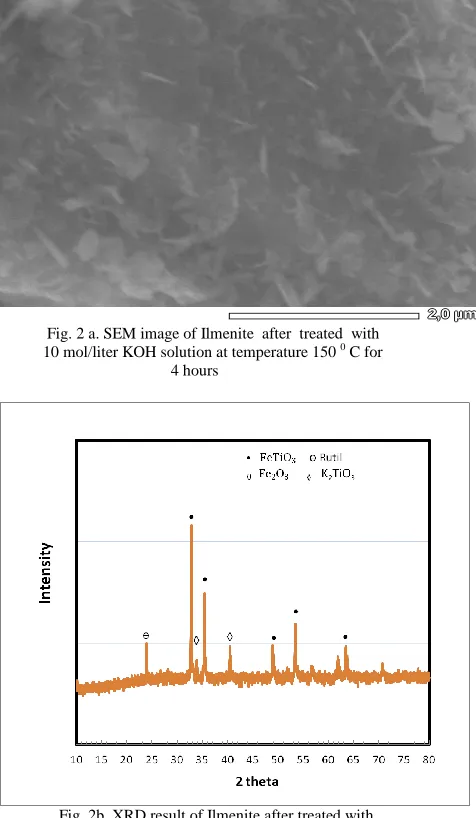
The micro structure of Ilmenite after reaction with 10 mol/liter aqueous KOH solution at temperature 150 o C for decomposition time 4 hours are respectivelly presented at figure 2a for the result of observation by using Scanning Electron Microscoup (SEM) and figure 2b for the result of observation by using XRD.
2,0 µm2,0 µm2,0 µm2,0 µm2,0 µm Fig. 2 a. SEM image of Ilmenite after treated with
10 mol/liter KOH solution at temperature 150 0 C for 4 hours
Fig. 2b. XRD result of Ilmenite after treated with 10 mol/liter KOH at temperature 150 o C for 4 hours
From the result of XRD analysis at figure 2b, we observed that the phase exist at decomposed ilmenite are FeTiO3, rutil, Fe2O3, and K2TiO3. This result of phase identification different with the results of Liu [20] and A.A Nayl [22] experiments. They found that K4Ti3O8 phase was found at their ilmenite decomposition products. The difference of our result with their result maybe due to the KOH consumption in our decomposition experiment were lower than their consumption. Liu carried out decomposition experiment by using 70 % up to 84 % KOH and A.A Nayl used 70 % KOH
solutions for decomposition process and our experiment used lower concentration KOH.
C. Effect of Sulfuric acid concentrations on titanium and iron dissolution from decomposed Ilmenite
The decomposed Ilmenite as a raw material for dissolution experiment was Ilmenite which has been reacted with 10 mol/liter aqueous potassium hydroxide solutions at temperature 150 o C for 4 hours in the autoclave.
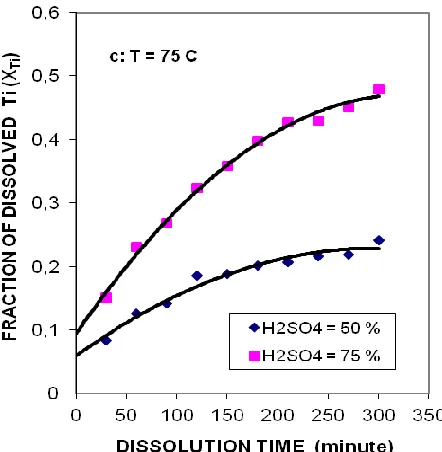
The dissolution experiment was caried out by using sulfuric acid solutions with concentration 50 % and 75 %, and the dissolution temperatures were 50 o C and 75 o C. The results of titanium and iron dissolution from decomposed Ilmenite at temperature 50 o C are presented at figure 3a and figure 3b, and the results of titanium and iron dissolution from decomposed Ilmenite at temperature 75 o C are presented at figure 4a and figure 4b, whereas the titanium dissolved from decomposed Ilmenite into the aqueous sulfuric acid solution is stated as a fraction of titanium dissolved from decomposed Ilmenite into the aqueous sulfuric acid solutions (Xti), and the iron dissolved from decomposed Ilmenite into the aqueous sulfuric acid solution is stated as a fraction of iron dissolved from decomposed Ilmenite into the aqueous sulfuric acid solutions (XFe), which are represented by equation 1 and equation 2.
Fig. 3a. The effect of sulfuric acid concentration on the dissolution of titanium from decomposed Ilmenite at dissolution temperature 50 o C
The fraction of titanium dissolved:
XTi = (CTi x V)/(YTi x W) ...(1)
X Fe = (C Fe x V)/(Y Fe x W ) ...(2)
Where,
C Ti = concentration of titanium in the leached solution C Fe = concentration of iron in the leached solution V = Total volume of the leached solution
Y Ti = weight percent of titanium in the decomposed Ilmenite Y Fe = weight percent of Iron in the decomposed Ilmenite W = Total weight of decomposed Ilmenite
Fig. 3b. The effect of sulfuric acid concentration on the dissolution of iron from decomposed Ilmenite at dissolution temperature 50 o C
Fig. 4a. The effect of sulfuric acid concentration on the dissolution of Titanium from decomposed Ilmenite at dissolution temperature 75 o C
Fig. 4b. The effect of sulfuric acid concentration on the dissolution of iron from decomposed Ilmenite at dissolution temperature 75 o C
The result of dissolution experiment at figure 3a and figure 3b show that at temperature 50 o C, the fraction of titanium and iron dissolved from decomposed Ilmenite increased when the sulfuric acid concentration were increased from 50 % to 75 %. This increase of the fraction of titanium dissolved into sulfuric acid solutions is probably due to ionic titanium form a complex species with SO4= and HSO4-. The increase of sulfuric acid concentration from 50 % to 75 % enhance the complex formation of titanium that lead to increase the number of titanium dissolved into the acid solutions.
The result of experiment at figure 4a and figure 4b show that at dissolution temperature 75 o C, the fraction of titanium dissolved into the aqueous sulfuric acid solution increased but the fraction of iron dissolved into the aqueous sulfuric acid solution slightly decreased when the sulfuric acid concentration was increased from 50 % to 75 %.
D. The effect of temperature on the titanium and iron dissolution from decomposed Ilmenite
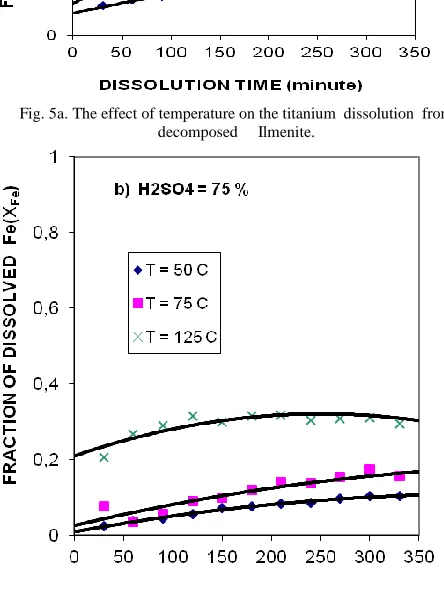
dissolutions temperature were increased from 50 o C to 125 0 C. These results of experiments have a same tendencies with A.A. Nayl experimental results which conducted an experiment to dissolve titanium from decomposed Ilmenite by using 6 M H2SO4. Their results of experiment show that when the dissolution temperature were increased from 25 0 C to 200 o C, the titanium and iron dissolved into sulfuric acid solutions
increased[22].
The result of experiments at Figure 5a and figure 5b show that when the dissolution experiments were caried out at temperature 125 0 C and dissolution time 120 minutes, almost 85 % of titanium and 30 % of iron were dissolved into the aqueous sulfuric acid solutions. However when the dissolution time was extended up to 360 minutes, the fraction of titanium and iron dissolved into the aqueous sulfuric acid solutions were nearly constant.
Fig. 5a. The effect of temperature on the titanium dissolution from decomposed Ilmenite.
Fig. 5b. The effect of temperature on iron dissolution from decomposed Ilmenite.
E. The Kinetics model
With an assumptions that the decomposed Ilmenite has a homogeneity spherical structure, in current study the shrinking core model is adopted from levenspiel [24]. There are two alternative models are selected to explain the kinetics for dissolution reaction of titanium from decomposed Ilmenite i,e a chemical reaction control model and diffusion control model. The equation for a chemical reaction control are represented by equation 3:
1 - (1 – X Ti ) 1/3 = kt ...(3)
and the equation for diffusion control are represented by equation 4
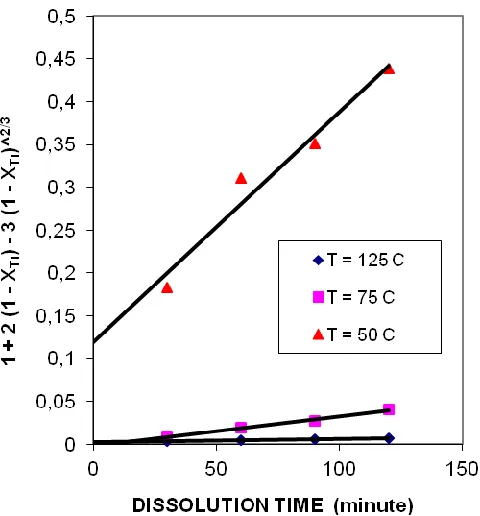
1 + 2 ( 1- X Ti ) – 3 (1- X Ti )2/3 = k t...(4)
Where X Ti is a fraction of titanium dissolved into the aqueous sulfuric acid solutions, k is a rate constant and t is a dissolution time. In current study, to decide a suitable kinetical model for the titanium dissolution from the decomposed ilmenite in to the aqueous sulfuric acid solutions, the fraction of titanium dissolved in to the sulfuric acid solutions, which is obtained from figure 5a were substituted in to the equation 3 and equation 4. The result are represented at figure 6 for equation 3 and at figure 7 for equation 4. The Linear regreation analysis then was aplied to equation 3 and equation 4 at various temperature. The result is represented with tabel 2 which is showing a comparation of linearity for equation 3 (Chemical reaction control model) and equation 4 (diffusion control model) at various temperature obtained from linear regreation analysis.
Fig. 6. Ploting of 1 - (1 – X) 1/3 versus reaction time
Table II
Linear regreation analysis of equation 3 and equation 4 at various temperature obtained by curve fitting
Temp. o C
Linearity of equation 3 for Chemical reaction control model
Linearity of equation 4 for diffusion control model
50 0,9956 0,9604
75 0,9824 0,9872
From the result of linear regreation analysis of equation 3 and equation 4 at table II, we observe that equation 4 ( plotting of 1 + 2 ( 1-X) – 3 (1-X)2/3 versus time) is more linear than equation 3 ( plotting of 1 - (1 – X) 1/3 versus time}. This result of analysis lead to the conclusion that the diffusion control model as represented by equation 4 is a suitable model for the dissolution of titanium from the decomposed Ilmenite.
Fig. 7. Ploting of 1 + 2 ( 1-X) – 3 (1-X)2/3 versus reaction time
F. Activation Energy for the dissolution of Titanium from decomposed Ilmenit
By using the Arrhenius law, the relationship between a rate constant k in equation 4 with temperature are represented by equation 6 as follows:
„k = A exp (-EA/RT) ...(6)
Where k is a reaction rate constant, A is Arrhenius constant (minute-1), R is ideal gas constant 8.314 Joule/Kelvin-mole, T is temperature in Kelvin and EA is activation energy (joule/mole).
By plotting ln k from equation 6 with (1/T) as shown in figure 8, we can get the activation energy 59 KJ/mole for the reaction of decomposed Ilmenite with sulfuric acid solutions.
Fig. 8. Arrhenius curve for dissolution titanium from decomposed Ilmenite
IV. CONCLUSION
The dissolution experiment to dissolve titanium from Bangka Island Indonesia Ilmenite into the aqueous sulfuric acid solutions has been studied by using 2 step process approach i.e decomposition proces in which Ilmenite was decomposed with 10 mol/liter aqueous KOH solutions at temperature 150 o C for 4 hours in the autoclave and it was followed by titanium dissolution from decomposed Ilmenite into the aqueous sulfuric acid solutions. From the result of experiments, it is concluded that:
1. At dissolution temperature 50 o C, the fraction of titanium and iron dissolved from decomposed Ilmenite into the aqueous sulfuric acid solutions increased when sulfuric acid concentration were increased from 50 % to 75 %.
2. At dissolution temperature 75 o C, the fraction of titanium dissolved into the aqueous sulfuric acid solution increased but the fraction of iron dissolved in to the aqueous sulfuric acid solutions was slightly decreased wen the sulfuric acid concentration were increased from 50 % to 75 %
3. At dissolution experiments using aqueous sulfuric acid solutions with concentration 75 %, the fraction of titanium and iron dissolved from decomposed ilmenite into the aqueous sulfuric acid solutions increased when the dissolution temperatures were increased from 50 o C to 125 o C. Almost 85 % of titanium and 30 % of iron were dissolved from decomposed Ilmenite into aqueous sulfuric acid solutions at dissolution temperature 125 o C and dissolution time 120 minutes .
ACKNOWLEDGEMENTS
The authors wish to thank the Indonesian Institute of Sciences (LIPI) for the financial support through the competitive LIPI program, and P.T Timah Indonesia for supporting the raw material Ilmenite for experiment.
REFERENCES
[1]Mineral sands annual review, Victoria park W. Australia: Minerals international Pty. Ltd, 2008
[2]Wensheng Zhang, Zhaowu Zhu, Chu Yong Cheng, “A literature review of titanium metallurgical processes”, Hydrometallurgy, 108, pp. 177–188, 2011
[3]A. Fujishima, K. Honda, Nature 238, p. 37, 1972.
[4]A. Fujishima, K. Kohayakawa, K. Honda, J. Electrochem. Soc. 122, 1487 , 1975
[5]A. Fujishima, T.N. Rao, D.A. Tryk, J. Photochem. Photobiol. C: Photochem. Rev. 1 (1), p. 1, 2000
[6]Tsuchida, H., Narita, E., Takeuchi, H., Adachi, M., Okabe, T., “Manufacture of high pure titanium (IV) oxide by the chloride, process: 1. Kinetic study of ilmenite ore in concentrated, hydrochloric acid solution”, Bull. Chem. Soc. Jpn. 55 (6), pp. 1934–1938, 1982.
[7]Mohanty, S.P., Smith, K.A., “Alkali metal catalysis of carbothermic reaction of ilmenite”, Trans. Inst. Min. Metall. 102, C163–C173 (September to December), 1993.
[8]Mackey, T.S., “Upgrading ilmenite into a high-grade synthetic rutile. JOM, pp. 59–64, April, 1994.
[9]Mahmoud, Y.D., Georges, J.K., “Processing titanium and lithium for reduced-cost application”, JOM 49 (6), pp. 20–27, June, 1997. [10] Han, K.N., Rubcumintara, T., Fuerstenau, M.C., “Leaching
behavior of ilmenite with sulfuric acid”, Metall. Trans. 18B, pp. 325–330, 1986.
[11] Jagasekera, S.,Marinovich,Y.,Avraamides, J., Baily, S.I.,“Pressure leaching of reduced ilmenite”, Hydrometallurgy 39, pp. 183–199, 1995.
[12] Sasikumar, C., Rao, D.S., Srikanth, S., Ravikumar, B., Mukhopadhyay, N.K., Mehrotra, S.P., “Effect of mechanical activation on the kinetics of sulfuric acid leaching of beach sand ilmenite from Orissa, Indian”, Hydrometallurgy, 75, pp. 189–204, 2004.
[13] Liang, B., Li, C., Zhang, C.G., Zhang, Y.K., “Leaching kinetics of Panzhihua ilmenite in sulfuric acid”, Hydrometallurgy, 76, pp. 173–179, 2005.
[14] Olanipekun, E., “A kinetic study of the leaching of a Nigerian ilmenite ore by hydrochloric acid”, Hydrometallurgy, 53, pp. 1– 10, 1999.
[15] Lanyon, M.R., Lwin, T., Merritt, R.R., “The dissolution of iron in the hydrochloric acid leach of an ilmenite concentrate”, Hydrometallurgy , 51 (3), pp. 299–323, 1999.
[16] Ogasawara, T., Veloso de Araiyo, R.V., “Hydrochloric acid leaching of a pre-reduced Brazilian ilmenite concentrate in an autoclave”, Hydrometallurgy, 56 (2), pp. 203–219, 2000.
[17] Van Dyk, J.P., Vegter, N.M., Chris Pistorius, P., “Kinetics of ilmenite dissolution in hydrochloric acid”, Hydrometallurgy, 65, pp. 31–36. 2002.
[18] Xue, T. Wang, L,Qi, Chu, Qw, J Liu, “Decomposition kinetics of Titanium slag in sodium hydroxide system”, Hydrometallurgy, 95, pp. 22-27, 2009.
[19] A.M. Amer, “Alkaline pressure leaching of mechanically activated Rosella Ilmenite concentrate”, Hydrometallurgy, 67, pp. 125 – 133, 2002.
[20] Liu, Y.M., Qi, T., Chu, J.L., Tong, Q., Zhang, Y., “Decomposition of ilmenite by concentrated KOH solution under atmospheric pressure”, International J. Mineral Processing, 81, pp. 79–84. 2006.
[21] Tong, Q.J., Qi, T., Liu, Y.M., “Preparation of potassium titanate whiskers and titanium dioxide from titaniferous slag using KOH
sub-molten salt method”, Chinese J. Process Engineering 7 (1), pp. 85–89, 2007.
[22] A.A. Nayl, H.F. Aly, “Acid leaching of ilmenite decomposed by KOH”, Hydrometallurgy, Vol.97, Issues 1–2, pp. 86–93, June 2009.
[23] Rudi subagja, Lia Andriyah, Latifa Hanum Lalasari “Decomposition of Ilmenite from Bangka Island Indonesia with KOH solutions”, Asian Journal for basic and applied sciences, Vol. 03, no 02, pp 59-64, 2013.