Abstract—In this paper Friction Pendulum Damper (FPD), as an innovative friction damper, has been studied, evaluated and compared with Pall friction damper. At first FPD is introduced and then its modeling and effect on seismic behavior of braced frame structures are studied. To evaluate the effects of radius of curvature and slip-load on structural responses, nonlinear time history analysis of two, three and eight storey steel braced frames with FPD dampers have been conducted under two different earthquakes. Finally, the behavior of steel braced frames equipped with FPD and Pall friction damper are compared. The results show that while some members are damaged in frames without dampers, the FPD and Pall friction damper have dissipated a lot of energy, so that no damage is observed in structural members. Increasing the radius of curvature, leads to more maximum roof displacement but decreases both base shear and roof acceleration. However, increasing the slip load leads to less displacement while base shear and roof acceleration increase. Within the optimum slip load the maximum roof displacement, base shear and acceleration under two earthquakes are approximately reduced 25%, 60% and 25% respectively. The results show that the FPD is more effective than Pall friction damper, so that FPD can reduces the maximum roof displacement 15% more than Pall friction damper. However, the base shear is increased about 20%.
Index Terms—Braced frame, friction pendulum damper (FPD), friction pendulum system (FPS), optimum slip load.
I. INTRODUCTION
In the conventional methods, structures resist against earthquakes via stiffness, ductility and dissipation of energy. Dissipated energy is minor in elastic range due to low damping in structures. The most dissipated energy develops during strong earthquakes after the elastic range behavior. The potential of inelastic displacement makes these structures to be stable. These inelastic displacements cause formation of plastic hinges at some points of structures. As it is known, plastic hinges cause ductility and dissipation of energy to increase. Ultimately, a lot of earthquake energy is dissipated due to local damages in lateral resistant system of structure [1].
Nowadays, another way has been concerned in the world in order to reduce earthquake effects with regard to how energy is distributed in structures. During an earthquake, a lot of energy is imposed to the structure. This energy enters the structure in both kinematic and potential forms absorbed or
dissipated to some degrees. As it is known, structural vibrations will approach infinity without damping, but there is always damping in structures because of structural properties. Also, it is possible to develop efficiency of structure by adding dampers [2].
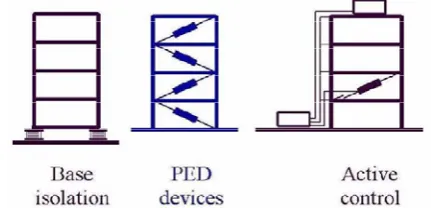
As mentioned, Structures can dissipate a lot of energy during earthquake via ductility, but the incidence of much ductility will be accompanied by formation of plastic hinges at some elements of structure [3]. Energy dissipation systems in buildings cause reduction of damage in structural elements during earthquake and as a result they prevent buildings from demolishing. Generally, Structural protective systems can be divided into three groups of active, semi-active and passive systems (seismic isolation is included in the passive systems). Structural protective systems have been shown in Fig. 1 [4], [5].
Fig. 1. Structural protective systems of structure.
II. FRICTION PENDULUM DAMPER (FPD)
Friction Pendulum Damper has an initial slip-load (μW) and a lateral restoring stiffness (W/R) with regard to its special geometry same as Friction Pendulum System (FPS) in base isolation, where W is supported weight, μis coefficient friction and R is the radius of curvature of concave surface [6]-[9].
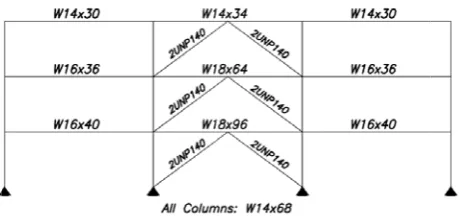
Difference between FPD and Pall friction damper is due to lateral restoring stiffness of FPD. This damper can be designed not to slide under weak earthquake or wind load, but it begins to slide during strong earthquakes under a predetermined force. This slide dissipates the input energy to the structure and prevents braces and other structural elements to yield. The special configuration of FPD dampers should be used in chevron and inverted chevron (V) braces. Fig. 2 indicates this special configuration [10]-[12].
III. MODELING
Models used in this paper for studying Pall friction and Friction Pendulum Dampers have been adopted from Montgomery and Hall researches, in 1979. They evaluated a
Application of Friction Pendulum Damper in Braced
Frames and Its Effects on Structural Response
S. M. Zahrai, M. S. Bozorgvar, and M. H. Bozorgvar
Manuscript received January 12, 2014; revised March 12, 2014. S. Mehdi Zahrai is with Center of Excellence for Engineering and ManagementofCivilInfrastructuresSchool of Civil Engineering, Faculty of Engineering. The Univ. of Tehran, Iran (e-mail: [email protected])
lo da th th ob str to de an of se ar ba flo la de hi ab fr
ow-rise steel in amper by DRA he low-rise ind he structural e bserve the effe
ructure, simpl An 8-story b o the 3-story s
esigned follow nd criterions o f soil material eismic region. re 24000 ton/m ays is 5 meter oors are rigid ateral bearing
esigned witho ighlight the r bsorbing earth ames have be
ndustrial struc AIN-2D prog dustrial mome elements are m fect of lateral r
le braced fram raced structur structure. The wing the requ of National se l is П and stru Yield strength m^2 and 370 rs and height
and weight o of the 8-sto out damper an role of FPD hquake energ
en shown in F
Fig. 2. FPD in ch
Fig. 4. 3-stor
cture equipped gram. Fig. 3 sh nt frame. All modeled nonli restoring stiffn me has been m
re has been ev e 8-story brac uirements of A eismic code of ucture has bee h ( ) and ulti 00 ton/m^2 .S
of the stories f each floor is orey braced s nd 20 percent in reduction gy. 3-storeyan
Fig. 4 and Fig
hevron braced fra
rey braced frame.
d with Pall fri hows properti floors are rigi inearly. In ord ness of FPD o modeled [13]-[
valuated in add ed frame has AISC specific f Iran (2800). en located in a imate strength Span length o s is 3.2 meters s 45 ton. Syste structure has weaker initia n of damage nd 8-storey b
. 5 respectivel
ame. . iction ies of d and der to on the 15]. dition been cation Type a high h ( ) of the s. All em of been ally to e and raced ly. To nonl and unde earth acce Th with unde equip as a energ Th resto curv respo valu with floor A when resto impo displ equip displ FPD To damp cond slip-10-F W maxi shea the s redu
I o evaluate th inear time his without FPD er the El Ce hquakes have
leration of 0.3 he results show h dampers som
er both earthq pped with FPD
friction dam gy.
he main diffe oring force of
ature, R. To onse, the stru es of R (0.5 to h the results o rs are shown f s seen in Fig. n radius of cu oring stiffnes
ortant point lacement at t pped with lacement decr D damper.
o capture the pers different ducted for 3 loads and radi Fig. 13. When slip-load
imum top flo ar increases. T slip load that uction in displa
Fig. 5. 8-storey b
V. NUMERIC he effects of tory analyses D and Pall da entro and T e been norma
36g.
w that when th me braces in bo
quakes. Howe D are not dam mper can dissi ference of FP f FPD that can o conduct the uctures have o 2 m) and th of Pall dampe for different ca 6-Fig. 9, max urvature (R) g ss (W/R) red seen in th the end of e Pall frictio reases with re e optimum s nonlinear tim 3 and 8-stor
iuses of curva d in FPD and P
oor lateral dis The optimum s its increasing acements. Thi
braced frame.
CAL RESULTS FPD on stru of 3 and 8 stor ampers have
abas earthqu alized for ma
he structures a oth 3 and8-stor ever the brace maged. This ind
ipate consider PD with Pall
n be adjusted e effect of R
been analyze e results have er. The time ases in Fig. 6-ximum displac goes up. It is duces as R he figures i earthquake for on damper.
educing R for slip load for me history ana
rey frames u ature. Results a Pall friction da splacement re slip load can b g will not cau is slip load ca
ctural respon ry structure w been conduct uakes. The tw
aximum grou are not equipp rey are damag es of the fram dicates that FP rable amount damper is t by its radius R on structu ed for differe e been compar
histories of t -Fig. 9. cement increas
because, late increases. A s the residu r the structur This residu r structures w
Pall and FP alyses have be
under differe are shown in F amper increas educes and ba
be considered use considerab an be consider
in the range of 160 kN to 220 kN for 3-storey frame and 120 kN to 180 kN for 8-storey frame.
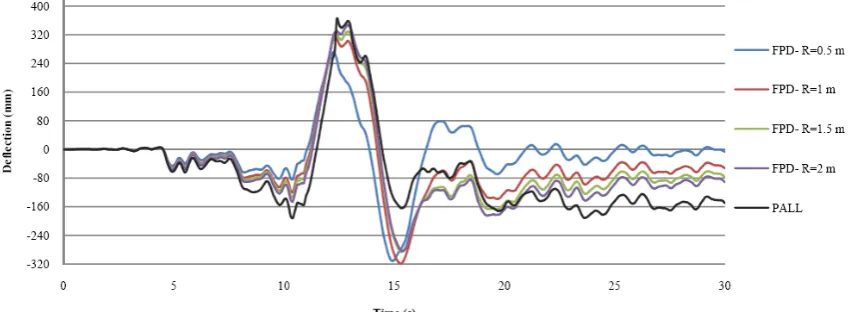
Fig. 6. Top floor lateral deflection for different radiuses of curvature under the El centro earthquake, Slip-Load = 140 kN, 3-storey frame.
Fig. 8. Top Floor lateral deflection for different radiuses of curvature under the El centro earthquake, Slip-Load = 100 kN, 8-storey frame.
Fig. 9. Top floor deflection for different radiuses of curvature under the tabas earthquake, Slip-Load = 100 kN, 8-storey frame.
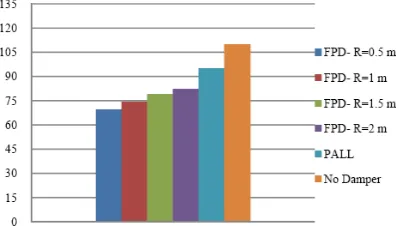
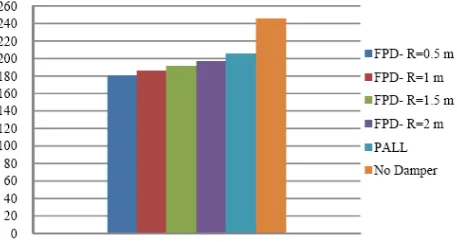
The results of maximum top floor deflection, maximum base shear and maximum top floor acceleration for the frames with and without FPD and Pall friction dampers for various radiuses of curvature and slip-loads of 200 kN (3-storey) and 160 kN (8-storey) are shown in Fig. 14-Fig. 25.
As seen in the figures, the amounts of maximum base shear and maximum top floor displacement are reduced and increased respectively by increasing R of FPD. Also, amount of maximum top floor acceleration is reduced by increasing R but this reduction is not considerable.
Maximum top floor deflection, maximum base shear and maximum top floor acceleration of 3-storey frame equipped with FPD have been reduced 30%, 60% and 24%
respectively in comparison with the 3-storey frame without damper. Also, Maximum top floor deflection of the frame equipped with FPD has been reduced 15% more compared to the frame equipped with Pall friction damper while base shear has increased 20% approximately.
Fig. 10. Changes in maximum top floor of deflection for different slip-loads, El centro earthquake, 3-storey.
Fig. 11. Changes in maximum top floor of deflection for different slip-loads, El centro earthquake, 8-storey.
Fig. 12. Changes in maximum base shear for different slip-loads, El centro earthquake, 3-storey.
Fig. 13. Changes in maximum base shear for different slip-loads, El centro earthquake, 8-storey.
Fig. 14. Maximum top floor deflection (mm), El centro earthquake, 3-storey.
Fig. 15. Maximum top floor deflection (mm), tabas earthquake, 3-storey.
Fig. 16. Maximum Base Shear (kN), El centro earthquake, 3-storey.
Fig. 17. Maximum base shear (kN), tabas earthquake, 3-storey.
Fig. 19. Maximum top floor acceleration (mm/s2), tabas earthquake, 3-storey.
Fig. 20. Maximum top floor deflection (mm), El centro earthquake, 8-storey.
Fig. 21. Maximum top floor deflection (mm), tabas earthquake, 8-storey.
Fig. 22. Maximum base shear (kN), El centro 1942 earthquake, 8-storey.
Fig. 23. Maximum base shear (kN), tabas earthquake, 3-storey.
Fig. 24. Maximum top floor acceleration (mm/s2),El centro 1942 earthquake, 8-storey.
Fig. 25. Maximum top floor acceleration (mm/s2), tabas earthquake, 8-storey.
V. CONCLUSION
1) Results of analyses of the frames equipped with FPD indicates that this damper dissipates considerable energy because no braces equipped with FPD yields while some of elements yield in the brace of frames without damper. 2) Some residual deformations are seen in the structure
equipped with Pall friction damper at the end of earthquake because this type of damper does not have restoring stiffness while, this residual deformation is greatly reduced in the structures equipped with FPD because of restoring stiffness.
3) Radius of curvature (R) is one of the most important parameters on behavior of FPD. If radius of curvature increases, maximum top floor deflection will increase, while base shear and top floor acceleration will be reduced. When R increases, behavior of FPD is quite similar to Pall friction damper.
4) Rise in slip-load of FPD and Pall friction damper is accompanied with reduction of maximum lateral top floor deflection and increase in base shear. There is a range of optimum slip-load for each of these dampers that rise in it will not have substantial effect on reduction of deflection.
5) Friction pendulum damper (FPD) through restoring stiffness (W/R) behaves better than Pall friction damper responses in ordinary braced frames and it has been 15% more effective than Pall in reduction maximum lateral top floor deflection, while base shear has increase quite 20% in FPD against Pall for different radiuses of curvature.
REFERENCES
[2] P. Mahmoodi and L.E. Robertson, “Performance of viscoelastic dampers in world trade center towers,” Dynamic of Structures, Sessions at Structural Congres, pp. 632-624, 1987.
[3] A. S. Whittaker, “Seismic rehabilitation using supplemental damping system,” EQ. Eng. Research at Berkeley, no.430, 1996.
[4] T. T. Soong and G. F. Dargush, Passive Energy Dissipation Systems in Structural Engineering, 1997.
[5] T. T. Soongand and M. C. Constontinou, Passive and Active Vibration Control in Civil Engineering, 1994.
[6] V. A. Zayas, S. S. Low, and S. A. Mahin, “Seismic isolation uses the friction pendulum system,” in Proc. the 10th International Conference on Structural Mechanics in Reactor Technology, Anaheim, California, vol. 6, no. 2, 1989.
[7] V. A. Zayas, S. S. Low, and S. A. Mahin, “The FPS earthquake resisting system,” Earthquake Engineering Research Center, University of California, Berkeley, p. 90, 1987.
[8] M. Garevski and M. Jovanovic, “Influence of friction pendulum system on the response of base isolated structures,” in Proc. 14th World Conference on Earthquake Engineering, Beijing, China, 2008. [9] A. S. Mokha, M. C. Constantinou, A. M. Reinhorn, and V. A. Zayas,
“Experimental study of friction pendulum isolation system,”Journal of Structural Engineering, vol. 117, no. 4, 1991.
[10] Earthquake Protection Systems, “Technical Characteristics of Friction Pendulum Bearings,” 451 Azuar Drive, Bldg. 759, Mare Island, Vallejo, California 94592, 2003.
[11] A.S. Pall and C. Marsh, “Response of friction damped braced frames,”
Journal of Structural Division, ASCE, 1982.
[12] A. Pall and R. T. Pall, “Performance-based design using pall friction dampers an economical design solution,” in Proc. 13th World Conference on Earthquake Engineering, Vancouver, Canada. 2004. [13] A. Filiatrault and S. Cherry, “Efficient numerical modeling for seismic
design of friction damped braced steel plane frames,” Canadian
Journal of Civil Engineering, vol. 16, no. 3, pp. 211-218, 1988.
[14] A. Filiatraultand and S. Cherry, “Comparative performance of friction damped systems and base isolation systemsfor earthquake retrofit and aseismic design,” Earthquake Engineering and Struct. Dynamics, vol. 16, no. 3, pp. 389-416, 1988.
[15] A. Filiatrault and S. Cherry, “Performance evaluation of friction damped braced steel frames under simulated earthquake loads,”
Earthquake Spectra, vol. 3, no. 1, pp. 57-78, 1987.
S. M. Zahrai was born in Tehran, Iran in 1964. He received his B.Sc. in civil engineering from Tehran Polytechnic in 1987, his M.Sc. instructural engineering from the Univ. of Tehran in 1990 and his Ph.D. in structural engineering from the Univ. of Ottawa in 1997.
He has been a professor at the School of Civil Eng., the University of Tehran since 1999. He has authored many publications including 10 books, more than 200 journal and conference papers, so far supervised about 100 theses and research projects, managed and directed lots of large steel and concrete building tower or bridge projects in design and construction phases, served a few conferences as the chairman, and many international journals as member of editorial board or reviewer.
S. M. Zahrai has been also a member of many scientific societies and innovation advisory committees in Iran, awarded a few times for teaching or research and uniquely recognized for about 300 workshops and educational sessions held on different aspects of seismic design, retrofit and construction of steel and concrete building and bridge structures.
Masoud Bozorgvar was born in Mashhad in Iran in 1986. He received his B.Sc. degree in civil engineering from the Islamic Azad University of Mashhad, Mashhad, Iran in 2008 and his M.Sc. degree in structural engineering from the Ferdowsi University of Mashhad, Mashhad, Iran in 2012. He is a PhD student at Islamic Azad university of Arak, Arak, Iran. He has been involved in design and construction of residential buildings. He was responsible for design and construction of structures. His research interests are seismic analyses and structural dynamics.
Mahmood Bozorgvar was born in Mashhad in Iran in 1985. He received his B.Sc. degree in civil engineering from the Iran University of Science and Technology, Tehran, Iran in 2008 and his M.S. degree in structural engineering from the Ferdowsi University of Mashhad, Mashhad, Iran in 2011.
He has been involved in construction of tall buildings. Also, when he was passing his military service, he was responsible for design and construction of industrial structures. He has studied blast loadings on reinforced concrete structures to compare behavior of the structures to blast and earthquake with each other and has paper published on