Throughput and Control Overhead Analysis using CBAODV
Algorithm for Link Breakage in VANET
N. Arulkumar1 and Dr. E. George Dharma Prakash Raj2
1
Asst. Prof., Department of Computer Science, Bishop Heber College, Trichy - 620 017 2
Asst. Prof., Department of Computer Science and Engineering, Bharathidasan University, Trichy - 620 023.
1
[email protected], [email protected]
ABSTRACT
Vehicular Ad hoc Networking (VANET) is a network that helps a vehicle to send information to neighboring vehicles, and data packets are transmitted from one vehicle to another vehicle. In VANET, Connection Breakage is an important issue in the existing routing protocols like Ad hoc On-demand Distance Vector (AODV), DSR, DSDV. In this paper, an analysis of Throughput and Control Overhead is done using our proposed CBAODV Algorithm. The CBAODV allows route discovery and route maintenance and it also reduces the connection breakage. The experimental results are very promising as the proposed algorithm exhibits superior performance with respect to traditional AODV routing algorithm in terms of QoS metrics like Throughput and Control Overhead. NS2 and MOVE tools are used as simulator to simulate the network and to prove the effectiveness of the research work.
Keywords: VANET, Routing Protocol, AODV, Connection/Link Breakage, NS2, Move.
1. INTRODUCTION
In VANET, each vehicle can act as a sender, receiver, and also as a router for data dissemination. It is a technology that is becoming a very interesting domain for research in computer science. The steps are taken to improve the quality of the data transmission and to reduce the risk in Connection Breakage (CB) or Link Failure (LF) or Link Breakage (LB) in VANET. This breakage in connection is also referred as link death. The breakage can happen when a vehicle is communicating with other vehicle or when a vehicle is communicating with the infrastructure like Road Side Terminals (RST). If there is any failure, the sender has to reuse the Route Discovery mechanism to find a route to the destination to deliver messages. Then the route has to be maintained without any breakage till the communication ends [1].
The structure of this research paper is organized as follows: The Related Work and a detailed explanation of AODV
(Ad hoc On-demand Distance Vector) protocol is examined in Section II. Section III introduces the pro-posed Algorithm CBAODV. In Section IV the propro-posed model is simulated and the results are analyzed with QoS parameters to prove the effectiveness of the proposed work.
2. RELATED WORK
The traditional routing algorithms are insufficient to deliver the messages due to draft changes in the mobility, traffic patterns, density of the vehicles, and limitation of the nodes. Routing protocols are classified as Proactive, Reactive and Hybrid. The Proactive Protocols are like table driven which uses periodic updates about the routing information in the network. Eg. FSR, DSDV and OLSR. Reactive Protocols are like On Demand or Source initiated protocol which searches for the shortest path in the net-work to reach the destination. Eg. AODV, DSR and TORA. Hybrid protocols are used to decrease the control overhead of Proactive Protocols and also it will reduce the initial route discovery delay in Reactive Protocols. Eg. ZHLS, ZRP and HARP. [2, 3].
Ad hoc On-demand Distance Vector (AODV) routing protocol is used to find the path on an On-demand basis when a node wants to communicate with other node. The Source Node (SN) broadcasts a Route Requests (RREQs) to the nearby nodes. The Destination Node (DN) unicast a Route Replies (RREPs) to send the response and sets available to receive the data. When there is any Route Error (REER) to the source node. This protocol can sup-port for large network and it also helps to solve the connection breakage problem [4].
proposed and compared Local Repair scheme in AODV-based Ad-Hoc networks. In case of link breakage, the route is managed by finding the next-to-next node to deliver the data [6]. Sarkar et al. proposed an AODV-based technique for quick and secure local recovery from link failures in MANETs. These techniques will also help to collect and manage the mobility information by extending current AOMDV [7].
3. PROPOSED METHOD
The breakage may happen during the communication even when the receiver is in offline or busy mode. The Source Node (SN) generates a request to Destination Node (DN) and it receives the data. The error message is delivered to SN, when there is any link breakage in data transmission [8]. In such case, Road Side Terminals (RST) will act as a DN to deliver the updated information to the SN.
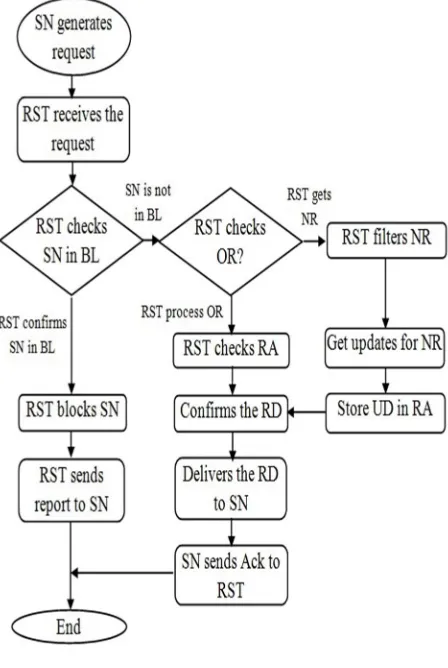
Fig. 1 CBAODV Flowchart
In this proposed method, the breakage can be prevented before it happens and some steps can be taken at the RST even after there is a breakage. The breakage in communication is inspected by transmitting the hello
mes-sages periodically to the nearby nodes [9]. When RST receives the unwanted requests, it will treat the request as Spam and it is add the SN to the Blocked List (BL). To conflict breakage, the RST maintains the list of frequently received requests as Request Archive (RA). If the request is not new one means, it will consider it as Old Request (OR) and RST starts to deliver the Requested Data (RD) itself before updating the information. When RST receives the New Request (NR), it will deliver the Updated Data (UD) after getting the updated information from the Server. The proposed CBAODV flowchart is represented in Fig.1 and the CBAODV algorithm is given below:-
Step 1: RST receives the request
Step 2: Classify request as Old Request (OR) and New Request (NR)
Step 3: Filter the requests and maintains Blocked List (BL)
Step 4: Maintains the frequent requests in Request Archive (RA)
if(OR)
{ RST will deliver the Requested Data (RD); SN sends ACK to RST;
}
else if(NR)
{ RST will deliver the Updated Data (UD); SN sends ACK to RST;
} else
{ continue searching RST for data; }
Step 5: Confirms the data deliver by receiving Acknowl-edgement (Ack).
4. IMPLEMENTATION AND ANALYSIS
The AODV protocol mechanism is selected for the implementation because it maintains the sequence number at the DN to determine the sender and to avoid breakage [10, 11]. It uses Time To Live (TTL) to find the destination node. This value is incremented when the search option begins with ring search method. The TTL values increases until the threshold value is reached. After implementing CBAODV, it gets the number of hops, se-quence number and TTL to transfer the data. The different functions in AODV like Hello-Message i.e. AODV::sendHello(), Send Request and Forwarding Re-quest are taken into consideration to implement the pro-posed model in VANET [12, 13]. The propro-posed algorithm CBAODV is compared with the existing AODV with re-spect to QoS parameters End-End Delay and Packet De-livery Ratio.
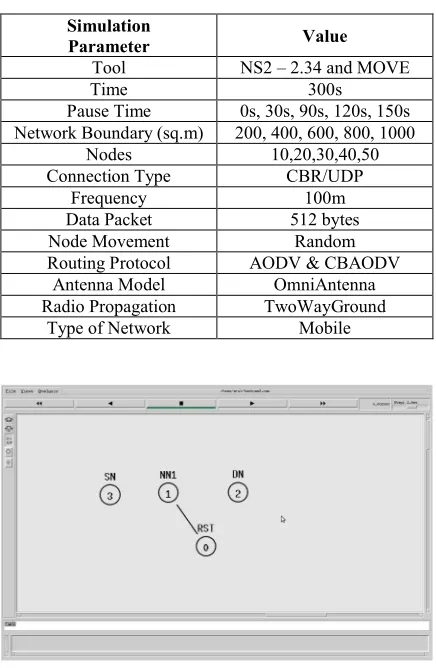
Table 1: Simulation Parameters
Simulation
Parameter Value
Tool NS2 – 2.34 and MOVE
Time 300s
Pause Time 0s, 30s, 90s, 120s, 150s Network Boundary (sq.m) 200, 400, 600, 800, 1000
Nodes 10,20,30,40,50 Connection Type CBR/UDP
Frequency 100m
Data Packet 512 bytes Node Movement Random Routing Protocol AODV & CBAODV
Antenna Model OmniAntenna Radio Propagation TwoWayGround
Type of Network Mobile
Fig. 2. Topology for VANET simulation using CBAODV in NS2
Throughput: It refers to the average data rate of the successful data or message delivery over a specific communication link [14]. The ratio of the number of packets received by Destination Node to the observation time duration.
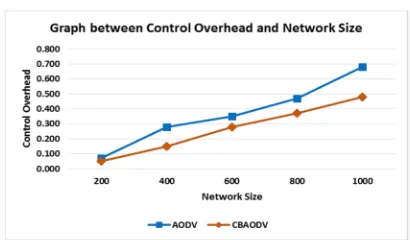
Control Overhead: It is ratio of the control information sent to the actual data received at each node in VANET [15]. It also refers to the processing time required to transmit a data by a node, which includes all the support-ing functions like node discovery, link maintenance, net-work size, netnet-work latency and data transmission.
4.1 Performance analysis of varying number of nodes
In this performance analysis, the number of nodes varies from 10 to 50. The nodes are incremented and the random scenarios are designed to analysis the output by changing the number of nodes. The proposed CBAODV gives more throughput and it faces only less routing overhead when it is compared with AODV model which is shown in Fig. 3 and 4.
Fig. 3. Graph between Throughput and Nodes
Fig. 4. Graph between Control Overhead and Nodes
4.2 Performance analysis of Varying pause time
Fig. 5. Graph between Throughput and Pause Time
Here, each node in VANET environment has var-ious velocity and direction. The Random model is taken into consideration to create various mobility models. The different pause times like 10s, 30s, 90s, 120s and 150s are used to simulate the vehicular node. In this analysis, CBAODV gives more throughput in various pause time and it takes only less overhead when it is analyzed with AODV which is shown in Fig. 5 and 6.
4.3 Performance analysis of varying network size
In this analysis, the network size is taken in dif-ferent levels like 200X200 sqm, 400X400 sqm, 600X600 sqm, 800X800 sqm and 1000X1000 sqm and keeping the number of nodes fixed. The throughput level of CBAODV reduces when the network size increases but it gives better results when compared with AODV which is shown in Fig. 5.
Fig. 7. Graph between Throughput and Network Size
Fig. 8. Graph between Control Overhead and Network Size
4.4 Performance analysis of speed of a node
The speed of the node is changed in different lev-els like 5 m/s, 20 m/s, 40 m/s, 60 m/s and 80 m/s. The CBAODV protocol gives better results when it is compared to AODV. The Control overhead in CBAODV is also less
when it is matched with AODV protocol which is shown in Fig. 6.
Fig. 9. Graph between Throughput and Speed
Fig. 10. Graph between Control Overhead and Speed
5.
CONCLUSION AND FUTURE WORK
REFERENCES
[1] Altayeb, Marwa, and Imad Mahgoub. "A survey of vehicular ad hoc networks routing protocols." Interna-tional Journal of Innovation and Applied Studies 3, no. 3 (2013): 829-846. [2] Al-Sultan, Saif, Moath M. Al-Doori, Ali H. Al-Bayatti, and
Hussien Zedan. "A comprehensive survey on ve-hicular Ad Hoc network." Journal of network and computer applications 37 (2014): 380-392.
[3] Sharef, Baraa T., Raed A. Alsaqour, and Mahamod Is-mail. "Vehicular communication ad hoc routing proto-cols: A survey." Journal of Network and Computer Applications 40 (2014): 363-396.
[4] Arulkumar. N, and E. Raj. "A simulation based study to implement Intelligent Transport Systems concepts in VANETs using AODV routing protocol in NS2." Fourth International conference on Advanced Compu-ting (ICoAC), IEEE, 2012, pp.1-4.
[5] Srinivasan, P., and P. Kamalakkannan. "Enhancing route maintenance in RSEA-AODV for mobile ad hoc networks." Intelligent Systems and Control (ISCO), 2013 7th International Conference on. IEEE, 2013. pp. 464-469. [6] Shin, Hyun-Ho, Seungjin Lee, and Byung-Seo Kim.
"Enhancements for Local Repair in AODV-Based Ad-Hoc Networks." In Grid and Pervasive Computing, pp. 570-576. Springer Berlin Heidelberg, 2013.
[7] Sarkar, Sajal, and Raja Datta. "AODV-based technique for quick and secure local recovery from link failures in MANETs." International Journal of Communication Networks and Distributed Systems 11, no. 1 (2013): 92-116.
[8] Jain, Jyoti, Roopam Gupta, and Tushar K. Bandho-padhyaya. "Performance analysis of proposed local link repair schemes for ad hoc on demand distance vector." Networks, IET 3, no. 2 (2014): 129-136.
[9] Gupta, Charu, and Pankaj Sharma. "An Approach to Link Failure in MANET." IJCSNS 14, no. 11 (2014): 108.
[10] Zaidi, Zainab R., Marius Portmann, and Wee Lum Tan. "Analysis of link break detection using HELLO mes-sages." In Proceedings of the 14th ACM international conference on Modeling, analysis and simulation of wireless and mobile systems, pp. 143-150. ACM, 2011.
[11] Zhang, Qin-Juan, Mu-Qing Wu, Yan Zhen, and Cui-Li Shang. "AODV routing overhead analysis based on link failure probability in MANET." The Journal of China Universities of Posts and Telecommunications 17, no. 5 (2010): 109-115.
[12] Khairnar, Vaishali D., and Dr SN Pradhan. "Simulation Based: Study and Analysis of Routing Protocol in Ve-hicular Ad-hoc Network Environment." arXiv preprint arXiv:1403.6013 (2014).
[13] Das, Sanjoy, Ram Shringar Raw, Indrani Das, and Rajib Sarkar. "Performance analysis of routing protocols for VANETs with real vehicular traces." In Intelligent Computing, Networking, and Informatics, pp. 45-56. Springer India, 2014.
[14] Bala, Raj, and C. Rama Krishna. "Performance analysis of topology based routing in a VANET." In Advances in Computing, Communications and Informatics (ICACCI, 2014 International Conference on, pp. 2180-2184. IEEE, 2014. [15] Omar, Hassan Aboubakr, and Weihua Zhuang. "VeMAC
Performance Evaluation for VANET Safety Applications." In
Time Division Multiple Access For Vehicular Commun-ications, pp. 39-58. Springer Inter-national Publishing, 2014.
AUTHOR PROFILES:
N. Arulkumar is currently working as an Assistant Professor of Computer Science, Bishop Heber College, Trichy. He has completed his Master of Computer Science in 2008 under University of Madras. He has also completed his M.Phil. Computer Science in 2010 and M.Tech. Information Technology in 2012 under Bharathidasan University. At present, he is pursing his Ph.D. in Computer Science under Bharathidasan University. He has published several papers in both Conferences and Journals at National and International level.