CONSTRUCTIVE TECHNIQUES OF THE PAST FOR A
SUSTAINABLE FUTURE. THE CASE OF TRADITIONAL
EARTHEN ARCHITECTURE IN ARAGON (SPAIN)
Laura Villacampa Crespo1, Lidia García-Soriano2, Fernando Vegas López-Manzanares3, Camilla Mileto4
1. INTRODUCTION
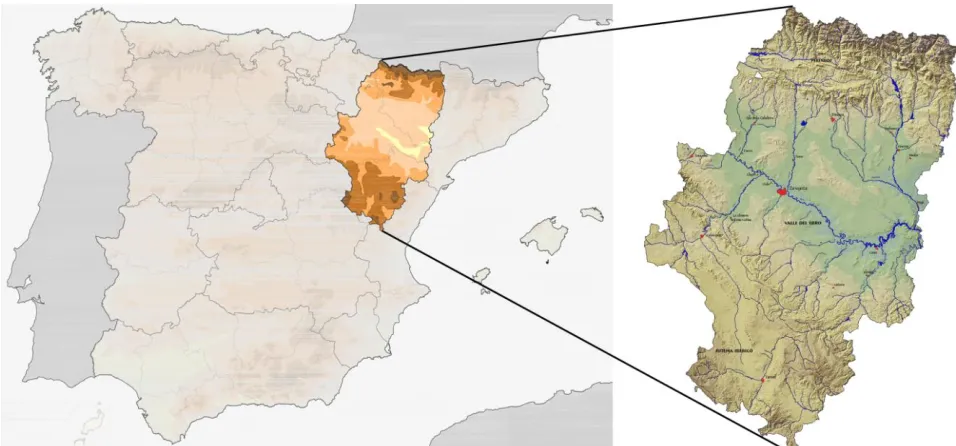
Aragon is a Spanish region in the northwest in the Iberian Peninsula, with very heterogeneous geographic characteristics and noted for the presence of two very different mountainous ranges, the Pyrenees to the north and the Iberian System to the south, both separated by one of the main rivers in the Peninsula, the Ebro (figure 1).
Earthen architecture is one of the most commonly widespread traditional constructive typologies in this region. Given its wide presence, direct data collection was carried out throughout the entire region in order to identify as many constructive solutions as possible.
Traditional architecture is linked to the resources and materials of each location, and over centuries its use has been optimised. In the case of earthen architecture, the characteristics and techniques of earth allow it to be combined with other materials or elements, resulting in a wide range of constructive solutions and variants [1]. These variants have appeared throughout history in response to specific needs and to improve on constructive techniques in order to facilitate construction or increase durability. This knowledge is currently at serious risk of disappearing due to globalisation and the indiscriminate use of materials and techniques alien to individual locations.
This study therefore aims to present a research methodology for the analysis of traditional architecture in relation to location, as well as the results and concepts established, and the importance of their application to interventions on existing buildings and new architecture. This methodology was applied to the specific case of earthen architecture in Aragon, identifying the constructive singularities of individual techniques and variants, as well as their relation to their location [2].
1
PhD Candidate, Instituto de Restauración del Patrimonio, Universitat Politècnica de València, Spain
2
Lecturer, Instituto de Restauración del Patrimonio, Universitat Politècnica de València, Spain
3
Associate Professor, Instituto de Restauración del Patrimonio, Universitat Politècnica de València, Spain
4
Associate Professor, Instituto de Restauración del Patrimonio, Universitat Politècnica de València, Spain
International Journal of Latest Trends in Engineering and Technology
Vol.(11)Issue(3), pp.030-036
DOI: http://dx.doi.org/10.21172/1.113.05
e-ISSN:2278-621X
Abstract- Traditional architecture in general, and earthen architecture in particular, are highly vulnerable to globalisation and the adaptation to modern uses, partly due to a lack of information. Hence the importance of knowledge about the values of this architecture, linked to the constructive culture of specific locations or regions which have optimised the use of resources a nd constructive techniques for centuries.
In Aragon, traditional earthen architecture is found almost throughout the entire territory. The study of different constructive techniques and variants, identifying their locations, was the starting point for this analysis. This research aims to establi sh correlations between the singularities of the variants in a specific location and the climate, geological and cultural characteristics of this location. This made it possible to identify some geographical characteristics which favour or hinder the development of earthen construction or some of its techniques or variants.
The study of the relationship between the characteristics of the architecture and the features of the setting is geared towar ds recovering lessons on traditional architecture which have formed over centuries of trial and error and have been increasingly disappearing in recent decades. These lessons on interventions on existing buildings, in combination with the design of new buildings, are considered the starting point for sustainable construction linked to its location.
Figure 1. Location. Source: Author’s own, based on data from Dirección General de Planificación Territorial, 1994 and comarcas. Es.
2. METHODOLOGY
The methodology developed is based on the data obtained from case studies throughout the entire territory. In the case of traditional architecture, data was collected directly from the constructions, given the lack of specific general bibliography. A study fiche was created to simplify the collection and organisation of this data directly, clearly and objectively [3]. Specific fields were established to gather the information needed for subsequent storage in a database for managing and obtaining the information needed on the desired parameters.
The fiches provide very complete descriptions of the characteristics of a building. However, this study has mostly focused on the study of traditional constructive technique, identifying building locations.
The section of the fiches on the study of the techniques includes different fields describing the type of technique, existing supplements and location in relation to the wall or constructions and the material form of these supplements. It should be noted that a single building can simultaneously feature several earthen constructive techniques or several supplements within a single technique. Therefore, the number of potential variants is very high.
In addition, these fiches include general information on the building, as well as its location, in order to establish a correlation between technique and surrounding geographical features. Also, in connection with the location, information was collected on elevation above sea level, a key detail due to the direct relationship with temperature and other climate factors which greatly condition the characteristics of traditional architecture. It is also important to look for additional information, ideally in the form of themed maps, on the characteristics of the surroundings.
Constructive and geographical data were cross-referenced with the aid of software in order to obtain information on the geographical characteristics influencing the development of different techniques and variants at territorial scale.
Finally, some local factors which have directly affected the local development of constructive techniques must be taken into consideration in the event of interventions or planning for new constructions. Properties of immediate surroundings including relief, the presence of waterways and the location of these surroundings in relation to the historic population nuclear are local factors which require individual case-by-case study. Furthermore, other characteristics that are unique to the building are directly influenced by local climate. This is the case of the position in relation to the sun and dominant winds and the shape or interior distribution of uses for example.
The combination of general, local and cultural geographic characteristics for each location are the result of centuries of learning, improving and optimising available resources in order to overcome the needs of a specific location.
3. CHARACTERISTICS OF TRADITIONAL EARTHEN ARCHITECTURE IN ARAGON
Aragon has a very rich and varied traditional earthen architecture. The predominant constructive techniques are rammed earth and adobe, found throughout most of the territory. Both techniques characteristically feature thick solid walls offering the interior of buildings protection from extreme heat and cold.
In Aragon these techniques can often be seen in combination with other materials which mostly act as supplements for the improvement of constructive characteristics and durability. These supplements are added as they become necessary for use, materials available and the financial resources of the owners.
Laura Villacampa Crespo, Lidia García-Soriano, Fernando Vegas López-Manzanares, Camilla Mileto 032
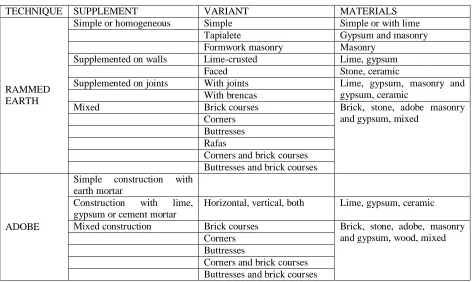
in the same wall there is a high number of different possibilities or variants [4]. The scheme of techniques and supplemented for classification based on the cases located in Aragon is as follows. (table 1).
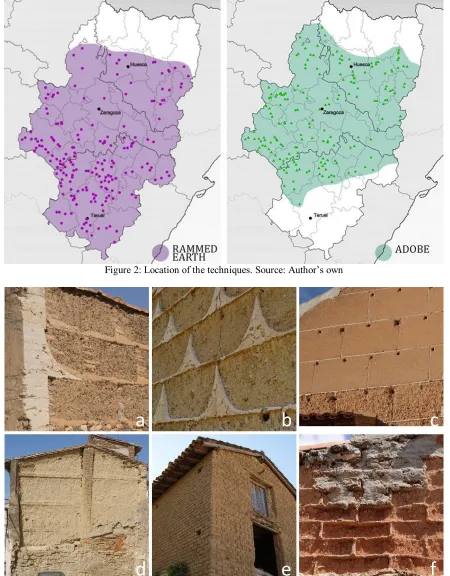
This classification was used to identify the most common techniques and their location in order to establish possible correlations. Both rammed earth and adobe are techniques frequently found in the region of Aragon. However, there is a much higher presence of rammed earth in the south while adobe is the predominant technique in the north (figure 2).
In both techniques the most common variant is mixed. This type of wall characteristically has supplements on the exterior of the earth constructions which are not generally linked with them. The most common supplements are found on the corners of buildings, aiding its construction and improving durability [5]. The materials for these supplements vary greatly depending on the geographical location of the building (figure 3).
TECHNIQUE SUPPLEMENT VARIANT MATERIALS
RAMMED EARTH
Simple or homogeneous Simple Simple or with lime
Tapialete Gypsum and masonry
Formwork masonry Masonry
Supplemented on walls Lime-crusted Lime, gypsum
Faced Stone, ceramic
Supplemented on joints With joints Lime, gypsum, masonry and
gypsum, ceramic With brencas
Mixed Brick courses Brick, stone, adobe masonry
and gypsum, mixed Corners
Buttresses Rafas
Corners and brick courses Buttresses and brick courses
ADOBE
Simple construction with earth mortar
Construction with lime, gypsum or cement mortar
Horizontal, vertical, both Lime, gypsum, ceramic
Mixed construction Brick courses Brick, stone, adobe, masonry
and gypsum, wood, mixed Corners
Buttresses
Corners and brick courses Buttresses and brick courses
Table 1: Classification of rammed earth and adobe constructive techniques in Aragon (Author’s own)
Due to its constructive properties rammed earth is compatible with a greater range of supplements than adobe. In Aragon, some of the most frequent supplements are found in the joints between coffered blocks or in the face of the walls. Both are especially common in southwest of Aragon, where they are usually made with gypsum - a material with a great constructive tradition in the region - or with gypsum and masonry.
In contrast, due to their nature, adobe constructions allow a smaller number of variants than rammed earth. In addition to adobe mixed walls, it is also possible to frequently find simple constructions and constructions with reinforcements in joints throughout the territory.
Figure 2: Location of the techniques. Source: Author’s own
Figure 3. Most frequent constructive variants in Aragon. 4a- Mixed rammed earth; 4b- Rammed earth with wave-like supplements in the joints (brencas); 4c- Rammed earth with gypsum joints and lime- crusted rammed earth on walls; 4d- Mixed adobe wall; 4e- Adobe wall with earthen mortar; 4f- Adobe wall with gypsum, lime or cement mortar. (Photos: Laura
Laura Villacampa Crespo, Lidia García-Soriano, Fernando Vegas López-Manzanares, Camilla Mileto 034
4. TRADITIONAL EARTHEN CONSTRUCTION IN ARAGON IN RELATION TO LOCATIONS
Earthen construction is closely linked to its location, due both to external conditioning factors and to the material extracted locally. The connection between this architecture and its surroundings highlights a series of concepts or lessons to be taken into account in the design of new buildings as well as in interventions on traditional elements [6].
Factors such as mean temperature or local temperature variations are very important to building design. This temperature directly affects the type, placement and distribution of architecture as well as the configuration and thickness of walls and the protective elements in place to guarantee passive indoor thermal comfort [7]. The thermal inertia of earth and the usual thickness of these buildings make them suitable for use in areas with all sorts of temperatures. Thermal inertia is also a property which is especially suited to locations with broad temperature variations given that it regulates the heat exchange between indoors and outdoors [8]. In Aragon the annual temperature difference in absolute terms is over 50°C in many points, while the variation in daily temperature usually reaches 20°C. In contrast, the specific case of supplements in joints or on rammed earth walls, common in the southwest of the country, helps protect earth blocks from the elements and the continuous freezes typical of the region.
Given its frequency and intensity, wind is a major factor in large areas of Aragon, especially the Ebro Valley, encouraged by the topography of the channel between the Pyrenees and the Iberian System. Although wind is not usually a determining factor in the use of materials, it is in the location of buildings and the position of the openings - preventing exposure to dominant winds, such as the northwest wind known as Cierzo in the case of Aragon. As regards earthen architecture, given that earth is an easily eroded material the façades which are exposed to this wind are sometimes protected by supplements in the wall, lime-crusted walls or rendering.
Rainfall is one of the determining factors in the development of earthen architecture given that water is one of the main culprits of degradation and noticeably affects its durability. In architectural terms, rainfall directly affects the configuration and architecture of population nuclei, especially the configuration of roofs, which are in charge of water runoff. Therefore, roofs in areas with heavy rainfall must be sufficiently sloping, with eaves large enough to protect the walls from water and damp. Although annual rainfall in Aragon is not excessively high, there are frequent heavy storms in summer. As a result, buildings throughout most of the territory have larger eaves to allow water to run off quickly, protecting the walls, something which is especially important in the case of earthen walls [9].
Geological factors are also major factors directly linked to the position of materials in a given location. Given that traditional architecture makes the best possible use of available resources, unnecessary transport is avoided and effort is reduced by using local materials [10]. Earthen architecture is linked to the existence of clay, which helps to join the particles which make up the earth. Throughout most of Aragon the predominance of clayey terrain encourages the use of these techniques. Moreover, the local extraction of earth rich in clay is linked to river valley areas, which are generally associated to human settlements, where sediment usually takes the form of mud, traditionally used in construction (figure 4).
Therefore, the use of materials such as gypsum, lime, wood, different types of stone or clay for ceramic, in combination with the surrounding conditions described and local culture and traditions are crucial factors in the development of the different techniques or variants in a specific location.
5. FUTURE POTENTIAL OF THIS ARCHITECTURE
The information compiled in this study and understanding of the factors influencing the characteristics of constructions in a specific location must be respected and applied in new architecture. Following these techniques based on spontaneity and the immediate availability of materials are aspects crucial to environmental sustainability, at least partly. Therefore, it is important to study the techniques used in a specific setting and to follow the existing examples.
The use of materials such as earth in the construction of buildings is closely linked to sustainability as, in addition to being non-polluting, the resulting spaces are more beneficial to health than those built using industrial materials. The spaces created are also of great environmental comfort due to the thermal and hygrothermal properties of earth which help regulate the temperature and humidity in the environment [11].
Figure 4. Diagram of the main factors influencing the configuration of architecture in Aragon. Example of constructions located on a hillside near the river to ensure protection from rises in water level. The village is oriented south to take full advantage of solar exposure and is protected from the predominant northwest wind by a mountain (Illustration: Laura
Villacampa)
As well as techniques, new architecture should take into consideration some of the aspects already touched upon, including orientation, openings, implementation in relation to the landscape and adverse climate and characteristics of the roof.
There is no longer a conception of architecture in relation to place, and globalisation has led to all types of constructions being built everywhere. On a local scale it is easy to identify how at present buildings occupy locations where before they would not have existed unless they had taken their surroundings into account. Consequently, in adverse climatological situations such as floods or strong winds, these buildings tend to be the most damaged.
6. CONCLUSIONS
Studies such as this can be extrapolated to other areas or based on other constructive techniques or typologies, given that their main aim is to identify the constructive values of traditional techniques associated with specific areas. These data represent fundamental values and aspects which ought to be taken into account in the construction of new buildings as well as in interventions on traditional ones.
In the case of Aragon, factors such as temperature, wind or rainfall, along with the use of specific materials, have brought about numerous constructive solutions, specifically, a wide range of constructive variants with earth.
The concept of architecture in relation to place has now been lost, while globalisation has made it possible to build any type of building anywhere. On a local scale it is easy to see how buildings are currently located in places where they would not have been before unless the surroundings had been taken into account. In adverse climate conditions such as floods or strong winds, these buildings usually suffer the worst damage.
Earthen techniques and variants, which are distributed throughout the territory based on its characteristics, use certain materials depending on availability. In addition, there it becomes important to know other factors on a local scale linked to the microclimates, surroundings and landscape elements so that they can be used to their full potential in construction. The study of the traditional architecture of a given location is a basic exercise for the understanding of the parameters to be considered. Given that architecture must follow a logic in keeping with its location, it is important to relearn the lessons from centuries of experience [12]. Traditional constructions are built historic documents from which to recall many forgotten concepts directly related to sustainability in energy as well as social, economic and cultural terms [13].
Laura Villacampa Crespo, Lidia García-Soriano, Fernando Vegas López-Manzanares, Camilla Mileto 036
This work is part of the research project “Restoration and rehabilitation of traditional earthen architecture in the Iberian Peninsula. Guidelines and tools for a sustainable intervention”, funded by the Spanish Ministry of Science and Innovation (Ref.: BIA2014-55924-R; main researchers: Camilla Mileto and Fernando Vegas López-Manzanares).
7. REFERENCES
[1] Vegas, F.; Mileto, C.; Cristini, V. y L. García Soriano L. (2014). La tapia en la Península Ibérica. La restauración de la ta pia en la Península Ibérica. Valencia: Ed. TC Cuadernos
[2] Figols González, M. 2006. Arquitectura de tierra en Valdejalón. Zaragoza: Institución “Fernando el Católico”
[3] García Soriano, L. (2015). La restauración de la arquitectura de tapia de 1980 a la actualidad a través de los fondos del Ministerio de Cultura y del Ministerio de Fomento del Gobierno de España. Criterios, técnicas y resultados (PhD Research). Universitat Politècnica de València. Valencia, España. [4] Abad Alegría, F. 1997. Construcciones de barro en Aragón. Huesca: La Val de Onsera
[5] Mileto, C.; Vegas López-Manzanares, F.; García-Soriano, L.; Villacampa Crespo, L.; Gómez Patrocinio, F.J. (2017) “Primera aproximación a la variedad constructiva de la arquitectura vernácula de tierra en la Península Ibérica”. X Congreso Nacional y II Congreso Internacional Hispanoamericano de Historia de la Construcción, San Sebastián.
[6] Minke, G. “Building with Earth: Design and Technology of a Sustainable Architecture”, Birkhäuser, 2012, p. 30
[7] Beckett, C.; Ciancio, D. (2012) “A review of the contribution of thermal mass to thermal comfort in rammed earth structures” Proceedings of the 3rd International Conference on Sustainable Built Environment, University of Peradeniya.
[8] Wilson, Q et Al. (2016) “When thermal mass becomes resistance” LEHM proceedings, Weimar [9] Allanegui Burriel, G. J. (1979). Arquitectura popular de Aragón. Zaragoza: Librería General.
[10] AA.VV. (2014) “Versus. Lessons from vernacular heritage to sustainable architecture”, ed. CRAterre / ESG / UNICA / UNIFI / UPV