1. INTRODUCTION
Modern wireless communication demands constant improved spectral efficiency. More number of users is needed to be accommodated in a given bandwidth with high quality standards for communication. Different diversity techniques are used for it. Spatial diversity deals with multiple number of transmitting and receiving antenna at transmitter and receiver respectively. When same signal is transmitted or received via multiple devices, spatial diversity is formed. There are main four types of spatial diversity:
SISO (Single Input Single Output -- No diversity) SIMO (Single Input Multiple Output)
MISO (Multiple Input Single Output) MIMO (Multiple Input Multiple output)
So, different number of antenna at transmitting end (Input side) and receiving end (Output side) forms spatial diversity systems. These systems are discussed and analyzed mathematically. MIMO, combined with OFDM is used for Long Term Evolution (LTE)[7,8] standards and makes 4G more reliable, fast and efficient. MATLAB 17 software has been used to evaluate different techniques graphically.
The rest of the paper is organized as follows. Proposed algorithm’s results and graphs for these diversity techniques are explained in section II. Analysis of experimental results is presented in section III. And concluding remarks are given in section IV.
2. PROPOSED CODES
2.1 SISO - Single Input Single Output
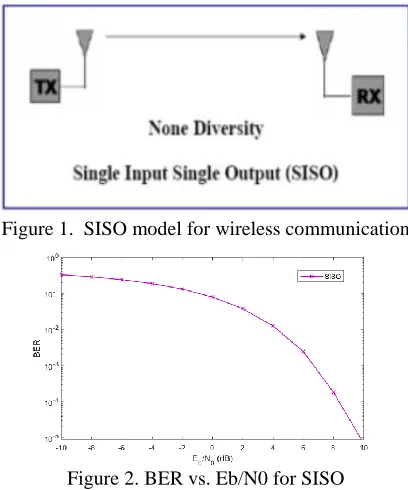
This case is actually considered as no diversity at all. Single input antenna at the transmitting end and single output antenna at the receiving end forms SISO system as shown in figure 1. Bit Error Rate (BER)[9] vs. Eb/N0 plot for SISO is shown in figure 2. As no diversity is applicable in SISO case, multipath fading[9] is a prominent issue in this category of communication[10-12]. The channel capacity for SISO is given as equation (1).
CSISO = B log2 (1 + S/N) ……….. (1)
Where, C is the capacity, B is the Bandwidth of the information signal and S/N is the signal to noise ratio of given wireless environment. SISO has a benefit of its design simplicity and economically cheap.
1 Department of Nanoscience and advanced materials, Saurashtra University, Rajkot, Gujarat, India 2 Department of Physics, Saurashtra University, Rajkot, Gujarat, India
techniques, security is not so much major issue for wireless communication. But modern communication systems are capacity limited[2][3], not interference or coverage limited. Spatial diversity techniques like SISO, SIMO, MISO and MIMO gives improved spectral efficiency and better capacity and coverage to cellular communication with limited bandwidth. BER is used as a tool to compare all of these four techniques and MIMO found to be best among four[4],[5],[6]. Advanced digital communication systems or modern wireless communication systems like 4G uses MIMO to obtain all benefits over 3G.
Figure 1. SISO model for wireless communication
Figure 2. BER vs. Eb/N0 for SISO
SISO system, similar to other diversity systems, is affected by multipath fading. But as no diversity is applied in this case, multipath degradation increases BER drastically improves for multipath SISO as shown in figure 3.
Figure 3. SISO - LOS and Multipath comparison
2.2 SIMO - Single InputMultiple Output
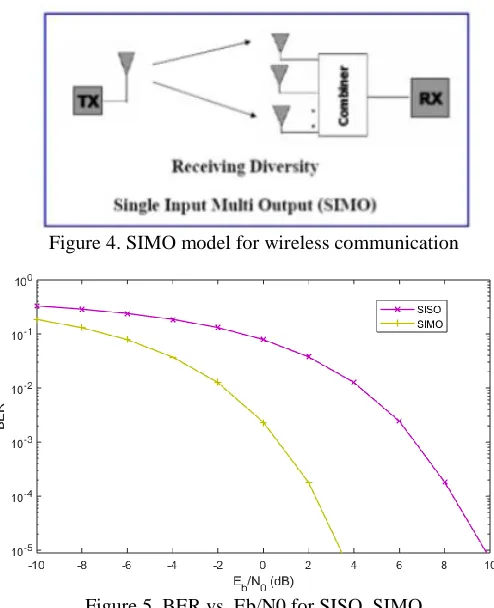
In this case, transmitter side single antenna works while receiving side multiple antenna is implemented as shown in figure 4. As number of receiving antenna increases, multipath fading effect is reduced. SIMO improves receiving diversity but channel capacity is not enhanced as such. Bit Error Rate (BER) vs. Eb/N0 plot for SIMO is shown in figure 5. The channel capacity[13] for SIMO, based on basic Shannon’s channel capacity equation is given as equation (2).
CSIMO = MR B log2 (1 + S/N) ………. (2)
Figure 4. SIMO model for wireless communication
Figure 5. BER vs. Eb/N0 for SISO, SIMO
2.3 MISO – Multiple Input Single Output
In this case, transmitter side multiple antennas are used while, reception is done by single antenna as shown in figure 6. As number of transmitting antenna increases, different sources of communication takes place but there is only one receiver. Fading effect is decreased but channel capacity is not so improved in MISO. Bit Error Rate (BER) vs. Eb/N0 plot for MISO is shown in figure 7. The channel capacity for MISO, is given as equation (3).
CMISO = Mt B log2 (1 + S/N) ………. (3)
Figure 7. . BER vs. Eb/N0 for SISO, SIMO and MISO
2.4 MIMO – Multiple InputMultiple Output
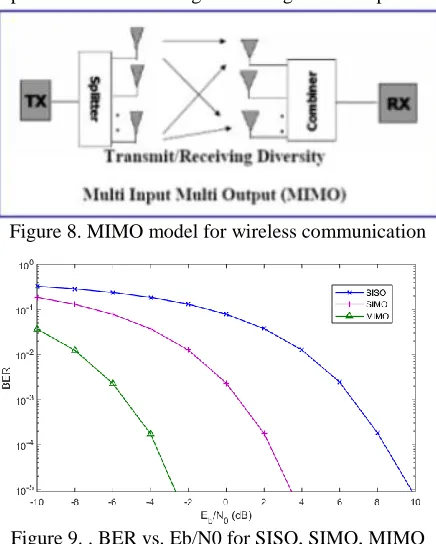
In this case, Both transmitter and receiver sides are implemented with multiple antennas as shown in figure 8. This diversity technique gives maximum channel capacity[17][18] at minimum BER. As number of transmitting and receiving antennas are increased, fading effect is decreased measurably. Channel capacity is maximum for MIMO so, it is used in so many modern wireless communication systems like LAN, MAN, 3G, 4G with OFDM etc. Bit Error Rate (BER) vs. Eb/N0 plot for MIMO is shown in figure 9. The channel capacity for MIMO[19], is given as equation (4).
CMIMO = NM B log2 (1 + S/N) ………. (4)
Where, N is the number of antennas used at transmitting end, M is the number of antennas used at receiver, C is the capacity, B is the Bandwidth of the information signal and S/N is the signal to noise ratio of given wireless environment. MIMO is far better than SISO but implementation cost is highest among all other spatial diversity techniques.
Figure 8. MIMO model for wireless communication
Figure 9. . BER vs. Eb/N0 for SISO, SIMO, MIMO
2.5 Experimental analysis and Results
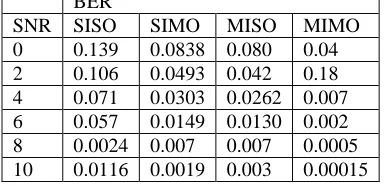
Table 1 shows the peak signal to noise ratio (SNR) based BER readings for different values of SNR. MIMO performance is best among all for any given SNR is clearly identified from the results obtained.
Different parameter wise comparison for SISO, SIMO, MISO and MIMO is tabulated in table 2.
Table -2 Parametric comparison results for SISO, SIMO, MISO and MIMO
Parameter Name SISO SIMO MISO MIMO
Quality of Signal at receiver
Poor /
Weak
Multiple antennas so, best reception is selected
Improved quality due to multiple
transmission Best quality
BER Maximum Medium Medium Minimum
Throughput Very less Better than SISO Slightly better than SIMO Best
throughput Complexity of
design Simplest Moderate design Moderate design complex
3. CONCLUSION
Different diversity techniques can be implemented for spatial diversity. Technical comparison of these techniques is required to implement any of them into real time technology or standards. From above comparison and analysis, we come across the fact that MIMO is best capacity system among all and it is maximum costly for obvious reasons of multiple antenna systems at transmitting and receiving ends.
4. REFERENCES
[1] S. M. Alamouti, “A simple transmit diversity technique for wireless communications”, IEEE Journal of Selected Areas on Communication, vol. 16, no.
8, (1998) October, pp. 1451-1458.
[2] A. J. Paulraj, D. A. Gore and R. U. Nabar, “Introduction to Space-Time Wireless Communication”, Cambridge University Press, (2003).
[3] H. Li, “Differential space-time modulation over frequency-selective channels”, IEEE Transaction on Signal Processing, vol. 53, no. 6, (2005) June, pp.
2228-2242.
[4] Q. Ma, C. Tepedelenlioglu and Z. Liu, “Differential Space-Time-Frequency Coded OFDM with Maximum Diversity”, IEEE Trans. Wireless
Communication, vol. 4, no. 5, (2005) September, pp. 2232 - 2243.
[5] A. Lodhi, F. Said, M. Dohler and A. H. Aghvami, “Performance comparison of space-time block coded and cyclic delay diversity MC-CDMA
systems”, IEEE Wireless Comm., (2005).
[6] Y. Chang, R. Zhang and Cioffi, “Transmit Optimization for MIMOOFDM With Delay-Constrained and NoDelay-Constrained Traffic”, IEEE
Transaction on signal processing, vol. 54, no. 8, (2006).
[7] A. Gorokhov, IEEE Transactions on Signal Processing, vol. 51, (2005).
[8] D. M. Terad and R. P. T. Jimenez, “Channel estimation for STBC-OFDM systems”, Proceedings of the IEEE Workshop on Signal Processing and
Advances in Wireless Comm., (2004), July 11–14, Lisbon, Portugal.
[9] S. N. Diggavi, N. Al-Dhahir, A. Stamoulis and A. R.Calderbank, “Differential Space-Time Transmission for Frequency-Selective Channels”, IEEE
Communication Letter, vol. 6, no. 6, (2002), pp. 253-255.
[10] I. S. Moskowitz, P. Cotae, M. H. Kang and P. N. Safier, “Capacity Approximations for a Deterministic MIMO Channel”, International Journal on
Advances in Electrical and Computer Engineering, vol. 11, no. 3, (2011), pp. 3-10.
[11] ECE 476/ECE 501C/CS 513 - Wireless Communication Systems Winter 200 Lecture 1: Introduction
[12] Intel, Broadband Wireless: The New Era in Communications, Technical White Paper, 2004
[13] Smart antenna systems for mobile communication by Ivica Stevanovi´c, Anja Skrivervik and Juan R. Mosig January 2003
[14] G. Tsoulos, M. Beach, and J. McGeehan. Wireless Personal Communications for the 21st Century: European Technological Advances in Adaptive
Antennas. IEEE Communications Magazine,September 1997.
[15] Handbook of wireless technologies – Elsevier FARID DOWLA Editor-in-Chief -- Lawrence Livermore National Laboratory 2004
[16] T.S. Rappaport, “Wireless communication”, PHI
[17] A. D. Joshi, N. A. shah, “Computer networking from theory to practice”, Saurashtra University publication
[18] Saleh Ali Alomari et al. “A Comprehensive Study of Wireless Communication Technology for the Future Mobile Devices,” European Journal of
Scientific Research, Vol. 60, pp. 565-573, 2011