S
U
ME
D
H
A
J
O
U
R
N
A
L
O
F
M
A
N
A
G
EMEN
T
A
p
ri
l-J
u
n
e
2
0
1
9
CMR College of Engineering & Technology
About Sumedha Journal of Management
Submission of Articles
is Sponsored by MGR Educational Society, which has established in 2002. The College is situated on Hyderabad - Nagpur National Highway (Medchal Road), Andhra green and free of pollution. The college endeavors to impart Quality Technical Education and to meet the challenge imposed on, by being in tune with the fast changing Technology & Globalization. Since 2006, Department of Master in Business Administration at CMR has been building individuals with the capability to think act and lead in an increasingly complex business world. CMR Strongly believes in the change that individuals can bring about in the world and in themselves, when empowered with the knowledge to analyze the world the confidence to act on their decisions and perseverance to lead others in pursuit of change. It provides a platform to building a strong society and nation.
aims at promoting and disseminating relevant, high quality research in the field of management. It is a double blind reviewed referred academic quarterly journal focuses on publishing scholarly articles from the areas of management, management principles, recent inventions in management, company management, financial management, human resources, accounting, marketing, operations management, human resource management, statistics, international business, information technology, environment, risk management, globalization and related areas. Asian journal of management research seeks original manuscripts that identify, extend, unify, test or apply scientific and multi-disciplinary knowledge concerned to the management field. The journal endeavors to provide forum for academicians, scholars and practitioners.
The following types of Papers are considered for publication: 1. Original research works in the above-mentioned fields.
2. Surveys, opinions, abstracts and essays related to Operations research.
3. Few review papers will be published if the author had done considerable work in that area. 4. Case studies related to management domain.
Authors are invited to submit their research articles, review papers, case studies in a properly formatted file as per the author guidelines to [email protected] mentioning the name of the journal or through the submission.
V o lu m e 8 N u m b e r 2
Vol. 8 No. 2 April-June 2019
Referred Journal of CMR College of Engineering & Technology
ISSN (Online) : 2322-0449
UGC Approval Journal (Serial No: 46802)
A Model Proposition for Prescreening Candidates in Recruitment Process Using Fuzzy Vikor Method
Murat Bolelli
An UGC Autonomous Institution
(Approved by AICTE, permanently affiliated to JNTU, Hyderabad)
(NAAC Accredited Institution with ‘A’ Grade)
ISSN (PRINT) : 2277-6753
Department of Master of Business Administration
An Integrated Marketing Communications, Media Synergies and its effect on the Consumer Decision Making Process Reshma Nikhat
Influence of Organizational Climate on Employee Turnover Intention in Information Technology Industry in Kerala Jnaneswar. K
Gayathri Ranjit
Impact of Transformational Leadership Style Dimensions on Organizational Performance: An Empirical Analysis Shruti Balhara
Harbhajan Bansal
Impact of Quality of Work Life on Organisational Commitment Indu Bala, Ramandeep Saini, B.B. Goyal
Mediating Role of Personal Accomplishment among Emotional Labour Strategies and Teaching Satisfaction among Professional College Teachers Jitha G. Nair
Testing of Long-Run Relationship between Gold Prices and Stock Market Return: An Empirical Analysis in India Tanvi Bhalala
Emerging Distribution Channel Effectiveness in Rural Jharkhand for Consumer Electronics
Punit Kumar Mishra Girish Kumar Srivastava
Changing Role of Learning and Development Methodologies Digital Age - A Comparison between Manufacturing and Service Industry S. Rajeswari, D.Raghunatha Reddy
M.Ramakrishna Reddy
Creativity and Innovation in B-Schools:Potential Areas for Development
K. Renuka Raju, Shakeel Ahmad A. Ramachandra Aryasri
Training Effectiveness on Job Performance - An Analytical Study with Reference to Dairy Industry
Menaka.Bammidi Puppala. Hyndhavi
Performance Appraisal Impact on Employee Job Satisfaction with Reference to TSSPDCL
M. Ramu Mohd. Akbar Ali Khan
Mobile Data Usage Behavior: A Study on Bottom of the Pyramid Market Leena Sharma
Dr. A Kotishwar
Dr. P. Vijaya Lakshmi, Associate Professor
Editorial Board
GUIDELINES FOR AUTHORS
1. The cover page of the article/research paper should include the title of the paper, Author’s name, Designation, organization with the address, contact number & email address.
2. Abstract of not more than 200 words outlining the purpose of study should be presented on a separate sheet along with 5-6 keyword immediately preceding the text.
3. Name(s) of the author(s) should not appear anywhere in the entire text other than the cover page. 4. All the manuscript will be sent for blind review process, the corresponding author will be informed by
the editor about acceptance or rejection of the manuscript within a period of time. On acceptance of the manuscript, the modifications suggested by the reviewers are to be incorporated by the author with in a period of 10 days and send copy of the revised manuscript again.
5. The editor reserves the right to modify or improve the manuscript as per the standard of journal. 6. The copyright of the research papers published in the journal shall lie with the publisher.
7. The authors whose papers are selected for publication shall make a subscription (Rs. 2500) for annual of the printed edition of the journal per author.
8. Copies of the journal are available by way annual subscription (Rs. 2,500 for annual or Life Time Rs. 10,000).
General Information about submission
1.
• Covering Letter: Title of the Paper, Author’s Name, Designation, Organizations, Official Address, Personal Address, Contact Numbers (Official & Personal) and e-mail address
• - objectives, Research Questions / Hypothesis, Methodology,
findings and 5-6 keywords. Words limit - 250-300 words.
2.
• Format : A4 size, Ms-word
• Word Limit : Not to exceed 5000 words • Font : Times New Roman
• Size : Title - 18, Heading - 14, Text-12 • Line spacing : 1.5
3. Author must declare originality of work. The article should not have been published or be submitted for publication else where.
4. Editorial Board’s decision will be final.
5. The copyright of all accepted papers will vest with dept. of MBA - CMRCET For Submission:
Abstract: should contain
Full Paper
Declaration :
Medchal Road, Hyderabad.
Assistant Managing Editors
Telangana, India. Chairman CMRGI
Vice-Chairman CMRGI Secretary & Correspondent CMRGI Ch. Malla Reddy,
Ch. Narasimha Reddy, Ch. Gopal Reddy,
Director - (Academics), CMRGI Principal - CMRCET Dr. N. Satyanarayana,
Major Dr. V.A. Narayana,
Chief Editor
Professor & HOD, Dep of MBA, CMRCET
Dr. A Kotishwar,
Managing Editors
Professor Dr. P. Hima Bindu,Dr. P. Alekhya, Associate Professor
S.No Name Address
1 Honorable Former Vice-Chancellor. Telangana University, Nizamabad,
Andhra Pradesh
2 Professor, Department of Commerce , Bangalore University
3 Pro-Vice chancellor, Maulana Azad National Urdu University,
Hyderabad
4 Professor & Head, Department of Commerce, University of Madras, Chennai
5 Head & Associate Professor, AL Buriami University College, Oman
6 Professor & HOD, Department of Banking & Business Economics,
Mohan Lal Sukhadia University, Udaipur, Rajasthan.
7 Director, School of commerce & Management Science, Swami
Ramanand Teerth, Marathwada University, Nandeds
8 Head, Department of Commerce. University of Mumbai
9 Professor, SMS, JNTUH
10 Professor, School of Management Studies, University, Hyderabad
11 Professor Department of Commerce, Dr. Babasaheb Ambedkar
Marathwada University, Aurangabad
12 Dean & Chairperson, Faculty of Commerce& Mgt, Bhagat Phool Singh
Mahila Vishwavidyalaya, Khanpur Kalan, Haryana
13 Associate Professor, Indian Institute of Management Kozhikode, Kerala
14 Professor & Head, School of Management Studies, Punjabi University,
Patiala, Punjab, India
15 Associate Professor, School of Management Studies, University,
Hyderabad
16 Associate Professor, Department of Commerce, Delhi School of
Economics, University of Delhi
17 Professor Finance , Indian institute of management Kozhikode, Kerala
18 Associate Professor, Department of Business Administration,
Annamalai University, Tamil Nadu.
19 Associate Professor Department of Business Administration and
Accounting, Al-Buraimi University College
(Affiliated to California State University, Northridge, USA), Prof. Mohd Akbar Ali Khan
Dr. M Muninarayanappa Dr. Shakeel Ahmad
Dr. S Gurusamy
Dr. Mohammed Jahangir Ali Prof. Renu Jatana
Prof. Vani N Laturkar
Dr. Vivek Deolankar Dr. Sindhu
Dr Mary Jessica
Prof. Walmik K. Sarwade
Prof. (Dr.) Sanket Vij
Dr. Sudershan Kuntluru Prof. G S Batra
Dr. Chetan Srivastava
Dr. Vanita Tripathi
Dr. Rachappa Shette Dr. A.A. Ananth
ISSN: 2277-6753 (Print) ISSN: 2322-0449 (Online)
SUMEDHA-Journal of Management
Referred Journal of CMR College of Engineering & Technology
April-June2019, Volume 8, No. 2
S. No.
Title Authors Page No.
1. A Model Proposition for Prescreening Candidates in Recruitment Process Using Fuzzy Vikor Method
Murat Bolelli* 1-19
2. An Integrated Marketing Communications, Media Synergies and its effect on the Consumer Decision Making Process
Reshma Nikhat* 20-32
3. Influence of Organizational Climate on Employee Turnover Intention in Information Technology Industry in Kerala
Jnaneswar. K*, Gayathri Ranjit**
33-46
4. Impact of Transformational Leadership Style Dimensions on Organizational Performance: An Empirical Analysis
Shruti Balhara*, Harbhajan Bansal**
47-57
5. Impact of Quality of Work Life on Organisational Commitment
Indu Bala*, Ramandeep Saini**, B.B. Goyal***
58-72
6. Mediating Role of Personal Accomplishment among Emotional Labour Strategies and Teaching Satisfaction among Professional College Teachers
Jitha G. Nair* 73-82
7. Testing of Long-Run Relationship between Gold Prices and Stock Market Return: An Empirical Analysis in India
Tanvi Bhalala* 83-96
8. Emerging Distribution Channel Effectiveness in Rural Jharkhand for Consumer Electronics
Punit Kumar Mishra*, Girish Kumar Srivastava**
97-112
9. Changing Role of Learning and Development Methodologies in Digital Age - A Comparison between Manufacturing and Service Industry
S. Rajeshwari*, D.Raghunatha Reddy**, M.Ramakrishna Reddy***
113-126
10. Creativity and Innovation in B-Schools: Potential Areas for Development
K. Renuka Raju*, Shakeel Ahmad**, A. Ramachandra Aryasri***
127-133
11. Training Effectiveness on Job Performance - An Analytical Study with Reference to Dairy Industry
Menaka.Bammidi*, Puppala. Hyndhavi **
134-147
12. Performance Appraisal Impact on Employee Job Satisfaction With Reference to TSSPDCL
M. Ramu*, Mohd. Akbar Ali Khan**
148-156
13. Mobile Data Usage Behavior:
A Study on Bottom of the Pyramid Market
Leena Sharma* 157-169
14. Cash to Cashless Economy: Challenges and Opportunities
Saneem Fatima*, Shakeel Ahmad**
As SUMEDHA Journal of Management Thirtieth issue, We look forward to the momentous
growth of our Journal, increasing in their appeal, readership and relevance to the fast-changing
world of Business Management. During these six years journey our journal has been critically
evaluated by various institutions with similar line of interest and faculty fraternity. We have
been consistently seeking advice from experts to continuously improve the quality of the
journal. Our journal has got UGC Approval Journal (Serial No : 46802 ), Indexed in Indian
Citation Index (ICI), PROQUEST Database, Google scholar JUSER Database, MIAR Data
Base, Index Copernicus value 59.11, ISRA Journal Factor 4.018, Sjifactor Impact factor 4.339,
International Scientific Indexing Impact factor 1.332. On behalf of the Management, Editorial
Board and Editorial Team, I express my profound gratitude to all our authors, reviewers,
readers and patrons for offering their overwhelming support and I anticipate a continued
and lively partnership for years to come.
All of us recognize the necessity for change, which results in progress. It gives way to new
ideas and perspectives reflecting the current and emerging environment, which builds on
the solid foundations of the past.
Last but not least valuable would be your response and suggestions on this issue. Kindly
send us your views so that we can keep on upgrading our journal.
Thanking you
A Model Proposition for Prescreening Candidates in Recruitment Process Using Fuzzy Vikor Method Murat Bolelli* SUMEDHA-Journal of Management
Referred Journal of CMR College of Engineering & Technology April-June 2019, Volume 8, No. 2, pp 1-19
ISSN: 2277-6753 (Print) ISSN: 2322-0449 (Online) http://cmrcetmba.in/sumedha/
A Model Proposition for Prescreening Candidates in
Recruitment Process Using Fuzzy Vikor Method
Murat Bolelli*
*Asst. Prof., Istanbul Okan University, Faculty of Business and Administrative Sciences, Avni Dilligil Sok. No:18 34394 Mecidiyekoy / Istanbul, TURKEY.
Abstract
Purpose of this study wasto test if fuzzy VIKOR method can be used to prescreen job applications and to select candidates to be interviewed as well as to propose a model forthe process.Recruiting qualified employees is a major concern for firms today. One of the important determinants for the success of recruitment process is pre-screening,whichrequire multi criteria decision making containingnoncommensurable and conflicting criteriawhere use of fuzzy techniques are appropriate. To test the use of fuzzy VIKOR method in prescreening,external hiring of a Region Manager to a pharmaceutical company scenario is developed, resumes of individuals working in the industry are found from various career portals, all the information are anonymizedand presented to decision makers as if they are actual job applicants.Following VIKOR methods steps, decision maker group consisting eight recruitment and human resources professionals is gathered. Decision makers determined and weigthed criteria to be used for prescreening (Total Experience, Experience in the Industry, Education Level, Education-Profession Relation, Languages, Age, Remuneration Expectations) and assessed candidates using them. After fuzzification and calculations, Candidate 6 is found to present the best compromise solutionsatisfying maximum group utility of the "majority" and minimum individual regret of the "opponent" conditions. Findingsare indicating that fuzzy VIKOR multicriteria decision making method with pre-defined criteria can effectively be used to prescreen job applications. .
Keywords: Recruitment, Prescreening, Fuzzy Logic, VIKOR, Multi Criteria Decision Making.
JEL classification : M10, M12, M51
PUBLISHING CHRONOLOGY PAPER SUBMISSION DATE :
DECEMBER 3, 2018;
PAPERSENTBACKFOR REVISION :
JANUARY 7, 2019;
PAPER ACCEPTANCE DATE :
FEBRUARY 5, 2019
Reference to this paper should be made as follows:
Murat Bolelli*
1.
I
NTRODUCTIONHuman resources departmentsare expected to identify potentialtalent and also conceptualize and implement relevant strategies tocontribute effectively to achieve organizational objectivesin today's fast changing, competitive, global business environment (Yadav & Singh, 2014).Attracting qualified employees, recruiting and retaining them are considered to be critical success factors in achieving competitive advantage.An important step of the recruitment process is prescreening inwhich applications are measured and eliminated against qualifications the job requires. Candidates are generally assessed by usingvarious pre-determined criteria like job requirements,job specifications, competencies etc. (Sadullah, Uyargil, Acar, Ozcelik, Dundar, Ataay, Adal and Tuzuner, 2015). Considering recruitment process isproceedingonly with the applications which remain after pre-screening, it can be said that decisons made in this step are one of the important factors which determines the quality of the overall output.
Assessments made in prescreening involves multi criteria decision making (MCDM) which has some weaknesses. Some criteria used to assess the level of appropriateness can be measured with relativelytangible expressions like exists or non-exists, 1 or 0, Yes or No, meets or does not meet (education level, certificates, language, time in job, time in position etc.) and others cannot be measured with absolute terms or crisp numbers hence should be measured with subjective statements like strongly agree-disagree, agree,neutral, slightly agree-disagree, sometimes-often-never, high-mid-low level etc.Another problem with the process is using different units of measurement that should be taken into accountsimultaneously. Even though thesehardshipsare solved, it is still difficult to find a solution which satisfies all criteria (Yildizand Deveci, 2013).Literature indicates that fuzzy MCDM method is appropriate especially when variables are subjective, conflicting, non-commensurable and vague (Zarghami and Szidarovszky, 2009).Since fuzzy approach and VIKOR methodhas the capability to present compromised solution using qualitative and quantitative criteria, they are observed to be used widelyon human resource processes,specifically on recruitment(Kelemenis and Askounis, 2010).
Purpose of this study is to test if fuzzy VIKOR method can be used to prescreen job applications and to select candidates to be interviewed as well as to propose a model for the process. The paper is organized as follows. Next section briefly reviews the literature of the concepts recruitment, fuzzy logic, and fuzzy VIKOR method. Third chapter presentsa numerical examplewhich is based on the scenario of external hiring a Region Manager to a pharmaceutical company. Fourth chapter draws conclusions and discusses findings.
2.
L
ITERATUER
EVIEW2.1. RECRUITMENT
A Model Proposition for Prescreening Candidates in Recruitment Process Using Fuzzy Vikor Method Murat Bolelli*
finding, selecting and recruiting individuals who has necessary qualifications for the job and consists of main steps given below (Sadullah et. al, 2015):
• Candidate Search • Selection
– Prescreening, – Interviewing,
– Testing (oral and written), Work Sampling, Assessment Center etc. applications. • Hiring Decision
Murat Bolelli*
Table1. Selected Studies Using MCDM Techniques in the Field of HR
Author(s) Position Method(s)
Chen (2000) System Engineer Fuzzy Logic Saghafi anandHejazi(2005) University Professor Fuzzy Logic Ecer (2006) Sales Person Fuzzy TOPSIS
Özkan (2007) R&D Personnel AHP, ELECTRE, TOPSIS Dereliet al.(2010) Industry Engineer Fuzzy PROMETHEE Afshariet al. (2010) IT Specialist SAW
NasabandRostamy-Malkhalifeh(2010) System Engineer Interval Fuzzy Method KelemenisandAskounis (2010) IT Specialist Fuzzy TOPSIS
DursunandKarsak(2010) Industry Engineer Multicriteria Fuzzy Logic
BaşkayaandÖztürk(2011) Sales Person Fuzzy TOPSIS
Ersoylu(2011) Aviation School Student Candidates
Fuzzy AHPand Fuzzy VIKOR
KabakandKazançoğlu (2012) Military School
Instructors Fuzzy AHP El-Santawy(2012) Personnel Training VIKOR Kabak, Burmaoğluand
Kazançoglu (2012) Professional Sniper
Fuzzy ANP, Fuzzy TOPSIS, Fuzzy ELECTRE
Source: (Yildiz& Deveci, 2013
This study focuses on decisions made in the prescreening phase which takes place after creating pool of candidates, aiming to determine applicationsto be processed in the following steps of the recruitment process. Prescreening is generally conducted by recruitment specialists, managers' etc. whomreviews resumes of the candidates and categorizes applications as fit or not. The nature of this assessment contains subjective elements and use of multiple and usually conflicting criteria. This research intends to suggesta model for prescreening job applications and to select candidates to be interviewed using fuzzy VIKOR method which may reduce subjectivity as well as helping to find the best compromise solution.
2.2. FUZZY LOGIC
A Model Proposition for Prescreening Candidates in Recruitment Process Using Fuzzy Vikor Method Murat Bolelli*
at 1965, suggesting classical system theory and mathematical applications are not sufficient enough when dealing with issues which contain subjectivejudgements. Zadeh proposed fuzzy sets definition in which membership function is usedfor qualification as a solution to the problem (Ozturk, Ertugrul and Karakasoglu, 2008). Later, in 1973 and 1975 studies author applied fuzzy logic to systems which contain uncertainty and concept become widespread. After the second half of 1980's fuzy logic is started to be used not only in theory but in practice and applied widely onJapan production processes. Mamdani (1974, 1976), Mamdani and Assilian (1975) adapted concept to control systems and had an important part in making the field where fuzzy logic is extensively used. Today fuzzy logic has broad applications especially on artificial intelligence, system analyses, decision analyses, data processing, economy, robotics, control systems, detection and identification technologies, optimization areas (Liou, Tsai, Lin and Tzeng, 2010; Changand Hsu, 2009; Sanayei, Mousavi and Yazdankhah, 2010; Chen and Wang, 2009). VIKOR method based on fuzzy MCDM technique is also frequently used in different areas of social sciences namely recruitment, employee training, supplier selection, project selection, performance evaluation of bank branches, supply chain strategy selection etc. (Ersoylu, 2011; El Santawy, 2012; Yildiz and Deveci, 2013; Chen and Wang, 2009; Akyuz, 2012; Yildiz, 2014; Ertugrul and Karakasoglu, 2009; Gorener, 2013). Essential elements of fuzzy logic are fuzzy sets, membership function and fuzzy numbers.
Figure1. Classical Set
Source: (Altaº,1999)
Murat Bolelli*
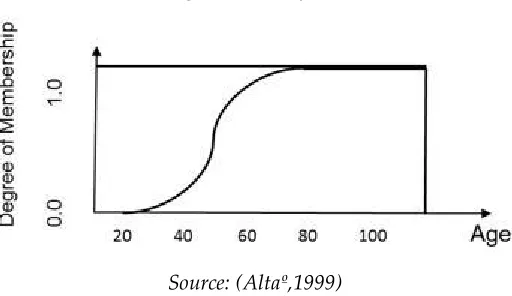
the set have 0 membership degree and elements which are in the set have membership degrees between 0 and 1. For example a person who isbelow twenty years old has 0 membership degree in the old category, members in twenties has a little over 0 membership degree and members in seventies has close to 1 membership degree in the fuzzy set.
Figure 2. Fuzzy Set
Source: (Altaº,1999)
Membership functions which represent fuzzy sets may have different forms. Although there are numerous forms namelygaussian, sigmoid, sinusoidal, cauchy, trapezoidal, polynomial, z shape, s shape etc., in practice triangular functions are stated to be used most commonly because of their simplicity and calculation convenience (Yildizand Deveci, 2013; Altas, 1999).Triangular membership function (Formula 1) is used in this study (Triantaphyllou, 2000).
(1)
Source: (Triantaphyllou, 2000)
A Model Proposition for Prescreening Candidates in Recruitment Process Using Fuzzy Vikor Method Murat Bolelli*
Figure3. Triangular Membership Function
Source: (Chen, 2000)
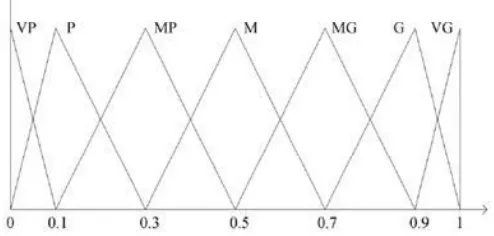
This approach is useful to transform vague linguistic termssuch as very good, good, mediumetc. to fuzzy numbers. For example, variable very good takes 9,10; good 7,9,10; medium good 5,7,9 values. Fuzzy membership functions of linguistic variablesareexhibitedin Figure 4 (BüyüközkanandÇiftçi, 2012).
Figure 4. Linguistic variables with fuzzy membership functions
Source: (BüyüközkanveÇiftçi, 2012)
2.3. VIKOR METHOD
Murat Bolelli*
The multi criteria measure for compromise ranking is developed from Lpmetric used as an aggregating function in a compromise programming method (Yu, 1973, Zeleny, 1982). Each one of i number of alternatives represented as c1, c2, c3,….ci is measured against ith criteria and denoted by fij.
(2)
Source: (Opricovic&Tzeng,2004)
Lpi measure shows normalized values of the distance between all alternatives and positive ideal solution (Formula 2). In the VIKOR method L1i, Si and Li are used to formulate the ranking measure. Min Si represents maximum group utility (majority rule) andmin Ri represents minimum individual regret of the opponent. Compromise solution is reached by optimizing both. Fuzzy VIKOR method contains following steps (
Yildiz and Deveci, 2013
): Step1: Identifying nnumber of decision makers, m number of alternatives and choosing k number of criteria.Step 2: Identifying appropriate linguistic varibles and triangular fuzzy numbers to represent alternatives and criteria. The decision makers use variables to evaluate the importance of the criteria and therating of alternatives.
Step 3: Weight of decision criteria and values assigned toalternatives are pulled from decision makers assessments and by using Formula 3 and 4,singular integrated values are calculated (Chen,Ching-Torngand Huang, 2006).
(3)
(4)
Source: (Chen et al., 2006)
Step 4: After obtaining single values for criteria and alternatives, fuzzy decision matrix and subjective weighting matrix is constructed.
A Model Proposition for Prescreening Candidates in Recruitment Process Using Fuzzy Vikor Method Murat Bolelli*
Xij, shows the fuzzy rating of ith alternative regarding jth criterion.
Step 5: The best f*j and and the worst f*j values of all criterion ratings are determined using Formula 6.
(6)
Source: (Opricovic&Tzeng,2004)
Step 6: Si and Ri values are calculated using Formula 7 and Formula 8.
(7)
(8)
Source: (Opricovic&Tzeng, 2004)
Step 7: S*i, S–
i and R*i, R
–
i which are the weights for maximum group utility and individual regret are determined using Formula 9 and Formula 10.
(9)
(10)
Source: (Opricovic&Tzeng, 2004)
Step 8: Qi value is calculated using Formula 11 where both group utility and individual regret taken into consideration. v is introduced as a weight for the strategy of maximum group utility, whereas 1-v is the weight of the individual regret. Although literature is indicating the use of different v values, 0,5 is observed to be the one which is generally accepted (Opricovic and Tzeng, 2007; Opricovic, 2011).
(11)
Murat Bolelli*
Step 9: Si, Ri, Qi which are average values of fuzzy numbers are calculated. Alternatives are ranked, sorted by the values S, R and Q in ascending order. The alternative which has the smallest index value presents the best solution.
Step 10: In order to decide if the best ranked alternative is the compromise solution, two conditions must be satisfied:
• C1. Acceptable advantage: requires existence of a significant difference between best solution and next (Formula 12). A1 represents the best ranked alternative, A2 represents second best alternative and m represents the number of alternatives.
(12)
Source: (Opricovic&Tzeng, 2004)
• C2. Acceptable stability in decision making: Alternative A1 must also be the best ranked by S and/or R(OpricovicandTzeng, 2007).
If one of the conditions is not satisfied, then a set of compromise solutions is proposed, which consist of
• Alternatives A1 and A2 if only the conditions C
2 is not satisfied, or • Alternatives A1,A2, . . .,A(M) if the condition C
1 is not satisfied; A(M) is determined by the relation Q(A(M)) – Q(A1) < DQ for maximum M (the positions of these alternatives are ''incloseness'').
3.
R
ESEARCHM
ETHODOLOGYIn order to apply proposed model, external hiring of a Region Manager to a pharmaceutical company scenario is developed, resumes of individuals working in the industry are found from various career portals, all the information are anonymized and presented to decision makers as if they are actual job applicants. Following process is conducted using VIKOR methods steps to evaluate applications and to determine candidates to be interviewed.
3.1. STEP 1
A Model Proposition for Prescreening Candidates in Recruitment Process Using Fuzzy Vikor Method Murat Bolelli*
Table2.Decision Criteria
Criteria
C1 C2 C3 C4 C5 C6 C7
Total Experience
Experience in the Industry
Education Level
Education-Profession Relation
Languages Age Remuneration Expectations
Source: Research Data
3.2. STEP 2
Criteria shown in Table 2 are weighted (Table 3), candidates are assessed by decision makers using them. Then linguistic terms (ie. very low, medium, very high, medium high etc.) are converted into triangular fuzzy numbers using Table 4.
Table 3. Importance Weigth of Criteria Assessed By Decision Makers
C1 C2 C3 C4 C5 C6 C7
DM1 High High High High High Medium Medium High
DM2 High Medium
High
Medium Medium Medium High
Medium High
DM3 High Very High High Medium Medium
High
High High
DM4 Medium
High
Medium High High Medium Medium Low
Medium
DM5 High High Medium
High
Medium High
Medium High
High Very High
DM6 Medium High
Medium High Low High Medium Low
Medium
DM7 Medium High
High High Medium Low
Very High
Medium Medium
DM8 Medium
High
High High High Very High
High Medium High
Murat Bolelli*
Table4. Linguistic Terms and Corresponding Fuzzy Numbers
C riteria C and id ate R atin g
L in gustic Term s
Fuzzy Num bers
L in gustic Term s
Fuz zy Num bers
Very Low 0,0 0,0 0,1 Very Poor 0 0 1 Low 0,0 0,1 0,3 P oor 0 1 3 Medium Low 0,1 0,3 0,5 Medium P oor 1 3 5 Medium 0,3 0,5 0,7 Medium 3 5 7 Medium High 0,5 0,7 0,9 Medium Good 5 7 9 High 0,7 0,9 1,0 Good 7 9 10 Very High 0,9 1,0 1,0 Very Good 9 10 10
Source: Author's Calculation
3.3. STEP 3
Formula 3 is used to calculate fuzzy numbers for criteria. After that, aggregated fuzzy weights of criteria are computed by averaging decision makers weightings (Table5).
Table5. Aggregated Fuzzy Weights of Criteria
Aggregated Fuzzy Weights Criteria Fuzzy Weights
C1 0,60 0,80 0,95
C2 0,60 0,79 0,91
C3 0,63 0,83 0,95
C4 0,41 0,60 0,76
C5 0,63 0,80 0,93
C6 0,40 0,60 0,76
C7 0,53 0,71 0,86
Source: Author's Calculation
3.4. STEP 4
A Model Proposition for Prescreening Candidates in Recruitment Process Using Fuzzy Vikor Method Murat Bolelli*
Table 6. Fuzzy Decision Matrix
Alternatives
Criteria A1 A2 A3 A4 A5 A6
C1 8,25 9,63 10,00 7,00 8,50 9,38 5,75 7,63 8,88 3,88 5,75 7,50 7,00 8,63 9,63 6,75 8,50 9,50
C2 8,00 9,50 10,00 7,00 8,63 9,63 6,50 8,25 9,38 3,88 5,75 7,63 6,75 8,50 9,63 6,75 8,50 9,50
C3 4,50 6,50 8,13 5,25 7,25 8,88 4,50 6,50 8,13 2,38 4,25 6,13 4,50 6,50 8,25 7,50 9,00 9,75
C4 2,63 4,50 6,38 6,00 8,00 9,38 3,50 5,50 7,38 1,88 3,75 5,75 3,38 5,13 6,88 7,75 9,13 9,63
C5 3,88 5,75 7,38 4,50 6,38 7,88 3,63 5,50 7,25 2,75 4,75 6,63 2,25 3,75 5,63 5,00 6,38 7,50
C6 3,00 4,75 6,50 3,63 5,50 7,25 4,00 6,00 7,75 4,00 6,00 7,88 3,63 5,50 7,13 4,25 6,25 7,88
C7 5,00 6,88 8,50 3,25 5,25 7,25 5,00 7,00 8,50 4,00 6,00 7,75 2,88 4,75 6,63 4,13 6,00 7,63
Source: Author's Calculation
3.5. STEP 5
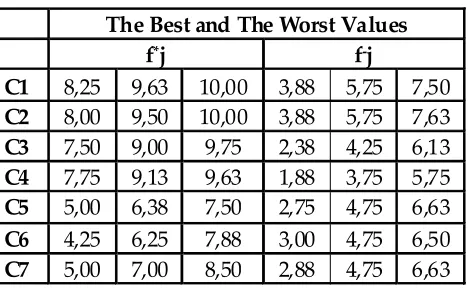
Formula 6 is used to determine the best (f*j) and the worst (f–
j) values of all criterion ratings (Table 7).
Table7. The Best and The Worst Values of Criteria
The Best and The Worst Values f*j f-j
C1 8,25 9,63 10,00 3,88 5,75 7,50
C2 8,00 9,50 10,00 3,88 5,75 7,63
C3 7,50 9,00 9,75 2,38 4,25 6,13
C4 7,75 9,13 9,63 1,88 3,75 5,75
C5 5,00 6,38 7,50 2,75 4,75 6,63
C6 4,25 6,25 7,88 3,00 4,75 6,50
C7 5,00 7,00 8,50 2,88 4,75 6,63
Source: Author's Calculation
3.6. STEP 6
Murat Bolelli*
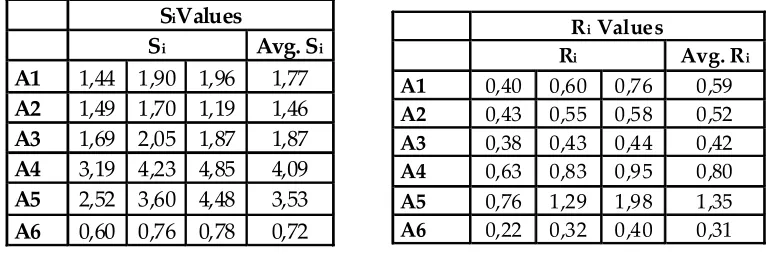
Table 8. The Values of Si for each Alternative Table 9. The Values of Ri for eachAlternative
SiValues
Si Avg. Si
A1 1,44 1,90 1,96 1,77
A2 1,49 1,70 1,19 1,46
A3 1,69 2,05 1,87 1,87
A4 3,19 4,23 4,85 4,09
A5 2,52 3,60 4,48 3,53
A6 0,60 0,76 0,78 0,72
Ri Values
Ri Avg. Ri
A1 0,40 0,60 0,76 0,59 A2 0,43 0,55 0,58 0,52 A3 0,38 0,43 0,44 0,42 A4 0,63 0,83 0,95 0,80 A5 0,76 1,29 1,98 1,35 A6 0,22 0,32 0,40 0,31
Source: Author's Calculation Source: Author's Calculation
3.7. STEP 7
In order to compute Qi which shows the compromise solution which meets the conditions of maximum group utility and minimum individual regret, first the values of S–
i and S*i (Table 10) are determined using Formula 9 and Table 8. After that, R–
i and R*i values shown in Table 11 are determined using Formula 10 and Table 9. Finally Qi values are calculated using Formula 11 (Table 12).
Table10. The Values of S–
i and S*i Table11. The Values of R –
i and R*i Si min 0,60 0,76 0,78
Si max 3,19 4,23 4,85
Ri min 0,22 0,32 0,40 Rimax 0,76 1,29 1,98
Source: Author's Calculation Source: Author's Calculation
Table 12. The Qi Values for Each Alternative
Qi Values
Alternatives Qi Avg. Qi
A1 0,329 0,309 0,259 0,299
A2 0,368 0,257 0,104 0,243
A3 0,361 0,246 0,146 0,251
A4 0,873 0,761 0,673 0,769
A5 0,870 0,910 0,955 0,911
A6 0,000 0,000 0,000 0,000
A Model Proposition for Prescreening Candidates in Recruitment Process Using Fuzzy Vikor Method Murat Bolelli*
3.8. STEP 8
Defuzzified Si, Ri, Qi values are obtained by averaging fuzzy numbers (Table 13).Alternative 6, which has the smallest index value shows the best solution.
Table 13. Qi, Si and Ri Rankings in Ascending Order by Qi
Alternatives Qi Si Ri
A6 0,000 0,716 0,312
A2 0,243 1,457 0,521
A3 0,251 1,867 0,420
A1 0,299 1,765 0,588
A4 0,769 4,088 0,800
A5 0,911 3,533 1,346
Source: Author's Calculation
In order to propose a compromise solution following two conditions is tested:
3.8.1. ACCEPTABLE ADVANTAGE
According to the Formula 12, Q(A2) – Q(A1) > 0,20 condition should be satisfied. Since the difference between first and second alternatives is bigger then 0.20 (0,243-0 > 0,20) according to the Table 13, it is concluded that A6 alternative is satisfying acceptable advantage condition.
3.8.2. ACCEPTABLE STABILITY IN DECISION MAKING
Alternative A1 must also be the best ranked by S and/or R (Opricovic and Tzeng, 2007). Table 13 shows that A6 alternative is also best ranked by Si and Ri index values.
Satisfied by the two conditions, alternative A6 has the best rank and is identified as the best compromise solution.
Murat Bolelli*
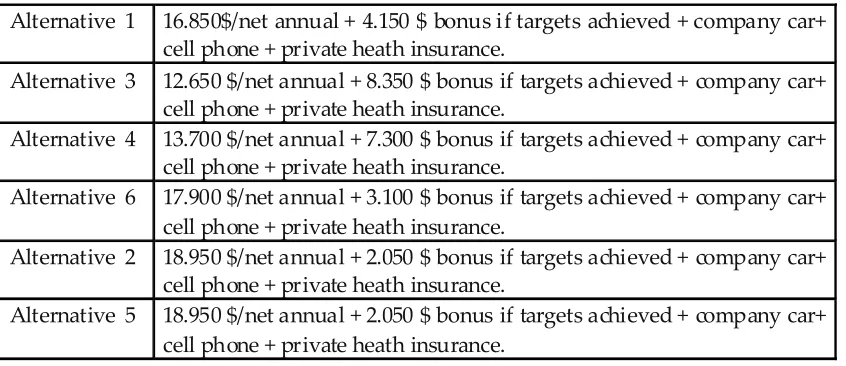
Table 14. Remuneration Expectations of Candidates
Alternative 1 16.850$/net annual + 4.150 $ bonus if targets achieved + company car+ cell phone + private heath insurance.
Alternative 3 12.650 $/net annual + 8.350 $ bonus if targets achieved + company car+ cell phone + private heath insurance.
Alternative 4 13.700 $/net annual + 7.300 $ bonus if targets achieved + company car+ cell phone + private heath insurance.
Alternative 6 17.900 $/net annual + 3.100 $ bonus if targets achieved + company car+ cell phone + private heath insurance.
Alternative 2 18.950 $/net annual + 2.050 $ bonus if targets achieved + company car+ cell phone + private heath insurance.
Alternative 5 18.950 $/net annual + 2.050 $ bonus if targets achieved + company car+ cell phone + private heath insurance.
Source: Research Data
4.
C
ONCLUSIONHuman capital is a distinctive factor forfirms in obtaining and sustaining competitive advantage. As part of personnel planning which is conducted by taking current and future needs into consideration, securingto have right number of employees with the qualifications needed in the right place and time is critical for the success of the company. Decisions and choices made in every step of this process have a significant effect on the overall quality of human capital. This study focuses on proposing a model for prescreening job applications as well as testing if fuzzy VIKOR method can be used for the process. For this purpose, external hiring of a Region Manager to a pharmaceutical company scenario is developed. After that,a group of eight decision makers consist of human resources managers and recruitment agents is formed. Recruitment scenario is presented to them to determine criteria and weights to be used for prescreening. Total experience, experience in the industry, education level, education-profession relation, languages, age, remuneration expectations are selected as criteria. Using criteria, candidates are assessed,linguistic variables provided by decision makers are transformed to fuzzy numbers and alternatives are evaluated by following VIKOR methodssteps. Candidate 6 is ranked as the best compromise solution which satisfies acceptable advantage and acceptable stability in decision making conditons as well.
A Model Proposition for Prescreening Candidates in Recruitment Process Using Fuzzy Vikor Method Murat Bolelli*
conducted in pharmaceteucal industry which is competitive and result oriented and the rising trend of pay for performance policies.
R
ESEARCHI
MPLICATIONSFuzzy VIKOR method can efficiently be used for prescreening job applications.
L
IMITATIONSOFTHES
TUDYThere are two limitations of the study:
1. Scenario developed to test the method comprises of external recruitment of a manager in pharmaceutical industry. In order to generalize the findings of this research, different scenarios for various positions, industries and source of recruitment can be studied. 2. The decision maker group who determined and weighted criteria to be used for
prescreening and assessed candidates is consisted of human resources and recruitment professionals. Model can be studied with different decision makers in future research.
S
COPEFORF
UTURER
ESEARCHThis study is focused on a specific problemof the recruitment process. It can also be used for other human resources processes which require multi criteria decision making, namely training and development, compensation and benefits, career management, performance management as well. Future studies are suggested to conduct research in different processes of human resources, alternative industries and positionswith samples containing larger data, using different number of decision makers, criteria, weights, v values etc. to examine subject further.
REFERENCES
[1]. Afshari, A., Majid, M. and Rosnah, M.Y. (2010). Simple Additive Weighting Approach to
PersonnelSelection Problem. International Journal of Innovation, Management and Technology, 1(5):511-515.
[2]. Akyüz, G. A. (2012). Bulanik VIKOR yöntemiiletedarikçiseçimi. Atatürk Üniversitesi?ktisadive?dari
Bilimler Dergisi, 26(1). Retrieved from http://dergipark.org.tr/atauniiibd/issue/2704/35554
[3]. Arvey, R.D., Campion, J.E. (1982).The employment interview: A summary and review of recent research,
Personel Psychology, 35(1), 281-322.https://doi.org/10.1111/j.1744-6570.1982.tb02197.x
[4]. Başkaya, Z. veÖztürk, B. (2011).Bulanýk TOPSIS ileSatýþElemanýAdaylarýnýnDeðerlendirilmesi.
Business and Economics Research Journal, 2(2):77-100.
[5]. Büyüközkan, G., &Çiftçi, G. (2012). A Combined Fuzzy AHP and Fuzzy TOPSIS Based StrategicAnalysis
of Electronic Service Quality in Healthcare Industry. Expert Systems with Applications, 39,2341-2354.https://doi.org/10.1016/j.eswa.2011.08.061
[6]. Chang, C.-L., & Hsu, C.-H. (2009). Multi-criteria analysis via the VIKOR method for prioritizing
land-use restraint strategies in the Tseng-Wen reservoir watershed. Journal of Environmental Management, 90, 3226-3230.https://doi.org/10.1016/j.jenvman.2009.04.020
[7]. Chen, C.T. (2000). Extensions of the TOPSIS for Group Decision Making Under Fuzzy Environment.
Murat Bolelli*
[8]. Chang, T.-H., & Wang, T.-C. (2009). Using the fuzzy multi-criteria decision making approach for
measuring the possibility of successful knowledge management. Information Sciences, 179, 355-370. https://doi.org/10.1016/j.ins.2008.10.012
[9]. Chen, T.C., Ching-Torng L., & Huang, S.F. (2006). A Fuzzy Approach for Supplier Evaluation and
Selection in Supply Chain Management. International Journal of Production Economics, 102, 289-301.https://doi.org/10.1016/j.ijpe.2005.03.009
[10]. Chen, L. Y., & Wang, T. C. (2009). Optimizing partners' choice in IS/IT outsourcing projects: The
strategic decision of fuzzy VIKOR. International Journal of Production Economics, 120(1), 233-242.https://doi.org/10.1016/j.ijpe.2008.07.022
[11]. Da?deviren, M. (2007). Bulanikanalitikhiyerar?iprosesiilepersonelseçimivebiruygulama.
GaziÜniversitesiMühendislik-Mimarl?kFakültesiDergisi, 22(4).Retrieved from http://dergipark.org.tr/ gazimmfd/issue/6674/88430
[12]. Dursun, E.M. veKarsak, E.E. (2010). A Fuzzy MCDM Approach for Personel Selection.Expert Systems
with Applications, 37:4324-4330.https://doi.org/10.1016/j.eswa.2009.11.067
[13]. Ecer, F. (2006).Bulan?kOrtamlardaGrupKararVermeyeYard?mc?BirYöntem: Fuzzy TOPSIS
veBirUygulama.??letmeFakültesiDergisi, 7(2):77-96.Retrieved from http://dergipark.org.tr/ifede/issue/ 4601/62873
[14]. El-Santawy, M. F. (2012). A VIKOR method for solving personnel training selection problem.
International Journal of Computing Science, 1(2), 9-12.
[15]. El-Santawy, M. F. (2012). Personnel Training Selection Problem Based On Modified Topsis. Computing
& Information Systems, 16(1).
[16]. Ersoylu, ?. (2011). Bulan?k VIKOR vebulan?k AHP yöntemleriileperformansölçümü:
Havac?l?kveUzayTeknolojileriEnstitüsü'neö?renciseçimi.Yay?nlanmam??YüksekLisansTezi.
[17]. Gargano, M.L., Marose, R.A., Kleeck, L. (1991). An application of artificial neural Networks and genetic
algorithms to personnel selection in the financial industry, Proceedings of the First International Conference on Artificial Intelligence Applications, 257-262.10.1109/AIAWS.1991.236592
[18]. Hooper, R.S., Galvin, T.P., Kimler, R.A., Liebowitz, J. (1998). Use of an expert system in a personnel
selection process, Expert Systems with Applications, 14(1), 425-432.https://doi.org/10.1016/S0957-4174(98)00002-5
[19]. Kabak, M. veKazanço?lu, Y. (2012).Bulan?kAnalitikHiyerar?iYöntemiyleÖ? retmenSeçimiveBir
Uygulama. AfyonKocatepeÜniversitesi?ktisadive?dariBilimlerFakültesiDergisi, 14(1):95-111.Retrieved from http://dergipark.org.tr/akuiibfd/issue/1621/20319
[20]. Kabak, M., Burmao?lu S. veKazanço?lu, Y. (2012). A Fuzzy Hybrid MCDM Approach for Professional
Selection,Expert Systems with Applications, 39:3516-3525.https://doi.org/10.1016/j.eswa.2011.09.042
[21]. Kelemenis, A. andAskounis D. (2010). A new TOPSIS Based Multicriteria Approach Personnel
Selection,Expert Systems with Applications, 37:4999-5008.https://doi.org/10.1016/j.eswa.2009.12.013
[22]. Liang, S.L., Wang M.J. (1994). Personnel selection using fuzzy MCDM algorithm, European Journal
of Operational Research, 78(2), 22-33.https://doi.org/10.1016/0377-2217(94)90119-8
[23]. Liou, J. J. H., Tsai, C.-Y., Lin, R.-H., &Tzeng, G.-H. (2010). A modified VIKOR multiplecriteria decision
method for improving domestic airlines service quality. Journal of Air Transport Management, 1-5. doi:10.1016/j.jairtraman.2010.03.004.https://doi.org/10.1016/j.jairtraman.2010.03.004
[24]. Mamdani, E.H. (1974). Application of fuzzy algorithms for control of simple dynamic plant.Proc.Iee,
A Model Proposition for Prescreening Candidates in Recruitment Process Using Fuzzy Vikor Method Murat Bolelli*
[25]. Mamdani, E.H. and Assilian, S. (1975). An experiment in linguistic synthesis with a fuzzy
logicController. Int. J. Man-Machine Studies7, 1-13.https://doi.org/10.1016/S0020-7373(75)80002-2
[26]. Mamdani, E.H. (1976). Advances in the linguisticsynthesis of fuzzy controllers. Int. J. Man-Machine
Studies, 8,.669-678.https://doi.org/10.1016/S0020-7373(76)80028-4
[27]. Nasab, F.G. veRostamy-Malkhalifeh, M. (2010). Extension of TOPSIS for Group Decision Making
Based on the Type-2 fuzzy Positive and Negative Ideal Solutions,International Industrial Mathematics, 2(3):199-213.
[28]. Opricovic, S. (1998). Multicriteria optimization of civil engineering systems. Faculty of Civil
Engineering, Belgrade, 2(1), 5-21.
[29]. Opricovic, S. veTzeng, G.H. (2004). Compromise Solution by MCDM Methods: A Comparative Analysis
of VIKOR and TOPSIS. European Journal of Operational Research, 156(2), 445-455.https://doi.org/ 10.1016/S0377-2217(03)00020-1
[30]. Opricovic, S. veTzeng, G.H. (2007). Extended VIKOR Method in Comparison with Other Outranking
Methods.EuropeanJournal of Operational Research, 178(2), 514-529.https://doi.org/10.1016/ j.ejor.2006.01.020
[31]. Opricovic, S. (2011). Fuzzy VIKOR with an Application to Water Resources Planning. Expert Systems
with Applications, 38, 12983-12990.https://doi.org/10.1016/j.eswa.2011.04.097
[32]. Öztürk A., Ertu?rul, ?. veKaraka?o?lu, N. (2008). NakliyeFirmas?SeçimindeBulan?k AHP veBulan?k
TOPSISYöntemlerininKar??la?t?r?lmas?.Marmara Üni. ??BF Dergisi, 15(2), 785-824.
[33]. Padala, S. R. (2014). Human Resource Practices in Voluntary Organisation (With reference to Integrated
Development through Environmental Awakening (IDEA)). Sumedha Journal of Management, 3(2), 12.
[34]. Sanayei, A., Mousavi, S. F., &Yazdankhah, A. (2010). Group decision making process for supplier
selection with VIKOR under fuzzy environment. Expert Systems with Applications, 37, 24-30. https:/ /doi.org/10.1016/j.eswa.2009.04.063
[35]. Saghafian, S., &Hejazi, S. R. (2005, November). Multi-criteria group decision making using a modified
fuzzy TOPSIS procedure. In International Conference on Computational Intelligence for Modelling, Control and Automation and International Conference on Intelligent Agents, Web Technologies and Internet Commerce (CIMCA-IAWTIC'06) (Vol. 2, pp. 215-221). IEEE. 10.1109/CIMCA.2005.1631471
[36]. Triantaphyllou, E. (2000). Multi-criteria decision making methods. In Multi-criteria decision making methods:
A comparative study. (pp. 5-21). Springer, Boston, MA. https://doi.org/10.1007/978-1-4757-3157-6_2
[37]. Y?ld?z, A., &Deveci, M. (2013). Bulan?k VIKOR YöntemineDayal?PersonelSeçimSüreci/Based on Fuzzy
VIKOR Approach to Personnel Selection Process. EgeAkademikBak??, 13(4), 427.
[38]. Yu, P. L. (1973). A Class of Solutions for Group Decision Problems. Management Science, 19 (8),
936-946.https://doi.org/10.1287/mnsc.19.8.936
[39]. Zadeh, L. A. (1965). Fuzzy sets. Information and control, 8(3),
338-353.https://doi.org/10.1016/S0019-9958(65)90241-X
[40]. Zadeh, L.A. (1973). Outline of a new approach to the analysis of complex systems and
decisionProcesses. IEEE Transactions on Systems, man, and Cybernetics, Vol. SMC-3, No. 1,.28-44,January.10.1109/TSMC.1973.5408575
[41]. Zadeh, L.A. (1975). The concept of linguistic variable and its application to approximateReasoning.
Part 1, 2, and 3. Information Sciences, 8: 199-249, 8: 301-357-, 9: 43-80.https://doi.org/10.1016/0020-0255(75)90036-5
[42]. Zarghami, M., &Szidarovszky, F. (2009). Revising the OWA operator for multi criteria decision making