Biometric IRIS Recognition using Canny Edge
Detection and Histogram Threshold
1
Manpreet Kaur,
2Mohita,
3Jasvir Singh Kalsi
1,2North West Group of Institutes, Moga, Punjab, India
3Desh Bhagat Foundation Group of Institutions, Moga, Punjab, India
Abstract
Iris recognition security system is a most versatile research field of recent years. The Iris recognition system comprises of a segmentation system that is based on the Hough Transform Gamma Correction and Histogram Threshold method. The combination of these systems is able to localize the circular Iris outer circle and inner pupil region, reflection, rejecting eyelid and eyelashes. In this paper, we will discuss the different steps to design a system that process an Iris image through image processing steps such as acquisition, segmentation, normalization, feature extraction and matching. However, it is highly probable that images captured at a distance, without user’s cooperation and within highly dynamic capturing environments lead to the appearance of extremely heterogeneous images, with several other types of information in the captured Iris regions (e.g. iris obstructions by eyelids or eyelashes and reflections). The algorithm is implemented over CASIA v4.0 database, IIT Delhi Database and ICE 2005 database and the accuracy of 99.20%, 97.71% and 98.16% is achieved respectively which is seen better from other literature studied and cited in the work..For the implementation of proposed design, the Image Processing Toolbox under MATLAB software is used.
Keywords
Iris Recognition, Biometrics, Iris Segmentation, Gamma correction, Histogram Threshold, Growing based segmentation, PCA, Gabor filter, Matching, Codification, Normalization and Image Processing.
I. Introduction
Since the beginning of civilization, identifying human beings has been crucial to the fabric of human society. Consequently, person identification is an integral part of the infrastructure needed for diverse business sectors such as finance, health care, transportation, entertainment, law enforcement, security, access control, border control, government, and communication. As our society becomes electronically connected to form one big global community, it has become necessary to carry out reliable person identification often remotely and through automatic means.
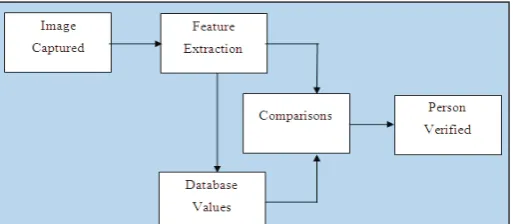
A Block representation of the process layout is as shown. Here in the figure, main emphasis is to be given on creating the database values. The values of captured image are to be compared with the same.
Fig. 1: Process Layout
Authentication is the process of associating an individual with his unique identity, that is, the manner in which the individual establishes the validity of his claimed identity. There are three basic authentication means by which an individual may authenticate his identity.
Something an individual KNOWS (e.g. a password, Personal •
ID Number (PIN), the combination to a lock, a set of facts from a person’s background).
Something an individual POSSESSES (e.g. a token or card, •
a physical key to a lock).
Something an individual IS (e.g. personal characteristics or •
“biometrics” such as a fingerprint or voice pattern).
These basic methods may be employed individually, but many user login systems employ various combinations of the basic authentication methods. An important distinction between identification and authentication is that identities are public whereas authentication information is kept secret and thus becomes the means by which an individual proves that he actually is who he claims to be. In addition, identification and authentication provides the basis for future access control.
A. Problems Related With Iris Biometric Recognition It is highly probable that the captured irises resultant of non-cooperative imaging environments contain several other types of information. This topic is concerned with the detection of these regions, which are considered as noisy. Having stressed the difference regarding the common meaning of noise in the general image processing domain, we overview and establish a classification of the most common noise detection methods in the iris biometrics compass.
1. Noise
Image noise can be defined as the degree of variation of pixel values caused by the statistical nature of the detection process. Commonly, it refers to stochastic variations in the pixels intensities, rather than deterministic distortions such as shading or lack of focus. In the digital image capturing, there are three common types of noise.
2. Random Noise
This type of noise results of short exposure times or high ISO speed. It is characterized by intensity fluctuations above and below the real image intensity and its pattern present highly variations, even with similar exposure settings.
3. Fixed Pattern
4. Banding Noise
It is highly dependent of the digital capturing devices and appears when the camera reads data from the digital sensor. It is most visible at high ISO speeds, in shadows or when the image is excessively brightened. However, the term of our work and of this dissertation the meaning of noise is quite distinct: We considered as noisy the image regions that correspond to any other types of information apart from the iris and are localized within the region delimited by the pupillary and scleric iris borders. As they obstruct portions of the iris texture, ideally they should not be captured because they significantly increase the challenges of the biometric recognition itself. Moreover, in the iris recognition literature it is common the reference to the term noise for all the information that obstructs portions of the iris.
5. Noise Factors in Normalized Iris Images
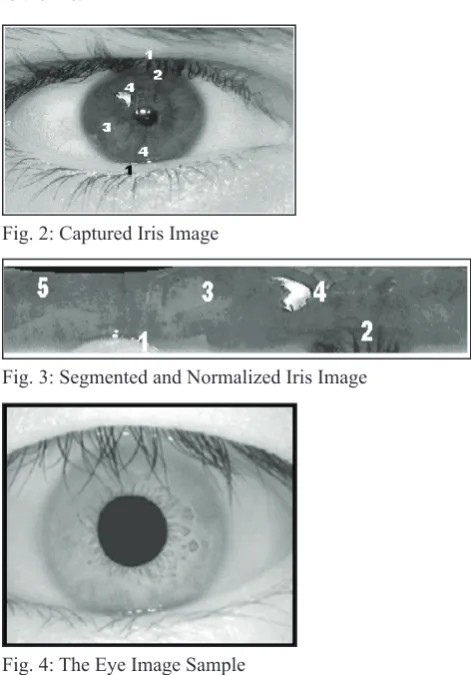
The most common types of information that obstruct the iris texture captured within non-cooperative imaging settings. This section analyzes the detection of these noisy regions within the segmented and normalized iris image, which, as described below, is the one used as basis for our noise detection proposal. Below figure illustrates the most common noise regions that result of non-cooperative imaging processes, either in the captured and in the segmented and normalized iris image. Eyelids and eyelashes obstructions are usual in the lower part of the normalized images (numbers 1 and 2), corresponding to the upper and lower iris extremes that are naturally obstructed by eyelid movement. Oppositely, since these are determined by heterogeneous lighting conditions, both specular and lighting reflections are highly disseminated across the irises and are in this example signalled with numbers 3 and 4. Finally, the noise region signalled with number 5 is due to the inaccurate pupil segmentation that resulted in the wrong classification of a portion of the pupil as belonging to the iris.
Fig. 2: Captured Iris Image
Fig. 3: Segmented and Normalized Iris Image
Fig. 4: The Eye Image Sample
B. Noise Detection and Feature Selection Methods In order to avoid the problems originated by noise, some authors (e.g. Daugman) propose to recognize individuals using exclusively portions of the iris, those where noise factors are less probable. Zhu et al. and Kim et al. proposed the equalization of the histogram of the segmented and normalized iris image to reduce the effect of non-uniform illumination. The latter proposed the utilization of morphological operators to detect isolated eyelashes. Ma et al. proposed a global iris image enhancement by means of local histogram equalization and the removal of the high-frequency noise through Gaussian low-pass filtering.
Motivated by the observed difference between the standard deviation of the intensity values within small windows from noisy and noise-free regions, Nam et al. and Du et al. proposed the computation of the standard deviations within small (3 × 3 and 5 × 5 pixels) windows. If the value is higher than a threshold, the central pixel of the window is considered noise, providing the exact localization of each noise region within the image. Wildes proposed the equalization of the histogram of the whole image and the localization of the inferior and superior eyelids by means of an edge detector, followed by the linear Hough transform. As other similar approaches, this implies a search in the N5 space for the ellipses fitting task, which contributes to its poor performance and its dependency of the threshold parameters used by the edge detector.
In a global measure of the quality of the captured images is described by Ma et al., based on the analysis of its frequency distributions. Authors claim that noise-free irises have relatively uniform distribution, as opposed to those with eyelid or eyelash obstructions. They started by the image enhancement, through the subtraction of the average intensity computed within small image windows, followed by the local equalization of the histogram. They did not identify eyelashes or eyelids, having however concluded that a substantial part of the observed false rejections were due to the eyelid and eyelash obstruction (57.7%) and inaccurate iris segmentation (21.1%).
Kond and Zhang proposed the classification of noisy iris regions directly in the captured image. They identified the separable (isolated) eyelashes through the energy of the convolution of the image with a bank of Gabor filters. The values that are lower than a threshold correspond to the noise regions. Multiple eyelashes were identified through the computation of the standard deviation within small regions of the image. Reflections were classified as strong (identified with a simple threshold) and weak. The latter simply correspond to transitions between the strong reflections and the noise-free areas and are identified through an iterative algorithm that expands the strong reflections areas.
Motivated by the problem of the high false rejection rates, Vatsa et al. proposed the use of an edge detector followed by the linear Hough transform to detect eyelids and eyelashes. This approach was also proposed with minor variants by Ives et al. and Huang et al.
Based on the analysis of the energy resultant of the convolution between the image and a group of Mexican-Hat wavelets at three different scales, Chen et al. proposed both local and global image quality measures. From our viewpoint, the database used was not adequate for the effective test of the method, since it contains almost no reflections.
an illumination invariant measure (phase congruency).
The remainder of this paper is organized as the following. At first, in Section II we illustrate the various components of our proposed technique to Iris Recognition. Further, in Section III we present some key experimental results and evaluate the performance of the proposed system. At the end we provide conclusion of the paper in Section IV and state some possible future work directions.
II. Proposed Technique
This section illustrates the overall technique of our proposed work. We present an extensive survey of iris recognition methods and also give a brief review of related topics. The main objective of this implementation is given:
Canny’s edge detection algorithm is computationally more 1.
expensive compared to Sobel, Prewitt and Robert’s operator. However, the Canny’s edge detection algorithm performs better than all these operators under almost all scenarios. Histogram Threshold based image segmentation is the process 2.
of partitioning a digital image into multiple segments (sets of pixels, also known as super pixels). The goal of segmentation is to simplify and change the representation of an image into something that is more meaningful and easier to analyze. Histogram Threshold-based methods are very efficient when 3.
compared to other image segmentation methods because they typically require only one pass through the pixels. In this technique, a histogram is computed from all of the pixels in the image, and the peaks and valleys in the histogram are used to locate the clusters in the image.
Compared with other biometric technologies, such as 4.
face, speech and finger recognition, Iris recognition can easily be considered as the most reliable form of biometric technology.
The gamma correction is an image-processing algorithm 5.
that compensates for the nonlinear effect of signal transfer between electrical and optical devices.
Complex
Real
Imaginary
Where And
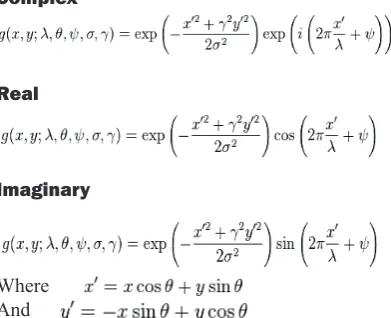
In this equation, represents the wavelength of the sinusoidal factor, represents the orientation of the normal to the parallel stripes of a Gabor function, is the phase offset, is the sigma/ standard deviation of the Gaussian envelope and is the spatial aspect ratio, and specifies the elasticity of the support of the Gabor function. Gabor filters are directly related to Gabor wavelets, since they can be designed for a number of dilations and rotations. However, in general, expansion is not applied for Gabor wavelets, since this requires computation of bi-orthogonal wavelets, which may be very time-consuming. Therefore, usually, a filter bank consisting of Gabor filters with various scales and rotations is
created. The filters are convolved with the signal, resulting in a so-called Gabor space. This process is closely related to processes in the primary visual cortex.Jones and Palmer showed that the real part of the complex Gabor function is a good fit to the receptive field weight functions found in simple cells in a cat’s striate cortex. The Gabor space is very useful in image processing applications such as optical character recognition, Iris detection and fingerprint recognition. Relations between activations for a specific spatial location are very distinctive between objects in an image. Furthermore, important activations can be extracted from the Gabor space in order to create a sparse object representation.
III. Evaluation and Results
A. Freely Available Databases
The biometrics research and development demands the analysis of human data. Obviously, it is unrealistic to perform the test of algorithms in data captured on-the-fly, due to the enormous uneasiness that this would imply. Moreover, the fair comparison between recognition methods demands similar input data to valorise and contextualize their results. Therefore, when it comes to the test of recognition methods, standard biometric databases assume high relevance and become indispensable to the development process. Regarding the iris biometrics compass, there are presently, apart from the UBIRIS, five public and freely available iris image databases. In the following subsections we describe the main characteristics of their images and turn our attention to the analysis of the noise factors we considered the analysis of these noise factors and the images heterogeneity as the most important parameters, concerning the terms and purposes of our work. Through illustration, we exemplify some of the most common types of noise that each database contains.
In this work we load an iris image and apply the different technique on loaded image in the Image Processing Toolbox under the MATLAB Software. Below steps of our proposed work is given:
Phase1: Firstly we develop a particular GUI for this implementation. After that we develop acode for the loading the iris image file in the Matlab database.
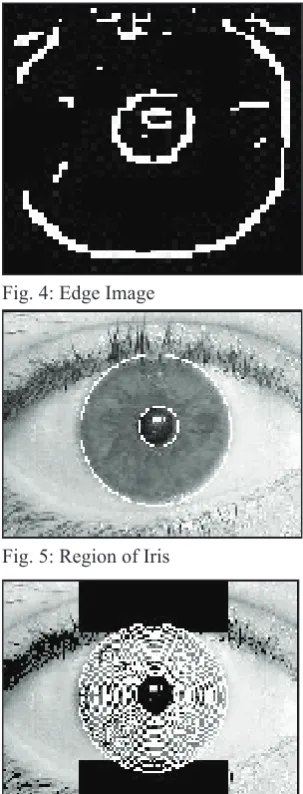
Phase 2: Develop a code for the edge detection using canny edge detector and apply on the image.
Phase 3: Develop a code for the gamma correction with histogram threshold for the segmentation and normalization. When code is develop then apply on the image for detection. We develop the code for the finding region of iris using Histogram thresholding.
Phase 4: After that we develop code for the iris matching using PCA. The main figure window of our proposed method is given below:
Results:
Fig. 4: Edge Image
Fig. 5: Region of Iris
Fig. 6: Normalized Image
Fig. 7: Comparison of FAR, FRR and Complete%
Table: 1: Result Comparison with Literature
CASIA 4.0 ICE2005 IIT Delhi
Literature 98.17% 96.40%
-NA-Our 99.20% 98.16% 97.71%
IV. Conclusion and Furure Scope
In this paper, we present proposed An Efficient Biometric Iris Recognition using Gamma Correction &Histogram Threshold with PCA. Iris recognition is most accurate and reliable biometric identification system. This paper described ocular detection which is very useful in biometric recognition. Image de-noising is used for eliminating noise which gives better result. First step is to filter out any noise in the original image before trying to locate and detect any edges. As the Gaussian filter can be computed using a simple mask, it is used exclusively in the Canny algorithm. Once a suitable mask has been calculated, the Gaussian smoothing can be performed using standard convolution methods. A convolution mask is usually much smaller than the actual image. Segmentation of iris is the main stage of iris recognition, because if areas that are wrongly identified as ocular regions will corrupt biometric templates resulting in very poor recognition. So the ocular region should be identified very accurately. The Specular reflection are observed and eliminated. A system is designed for enhancing and matching the conjunctival structure. This conjunctival structure is used in biometric recognition, which is also known as Iris Recognition System. The experiments presented in the paper demonstrate that at its best, the iris region holds a lot of promise as a novel modality for identifying humans with a potential of influencing other established modalities based on ocular and face. At the very least, the results suggest a potential for using iris region as a soft biometric. Future work includes evaluation of more iris features, comparison of iris based recognition performance to a commercial face recognition algorithm, exploration of how the capture conditions and the image quality such as uncontrolled lighting, or subjects wearing cosmetics affect the Per ocular skin texture and color, among others.
References
[1] S. Sanderson, J. Erbetta,“Authentication for secure environments based on iris scanning technology”, IEE Colloquium on Visual Biometrics, pp. 1-6, 2000.
[2] J. Daugman,"How iris recognition works?", Proceedings of 2002 International Conference on Image Processing, Vol. 1, pp. 16-22, 2002.
[3] E. Wolff,"Anatomy of the Eye and Orbit", 7th edition. H. K. Lewis & Co. LTD, 1976.
[4] R. Wildes,“Iris recognition: an emerging biometric technology”, Proceedings of the IEEE, Vol. 85, No. 9, pp. 1349 13-60, 1997.
[5] J. Daugman,“Biometric personal identification system based on iris analysis”, United States Patent, Patent Number: 5, 291, 560, 2010.
[6] J. Daugman,"High confidence visual recognition of persons by a test of statistical independence", IEEE Transactions on Pattern Analysis and Machine Intelligence, Vol. 15, No. 11, pp. 1148-1160, 2011.
[7] R. Wildes, J. Asmuth, G. Green, S. Hsu, R. Kolczynski, J. Matey, S. McBride,“A system for automated iris recognition”, Proceedings IEEE Workshop on Applications of Computer Vision, Sarasota, FL, pp. 121-128, 2011.
[8] W. Boles, B. Boashash,“A human identification technique using images of the iris and wavelet transform”, IEEE Transactions on Signal Processing, Vol. 46, No. 4, pp. 1185-1188 ,1998.
[10] S. Noh, K. Pae, C. Lee and J. Kim,“Multiresolution independent component analysis for iris identification”, The 2002 International TechnicalConference on Circuits/ Systems, Computers and Communications, Phuket, Thailand, 2002.
[11] Y. Zhu, T. Tan, Y. Wang,“Biometric personal identification based on iris patterns”, Proceedings of the 15th International Conference onPattern Recognition, Spain, Vol. 2, 2000. [12] C. Tisse, L. Martin, L. Torres, M. Robert,“Person identification
technique using human iris recognition”, International Conference on Vision Interface, Canada, 2002.
[13] Chinese Academy of Sciences – Institute of Automation. Database of 756 Greyscale Eye Images, [Online] Available: http://www.sinobiometrics.com Version 1.0, 2003.
[14] Indian Institute of Technology Delhi, iris Database for research. [Online] Available: http://web.iitd.ac.in/~biometrics/ Database_Iris.html,2013
[15] W. Kong, D. Zhang,“Accurate iris segmentation based on novel reflection and eyelash detection model”, Proceedings of 2001 International Symposium on Intelligent Multimedia, Video and Speech Processing, Hong Kong, 2001.
[16] L. Ma, Y. Wang, T. Tan,“Iris recognition using circular symmetric filters”, National Laboratory of Pattern Recognition, Institute of Automation, Chinese Academy of Sciences, 2002.
[17] N. Ritter,“Location of the pupil-iris border in slit-lamp images of the cornea”, Proceedings of the International Conference on Image Analysis and Processing, 1999.
[18] M. Kass, A. Witkin, D. Terzopoulos, Snakes,“Active Contour Models”, International Journal of Computer Vision, 2008. [19] D. Field,“Relations between the statistics of natural images
and the response properties of cortical cells”, Journal of the Optical Society of America, 2011.
Manpreet Kaur is pursuing M. Tech (Computer Science Engg.) from Northwest Institute of Engineering and Technology Dhudike Moga, (Under Maharaja Ranjit Singh Technical University Bathinda). I am working on thesis (Biometric IRIS Recognition and Canny Edge Detection and Histogram Threshold).
Dr. Mohita has done Ph. D., M. Phil. and M.Tech. She has published 10 research papers in different International and National Journals. She has presented more than 35 papers in different National & International Conferences and Seminars. She has also participated in more than 10 National seminars, Conferences and Workshops. She has a rich working experience in the field of Teaching and Research. Dr. Mohita has also acted as a Resource Person for delivering Guest Lectures in number of Institutes and under EDUSAT programme O/o Director General, Higher Education,
Haryana. Her Research interest include Management information System, Data Mining and its applications , Artificial intelligence, At present, she is working as Associate professor in North West Group of Institutions.