A Comparative Study of Multi Scale Transform
based Fusion Techniques
1
Arwinder Kaur, 2 Ramanjeet Kaur, 3 Manish Mahajan, 4 Shalini Singh
1
Assistant Professor, Department of CSE, CGC-CoE, Landran,Punjab
2
Assistant Professor, Department of CSE, CGC-CEC, Landran, Punjab
3
Associate Professor, Department of CSE, CGC-CoE, Landran
4
Assistant Professor, Department of CSE, CGC-CEC, Landran
Abstract -Image fusion is the progression of amalgamation of information from a number of cataloged images exclusive of the introduction of deformation. Image fusion is ready to lessen the amount of data, maintain important information and construct new image that is more appropriate for additional processing tasks. High-resolution multispectral images images can be formulated from a high-resolution panchromatic (PAN) image and low-resolution multispectral (MS) of remote sensed images using number of image fusion schemes. Multisensory fusion is used to achieve high spatial and spectral resolutions. It do so by merging images from two sensors, one of which has high spatial resolution and the other one has high spectral resolution in remote sensing regions. Image fusion technique is also used to eradicate noise from the images i.e. unwanted material which declines the quality of an image. Image fusion is applicable in many areas like remote sensing, computer vision, military purposes and intelligent robots. The present paper analyses some of the successful fusion levels such as pixel level, feature level and decision level fusion. The paper also presents some of the image fusion algorithms such as Average method, PCA fusion, high pass filtering whichare spatial domain methods and they deal with the image pixels directly. The temporal domain fusion methods include transformation like Discrete Cosine Transform, Discrete wavelet transform. The methods presented in the paper also have some influences and flaws.
Keywords - Fusion Levels, Principal Component Analysis, Intensity Hue Saturation, Multiscale transform, ANN, DCT.
1. Introduction
Image fusion is a technique of merging two images into a distinct fused image that has the original information without obtaining non- existent particulars of the input images. The relevant information is taken out from the input images and the vital information and important characteristics are highlighted in the fused image. The
resultant image contains more precise and complete information than the individual source images, without introducing any artifacts.Image Fusion helps to improve the quality of information from the collected images. Different sensors are used to capture these images at different times and they have different spatial and spectral features. It reduces ambiguity and minimizes redundancy in the output while maximizing appropriate information from two or more images of a scene into a single fused image that is more useful. There are number of applications of image fusion such as remote sensing, medical imaging, computer vision, robotics and microscopic imaging.
Fig.1 Fused image
2. Literature Survey
Sunil Kumar Panjeta and Deepak Sharma (2012) [1] demonstrated that the previous method like brovey method provided nice images with sharp details but the close examination of these images indicated that the dark areas became darker and the white one whiter than the original images. But the use of PCA method presented better improved fused images. The better fused image does not
Image 1
Image 2
include much change in the spectral and spatial information of the original image. The PCA and the Wavelet fusion techniques preserved the original colors in all the possible RGB band combinations. But, it was also conclude that the Wavelet fusion method include small distortion.
Deepak Kumar Sahu and M.P. Parsai (2012) [2] studied a image fusion algorithm based on the combination of DWT and PCA with morphological processing. The algorithm improved the image fusion quality because the Wavelet transforms was the very good practice for the image fusion that provided a high quality spectral content which was essential feature of image fusion.
S. S. Bedi and Rati Khandelwal (2013) [3] studied the three categories of image fusion algorithms, i.e. the pyramid based algorithms, the basic DWT algorithms and the basic fusion algorithms. Researchers had exposed those fusion practices that operate on such features in the transform domain, which yield subjectively better fused images. Feature based fusion techniques were typically based on empirical or heuristic rules. The authors observed that spatial domain provided high spatial resolution but spatial domain had image blurring problem. This problem was overcome by using Wavelet transforms which was very good technique for the image fusion as it provided a high quality spectral content.
Sreelekshmi A. N (2013) [4] had found the merging of gray-level high-resolution panchromatic [PAN] image and the colored low-resolution multispectral [MS] image as the main application of image fusion. The applied methodology i.e. Modified HIS and Saturated compensated HIS methods were good at preserving spatial quality, where as Normal HIS and General HIS methods were good at conserving the spectral quality. It was experimented that for the given sample images, saturation compensated HIS scheme outperformed the Normal HIS method while Saturated compensated HIS system had the best performance with respect to spatial preservation.
Tajinder Singh, Mandeep Kaur and Amandeep Kaur (2013) [5] proposed a number of different fusion schemes in terms of the panchromatic (PAN), multispectral (MS) image fusion and multi focus image fusion. The authors concluded from the statistics that the PCA algorithm outperformed the IHS scheme whereas IHS-DWT system had the best performance because its spectral distortion was negligible.
Jagalingam P. and Arkal Vitta Hedge (2014) [6] considered that to produce high resolution MS image, the spatial information of high-resolution panchromatic (PAN) image and the color information of a low resolution
multispectral (MS) image was required. The authors found that the traditional image fusion procedure such as HIS, PCA and Brovey transform created color distortion problem. To overcome this difficulty, developers developed multiscale transforms such as discrete wavelet transform, pyramid method, wavelet transform, contourlet transform etc.
Maheswari. and Dr. Reeba Korah (2015) [7] studied that the standard fusion schemes performed well spatially but generally introduced spectral distortion. To overcome this problem, many multiscale transform based fusion methods have been proposed. The techniques like Brovey transform, HIS and PCA had lower complexity and faster processing time, but the color distortion was the most significant problem. The authors concluded that the wavelet based systems executed better than those methods which had the provisions of diminishing color distortion.
Jyoti Agarwal1 and Sarabjeet Singh Bedi (2015) [8] proposed an efficient image fusion technique which was formed by joining the features of both curvelet and wavelet image fusion algorithms. The high pass filter mask used to enhance the edges as compared to averaging filter mask that helped in removing noise by taking mean of grey values surrounding the centre pixel of the window. It was found that the presented method of image fusion get more enhanced image and it also worked well for edges, corners and helped in minimization of the restricted errors.
Ashishgoud Purushotham G. Usha Rani and Samiha Naik (2015) [9] concluded that the image fusion using wavelets with superior level of decomposition showed better performance in some metrics and in other metrics PCA showed better performance. It was also observed that
DWT performed better than PCA.
Gagandeep Kaur (2015) [10] presented a new hybrid approach for image fusion method which was a combination of DCT(Discrete Cosine Transform) and Variance. It also compared this process with Hybrid DWT(Discrete Wavelet Transform). It was observed that a new hybrid technique for the image fusion use only two images. So work can be improved in the future as fusion can be done on two videos or even on one video and one image or on an audio and one image.
conversion was more along with the hybridization of IHS and PCA.
3. Image Fusion Classification
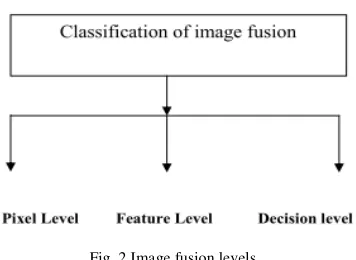
Image fusion can be classified as:
Fig. 2 Image fusion levels
1) Pixel Level Image Fusion (Signal Level Image Fusion):
Pixel–level fusion can be used to amplify the information content, that is linked with each pixel in an image and shaped through a combination of multiple images. Different images to be combined can be provided by a single imaging sensor or a group of sensors. The enhancement in quality coupled with pixel-level fusion can most easily be accessed through the improvements noted in the performance of image processing tasks such as feature extraction, restoration and segmentation. Pixel level fusion can take place at different levels of demonstration. The first level includes the synthesis of the raw signals from multiple sensors prior to their involvement with a particular pixel. The second level includes the fusion of analogous pixels in several registered images to form a complex or fused image, and the third level included the use of related pixels or local groups of pixels in various registered images for segmentation and pixel-level feature extraction.
2) Feature level image fusion (Object Level Image Fusion):
Feature level fusion includes the combination of feature sets related to multiple modalities. Firstly, the features are extracted from numerous biometric traits. The features from the biometric traits are represented in the form of vectors. There is a need to perform some preprocessing steps for enhancing an image before extracting the features. Feature level fusion deals with the fusion of features such as edges or texture. As the
feature set encloses useful information about the raw biometric data than the final decision level, the feature level fusion is considered better than the other fusion methods.
3) Decision level image fusion (Symbol Level image fusion):
Decision-level fusion involves mixture of information from various sensors and this informtion is preliminary concluded by the them. The above fusion level combines decisions from several experts. The output from multiple algorithms is merged together to get a final fused decision. A system using the decision level fusion strategy integrates different biometric data at a later stage than the multi-biometric system using feature level fusion or matching score level fusion strategies.
4.
Image Fusion Methods
4.1. Spatial Domain Fusion Method
Spatial domain methods deal with the image pixels directly. To achieve the desired results, the pixel values are manipulated.
4.2. Transform Domain Fusion Method
In transform domain process, the image is initially shifted into frequency domain.
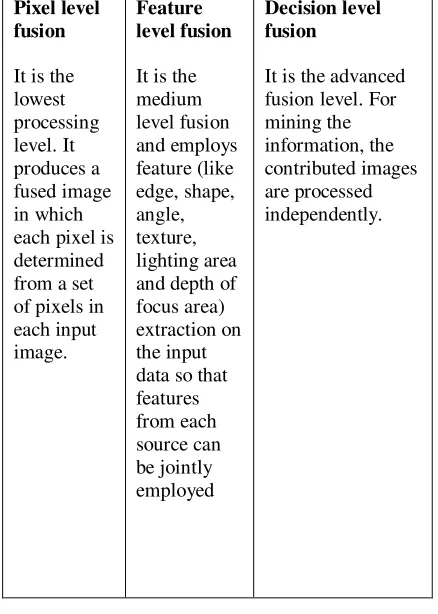
Table 1 – Comparison of Fusion Level
Pixel level fusion
It is the lowest processing level. It produces a fused image in which each pixel is determined from a set of pixels in each input image.
Feature level fusion
It is the medium level fusion and employs feature (like edge, shape, angle, texture, lighting area and depth of focus area) extraction on the input data so that features from each source can be jointly employed
Decision level fusion
It is the advanced fusion level. For mining the information, the contributed images are processed independently.
5. Existing Image Fusion Techniques
There are different image fusion techniques under spatial domain and transform domain.
These are as follows:
1. IHS (Intensity-Hue-Saturation) Transform
2. Principal Component Analysis (PCA)
3. Multi scale transform based fusion
(a) High-pass filtering method
(b) Pyramid method
(i) Gaussian pyramid (ii) Laplacian Pyramid (iii) Gradient pyramid
(iv) Ratio of low pass pyramid (v) Contrast pyramid
(vi) Filter-subtract-decimate fusion (vii) Morphological pyramid
(c) Wavelet transforms
(i) Discrete wavelet transforms (DWT) (ii)Stationary wavelet transforms (SWT) (iii)Multi-wavelet transforms
(d) Curvelet transforms
4. Artificial Neural Networks
5. Discrete Cosine Transform
5.1 HIS (Intensity-Hue-Saturation) Transform
There are three properties of a color i.e. Intensity, Hue and Saturation. These properties are used to control the visual representation of an image. IHS transform technique is the oldest of image fusion methods. Two of the three properties i.e. hue and saturation need to be carefully controlled because it contains most of the spectral information. The complete information of high spatial resolution is added to the spectral information for the fusion of high resolution PAN and multispectral images. There are many IHS transformation techniques based on different color models and these techniques involve HSV, IHS1, IHS2, HIS3, IHS4, IHS5, IHS6, YIQ.
The main steps for the standard IHS fusion scheme are:-
i. Perform image registration (IR) to PAN and MS, and resample MS.
ii. Convert MS from RGB space into IHS space.
iii. Match the histogram of PAN to the histogram of the I component.
iv. Replace the I component with PAN.zzv. Convert the fused MS back to RGB space.
5.2 Principal Component Analysis (PCA)
This is one of the most popular method for image fusion. A new set of variables called principal components, are generated and each principal component is a linear combination of the original variables. The principal components are orthogonal to each other, so there is no redundant information. The information contained in the first principal component (PC1) is commonly used by all the bands. It contains high variance to provide more information about panchromatic image. The second principal component (PC2) is placed vertically to the first and the third one lies perpendicular to the first two and so on. The low resolution multispectral images form uncorrelated principal components. A high resolution PAN component is stretched to have the same variance as PC1 and replaces PC1. Then an inverse PCA transform is employed to get the high resolution multispectral image. PCA is quite similar to IHS transform. The advantage of PCA method over IHS method is that an arbitrary number of bands can be used. PCA and HIS transforms provide good results at the cost of color distortion.
Fig. 4 PCA Method of Fusion
5.3 Multi Scale Transform Based Fusion
Multi-scale transform based fusion is one of the most popular technique in the field of pixel-level image fusion. It is also known as signal level image fusion. The fusion performance of multi-scale transform techniques often weakens for images derived from various sensor
modalities. Basically there are three methods available,
based on multi scale transform based fusion.
5.3.1 High Pass Filtering (HPF)
The high resolution multispectral images are acquired from high pass filtering. To achieve the output image, high frequency information from the high resolution panchromatic image is added to the low resolution multispectral image. It is executed either by filtering the High Resolution Panchromatic Image with a high pass filter or by taking the original HRPI and subtracting LRPI from it.
Fig. 5 Multi scale transform based fusion
The spectral information contained in the low frequency information of the HRMI is preserved by this technique. The use of low pass filter shows a smooth transition band besides a high ripple outside the pass band [4].
5.3.2 Pyramid Technique
Image pyramids can be expressed as a model for the binocular fusion for human visual system. An original image is represented in different levels by forming the pyramid structure. A compound image is created by applying a pattern selective approach of image fusion. Initially, the pyramid decomposition is performed on each source image. All these images are integrated to form a fused image and then inverse pyramid transform is applied to get the resultant image.
a) Gaussian Pyramid
The Gaussian pyramid consists of low-pass filtered, reduced density (i.e., downsampled) images of the preceding level of the pyramid, where the base level is defined as the original image. This method includes a series of images which are weighted down using a Gaussian average and scaled down. When this procedure is used multiple times, it creates a stack of sequentially smaller images, with each pixel containing a local average that corresponds to a pixel neighborhood on a lower level of the pyramid.
b) Laplacian Pyramid Fusion
Laplacian pyramid of an image is a set of band pass images in which each is a band pass filtered copy of its ancestor. Band pass copies can be attained by calculating the variation between low pass images at successive levels of a Gaussian pyramid. In this approach, the Laplacian pyramids for each image component (IR and Visible) are used. A strength measure is employed to decide from which source what pixels contribute at each particular sample location. The final image is simply an average of two low resolution images when the average of the two pyramids corresponding to each level is taken and addition is performed on them. The Laplacian pyramid is derived from the Gaussian pyramid, which is essentially a chain of increasingly filtered and down sampled versions of an image.
c) Gradient Pyramid Fusion
using various parameters. Simulation consequences show that gradient pyramid algorithm is competent to
multi-focus and color image. Also, the Gradient pyramid Fusion
system utilizes Gradient pyramid as a substitute of Laplacian.
d) Ratio Of Low Pass Pyramid
Ratio of Low Pass Pyramid is a pyramid that uses the ratio of levels of the Gaussian pyramid to construct the next level, rather than the difference. At every level the image is the ratio of two consecutive levels of the Gaussian pyramid.
e) Contrast Pyramid
Contrast Pyramid is similar to the ratio of Low Pass Pyramid method. Contrast itself is defined as the ratio of the difference between luminance at a certain location in the image plane and local background luminance. Luminance is defined as the quantitative measure of brightness and is the amount of visible light energy leaving a point on a surface in a given direction.
f) Filter-Subtract-Decimate Fusion
Filter-Subtract-decimate (FSD) Pyramid method is a more computationally proficient variant of the Gaussian Pyramid. FSD pyramid is similar to Laplacian fusion but the only difference is in the use of it.
g) Morphological Pyramid Fusion
This method employs morphological pyramids instead of Laplacian or contrast pyramids. The multi-resolution technique is a type of morphological pyramid which is introduced by Burt and Adelson etc. This scheme normally use low or band pass filters as part of the practice. But, These filtering functions frequently modify the details of shape and the exact location of the objects in the image. This problem has been addressed by using morphological filters to eliminate the image information without unfavorable effects.
5.3.3 Wavelet Transform
A multi-resolution decomposition of an image is a bi-orthogonal basis and it results in non-redundant image representation. This basis is called wavelets. Initially, the images are distorted to the wavelet domain by using function wfusimg ( ), where the number of scales, the wavelet filter and the edge handling are specified .Then, a decision mask is built in the same way as it was clarified in the Laplacian fusion implementation. The next step is carried out by constructing the fused transformed image
with this decision mask. Finally, the fused image is acquired by applying an inverse wavelet transform. Wavelet transform is considered as an alternative to the short time Fourier transforms. It is advantageous over Fourier transform in that it provides desired resolution in time domain as well as in frequency domain whereas Fourier transform provides a good resolution in only frequency domain. In Fourier transform, the signal is decomposed into sine waves of different frequencies whereas the wavelet transform decomposes the signal into scaled and shifted forms of the mother wavelet or function. In the image fusion using wavelet transform, the input images are decomposed into approximate and informative coefficients using DWT at some specific level. A fusion rule is applied to combine these two coefficients and the resultant image is obtained by taking the inverse wavelet transform [10].
5.4 Artificial Neural Networks (ANN)
Artificial Neural networks (ANN) is very significant in pattern recognition. A non linear response function is used in artificial neural networks. It uses Pulse Coupled Neural Network (PCNN) which consists of a feedback network. This network is divided into three parts namely pulse generator, the receptive field and the modulation field. Each neuron corresponds to the pixel of the input image. The matching pixel’s intensity is used as an external input to the PCNN.
This method is advantageous in terms of hardiness against noise, independence of geometric variations and capability of bridging minor intensity variations in input patterns. PCNN has biological importance and used in medical imaging as this method is feasible and gives real time system performance [5].
5.5 Discrete Cosine Transform
The Discrete Cosine Transform is widely useful in terms of compaction of energy. It stores maximum information in minimum coefficients located at low frequency and every time that one coefficient goes down again towards the high frequencies, then the information will be degraded. This makes it possible to eliminate the coefficients having relatively small amplitudes without presenting a deformation of the characteristics of the image.
6. Conclusion
preeminent practice is chosen on basis of the application. Depending upon the type of the application and the constraint of the user that one might have need to attain the visually beautiful informative image as someone else may require the more details of the colors for getting more detailed and precise results about the image.
References
[1] S.A.Panwar, SayaliMalwadkar A Review:Image Fusion Techniques for Multisensor I mages
[2] Qiang Yang, Hua Jun Wang and Xuegang Luo “Research on Remote Sensing Image Fusion Algorithm Based on Compressed Sensing” International Journal of Hybrid Information Technology Vol.8, No. 5 (2015), pp. 283-292
[3] Gagandeep Kaur and Anand Kumar Mittal “A New
Hybrid Wavelet Based Approach for Image Fusion “
International Journal of Innovative Research in Science, Engineering and Technology Vol. 4, Issue 1, January 2015
[4] Suruchi Goyal and Rupinder Wahla “A Survey on Image Fusion” International Journal of Innovative Research in Computer and Communication Engineering Vol. 3, Issue 8, August 2015
[5] Sunil Kumar Panjeta1 and Deepak Sharma “A Survey on Image fusion Techniques used to Improve Image Quality” International Journal of Applied Engineering Research, ISSN 0973-4562 Vol.7 No.11 (2012) [6] Firouz Abdullah Al-Wassai1, N.V. Kalyankar and Ali
A. Al-Zaky “The Statistical methods of Pixel-Based Image Fusion Techniques”
[7] Srinivasa Rao Dammavalam1 Seetha Maddala2 and Krishna Prasad “Mhm3 Quality Assessment of Pixel-Level Image Fusion using Fuzzy logic” International Journal on Soft Computing ( IJSC ) Vol.3, No.1, February 2012
[8] S. S. Bedi and Rati Khandelwal “Comprehensive and Comparative Study of Image Fusion Techniques” International Journal of Soft Computing and Engineering (IJSCE) ISSN: 2231-2307, Volume-3, Issue-1, March 2013
[9] Maheswari.S1 and Dr.Reeba Korah “Survey on Image Fusion Algorithm” International Journal of Emerging Trends & Technology in Computer Science (IJETTCS) Volume 4, Issue 1, January-February 2015 ISSN 2278-6856
[10] Nagina Yadav, Romika Yadav, Monika, Tarun Kumar “Deportment of Image Fusion in MATLAB and SCILAB” IJITE Vol.03 Issue-04, (April, 2015) ISSN: 2321-1776 International Journal in IT and Engineering, Impact Factor- 3.570
[11] C. Morris and R.S. Rajesh “Two Stage Spatial Domain Image Fusion Techniques” Ictact Journal On Image And Video Processing: Special Issue On Video Processing For Multimedia Systems, August 2014, Volume: 05, Issue: 01
[12] Shalima, Dr. Rajinder Virk “Review Of Image Fusion Techniques” International Research Journal of
Engineering and Technology (IRJET) Volume: 02 Issue: 03 | June-2015
[13] Ms.Dhara Dharsandia, Ms.Anjali Bhatt and Mr.Manish Patel Review on “Image Fusion and Its Techniques” February 2015, Volume 2, Issue 2 JETIR
[14] Sreelekshmi A. N Survey on “His Image Fusion Methods” International Journal of Engineering Science InventionVolume 2 Issue 8 ǁ August. 2013 ǁ PP.80-86 [15] Zhang Ning and Zhu Jinfu “Study On Image
Compression And Fusion Based On The Wavelet Transform Technology” International Journal On Smart Sensing And Intelligent Systems Vol. 8, No. 1, March 2015
[16] Jyoti Agarwal and Sarabjeet Singh Bedi “Implementation of hybrid image fusion technique for feature enhancement in medical diagnosis” Human-centric Computing and Information Sciences (2015) [17] C. Morris & R. S. Rajesh” Survey of Spatial Domain
Image fusion Techniques” International Journal of Advanced Research in Computer Science Engineering and Information TechnologyVolume: 2 Issue: 3 08-Apr-2014,ISSN_NO: 2321-3337
[18] R.Johnson Suthakar, J.Monica Esther M.E, D.Annapoorani and F.Richard Singh Samuel “Study of Image Fusion- Techniques, Method and Applications” IJCSMC, Vol. 3, Issue. 11, November 2014, pg.469 – 476
[19] Ashishgoud Purushotham, G. Usha Rani and Samiha Naik “Image Fusion Using DWT & PCA” Volume 5, Issue 4, 2015 ISSN: 2277 128X International Journal of Advanced Research in Computer Science and Software Engineering
[20] Tajinder Singh, Mandeep Kaur and Amandeep Kaur “A Detailed Comparative Study Of Various Image Fusion Techniques Used In Digital Images” International Journal of Advanced Engineering Technology/IV/III/July-Sept.,2013/50—52.
[21] Deepak Kumar Sahu and M.P.Parsai “Different Image Fusion Techniques –A Critical Review” International Journal of Modern Engineering Research (IJMER) www.ijmer.com Vol. 2, Issue. 5, Sep.-Oct. 2012 pp-4298-4301
[22] Jagalingam P., Arkal Vittal Hegde “Pixel Level Image Fusion–A Review on Various Techniques” 3rd World Conference on Applied Sciences, Engineering & Technology 27-29 September 2014, Kathmandu, Nepal [23] Leelavathi H P , Ram Manohar Nisarg “Comparative Study of Frequency Vs Spacial Domain for Multi Sensor Image Fusion” International Journal of Innovative Research in Science, Engineering and Technology (An ISO 3297: 2007 Certified Organization) Vol. 3, Issue 7, July 2014[14242-14249].
Author Profile:
Ramanjeet Kaur working as an Assistant Professor in CGC-CEC , Landran, Mohali , Punjab as an Assistant Professor in CSE Department. She has done her M.tech in Computer Science & Engineering. Her specification is in the field of Digital Image Processing.
Manish Mahajan working as an Associate Professor & HOD (CSE) in CGC-COE , Landran, Mohali, Punjab . He has done his M.tech in Computer Science & Engineering. His specification is in the field of Digital Image Processing.
Shalini Singh working as an Assistant Professor in CGC-CEC ,