VOLUME 8 | ISSUE 3 | 2013 | 778
Comparison of ground reaction force during
different angle of squatting
SHARIKH DALI 1, 2, MARIA JUSTINE 1 , HAMID AHMAD3, ZAINAL OTHMAN3
1 Physiotherapy Dept, Faculty of Health Sciences, Universiti Teknologi MARA, Puncak Alam Campus, Puncak Alam,
Selangor Malaysia
2 Physiotherapy Dept, Faculty of Health Sciences, Universiti Industri Selangor, Shah Alam Selangor, Malaysia 3 Physiotherapy Dept, 94 Hospital Angkatan Tentera, Kem Terendak Melaka Malaysia
ABSTRACT
Dali, S., Justine, M., Ahmad, H. & Othman, Z. (2013). Comparison of ground reaction force during different angle of squatting. J. Hum. Sport Exerc., 8(3), pp.778-787. Squatting is a form of closed kinetic chain movement which commonly being employed in exercise training. However, little is known regarding the amount of force being imposed on the knee at different angles of squat. Thus, the purpose of this study was to compare the vertical ground reaction force (VGRF) at different angles of squatting among the military personnel. Thirty-seven subjects (age=27.1±2.77 years old) participated in this cross-sectional comparative study. The peak of VGRF was identified during squatting at 40º, 70º, and 110 º of knee flexion, which was measured using a force platform. The data were analysed using the one way repeated measure ANOVA and Pairwise Comparisons via Bonferroni adjustment. The VGRF were shown significantly different between the three angles of squatting (p<0.05). Since the Mauchly Test of Sphericity was significant (p>0 .05), the result was corrected using Greenhouse-Geiser Epsilon and continued to show a significant different [F (1.36, 49.08)=43.56] (p<0.05). The effect size was large (ηρ²=0.55). This study suggests that the angle of knee flexion during squatting exercise may influence VGRF. Deep squatting was found to generate the highest VGRF compared to semi and half squatting. Thus, it is suggested that squatting may be best performed at smaller angle in order to avoid excessive force that may be detrimental to the joint surface. Key words:GROUND REACTION FORCE, KNEE, SQUATTING.
1 Corresponding author. Physiotherapy Dept, Faculty of Health Sciences,Universiti Teknologi MARA Puncak Alam Campus, 42300 Puncak Alam, Selangor Malaysia
E-mail: [email protected] Submitted for publication August 2012 Accepted for publication August 2013
JOURNAL OF HUMAN SPORT & EXERCISE ISSN 1988-5202
© Faculty of Education. University of Alicante
doi:10.4100/jhse.2013.83.02
779 | 2013 | ISSUE 3 | VOLUME 8 © 2013 University of Alicante INTRODUCTION
Squatting is a common movement employed in the athletic training and proven to improve jumping height, peak power output, dynamic strength, sprint performance and horizontal jumping distance (Chelly et al., 2009; Lamont et al., 2009; Ruben et al., 2010). In physical rehabilitation, squatting is usually incorporated in exercise protocols for muscle strengthening in disorders like patellofemoral pain syndrome, arthritis of the knee and hip joints (Baker, & McAlindon, 2000; Grossi et al., 2005; Jan et al., 2009).
Apart from the beneficial effect of squatting on muscle strength, the ground reaction force is one of the major issues that is understudied. The ground reaction force (GRF) is a force of equal magnitude exerted on the opposite direction from the ground up to the foot (DeLee et al., 2010). It consists of vertical ground reaction force (VGRF) and two shear forces: anterior posterior and medial lateral shear forces (DeLee et al., 2010). It has been observed that excessive shear forces can be injurious to the cruciate ligaments, whereas excessive vertical forces can be deleterious to the menisci and articular cartilage (Eckstein et al., 2006; Escamilla, 2001; Herberhold et al., 1999). Increase GRF on the knee also produces discomfort and elicits pain among patients undergoing knee rehabilitation program (Eastlack et al., 2005). In contrast, vertical forces have been demonstrated to be an important factor in knee stabilization whereby it helps to resist shear forces and minimize tibial translation relative to the femur (Escamilla, 2001; Shoemaker, & Markolf, 1985; Markolf et al., 1981).
On the other hand, squatting activity has been shown to contribute to various musculoskeletal problems such as osteoarthritis (Zhang et al., 2004) and deformation of the joint cartilages (Eckstein et al., 1998, 2005). Therefore, it is logical to mention that incorrect technique of squatting that is prescribed in both rehabilitation and athletic training may increase the risk of injury to the performer and reduce its effectiveness.
Although the knee bending activities were thought to produce high loads that increase the risk of injury, Yack et al. (1993) reported that the stress to the anterior cruciate ligament can be minimized by using parallel squat compared to dynamic knee extension exercise. In addition, Lutz et al. (1993) revealed that squatting produced less anterior and posterior shear forces compared to open kinetic chain exercise in all angles. This shows that the GRF is the critical component that may influence the safety of squatting exercise. Therefore, question needs to be raised regarding what degree of squatting angle or knee flexion that may be considered safe and effective. However, there is no documentation that has emphasized on this issue. As such, it is vital to know that how much the human body can sustain the different amount of forces during different types of movement, specifically during squatting. With this information, the squatting exercises can be safely implemented in the rehabilitation program without compromising the effectiveness of the exercise.
VOLUME 8 | ISSUE 3 | 2013 | 780 METHODS
Study Design and Participants
The subjects for this cross-sectional comparative study were military personnel who were selected based on a simple random sampling using index card. The sample size was determined by the GPower 3 version 3.0.10 Software using the F test ANOVA for repeated measures. A total of 39 participants were recruited after taking into consideration of 10% drop outs (90% power, with the risk of type 1 error occurrence at 0.05). A few studies that have examined the muscle activity using EMG of lower limb muscles during squatting had sample sizes ranging from five to forty one subjects (Sousa et al., 2007; Salem, & Powell, 2001; Escamilla et al., 2000; Isear et al., 1996).
The criteria for study inclusion were normal body mass index (BMI), no history of ligament injury and knee surgery, and no history of systemic diseases and other medical illnesses as verified by the doctor involved in the medical clearance. An initial ethical application was addressed to the Research Ethics Committee, Universiti Teknologi MARA prior to initiation of the study and was given approval on December 30th, 2010.
Instrumentations
Demographics and anthropometrics data
The demographic data gathered were age (years) and number of years working experience in military service. The anthropometric data included the height, weight, and body mass index (kg/m²). The body weight was measured using the weight scale (Tanita BC-418 MA, Tanita, Illinois, US) and recorded in the unit of kilogram (kg). The Stadiometer (SECA Vogel & Halke, Hamburg, Germany) was used to measure the height of the subjects.
The vertical ground reaction force
The VGRF was measured using a force platform (The Zebris® FDM-SX Multi forces measuring plate, Noraxon Inc. US). This platform has the capacity to measure the VGRF during weight bearing activity; however, it does not provide recording for the anterior-posterior and medio-lateral forces. The force platform was calibrated each time prior to data collection using the WinFDMS software.
The peak VGRF force was identified during the complete squatting movement performed by the subjects. The force platform in this study was fixed rigidly on the ground. This was necessary in order to ensure the movement was not affected by the platform, and to ensure a valid and reliable reading from the platform (Fritz & Peikenkamp, 2003). The best three data for peak VGRF were documented for each angle of squatting, thus the participants needed to perform at least three movements for each squatting angle. The mean for peak VGRF for each angle was calculated as the average score in Newton (N).
The squatting procedure
781 | 2013 | ISSUE 3 | VOLUME 8 © 2013 University of Alicante
A warm up session was conducted prior to testing procedures, which was consisted of 10 repetitions of squatting at any angles, followed by cycling on the stationary bicycle for five minutes (Kisner & Colby, 2002). The participants were allowed to take a five-minute rest by walking around the testing area. In this study, only the dominant leg was measured and recorded for data analysis, as determined based on the leg that subjects preferred for kicking a ball (Maior et al., 2009; Stensdotter et al., 2007).
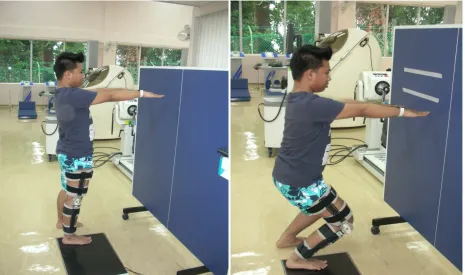
The starting position for the squatting was in the upright position with the hip and knees were fully extended. The dominant leg was placed on the force plate while the other leg was placed outside as shown in Figure 1. The stance width for each squatting movement was positioned based on the width of the subject’s shoulder (Escamilla et al., 2001). The subjects were instructed to squat down until the end of the available range of motion that was set for the pin-stops with the shoulder flexion maintained at 90º, 15cm from the surface of the marker placement surface (Dionisio et al., 2008).
Figure 1. The position for determining the specific angle of squatting.
VOLUME 8 | ISSUE 3 | 2013 | 782
Statistical Analysis
The data in this study were analyzed using the PASW (Predictive Analytics Software) Statistic 18 package. The one way repeated measures ANOVA within factors were used to analyze the significant difference of VGRF, while the multiple pairwise comparisons between the three angles of squatting were assessed using the Bonferroni adjustment. The level of significance was set at p < 0.05. All sets of data were reportedly normal since the Shapiro-Wilk test showed non significant result (p > 0 .05).
RESULTS
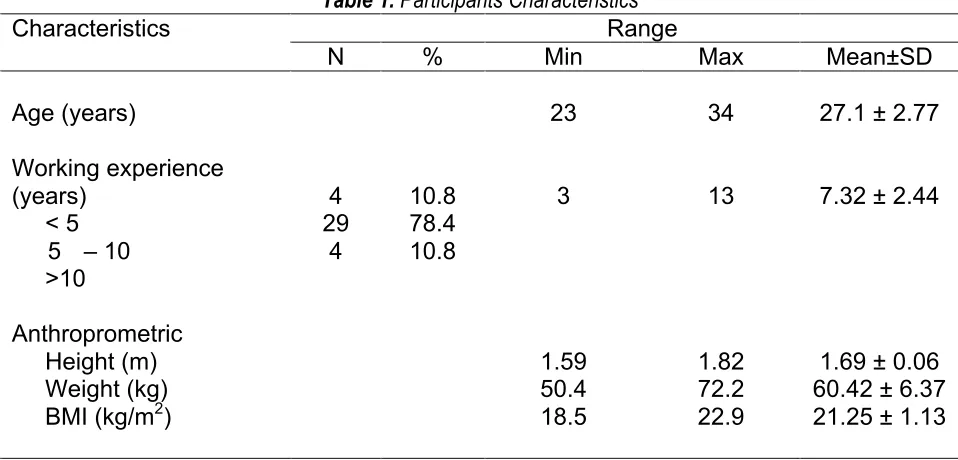
The demographic and anthropometric characteristics of the study population are tabulated in Table 1.
Table 1. Participants Characteristics
Characteristics Range
N % Min Max Mean±SD
Age (years) 23 34 27.1 ± 2.77
Working experience (years)
< 5 5 – 10 >10
4 29
4
10.8 78.4 10.8
3 13 7.32 ± 2.44
Anthroprometric Height (m) Weight (kg) BMI (kg/m2)
1.59 50.4 18.5
1.82 72.2 22.9
1.69 ± 0.06 60.42 ± 6.37 21.25 ± 1.13
783 | 2013 | ISSUE 3 | VOLUME 8 © 2013 University of Alicante
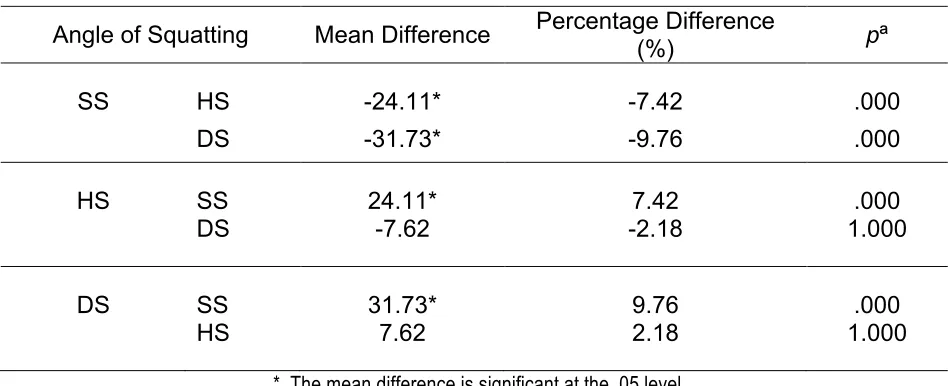
Table 2. The Pairwise Comparison of VGRF between different angles of squatting
*. The mean difference is significant at the .05 level. a. Adjustment for multiple comparisons: Bonferroni
SS: semi squatting, HS: half squatting DS: deep squatting
VGRF: Vertical ground reaction force
The result of repeated measures ANOVA revealed that there was a significant difference in VGRF produced between semi squatting, half squatting and deep squatting. Since the Mauchly Test of Sphericity was significant (p > 0.05), the result was corrected using Greenhouse-Geiser Epsilon and continued to show a significant different [F (1.36, 49.08) = 43.56] (p < 0.05). Therefore, the null hypothesis was rejected. The effect size was large (partial eta squared = 0.55). The Pairwise comparisons were conducted via Bonferroni adjustment between semi squatting and half squatting; half squatting and deep squatting and between semi squatting and deep squatting and all showed significant differences at p < 0.05.
DISCUSSION
The VGRF showed significant differences between the three angles (semi squatting, half squatting, deep squatting) of knee flexion. These study findings show the means of VGRF increased as the angles of squatting were increased from semi to deep squatting. The VGRF increased ranging from 309.03 N to 383.22 N (approximately 52.08% to 64.57% mean of Body Weight). To date, there were no other studies that have measured the VGRF during various angle of squatting. The VGRF in the same movement can be explained in relation to the Newton’s third law.
The Newton's third law states that, for every action or force, there is an equal but opposite reaction. Forces of action and reaction are equal in magnitude but in the opposite direction. This is crucial when upholding the principle of equilibrium and using tools that assess forces being applied to the body of interest. Reaction forces act to constrain motion by reacting to an applied force. The GRF acts simultaneously due to the weight of the body which is exerted in the opposite direction from the ground. As such, based on this concept, the different types of activity may produce different GRF to the body.
Although there was a different in the angle of squatting, the body does not receive any additional force since the body mass is not influenced by the position of the body without any external force such as
Angle of Squatting Mean Difference Percentage Difference (%) pª
SS HS -24.11* -7.42 .000
DS -31.73* -9.76 .000
HS SS 24.11* 7.42 .000
DS -7.62 -2.18 1.000
DS SS 31.73* 9.76 .000
VOLUME 8 | ISSUE 3 | 2013 | 784
acceleration of the movement. As such, when performing the same movement, with the same acceleration, although the angle of the movement was different, it will never produce different amount of VGRF on the body. Therefore, the increment of the VGRF as shown in this finding violated the Newton’s third law and this condition was not possible without any other factors such as acceleration of the movement and external load from the exercise modalities such as dumb bell or bar bell.
The acceleration was identified as the main factors that cause the findings of this study violate the Newton’s third law. The significant increment of the VGRF produced during different angle of squat exercise may be due to the movement cadence since the subjects were instructed to squat down until the desired angle and back to the starting position as fast as they can within 1 second. Considering that the distances of the squat movement increase with the increment of the angle of squatting, therefore, the subjects were needed to accelerate the movement more in the deeper squat exercise in order to fulfill the requirements based on the instruction given to squat as fast as they can within 1 second.
The Newton’s second law supported these findings. According to the law, the force acting on the body is parallel and directly proportional to the acceleration and mass (F = ma) (DeLee et al., 2010; Luttgens & Wells, 1982). In other words, the force produced was influenced by the mass of the object and the acceleration of the movement. Since this study did not use or apply external load to the subjects, the acceleration is the best explanation for the findings. This finding is consistent with Bentley et al. (2010), which explained that the acceleration is a vector quantity that can alter the inertial force whether to decrease or increase during movement. Moreover, the force experienced by the musculoskeletal system is influenced by the inertial force. They also reported that the GRF was significantly higher in the faster acceleration of squatting (one second ascend and one second descend) compared to a slower acceleration of squatting. In recent studies, Jason (2011) and Yang (2011) have shown an agreement with the present study findings, using the different type of closed kinetic chain exercises in which acceleration was one of the components that can affect the force production during weight bearing activities.
Therefore, the result from this present study is consistent with the theory of Newton’s 2nd Law (F= ma). Although the current finding showed a significant difference in VGRF at different angles of squatting, the increased in VGRF as the subjects moved into the deeper squat may be influenced by the acceleration of the movement. The findings indicated that in the rehabilitation program that involves squatting activity, the angle of squat exercise does not influence the VGRF acted on the foot.
CONCLUSION
This study suggests that the angle of knee flexion during squatting exercise may influence VGRF. Deep squatting was found to generate the highest VGRF compared to semi and half squatting. Thus, it is suggested that squatting may be best performed at smaller angle in order to avoid excessive force that may be detrimental to the joint surface.
785 | 2013 | ISSUE 3 | VOLUME 8 © 2013 University of Alicante ACKNOWLEDGMENT
All authors acknowledge the participants for this study.
REFERENCES
1. Baker, K., & Mcalindon, T. (2000). Exercise for knee osteoarthritis. Curr Opin Rheumatol, 12, pp.456–63.
2. Bentley, J.R., Amonette, W.E., De Witt, J.K., & Hagan, R.D. (2010). Effects of different lifting cadences on ground reaction forces during the squat exercise. J Strength Cond Res, 24, pp.1414-20.
3. Bottoni, C.R. (2005). Anterior Cruciate Ligament Reconstructions in Active-Duty Military Patients. Operative Techniques in Sport Medicine, 13, pp.169-75.
4. Bullock, S.H., Jones, B.H., Gilchrist, J., & Marshall, S.W. (2010). Prevention of physical training– related injuries recommendations for the military and other active Populations based on expedited systematic reviews. Am J Prev Med, 38, pp.S156–S181.
5. Chelly, M.S., Fathloun, M., Cherif, N., Amar, M.B., Tabka, Z., & Van Praagh, E. (2009). Effects of a back squat training program on leg power, jump, and sprint performances in junior soccer players. J Strength Cond Res, 23, pp.2241-9.
6. Delee, J.C., Drez, J.R.D., & Miller, M.D. (2010). Delee & Drez's Orthopaedic Sports Medicine: Principles and Practice. 3rd ed. Philadelphia: Saunders Elsevier Inc.
7. Dionisio, D.C., Almeida, G.L., Duarte, M., & Hirata, R. (2008). Kinematic, kinetic and EMG patterns during downward squatting. J Electromyogr Kines, 18, pp.134–43.
8. Eastlack, R.K., Hargens, A.R., Groppo, E.R., Steinbach, G.C., White, K.K., & Pedowitz, R.A. (2005). Lower body positive-pressure exercise after knee surgery. Clin Orthop Relat R, 431, pp.213-19.
9. Eckstein, F., Hudelmaier, M., & Putz, R. (2006). The effects of exercise on human articular cartilage. J Anat, 208, pp.491-512.
10. Eckstein, F., Lemberger, B., Gratzke, C., Hudelmaier, M., Glaser, C., Englmeier, K., & Reiser, M. (2005). In vivo cartilage deformation after different types of activity and its dependence on physical training status. Annals of Rheumatic Diseases, 64, pp.291-295.
11. Eckstein, F., Tieschky, M., Faber, S.C., Faber, S., Englmeier, K., & Reiser, M. (1999). Functional analysis of articular cartilage deformation, recovery, and fluid flow following dynamic exercise in vivo. Anat Embryol, 200, pp.419-24.
12. Eckstein, F., Tieschky, M., Faber, S.C., Kolem, M.H.H., Englmeier, K., & Reiser, M. (1998). Effect of physical exercise on cartilage volume and thickness in vivo: MR Imaging study. Radiology, 207, pp.243-248.
13. Ekeland, A. (1997). Injuries in military parachuting: a prospective study of 4499 jumps. Injury, 28, pp.219-22.
14. Escamilla, R.F. (2001). Knee biomechanics of the dynamic squat exercise. Med Sci Sport Exer, 33, pp.127-41.
15. Escamilla, R.F., Fleising, G.S., Barrentine, S.W., & Andrews, J.R. (2001). A three-dimensional biomechanical analysis of the squat during varying stance widths. Med Sci Sport Exer, 33, pp.984-98.
VOLUME 8 | ISSUE 3 | 2013 | 786
17. Fritz, M., & Peikenkamp, K. (2003). Simulation of the influence of sports surfaces on vertical ground reaction forces during landing. Med Biol Eng Comput, 41, pp.11-17.
18. Grossi, D.B., Felicio, L.R., Simões, R., Coqueiro, K.R., & Pedro, V.M. (2005). Electromyographic activity evaluation of the patella muscles during squat isometric exercise in individuals with patellofemoral pain syndrome. Brazilian Journal of Sports Medicine, 12, pp.155-58.
19. Herberhold, C., Faber, S., Stammberger, T., Steinlechner, M., Putz, R., Englmeier, K.H., Reiser, M., & Eckstein, F. (1999). In situ measurement of articular cartilage deformation in intact femoropatellar joints under static loading. J Biomech, 32, pp.1287-95.
20. Howard, R.L. (2005). Kinematic and kinetic effects of knee and ankle sagittal plane joint restrictions during squatting. [Unpublished thesis]. University of North Carolina, Greensboro, United States. 21. Isear, J.A., Erickson, J.C., & Worrell, T.W. (1997). EMG analysis of lower extremity muscle
recruitment patterns during an unloaded. Med Sci Sport Exer, 29, pp.532-39.
22. Jan, M.H., Lin, C.H., Lin, Y.F., Lin, J.J., & Lin, D.H. (2009). Effects of weight-bearing versus nonweight-bearing exercise on function, walking speed, and position sense in participants with knee osteoarthritis: a randomized controlled trial. Archive of Physical Medicine & Rehabilitation, 90, pp.897-904.
23. Jason, J. (2011). The effect of cadence on ground reaction force during the push up exercise. [Unpublished thesis]. California State University, Long Beach, United States.
24. Jones, B.H., Perrotta, D.M., Canham-Chervak, M.L., Nee, M.A., & Brundage, J.F. (2000). Injuries in the military a review and commentary focused on prevention. Am J Prev Med, 18, pp.71-84. 25. Kaufman, K.R., Brodine, S., & Shaffer, R. (2000). Military training-related injuries surveillance,
research, and prevention. Am J Prev Med, 18, pp.54-63.
26. Kisner, C., & Allen, L. (2007). Therapeutic exercise: foundations and techniques. 5th ed. Philadelphia: FA Davis.
27. Lamont, H.S., Cramer, J.T., Bemben, D.A., Shehab, R.L., Anderson, M.A., & Bemben, M.G. (2009). Effects of a 6-week periodized squat training program with or without whole-body vibration on jump height and power output following acute vibration exposure. J Strength Cond Res, 23, pp.2317-25.
28. Luttgens, K., & Wells, K.F. (1982). Kinesiology: Scientific basic of human movement. 7th ed. Philadelphia: Saunders College Publishing.
29. Lutz, G.E., Palmitier, R.A., An, K.N., & Chao, Y.S. (1993). Comparison of tibiofemoral joint forces during open kinetic chain and closed kinetic chain exercises. J Bone Joint Surg, 75, pp.732-39. 30. Maior, A.S., Simao, R., Salles, B.F., Miranda, H., & Costa, P.B. (2009). Neuromuscular activity
during the squat exercise on an unstable platform. Brazilian Journal of Biomotricity, 3, pp.121-29. 31. Markolf, K.L., Bargar, W.L., Shoemaker, S.C., & Amstutz, H.C. (1981). The role of joint load in
knee stability. J Bone Joint Surg, 63, pp.570-88.
32. Ruben, R.M., Molinari, M.A., Bibbee, C.A., Childress, M.A., Harman, M.S., Reed, K.P., Haff, G.G. (2010). The acute effects of an ascending squat protocol on performance during horizontal plyometric jumps. J Strength Cond Res, 24, pp.358–69.
33. Salem, G.J., & Powers, C.M. (2001). Patellofemoral joint kinetics during squatting in collegiate women athletes. Clinical Biomechanics, 16, pp.424-30.
34. Shoemaker, S.C. & Markolf, K.L. (1985). Effects of joint load on the stiffness and laxity of ligament-deficient knees: An in vitro study of the anterior cruciate & medial collateral ligaments. J Bone Joint Surg, 67, pp.136-46.
787 | 2013 | ISSUE 3 | VOLUME 8 © 2013 University of Alicante
36. Stensdotter, A., Hodges, P., Ohberg, F., & Hager-Ross, C. (2007). Quadriceps EMG in open and closed kinetic chain tasks in women with patellofemoral pain. J Motor Behav, 39, pp.194-202. 37. Yack, H.J., Collins, C., & Whieldon, T.J. (1993). Comparison of closed and open kinetic chain
exercise in the anterior cruciate ligament-deficient knee. Am J Sport Med, 21, pp.49-54.
38. Yang, K. (2011). Kinetic, kinematic and electromyographical analysis of inline and decline push-ups with different cadences. [Unpublished thesis]. Michigan State University, United States.