Contractors - Subcontractors Interface Problems in
the KSA Construction Projects
Yahya Nasser Alfraidi
Arch. Engineering Department, Engineering Faculty, Hail University, Hail, KSA. Email: [email protected]
Abstract-- The main objective of this paper is to identify the factors that have the potential to negatively affect the relation between the main contractors and their subcontractors in Saudi Arabia and to determine their level of severity from contractors' viewpoint. A total of 41 factors were identified in this study, with identification of factors influencing relation between the main contractors and their subcontractors being based on a careful review of literature and suggestions from local experts in construction industry. Contractors have ranked the following factors as top 10 factors with high potential to negatively affect the relation between the main contractors and their subcontractors: contractor delay in contract progress payments, non- adherence of the subcontractor to the time schedule, incomplete understanding of the main contractor to the contract documents, delay of the owner in releasing payments to the main contractor, frequent change orders by the owner, shortage of equipment or machinery at the sub-contractor, low experience and low capability of the main contractor, awarding the work to the subcontractor with lowest price, low experience of the consultant's team, and contractor delay in shop drawings and sample material approval.
Index Term-- Subcontractors, contractors, interface problems, importance index, construction industry.
INTRODUCTION
The construction industry is one of the main sectors of the Saudi Arabian economy. Saudi Arabia has experienced a construction boom during the past three decades, attracting construction professionals from all over the world. According to the Saudi Ministry of Planning, the construction industry contributed between 30% to 40% of the non-oil productive sectors at the end of each National Development Plan from 1980 to 2000 (Cordsman, 2000). However, it is at or near the top in the annual rate of business failures and resulting liabilities compared to other industries (Chapman et al., 2001). Construction projects involve many parties namely the contractors, consultants, clients, suppliers, architects, subcontractors, etc. The contractors normally sublet the works to the subcontractors to transform the risks (Fah, 2006). The general contractor who wins the contract normally subcontracts about at least 70% of the work to subcontractors who reported directly to him (Tayeh, 2009).The majority of works in construction projects (such as shuttering, building,
Tracey, 1994; Wong and So, 2001; Enshassi and Medoukh, 2007).
The relationship between the general contractor and subcontractors is one of the keys to any successful construction project (Tayeh, 2009). Despite this importance, little information is available about the factors that might negatively affect the relationship between the main contractors and their subcontractors. This study is conducted to highlight the common factors that cause conflicts and interface problems between the contractors and subcontractor, and to identify the most common problems and their relative importance from the contractors’ perspective. It is hoped that the results of this study will help in proposing recommendations to improve the contractor-subcontractor relationship with respect to solving problems and improving performance in the construction industry.
LITERATURE REVIEW
Othman (2002) conducted a study to investigate the interface problems between the main contractor and subcontractor. He concluded that poor communication, lack of information on site, poor supervision, master and slave syndrome, and lack of management systems are the main affecting factors. Artto et al. (2008) concluded that issues related to project management and planning, operational relationship, financial, work quality, and project complexity are top variables influencing the contractor-subcontractor interface. Arditi and Chotibhongs (2005) studied the relationship between the contractors and subcontractors from owners, main contractors’ and subcontractors’ viewpoint. A questionnaire survey was used in the study. 450 specialty subcontractors, 300 general contractors and 250 owner firms were filled the questionnaire. They concluded that payment issues such as timeliness of payment and retainage is one of the main affecting factors.
between the main contractors and their subcontractors (Segerstedt and Olofsson, 2010). Hartmann and Caerteling (2010) identified that the relationship between the main contractors and their subcontractors could be affected by issues related to trust, quality, cost and management. Fryer (2004) concluded that lack of communication between contractors and their subcontractors, poor planning and management are among the top factors influencing the contractor-subcontractor interface.
Tayeh (2009) conducted a study aimed at investigating the relationship between the main contractors and their subcontractors in the Gaza strip for contractors and subcontractors view. The study used a questionnaire survey to achieve its objectives. The study found out that the important factors that cause interface problems include: Assigning part of the works to new sub-contractor without informing the original subcontractor, main contractor's financial problems, delay in contract progress payments, non-adherence to the conditions of the contract, non- adherence of the subcontractor to the time schedule, and lack of construction quality work. Alinaitwe et al. (2007) concluded that the inspection delay affecting productivity which leads to interface problem between main contractor and subcontractor. Enshassi et al. (2007) indicated that the lack of labor experience affects productivity. The low productivity leads to interface problem between main contractor and subcontractor. Huang et al. (2008) identified that the unclear details in the drawing lead to interface problems between contractor and subcontractor. Huang et al. (2008) concluded that all of the contractors-subcontractors interface problems are caused by deficient experiences leading to poor flexibility in the adaptation to a new environment. Mahamid (2011) indicated that the most severe factors affecting time delay in road construction projects in the West Bank in Palestine from the owner perspective are: poor communication between construction parties, poor resource management, delay in commencement, insufficient inspectors, and rework. The delay leads to interface problems between the main contractors and their subcontractors.
RESEARCH METHOD
Fourty one (41) factors that might affect contractor-subcontractor interface were identified through literature review and discussion with some experts in the construction industry. The factors were tabulated in a questionnaire form. The questionnaire was developed in order to evaluate the importance of the identified factors. Data were gathered through a survey, analyzed by using importance index, taking in the view of the main contractors.
Questionnaire Design
The collected factors were used in developing a postal questionnaire with the objective of investigating the main important contractors-subcontractors interface problems in Saudi Arabia. Then, the designed questionnaire was sent to some local construction experts to check its content and its validation. Some amendments were conducted that improved the questionnaire prior to sending it to the representative research sample. The questionnaire is divided into two main parts. Part I is related to general information for the company. The contractors were requested to answer questions pertaining to their experience in the construction industry. Part II includes the list of the identified factors. The factors of similar nature were grouped together; giving rise of five main groups: 1) contractors related factors 2) subcontractors related factors 3) owners related factors 4) consultants related factors 5) external factors. For each factor a question was asked: “what is the impact level of this factor on teh contractor-subcontractor interface?” The respondent has to choose one of the categories very high, high, moderate, low, very low and no influence (on 5 to 0 point scale).
QUESTIONNAIRE DISTRIBUTION
One population was targeted in this research: the main contractors in the Northern Province of Saudi Arabia. The
questionnaire was distributed to the randomly selected sample. 80 questionnaires were distributed to the research. The
following ways were used to distribute and collect the questionnaires:
Direct distributing and collecting by hand.
Sending and receiving it by fax.
Sending and receiving it by email.
RESULTS AND DISCUSSION
Respondents
72 completed questionnaires were returned representing a
good response rate of 90%. Regarding the position of the
respondents, the results show that 26% of the respondents
were project managers, 44% of them were site engineers and
30% of them were construction managers, indicated that the
questionnaire respondents are almost the key persons in their
firms. Regarding the experience in the construction industry,
the results indicate that the 88% of the participating
Factors analysis
Contractors related factors
Table I shows the importance index value of and rank for each factor under this group in a descending order. The descriptive results indicate that Contractor delay in contract progress payments (IMP.I = 81.20), and incomplete understanding of the main contractor to the contract documents (IMP.I = 79.72) are the top two factors that may affect the relation between the main contractor and the subcontractor. These are followed by low experience and low capability of the main contractor (IMP.I = 76.78), awarding the work to the subcontractor with lowest price (IMP.I = 75.56), and contractor delay in shop drawings and sample material approval (IMP.I = 71.72) complete the list of the most five important factors affecting the relation between the main contractors and their subcontractors under this group of contractors related factors. The lowest ranked factors were delay of the main contractor in submitting the formal documents to the supervision staff, which leads to delay in implementing the works(IMP.I =
46.17), and assigning part of the works to new sub-contractor, without informing the original sub-contractor(IMP.I = 48.28).
Payment delay to the subcontractor will impose financial difficulties on the subcontractor. For example, it will make him unable to pay for the suppliers and labors that leads to delay in the project completion within the contracted time, cost, and quality. This result is in line with Tayeh (2009), Arditi and Chotibhongs (2005), Hartmann and Caerteling (2010), and Artto et al. (2008).
Incomplete understanding of the main contractor to the contract documents has a high potential to negatively affect the relation between the main contractors and their subcontractors. The lack of contractor experience in contract affects his capability to plan his work and that of his subcontractors during the bidding process so that the prospective subcontractor fully understands the scope of work
he should cover.
Table I
Importance index and ranking of contractors related factors
Factor IMP.I Rank
Contractor delay in contract progress payments 81.20 1
Incomplete understanding of the main contractor to the contract documents 79.72 2
Low experience and low capability of the main contractor 76.78 3
Awarding the work to the subcontractor with lowest price 75.56 4
Contractor delay in shop drawings and sample material approval 71.72 5
Delay by the main contractor in providing the necessary materials to the subcontractor 70.33 6
Contractor failure to provide necessary clarifications of the drawings to the sub-contractor 70.06 7
Failure to provide the subcontractor with essential services such as electricity, water, etc. 69.50 8
Providing low-quality materials by the contractor that result in low-quality workmanship 57.03 9
Failure of the main contractor to provide proper security for the site and plant 55.22 10
Frequent absence of the main contractor from the site 54.67 11
Involvement of the main contractor in several projects at the same time 54.17 12
Scheduling conflicts between the contractor and the subcontractor 53.39 13
Scheduling conflicts among the subcontractors 52.44 14
Assigning part of the works to new contractor, without informing the original
sub-contractor 48.28 15
Delay of the main contractor in submitting the formal documents to the supervision staff,
which leads to delay in implementing the works 46.17 16
Subcontractors related factors
There are ten factors under this group as outlined in Table 2.
execution of the subcontractor scheduled construction activities. Therefore, the main contractors should select experienced subcontractors and should adopt proper systems and procedures for selecting, supervising and managing them. They should check their financial conditions, experience,
technical capabilities, staff, tools and equipments, etc. This result is supported by Artto et al. (2008), Hartmann and Caerteling (2010), and Tayeh (2009) that poor work quality and delay by the subcontractors lead to conflict between them and their main contractors.
Table II
Importance index and ranking of subcontractors related factors
Factor IMP.I Rank
Non- adherence of the subcontractor to the time schedule 80.83 1
Shortage of equipment or machinery at the sub-contractor 76.83 2
Poor quality work by the subcontractor 61.89 3
Subcontractor failure to preserve and take care of the materials 61.33 4
Absence of the sub-contractor from the site 61.06 5
Involvement of the sub-contractor in several projects at the same time 59.94 6
Neglecting of the subcontractor to the instructions of the main contractor 59.39 7
Shortage of skilled labor with the sub-contractor 58.83 8
Non-adherence of the subcontractor to the conditions of the contract 58.28 9
Lack of experience of the sub-contractor in similar projects 51.00 10
Owners related factors
There are six factors under this group as outlined in Table 3. Delay of the owner in releasing payments to the main contractor and frequent change orders by the owner were ranked first and second with index values of 79.17 and 77.22, respectively. This is followed by awarding the tender to the contractor with lowest price and Owner delay in providing the information such additional drawings, benchmarks, set-backs, etc. were ranked in the third and fourth position. Both, objection of the owner on the implementation method used by the sub-contractor and Short period allowed for implementing
the project were ranked at position 5 and 6 with index values of 51.33 and 51.06, respectively (Table 3).
The contractor may face financial problems due to payments delayed by the owner. This may delay the progress payment given by the contractor to his subcontractor that negatively affects the relation between them. Frequent change orders by the owner could negatively affect the relation between the main contractor and his subcontractor. Late change orders may require rework, work addition or omission that leads to conflict between the main contractor and his subcontractor and affect the execution and completion of the construction projects.
Table III
Importance index and ranking of owners related factors
Factor IMP.I Rank
Delay of the owner in releasing payments to the main contractor 79.17 1
Frequent change orders by the owner 77.22 2
Awarding the tender to the contractor with lowest price 64.10 3
Owner delay in providing the information such additional drawings, benchmarks, set-backs,
etc. 62.23 4
Objection of the owner on the implementation method used by the sub-contractor 51.33 5
Consultants related factors
There are five factors listed under this group as shown in Table 4. The highest two factors affecting the relation between the main contractors and their subcontractors are Low experience of the consultant's team (IMP.I = 74.72) and consultant delay in approving materials samples and shop drawings (IMP.I = 60.22). Ambiguity of the drawings and technical specifications, contradiction among the tender documents, and consultant delay in hand-over of sub-contractor's works were ranked at position 4, 5 and 6 with index values of 50.50%, 49.06%, and 48.83%, respectively (Table 4).
According to the contracts, the contractors and their subcontractors should submit shop drawings or sample materials to the consultant for his approval. Due to the lack experience of the consultant’s team and poor management and coordination between the contractor and the consultants, the consultant may delay the approval of the submitted shop drawings and materials. Therefore, a problem may arise between the contractor and his subcontractor for the responsibility about the delays. This result is in line with Alinaitwe et al. (2007).
Table IV
Importance index and ranking of consultants related factors
Factor IMP.I Rank
Low experience of the consultant's team 74.72 1
Consultant delay in approving materials samples and shop drawings 60.22 2
Ambiguity of the drawings and technical specifications 50.50 3
Contradiction among the tender documents 49.06 4
Consultant delay in hand-over of sub-contractor's works 48.83 5
External factors
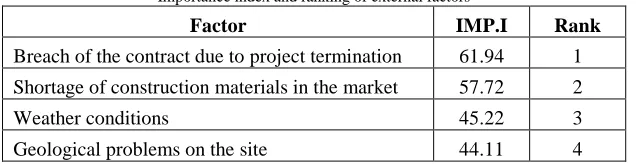
Table 5 illustrates the ranking of four factors under this group. The top-ranked factor is breach of the contract due to project termination, with index value of 61.94. Shortage of construction materials in the market, weather conditions, and geological problems on the site were ranked at position 2, 3 and 4 with index values of 57.72, 45.22, and 44.11
respectively. Breach of the contract due to project termination has a high potential to negatively affect the relation between the contractor and his subcontractor. For example, 17 public construction projects were terminated in Hail city, one of the main cities in the Northern Province of Saudi Arabia, in 2012. This is due to many reasons such as owner financial problems, delay and cost overrun, and lack of contractor commitment.
Table V
Importance index and ranking of external factors
Factor IMP.I Rank
Breach of the contract due to project termination 61.94 1
Shortage of construction materials in the market 57.72 2
Weather conditions 45.22 3
Geological problems on the site 44.11 4
Overall Factors Ranking
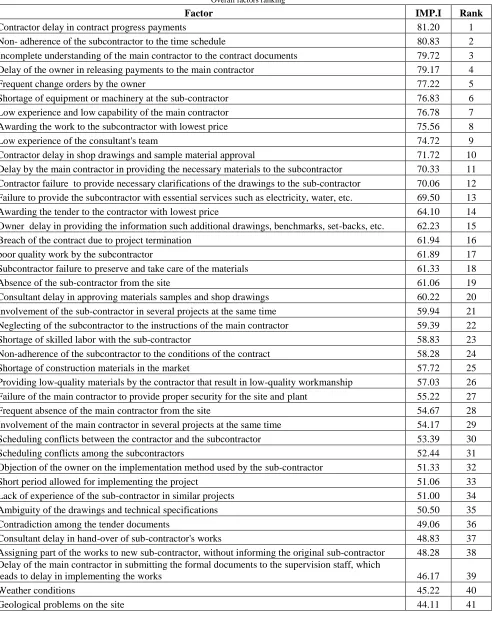
The results in Table 6 depict that the most 5 important factors negatively affecting the relation between the main contractors and their subcontractors are: contractor delay in contract progress payments, non- adherence of the subcontractor to the time schedule, incomplete understanding of the main contractor to the contract documents, delay of the owner in releasing payments to the main contractor, and frequent
Table VI Overall factors ranking
Factor IMP.I Rank
Contractor delay in contract progress payments 81.20 1
Non- adherence of the subcontractor to the time schedule 80.83 2
Incomplete understanding of the main contractor to the contract documents 79.72 3
Delay of the owner in releasing payments to the main contractor 79.17 4
Frequent change orders by the owner 77.22 5
Shortage of equipment or machinery at the sub-contractor 76.83 6
Low experience and low capability of the main contractor 76.78 7
Awarding the work to the subcontractor with lowest price 75.56 8
Low experience of the consultant's team 74.72 9
Contractor delay in shop drawings and sample material approval 71.72 10
Delay by the main contractor in providing the necessary materials to the subcontractor 70.33 11
Contractor failure to provide necessary clarifications of the drawings to the sub-contractor 70.06 12 Failure to provide the subcontractor with essential services such as electricity, water, etc. 69.50 13
Awarding the tender to the contractor with lowest price 64.10 14
Owner delay in providing the information such additional drawings, benchmarks, set-backs, etc. 62.23 15
Breach of the contract due to project termination 61.94 16
poor quality work by the subcontractor 61.89 17
Subcontractor failure to preserve and take care of the materials 61.33 18
Absence of the sub-contractor from the site 61.06 19
Consultant delay in approving materials samples and shop drawings 60.22 20
Involvement of the sub-contractor in several projects at the same time 59.94 21
Neglecting of the subcontractor to the instructions of the main contractor 59.39 22
Shortage of skilled labor with the sub-contractor 58.83 23
Non-adherence of the subcontractor to the conditions of the contract 58.28 24
Shortage of construction materials in the market 57.72 25
Providing low-quality materials by the contractor that result in low-quality workmanship 57.03 26
Failure of the main contractor to provide proper security for the site and plant 55.22 27
Frequent absence of the main contractor from the site 54.67 28
Involvement of the main contractor in several projects at the same time 54.17 29
Scheduling conflicts between the contractor and the subcontractor 53.39 30
Scheduling conflicts among the subcontractors 52.44 31
Objection of the owner on the implementation method used by the sub-contractor 51.33 32
Short period allowed for implementing the project 51.06 33
Lack of experience of the sub-contractor in similar projects 51.00 34
Ambiguity of the drawings and technical specifications 50.50 35
Contradiction among the tender documents 49.06 36
Consultant delay in hand-over of sub-contractor's works 48.83 37
Assigning part of the works to new sub-contractor, without informing the original sub-contractor 48.28 38 Delay of the main contractor in submitting the formal documents to the supervision staff, which
leads to delay in implementing the works 46.17 39
Weather conditions 45.22 40
Ranking of Groups
Table 7 shows the index value and rank of the main groups that may lead to conflict between the main contractors and their subcontractors. It is clear that the owners group of factors is the most critical with index value of 64.19. This is closely
followed by contractors group and subcontractors group of factors, with index values of 63.52 and 62.94 respectively. Consultants group of factors and external group were ranked at position 4 and 5 with index values of 56.67 and 52.25 respectively.
Table VII
Importance index and ranking of main group
Group IMP.I Rank
Owners related factors 64.19 1
Contractors related factors 63.52 2
Subcontractors related factors 62.94 3
Consultants related factors 56.67 4
External factors 52.25 5
Statistical analysis
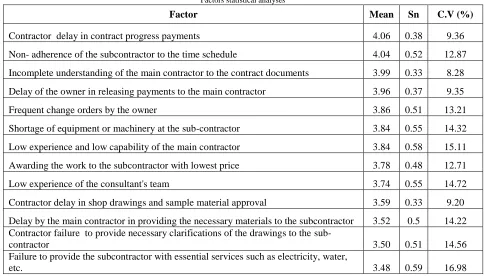
Table 8 presents the statistical analyses for the responses of factors affecting the relation between the main contractors and their subcontractors as assessed by contractors. The table contains the computation of the weighted mean, standard deviation, and coefficient of variation. These statistics are used to interpret the dispersion, compactness, and the degree of homogeneity of the collected data.
Table 8 shows that the standard deviation of the identified factors is ranging from 0.27 to 0.77 and. A visual indication
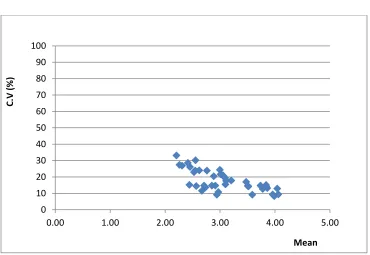
obtained from the scatter diagram shown in Figure 1 shows that the data has good compactness, indicating a good data consistency and agreement between the surveyed contractors on the importance of the identified factors. The results indicate a reasonable coefficient of variations (8% - 33%). Visually, it can be seen from Figure 2 that the coefficient of variation decreases as the factor weighted mean increases. This indicates that the surveyed contractors are highly agreed on the severity of the top affecting factors.
Table VIII Factors statistical analyses
Factor Mean Sn C.V (%)
Contractor delay in contract progress payments 4.06 0.38 9.36
Non- adherence of the subcontractor to the time schedule 4.04 0.52 12.87
Incomplete understanding of the main contractor to the contract documents 3.99 0.33 8.28
Delay of the owner in releasing payments to the main contractor 3.96 0.37 9.35
Frequent change orders by the owner 3.86 0.51 13.21
Shortage of equipment or machinery at the sub-contractor 3.84 0.55 14.32
Low experience and low capability of the main contractor 3.84 0.58 15.11
Awarding the work to the subcontractor with lowest price 3.78 0.48 12.71
Low experience of the consultant's team 3.74 0.55 14.72
Contractor delay in shop drawings and sample material approval 3.59 0.33 9.20
Awarding the tender to the contractor with lowest price 3.21 0.57 17.78 Owner delay in providing the information such additional drawings, benchmarks,
set-backs, etc. 3.11 0.55 17.68
Breach of the contract due to project termination 3.10 0.48 15.50
poor quality work by the subcontractor 3.09 0.6 19.39
Subcontractor failure to preserve and take care of the materials 3.07 0.62 20.22
Absence of the sub-contractor from the site 3.05 0.64 20.96
Consultant delay in approving materials samples and shop drawings 3.01 0.65 21.59
Involvement of the sub-contractor in several projects at the same time 3.00 0.73 24.36
Neglecting of the subcontractor to the instructions of the main contractor 2.97 0.32 10.78
Shortage of skilled labor with the sub-contractor 2.94 0.27 9.18
Non-adherence of the subcontractor to the conditions of the contract 2.91 0.43 14.76
Shortage of construction materials in the market 2.89 0.59 20.44
Providing low-quality materials by the contractor that result in low-quality
workmanship 2.85 0.42 14.73
Failure of the main contractor to provide proper security for the site and plant 2.76 0.66 23.90
Frequent absence of the main contractor from the site 2.73 0.37 13.54
Involvement of the main contractor in several projects at the same time 2.71 0.4 14.77
Scheduling conflicts between the contractor and the subcontractor 2.67 0.31 11.61
Scheduling conflicts among the subcontractors 2.62 0.63 24.03
Objection of the owner on the implementation method used by the sub-contractor 2.57 0.37 14.42
Short period allowed for implementing the project 2.55 0.77 30.16
Lack of experience of the sub-contractor in similar projects 2.55 0.61 23.92
Ambiguity of the drawings and technical specifications 2.53 0.58 22.97
Contradiction among the tender documents 2.45 0.64 26.09
Consultant delay in hand-over of sub-contractor's works 2.44 0.37 15.15
Assigning part of the works to new contractor, without informing the original
sub-contractor 2.41 0.69 28.58
Delay of the main contractor in submitting the formal documents to the supervision
staff, which leads to delay in implementing the works 2.31 0.62 26.86
Weather conditions 2.26 0.62 27.42
Fig. 1. Factor mean vs standard deviation
Fig. 2. Factor mean vs coefficient of variation
CONCLUSION
The main objective of this paper is to identify the factors that have the potential to negatively affect the relation between the main contractors and their subcontractors in Saudi Arabia and to determine their level of severity from contractor's viewpoint. A total of 41factors were identified in this study,
following factors as top 10 factors with high potential to negatively affect the relation between the main contractors and their subcontractors:
1. Contractor delay in contract progress payments 2. Non- adherence of the subcontractor to the time
schedule
3. Incomplete understanding of the main contractor to 0.00
0.10 0.20 0.30 0.40 0.50 0.60 0.70 0.80 0.90 1.00
0.00 1.00 2.00 3.00 4.00 5.00
Stan
d
ar
d
d
e
vi
ation
(
Sn
)
Mean
0 10 20 30 40 50 60 70 80 90 100
0.00 1.00 2.00 3.00 4.00 5.00
C.V (%
)
5. Frequent change orders by the owner
6. Shortage of equipment or machinery at the sub-contractor
7. Low experience and low capability of the main contractor
8. Awarding the work to the subcontractor with lowest price
9. Low experience of the consultant's team
10. Contractor delay in shop drawings and sample material approval
Furthermore, 41 factors considered in the study were divided into 5 groups, which were ranked according to their importance index:
1. Owners related factors 2. Contractors related factors 3. Subcontractors related factors 4. Consultants related factors 5. External factors
The responses statistical analyses indicated that the gathered data has good compactness and homogeneity, meaning that there is a good data consistency and agreement between the surveyed contractors on the severity of the identified factors. It also shows that the participants are highly agreed on the impact of the top affecting factors. It is hoped that the results of this study will be of high importance for construction parties and will provide a solid overview of the knowledge domain for practitioners. The results will also fill an important research and practice gap.
REFERENCES
[1] Alinaitwe, H., Mwakali, J. and Hansson, B. (2007). Factors affecting the productivity of building craftsmen studies of Uganda. Journal of Civil Engineering and Management, Vol. XIII, No. 3, pp. 169-176.
[2] Arditi, D. and Chotibhongs, R. (2005). Issues in subcontracting practice. Journal of Construction Engineering and Management, Vol. 131, No. 8, pp. 866-878.
[3] Artto, K., Eloranta, K. and Jaakko, K. (2008). Subcontracors’ business relationships as risk sources in project networks. An International Journal of Managing Projects in Business, 1(1), 88-105.
[4] Chapman, R. (2001). The controlling influences on effective risk identification and assessment for construction design management. International Journal of Project Management, 19, 147-160. [5] Cordsman, A. (2000). Saudi Arabia enters the 21st century V:
economic, demographic and social challenges. Center for Strategic and International Studies, 1800 K Street NW, Washington DC 20006.
[6] Enshassi, A. and Medoukh, Z. (2007). The contractor– subcontractor relationship: the general contractor’s view. [7] Enshassi, A., Mohamed, S., Abu Mustafa, Z. and Mayer,P. (2007).
Factors affecting labour productivity in building projects in the Gaza strip. Journal of Civil Engineering and Management, Vol. XIII, No. 4, pp. 245-254.
[8] Fah, C. (2006). A study on domestic subcontractor, www.efka.utm. retrieved on 15-06- 2008.
[9] Fryer, B., Egbu, C., Ellis, R., and Gorse, C. (2004). The practice of construction management. 4th edition, Oxford: Blackwell. [10] Hartmann, A. and Caerteling, J. 92010). Subcontractor
procurement in construction: the interplay of price and trust. Supply Chain Management, 15(5), 354-362.
[11] Hinze, J. and Tracy, A. (1994). The contractor-subcontractor relation-ship: The subcontractor’s view. Journal of Construction Engineering and Management, Vol. 120, No. 2, pp. 274–287. [12] Huang,R., Huang, C., Lin, H. and Ku, W. (2008). Factor analysis
of interface problems among construction parties a case study of MRT. Journal of Marine Science and Technology, Vol. 16, No. 1, pp. 52-63.
[13] Mahamid, I. (2011). Risk Matrix for Factors Affecting Time Delay in Road Construction Projects: Owners’ Perspective. Engineering, Construction and Architectural Management, 18 (6), 609 – 617. [14] McCord, J. (2010). Subcontractor perspectives: Factors that most
affect their relationships with general contractors- A Pacific Northwest study. 49th ASC Annual International Conference Proceedings, the Associated Schools of Construction, Washington State University, USA.
[15] Othman, M. (2007).Forging main and subcontractor relationship
for successful projects,
http://rakan1.jkr.gov.my/csfj/editor/files/File/Projek/LessonsLearn ed/MAINandSUB_2.pdf., retrieved on 10-08-2008.
[16] Segerstedt, A and Olofsson, T. (2010). Supply Chains in the Construction Industry. Supply Chain Management, 15(5), 347-353. [17] Tayeh, B. (2009). The relationship between contractors and their subcontractors in the Gaza Strip. Master thesis, The Islamic University of Gaza, Gaza.