George Zhou
University of WindsorNorma Nocente
and
Wytze Brouwer
University of AlbertaUnderstanding Student Cognition Through
an Analysis of Their Preconceptions in Physics
Over the last three decades, many studies have been conducted to identify students’ preconceptions on various science topics. It is time now for a synthetic study of preconceptions to enhance our understanding of students’ everyday cognition and to benefit our effort in developing effective instructional inventions for conceptual change. Through a classroom-based study, we collected quantitative and qualitative data about students’ preconceptions in physics. Data analysis produced an in-depth understanding of the features of students’ preconceptions and cognition. For example, we found that students thought analogically as scientists did, but they used analogies differently. We also found that students’ preconceptions were highly correlated and that some preconceptions were more fundamental than others. Having the core preconception probably means having many others. The pedagogical and research implications of these findings are highlighted.
Plusieurs études ont porté sur l’identification des idées préconçues qu’ont les élèves face à divers thèmes en sciences. Il faut maintenant passer à une synthèse de ces préconceptions pour améliorer notre connaissance du niveau de compréhension des élèves, d’une part, et pour appuyer nos efforts visant le développement de matériel pédagogique efficace qui mènera à des changements conceptuels, d’autre part. Une étude basée dans la salle de classe a permis aux auteurs de recueillir des données quantitatives et qualitatives sur les idées préconçues qu’ont les élèves au sujet de la physique. L’analyse des données a fourni des informations détaillées sur les caractéristiques des préconceptions et de la cognition des élèves. Par exemple, nous avons appris que les élèves raisonnent par analogie tout comme les scientifiques, mais que les deux groupes ne se servent pas des analogies de la même façon. De plus, nous avons noté une grande corrélation parmi les préconceptions des élèves et avons découvert que certaines préconceptions étaient plus fondamentales que d’autres. Il est probable que quand on tient la préconception de base, l’on en tient également plusieurs autres. Nous soulignons les répercussions de ces conclusions, tant pour la pédagogie que la recherche.
Introduction
Since the late 1970s, scholars have become increasingly aware that students come to school with their own understanding of the world (Driver, Guesne, &
George Zhou is an assistant professor.
Norma Nocente is an associate professor and Associate Chair of the Department of Secondary Education.
Wytze Brouwer is a professor emeritus in the Department of Physics.
Tiberghien, 1985). In the literature this preconceived knowledge is often called student preconceptions. Preconceptions have been identified in various areas of science. In classical physics, for example, the following preconceptions have been documented. Forces are needed to maintain the motion (Clement, 1982; McCloskey, 1983); a force can be given to an object in the name of “impetus” (Berg & Brouwer, 1991; Clement; McCloskey); a heavy body falls faster than a light one (Champagne & Klopfer, 1980); gravity is related to the earth alone (Bar, Zinn, & Rubin, 1997); and heat is a kind of material substance (Erickson, 1979, 1980).
Preconceptions serve as a platform from which students interpret their world. Unfortunately, in most cases preconceptions are quite different from scientific notions. Learning under these circumstances involves the restructur-ing of preconceptions. This restructurrestructur-ing is referred to as conceptual change (Vosniadou, 1999). Some teaching strategies have been designed to foster con-ceptual change (Martinez, 2001; Scott, Asoko, & Driver, 1992). One of the earliest and yet famous conceptual change models was proposed by Posner, Strike, Hewson, and Gertzog (1982). Paralleling the conditions of scientific revolutions (Kuhn, 1970), Posner et al. stated that several important conditions must be fulfilled before any conceptual change occurs. These conditions could be briefly described in terms of students’ dissatisfaction with the old concep-tion and the intelligibility, plausibility, and fruitfulness of the new concepconcep-tion. Posner et al.’s model correctly addresses the importance of cognitive conflict in conceptual change (Tao & Gunstone, 1999; Zhou, Brouwer, Nocente, & Martin, 2005). Many instructional strategies proposed to address student preconcep-tions such as Prediction-Observation-Explanation share a common feature of confronting students with discrepant events that contradicted their concep-tions (Scott et al.). Through the use of discrepant events, students are expected to experience cognitive disequilibration that will induce them to reconstruct knowledge.
Following Pintrich et al.’s (1993) article, a warming trend in contrast to the cold nature of Posner et al.’s (1982) model took place in conceptual change research (Sinatra, 2005). The Cognitive Reconstruction of Knowledge Model (CRKM) by Dole and Sinatra (1998) and the Cognitive-Affective Model of Conceptual Change (CAMCC) by Gregoire (2003) are two typical examples of warm models that incorporate motivational constructs into the complexity of conceptual change learning. The CRKM describes how learner and message characteristics interact, leading to a degree of engagement with the new con-cept. The learner characteristics entail existing knowledge and motivational factors. The strength and coherence of a learner’s existing knowledge and his or her commitment to this knowledge influence the likelihood of conceptual change. Motivational factors refer to a learner’s interest, emotional involve-ment, self-efficacy, importance, need for cognition, as well as the social context that supports or undermines his or her motivation. Message characteristics refer to the features of the instructional content or persuasive discourse designed to promote conceptual change, which can be described using con-junctives such as comprehensible, coherent, plausible, and rhetorically compelling. It is the interaction of the existing knowledge, instructional message, and in-dividual motivational factors that creates a space for knowledge reconstruc-tion. The CAMCC shares much similarity with the CRKM, but posits a great role for affective constructs such as anxiety and fear in conceptual change. Gregoire (2003) claimed that stress and threat appraisals “happen automatical-ly before characteristics of the message are seriousautomatical-ly considered” (p. 168); that is, the message characteristics may never be fully processed by a learner if the affective appraisals create a strong tendency to dismiss the message. The CAMCC was proposed to interpret teachers’ resistance to reform-oriented curricula that conflicted with their teaching beliefs. It therefore reads as more suitable for the case of belief change. However, because the conceptual change in science involves self-efficacy beliefs and epistemological beliefs (Andre & Windschitl, 2003), the CAMCC provides insights about instructional inven-tions that take affective appraisals into account.
Purposes of the Study
concep-tual change. Martinez (2001) observed that the theory of concepconcep-tual change had gained little significant progress since 1975. Although we believe that he might be overly negative considering the recent contributions of educational psycho-logists such as Pintrich, Sinatra, and Gregoire, we believe that more efforts are necessary in the conceptual change study.
It was our intention in this study to inform the further development of effective teaching approaches for conceptual change by studying the cognitive processes behind students’ preconceptions. We believe that a synthetic study of student preconceptions that examines the common features of these precon-ceptions and the correlation between them can provide us with insights about student cognition. Based on a project spanning several years, in this article we report our findings about the following research questions. What are the com-mon characteristics of student preconceptions? How are they related to each other? What features of student cognition can be inferred from analysis of student preconceptions?
Methodology
Over the last few years we have been developing and evaluating computer simulations designed to address well-known student preconceptions. The data and findings reported in this article are drawn from four control classes com-prising 361 students who were registered in an introductory algebra-based physics course. This course was set up for the first- or second- year university students from various science-related departments and covered the topics of kinematics, dynamics, and heat.
To investigate students’ conceptions, a conceptual test was administered at the beginning and end of the course. Interviews with students were conducted while the course was in progress to gain in-depth understanding of their ideas. The interviewees were selected from those students who had more problems with conceptual understanding in the pre-test. Real-time class observations were carried out during the course. The interaction between the teacher and students was recorded in journals and analyzed after class. Students’ assign-ments were reviewed in order to gain more insight into students’ actual con-ceptions. In addition, a physics clinic was set up by Zhou to help students with any problems in learning physics. Just as a physician does in a medical clinic, he started his clinical service with a diagnosis. When students asked a question, he always requested that they attempt the question first and explain their own solution, and then he worked on the critical points where students failed. The clinic provided him with wonderful opportunities to know what students were thinking when facing a question.
a conceptual nature. They were not produced to cover fully the domain of mechanics, but created for the topics on which students most often have preconceptions. To answer these questions, simply recalling the definition of a concept is not enough: students rather need to understand the underlying concepts and to be able to apply these concepts to diverse situations. Therefore, these questions can solicit students’ intuitive concepts and concurrently test their understanding of concepts. The FCI has been widely and successfully used to test the effectiveness of physics classes (Hake, 1998; Redish, Saul, & Steinberg, 1997; Redish & Steinberg, 1999). The three extra questions were adapted from the literature (Berg & Brouwer, 1991; Whitaker, 1983). They were used to study students’ conceptions about the independence of motion com-ponents and gravity in space, which the FCI does not cover.
Because all the questions in the FCI-Plus were developed and widely used by university scholars, the validity of the FCI-Plus in testing students’ concep-tual understanding should not be a problem. For the reliability of the FCI-Plus, we used the split-half method to estimate the reliability coefficient in all in-volved classes, which resulted in a value of 0.90. We used another method— Kuder-Richardson 20—and obtained a result of 0.89. These results confirm a high reliability of the FCI-Plus test.
Because the FCI-Plus covers a range of topics including motion and force, action and reaction forces, velocity and acceleration, and gravity, and so forth, and addresses a range of student preconceptions, it provides us with an oppor-tunity to investigate the correlation of students’ preconceptions and examine their common features..
Data Analysis and Findings
In order to identify students’ preconceptions and check their conceptual growth over the course, the conceptual test results were analyzed in two steps. First, the test was taken as an ordinary test, which means students received one mark for each question that they answered correctly. The class means for the pre- and post-tests were calculated and are reported in Table 1. In the second step, an item analysis was conducted on the test. Each question has several distracters that represent possible preconceptions that students may have on the topic covered by the question. By analyzing students’ response distribution among the distracters for each question, we were able to identify student preconceptions on the topics covered by the test. These findings were triangu-lated with the qualitative data collected from the interviews, class observa-tions, assignment review, and clinical diagnosis. Table 2 lists the major preconceptions we discovered from this study.
After students’ preconceptions were identified, we investigated the connec-tions between preconcepconnec-tions from both quantitative and qualitative angles.
Table 1
Class Means of the FCI-Plus Test (Full Mark is 33)
Class 1 2 3 4 Overall
Class size 81 76 99 105 361
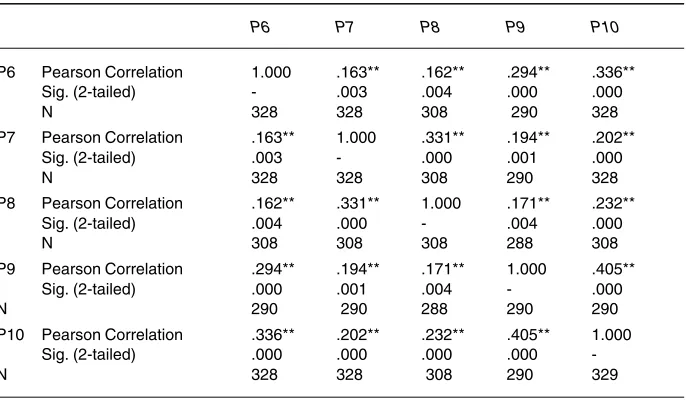
For each identified preconception, students who demonstrated it in the test were assigned 1, and the rest who did not have this preconception were assigned 0. In doing this we generated 14 sets of data for the studied students that corresponded to each preconception in Table 2. The Pearson correlation coefficient was calculated for each pair of preconceptions. We found that the correlation between preconceptions varied from one pair to another. Table 3 reports these significant correlations (p<0.01). With a belief that preconceptions are related to each other, we integrated the qualitative data to generate a connected picture of various preconceptions. This examination is infused in the following section.
Our final data analysis task is based on the analysis described above to synthesize our quantitative and qualitative data in order to identify features of students’ preconceptions and to understand students’ cognition behind these preconceptions. To this end, we sometime traveled back and forth between our data and other persons’ findings so that we could ensure that our conclusions were well situated in the research literature.
Discussion Characteristics of Student Preconceptions
Preconceptions versus scientific concepts. As Table 2 reports, student preconcep-tions were clustered around the following main topics of Newtonian physics: gravity, action and reaction forces, the relationship between force and motion, the connections among position, velocity and acceleration, and the principle of the independence of motion components. Student preconceptions found in this study were quite different from scientific concepts. This finding has been documented by many earlier studies. For examples, According to Newton’s Third Law, the action and reaction forces are always equal but appositely directed. In contrast, 67% of students in the pre-test thought a heavy truck exerted a bigger force on a compact car than the force the car exerted on the
Table 2
Students’ Preconceptions in Mechanics
Number Students’ preconceptions
P1 Heavier bodies fall faster than lighter ones. P2 There is no gravity on the moon.
P3 Greater mass exerts greater force.
P4 Most active agent produces the largest force.
P5 Only active agents exert force; obstacles exert no force.
P6 Motion implies force. As soon as the force stops, the motion stops. P7 Largest force determines the motion.
P8 Velocity is somewhat proportional to applied force. P9 Students view the impetus of an object as a force.
P10 Impetus dissipates while an object moves against resistance. P11 There exists a centrifugal force.
P12 Objects have the same velocity at the moments that they move side by side. P13 Students confuse acceleration with position or with velocity.
truck when they collided (preconception #3). According to Newton’s First and Second Laws, a force changes motion, but is not necessary to maintain motion with a constant velocity, and a moving body may experience a force in the opposite direction of its motion. For many of the students studied, however, the relationship between motion and force became much simpler. These stu-dents thought that wherever and whenever there was a motion, there must be a force (preconception #6). About 76% of students in the pre-test insisted that a child experienced a force in the direction of his motion on a swing. When an elevator was pulled up with a constant speed by a cable, 73% of students thought that the upward force exerted by the cable must be bigger than the downward force (preconception #7).
Preconception and culture. Although the literature continually reports the effect of cultures on children’s world view, our study suggested that students from varied countries have similar preconceptions about force and motion. Clement (1982) reported that college students in the United States thought a force (impetus) could be given to an object and that any motion implied a force. Viennot (1979) found that high school and university students from France, Britain, and Belgium thought that force was proportional to velocity and that action forces equaled reaction forces only when bodies were at equilibrium. Our study shows that Canadian university students shared similar preconcep-tions with their peers from other countries.
Preconception and age. Berg and Brouwer (1991) tested 315 grade 9 students in Edmonton, Canada, and found that students thought force (impetus) could be given to an object, that a force was required in the direction of motion, and that there was no gravity in space and on the moon. Champagne and Klopfer (1980) stated that grades 7 or 8 students in the US thought that heavier bodies fell faster than lighter bodies. Erickson and Agurirre (1984) reported that high
Table 3
Correlation Between Preconceptions
P6 P7 P8 P9 P10
P6 Pearson Correlation 1.000 .163** .162** .294** .336** Sig. (2-tailed) - .003 .004 .000 .000
N 328 328 308 290 328
P7 Pearson Correlation .163** 1.000 .331** .194** .202** Sig. (2-tailed) .003 - .000 .001 .000
N 328 328 308 290 328
P8 Pearson Correlation .162** .331** 1.000 .171** .232** Sig. (2-tailed) .004 .000 - .004 .000
N 308 308 308 288 308
P9 Pearson Correlation .294** .194** .171** 1.000 .405** Sig. (2-tailed) .000 .001 .004 - .000
N 290 290 288 290 290
P10 Pearson Correlation .336** .202** .232** .405** 1.000 Sig. (2-tailed) .000 .000 .000 .000
-N 328 328 308 290 329
school students generally did not think of the components of motion as inde-pendent. Our study revealed that although college students are normally older than high school students, students in colleges and high schools shared similar intuitive understanding of these topics. And more surprising, for some precon-ceptions the portion of college students who had these preconprecon-ceptions was close to that of high school students. For example, Berg and Brouwer reported that 29.5% of grade 9 students thought that there was no gravity on the moon. Our study found that 25% of university students held this preconception before the introductory physics course and 24% after it.
Preconception and the history of science. As shown in Table 2, many of the students studied, as did people of Aristotle’s time, thought that heavier bodies fell faster than lighter ones (preconception #1), that a force was required to maintain a motion (preconception #6), and that a force or impetus could be given to an object (preconception #9). Student preconceptions are, therefore, reminiscent of conceptions that are well known from the history of science. This finding is compatible with the study report of Bar and Zinn (1998), who observed that a parallelism exists between student concepts and historical concepts concerning action at a distance.
Preconception and experience. During the interviews, when students were asked why they thought there was a force in the direction of the motion of a pendulum, they said, “[a force] keeps the ball moving this way [along the curve].” Two student interviewees did hands-on experiments to support their ideas. One student pushed the teacup on a desk and said, “[I] push it and it moves. [I] stop pushing and it stops moving.” The other student pushed a pencil on a desk instead of a cup and made similar remarks (students were interviewed individually). These examples indicate to us that students’ precon-ceptions arose from their experiences.
Difficulty of conceptual change. In our study many preconceptions did not change much after a four-month university physics course. For example, at the beginning of the course approximately 76% of students believed in the exist-ence of a force exerted in the direction of a child’s movement on a swing. After the course 64% of students still held this conception (preconception #6). Preconception #3 was also persistent. Of our tested university students, 67% thought that a big truck exerted a larger force on a small car during a head-on collision in the pre-test. In the post-test 52% of students still held this precon-ception. Preconception #9 was also found to be resistant to change. In the pre-test, 58% of students thought that a tennis ball experienced a force (im-petus) produced by the player, and 55% still thought the same in the post-test. In short, preconceptions were found difficult to change through traditional teaching.
post-test failed to notice the force that the floor applies on the chair, 28% of students in the pre-test and 18% of students in the post-test failed to see the force that the ice surface exerts on a hockey puck.
Driver (1989) and von Glaserfeld (1995) have made a point that in most cases children’s conceptions make sense to the children themselves. They have their own ways of construing events and phenomena that are coherent within their domain of experience. Our findings do not totally agree with this idea of coherence, but stay in the same line with the report of Lijnse (1990). Lijnse stated that students held varied conceptions of energy in varied problem situations. We found that students’ understanding about physics topics such as gravitational force and normal force may vary from context to context.
Conceptual change and instruction. This study indicated that careful instruc-tional design is necessary to change preconceptions. Learners often fail to see the connections among the topics taught in class. Students may learn by rote due to a lack of strategies and abilities to build a big picture of physics or an absence of intention to make the extra effort needed to extend their learning to new situations. It does not seem difficult to relate the gravity of the moon with the universal law of gravitation, but many participant students could not apply this conceptual transfer in the test. During interviews, when students were reminded of the source of the gravitational force and the universal law of gravitational force, most students who had thought that there was no gravity on the moon changed their minds.
Students can transfer knowledge if they are directed properly and explicitly to extend their basic principles to new situations. Careful instructional design is therefore necessary to overcome many preconceptions. Novak (1977) claimed that the meaning of a concept is defined and strengthened by the network of propositions that students have connected to it. The case discussed above shows the importance of building a big picture of physics and general-izing applications of the principles of physics to as many situations as possible. Teachers should not take for granted that students will transfer their under-standing of physical laws and principles to new situations, although this trans-fer might appear straightforward to the teacher.
Features of Students’ Cognition
a result of an action. For example, one test question asks what force(s) acts on a tennis ball after it has left contact with the racquet and before it touches the ground. Over 55% of students in pre- and post-tests thought that the ball experienced “a force by the ‘hit.’” Just as a car runs on gas, an object would move on impetus. An object would slow down while the impetus was dissipat-ing. Impetus was thus seen as a kind of “go power.” When interviewed about the force(s) a ball would experience after being thrown up, one interviewee made a gesture of throwing a ball up. A typical response was that the “intrinsic force” (caused by the action of throwing) was used up when the ball went up against gravity. The pushing action of people was probably seen as a metaphor or prototype for force action. Because the floor or surface could not “push,” some students failed to indicate the normal force that the floor acts on a chair or that the surface of the ice acts on a hockey puck. When asked to explain their choice in the case of a hockey puck, these students typically replied, “I don’t see any other things pushing the puck. The puck only moves horizontally, doesn’t it?” The social or life phenomenon that the stronger party plays a dominating role was another metaphor students probably used to interpret dynamic processes. They thought that the strongest force determined the motion. For example, in such a situation as an elevator being pulled up by a cable with a uniform speed, some students thought that the upward force applied by the cable must be bigger than the downward force of gravity because the elevator was pulled up. Following a similar reasoning, students believed that the force applied by a woman who was pushing a box forward with a constant speed should be larger than the total resisting force because the box was pushed forward.
Students’ thinking and context. Students’ approaches of using analogies are different from those of scientists. Based on their current knowledge, scientists use an analogy to guide their further investigation of a phenomenon as illus-trated by the study of atomic structure described above. Students, however, use an analogy to interpret a phenomenon. Therefore, their concepts are most often phenomenological in nature. One test question asks what force(s) act(s) on a ball that is thrown up. Some students thought an upward force (impetus) acted on the ball even after the ball left the hand. Another test question de-scribes a ball shot into a frictionless curved channel that is anchored to a horizontal table top. Some students thought the ball experienced a force in the direction of motion (impetus) inside the channel and would continually move in a curve after it left the other end of the channel. From these two examples we understood that students thought impetus had only one dimension in the case of linear motion; however, in the case of a circular motion, they saw impetus as a kind of bendable matter keeping an object moving in a curve. It was clear that students had no fixed definition of impetus. It was just a tool that they used to interpret a situation. In other words, the meanings of students’ concepts could change in other contexts.
R: What forces are acting on the ball when the ball goes up?
S: Gravity is always there. It is downward. And an applied force; it is upward. R: Where does that force come from?
S: The boy. He threw the ball up. (with a gesture of throwing a ball up) R: You mean that force is still acting after the ball leaves the boy’s hand? S: Hm.… Well, I mean the energy the boy put on the ball. It keeps the ball moving up.
Students’ thinking and perception. Only a small number of students who held preconception #3 in the pre-test changed their minds after instruction. The application of Newton’s Third Law in non-equilibrium interactions still proved to be elusive. The fact that one object damaged the other appeared to create a conceptual obstacle for them to believe that the action force was, even in this kind of case, still equal to the reaction force. In such a complex case students were often attentive to some visible variables and ignored others. In a complex situation such as a collision, other factors such as anti-collision design of vehicles are involved in the damage caused. This might complicate the situa-tion and made it difficult for students to focus on the nature of forces involved in the collision.
Another example demonstrating the great influence of perceptions on stu-dent cognition is the lack of discrimination between position, velocity, and acceleration. One test question poses a situation illustrated by Figure 1. The positions of two moving blocks at successive equal time intervals were given to students on a graph (one moves with a uniform velocity and the other ac-celerates). Students were asked to answer if the blocks ever had the same speed. Over a quarter of the studied students thought that the two blocks had the same speed at the moment they moved side by side. For these students, being ahead in position meant having a bigger velocity, and a bigger distance meant a bigger acceleration (preconception #13). The variables such as the initial position and velocity were often ignored in students’ intuitive thinking. During an interview, a student told us an interesting story that clearly demonstrated his perception-based thinking. The student was asked to predict which path a ball, which was swung in a circular path in a horizontal plane, would follow after the string suddenly broke, this student answered the ques-tion correctly: “The ball would go straight out along the tangential line of the circle.” However, he came up with this choice not through the application of Newton’s First Law, but rather by thinking of a track-and-field meet. An athlete throws a discus after he makes a few turns. If the discus did not go straight forward, it would hit the spectators sitting on the sidelines. This was how he concluded that the discus or the ball must go straight along the tangential line. The same interviewee told us another interesting story. The teacher was giving an example of problem-solving after he taught the
ciples associated with the rotational motion of a rigid object. The question was to determine the minimum angle between a ladder and the ground in order to keep the ladder from slipping off when a person steps onto it. The student told us that when the teacher solved this problem, his mind momentarily went back to the time many years ago when his father had adjusted the position of a ladder before he stepped onto it to fix the roof of their house. He was standing beside him when his father did this. The flash of this recall made the situation of the question closer to this student’s real life and reportedly made the solu-tion more meaningful and easier for him to understand.
Perception-dominated cognition was said by Piaget (1970) to be a feature of young children’s knowing. Our study indicated that this feature still exists to some degree even when children grow up to university age. It is clear that the cognition of university students still relies strongly on visible facts or concrete experiences. This finding is consistent with the statement of Schlenker and Perry (1983) that nearly half of college students are still not good at abstract reasoning and that their thinking still possesses some features of the concrete operational stage defined by Piaget.
The interpretation-orientated and perception-dependent nature of student cognition was often flawed in a logical sense. In this study, we found that students often confused sufficient conditions with necessary conditions. For students, that A caused B (the event A was a sufficient condition for the event B to occur) meant that B must need A (the event A became a necessary condi-tion for the event B). Such facts as people pushing a box across a floor became evidence for students to think that motion implied force. They did not see the difference between what makes the object move and what keeps it moving. Among the closely connected concepts of force, inertia, momentum, and ener-gy, students did not know which they should start with in order to solve a problem.
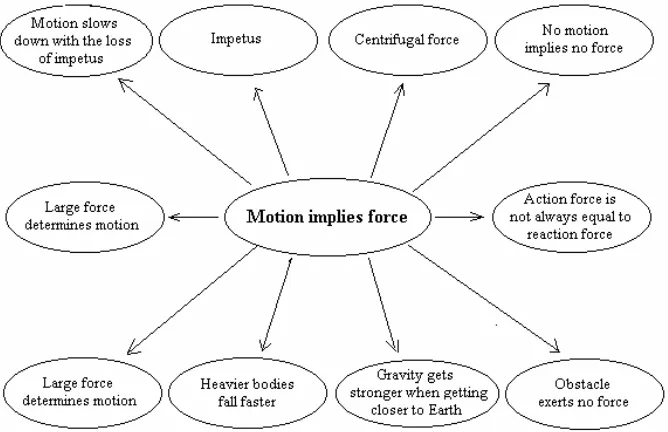
Structure of preconceptions. Our calculation of the correlation between preconceptions revealed that student preconceptions in dynamics were sig-nificantly related to each other (Table 3). Having one preconception probably means having many others. Figure 2 represents our examination of the content connections between preconceptions. The preconception “motion implies (net) force” is at the center, and other preconceptions could be a direct deduction from this concept when applied in various situations. For example, in the case of a falling body, the following deduction can easily lead to the conclusion that heavier objects fall faster than lighter ones.
1. A force is required by motion.
2. Heavier bodies experience a bigger force. 3. Therefore, heavier bodies fall faster.
We were convinced that students build their own hierarchical conceptual structures based on their own imperfect logic and vague concepts.
students in both pre- and post- conceptual tests. In our study students’ average scores of 16.3 in the pre-test and 17.6 in the post-test out of 33 were below the conceptual threshold, 60% correct, set up by Hestenes and Wells (1992). Below this threshold a student’s understanding of Newtonian concepts is too limited for effective problem-solving.
Educational Implications
The findings of this study apply to first- or second-year university students. However, because our findings were concluded from analyzing students’ preconceptions, most of which were formed in their early life experience and survived through school to university, we believe that these findings probably apply to school students with little deviation. Of course, this statement is subject to further research.
Some implications for the research and teaching in science education can be drawn with respect to our findings. We found that students thought through analogies. This provides justification for those studies that are designed to investigate the effectiveness of using analogies in science teaching. As Dagher (1995) stated, based on a review of studies on the use of analogies in science education, analogies are a valuable teaching strategy, but undesired conse-quence may take place as a result of inappropriate use of analogies. Further research on students’ cognitive processes behind the analogy is necessary to find out how to use analogies more properly and effectively in science teach-ing.
Because perception plays an important role in students’ cognition, a variety of visualization methods such as demonstrations and computer simulations can be helpful for students to construct understanding. University physics courses are primarily abstract and this is perhaps why students feel physics is hard to learn. A demonstration or simulation can make the concept and
cal process visible and therefore is helpful. Studies have documented the effectiveness of visualization in science teaching and learning. For example, we and our colleagues have developed computer simulations to address common preconceptions in physics. Through these simulations students can input their predictions and observe the consequences of their predictions. An experimen-tal study confirms the effectiveness of these simulations in enhancing student conceptual learning (Zhou et al., 2005).
Because some preconceptions appear to be more fundamental than others, these preconceptions need to be treated with more attention. In this study we found that the relationship between motion and force was at the center of students’ concepts in mechanics. More effort, therefore, should be directed to the instruction of the First Law of Newtonian physics, which conceptually clarifies the relationship of motion and force. Unfortunately, the First Law was only briefly described in the courses observed. Instead, most of the class time was devoted to the Second Law and its applications. Teachers were more interested in applying the Second Law in various problem settings than in conceptually strengthening the First Law or showing how the First and Second Laws work together.
Before ending the article we provide some discussion on a frequently asked question about student preconceptions: Why are preconceptions so resistant to change? The first reason is that preconceptions are much closer to student experiences than scientific concepts. Students’ preconceptions are formed in their everyday life environment and are situation-dependent as our study found. In most cases these preconceptions have sufficient power to provide plausible explanations of students’ experiences. In contrast, scientific concepts are abstracted and generalized from research results. They are, therefore, much more abstract and relatively further from what students see, hear, and feel in daily life.
The second reason is that the transition from preconceptions to scientific notions requires great intelligence. In the history of physics, physicists such as Newton and Descartes did not agree on the concepts of force, kinetic energy, momentum, and so forth. Descartes took momentum as the fundamental con-cept of motion. Newton, however, put the concon-cept of force at the center of dynamics. In Newton’s Principia there still exists confusion in the use of the force concept. Newton called applied force moving force and inertia intrinsic force, resisting force, or inertia force. The struggle of these great physicists over the concepts of force and motion is an indicator of the difficulty that students have in grasping these concepts.
generate a theory from a hypothesis. This meta-knowledge about science is useful for students to make decisions on conceptual change.
Earlier studies reported in the literature have documented some useful suggestions about teaching for conceptual change. We hope our findings about student cognition provide further insights for the future effort in developing effective teaching strategies that help students with conceptual change. Based on our study, we believe that the research on conceptual change needs to move from a solo focus on cognitive conflict to a more comprehensive study adven-ture. Pintrich et al. (1993), Dole and Sinatra (1998), and Gregoire (2003) have brought the motivational constructs into the study scope in conceptual change. We suggest that the conceptual change study should also embrace the inves-tigation of the roles that meta-cognition skills, criteria the science community uses to judge knowledge claims, and the nature of science, and so forth play in the process of conceptual change.
References
Andre, T., & Windschitl, M. (2003). Interest, epistemological belief, and intentional conceptual change. In G.M. Sinatra & P.R. Pintrich (Eds.), Intentional conceptual change (pp. 173-197). Mahwah, NJ: Erlbaum.
Bar, V., & Zinn, B. (1998). Similar frameworks of action-at-a-distance: Early scientists’ and pupils’ ideas. Science and Education, 7, 471-491.
Bar, V., Zinn, B., & Rubin, E. (1997). Children’s ideas about action at a distance. International Journal of Science Education, 19, 1137-1157.
Berg, T., & Brouwer, W. (1991). Teacher awareness of student alternate conceptions about rotational motion and gravity. Journal of Research in Science Teaching, 28, 3-18.
Champagne, A., & Klopfer, L. (1980). Technical report. Pittsburgh, PA: University of Pittsburgh. Clement, J. (1982). Students’ preconceptions in introductory mechanics. American Journal of
Physics, 50, 66-71.
Dagher, Z.R. (1995). Review of studies on the effectiveness of instructional analogies in science education. Science Education, 79, 295-312.
Demastes, S.S., Good, R.G., & Peebles, P. (1996). Patterns of conceptual change in evolution. Journal of Research in Science Teaching, 33, 407-431
Dole, J.A., & Sinatra, G.M. (1998). Reconceptualizing change in the cognitive construction of knowledge. Educational Psychologist, 33, 109-128.
Driver, R. (1989). Students’ conceptions and learning of science. International Journal of Science Education, 11, 481-490.
Driver, R., Asoko, H., & Leach, J. (1994). Constructing scientific knowledge in the classroom. Educational Researcher, 23(7), 5-12.
Driver, R., Guesne, E., & Tiberghien, A. (Eds.). (1985). Children’s ideas in science. Milton Keynes, UK: Open University Press.
Erickson, G.L. (1979). Children’s conceptions of heat and temperature. Science Education, 63, 221-230.
Erickson, G.L. (1980). Children’s viewpoints of heat: A second look. Science Education, 64, 323-336. Erickson, G., & Agurirre, J. (1984). Students’ conceptions about the vector characteristics of three
physics concepts. Journal of Research in Science Teaching, 21, 439-457.
Gregoire, M. (2003). Is it a challenge or a threat? A dual-process model of teachers’ cognition and appraisal process during conceptual change. Educational Psychology Review, 15, 117-155. Hake, R.R. (1998). Interactive-engagement versus traditional methods: A six-thousand-student
survey of mechanics test data for introductory physics courses. American Journal of Physics, 66, 64-74.
Hestenes, D., & Wells, M. (1992). A mechanics baseline test. Physics Teacher, 30, 159-166. Hestenes, D., Wells, M., & Swackhammer, G. (1992). Force concept inventory. Physics Teacher,
30(3), 141-158.
Kuhn, T. (1970). The structure of scientific revolution. Chicago, IL: Chicago University Press. Lijnse, P. (1990). Energy between the life-world of pupils and the world of physics. Science
Martinez, M. (2001). Characteristics of the methodology used to describe students’ conceptions. International Journal of Science Education, 23, 663-690.
Mazur, E. (1997). Peer instruction: A user’s manual. Englewood Cliffs, NJ: Prentice Hall. McCloskey, M. (1983). Intuitive physics. Scientific American, 248, 114-122.
Novak, J. (1977). A theory of education. Ithaca, NY: Cornell University Press. Piaget, J. (1970). Genetic epistemology. New York: Columbia University Press.
Pintrich, P.R., Marx, R.W., & Boyle, R.A. (1993). Beyond cold conceptual change: The role of motivational beliefs and classroom contextual factors in the process of conceptual change. Review of Educational Research, 63(2), 167-199.
Posner, G.J., Strike, K.A., Hewson, P.W., & Gertzog, W.A. (1982). Accommodation of a scientific conception: Towards a theory of conceptual change. Science Education, 66(2), 211-227. Redish, E.F., Saul, J.M., & Steinberg, R.N. (1997). On the effectiveness of active-engagement
microcomputer-based laboratories. American Journal of Physics, 65, 45-54.
Redish, E.F., & Steinberg, R.N. (1999). Teaching physics: Figuring out what works. Physics Today, 52, 24-30.
Scott, P.H., Asoko, H.M., & Driver, R.H. (1992). Teaching for conceptual change: a review of strategies. In R. Duit, F. Goldberg, & H. Niedderer (Eds.), Research in physics learning: Theoretical issues and empirical studies (pp. 310-329), Kiel: IPN.
Schlenker, R.M., & Perry, C.M. (1983). The molar concept: A Piagetian-oriented learning cycle. Journal of College Science Teaching, 12(6), 431-434.
Sinatra, G.M. (2005). The “warming trend” in conceptual change research: The legacy of Paul R. Pintrich. Educational Psychologist, 40, 107-115.
Strike, K.A., & Posner, G.J. (1992). A revisionist theory of conceptual change. In R.A. Duschl & R.J. Hamilton (Eds.), Philosophy of science, cognitive psychology, and educational theory and practice (pp. 147-176). Albany, NY: SUNY Press.
Tao, P., & Gunstone, R. (1999). The process of conceptual change in force and motion during computer-supported physics instruction. Journal of Research in Science Teaching, 36, 859-882. Viennot, L. (1979). Spontaneous reasoning in elementary dynamics. European Journal of Science
Education, 1, 205-221.
Vosniadou, S. (1999). Preface. In W. Schnotz, S. Vosniadou, & M. Carretero (Eds.), New perspectives on conceptual change (pp. xiii-xxiv). Amsterdam: Pergamon
von Glaserfeld, E.V. (1995). A constructivist approach to teaching. In L.P. Steffe & J. Gale (Eds.), Constructivism in education (pp. 3-15). Hillsdale, NJ: Erlbaum.
Whitaker, R.J. (1983). Preconceptions about trajectory motion. American Journal of Physics, 51, 352-357.