In-service Professional Development
and Constructivist Curriculum:
Effects on Quality of Child Care,
Teacher Beliefs, and Interactions
Nina Howe
1, Ellen Jacobs
1, Goranka Vukelich
2, Holly Recchia
1Concordia University1, Conestoga College2
The purpose of this study was to assess three methods of delivering in-service professional development regarding constructivist curriculum for early childhood educators. Educators in 44 not-for-profit child care centres in three Canadian cities were studied; 94 educators with formal preservice training participated. The three methods were (a) a consultant model, (b) workshops, and (c) a readings group. Global classroom quality was assessed with the Early Childhood Environment Rating Scale-Revised ([ECERS-R], Harms, Clifford, & Cryer, 2005), educators were interviewed about their beliefs regarding curriculum, and modified running record observations of educator-child interactions (i.e., guidance, directives) were assessed before and after the 15-week intervention. Over time the consultant model was associated with an increase in guidance interaction (i.e., promoting children’s learning and development). A number of findings related to site were evident for quality of child care and educator beliefs, and highlight the challenges associated with conducting multi-site research studies. Implications for providing in-service professional development regarding curriculum are discussed.
The quality of child care has been a prominent issue for several decades and is associated with various child development outcomes (Lamb & Ahnert, 2006). In particular, process measures focusing on the characteristics of child care settings (e.g., physical environment, types of activities, educator-child interactions) are critical factors in assessing the quality of children’s daily experiences. These aspects of quality are the prime responsibility of the educator who creates the classroom activities (i.e., the curriculum), which are at the heart of the child’s day. Unfortunately, classroom activities have frequently been rated as minimally adequate (e.g., Cryer & Phillipsen, 1997; Warash, Markstrom, & Lucci, 2005) indicating that children are not receiving optimal opportunities for learning and development. Although many educators espouse a constructivist or developmentally appropriate approach to curriculum, findings regarding the connections between beliefs and practices are mixed (Cassidy, Buell, Pugh-Hoese, & Russell, 1995; Wilcox-Herzog, 2002). In the present study, three methods of in-service professional development regarding constructivist curriculum (consultant, workshops, readings group) were implemented in 44 not-for-profit centres in three Canadian cities. The impact of the intervention on child care quality, educator beliefs, and educator-child interactions was investigated.
The Problem with Quality of Child Care
Ackerman (2006) defines child care quality as “the result of specific, intentional practices” (p. 87), which is determined by a combination of structural and process variables. Structural variables (e.g., teacher education, adult-child ratios, group size) are easy to regulate and are positively associated with quality of care, but alone do not guarantee quality care (Lamb & Ahnert, 2006). The educator is primarily responsible for implementing process quality variables (e.g., physical environment, activities, program structure, educator-child interactions). Structural and process variables (i.e., overall quality of care) are positively associated with positive social, cognitive, and language child outcomes (for reviews see Hyson, Copple, & Jones, 2006; Lamb & Ahnert, 2006; Phillips, McCartney, & Sussman, 2006).
In recent years, international developments in constructivist approaches to curriculum design such as the Reggio Emilia approach to early childhood education and the New Zealand Te Whāriki framework have captured the attention of Canadian early childhood professionals (Pence & Pacini-Katchabaw, in press). One recent initiative is the creation of provincial “learning frameworks” (e.g., British Columbia, New Brunswick, Saskatchewan), which are loosely based on a social constructivist model (Langford, in press). A defining characteristic of the learning frameworks is that they are an approach or orientation to curriculum and not a “prescribed curriculum.” The critical premise here is that addressing curriculum issues may enhance the quality of children’s daycare experiences and, consequently their development, in particular by focusing on educators’ design and implementation of the curriculum. Yet, as Borko (2004) notes, changes in classroom practices rely on the educator’s motivation and ability to implement changes. This process is difficult to bring into effect without providing support and guidance, but can be facilitated via in-service professional development that emphasises curriculum theory and implementation (e.g., Fantuzzo, Childs, Hampton, Ginsburg-Block, Coolahan, & Debnam, 1997). We now discuss the literature on constructivist curriculum and teacher beliefs, followed by a critique of different methods of delivering in-service professional development.
Constructivist Approaches to Curriculum
Early childhood education curriculum has been greatly influenced by constructivist views of how children learn and develop (Bodrova & Leong, 1996; Branscombe, Castle, Dorsey, Surbeck, & Taylor, 2003). Edwards (2003) articulates three main “pathways” of constructivist thought that have influenced recent curriculum models (see Doolittle & Camp, 1999, for a review); we focus on the social-constructivist path, which is heavily influenced by Vygotsky’s (1978) ideas. In this perspective, children construct their knowledge and understanding of the world through interactions with others and thus, knowledge is a shared and co-constructed cultural experience rather than an individual or solitary experience; as Bodrova and Leong (1996) state, “development cannot be separated from its social context” (p. 8). The social context has a major impact on children’s cognitive development, specifically their ways of thinking and understanding of the world. Language also has a primary role in children’s cognitive development due to peer and adult social interactions. As Fosnot (2005) articulates, social constructivism is a theory of learning and knowledge, a way of “meaning-making in social and cultural communities of discourse” (p. ix), and not specifically a “description” of teaching. From this perspective, social constructivism is a “theory of knowing that emphasizes the role that each person plays in constructing his or her own knowledge” as one learns via social interactions (Branscombe et al., 2003, p. 10); it is through the process of learning that one constructs knowledge.
stories, documentation panels). The notion of a community of classroom learners is also fundamental, because the social dialogue that facilitates children’s exchange of ideas furthers their cognitive development. Thus, educators are guides and facilitators whose own knowledge may also change during interactions. To guide appropriately, the child-centred educator must observe children’s individual approaches to learning to understand their thinking, reasoning, and judgment processes, and reflect on effective ways to enhance learning. The educator also organizes appropriate materials to stimulate learning and takes an active role in the children’s daily activities. In contrast, more teacher-directed educators have the belief that learning is unidirectional (i.e., emanates from the “expert” adult to the child via direct instruction) and that the goal of curriculum is to ensure children have the skills required for later academic success, thus they predetermine the curriculum, deliver planned lessons, favour worksheets, and highly structured activities (Katz, 1999).
The constructivist or child-centred approach is the foundation of a number of curriculum models (e.g., High/Scope, Developmentally Appropriate Practice, Reggio Emilia). This approach is associated with positive cognitive, language, social-emotional child outcomes in early childhood compared to more behaviourist or teacher-centred models (DeVries & Kohlberg, 1987, 1990; Edwards, Gandini, & Forman, 1993; Forman & Kaden, 1992). For example, preschoolers in the Perry Preschool Project that employed the High/Scope model demonstrated both early academic gains and long-term societal benefits (i.e., higher secondary school graduation rates, greater lifetime earnings) compared to children enrolled in more direct instruction preschool programs (Schweinhart, Montie, Xiang, Barnett, Belfield, & Nores, 2005; Schweinhart & Weikart, 1997). Recently, Montie, Xiang, and Schweinhart (2006) compared preschool programs in 10 countries; programs with a constructivist or child-centred approach versus more adult-directed programs positively predicted children’s language and cognitive skills at age seven.
Educator Beliefs and Classroom Practice
Beliefs are one contextual filter by which teachers manage their classrooms, interpret children’s development and ways of learning, and guide classroom practices (Wilcox-Herzog, 2002). Thus, beliefs guide and evaluate one’s thoughts and actions (Fang, 1996) and are shaped by many factors such as personal experiences or preservice education, but are often resistant to change (File & Gullo, 2002; Pajares, 1992; Tillema, 2000), particularly for experienced teachers.
2003). Thus, curriculum and teaching practice beliefs are most likely a continuum from constructivist (child-centred) to more direct instruction (teacher-directed); skilled educators employ a range of teaching strategies when implementing the curriculum (McMullen et al., 2006). Given the importance of educator beliefs, we were interested in the question of how beliefs influence the effectiveness of in-service professional development focusing on constructivist curriculum.
The Need for Professional Development
The extensive literature on professional development for teachers addresses a variety of educational sectors, subject areas, and teaching tools (Avalos, 2011; Borko, 2004); however, we focus on the early childhood literature. Child care quality depends at least in part on the training of the educators (Epstein, 1993). Early childhood teachers with formal preservice education and specialized training in child development provide higher quality, developmentally appropriate programs, and engage in more sensitive child interactions (Ackerman, 2006; Burchinal, Cryer, Clifford, Howes, 2002; Howes, 1997; McMullen et al., 2006; NICHD Early Child Care Research Network, 1996). Early childhood teachers with formal education are also more likely to endorse beliefs about developmentally appropriate practice (Ackerman, 2006; Kontos & Wilcox-Herzog, 1997; McMullen & Alat, 2002). Moreover, early childhood educators who hold child-centred or developmentally appropriate beliefs were less likely to hold beliefs regarding the direct instruction of basic skills (Stipek & Byler, 1997; Vartuli, 1999).
In-service professional development allows early childhood educators to keep abreast of new directions in the field and enhance their knowledge and practice. Professional development for early years educators is generally in the form of short-term workshops or seminars (2-3 hours), intensive short-term training (1-5 days), or longer-term courses (3-12 months) provided by an agency or community college (Burchinal et al., 2002; Buysse, Winton, & Rous, 2009). The goals of in-service professional development vary from providing basic training for nonqualified care staff to continuing education for qualified staff. The efficacy of professional development has been examined by comparing methods of delivering programs, mostly in short- rather than long-term programs (Fantuzzo et al., 1997; Horm-Wingerd, Caruso, Gomes-Atwood, & Golas, 1997).
Although some in-service programs meet their goals, a number of criticisms have been raised. The typical approach, a 2- or 3-hour workshop on a predetermined topic, is often a snapshot of fragmented, superficial, and episodic information (Borko, 2004); the content is sometimes disconnected from the educator’s prior knowledge and practice and may not address how adults learn (Helterbran & Fennimore, 2004). Although early childhood educators with formal preservice education versus those without may be better equipped to integrate the presented information because of their prior education and classroom experience, this may not be optimal. In fact, experienced educators may require more intensive professional development so as to (a) assess their own entrenched classroom practices critically, (b) challenge their educational beliefs, (c) become current with new approaches and methods (e.g., documentation, portfolios), and (d) enhance their observational and analytical skills. The mode of delivery of in-service training requires a situated learning framework that uses the educator’s classroom as a meaningful context to facilitate professional growth (Borko, 2004).
and needs. The three facilitators worked individually with five educators in each site to provide guidance and feedback on implementing a constructivist curriculum (i.e., classroom activities, practice) during 15 weekly visits. They employed a developmentally appropriate focus with hands-on activities, used a specifically designed manual on constructivist curriculum (Jacobs, Vukelich, & Howe, 2007b) that addressed critical issues (e.g., beliefs, child development, implementing constructivist curriculum), and followed a set of readings to promote discussion and support the educator’s professional development. Finally, to create a community of learners, each facilitator met three times with the group of five educators to discuss issues (e.g., classroom space, curriculum). Further details are provided in the method section.
The Present Study
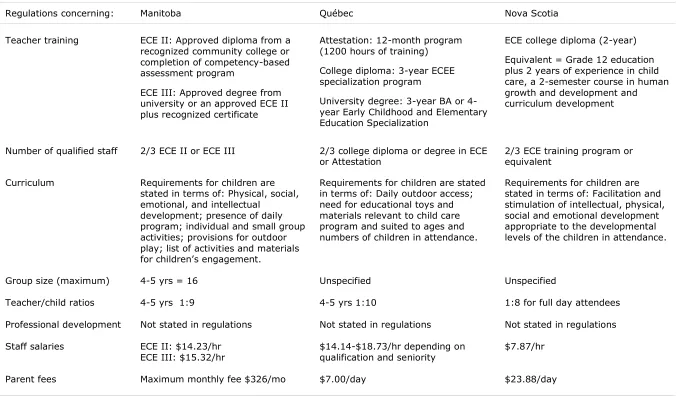
This study assessed the effectiveness of three models of in-service professional development regarding the delivery of constructivist curriculum and the impact on classroom quality, educators’ beliefs, and interactions with children. Specifically, the goal was the delivery of a constructivist curriculum over a 15-week period via one of three methods: (a) consultant model, (b) workshops, and (c) a readings only group. We studied educators in 44 not-for-profit centres in three cities in three Canadian provinces. Each province has jurisdiction regarding child care legislation and regulations (Friendly, Beach, Ferns, & Turiano, 2006; Jacobs, Howe, & Vukelich, 2007a); the three sites were selected due to differences in provincial regulations (see Table 1). In each city, five child care centres were randomly assigned to each group who were guided by a facilitator.
The consultant group employed a constructivist model and implementation included (a) weekly visits by the site facilitator to each educator, (b) three group meetings, (c) non-technical, practical readings on constructivist curriculum, and (d) a constructivist approach to learning (i.e., guidance, feedback, responsiveness to educator’s needs). The second group of educators met jointly for four workshops on constructivist curriculum (i.e., observation, implementing a constructivist curriculum) delivered at a daycare centre by the facilitator; the topics, agenda items, and delivery of content were predetermined by the facilitator, who also initiated discussion and links to the readings. The workshop educators had no other intervention or follow-up as this condition mirrored typical professional development (Burchinal et al., 2002). Finally, the educators in Group 3 received the same non-technical, practical articles provided to Groups 1 and 2, but had no further contact with the facilitator; it was a comparison for Groups 1 and 2.
Table 1
Provincial Regulations for Group Child Care Centres for 4-year-old Children
Regulations concerning: Manitoba Québec Nova Scotia
Teacher training ECE II: Approved diploma from a
recognized community college or completion of competency-based assessment program
ECE III: Approved degree from university or an approved ECE II plus recognized certificate
Attestation: 12-month program (1200 hours of training)
College diploma: 3-year ECEE specialization program
University degree: 3-year BA or 4-year Early Childhood and Elementary Education Specialization
ECE college diploma (2-year)
Equivalent = Grade 12 education plus 2 years of experience in child care, a 2-semester course in human growth and development and curriculum development
Number of qualified staff 2/3 ECE II or ECE III 2/3 college diploma or degree in ECE
or Attestation 2/3 ECE training program or equivalent
Curriculum Requirements for children are
stated in terms of: Physical, social, emotional, and intellectual
development; presence of daily program; individual and small group activities; provisions for outdoor play; list of activities and materials for children’s engagement.
Requirements for children are stated in terms of: Daily outdoor access; need for educational toys and materials relevant to child care program and suited to ages and numbers of children in attendance.
Requirements for children are stated in terms of: Facilitation and stimulation of intellectual, physical, social and emotional development appropriate to the developmental levels of the children in attendance.
Group size (maximum) 4-5 yrs = 16 Unspecified Unspecified
Teacher/child ratios 4-5 yrs 1:9 4-5 yrs 1:10 1:8 for full day attendees
Professional development Not stated in regulations Not stated in regulations Not stated in regulations
Staff salaries ECE II: $14.23/hr
ECE III: $15.32/hr
$14.14-$18.73/hr depending on qualification and seniority
$7.87/hr
Parent fees Maximum monthly fee $326/mo $7.00/day $23.88/day
Method
Recruitment
Child care centres in three Canadian cities participated (Montreal, Winnipeg, Halifax); the research project was coordinated from Montreal. Not-for-profit centres were identified from lists provided by the provincial Ministries or professional associations and were selected because they are generally of higher quality (Goelman, Forer, Kershaw, Doherty, Lero, & LaGrange, 2006) and are more likely to hire teachers with preservice education (see Table 1). Teachers with preservice education were recruited, because they had a comparable foundation of knowledge based on our assessment of the similarity in early childhood education curriculum in Canadian college programs (Jacobs et al., 2007a). Fifteen centres each participated in Winnipeg and Halifax and 14 in Montreal. In each city, five centres were randomly assigned to each of the three groups, except in Montreal, where the readings group was assigned four centres; educators were only informed about their own group assignment. One classroom in each centre participated; classrooms had an average of 2.1 educators (range 1-5), all of whom were invited to participate. Research assistants were blind to each centre’s group assignment.
Participants
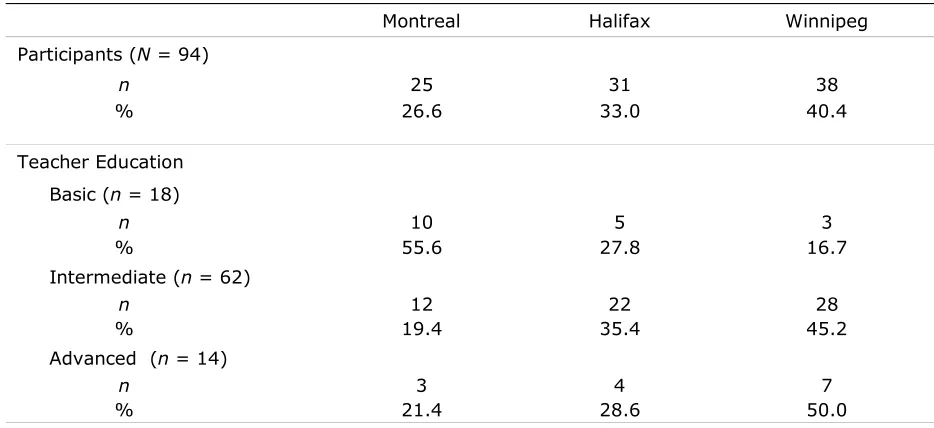
At pretest, 94 educators (89 female, 5 male) participated with 7.10 years of experience (sd = 5.23, range = 1 to 31 years) (see Table 2). At posttest, the retention rate was 89%; 10 teachers (Montreal = 4, Winnipeg = 6; Halifax = 0) dropped out of the study (e.g., parental leave,
Table 2
Demographic Information about Educators by Site
Montreal Halifax Winnipeg
Participants (N = 94)
n 25 31 38
% 26.6 33.0 40.4
Teacher Education
Basic (n = 18)
n 10 5 3
% 55.6 27.8 16.7
Intermediate (n = 62)
n 12 22 28
% 19.4 35.4 45.2
Advanced (n = 14)
n 3 4 7
% 21.4 28.6 50.0
Note. Ten educators dropped out of the study at the post-intervention (Montreal = 4 or 16%, Group 1 = 3, Group 2 = 1; Winnipeg = 6 or 16%, Group 1 = 3, Group 2 = 1, Group 3 = 2).
Overall, the ten educators were from Group 1 (n = 6 or 18%), Group 2 (n = 2 or 7%), and
classroom assignment). Teachers’ preservice education was categorized as basic (e.g., 1-year
Attestationi program), intermediate (e.g., 2- or 3-year college/CEGEPii program, and advanced (e.g., university). Following approval of the university ethics committee, informed written consent was obtained from centre directors, educators, and parents.
Design and Procedure
The study employed a pre-post quasi-experimental design; data were collected before and after the 15-week implementation of the intervention. Measures were collected at pretest and posttest. Global classroom quality was rated with the ECERS-R (Harms et al., 2005). Educators were individually and privately interviewed about their beliefs regarding curriculum. Finally, language samples of on-going educator-child interactions in structured versus unstructured contexts were collected, as described below. The research assistants from the three sites were trained on all measures in Montreal by the first three authors over a 3-day period before data collection commenced to ensure consistency of measurement. During training, reliability of the research assistants with the second and third authors for the ECERS-R and language samples was determined.
Measures
Early Childhood Environmental Rating Scale-Revised (ECERS-R). The global quality
of the classroom environment was measured by 43 items comprising seven subscales (e.g., space and furnishings). Each item is rated on a 7-point scale (inadequate to excellent) with higher ratings indicating higher quality. Centres receiving mean scores of 5 or higher are rated as good quality. The ECERS-R has well-established reliability and validity (Harms et al., 2005; Peisner-Feinberg & Burchinal, 1997). Cassidy, Hestenes, Hegde, Hestenes, & Mims (2005) reported a two-factor model (Materials/Activities, 9 items; Language/Interaction, 7 items) that explained 69% of the variability in their sample. We used the Cassidy et al. factors and added three items to the Activities scale (music, sand/water, diversity) and two items to the Interactions scale (greeting/departures, child communication) based on their conceptual similarity to the items on the Cassidy et al. factors. The additional items were significantly correlated with the relevant Cassidy et al. scale (rs = .31 to .66; p < .05). Cronbach’s alphas were good for the Activities (pretest = .83, posttest = .72) and Interactions (pretest = .86, posttest = .88) subscales.
Reliability. Two research assistants in each site conducted reliability observations on 20%
of classrooms (n = 3/15 per site; total = 9/44 classrooms) at both pre and posttest. Disagreements were resolved by discussion between raters. Reliability was determined for the combined pre and posttest data with the Spearman-Brown formula (Montreal = .86; Winnipeg = .99; Halifax = .85).
Educator Beliefs Interview. This semi-structured interviewiii captured educators’
six open-ended questions, and activities questions were used in this study. Educators were interviewed privately; interviews were audio-taped and transcribed in each site, however, a Montreal assistant listened to and verified the accuracy of the transcription of 19% (n = 18/94) of interviews prior to coding.
Using a grounded-theory approach (Strauss & Corbin, 1998), a coding scheme was developed from responses to the open-ended questions. Grounded theory is a systematic approach to analyzing qualitative data that derives common concepts or categories based on a careful and independent reading of the interviews by several persons. First, the transcripts were independently read by the first three authors to identify themes in the responses to each question. The authors then compared lists and identified common themes; the compiled themes became the coding scheme for each question and the number of possible themes varied by question. Next, the research assistants were trained to identify the themes and coded the presence or absence of each possible theme for each question. Then the authors reviewed the list of themes for each question and identified the themes that focused on beliefs about constructivism and direct instruction to be used in the analyses (see Table 3 for definitions and examples). Constructivism was further subdivided into beliefs about learning, methods, and communication. Themes were mutually exclusive, but if responses included multiple themes, the occurrence of each theme was noted.
Reliability. All interviews from the three sites were coded by two Montreal assistants, who
were trained by the third author on the coding scheme. Reliability between the two coders was conducted on 19% of pre and posttest interviews (n = 18/94) and was calculated as agreement/(agreements + disagreements) for constructivist learning = .92, methods = .94, communication beliefs = .90, and direct instruction beliefs = .93; overall kappa = .88. Disagreements were resolved by discussion with the authors.
Language samples of educator-child interactions. The purpose of the sampling was
to collect information about educator-child language and interactions. For each exchange, the assistants recorded language, time, and context (e.g., free play). In each classroom, the teacher with the highest level of education was selected as the focal educator. If two or more teachers had the same educational level, one was randomly selected. Observations were conducted during one hour of structured adult-directed activities (e.g., circle, lunch) and one hour of unstructured time (e.g., free play). Each educator was observed for five minutes on, five minutes off, to avoid observer fatigue with a modified running record to record the educator’s and children’s language. At pre and posttest, observations were counterbalanced for time of day (a.m., p.m.) and activity (e.g., Week 1: a.m. free play; Week 2: p.m. circle) until two hours per educator was collected.
reduce opportunities for the child to consider possibilities and make decisions regarding best outcomes. Directives included custodial, social management, sustenance, unproductive, closed-ended questions, or no response codes (see Table 3).
Table 3
Interview Themes and Language Sample Coding
Beliefs regarding:
1. Constructivism: Statements that the educator’s role is to guide children’s learning and
development, child-centred approach.
a. Learning: Children learn through hands-on experiences with concrete materials as they
interact with environment; learning is frequently initiated by children’s interests; learning and development are supported/guided/scaffolded by educators.
b. Methods: Includes documentation, portfolios, observations; large, uncommitted play spaces
that can evolve into various scenarios as led by child interests; open-ended materials; emergent schedule that supports different needs/interests occurring at the same time (e.g., one group of children having snack while another engages in group time).
c. Communication: Includes nonverbal strategies (e.g., kneeling down to child’s level,
acknowledging child with smile, eye contact) and verbal strategies (e.g., labelling child’s actions, encouraging children to refer to one another, open-ended questions).
2. Direct Instruction: Teacher-centred approach where the educator’s role is to “teach children,”
impart knowledge; highly teacher-directed activities include worksheets; close-ended materials; activities with a predetermined product (craft time); predetermined themes that are not based on children's interests.
Language Samples Coding
1. Guidance: Evidence that the teacher is guiding the child’s thinking, or problem-solving, logical
reasoning, making comparisons or predications, asking probing questions. Type of guiding included:
a. Physical (e.g., Ch: I can’t make this letter (a). T: Would you like some help? Ch: Yes. T: Well,
we can try to make the letter together in the air. Ch: Okay but I want to write it on the paper. T: Would you like me to hold your hand while you try to write it on the paper? Ch: Yes. T: Wraps hand around Ch’s hand and writes letter “a” with the child. Ch: Yeah! Now I can do it all by myself.).
b. Cognitive (e.g., Ch: There is a bumble bee. T: No, it’s a fly. Where do you think the fly came
from? Ch: Outside. T: How did it get in? Ch: The door. T: Did he open the door himself? Ch: No!).
c. Language (e.g., Ch: Hey! T: The horses are coming? Ch: We’re not horses, we’re people. T:
We’re people. Do we eat hay? Ch: No! Horses do! T: That’s why I always say. “Hay is for horses!”).
d. Social-emotional (e.g., Ch: I am angry at Maria. T: Why are you angry? Ch: She took my toy.
T: What can you do about that? Ch: Grab it back. T: Will that solve the problem? Ch. Yeah, I’ll have it back. T: How do you think Maria will feel? Ch: She’ll be sad. T: So is there a way for both of you to be happy? Ch: Yeah, we could share the toy.).
2. Directives: No evidence that the teacher is guiding child’s problem-solving; the following
behaviours were included:
a. Custodial: Meeting child’s basic needs (e.g., food, toileting, safety).
b. Social management: Getting along with peers or behaving in general.
c. Nurturance: Concerns about the child’s emotional state (e.g., crying).
d. Unproductive: Interactions do not go beyond a brief response or acknowledgement
representing a missed opportunity to continue interaction.
e. Close-ended: Questions posed by teachers that require right/wrong answers.
f. No response: Teacher does not respond to child initiated interaction.
Unfortunately, complete data were only available for Montreal and Winnipeg, because the Halifax research assistant did not complete the observations due to illness. Across contexts, the overwhelming majority of exchanges (89.9%) were directives, whereas 2.9% were guidance (the remaining exchanges were not codable due to a lack of contextual information or the brevity of the sample; e.g., “This goes here” with no contextual information to make sense of the statement). However, some contexts (i.e., freeplay, outside play, circle/story time, activity/art/small group, gym) were more conducive to guiding than others (i.e., snack, lunch). While guidance occurred in only 1.6% of exchanges recorded during lunch or snack, guidance occurred in 3.6% of exchanges in other contexts. Thus, to investigate individual differences between centres and avoid statistical issues related to floor effects, we examined the number of guidance exchanges as a proportion of the total number of codable exchanges in contexts other than lunch or snack.
Reliability. Intercoder reliability was established by two Montreal research assistants who
independently coded 30% (n = 26/88) of the pre and posttest transcripts; reliability was calculated as agreement/(agreements + disagreements): guidance = .94, directives = .96, overall
kappa = .90. Disagreements were resolved by discussion with the authors.
Intervention
Prior to the 15-week intervention, the three site facilitators received three days of training in Montreal regarding constructivist curriculum, the training manual, and other resources. During the intervention, there were weekly conference calls with the three facilitators and the second and third authors to discuss issues of implementation. The site facilitators were encouraged to discuss possible solutions, which were assessed for their constructivist approach and content. The third author also kept in frequent e-mail contact with the site facilitators.
(a) Group 1: Consultant group. Three external curriculum experts (in collaboration with
first three authors) developed the 135-page training manual based on current literature on constructivist education (Jacobs, Vukelich, & Howe, 2007biv). The manual included five pathways: (a) values and beliefs, (b) child development and the early childhood curriculum, (c) observation, (d) documentation, and (e) reflection (see Table 4). Each section included exercises and training tools. The implementation schedule included weekly visits by the facilitator to each centre (approximately 2-4 hours/visit) that included classroom observations and feedback sessions, modeling by the facilitators during ongoing classroom activities, and discussion of issues in the manual, handouts, and articles (see Group 3 below). The content of sessions varied according to the educator’s needs and issues observed by the facilitator (see Howe & Jacobs, in press, for an analysis of the mentoring process). Educators also met as a group three times during the intervention to discuss the manual (e.g., reflecting on values) and common issues (e.g., outdoor play in the curriculum), and to visit other Group 1 centres.
(b) Group 2: Workshop group. Four workshops delivered by the site facilitators covered
author. Facilitators offered workshops every 3-4 weeks, the content and format was constructivist, and educators were encouraged to reflect on their practice during discussions and connect the theoretical ideas in the workshops and readings (see Group 3) to their daily classroom practices.
(c) Group 3: Readings group. Participants were informed during Week 1 that they would
receive two packages of eight articles on curriculum in Weeks 4 and 11. All the articles appeared in Young Children (published by the National Association for the Education of Young Children, the largest association for early childhood education in North America), which publishes short, practical, and non-technical articles. We selected articles that included information about principles and implementation of constructivist curriculum, integrating math, dramatic play, and literature into the curriculum, and dealing with conflict resolution (i.e., Dizes & Dorl, 1999; Kupetz & Twiest, 2000; Williams, 1997). There was no other contact with these educators.
Results
Plan of Analyses
To determine the effects of the interventions across time, we employed a series of 3 (intervention groups) x 2 (pre and posttest) x 3 (site) mixed-model ANOVAs. Outcomes included the ECERS-R scores, educator beliefs, and educator language samples. Site (Montreal,
Table 4
Description of Content in Group 1 Training Manual and Group 2 Workshops
Group 1 Training Manual
Introduction: Constructivism is defined and five pathways are identified:
1. Values and beliefs: Information regarding how values and beliefs are the foundation of teaching philosophy and impact on practice, exploration of personal beliefs;
2. Constructivism and the early childhood curriculum: Constructivist views of children and education, principles of the constructivist classroom (organization, programming, communication with children);
3. Observation: Key to understanding learning and development; preparation for methods (narrative, sampling), interpreting and applying observation to classroom practice; 4. Documentation: Examples (drawings, portfolios, documentation panels), strategies for
classroom documentation, communication tools;
5. Reflection: Self-reflection and analysis regarding philosophy, classroom practice, interactions with children and parents.
Group 2 Workshops
1. Observation: Value of observation in enhancing program quality, skills, and attitudes for conducting observations, integrating observation into educator’s program, relating observations to children’s development; values and beliefs about education.
2. Behaviour guidance: Meaning and value of children’s conflicts and role in development, increase awareness of responses to conflict, management of conflict situations, promoting personal and professional integrity.
3. Language and literacy: Child development with an emphasis on language and literacy, enhance awareness of personal experiences and values that shape curriculum decisions, enrich practice by sharing ideas, and new skills, strategies, documentation.
Halifax, Winnipeg) was included as a syntax command in the SPSS computer program for the ANOVAs to account for any possible differences due to location. Finally, we assessed whether the levels of teacher education varied across the three sites to determine if it might be a possible explanatory factor in interpreting the findings.
Effects of Intervention Group and Site on Child Care Quality
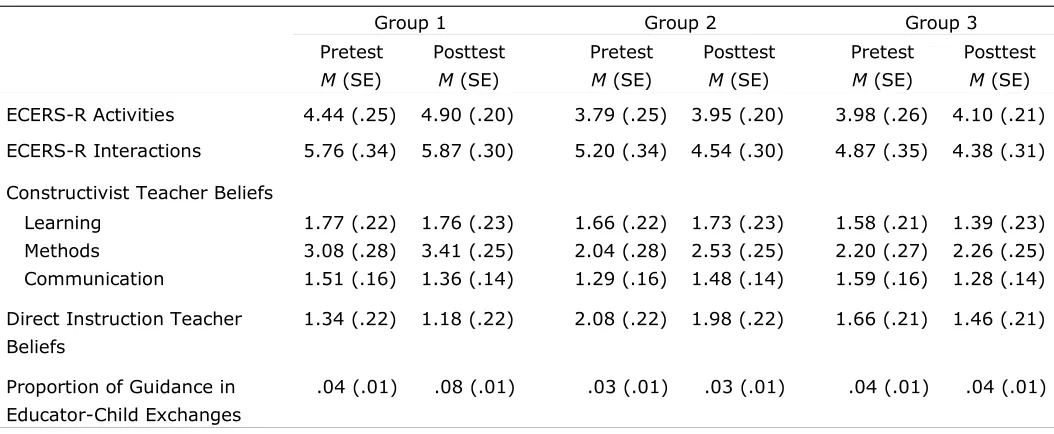
Descriptive information for the three intervention groups is found in Table 5. At the pre- and post-intervention, the Activities and Interactions scales were correlated (r = .68, .49, p < .05, respectively). To examine how the ECERS-R scores changed over time as a function of site and group, we conducted two 3 (intervention group) x 3 (site) x 2 (time) mixed-model ANOVAs, with ECERS-R Activities and Interactions scores entered as dependent variables, respectively. The first analysis predicting Activities revealed a main effect of time, F(1, 35) = 4.11, p < .05, η2 = .11, qualified by a time by site interaction, F(2, 35) = 3.41, p < .05, η2 = .16. Activities scores did not change significantly over time in Montreal, whereas they increased slightly in Halifax and Winnipeg (ps < .05). There was also a significant main effect of intervention group, F(2, 35) = 4.48, p < .05, η2 = .20; Activities scores in Group 2 were lower than in Group 1. Scores in Group 3 were not significantly different from either Group 1 or 2. The second ANOVA predicting ECERS-R Interactions indicated a similar pattern. There was a significant interaction between time and site, F(2, 35) = 7.42, p < .01, η2 = .30; Montreal scores decreased substantially over time (p < .001), but those for Winnipeg and Halifax did not change. The analysis also revealed a main effect of group, F(2, 35) = 4.86, p < .05, η2 = .22. Interactions scores in Group 3 were lower than Group 1, whereas Group 2 was not significantly different from either Group 1 or 3.
Effects of Intervention and Site on Educators’ Beliefs
The next set of analyses concerned the effects of site and intervention group on educators’ endorsement of constructivist learning, methodology, communication, and direct instruction teaching practices (see Table 5 for means). The correlations between the three constructivist
Table 5
Descriptors for ECERS-R, Educators’ Endorsements of Beliefs, and Guidance Behaviours
Group 1 Group 2 Group 3
Pretest
M (SE)
Posttest
M (SE)
Pretest
M (SE)
Posttest
M (SE)
Pretest
M (SE)
Posttest
M (SE)
ECERS-R Activities 4.44 (.25) 4.90 (.20) 3.79 (.25) 3.95 (.20) 3.98 (.26) 4.10 (.21)
ECERS-R Interactions 5.76 (.34) 5.87 (.30) 5.20 (.34) 4.54 (.30) 4.87 (.35) 4.38 (.31)
Constructivist Teacher Beliefs
Learning 1.77 (.22) 1.76 (.23) 1.66 (.22) 1.73 (.23) 1.58 (.21) 1.39 (.23)
Methods 3.08 (.28) 3.41 (.25) 2.04 (.28) 2.53 (.25) 2.20 (.27) 2.26 (.25)
Communication 1.51 (.16) 1.36 (.14) 1.29 (.16) 1.48 (.14) 1.59 (.16) 1.28 (.14)
Direct Instruction Teacher Beliefs
1.34 (.22) 1.18 (.22) 2.08 (.22) 1.98 (.22) 1.66 (.21) 1.46 (.21)
variables were relatively modest (rs < .27). Direct instruction beliefs were not correlated with the total score for constructivist beliefs (r = -.02). The first analysis examined the effects of the intervention group and site on educators’ beliefs about constructivist learning over time using a 3 (site) x 3 (intervention group) x 2 (time) mixed-model ANOVA, with the number of references to constructivist learning principles as the dependent variable. None of the main effects or interactions was significant, Fs < 1, ns. When the same analysis was performed to assess effects on beliefs about constructivist methodology, only the main effects for site, F(2, 74) = 5.97, p < .05, η2 = .14, and group, F(2, 74) = 7.44, p < .05, η2 = .17, were significant. In terms of site, follow-up t-tests revealed that Winnipeg educators (M = 3.15) endorsed more beliefs about constructivist methodology than either Montreal (M = 2.26) or Halifax (M = 2.35) educators. Further, constructivist methodology beliefs were endorsed overall more by educators in Group 1 than either Group 2 or Group 3 educators. Finally, we examined the effects of intervention group and site on educators’ constructivist communication beliefs over time. Results of a similar mixed-model ANOVA revealed only a significant time x site interaction, F(2, 74) = 3.70, p < .05, η2 = .09. Follow-up analyses revealed that Winnipeg educators’ endorsement of constructivist communication beliefs significantly decreased over time (pre and posttest Ms = 1.63, 1.23, respectively), whereas scores for educators in Montreal (Ms = 1.33, 1.62) and Halifax (Ms = 1.40, 1.28) did not change over time. Finally, we examined the effects of intervention group, site, and time on educators’ endorsements of direct instruction beliefs and only a main effect of intervention group was revealed, F(2, 74) = 4.65, p < .05, η2 = .11. Follow-up analyses revealed that Group 1 educators endorsed fewer direct instruction beliefs than Group 2 educators; educators in Group 3 did not differ from the other two groups.
Effects of Intervention and Site on Educator-Child Exchanges
Our analyses of the language sampling data focused on the relative proportions of educators’ guidance and directives (i.e., guidance as a proportion of the total number of codable sequences in relevant contexts). A mixed-model ANOVA predicting the proportion of guiding exchanges as a function of time, site, and group revealed main effects of site, F(1, 22) = 8.88, p < .01, η2 = .31, and time, F(1, 22) = 4.60, p < .05, η2 = .17, qualified by a time x site interaction, F(1, 22) = 6.34,
p < .05, η2 = .22. Whereas Winnipeg educators engaged in more guidance at the posttest (M = .08) than at the pretest (M =.04), Montreal educators engaged in similarly low levels of guiding over time (both Ms = .02). Further, the analysis revealed a time x group interaction, F(1, 22) = 3.51, p < .05, η2 = .24. The proportion of guiding exchanges in Group 1 increased over time, whereas those in the other two groups did not (see Table 5).
Teacher Education
To account for potential findings due to teacher education, we performed analyses to determine whether educators’ preservice education was significantly associated with the independent variables (i.e., intervention group, site). There was no association between education and intervention group, χ2 (4, N = 94) = 1.61, ns. However, teacher education (basic, intermediate,
advanced) did vary by site, χ2 (4, N = 94) = 10.56, p < .05. An examination of adjusted
Discussion
The discussion is organized according to the effects of intervention group and site on child care quality, educator beliefs, and educator-child interactions. Limitations of the study and implications for practice are also addressed.
Effects of Intervention and Site on Child Care Quality
The first set of findings addressed the impact of the intervention program on the global quality of child care. There was a main effect for intervention group with Group 2 scoring lower than Group 1 on the ECERS-R; Group 3 did not differ from the other two groups. The initial differences on the Activities scores for the intervention groups made it difficult to conduct group comparisons over time (e.g., due to ceiling effects for Group 1); thus our hypothesis that Group 1 classrooms would improve over time was not supported. In Group 1, the facilitators focused on constructivist philosophy and beliefs and did not directly instruct the educators how to make specific improvements on the ECERS-R Activities items. Finally, there was a main effect for site; over time, the Activities scores for the Montreal centres did not change perceptibly, whereas those for the other two sites increased somewhat.
Although not expected, the ECERS-R Interactions subscale was significantly higher at pretest in Montreal than Halifax or Winnipeg centres. However, the Montreal Interactions scores decreased significantly over time, whereas the pre to posttest scores for Halifax and Winnipeg did not change. Although the centres were randomly assigned to the three groups at pretest, Group 3 centres had lower Interaction scores than Group 1 centres, while Group 2 scores did not differ from Groups 1 and 3. Group 1 Interaction scores tended to increase more over time compared to Groups 2 and 3, although not significantly. Perhaps this pattern would have been stronger with a larger sample or a longer intervention period. Certainly, the direction of the finding is consistent with the literature indicating that an intensive, long-term, classroom-based in-service professional development may positively impact educators’ developmentally appropriate practices (Cassidy et al., 1995). Also, a targeted focus on improving specific items for Group 1 educators might have increased the scores. Finally, the global ECERS-R ratings may not be sensitive enough to detect subtle differences in actual educator behaviour over time (Wilcox-Herzog, 2002), suggesting that measurement specificity is a potential methodological problem. This finding was in contrast to those for educator-child interactions discussed below.
Effects of Intervention and Site on Educators’ Beliefs
There were interesting site effects for educators’ beliefs about constructivist methodology and communication, but no intervention effects. Winnipeg educators most often endorsed beliefs about constructivist methodology. This difference may perhaps reflect their prior experiences (e.g., professional development offered by the provincial professional association) or their college courses (i.e., training in documentation and portfolios). Relative to the overall sample, Winnipeg educators were most likely to have an intermediate level of education (2- or 3-year ECE college program) and less likely to have basic education. This suggests that a longer, more intensive program may be required for students to become knowledgeable about the use of constructivist methods (e.g., portfolios, documentation), which are more difficult to address in depth during a 1-year program. Further, most of the Winnipeg educators graduated from Red River College, which offers the only ECE program in Manitoba. Local professional associations may also promote constructivist methodologies via workshops to keep in-service child care educators abreast of new developments. In terms of constructivist communication beliefs, Winnipeg educators significantly decreased their endorsement over time, while scores for Montreal increased and Halifax educators decreased, but neither change was significant; these findings are not easy to interpret. The means show that the Montreal educators’ beliefs increased in the expected direction and their T2 scores were similar to the T1 Winnipeg scores, tentatively suggesting change due to participating in the study. Nevertheless, the drop in the Winnipeg (and the Halifax) scores is perplexing; perhaps, some factor related to site was important here (e.g., interviewers, participant fatigue, time of post-intervention follow-up). Unfortunately, the small sample makes it difficult to untangle possible explanations and a more intensive qualitative examination of the interviews might also provide some guidance. Finally, Group 1 educators initially endorsed more beliefs about constructivist methodology compared to other educators, making change due to the intervention more difficult to achieve.
Direct instruction beliefs were also examined for the effects of intervention group, site, and time. Group 1 educators endorsed fewer direct instruction beliefs than Group 2 (workshop group) educators, but there was no interaction with time. In concert with the above findings that Group 1 educators most often endorsed constructivist methods, the findings suggest that these educators put less value on adult-directed approaches to teaching and learning (e.g., worksheets, product-oriented art). In contrast, they endorsed constructivist approaches to understanding children’s learning via methods such as observations, portfolios, and documentation. In sum, beliefs may be one contextual filter through which educators interpret children’s learning and development and, possibly, guide their classroom practice (Wilcox-Herzog, 2002). The lack of a time by intervention group interaction may have been due to the initially stronger constructivist (and fewer direct instruction) beliefs of Group 1 educators. Also, perhaps the intervention was not long enough to affect an increase in beliefs (Pajares, 1992).
Effects of Intervention and Site on Educator-Child Interactions
exchanges can be rewarding and also challenging for both educators and children, in the sense that the discussions that ensue are not always predictable. That is, since the child’s response is unknown, the educator must be ready to deal with unexpected answers that require a response. The educator’s response is likely to be thoughtful and perhaps, reflective. This form of conversational turn-taking is valuable for the child’s cognitive and language development and also provides the educator with an opportunity to assess the child’s learning and development. Apparently, the consultant model intervention had a positive impact on educator-child exchanges.
Certainly, learning to guide children’s thinking is a skill that is difficult for some educators to acquire without modeling, reflection, and tutoring from a more skilled adult, in this case, the facilitator. Guiding may also be a skill that takes time to learn to use effectively. As Borko (2004) noted, changing classroom practices depends on the educator’s understanding and ability to implement changes. Our educators were generally well-educated, yet only the more intensive nature of the consultant model had an impact on educator language. We should not underestimate the challenge of changing educator behaviour to promote positive child behaviours so that they will take advantage of opportunities to enhance children’s developmental outcomes.
Implications of Findings Regarding Site
Our data suggest some very interesting patterns and, in particular, we highlight the effect of site as an important factor associated with the qualitatively different behaviours in educators. Clearly, local environmental conditions may influence how educators perceive their classroom role. For example, Winnipeg educators most often endorsed constructivist curriculum approaches, placed more value on constructivist principles, and engaged in more guiding interactions. In contrast, Montreal educators were less likely to endorse constructivist methods and engaged in proportionally less guidance. This pattern suggests that the educators in the three sites had somewhat different priorities and views of their roles as educators. Perhaps the site differences may be related to sampling differences, although we applied consistent selection criteria (i.e., not-for-profit centres, preservice education, random assignment to condition).
Conclusions
The present study has a number of limitations. The three facilitators may not have implemented the interventions uniformly across the sites, yet our design does replicate realistic situations where several individuals would be employed in a multi-site program. A careful assessment of the curriculum content may also be warranted to ensure that it is in line with expected changes in educator behaviour and beliefs. Given the complexity of the research design, a larger sample might have strengthened our findings by allowing for more sophisticated statistical procedures (e.g., multi-level modeling) and investigation of other factors (e.g., impact of type of preservice teacher education). The not-for-profit auspice of all centres, which has been associated with higher quality care (Goelman et al., 2006; Howes, Whitebrook, & Phillips, 1992), may have restricted the ability to detect differences due to the intervention. The lack of a long-term follow-up did not allow us to determine if some effects might have become more pronounced over time. Moreover, posttest data were collected in June when some centres introduce a more informal summer program. Finally, it would have been ideal if we had matched centres on pretest characteristics as well as teacher education, rather than using random group assignment given the initial unexpected group differences.
A number of potential research questions follow from our study. Replication with a larger sample is always a wise decision so as to verify the findings and to attempt to sort out the site and group differences that were revealed. Comparing longer and shorter periods of intervention may also indicate an optimal time period for affecting change, as well as more creative approaches to professional development (e.g., combining workshop and mentoring approaches). An intensive comparison of the factors associated with the program length and comprehensiveness of the two Quebec ECE programs (i.e., 12-month Attestation versus 3-year CEGEP) would allow for a more detailed analysis of the critical factors associated with facilitating possible change in teacher beliefs and practices. This analysis would provide guidance for how to design in-service professional development programs that build upon the specific foundation of knowledge already constructed by educators graduating from the two programs. The role of professional organizations in promoting professional development that is meaningful and that will have a long-term impact on educator practice is certainly warranted.
Acknowledgements
This study was funded by a grant from Human Resource Development Canada, Social Partnerships Program to the first two authors. We thank the centres and educators who participated, the site facilitators (Monica Lytwyn, Madalena Coutihno, Chris Kronick), the curriculum manual designers (Jill Fortney, Cathy Mott, Ruth Strubank, Shelley Thompson), the Montreal, Winnipeg, and Halifax research assistants, and Allyson Funamoto and Joanna Rosciszewska for editorial assistance. Please address correspondence to Nina Howe, Dept of Education, Concordia University, 1455 de Maisonneuve West, Montreal, Québec H3G 1M8, Canada. Phone: 514-848-2424, x 2008; email: [email protected].
References
Ackerman, D. J. (2006). The costs of being a child care teacher: Revisiting the problem of low wages. Educational Policy, 20(1), 85-112.
Avalos, B. (2011). Teacher professional development in Teaching and Teacher Education over ten years. Teaching and Teacher Education, 27, 10-20. Retrieved November 20, 2011, from
http://www.elsevier.com/authored_subject_sections/S06/S06_342/misc/Teacher_professional_de velopment.pdf
Borko, H. (2004). Professional development and teacher learning: Mapping the terrain. Educational Researcher, 33(8), 3-15. Retrieved November 20, 2011, from
http://www.aera.net/uploadedFiles/Journals_and_Publications/Journals/Educational_Researcher/ Volume_33_No_8/02_ERv33n8_Borko.pdf
Bodrova, E., & Leong, D. J. (1996). Tools of the mind: The Vygotskian approach to early childhood education. Columbus, OH: Pearson Education.
Branscombe, N. A., Castle, K., Dorsey, A. G., Surbeck, E., & Taylor, J. B. (2003). Early childhood curriculum: A constructivist perspective. Boston, MA: Houghton Mifflin.
Burchinal, M. R., Cryer, D., Clifford, R. M., & Howes, C. (2002). Caregiver training and classroom quality in child care centers. Applied Developmental Science, 6(1), 2-11.
Buysse, V., Winton, P. J., & Rous, B. (2009). Reaching consensus on a definition of professional
development for the early childhood field. Topics in Early Childhood Special Education, 28(4), 235-243.
Cassidy, D. J., Buell, M. J., Pugh-Hoese, S., & Russell, S. (1995). The effect of education on child care teachers' beliefs and classroom quality: Year one evaluation of the TEACH early childhood associate degree scholarship program. Early Childhood Research Quarterly, 10(2), 171-183.
Cassidy, D. J., Hestenes, L. L., Hegde, A., Hestenes, S., & Mims, S. (2005). Measurement of quality in preschool child care classrooms: An exploratory and confirmatory factor analysis of the Early
Childhood Environment Rating Scale-Revised. Early Childhood Research Quarterly, 20(3), 345-360. Charlesworth, R., Hart, C. H., Burts, D. C., Thomasson, R. H., Mosley, J., & Fleege, P. O. (1993).
Measuring the developmental appropriateness of kindergarten teachers' beliefs and practices. Early Childhood Research Quarterly, 8(3), 255-276.
Cryer, D., & Burchinal, M. (1997). Parents as child care consumers. Early Childhood Research Quarterly, 12(1), 35-58.
Cryer, D., & Phillipsen, L. (1997). Quality details: A close-up look at child care program strengths and weaknesses. Young Children, 52(5), 51-61.
DeVries, R., & Kohlberg, L. (1990). Constructivist early education: Overview and comparison with other programs. Washington, DC: National Association for the Education of Young Children.
Dizes, D. E., & Dorl, J. (1999, July). Your mop is my guitar: Emergent curriculum in our classroom. Young Children, 54(4), 14-16.
Doherty, G., Lero, D. S., Goelman, H., Tougas, J., & LaGrange, A. (2000). You bet I care! Caring and learning environments: Quality in regulated family child care across Canada. Geulph, ON: Centre for Families, Work and Well-Being, University of Guelph, Ontario. Retrieved November 21, 2011, from http://action.web.ca/home/cfwwb/attach/ybic_report_3.pdf
Doolittle, P. E., & Camp, W. G. (1999). Constructivism: The career and technical education perspective. Journal of Vocational and Technical Education, 16(1), 23-46.
(ERIC Document Reproduction Service No. EJ598590) Retrieved November 21, 2011, from the Educational Resources Information Center (ERIC) website:
http://www.eric.ed.gov/PDFS/EJ598590.pdf
Drouin, C., Bigras, N., Fournier, C., Desrosiers, H., & Bernard, S. (2004). Grandir en qualité 2003: Enquête québécoise sur la qualité des services de garde éducatifs. Québec City, QUE: Institut de la statistique du Québec.
Edwards, S. (2003). New directions: Charting the paths for the role of sociocultural theory in early childhood education and curriculum. Contemporary Issues in Early Childhood, 4(3), 251-266. Edwards, C., Gandini, L., & Forman, G. (1993). The hundred languages of children: The Reggio Emilia
approach to early childhood education. Norwood, NJ: Ablex Publishing Corporation.
Epstein, A. S. (1993). Training for quality: Improving early childhood programs through systematic inservice training. Monographs of the High/Scope Educational Research Foundation, Number Nine. Ypsilanti, MI: Monograph Series, High/Scope Educational Foundation.
Fang, Z. (1996). A review of research on teacher beliefs and practices. Educational Research, 38(1), 47-65. Fantuzzo, J., Childs, S., Hampton, V., Ginsburg-Block, M., Coolahan, K. C., & Debnam, D. (1997).
Enhancing the quality of early childhood education: A follow-up evaluation of an experiential, collaborative training model for head start. Early Childhood Research Quarterly, 12(4), 425-437. File, N. (1994). Children's play, teacher-child interactions, and teacher beliefs in integrated early
childhood programs. Early Childhood Research Quarterly, 9(2), 223-240.
File, N., & Gullo, D. F. (2002). A comparison of early childhood and elementary education students' beliefs about primary classroom teaching practices. Early Childhood Research Quarterly, 17(1), 126-137.
Forman, G., & Kaden, M. (1992). Research on science education for young children. In C. Seefeldt (Ed.), The early childhood curriculum: A review of current research (pp. 175-192). New York: Teachers College Press.
Fosnot, C. T. (2005). (Ed.). Constructivism: Theory, perspectives and practice. New York: Teachers College Press.
Fosnot, C. T., & Perry, R. S. (2005). Constructivism: A psychological theory of learning. In C. T. Fosnot (Ed.), Constructivism: Theory, perspectives and practice (pp. 8-38). New York: Teachers College Press.
Friendly, M., Beach, J., Ferns, C., & Turiano, M. (2006). Early childhood education and care in Canada 2006. Toronto: Childcare Resource and Research Unit. Retrieved November 23, 2011, from
http://childcarecanada.org/publications/ecec-canada/07/06/early-childhood-education-and-care-canada-2006
Goelman, H., Forer, B., Kershaw, P., Doherty, G., Lero, D., & LaGrange, A. (2006). Towards a predictive model of quality in Canadian child care centers. Early Childhood Research Quarterly, 21(3), 280-295.
Helterbran, V. R., & Fennimore, B. S. (2004). Collaborative early childhood professional development: Building from a base of teacher investigation. Early Childhood Education Journal, 31(4), 267-271. Horm-Wingerd, D. M., Caruso, D. A., Gomes-Atwood, S., & Golas, J. (1997). Head start teaching center:
Evaluation of a new approach to head start staff development. Early Childhood Research Quarterly, 12(4), 407-424.
Howe, N., & Jacobs, E. (in press). Elements of mentoring: A case study of inservice professional
development for early childhood educators. In N. Howe & L. Prochner (Eds.), Recent perspectives on early childhood education and care in Canada. Toronto: University of Toronto Press.
Howe, N., Jacobs, E., Vukelich, G., & Recchia, H. (2007). Canadian Child Care Curriculum Study. Ottawa, ON: Social Development Partnerships Program, Human Resources Development Canada. Howes, C. (1997). Children's experiences in center-based child care as a function of teacher background
and adult:child ratio. Merrill-Palmer Quarterly, 43(3), 404-425.
Howes, C., Whitebrook, M., & Phillips, D. (1992). Teacher characteristics and effective teaching in child care: Findings from the national child care staffing study. Child & Youth Care Forum, 21(6), 399-414. Hyson, M., Copple, C., & Jones, J. (2006). Early childhood development and education. In W. Damon, R.
M. Lerner, K. A. Renninger, & I. E. Sigel (Eds.), Handbook of child psychology: Vol. 4. Child psychology in practice. (6th ed., pp. 3-47). Hoboken, NJ: John Wiley & Sons, Inc.
Jacobs, E., Howe, N., & Vukelich, G. (2007a). The influence of regulations, policies, professional associations, and early childhood college programs on child care curriculum. Ottawa, ON: Human Resources Development Canada.
Jacobs, E., Vukelich, G., & Howe, N. (2007b). Pathways to constructivism: A self-directed guide for educators Ottawa, ON: Human Resources Development Canada.
Japel, C. (in press). The Québec child care system: Lessons from research. In N. Howe & L. Prochner (Eds.), Recent perspectives on early childhood education and care in Canada. Toronto: University of Toronto Press.
Japel, C., Tremblay, R., & Côté, S. (2005). Quality counts! Assessing the quality of day care services based on the Quebec Longitudinal Study of Child Development. Montreal, QUE: Institute for Research on Public Policy. Retrieved November 21, 2011, from
http://www.irpp.org/choices/archive/vol11no5.pdf
Katz, L. G. (1999). Balancing constructivist and instructivist curriculum goals in early childhood education. Kindergarten Education: Theory, Research, and Practice, 4(1-2), 71-83.
Kontos, S., & Dunn, L. (1993). Caregiver practices and beliefs in child care varying in developmental appropriateness and quality. In S. Reifel (Ed.), Advances in early education and day care: Perspectives in developmentally appropriate practice (pp. 53-74). New York: JAI Press. Kontos, S., & Wilcox-Herzog, A. (1997). Influences on children's competence in early childhood
classrooms. Early Childhood Research Quarterly, 12(3), 247-262.
Kupetz, B. N., & Twiest, M. M. (2000, January). Nature, literature, and young children: A natural combination. Young Children, 55(1), 59-63.
Lamb, M. E., & Ahnert, L. (2006). Nonparental child care: Context, concepts, correlates, and
consequences. In W. Damon, R. M. Lerner, K. A. Renninger, & I. E. Sigel (Eds.), Handbook of child psychology: Vol. 4. Child psychology in practice. (6th ed., pp. 950-1016). Hoboken, NJ: John Wiley & Sons, Inc.
Langford, R. (in press). Innovations in provincial early learning curriculum frameworks in Canada. In N. Howe & L. Prochner (Eds.), Recent perspectives on early childhood education and care in Canada. Toronto: University of Toronto Press.
McMullen, M. B., Elicker, J., Goetze, G., Huang, H.-H., Lee, S.-M., Mathers, C., Wen, X., & Yang, H. (2006). Using collaborative assessment to examine the relationship between self-reported beliefs and the documentable practices of preschool teachers. Early Childhood Education Journal, 34(1), 81-91. Retrieved November 21, 2011, from http://profile.educ.indiana.edu/Portals/15/Articles/ECEJ-06.pdf
Montie, J. E., Xiang, Z., & Schweinhart, L. J. (2006). Preschool experience in 10 countries: Cognitive and language performance at age 7. Early Childhood Research Quarterly, 21(3), 313-331. Retrieved November 21, 2011, from
http://www.highscope.org/file/Research/international/IEA_Age_7_ecrq_art.pdf
NICHD Early Child Care Research Network. (1996). Characteristics of infant child care: Factors contributing to positive caregiving. Early Childhood Research Quarterly, 11(3), 269-306.
Pajares, M. F. (1992). Teachers' beliefs and educational research: Cleaning up a messy construct. Review of Educational Research, 62(3), 307-332.
Peisner-Feinberg, E., & Burchinal, M. R. (1997). Relations between preschool children's child-care experiences and concurrent development: The cost, quality, and outcomes study. Merrill-Palmer Quarterly, 43(3), 451-477.
Pence, A., & Pacini-Katchabaw, V. (in press). The Investigating Quality Project: Innovative approaches in early childhood education. In N. Howe & L. Prochner (Eds.), Recent perspectives on early childhood education and care in Canada. Toronto: University of Toronto Press.
Perkins, D. (1999, November). The many faces of constructivism. Educational Leadership, 57(3), 6-11. Phillips, D., McCartney, K., & Sussman, A. (2006). Child care and early development. In K. McCartney &
D. Phillips (Eds.), Blackwell handbook of early childhood development (pp. 471-489). Malden, MA: Blackwell Publishing.
Phillips, D., Fox, N. A., & Gunnar, M. R. (2011). Same place, different experiences: Bringing individual differences to research in child care. Child Development Perspectives, 5(1), 44-49.
Schweinhart, L. J., & Weikart, D. P. (1997). The High/Scope preschool curriculum comparison study through age 23. Early Childhood Research Quarterly, 12(2), 117-143.
Schweinhart, L. J., Montie, J., Xiang, Z., Barnett, W. S., Belfield, C. R., & Nores, M. (2005). Lifetime effects: The High/Scope Perry Preschool Study through age 40. Ypsilanti, MI: High/Scope Press. Statistics Canada. (n.d.). Census 2006 labour force activity. Ottawa, ON: Author.
Stipek, D. J., & Byler, P. (1997). Early childhood education teachers: Do they practice what they preach? Early Childhood Research Quarterly, 12(3), 305-325.
Strauss, A., & Corbin, J. (1998). Basics of qualitative research: Techniques and procedures for developing grounded theory (2nd ed.). Thousand Oaks, CA: Sage Publications.
Tillema, H. H. (2000). Belief change towards self-directed learning in student teachers: Immersion in practice or reflection on action. Teaching and Teacher Education, 16(5-6), 575-591.
Vartuli, S. (1999). How early childhood teacher beliefs vary across grade level. Early Childhood Research Quarterly, 14(4), 489-514.
Vygotsky, L. S. (1978). Mind in society: The development of higher psychological processes (M. Cole, V. John-Steiner, S. Scribner, & E. Souberman, Eds.). Cambridge, MA: Harvard University Press. Warash, B. G., Markstrom, C. A., & Lucci, B. (2005). The Early Childhood Environment Rating
Scale-Revised as a tool to improve child care centers. Education, 126(2), 240-250.
Wilcox-Herzog, A. (2002). Is there a link between teachers' beliefs and behaviors? Early Education and Development, 13(1), 81-106.