How important is practicum to pre-service
teacher development for inclusive teaching?
Effects on efficacy in classroom
management.
Laura Sokal, Debra Woloshyn, Savannah Funk-Unrau
University of WinnipegSixty pre-service teachers were surveyed about their confidence, concerns, and efficacy for inclusive classroom teaching before and after a course on inclusive education. Some students experienced a practicum in an inclusive setting alongside the coursework, and some students did not. Both groups made significant gains in all dependent variables and their subscales from pre- to post-treatment. However, the students who experienced a practicum in an inclusive setting developed greater teacher efficacy in classroom management than those students with no practicum. Given the importance of successful classroom management to teacher retention and student success, the findings support the importance of high-quality inclusive practica as an essential feature of effective inclusive teacher preparation programs.
Nous avons fait une enquête auprès de soixante enseignants avant l’emploi; les questions portaient sur leur niveau de confiance, leurs préoccupations et leur efficacité à créer une salle de classe inclusive avant et après un cours sur l’éducation inclusive. Certains étudiants ont fait un stage dans un milieu inclusif en plus de leur travail de cours, d’autres n’ont pas suivi le stage. Les deux groupes ont réalisé des progrès importants relativement à toutes les variables et leurs sous-échelles entre le pré- et le post-traitement. Toutefois, les étudiants ayant passé par le stage dans un milieu inclusif sont devenus plus efficaces dans la gestion de salle de classe que ceux n’ayant pas fait le stage. Compte tenu de l’importance d’une bonne gestion de classe dans le maintien à leur poste des enseignants et dans la réussite des élèves, les résultats de cette étude viennent appuyer le rôle d’un stage de qualité dans un milieu inclusif comme composante essentielle des programmes de formation des enseignants.
Context
Importance of Practicum
Copious research has investigated the essential features of general teacher education programs. Wideen, Mayer-Smith, and Moon (1998) reviewed 97 reports on teacher education programs and found that high quality practicum experiences characterized by high levels of collaboration between the university and school were essential to fostering conceptual changes in pre-service teachers. Unfortunately, there is no similar research base in the area of inclusive education that has explored the effects of practicum experiences on pre-service teachers’ conceptual development in working with children with special needs (Brownell, Ross, Colon, & McCallum, 2005). Sindelar, Bishop, and Brownell (2006) concluded that there are distinctions between general education and special education and that making policy decisions for inclusive practices based on a general education data base is poor practice. Conderman, Morin, and Stephens (2005) suggested it therefore follows that more research specifically about inclusive education must occur so that improved practice may be generated from appropriate data. Similar to general education, university special education programs value the inclusion of practica: Brownell et al. (2005) showed that collaboration between universities and schools through inclusive practica placements is a component of 74% of the inclusive teacher education programs they studied. Furthermore, Harvey, Yssel, Bauserman, and Merbler (2010) found that based on a national survey of 124 faculty members teaching in university Faculty of Education programs, providing opportunities for pre-service teachers to work with diverse learners was viewed as an important aspect of teacher education. In fact, inclusive practica were required in 89% of pre-service training programs included in their study.
Given that the vast majority of education programs include practica in inclusive settings as a component of their programs, it is reasonable to conclude that these types of experiences are viewed as essential to teacher development (Salend, 2010) and that they perhaps provide an aspect of teacher development that is less likely to be attained with university classroom instruction alone. Collectively, the research seems to indicate that collaborations between university-based learning and classroom-based experiences are an effective strategy for inclusive teacher development.
Constructs Associated with Successful Inclusion
In considering the goals of inclusive teacher education, several constructs have been associated with successful inclusive teaching. There is little consensus on whether a distinct knowledge base and skill set exist for inclusive teaching (Alexander, 2004; Davis & Florian, 2004; Jordan, Schwartz, & McGhie-Richmond, 2009; LePage et al., 2010; Sokal, 2012). Recent research however, has examined affective teacher constructs such as their attitudes towards inclusion, their teacher efficacy with inclusive practices, and their concerns about inclusion as they pertain to effective teacher development: This research has generated interesting results.
Shippen, Crites, Houchins, Ramsey, and Simon (2005), and Shade and Stewart (2001) demonstrated that an introductory class in special education could enhance students’ positive attitudes towards inclusion. Similarly, Loreman et al. (2007) conducted a study across four countries that examined the factors associated with pre-service teachers’ positive attitudes toward inclusion. They found that there was a correlation between intimate contact with a person with a disability (having a close friend or family member with a disability) and positive views of inclusion. Moreover, they found a strong correlation between pre-service teachers having had experiences teaching a student with a disability and their positive views of inclusion. They suggested that the teacher/student relationship is especially salient in promoting positive attitudes toward inclusion and that teacher preparation programs “need to provide pre-service teachers with opportunities to experience success in working in inclusive environments” (Loreman et al., 2007, Discussion section, para. 11). They cautioned however, that these experiences should be restricted to those where the environments support inclusion and where the necessary supports are in place to ensure a positive practicum experience. Implicit in all these scenarios is not only exposure to experiences that challenge pre-existing attitudes, but also support for students to examine and reflect on those attitudes.
Contrasting findings were generated by Yellin et al. (2003), who conducted a study about pre-service teachers’ attitudes about inclusion that compared the effects of classroom-based instruction about inclusive education alone and classroom-based instruction about inclusive education coupled with field-based experiences in inclusive classrooms. Despite the hypotheses proposed by the authors, they found that the addition of participation in a practicum in an inclusive setting had no more positive effects on students’ attitudes regarding benefits of integration or integrated classroom management than did the classroom-based instruction about inclusive education alone. Moreover, pre-service teachers who participated in the practicum developed significantly less positive attitudes towards inclusive setting for children with disabilities than those students who participated only in classroom-based instruction. Yellin et al. (2003) concluded that the one-semester practicum may have been too short or the interactions too superficial to promote the differential development of positive attitudes toward inclusion or greater teacher self-efficacy in inclusive classrooms.
Brownell et al. (2005) supported this interpretation, and suggested that the variations in quality and extensiveness of inclusive education practica contribute to the inconclusiveness of the effects of these placements on pre-service teacher development. Moreover, McNaughton, Hall, and Maccini (2001) observed that even in inclusive classrooms, “pre-service practicum experiences may not represent the range of children, classes, schools and situations which occur” (p. 85). These authors suggested that in-class case studies be used to supplement the student experiences and provide a wider range of experiences than those of practica in inclusive settings.
Overall, research examining the effects of practicum on teacher attitudes toward inclusion has supported the conclusion that sustained, high-quality interactions foster pre-service teachers’ growth in their positive attitudes towards inclusion.
inclusive education specifically, as even teachers with generally high teacher efficacy feel less efficacious in teaching students with disabilities (Smith, 2000). Research has generally shown a long-term, resistant pattern indicating that many teachers leave their teacher education programs with low levels of teacher efficacy for teaching in inclusive settings (Edmunds, 1998; Forlin, Keen, & Barrett, 2008).
How might a practicum in an inclusive classroom affect pre-service teachers’ efficacy? While this construct has received less research attention than has teacher attitudes toward inclusion, there is some research to suggest that these two constructs are correlated. Weisel and Dror (2006) demonstrated that teachers with positive attitudes toward inclusion are also more likely to have higher levels of teacher efficacy for inclusion. Sprague and Pennell (2000) showed that even having a limited period of observation in various inclusive school settings generated greater teacher efficacy about inclusive teaching in pre-service teachers, supporting the importance of direct experience to development of efficacy for inclusive teaching. However, Yellin et al. (2003) failed to demonstrate greater gains in self-perceived ability to teach students with disabilities in students who completed course work as well as a practicum in an inclusive setting when compared to students who only completed coursework about inclusion. Lancaster and Bain (2007) compared teacher efficacy gains in students who took a special education course alone, with a mentoring practicum, and with a practicum in an inclusive setting. While all participants demonstrated gains in teacher efficacy, they too found there were no differential effects between the groups. When these studies are considered together, the effects of practicum on teacher efficacy for inclusive teaching are inconclusive.
Concerns about inclusion and effects of practicum. While teacher attitudes and teacher efficacy have received some attention in terms of their relationship with effective teaching practice, research on teacher concerns is virtually non-existent. It is only recently that researchers have begun to examine concerns as distinct from attitudes and teacher efficacy. Research that has been conducted has indicated that course work about inclusion can actually increase pre-service teachers’ concerns (Hemmings & Woodcock, 2011). While it is intuitive that concerns, attitudes, and efficacy are linked, the predicted directions of the relationships are not always borne out. For example, Forlin and Chambers (2011) and Romi and Leyser (2006) showed that as pre-service teachers in their studies developed more teacher efficacy for inclusive settings, they also developed higher levels of concerns. That is, even though these pre-service teachers had positive attitudes and felt confident of their skills in inclusive settings, the more they learned about and experienced inclusive practices within the current system, the higher their levels of concern became. It would seem that gaining experience and knowledge of inclusion in practice may have challenged naïve conceptualizations about the realities of inclusion that pre-service teachers held at the beginning of their teacher education programs.
Thus, while the research literature generally supports the benefits of sustained, high-quality inclusive practicum on generating positive attitudes toward inclusion in pre-service teachers, its effects on teacher efficacy and teacher concerns are as yet inconclusive.
Theoretical Framework
is a critical component of teacher education programs. According to Rice (2003), these types of experiences in turn decrease stress on teacher candidates. Moreover, when asked about the most important and influential components of their teacher education programs, recent graduates recognized student teaching and early direct interactions with students as being most beneficial (Conderman, Johnston-Rodriguez, Hartman, & Walker, 2013). Candidates noted, “student teaching provided the opportunity to understand the realities of the profession and [our] future roles and also to try various instructional methods with a supervising teacher before trying them in [our] own classrooms” (p. 70).
Research Question
The research literature suggests that inclusive practica and coursework together have the potential to contribute to the development of competent inclusive educators. Furthermore, the importance of addressing affective variables within the pre-service training of inclusive educators has copious support. The current study examined whether coursework alone or coursework incorporated with a concurrent practicum in an inclusive setting would differentially affect the affective development (confidence, efficacy, and concerns) of teacher candidates.
Method Participants and Procedures
The participants were pre-service teachers recruited from a mid-sized university in central Canada. All were enrolled in a five-year Bachelor of Education program. One mandatory Inclusive Education course is required as part of this teacher preparation program, which is described as follows in the course calendar:
This course addresses the relevant theories, delivery systems, assessment, adaptive programming, family and community involvement, and education services for children with mild to moderate cognitive, emotional, and behavioural special needs. Attention is paid to the mandated provincial curriculum and policies as well as professional, legal, ethical, and societal considerations. Students are expected to begin to link a theoretical perspective to a practical understanding of the wide-ranging issues of inclusive education in Manitoba schools. (University of Winnipeg, 2012, p. 210)
responses on the questionnaires indicated this was the case.
All students (N = 240) were approached during the first week of classes by the principal investigator during their inclusive education course and were asked to complete a three-part questionnaire about inclusive education before the end of that day. Participation was voluntary. The questionnaires were distributed in hard copies in class. In order to protect the participants’ identities given the position of authority of the principal investigator vis-à-vis the students, the students were asked to fill out the questionnaires outside of class and return them to the department office assistant that same day. All participants were asked to use a pseudonym on their survey. In this way, the course instructor and the principal investigator were neither able to determine which students had participated nor to match their data to their identities. At the end of the course, exactly 12 weeks after the first administration of the questionnaires, the same procedure was repeated. Those students who completed questionnaires at both times using the same pseudonym received a ten-dollar gift card to the student-run café.
Instruments
A three-part questionnaire was used to collect data from the participants. The first part of the questionnaire collected information about participants’ demographics such as age, gender, training in special education, and whether or not they knew anyone with a disability. Included were two Likert-type questions that asked participants to indicate their knowledge of local laws and confidence in teaching in inclusive settings. The first question asked participants to indicate their level of knowledge about the local policies and legislation that promote inclusive education in Manitoba using a five-point scale from nil to very high. The second question asked participants to indicate their level of confidence in teaching students with disabilities also using a five-point scale from very low to very high.
Part two of the questionnaire was the Concerns about Inclusive Education Scale (CIES) (Sharma & Desai, 2002). The 21 item scale measures participants’ level of concerns about practical aspects of implementing inclusive education. Each item presents a concern (e.g., I do not have the knowledge and skills required to teach students with disabilities) and requires participants to express their degree of concern using a 4-point Likert-type classification with responses ranging from 1 (not at all concerned) to 4 (extremely concerned). The scale yields a total score, the value of which can range from 21 to 84. A higher CIES score indicates that a respondent is more concerned about his/her ability to implement inclusion. The scale was found to have an α coefficient of 0.91 (Sharma & Desai, 2002) and has been used by researchers across different contexts (e.g., Chhabra, Srivastava, & Srivastava, 2010). In the current sample, the alpha coefficient for the total scale was 0.89. The scale also yields four factor scores. These factors are concerns about lack of resources, concerns about lack of acceptance, concerns about schools’ declining academic standards, and concerns about increase in workload. Alpha coefficients for the sub-scales were 0.84 (resources), 0.69 (acceptance), 0.82 (academic standards), and 0.76 (workload).
efficacy to teach in inclusive classrooms. An example of an item from the scale reads as follows: “I am confident in my ability to prevent disruptive behaviour in the classroom before it occurs.” The scale is found to be reliable across different country contexts (Hong Kong, India, Australia, and Indonesia), and the reliability of the scale based on the original validation sample was found to be 0.89 (Sharma et al., 2012). We calculated the reliability of the TEIP scale for the study population and found it to be 0.88. The scale yields three sub-scales related to efficacy in inclusive settings: efficacy in implementation, efficacy in collaboration, and efficacy in management of student behaviour. Alpha coefficients for the three sub-scales ranged from 0.80 to 0.89.
Findings Demographics
The participants were 60 pre-service teachers attending a mid-sized university in central Canada. All were enrolled in a five-year Bachelor of Education program. The participants in the study included nine men and 51 women. This matches closely to the gender distribution of in-service teachers in Winnipeg, Manitoba, where 88% of Kindergarten-Grade 3 teachers, 81% of Kindergarten-Grade 6 teachers, and 71% of Grade 7-Grade 8 grade teachers are female (T. Price, personal communication, March 14, 2012). The participants included four students under age 19, 55 students ages 20-29, one student age 30-39. Of these students, 20 students had a family member with a disability, 16 students had a friend with a disability, 13 had a different relationship with a person with a disability (e.g., co-worker, peer), and 10 students had both a friend and a family member with a disability. Thirty-four of the students had participated in several practica in inclusive classrooms at local schools. Twenty-five of the students had not participated in such practica, and one student did not report this information.
Changes over the Duration of the Course
Differences Between Students Who Experienced an Inclusive Practicum Setting and Those Who Did Not
An analysis was conducted to determine whether the magnitude of growth over the duration of the course differed between those students who had experienced a practicum in an inclusive classroom and those who did not. A one-way ANOVA was conducted with whether or not the students had the practicum experience as the independent variable and their knowledge of laws, confidence levels, total concerns and all sub-scales of concerns (acceptance, resources, standards, and workload), and their total efficacy score as well as its sub-scale scores (collaboration, implementation, management) as the independent variables. A significant level under .05 was pre-set for this analysis. The ANOVA revealed that there were no statistically significant differences between the two groups (F range = 5.55 - .03, p range = .86 - .06), with the exception of the magnitude of change in their teacher efficacy for managing behaviour (F(58,1) = 5.55, p = .02). Students who had experienced the inclusive practicum had statistically significant greater growth in their teaching efficacy for managing behaviour (M = .58) than
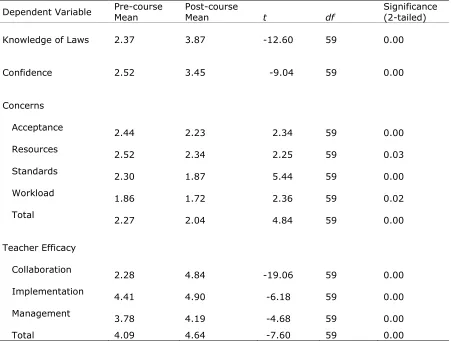
Table 1
Pre- and Post-course scores and significance
Dependent Variable Pre-course Mean Post-course Mean t df Significance (2-tailed)
Knowledge of Laws 2.37 3.87 -12.60 59 0.00
Confidence 2.52 3.45 -9.04 59 0.00
Concerns
Acceptance 2.44 2.23 2.34 59 0.00
Resources
2.52 2.34 2.25 59 0.03
Standards
2.30 1.87 5.44 59 0.00
Workload 1.86 1.72 2.36 59 0.02
Total 2.27 2.04 4.84 59 0.00
Teacher Efficacy
Collaboration 2.28 4.84 -19.06 59 0.00
Implementation 4.41 4.90 -6.18 59 0.00
Management 3.78 4.19 -4.68 59 0.00
Total 4.09 4.64 -7.60 59 0.00
those who had not (M = .18).
Discussion
The findings contribute to the literature on preparing teachers for success in inclusive classrooms in several respects. They validate the potential for university coursework to contribute to increasing teaching efficacy, decreasing concerns, and increasing confidence as they relate to teaching children with special learning needs. Pre-service teachers who took the course in inclusive education, regardless of whether they were in their second or fourth year of the program and regardless of whether they undertook a practicum in an inclusive setting, gained on every scale. They felt more confident as inclusive educators, had better knowledge of the laws related to inclusion, had lower levels of concerns about acceptance, resources, standards, and workload, and they developed greater teacher efficacy in collaboration, behaviour management, and implementing effective teaching practices in inclusive settings. It is remarkable that significant gains were made on every scale and sub-scale. These findings suggest that coursework can make a difference. Furthermore, they validate the 2008 provincial policy that requires all Manitoba pre-service teachers to complete coursework in inclusive education as part of their teacher preparation program.
The general lack of differences between students who experienced an inclusive practicum and those who did not is also noteworthy. Past research by Hemmings and Woodcock (2011) would predict that pre-service teachers’ levels of concern would increase during the practicum. In the current research, levels of concerns decreased for both groups—both those who were enrolled in inclusive practica placements and those who were not. Furthermore, whereas some past research has suggested that practica in inclusive settings would enhance pre-service teachers’ efficacy (Sprague & Pennell, 2000), other research would predict no differential effects when compared to coursework alone (Lancaster & Bain, 2007; Yellin et al., 2003). The current findings illuminate this discrepancy, in that they do not show differential effects of inclusive practicum on efficacy for collaboration with colleagues and parents nor efficacy for implementing inclusive practices, but instead demonstrate differential and positive effects of inclusive practicum experiences on pre-service teachers’ efficacy for managing student behaviour. In fact, the finding of differential effects of practicum on efficacy for managing behaviour was the only significant difference between the two groups, suggesting that practica in inclusive classrooms has a limited additive effect on the development of pre-service teachers’ skills.
strategies and theories, it is not until pre-service teachers are actually in the classroom that they can determine whether the strategies work for them with diverse groups of students. Conderman et al. (2013) suggested that it is practica’s provision of opportunities to try out various methods under the mentorship of a co-operating teacher that solidifies its value to pre-service teachers. It is therefore not unexpected for student teachers who have had positive experiences in inclusive settings would also have greater teacher efficacy in managing student behaviours in those settings.
A key factor in generating higher levels of teacher efficacy for managing behaviours in diverse settings is the quality of those settings. Goodnough (2000) found that teachers who graduated from their teacher preparation program feeling unprepared in the area of classroom management tended to cite poor supervision during their practicum as the cause and were more likely to leave the teaching profession. Cook (2007) showed that pre-service teachers placed more trust in what they learned from their co-operating teachers (CTs) during practicum than what they learned in university-based courses. Given that the lessons taught by CTs are so salient to teachers in training, it is important that CTs who use evidence-based strategies in a consistent manner are selected to mentor pre-service teachers in inclusive settings. Ensuring this type of practicum experience is difficult however, seeing as 43% of current teachers in the study’s central Canadian province have not taken courses in special education and 38% have low or very low confidence in teaching in inclusive settings. These findings are troubling in light of the reality that their average years of experience in the classroom is 15, and that 94% of them have taught or are currently teaching children with special needs (Sokal & Sharma, 2014). Conderman et al. (2013) showed that pre-service teachers are especially interested in gaining experiences with evidence-based strategies while under the mentorship of a CT. However, without ensuring that the strategies used by the CTs are sound and evidence-based, it is impossible to determine whether pre-service teachers will gain this skill set from their practicum experience. To put in succinctly, Spooner, Algozzine, Wood, and Hicks (2010) suggested future research on inclusive teacher preparation should focus on determining “the way that high-quality teachers are trained, what high quality means, and how that is translated to pedagogy” (p. 50). “Researchers must study the impact of field experiences, including selections of field sites and co-operating teachers, on future special educators’ classroom performance” (Prater & Sileo, 2004, p. 252). Given the importance of effective classroom management to teacher success and student success, the finding that practica in inclusive settings can increase teacher efficacy about this aspect of inclusive teaching is sufficient evidence to justify that positive practicum experiences are an essential feature of pre-service teacher development in inclusive education.
Limitations
settings and therefore cannot make claims about their quality.
A second limitation relates to the sample size. Only 25% of the students who were invited to participate completed both the pre- and post-course surveys. While there is no commonly agreed-upon minimum return rate for anonymous survey research (Fowler, 2002), the response rate of the current study calls into question the potential differences between those students who participated in the study and those who did not. It is impossible to state whether those who chose not to participate might have contributed to different findings, or to determine the motivation behind their lack of participation. The findings should be considered in light of these realities.
A third limitation relates to the findings around increased confidence in both samples. Being as the raw data for the analysis of this variable was generated by a single question on the questionnaire, we should use caution in drawing conclusions from this finding alone (Gliem & Gliem, 2003). Even though efficacy and confidence are highly correlated constructs, and efficacy was measured using 20 separate questions, we cannot be as confident about the findings related to confidence as we can those related to efficacy.
Conclusion
While teacher efficacy for classroom management in inclusive settings was the only dependent variable found to be differentially affected by a practicum experience, this finding cannot be dismissed in light of the past research about its relevance. Being as inclusion and classroom management are common concerns of new teachers (Milner & Tenore, 2010), and seeing as pre-service teachers privilege their practicum as an important source of their development (Conderman et al., 2013; Goodnough, 2000), teacher education programs have the opportunity to use these findings to address these needs through carefully designed practica. The current findings suggest that investing time and resources into high-quality practica in inclusive settings would contribute to better prepared inclusive teachers.
Acknowledgments
The authors would like to express their gratitude to the students who participated in this study and to the University of Winnipeg for funding the study.
References
Alexander, R. (2004). Still no pedagogy? Principle, pragmatism, and compliance in primary education.
Cambridge Journal of Education, 34(100), 7-33. doi:10.1080/0305764042000183106
Brownell, M. T., Ross, D. D., Colon, E. P., & McCallum, C. L. (2005). Critical features of special education teacher preparation: A comparison with general teacher education. The Journal of Special Education, 38(4), 242-252. doi:10.1177/00224669050380040601
Chhabra, S., Srivastava, R., & Srivastava, I. (2010). Inclusive education in Botswana: The perceptions of school teachers. Journal of Disability Policy Studies, 20(4), 219-228.
doi:10.1177/1044207309344690
Conderman, G., Morin, J., & Stephens, J. (2005). Special education student-teaching practices.
Preventing School Failure, 49(3), 5-10. doi:10.3200/PSFL.49.3.5-10
Cook, L. (2007). When in Rome…: Influences on special education student-teachers’ teaching.
International Journal of Special Education, 22(3), 119-130. doi:10.1177/088840640202500306 Davis, P., & Florian, L. (2004). Searching the literature on teaching strategies and approaches for pupils
with special education needs: Knowledge production and synthesis. Journal of Research in Special Education Needs, 4(3), 142-147. doi:10.1111/j.1471-3802.2004.00029.x
Edmunds, A. (1998). Classroom teachers are not prepared for the inclusive classroom. Exceptional Education Canada, 8(2), 27-40.
Forlin, C., & Chambers, D. (2011). Teacher preparation for inclusive education: Increasing knowledge but raising concerns. Asia-Pacific Journal of Teacher Education, 39(1).
doi:10.1080/1359866X.2010.540850
Forlin, C., Keen, M., & Barrett, E. (2008). The concerns of mainstream teachers: Coping with inclusivity in an Australian context. International Journal of Disability, Development and Education, 55(3), 251-264. doi:10.1080/10349120802268396
Forlin, C., Loreman, T., Sharma, U., & Earle, C. (2009). Demographic differences in changing pre-service teachers’ attitudes, sentiments and concerns about inclusive education. International Journal of Inclusive Education, 13(2), 195-209. doi:10.1080/13603110701365356
Fowler, F. J. (2002). Survey Research Methods (3rd ed.). Thousand Oaks, CA: Sage Publications.
Gee, G. (2001, April). What graduates in education fear most about their first year of teaching. Paper presented at the annual meeting of the Louisiana Educational Research Association, Baton Rouge, LA.
Gliem, J., & Gliem, M. (2003, October). Calculating, Interpreting, and Reporting Cronbach’s Alpha Reliability Coefficient for Likert-Type Scales. Paper presented at the Midwest Research-to-Practice Conference in Adult, Continuing, and Community Education, The Ohio State University, Columbus, OH.
Goodnough, A. (2000, November 22). Winnowing process begins for novice teachers. New York Times, p. B9.
Harvey, M. W., Yssel, N., Bauserman, A. D., & Merbler, J. B. (2010). Pre-service teacher preparation for inclusion: An exploration of higher education teacher-training institutions. Remedial and Special Education, 31(1), 24-33. doi:10.1177/0741932508324397
Hemmings, B., & Woodcock, S. (2011). Pre-service teachers’ views of inclusive education: A content analysis. Australasian Journal of Special Education, 35(2), 103-116.
Jordan, A., Schwartz, E., & McGhie-Richmond, D. (2009). Preparing teachers for inclusive classrooms.
Teaching and Teacher Education, 25, 535-542. doi:10.1016/j.tate.2009.02.010
Kolb, D. (1984). Experiential learning: Experience as the source of learning and development.
Eaglewood Cliffs, NJ: Prentice Hall.
Kolb, A., & Kolb, D. (2005). Learning styles and learning spaces: Enhancing experiential learning in higher education. Academy of Management Learning and Education, 4, 193-212.
doi:10.5465/AMLE.2005.17268566
Lancaster, J., & Bain, A. (2007). The design of inclusive education courses and self-efficacy of preservice teacher education students. International Journal of Disability, Development, and Education, 54(2), 245-256. doi:10.1080/10349120701330610
LePage, P., Courey, S., Fearn, E., Benson, V., Cook, E., Hartmann, L., & Nielson, S. (2010). Curriculum recommendations for inclusive teacher education. International Journal of Whole Schooling, 6(2), 19-45.
Manitoba Teachers’ Society (2012). Five challenges noted by teachers. The Manitoba Teacher, 90(4), 1. McNaughton, D., Hall., T., & Maccini, P. (2001). Case-based instruction in special education teacher
preparation: Practices and concerns of teacher educator/researchers. Teacher Education and Special Education, 24(2), 84-94. doi:10.1177/088840640102400203
Milner, H. R., & Tenore, F. B. (2010). Classroom management in diverse classrooms. Urban Education, 45(5), 560-603. doi:10.1177/0042085910377290
Prater, M., & Sileo, T. (2004). Fieldwork requirements in special education preparation: A national study.
Teacher Education and Special Education, 27(3), 251-263.
Raudenbuch, S., Rowen, B., & Cheong, Y. (1992). Contextual effects on the self-perceived efficacy of high school teachers. Sociology of Education, 65(2), 150–167. doi:10.2307/2112680
Rice, J. (2003). Teacher quality: Understanding the effectiveness of teacher attributes. Washington, DC: Economic Policy Institute.
Romi, S., & Leyser, Y. (2006). Exploring inclusion preservice training needs: A study of variables associated with attitudes and self-efficacy beliefs. European Journal of Special Needs Education, 21(1), 85–105. doi:10.1080/08856250500491880
Ross, J., Cousins, J., & Gadalla, T. (1996). Within-teacher predictors of teacher efficacy. Teaching and Teacher Education, 12, 385-400.
doi:10.1016/0742-051X(95)00046-M
Salend, S. (2010). Evaluating inclusive teacher education programs. In C. Forlin (Ed.), Teacher education for inclusion: Changing paradigms and innovative approaches (pp. 130-140). London: Routledge. Shade, R., & Stewart, R. (2001). General education and special education pre-service teachers’ attitudes
toward inclusion. Preventing School Failure, 46(1), 37-41.
Sharma, U., & Desai, I. (2002). Measuring concerns about integrated education in India. Asia and Pacific Journal on Disability, 5(1), 2–14. Retrieved from
http://www.dinf.ne.jp/doc/english/asia/resource/z00ap/004/z00ap00401.html
Sharma, U., Forlin, C., & Loreman, T. (2008). Impact of training on pre-service teachers’ attitudes and concerns about inclusive education and sentiments about persons with disabilities. Disability and Society, 13(7), 773-785. doi:10.1080/09687590802469271
Sharma, U., Loreman, T., & Forlin, C. (2012). Measuring teacher efficacy to implement inclusive practices: An international validation. Journal of Research in Special Needs Education, 12(1), 12-21.
doi:10.1080/09687590802469271
Shippen, M., Crites, S., Houchins, D., Ramsey, M., & Simon, M. (2005). Pre-service teachers’ perceptions of including student with disabilities. Teacher Education and Special Education, 28, 14-21.
Sindelar, P., Bishop, A., & Brownell, M. (2006). What is special about special education? Research on the preparation of special education teachers. In B. Cook & B. Schirmer (Eds.). What is special about special education? The role of evidence-based practice (pp. 113-126). Austin, Texas: Pro Ed. Smith, G. (2000). Secondary teachers' perceptions toward inclusion of students with severe disabilities.
NASSP Bulletin, 84, 54-60. doi:10.1177/019263650008461309
Sokal, L. (2012). What are schools looking for in new, inclusive educators? McGill Journal of Education, 47(3), 403-420.
Sokal, L. & Sharma, U. (2014). In-service teachers’ concerns, efficacy, and attitudes about inclusive teaching and its relationship with teacher training. Exceptionality Education International 23(1), 59-71.
Spooner, F., Algozzine, B., Wood, C., & Hicks, S. (2010). What we know and what we need to know about teacher education and special education. Teacher Education and Special Education, 33(1), 44-54. doi:10.1177/0888406409356184
Sprague, M., & Pennell, D. (2000) The power of partners: Preparing preservice teachers for inclusion. The Clearing House, 73(3), 168-170. doi:10.1080/00098650009600940
special education teachers: Implications for retention. Remedial and Special Education, 23(5), 258-67. doi:10.1177/07419325020230050101
Swain, K., Nordness, P., & Leader-Janssen, E. (2013). Changes in pre-service teacher attitudes toward inclusion. Preventing School Failure: Alternative Education for Children and Youth, 56(2), 75-81. Tschannen-Moran, M., & Woolfolk Hoy, A. (2001). Teacher efficacy: Capturing an elusive construct.
Teaching and Teacher Education, 17, 783-805. doi:10.1016/S0742-051X(01)00036-1
United Nations Educational, Scientific, and Cultural Organization (UNESCO). (1994). Salamanca statement and framework for action on special needs education. Retrieved from
http://www.unesco.org/education/pdf/SALAMA_E.PDF
United Nations Educational, Scientific, and Cultural Organization (UNESCO). (2008, November).
Inclusive Education: The Way of the Future. Paper presented at the conference of the International Conference on Education at the International Conference Centre, Geneva.
University of Winnipeg Course Calendar. (2012). Winnipeg, MB: University of Winnipeg. Retrieved from
http://www.uwinnipeg.ca/index/cms-filesystem-action/pdfs/calendar/2012-2013-course-calendar.pdf
Weisel, A., & Dror, O. (2006). School climate, sense of efficacy and Israeli teachers' attitudes toward inclusion of students with special needs. Education, Citizenship and Social Justice, 1, 157-174. doi:10.1177/1746197906064677
Wideen, M., Mayer-Smith, J., & Moon, B. (1998). A critical analysis of the research on learning to teach: Making the case for an ecological perspective on inquiry. Review of Educational Research, 68(2), 130-178. doi:10.3102/00346543068002130
Yellin. P., Yellin, D., Claypool, P., Mokhtari, K., Carr, R., Latiker, T., Risley, L., & Szabo, S. (2003). I’m not sure I can handle the kids, especially the, uh, you know special needs kids. Action in Teacher
Education, 1(25), 14-19.
Laura Sokal is an award-winning professor at the Faculty of Education at the University of Winnipeg. She enjoys learning with and from her students.
Deb Woloshyn is the Director of Student Teaching at the University of Winnipeg.