Page 62 www.ijiras.com | Email: [email protected]
Relationship Between School Feeding Programmes And Pupils’
Effectiveness In Learning In Public Primary Schools In Kitui
County, Kenya
Evelyne Mwendwa
Maasai Mara University, School Of Education, Kenya
Dr. Susan Yego Chepkonga, PhD
University Of Nairobi, Department of Educational Administration and Planning, Kenya
I. INTRODUCTION
To participate effectively in the development of the country, each individual ought to be educated in this current world. No education can smoothly take place without provision of food since food is one of the basic needs for the human beings. School feeding Programme is necessary and
important in the provision of food in schools for learning to take place successfully. Food will sustain good health to the pupils and this result to effective learning of the pupils worldwide. Ineffectiveness in learning by the children from families struck by absolute poverty is affected especially if the family cannot afford to provide food to the children. In the marginalized areas such as Kitui County, provision of food to
Abstract: School Feeding Programme (SFP) was initiated in Kenya in 1979 and was implemented in 1980 by the government of Kenya in collaboration with World Food Programme (WFP). The objective of this study was to assess the relationship between SFPs and the pupils’ effectiveness in learning in public primary schools in Kitui County. The study assessed enrolment as a factor that indicates effectiveness in learning. The study used Classical Liberal Theory of Equal Opportunity and Maslow’s Theory of Human Motivation and it used Survey Research Design. The target population was 374 primary schools under Feeding Programme in Kitui County. The sample size was 112 schools which was 30% of the target population. These schools were sampled randomly. The researcher also randomly sampled five percent (19) class seven teachers of the target population making a total of 131 respondents. The research instruments used were the questionnaires for head teachers and interviews for class seven teachers’ representatives. To test validity of the research instruments, a piloting study was carried in two schools (10%) of the sample target of 19 class seven teachers. The researcher also discussed the instruments with her supervisors and was advised accordingly. Reliability of the research instruments was calculated using test-retest method. Quantitatively collected data was analyzed using descriptive statistics and Pearson r coefficient with the help of SPSS software while qualitatively collected data was analyzed using Focus by Question Analyses Strategy. Analyzed results were presented using tables, graphs and pie-charts. Results show that there was a significant relationship between school feeding program and pupils’ enrolment. Findings from the interviews further confirmed that there was unwavering agreement among class seven teachers’ representatives that school feeding program was positively associated with effectiveness in learning. The study concludes that school feeding program has significant influence on effectiveness in learning among primary school pupils, hence the hypothesis was therefore rejected and the hypothesis was accepted. The study recommends that the Kitui County government ought to liaise with parents and guardians of primary school pupils and join hands to expand the School Feeding Program. They should also include breakfast and supper in their Feeding Programme. In doing this, more pupils will be enrolled and be retained in schools. These findings will be beneficial to the Ministry of Education and school managers while planning on matters pertaining feeding of pupils in primary schools.
Page 63 www.ijiras.com | Email: [email protected] pupils is very important because it will enhance pupils‟
enrolment and reduce absenteeism once the children are in school, the Programme can contribute to their learning through avoiding hunger and enhancing cognitive abilities. In such areas such like Kitui, rainfall is scares and it results to farmers harvesting little food or none in some years.
School Feeding Programme (SFP) can be used to address temporary hunger to make a significant contribution in the improvement of effectiveness in learning. Kenya is a signatory to many international agreements that have among other things recommended the attainment of Universal Primary Education (UPE). School feeding programme is aimed at achieving this course in Kenya. When pupils feed in schools, wastage in education is minimized. Nwankwo (1981) defined educational wastage as an inefficient use of educational resources. He added that wastage involves, dropouts, repeaters, pre-mature withdrawal, misguided types of education, un-employment of school leavers and even brain drain. Adesina (1983) described education wastage, from the perspective of the education planners as, when an investment does not produce either it‟s desired or anticipated results or produces these results at a scale considerably lower than it was set for itself. All the above mentioned issues can be fully controlled if feeding programmes are fully introduced in schools, supported and implemented in totality in the whole country. Learners will be confined in schools and learn as per the individuals‟ rate of understanding. There will be no disturbance of movement here and then.
II. BACKGROUND OF THE STUDY
Investing in education is a key component which leads to the development of a country. Education is a fundamental right for a person for effective contribution to the development of a country since it enhances equity, diversity and lasting peace as stipulated by World Education Forum Education for all in 2000.Successful effectiveness in learning can be sustained through provision of food which can be done through implementation of feeding programmes in schools. According to Jacoby (2002), school meals should be available in schools throughout the term in order to retain children in school. Any delay of the school meals delivery to schools would lead to absenteeism as it was experienced in northern Namibia whereby more than half of the child stayed away from schools for two weeks until the food was delivered (WFP, 2006). According to the Newspaper (The Star January, 19,2017) by Lydia Ngoolo , the former Kitui Senator David Musila with the former Mwingi North MP John Munuve commended that, Kitui County should Restart feeding plans in all the primary schools in the county so as to keep kids in schools. The two leaders in Kitui County urged the government to re-introduce the SFP in the whole county so as to keep children in school. They said that the prolonged drought had caused some pupils to drop out of school in search of food and water in various counties hard –hit by the dry spell. They said that the area did not receive enough rain, resulting into a poor harvest. They also pointed out that starvation was looming and students were to remain in school if there will be food in schools. Also, Musila said. “The
government should provide food to residents too, since they have nothing in their stores. “We are not sure if the next rain will be sufficient, so the state should plan fully, “he said”.
In Kenya, school feeding program have been implemented since 1980s with varying degrees of success. They were originally focused in promoting enrollment and retention of pupils in schools especially in rural areas, with involvement of multiple sponsors, leading to fluctuations on the success of projects. However, the first homegrown school feeding program was introduce in 2009, but the questionable government commitment has led to mixed achievements (Langernger, 2011).
Currently, millions of primary school children from poor areas that have previously benefited from the WFP food for primary schools initiative are at risk of losing this advantage. This is due to the strained relationship between WFP and the government through the ministry of education, who believe that Kenya is independently adequate to feed its population. According to the ministry, WFP supports about 1.1 million learners in the school feeding program while GoK supports only 500 000 learners (Ondieki, 2018).
The Kenyan Home Grown School Meals Program (HGSM) is designed as a safety net strategy to increase food supply, improve incomes and reduce hunger and malnutrition. The program, adopted from the externally sponsored program was aimed at making school feeding a national program rather than a select for a few schools. Currently, the program targets 2115 schools with a beneficiary level of 760 895 pre-school and primary school children in nationally selected schools in 60 arid and semi-arid sub counties. The program is designed in such a way in links with agricultural development agencies to aid in purchase and delivery of food from the local community.
III. STATEMENT OF THE PROBLEM
Food has been acknowledged as one of the tools that help in the effectiveness in learning of primary school pupils. Education is one of the economic developmental factors in the world; therefore effective strategies for providing education to pupils should be well formulated especially in primary schools since they lay the learning foundation worldwide. Effectiveness in learning in Kitui County was not achieved positively as evidenced by the 2016 KCPE results; Kitui County was ranked position 37 out of the 47 counties in the nation. The enrolment rate was very high but the completion rate was very low (EMIS 2005).The county has low retention rates and attendance rates.
Page 64 www.ijiras.com | Email: [email protected] county‟s poor performance in the national examinations. In the
beginning of the academic years, the enrolment is high but and the end of the completion of the courses the enrolment reduces. Drop-outs increases as the year matures. Absenteeism increases and attendance in classes reduces in various schools.
IV. PURPOSE OF THE STUDY AND RESEARCH HYPOTHESIS
This study was set to assess the relationship between school feeding programmes (SFP) and the pupils‟ effectiveness in learning by examining the pupil‟ enrolment in Kitui County. This study was guided by the below objective:
To investigate the importance of school feeding programme on pupils‟ enrolment in public primary schools in Kitui County. The study used the Hypothesis, “There is no significant relationship between school feeding progranmme and the pupils‟ retention rates in public primary schools in Kitui County.
V. SIGNIFICANCE OF THE STUDY
The findings of this study were intended to help the educational policy makers to make relevant policies pertaining SFPs. The findings of this study could also be used by the WFP to improve on their effectiveness and efficiency when laying their strategies. The findings may also assist the school administrators in their administration especially when planning about issues concerning feeding. The findings of this study could become a base for further researches related to this study. This study was aimed at identifying educational benefits of effective learning such as enrollment, retention and attendance of school by children through establishment of school feeding programs.
Teachers and pupils will also greatly benefit from this study. The study will enhance their perception and understanding of factors promoting effective learning. It may also help to determine strategies teachers use in teaching. Therefore, this study will help them to prioritize their teaching strategies. Pupils will also directly benefit from this study. This is because other stakeholders will be inspired to promote school feeding programs, hence increasing educational outcomes of the learners. Finally, this study closes a gap in the field of school feeding program, hence enriching the field, further, its recommendations and gaps offer further research opportunities for other researchers, which is necessary for the educational administration. The findings of this study are therefore beneficial to headmasters and the board of management of these schools.
VI. JUSTIFICATION OF THE STUDY
This study seems to be valid because there are problems and challenges concerning pupils‟ enrolment in Kitui County. When pupils enroll, they drop from school before completing their courses and pupils‟ enrolment rates seem not According
to World Food Programme 2008; SFP is an incentive for vulnerable families to retain children in school. This makes this study significant, relevant and timely. Therefore, this study intended to assess the relationship between school feeding programme and pupils‟ effectiveness in learning. Effectiveness in learning in Kitui County is decelerating, completion of the primary school course is negatively affected therefore the researcher chose to carry out the study in Kitui County to assess the relationship between the SFP and effectiveness in learning. Quality education is considered the key to economic development of any country.
VII. LIMITATION AND THE DELIMITATION OF THE STUDY
The results of the sample taken in this study may not be generalized to cover other counties in the republic since the study did not include all the schools for instance, the private schools and the schools not under Feeding Programme. The researcher recommended another study to be done covering all the primary schools in the county. The study involved different categories of respondents, head teachers were requested to give the required information through answering the set questions and availing the required documents. The class seven teachers‟ representatives did not attend the interviews fully. The researcher encouraged the respondents through creating rapport and simplifying the research instruments.
The study involved 374 schools under the feeding programmes in Kitui County in particular primary schools and it relied on responses from the sampled respondents. The researcher did not focus on any other factor that was related to effectiveness in learning other than the relationship between the SFP and the pupils‟ enrolment in public primary schools in Kitui County. The period for the study was between February and June 2019
VIII. LITERATURE REVIEW
Literature was reviewed in relation to school feeding programmes and its effects on enrolment of pupils in various parts of the world and the importance of school feeding programme was also discussed.World Bank defines school feeding programs as targeted social safety nets aimed at providing both educational and health benefits go the most vulnerable children in order to increase enrollment rates in school, reduce absenteeism, and improve food security at the household level. The biggest stakeholder of school feeding program is WFP, providing meals, snacks or take-home food to about 18.3 million school children in over 60 countries across the world (WFP, 2017).
Page 65 www.ijiras.com | Email: [email protected] program offers cooked food to school children but it does not
involve private school children. Its main purpose is to provide quality lunch to learners, hence improving the quality of their nutrients uptake (NSLP, 2018). Children who have low cognitive development are likely to repeat classes or to drop-out of school. Pupils who are hungry have more difficulty concentration and performance problems. School feeding programmers can alleviate short-term hunger for the school children. According to (K.I.E.2006), the child‟s survival, growth, development and happiness depends on the child‟s feeding patterns.
In Africa, the harsh economic and geographical conditions inhibit a number of children from enrolling in school. In Chimutu, Malawi, Yasin (2013) conducted a study to assess the state of the school feeding program in terms of the benefits, opportunities, and challenges. Data was collected from 46 respondents of whom 14 were key informants from government and NGO implementers and 32 community members who were benefiting from the intervention in the area of Traditional Authority Chimutu in Lilongwe District, Malawi. The program was not fully meeting its objectives as explained in the study, some positive observations indicated that since implementation of the program, there had been a tremendous increase of school enrolment rates. Further, with annual expansion of the program, there had been a similar increase in enrollment rate.
IX. CLASSICAL LIBERAL THEORY OF EQUAL OPPORTUNITY
The theory expresses that there should be equal opportunities of similar treatment of people in every area including education as evidenced by education for all in Kenya. (John Dewey in 1946). The basic assumption of this theory is that every child is born with innate talents and capabilities therefore; education systems should be designed with a view of a pupil taking advantage of the inborn talents that could accelerate social promotion (Sherman & Wood 1982).
This theory demands that opportunities including education to be availed to individuals at schools and barriers for instance hunger to be curbed through provision of food through school feeding programmes. This would enable the learners to be more effective in learning and this would enhance pupils‟ enrollment, attendance, transition from a class to another and retention. This Theory suits this study because the independent variable (SFPs) will have effect on dependent variable (Effectiveness in Learning). When food is provided to schools it will enable pupils from different family backgrounds to access education equally and at ease.
Free primary education and education for all may be achieved through the provision of food to the pupils at schools. The theory assumes that positive impact will be posted through high retention rates, high enrolment pupil attendance and increased transition of learners from a class to another. Other factors that can enhance successful effectiveness in learning are, the parents‟ support for the Programme, quality teaching which is enhanced by learning
resources, qualified teaching staff and the teachers attitude towards the Programme.
X. ABRAHAM MASLOW‟S THEORY OF HUMAN MOTIVATION
Another theory that has been used in this study is Abraham Maslow‟s theory of human motivation which was developed in 1943. The theory explains that at while human beings aim to meet their basic needs, they equally aim to meet successfully higher needs in the form of a pyramid as established by Maslow. Maslow‟s Hierarchy of needs have often been presented in a hierarchical pyramid with five levels with the largest and most fundamental at the bottom and the need for self-actualization at the top. At the base of the hierarchy are the physiological needs, followed by safety needs, love/belonging, esteem, and self-actualization, which is the topmost need at the top of the pyramid (Jerome, 2013).
According to Huit (2006), physiological needs refer to the needs of human beings in order to satisfy physiological processes such as hunger, bodily comfort, or thirst. It is the lowest yet the most basic type of need since it is about survival. On the other hand, safety needs refers to the need for one`s security. Therefore, it entails keeping an individual out of danger. Need for belonging entails the desire of an individual to feel loved through association with others or being accepted by others in group or the mainstream society. The need for esteem refers to the desire of an individual to feel competitive through achievements in places of work or recognition and approval by peers or superiors. Finally, self-actualization refers to the ability of an individual to realize one`s full potential. It is associated with absolute success as defined by all aspects of the society. Therefore, as explained by Maslow, provision of food leads to satisfaction of hunger, which is a physiological need that ought to be satisfied before others are satisfied.
XI. CONCEPTUAL FRAMEWORK
Page 66 www.ijiras.com | Email: [email protected] XII. RESEARCH METHODOLOGY
The study adopted survey research design. The use of surveys refers to an approach of collecting information through asking questions. It uses approaches such as focus group discussions, interviews, and questionnaires to ensure that questions are answered. Further, since it is difficult to ask questions to every individual in the population under study, a survey research design allows selection of a representative sample of participants that will be involved in the study, and the findings of the study are applied to the larger population. Therefore, in a study such as this covering all primary schools in Kitui County, a survey research design is the most appropriate. To conduct a survey research design, the first step involves identification of the study population. This is followed by sampling the study population to identify a representative sample that will take part in the study. After identification of the study sample, a data collection tool is identified and designed to suit the identified respondent characteristics. Data collection is then scheduled and performed, while data is analyzed through appropriate techniques.
The researcher personally administered the questionnaires to the head teachers and left them to work at their own phase however the researcher was there for any clarification. The researcher also interviewed the class seven teachers and recorded down the responses given by the teachers. These responses were later used by the researcher for analyzing the qualitative data. This created high response rates as well as good return rate. The researcher compared responses from the head teachers and the ones from the class seven teachers; The researcher then got similarities and differences that helped the researcher to get the relationship between school feeding programme and the pupils‟ effectiveness in learning Survey research design is less time consuming and it is not expensive as compared to other designs. The design is also convenient for data collection. A researcher can use various ways to administer the surveys. For instant, questionnaires can simply be send through e-mail, fax or can be administered through the internet. Survey research design can also analyze multiple variables effectively. The design has minimal biases and finally it provides precise results.
XIII. TARGET POPULATION
The target population for this study was 374 schools and these are the only schools under feeding Programme. The study targeted the head teachers and the class seven teachers of these schools. In Kenya, the school feeding programs have been implemented in primary schools for a long period of time. Therefore, they have evolved over the years through various challenges and their achievements can easily be observed when studied. This is unlike secondary schools, where school feeding are either partially implemented or not implemented at all. Sampling Techniques and Sample SizeThe researcher used simple random sampling to sample the schools. According to the rule of thumb as stated by John Curry professor for Educational research, 30% is convenient for sampling a big population like the 374 schools to be
studied. This translated to 112 schools out of which the researcher used the112 head teachers of these schools. The researcher wrote the names of the 374 schools in separate pieces of papers, put them in a container and mixed them thoroughly. The researcher randomly picked 112 pieces which is 30% of the target population.
The head teachers of these schools formed the sample size to attempt the questionnaires to get the quantitative data. The researcher sampled 5% of the class seven teachers that translated to 19 class teachers. The researcher gave numbers to all schools among the 374 schools which had class seven and randomly picked 19 schools. The class seven teachers from these schools formed the other part of the sample size to be interviewed to get the qualitative data. This totaled to 131 respondents. According to Gall, Gall & Borg (2003), a smaller percentage for the qualitative study is allowed provided the respondents are the key informants. As in this study, the head teachers and the teachers are the key informants.
Table 1: Sample for the study
XIV. RESEARCH INSTRUMENTS
The researcher used questionnaires because they can yield quantitative data and the interview guide because they can yield qualitative data. To collect the quantitative data, the researcher personally distributed the questionnaires to the 112 head teachers. From their responses, the researcher collected quantitative data. The researcher conducted face-face interviews to the 19 class seven teachers; from their responses the researcher got the qualitative data that was required for the study.
XV. PRE-TESTING AND PILOTING OF THE RESEARCH INSTRUMENTS
The researcher first discussed the research instruments with her supervisors and was advised accordingly pertaining the accuracy and dependability of the instruments. The researcher also discussed the research instruments with some of her course mates to ascertain the accuracy of the research instruments. This prepared the researcher for the next step of piloting the research instruments. According to Gay (1992), selecting an appropriate instrument developed by experts with necessary skills saves time and money for a researcher who is a beginner. Orodho (2005) also notes that one can select and adopt a method, instrument or even replicate the entire study already used by another researcher. Therefore, a pilot is necessary to inform the researcher on what to expect during the study especially concerning the tools and instruments to be used, hence preparing for the study adequately.
According to Connelly (2008), it is suggested that a pilot study sample should be 10% of the target population. In this Target Population Sampling% Sample Head
teachers Class seven
teachers
374 374
30 5
112 19
Page 67 www.ijiras.com | Email: [email protected] case, the researcher used 2 schools for piloting which is 10%
of 19 schools. Schools for piloting were selected randomly from the list of the 264 schools. The researcher personally administered the research instruments to this small group of the respondents. This enabled the researcher to make sure that everyone sampled not only understands the questions and the interviews but understands them in the same way. It also helped the researcher to understand if the respondents were feeling comfortable with the instruments. The researcher was able to know how long the research would take to be completed.
XVI. VALIDITY OF THE RESEARCH INSTRUMENTS According to Mugenda and Mugenda (1999), validity refers to the degree to which the empirical measure or several measures of the concept accurately measures the concept. For purposes of the study, the adapted instruments are piloted to subjects in the exact same way they would be used in the real study. The respondents are then asked some ambiguous and difficult questions. The respondents then provide a range of responses to the questions. Irrelevancies and ambiguities are then identified. The overall information obtained from this pilot study is used to modify the instruments in order to improve the degree to which they accurately measure concepts during the real study. Hence, through this approach, a pilot study successfully increases validity of study instruments.
XVI. RELIABILITY OF THE RESEARCH INSTRUMENTS
Reliability is the level of internal consistency or stability over time. It means the degree of accuracy that the measuring instruments provide. It is essentially a measure of degree to which research instruments yield constant results of data after repeated trials, Mugenda & Mugenda (2003). Reliability of instruments is therefore, consistency in producing the same results, over a number of repeated trials (Orodho, 2004). There are a number of methods used for testing whether study instruments are reliable.
XVII. DATA COLLECTION PROCEDURE An introduction letter was obtained from the School of Education (SOE), Maasai Mara University for approval to proceed to NACOSTI. The researcher proceeded to National Committee for Science Technology and Innovation (NACOSTI) to get research authorization permit. The researcher then proceeded to the Education County Director and the County Commissioner Kitui County to seek permission to collect data from the selected public primary schools. Respondents were explained about the study and were requested to sign the consent form. The researcher had enough questionnaires for all the head teachers and an interview question form for the class seven teachers‟representatives. During the administering of the questionnaires, respondents were requested to fill the questionnaires. The researcher
administered the questionnaires to the head teachers personally and collected them the same day, ensured that they were fully filled. The researcher also conducted interviews to the class seven teachers‟ representatives and assured the participants of confidentiality. This determined high response and return rate.
XVIII. DATA ANALYSIS
The first data to be analyzed was the quantitative data from the head teachers‟ opinions assessing the relationship between school feeding programme and the learners‟ effectiveness in learning which was presented using tables. The information in these tables showed the head teachers‟ views pertaining the relationship between school feeding programme and the learners‟ effectiveness in learning. Qualitative data was also presented by analyzing the answers given by various teachers pertaining various interview questions, comparison was made and a certain conclusion was arrived at. Pearson r Product Moment Correlation was used to analyze quantitatively collected data from the head teachers. In this study, the main objective is to investigate whether there is a relationship between school feeding program and the effectiveness of learning in public primary schools in Kitui County. Therefore, the two main variables involved are the school feeding programs and the effectiveness of learning among primary school pupils. The correlation method was therefore used to identify existence of a linear correlation between the two variables with the help of Statistical Package for Social Sciences (SPSS). The coded data was calculated to determine the relationship between schools feeding programme enrolment. Qualitative data was recorded after interviewing the class seven teachers and it was analyzed by comparing responses got from different interviewers. With this method, the researcher had all the answers given by each respondent for each question then comparison was done to get out similarities and differences. Percentages based on the19 respondents were sought to help in the analysis.
XIX. ETHICAL CONSIDERATIONS
Page 68 www.ijiras.com | Email: [email protected] names or contacts for the respondents was not necessary,
hence this was essential in maintaining anonymity. Further, privacy was observed especially during interviews, where respondents felt more comfortable responding to interview questions in privacy. Finally, the respondents were promised that the information provided during interviews would not be disclosed regardless of its impact. The findings of the study were presented in a generalized manner. As pertains confidentiality, the respondents were requested to omit their names while filling the questionnaires. No reference was used for individual schools or any respondent participating in the study. On the other hand, other ethical issues that had to be adhered to include the researcher‟s acknowledgment of sources used to prevent plagiarism and para- plagiarism and referencing of the resources used in the study.
XX. FINDINGS, RESULTS AND DISCUSSIONS It presents the results of the study whose aim was to establish the relationship between school feeding programme and the pupils‟ enrolment as a factor of learning effectiveness in public primary schools in Kitui County. A total of 112 questionnaires were administered to head teachers of the sampled 112 schools which were randomly selected. A total of 108 questionnaires which is 96.43% of the 112 questionnaires presented to the head teachers were returned and the response rate was considered adequate. Not all the 19 class seven teachers representatives sampled were interviewed. Only 15(78.95 %) class seven teachers‟ representatives were interviewed due to postponement of the interview schedule by the class teachers. Data collected using questionnaires was analyzed using descriptive analyzes and Pearson r correlation. Data from interviews was analyzed using Focus by Question Strategy. Verbatims from the interviewees were also put in to consideration which was an added advantage to know the class seven teachers‟ representative views and attitudes towards the relationship between school feeding Programme and the pupils‟ enrolment in public primary schools in Kitui County.
XXI. RESPONSE RATE
The researcher expected a total of 131 respondents comprising of 112 head teachers and 19 class seven teachers‟ representatives. However, due to various challenges encountered during the process of data collection, the researcher was not able to get maximum response. Only 108 (96.43%) of the head teachers were able to fill and return their questionnaires as required and 15(78.95 %) of the class seven teachers‟ representatives were able to be interviewed. Some of the challenges that led less than expected response included, return of blank questionnaires and constant postponement of interview schedule by some of the teachers‟ representatives. Nevertheless, there was adequate response to warrant reliable results. The respond rate indicates 108(96.43% of the head teachers were able to fill their questionnaires successfully and the class seven teachers‟ representatives 15(78.95%) were able to be interviewed accordingly.
Figure 1
RESPONSE RATE
The above figure shows that 108(96.43%) of the targeted head teachers successfully filled and returned their questionnaires while only 4 (3.57%) either did not complete or failed to return the questionnaire at all. On the other hand, 15 (78.95%) of the class seven teachers‟ representatives fully participated in the interview and 4 (21.05 %) did not participate in the interviews. When a respondent fills all the options, the researcher is unlikely to establish the actual response that was intended to be given. In this case, the researcher dropped the research instrument and it was termed as a non-response. Creswell (2014) asserts that a response rate of 70% and above is adequate to validate the findings of a study. As pertains the case of this study, both the response rates were above 70% and they were adequate to allow the researcher to proceed with the analysis.
XXII. DEMOGRAPHIC AND GENERAL INFORMATION OF THE RESPONDENTS Some of the demographic information considered in this study includes: gender, level of education, period respondents had served as well as the type of school they were representing. This information was considered relevant since the kind of responses provided could vary depending on these variables. Moreover, some demographic data can greatly affect the nature of response given and help the researcher to understand the differences in perceptions in relation to socio-demographic characteristics of respondents.
GENDER-- INFORMATION ON GENDER OF
RESPONDENTS IS INDICATED BELOW
Page 69 www.ijiras.com | Email: [email protected]
Figure 2
The results of the above figure shows that 74(68.52%) of the head teachers were male while 34(31.48%) were female. On the other hand 8(54.8%) of the class seven teachers‟ representatives were male while 7(45.2%) were female. The findings imply that most of the persons in leadership and class teachers were male, an indication of existing gender disparities in leadership of public primary schools in Kitui County. LEVEL OF EDUCATION
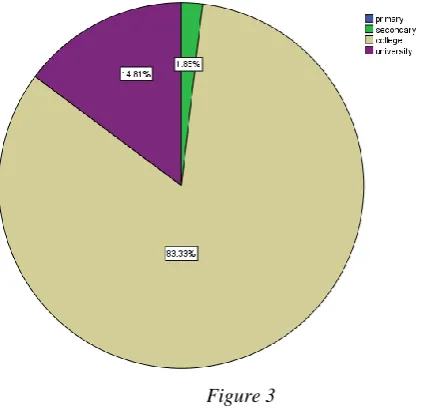
Head teachers were further asked to indicate their levels of education for the researcher to gather the information if the teachers in Kitui County were academically competed to deliver quality education to the pupils. The figure below indicates the information clearly.
Figure 3
HEAD TEACHERS’ LEVEL OF EDUCATION
The above results show that majority of the head teachers had a college level of education 90 (83.33%) while 16 (14.81%) of them had a university education level. Interestingly, there were 2 (1.85%) of the head teachers who had attained only secondary level of education, raising questions on how they ascended to the helm of leadership at a primary school level. Nevertheless, most of the head teachers had adequate education qualifications to lead public primary schools and were expected to manage and scrutinize the role of School Feeding Program in their schools in relation to
enrolment. It is also important to note that the status of leadership in these primary schools was not in congruent with the Ministry of Education requirement in Kenya; the ministry requires that all school head teachers in primary schools must have acquired a masters‟ degree. However, in the case of Kitui County, very few head teachers had met this requirement by the time this study was conducted, an implication that most of the Ministry of Education guidelines were breached in these primary schools. It also points to poor implementation of policies since appointment of head teachers is done at the Jogoo House.
PERIOD OF SERVICE
Head teachers were asked to indicate the period they had headed their respective schools while teachers‟ representatives were asked to indicate the period they had been representatives as class seven teachers in the respective schools. This information was necessary to know if the respondents had enough information of the schools they were leaders and more so if they could give information of the relationship of the school feeding programmes and enrolment in the public primary schools in Kitui County. Majority of the head teachers and the class seven teachers‟ representatives had served in their schools in a period between 2-4 years an indication that they were knowledgeable enough to give information about their schools in relating to school feeding programme and enrolment.
Period Head teachers Teachers‟ representatives Frequency Percentage Frequency Percentage
0 to 1 year 20 18.5 3 20.0
2-4 years 56 51.9 7 46.7
5-10 years 32 29.6 5 33.3
Total 108 100.0 15 100
Table 2: Respondents’ Period of Service in public primary schools in Kitui County
The results above show that most of the head teachers 56(51.9%) and teachers‟ representatives 7(46.7%) had served in their respective schools for 2 to 4 years. Another 32(29.6% of the head teachers and 5(33.3%) of the teachers‟ representatives had served in their schools for 5 to 10 years. Basically, the findings imply that both head teachers and teachers‟ representative who participated in this study had adequate experience relevant to the study. Much of the information sought required respondents with adequate experience with School Feeding Programs and enrolment and the respondents demonstrated to have the right experience.
TYPE OF THE SCHOOL
Page 70 www.ijiras.com | Email: [email protected]
Figure 4
HEAD TEACHERS’ TYPE OF SCHOOLS
The above results show that majority of the head teachers 106(94.44%) were from day primary schools while only 6(5.56% were from boarding primary schools. The implication is that most of the public primary schools in Kitui County were day schools, which also means that learning in such schools could greatly be affected by lack of proper feeding regimens. The findings further show that provision of school feeding program might have been the main factor considered when adopting boarding or day school mode of education. The researcher intended to establish the extent to which school feeding program was being implemented among public primary schools in Kitui County. Head teachers were asked to indicate the extent to which they agreed or disagreed on whether school meals were provided on regular daily basis. The findings were as shown below.
Frequency Percentage
strongly agree 11 10.2
agree 35 32.4
disagree 36 33.3
strongly disagree 26 24.1
Total 108 100.0
Table 3: School Meals are Provided Regularly on daily basis in public primary schools in Kitui County
The results above, show that majority 36(33.3%) of the head teachers disagreed that meals were provided regularly in their respective schools. On the other hand 35(32.4%) agreed that provision of meals was regular. Basically, more than half of the respondents admitted that school feeding program was not consistent in their respective schools. The findings therefore imply that most public primary school in Kitui County were struggling to implement significant aspects of school meals. The findings are consistent with the findings by World Bank (1999) report that found that school feeding program in Kenya was not consistent in many primary schools, even in the schools within arid and semi-arid areas.
XXIII. RELATIONSHIP BETWEEN SCHOOL FEEDING PROGRAM AND THE PUPIL‟ ENROLMENT IN PUBLIC PRIMARY SCHOOLS IN KITUI COUNTY This study sought to establish the relationship between School Feeding Program and pupils‟ enrolment in public primary schools in Kitui County. The study tested the hypothesis that „There is no significant relationship between school feeding program and pupils‟ enrolment in public primary schools in Kitui County”. While testing this hypothesis, the researcher used 95% confidence level. Both head teachers and class seven teachers‟ representatives participated in answering questions related to this area. The head teachers participated in answering the questionnaires, class seven teachers‟ representatives participated in answering interview questions asked by the researcher.
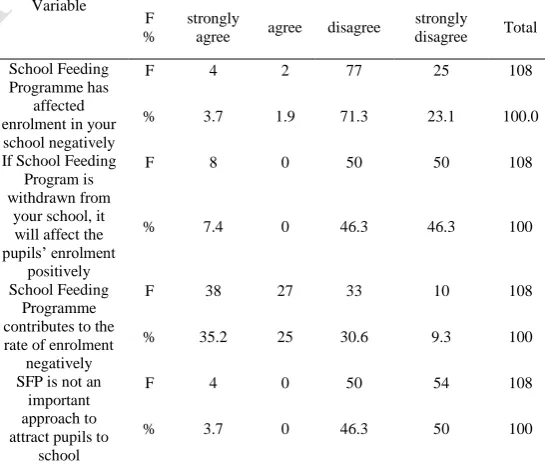
As well, opinions of head teachers become the most important when evaluating the issues about pupils‟ enrolment in relation to school feeding program. Head teachers were provided with a set of statements and they were asked to indicate the extent to which they agreed or disagreed with them. A scale of 1 to 4 was used to gauge the responses from strongly agree to strongly disagree so as to come up with the true picture of if there was any relationship between school feeding programme and the pupils‟ enrolment in public primary schools in Kitui County. Respondent‟s responses were based on their frequencies and they were calculated in percentages in order to get the real picture. They were not allowed to choose more than one answer in every statement. The relationship was also tested using the Pearson correlation coefficient (r).
Variable
F %
strongly
agree agree disagree
strongly
disagree Total
School Feeding Programme has
affected enrolment in your school negatively
F 4 2 77 25 108
% 3.7 1.9 71.3 23.1 100.0
If School Feeding Program is withdrawn from
your school, it will affect the pupils‟ enrolment
positively
F 8 0 50 50 108
% 7.4 0 46.3 46.3 100
School Feeding Programme contributes to the rate of enrolment
negatively
F 38 27 33 10 108
% 35.2 25 30.6 9.3 100
SFP is not an important approach to attract pupils to
school
F 4 0 50 54 108
% 3.7 0 46.3 50 100
Table 4: Head Teachers’ Opinions on School Feeding Program and Pupils’ Enrolment in Public Primary Schools in
Kitui County. The results are shown in table 9 after the descriptive calculations were done
Page 71 www.ijiras.com | Email: [email protected] It can further be explained that the opinions of the head
teachers in regard to school feeding program and enrolment in primary schools were positive, hence they would welcome the invention of school feeding program as a strategy to improve enrolment in primary schools. In fact, some of the head teachers have very strong conviction that if the problem surrounding school feeding program is solved, then all the learners would attend school within the right age group. However, due to inconsistent provision of the food, it was observed that some learners were not able to join school at all while others were joining late.
Pearson Relationship between School Feeding Program and Pupils’ Enrolment in Public Primary Schools in Kitui County. Pearson calculations were done and the results were as shown beiow.
School feeding program
Enrolment
School feeding program
Pearson Correlation 1 .86
Sig. (2-tailed) .000
N 108 108
Enrolment
Pearson Correlation .86 1 Sig. (2-tailed) .000
N 108 108
Correlation is significant at P< 0.05 (2-tailed), df = 106:r = .86
Table 5
The hypothesis read “There is no significant relationship between SFP and the pupils‟ enrolment in public primary schools in Kitui County. This hypothesis was used to investigate on the importance of the SFP on the pupils‟ enrolment in public primary schools in Kitui County. The researcher used Pearson Correlation Coefficient (r) to test the relationship between School Feeding programme and the pupils‟ enrolment in public primary schools in Kitui County. The researcher also used 95% confidence level. After the computation, it was found that the P- Value.000 was less than the Alpha Value 0.05 and the calculated r of.86. r (106) =.86, P<0.05. Therefore, the Null hypothesis that “there is no significant relationship between SFP and the pupils‟ enrolment in public primary schools in Kitui County” was rejected. This means SFP have great importance on pupils‟ enrolment in public primary schools in Kitui County. The results show that School feeding Program had strong relationship with enrolment hence, improvement in provision of school meals would tremendously improve enrolment.Similar sentiments were also expressed by class seven teachers‟ representatives.
XXIV. CONCLUSION
On whether school feeding program had a significant relationship with pupils‟ enrolment in public primary schools in Kitui County, this study concludes that enrolment improved exponentially under courtesy of school feeding program when it was introduced in the region. The study finds a significant relationship; hence the hypothesis that „There is no significant relationship between school feeding program and pupils‟ enrolment in public primary schools in kitui county „ is hereby rejected.
XXV. RECOMMENDATIONS
The study recommends that, the county government should liaise with parents and guardians of primary school pupils in order to expand the school feeding program to include breakfast and supper so that more learners can be enrolled in schools.
The researcher further recommends that the head teachers and teachers to take advantage of school feeding program to ensure that more learners complete their studies within their respective cohorts.
The study recommends that teachers and the school management to ensure learners attend school as expected, by ensuring all the pupils benefit maximally from the provision of food in school.
The study further recommends that the National Government should further improvise more strategies that will ensure more learners are enrolled in schools,
The researcher recommends that the County Government to ensure that all the schools in Kitui County have school feeding programmes and support them totally.
XXVI. SUGGESTIONS FOR FURTHER STUDIES
The researcher suggests further studies to be conducted on methods used to implement the school feeding program, in order to ensure that the intended purpose is fulfilled.
The researcher further recommends further studies to be done on school feeding program disparities existing between boarding and day primary schools.
REFERENCES
[1] Adam J Kamuzora, F. Resarch methods for business and social studies, Morogoro; Mozambique book project (2008).
[2] Adekunle, T. & Ogibogu, C. (2016).
[3] The Effects of School Feeding Programme on Enrolment and Performance of Public Elementary School Pupils in Osun State, Nigeria. World Journal of Education, 6(3). doi: 10.5430/wje.v6n3p39
[4] Ademokun, O. Osungbade, K. & Obembe, T. (2014). A Qualitative Study on Status of Implementation of School Health Programme in South Western Nigeria: Implications for Healthy Living of School Age Children in Developing Countries. American Journal of Educational Research, 2(11). doi: :10.12691/education-2-11-12
[5] Ahmed, A. U. Targeted Distribution. In out of the shadow of famine: Evolving food markets and food policy in Bangladesh, ed. R. Ahmed, S. Haggblade, & T. E. Chowdhury, 213-231. Baltimore, Johns Hopkins University Press (2000).
Page 72 www.ijiras.com | Email: [email protected] [7] Ahmed, A.U. (2004). Impact of feeding children in
school; Evidence from Bangladesh, Washington, DC: International food policy research Institute (IFPR). [8] Aila, B. (2012). The Impact And Challenges of School
Feeding Programme In Enhancing Access to Primary Education In The Unplanned Settlements of Kibera in Nairobi [Ebook]. Retrieved from http://ir-library.ku.ac.ke/bitstream/handle/123456789/5491/Ouko %20Boniface%20Aila.pdf?sequence=3
[9] Atta, G. & Manu, D. (2015). Ghana School Feeding Program: A Retrospective Review [Ebook]. Retrieved from
http://www.ijird.com/index.php/ijird/article/viewFile/753 21/58614
[10] Barnabas, K. (2014). School Feeding Programme and its Influence on the Preschool Children Academic Performance in Kaplong Zone Bomet County. [Ebook].
Retrieved from
http://cees.uonbi.ac.ke/sites/default/files/cees/barnabas%2 0project_0.pdf
[11] Best, J. W & Kahnj. (2000). Research in education; New Delta: Prentice Hall India.
[12] Chatterjee, R. (2016). The Evolution of Brazil's National School Feeding Program. Retrieved from https://pulitzercenter.org/reporting/evolution-brazils-national-school-feeding-program
[13] Chaula, E. (2015). An Assessment of Influence of School Feeding Program on Pupils‟ Enrollment, Attendance and Academic Performance in Primary Schools in Njombe District, Tanzania.
[14] Cheserem, K, G. (2013). Influence of School Feeding Programme on Pupils‟ Participation in Public Primary Schools in Baringo North, Baringo County – Kenya. Unpublished:Thesis, University of Nairobi.
[15] Clay, E. & O. Stokke. (2000). Food aid and human security book, Frank Cass, EADI and ODI. Functions of school children of differing nutritional status. American Journal of Clinical
[16] Dei, F. (2015). An Evaluation of the School Feeding Programme: A Case Study of Magog Primary School
[Ebook]. Retrieved from
http://uir.unisa.ac.za/bitstream/handle/10500/18779/disser tation_dei_fa.pdf?sequence=1&isAllowed=y
[17] Dheresa, D. (2008). Education in Focus: Impacts of School Feeding Program on School Participation: A Case Study in Dara Woreda of Sidama Zone, Southern Ethiopia
[Ebook]. Retrieved from
https://brage.bibsys.no/xmlui/bitstream/handle/11250/187 763/Final%20Master%20Thesis%20%28Desalegn%20Ke ba%20Dheressa%29.pdf?sequence=
[18] Doets, E. (2007). Quality evaluation and update of the Mali food composition table (TACAM 2004) .Wageningen University.
[19] Drake, L. Woolnough, A., Burbano, C. & Bundy, D. (2016). Global School Feeding Source Book: Lessons from 14 countries [Ebook]. Imperial College Press. [20] Finan, T. (2010). Impact Evaluation of WFP School
Feeding Programmes in Kenya (1999- 2008): A Mixed-Methods Approach. Rome: World Food Programme.
[21] Galloway, R. (2009). School Feeding: Outcomes and Costs. Food and Nutrition Bulletin.
[22] Gay, L.R. (1992). Education Research: Competence for Analysis and Application. 4th Edition. New York. Macmillan Publishers.
[23] Gete, T. (2017). Over 1.3m Students to Benefit from School Feeding Program. Retrieved from https://reliefweb.int/report/ethiopia/over-13m-students-benefit-school-feeding-program
[24] Ghana School Feeding Programme (GSFP): Ministry of Gender, Child and Social Protection. (2017). Retrieved from http://mogcsp.gov.gh/ghana-school-feeding-programme-gsfp/
[25] Githuku, J. (2012). Effects of School Feeding Programme on Pupils Enrolment in Early Childhood Education in Karaba Zone, Mbeere South District, Embu County
[Ebook]. Retrieved from
http://erepository.uonbi.ac.ke/bitstream/handle/11295/904 27/Githuku_Effects%20of%20school%20feeding%20pro gramme%20on%20pupils%20enrollment%20in%20early %20childhood%20education%20in%20Karaba%20zone, %20Mbeere%20south%20district,%20Embu%20county.p df?sequence=1
[26] http://repository.unam.na/bitstream/handle/11070/1950/ha mupembe_2016.pdf?sequence=1&isAllowed=y
[27] HGSF-Global. (2017). School Feeding Programs in Kenya: Transitioning to a Homegrown Approach. http://hgsf-global.org/kenya/en/policy/policy-and-governance/251-home- grown-school-meals-programme-hgsmp.
[28] Home Grown School Feeding Programme: Zambia.
(2013). Retrieved from
https://documents.wfp.org/stellent/groups/public/documen ts/newsroom/wfp260972.pdf?_ga=2.101711367.7870443 05.1532685765-619315096.1532685765
[29] Huitt, W. (2007). Maslow's hierarchy of needs. Educational Psychology Interactive. Valdosta, GA:
Valdosta State University
http://www.edpsycinteractive.org/topics/regsys/maslow.ht ml
[30] Huitt, W. (2007). Maslow's hierarchy of needs. Educational Psychology Interactive. Valdosta, GA:
Valdosta State University
http://www.edpsycinteractive.org/topics/regsys/maslow.ht ml
[31] Jerome, N. (2013). Application of the Maslow‟s hierarchy of need theory; impacts and implications on organizational culture, human resource and employee‟s performance. International Journal of Business and Management Invention, 2(31). Retrieved from https://pdfs.semanticscholar.org/b0bc/c8ca45193eaf70035 0a8ac2ddfc09a093be8.pdf
[32] Kamaludeen, H. (2014). The Impact of the Ghana School Feeding Programme on Enrollment, Attendance and Retention in Ga South Municipal Schools. Retrieved from http://ugspace.ug.edu.gh/handle/123456789/7492
Page 73 www.ijiras.com | Email: [email protected] [34] Khatete, I. Pendo, W. & Oyabi, J. (2013). School Feeding
Program and Pupils‟ Participation in Primary Schools in Kenya. A Study of Taita Taveta and Nairobi Districts. Journal of Emerging Trends In Educational Research And
Policy Studies. Retrieved from
http://jeteraps.scholarlinkresearch.com/articles/School%2 0Feeding.pdf
[35] King, N., Dewey, C. & Borish, D. (2018). Determinants of Primary School Non-Enrollment and Absenteeism: Results from a Retrospective, Convergent Mixed Methods, Cohort Study in Rural Western Kenya. PLOS, 10(9). doi: 10.1371/journal.pone.0138362
[36] King, N. Dewey, C. & Borish, D. (2018). Determinants of Primary School Non-Enrollment and Absenteeism: Results from a Retrospective, Convergent Mixed Methods, Cohort Study in Rural Western Kenya. PLOS, 10(9). doi: 10.1371/journal.pone.0138362
[37] Kitui-west sub-county. (2013).DEO‟ Office inspection report.
[38] Kokwee, Z. (2014). Impact of school feeding programme on participation of learners in primary school education in Mogotio district, Baringo County [Ebook]. Retrieved from http://ir-library.ku.ac.ke/handle/123456789/11246 [39] Kombo, T. (2006). Guidelines to proposal and thesis
writing. Nairobi: Paulin publication
[40] Kristjansson et al (2016). Costs and cost-outcome of school feeding programmes and feeding programmes for young children. Evidence and recommendations. International Journal of Educational Development 48:79 -83.
[41] Krugrendo, P. & Benson, T. (2011). Food-for-Education programs: Lessons for Uganda [Ebook]. Retrieved from https://reliefweb.int/sites/reliefweb.int/files/resources/ussp pn13.pdf
[42] Krugrendo, P. & Benson T. (2011). Food-for-Education programs: Lessons for Uganda [Ebook]. Retrieved from https://reliefweb.int/sites/reliefweb.int/files/resources/ussp pn13.pdf
[43] LACA. (2010). The School Food Plan [Ebook]. Retrieved from
http://laca.co.uk/sites/default/files/LACA%20briefing%20 on%20the%20School%20Food%20Plan.pdf
[44] Langinger, N. (2011). School Feeding Programs in Kenya: Transitioning to a Homegrown Approach. Stanford Journal of International Relations, 13(1): 30-38 [45] Langinger, N. (2011). School Feeding Programs in
Kenya: Transitioning to a Homegrown Approach [Ebook]. Retrieved from https://www-leland.stanford.edu/group/sjir/13-1/kenya.pdf
[46] Langinger, N. (2011). School Feeding Programs in Kenya: Transitioning to a Homegrown Approach [Ebook]. Retrieved from https://www-leland.stanford.edu/group/sjir/13-1/kenya.pdf
[47] Lawson, M. (2012). School Feeding programmes in Developing countries. Impacts on Children‟s Health and Education Outcomes. Nutrition Review, 69. 83-98 [48] Lawson, T. (2012). Impact of School Feeding Programs
on Educational, Nutritional, and Agricultural Development Goals: A Systematic Review of Literature.
Retrieved from
https://ideas.repec.org/p/ags/midagr/142466.html
[49] Mburu, P. (2012). Effectiveness of management strategies in the enhancement of Pupils‟ access and participation in free primary school Education in Githunguri Kiambu County [Ebook].
[50] McEwan, P. (2013). The Impact of Chile's School Feeding Program on Education Outcomes. Retrieved from https://eric.ed.gov/?id=EJ997917
[51] McEwan, P. (2013). The Impact of Chile's School Feeding Program on Education Outcomes. Retrieved from https://eric.ed.gov/?id=EJ997917
[52] Meng, X. & J. Ryan. (2004). Evaluating the food for education programme in Bangladesh. Draft report. Canberra: Australian National University.
[53] Mhurchu, C. Gorton, D. Turley, M. Jiang, Y. Michie, J. Maddison, R. & Hattie, J. (2012). Effects of a free school breakfast programme on children's attendance, academic achievement and short-term hunger: results from a stepped-wedge, cluster randomised controlled trial. Journal of Epidemiology And Community Health, 67(3), 257-264. doi: 10.1136/jech-2012-201540
[54] Mhurchu, C. Gorton, D. Turley, M. Jiang, Y. Michie, J. Maddison, R. & Hattie, J. (2012). Effects of a free school breakfast programme on children's attendance, academic achievement and short-term hunger: results from a stepped-wedge, cluster randomised controlled trial. Journal of Epidemiology and Community Health, 67(3), 257-264. doi: 10.1136/jech-2012-201540
[55] Migosi, J. Nanok, D. Ombuk, C. Ombuk, K. Evusa, Z. & Metet J. (2012). Determinants of primary school access and participation rates in the pastoralist Turkana County, Kenya. Universal Journal of Education and General
Studies, 1(11). Retrieved from
http://repository.seku.ac.ke/bitstream/handle/123456789/4 3/Migosi_Determinants%20of%20primary%20school...% 20.pdf?sequence=1&isAllowed=y
[56] Migosi, J. Nanok, D. Ombuk, C. Ombuk, K. Evusa, Z. & Metet, J. (2012). Determinants of primary school access and participation rates in the pastoralist Turkana County, Kenya. Universal Journal of Education and General
Studies, 1(11). Retrieved from
http://repository.seku.ac.ke/bitstream/handle/123456789/4 3/Migosi_Determinants%20of%20primary%20school...% 20.pdf?sequence=1&isAllowed=y
[57] Mohamed, A. (2015). Influence of feeding programs on the participation of learners at early childhood development education institutions: A case of Bungoma South district. International Academic Journal of Social Sciences and Education, 1 (4), 1-14
[58] Mohammed, Y. (2010). The impact of school feeding programme on pupil retention in primary schools: a case of Garissa District; Kenya [Ebook].
[59] Mohammed, Y. (2010). The impact of school feeding programme on pupil retention in primary schools: a case of Garissa District; Kenya [Ebook].
Page 74 www.ijiras.com | Email: [email protected] [61] Molinas, L. & de la Mothe, M. (2010). The multiple
impacts of school feeding: a new approach for reaching sustainability [Ebook].
[62] Moore, E. & L. Kunze. (1994). Evaluation of the Burkina Faso school feeding programme. Catholic Relief Services, Consultant Report (Unpublished).
[63] Muema, T. & Mutegi, R. (2011). The impact of school feeding programmes on pupil retention in primary schools in Kenya [Ebook].
[64] Mugenda, J. (2003).Research methods, African Centre for technology studies. Nairobi, Kenya.
[65] Mugenda, O. and Mugenda A (1999). Research Methods: Qualitative and Quantitative Aprroaches. Nairobi; Africa Centre for Technology Studies Press.
[66] Mugenda, O. & Mugenda A. (1999). Research methods quantitative and qualitative approaches. Nairobi: Act Press, Kenya UNESCO, (1990).World Food Programme Handbook Rome UNESCO, Printing Press.
[67] Mukanyiriga, V. (2010). WFP Rwanda School Feeding Programme: “Food Assistance For Education” [Ebook].
Retrieved from
http://file:///C:/Users/alfred%20mwiti/Desktop/mugithi/R wanda%20school%20feeding%20snapshot%20(1).pdf [68] Murungi, K. (2013). An Evaluation of the School Feeding
Programme: A Case of Wamba Division, Samburu County, Kenya [Ebook]. Retrieved from https://erepository.mku.ac.ke/bitstream/handle/123456789 /2457/MURUNGI%20M.%20KENNETH.pdf?sequence= 1&isAllowed=y
[69] Mushonga, Kujinga, Changwena, Chituhu & Nyabanga. (2014). A Retrospective Study of
[70] Musyoka. (2013). Provision of basic needs and its impacts on educational outcomes. Kenyatta University. Unpublished theses
[71] Mutia J. (2015). Strategic planning in public secondary schools in Kitui West sub- County.
[72] Mwavula, A. (2014). Influence of School Feeding Programme On Pupils Participation In Public Primary Schools In Flood Prone Areas of Garsen Division, Tana Delta District, Kenya [Ebook]. Retrieved from http://eap.uonbi.ac.ke/sites/default/files/cees/education/ea p/Final%20Project%20-%20Agripina.pdf
[73] Mwavula, A. (2014). Influence of School Feeding Programme on Pupils Participation in Public Primary Schools in Flood Prone areas of Garsen Division, Tana Delta District, Kenya [Ebook]. Retrieved from http://eap.uonbi.ac.ke/sites/default/files/cees/education/ea p/Final%20Project%20-%20Agripina.pdf
[74] Nafula, W. (2015). Impact of School Feeding Programme on Pupils‟ Retention Rates in Public Primary Schools in Fafi Sub-County Garissa County Kenya. Unpublished Thesis University of Nairobi.
[75] National School Lunch Program - Office for Food and Nutrition Programs. (2018). Retrieved from http://www.doe.mass.edu/cnp/nprograms/nslp.html [76] Ndingu, E. (2010). The Status of School Feeding
Programme and Implication for Access and Retention: A case of primary schools in Kamukunji District, Nairobi, Kenya. [Ebook]. Retrieved from
http://ir-library.ku.ac.ke/bitstream/handle/123456789/768/Ndungu ,%20Elizabeth%20N.%20.pdf?sequence=3
[77] Ndungu, E. (2010). The Status of School Feeding Programme and Implication for Access and Retention: A Case of Primary Schools in Kamukunji District, Nairobi, Kenya. [Ebook]. Retrieved from http://ir-library.ku.ac.ke/bitstream/handle/123456789/768/Ndungu ,%20Elizabeth%20N.%20.pdf;jsessionid=876E4704624C FC45F53C3512571683F8?sequence=3
[78] Ngome, C. (2012). The impact of the school feeding programme on the school participation rates of primary pupils in Kajiado District, Kenya [Ebook]. Retrieved from
http://ir-library.ku.ac.ke/handle/123456789/2431?show=full [79] Newspaper (The star,19,2017 ) By Lydia Ngoolo
[80] Nikema, P. (2017). Impact of school feeding programmes on educational outcomes: Evidence from dry cereals in schools in Burkina Faso [Ebook]. Retrieved from https://www.wider.unu.edu/sites/default/files/Publications /Working-paper/PDF/wp2017-182.pdf
[81] Nyakundi, E. M. (2017). Influence of School Feeding Program on pupil‟s retention in public primary schools in Dagoretti South Sub-County, Nairobi County Kenya. Unpublished Thesis University of Nairobi.
[82] Oduoro-Ofori, E. & Gyapon, A. (2014). The Contribution of the Ghana Schools Feeding Programme to Basic School Participation: A study of selected schools in the Kwaebibirim District of Ghana [Ebook.
[83] Ondieki, E. (2018). What to expect as WFP cuts free food
to learners. Retrieved from
https://www.nation.co.ke/news/education/What-to- expect-as-WFP-cuts-free-food-to-learners/2643604-4604358-lr3omq/index.html
[84] Orodho, J. A. (2008). Techniques of writing research proposals and reports in education and social sciences. [85] Orodho,J.A. (2005). Education Research for Social
Science. Nairobi: Masola Publishers.
[86] Orodho,J.A. (2004). Education Research for Social Science. Nairobi: Masola Publishers.
[87] Otieno, D. (2014). Influence of School Feeding Program on Academic Performance of Pre-School Children In Kayole Zone, Nairobi County [Ebook]. Retrieved from https://cees.uonbi.ac.ke/sites/default/files/cees/dan%20pro ject_0.pdf
[88] Otieno, D. (2014). Influence of School Feeding Program on Academic Performance of Pre-School Children in Kayole Zone, Nairobi County [Ebook]. Retrieved from https://cees.uonbi.ac.ke/sites/default/files/cees/dan%20pro ject_0.pdf
[89] Oyugi, M. (2007).Research on impact of school feeding programme on performance of children in Bondo division Kenya.
[90] Pelletier, D.L. K. Deneke, Y.Kidane, B. Haile & F. Negussie. (1995). The food–first bias and nutritional policy. Lessons from Ethiopia. Food Policy (2004). [91] Pollitt, E. M. Gersovitz & M. Garguilo. (1978).