Abstract—The pool boiling phenomenon is used for the cooling of walls in several areas such as refrigeration and electrical energy production, in order to cope with the problems of thermal dissipation that limit significantly the current densities of operation. To quantify the thermal exchanges in pool boiling, we realized in one hand an experimental study of liquid nitrogen in steady and transient state regimes. This investigation has been realized on a brass ribbon in a horizontal position subjected to different heat flux densities. The results obtained allow to contribute to a better understanding of heat transfer in a nucleate boiling system and to highlight the nucleation phenomenon. On the other hand, a first numerical attempt is carried out to investigate the natural convection area in pool boiling. The heat equation is solved by the Finite-Differences method in order to model the temperature distribution of the ribbon, than the numerical results are compared with experimental data.
Index Term—Experimental study, Numerical modeling, Phase change, Pool boiling, Liquid nitrogen, Thermal inertia, Superheat on triggering.
I. INTRODUCTION
The research on the pool boiling has for object the characterization in the steady and transient state regimes of the boiling of cryogenic fluids (LN2) on massive, ribbons and wired metallic materials. The process of boiling heat transfer is very important in industry because it is a mean to increase the heat flux density transmitted for relatively low temperature gradients. The pool boiling is the subject of a large number of studies that serve as a basis for the understanding of thermal exchanges involved. In most cases, the dimensioning of the cooling systems is performed from steady-state studies. Moreover, given the complexity of the phenomenon, the knowledge acquired does not allow to quantify correctly heat exchanges between the wall and the fluid in the absence of experimental study.
1 Laboratoire d’Etude des Matériaux Avancés et Applications (LEM2A), Université Moulay Ismail, Faculté des sciences, Ecole Supérieure de
Technologie Meknès, Morocco
2Université Cadi Ayyad, Faculté des sciences et techniques de Marrakech, Morocco.
* Corresponding author [email protected]
A good knowledge of the boiling in the transient-state requires a detailed experimental approach. Consequently, this work aims to improve the knowledge of the pool boiling phenomenon of liquid nitrogen on a brass ribbon in a horizontal position and determine the corresponding operating limits in both the
steady and transient state regimes. The purpose of the study is to determine the temperature of the wall which allows the triggering of the boiling and its maximum value, as well as the critical flux which represents an important issue for the security of the systems. We finally try to establish a parametric study showing the influence of the heat flux variation on the trigger temperature of boiling.
II. BIBLIOGRAPHIC STUDY
The studies of pool boiling phenomenon have been much investigated. Many authors have worked on pool boiling in steady-state regime. Nukiyama [1] was the first who investigated the heat transfer between subcooled water and an horizontal platinum wire heated by Joule effect. This investigation showed that heat transfer can be carried out in first instance on pure conduction and then possibly by convection until the liquid reach the superheating conditions required for the onset boiling. Similarly, Duluc et al. [2] have carried out studies on a cooper wires in liquid nitrogen at saturation. The authors tried to study the transition region observed between nucleate boiling and film boiling regimes. Over the past years many studies have been realized to understand boiling phenomena that appear in transient regime encountered notably in cooling electronics device cooling [3, 6, 9 ]. The study of pool boiling under transient conditions was first undertaken by Rosenthal and Miller [4] with a ribbon submerged in stagnant water. The authors observed the overshoot temperature and delay time occurring in the process of incipient boiling when the ribbon is rapidly heated. They also studied the effects of the heating exponential period and the subcooling upon the transient characteristics of boiling phenomenon.
Studies in transient state have been carried out on different boiling surfaces (wires, ribbons, massive samples) which are made of various materials andhave been investigated over a
Experimental and Numerical Study of Pool
Boiling Heat Transfer of Liquid Nitrogen LN2:
Application to the Brass Ribbon Cooling in
Horizontal Position
wide range of boiling conditions (Iida et al. [5], Drach et al. [6], Sakurai et al. [7], Duluc et al. [8], Héas et al. [9,10]). The study on massive samples generally concerned the case where the temperature or heat flux are imposed (Héas et al. [9,10], Hohl et al. [11-13] The phenomenon of the Trempe
was studied by Owens and Florshuetz [14],
Peyayopanakul and Westwater [15],Westwater et al. [16], Casadessus [17]).
Attempts have been made to qualify the heating modes like step-wise and ramp-wise heating. For the same study, Kawamura et al. [18], Sakurai et al. [19, 20] had heated the simples by flux ramps. Moreover, these studies have been realized with several working fluids (FC72, liquid nitrogen, water, Alcohol, n-Pentane). [21-24].
Starting from a point of operation in nucleate boiling, when the heat flux density increases gradually, more and more vapor will appear on the heated element surface in the form of columns. For metallic films heated with heat flux ramps, Sakurai et al. [25] and Shiotsu et al. [26] highlighted the fact that the onset time of the boiling decreases when the heat flux increases. In the case of a step-wise heating on different surfaces immersed horizontally in the liquid nitrogen, Drach and Fricke [27] have shown that in transient state regime, the superheat reached its value of the steady-state and doesn’t exceed it for low heat flux densities, but for high heat flux densities, the transient superheat exceeds the steady state value and then stabilizes.
When the vapor reaches the upper surface of the pool, it condensates and cools. The cooling is then ensured by the liquid which falls toward the heating element. If the production of vapor becomes too intense, the speed of the vapor in the columns reaches a value such as the fluid is stopped in its descent to the heating element. We then come to a boiling crisis that corresponds to the disappearance of any contact between the liquid and the heated element, this phenomenon occurs when the critical heat flux (CHF) is reached. Haramura and Katto [28] proposed a correlation to calculate the critical heat flux density in the case of a ribbon.
Mudawar and Howard [29] presented another quantitative expression of the critical heat flux density depending on the ribbon orientation angle.
One of the important results of the study of boiling in the transient state regime on ribbons is the possibility of a direct passage of the conduction regime to that of the film boiling. According to Okyama and Iida [22], for an intense heat flux, a sheath of vapor rises along the wire and transition boiling occurs when the vapor sheath completely covers the wire. Many numerical studies were done on boiling phenomenon of a fluid in contact with a heated wall [30-33]. Sanna et al.[34] conducted a numerical investigation of nucleate boiling heat transfer on thin substrates horizontally immersed in a saturated liquid (FC-72 and water). They showed that the boiling phenomenon is based firstly on a heat transfer by natural convection regime with the surrounding areas, and the superheat variation is determined by correlations which evaluate the natural convection importance between wall and liquid. Furthermore, Jin et al.[35] reported numerically that in natural convection regime, the superheat varies slowly for low heat flux density. Miyamoto et al. [36] studied numerically the free convection heat transfer zone for short plates at horizontal
and vertical positions. Finite Differences method was used to solve the conservation equations. This investigation gave a reasonable solution in terms of the average heat transfer rate and the local distribution of the velocity and temperature. Studies carried out on different sample pairs (wall-liquid) giving results which show the influence of transient regime on heat transfer by boiling. In our study, the experiment carried out on the couple of brass ribbon and liquid nitrogen gives results more clarified than those of old studies in terms of boiling time transition, of the superheat which corresponds to boiling triggering and also of critical flux. Concerning the numerical study, we focus only on results in the convection regime zone and made a comparison with experimental data. Indeed, we have observed that this zone of interest have an important occurring time and appears clearly especially for low heat flux densities.
III. EXPERIMENTAL DEVICE AND PROCEDURE
Pool boiling experiments are carried out on a brass ribbon (length=10-1 m, width = 2.10-3 m, thickness = 50.10-6 m) which is subjected to stepwise flux generated by a power supply system. The cell is immersed permanently in a Dewar tank filled with LN2 whose temperature is followed by a platinum probe (see fig.1). The experiments are performed using nitrogen under atmospheric pressure (1atm, 77K). Furthermore, a package consisting of an endoscope, a camera for the observation, and a data acquisition system that allows acquiring a large number of points at the requested frequency (105 Hz), as well as an acquisition card controlled by Lab View, complete the experimental device.
Fig.1. Experimental device: 1- brass ribbon, 2- platinum probe Pt-100,
3-SCXI-1000 Chassis, 4- computer.
The ribbon is fixed horizontally on a support in Bakelite using a glue ECCOBAND 286 manufactured by Emerson & Cuming [37]. The surface contact (bakelite and glue) with the ribbon is insulating.
The flux meter is placed below the glue in order to measure the density of heat flux passing across the insulating glue. This allows estimating the losses of the imposed flux density and to ensure that this latter is mostly released in the contact surface between the ribbon and the liquid nitrogen. The flux meters used include sensors that are calibrated in order to set the sensitivity factor which links their signals to the exchanged flux density.
2
I n t 1
I
Iintet URibbon
Ioutet Uout
J Xantrex
Alimentation
SCXI PCI-MOI-16E4
PCI-6111-E
Fig.2. Experimental set-up for a ribbon in horizontal position.
The choice of the ribbon is conditioned by the two main characteristics of the materials: the importance of the electrical resistivity to the liquid nitrogen temperature and the thermoelectric sensitivity. The geometry factor also plays an important role. Indeed, the electrical resistance of the ribbon must be important in such a way the dissipation by Joule effect will be sufficient without exceeding the melting temperature. The electrical resistance of the ribbon is measured at the ambient temperature and at the liquid nitrogen temperature at the beginning and at the end of each manipulations series. This allows calculating the electrical resistivity, Eq.2. The activation nucleation sites consist in applying a flux density to the ribbon equal to 90% of the critical flux during 5 minutes. After the return to the equilibrium temperature, the sample is powered by step-wise flux density, Eq.3. Its resistance is regularly raised by instrumentation acquisition.
LN2 T T
T
) 1 ( )
(
0
0 T
L I
S U
L S R
T t t
e
S I U q
IV. EXPERIMENTAL RESULTS
The work done in this part outlines the experimental results obtained during the pool boiling of liquid nitrogen in steady and transient state regimes on a brass ribbon. Firstly, we realized the calibration of the ribbon to determine the electrical resistivity. The precision in the determination of the temperature and the surface flux is respectively 0.3 K and 0.1 W.cm-2.
A. Calibrating the ribbon
The ribbon calibration was done in two parts. Firstly, we have immersed the sample in a bath of oil thermostat at high temperatures varying from +20°C to +90°C. Secondly, the sample was immersed in a mixture of ethanol and liquid nitrogen at low temperatures varying from -100°C to +20°C. The values of the resistivity 𝜌(𝑇) have been determined on the
The values of the resistivity 𝜌(𝑇) have been determined on basis of the average temperature of the three temperature sensors immersed in the bath (see fig.3).The polynomial approximation of the second order of 𝜌(𝑇) isthe following:
3842 , 7 0097 , 0 10
, 5 )
( 6 2
T T
T
Fig.3. Calibration of the brass ribbon.
We deduce the values of the coefficient of temperatureσ0=
0,00131 K−1 and the resistivity at 0°C 0 = 7,3842𝜇𝛺𝑐𝑚
B. Steady nucleate boiling
We present below in steady state regime some results obtained for a ribbon mounted in a horizontal position. After the conventional procedure of sites activation, we raised the variation of the ribbon’s temperature with different stepwise heating.
For low flux densities, heat transfer is mainly conducted by natural convection between the ribbon and the liquid nitrogen (curve (AB)). In this area, no nucleation site is activated. At point B, the flux density imposed becomes important and allows the activation of the first nucleation sites. Small bubbles begin to appear on the heated surface for a mean flux of 1.2 W.cm-2 and superheat of 11.3 K. This is the onset of nucleate boiling. The appearance of this triggering mechanism of bubbles on ribbon surface causes a decrease of wall temperature until point C. From this point, the activation of the nucleation sites becomes important and the bubbles number increase with the heat flux density. This process continues until reaching a critical flux value approached at a mean density of 16.6 W.cm-2 and a parietal superheat of 11.2 K.
Fig .5 clearly shows that the heat exchange coefficient h is significantly higher in nucleate boiling than in natural convection. In nucleate boiling area, h increases with ΔT to reach a maximum value that corresponds to the critical flux density. This last characterizes the transition from the nucleate boiling area toward the film boiling.
C. Transient nucleate boiling
The temporal variation of the superheat is presented in this part. A first procedure of degassing the ribbon is performed before each registration in order to ensure a repeatable initial state. Then, heat flux density values corresponding to different zones of the steady state boiling (natural convection, nucleate boiling, Film boiling) have been applied.
(1)
(2)
(3)
(4)
Micro-fluxmeter
Thermocouples
I U
Ribbon
Amovible Support
0 1 2 3 4 5 6 7 8 9
-150 -100 -50 T (°C) 0 50 100
(
.c
m
)
(
.cm
Fig.4.Steady-state boiling curve of liquid nitrogen over a ribbon in horizontal position at saturation under a pressure of 1 atm.
Fig.5. Evolution of heat transfer coefficient in steady-state regime while increasing heat flux.
1) Natural convection zone
For low flux density, the heat generated by Joule effect is dissipated by natural convection around the ribbon. Fig. 6 shows that the application of the heat flux densities which are lower than 1.17W.cm-2 led to steady-states of natural convection with a transient state duration of 2 seconds approximately. The values 𝛥𝑇 obtained in permanent regime are in good agreement with those reached in Transient regime (see fig.4).
2) Nucleate boiling zone
Fig .7 shows the superheat 𝛥𝑇 evolution for different flux densities imposed. We note that the boiling came at the moment when the ribbon temperature reaches a maximum. After the triggering of the boiling, the ribbon’s temperature decreases rapidly until reaching values corresponding to those of steady-stat regime of the nucleate boiling. The wall begins to decrease. In effect, each bubble which is released from the ribbon surface carries with it a thermal energy quantity which involves the decrease of the ribbon’s temperature.
Fig.6.Transient superheat ∆T versus time for different step-wise heat generations in the natural convection area
Fig.7.Transient superheat ∆T versus time for different step-wise heat generations in the low nucleate boiling area.
Boiling study in the transient-state regime shows that the heating rate has a considerable influence on the superheat required to trigger the boiling. Indeed, the increase in the heating rate generates the activation of all nucleation sites, therefore, a large number of small bubbles spread on the entire ribbon surface.
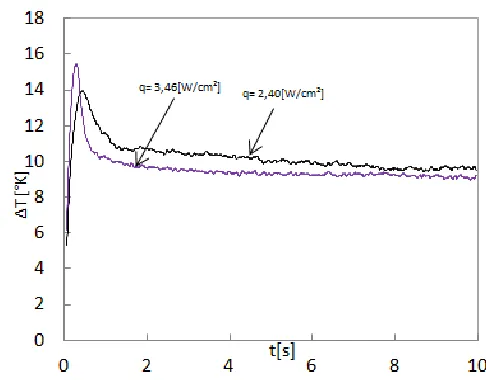
Fig.8 shows that for flux heat densities varying from 4.70 W.cm-2 to 13.8 W.cm-2, the transient regime is characterized by a superheat that can reach20.32 K in 0.045 seconds, while establishment time of steady-state regime of nucleate boiling remains less than 0.3 seconds. The Heating rate process influences similarly the maximum superheat (∆𝑇𝑀𝑎𝑥) and the superheat required to trigger boiling(∆𝑇𝑂𝐵). Fig.9 and
Fig.10 show an exponential variation
of ∆𝑇𝑂𝐵 𝑎𝑛𝑑 ∆𝑇𝑀𝑎𝑥 when the imposed flux density increases. Fig.11 and Fig. 12 show that the maximum time (𝑡𝑀𝑎𝑥) and the time required to trigger the boiling (𝑡𝑂𝐵) decrease when the flux density increases.
Fig.4. Steady-state boiling curve of ribbon to increasing heat flux and at pressure of 1 atm
7 7.5 8 8.5 9 9.5 10 10.5 11 11.5
0 2000 4000 6000 8000 10000 12000 14000 16000
T[°K]
h
[W
/m
².
K
]
A C
D
B
7 7.5 8 8.5 9 9.5 10 10.5 11 11.5
0 2 4 6 8 10 12 14 16 18
T[°K]
q
[W
/c
m
Fig.8. Superheat evolution∆T versus time for different stepwise heat generations in the fully developed boiling area.
Fig.9.Influence of heat flux density on the maximum superheat of boiling triggering.
Fig.10.Influence of heat flux density on the superheat at the Boiling triggering.
Fig.11.Influence of heat flux density on the time of boiling triggering
Fig.12. Influence of heat flux density on the maximum time of boiling triggering
3) Film boiling
When we increase the flux density continuously, a sheath of vapor grows along the ribbon and the boiling film occurs when the bubbles cover the whole ribbon’s surface. The superheat rises very quickly for a flux density of 16.2 w.cm-², (see fig.13, 14).Furthermore, the critical flux appearsquite instantly after the nucleation appearance (see Fig 14):it is also possible to have a direct transition between the conduction and film boiling regimes without nucleated boiling phase
V. NUMERICAL MODELING: THE NATURAL CONVECTION AREA
In this part of study, we were only interested to model the heat transfer around the ribbon in the natural convection area (cf). As said previously, we have observed that this zone of interest have an important occurring time and appears more
0 0.05 0.1 0.15 0.2 0.25 0.3 0.35 0.4
0 5 10 15 20 25
t[s]
T
[°
K
]
q=4.70[W/cm²] q=6.15[W/cm²] q=7,81[W/cm²] q=9,54[W/cm²] q=11,6[W/cm²] q=13,8[W/cm²]
Fig.4. Steady-state boiling curve of ribbon to increasing heat flux and at pressure of 1 atm
4 5 6 7 8 9 10 11 12 13 14
15 16 17 18 19 20 21
q[W/cm²]
T
m
a
x
[°
K
]
0 2 4 6 8 10 12 14 16 18 12
13 14 15 16 17 18 19 20 21 22 23
q[W/cm²]
T
O
B
[°
K
]
0 2 4 6 8 10 12 14 16 18
0 0.2 0.4 0.6 0.8 1 1.2 1.4
q[W/cm²]
tO
B
[s
]
4 5 6 7 8 9 10 11 12 13 14
0.04 0.06 0.08 0.1 0.12 0.14 0.16
q[W/cm²]
tm
a
x
[s
clearly than in the old studies especially for low heat flux densities. The numerical results will be then compared with those obtained experimentally
Fig.13.Superheat evolution versus time (transition from the nucleate boiling to the film boiling).
Fig.14.Superheat evolution versus time (the impulse of heat flux during 1s).
A. Geometrical set-up and mathematical formulation
The configuration studied is depicted on Fig.15. It is a brass ribbon of length l, width L and density. The ribbon is permanently submerged in a bath of liquid nitrogen (LN2) at a temperature of -196°C.
The ribbon receives a flux density of heat q on the right end while the other ends are adiabatic. For a simple formulation of the mathematical model, we consider that ribbon is homogeneous and isotropic and that its temperature is uniform on its entire length.
In the following, we present the geometric configuration, the mathematical formulation and the numerical method used to solve numerically the equation of energy conservation.
The modeling of the thermal transfer within the brass material returns to solve the heat equation which is written under the following form, assuming a two-dimensional problem:
Fig.15.Geometrical configuration with boundary conditions.
2 2 2 2y
T
x
T
t
T
c
w w wp
By performing the variable change T =Tw-Tsat, the equation of the problem is written in the form [38]:
2 2 2 2y
T
x
T
t
T
Or 𝛼 = 𝜆
𝜌𝐶𝑝represents the material thermal diffusivity. On the surface of direct contact with the liquid nitrogen, the thermal exchange is done by natural convection, and h is the convective exchange coefficient per surface unit obtained experimentally. The heat flux density on this surface is written as the following:
hT
T
T
h
q
satw
(
)
1) Initial and Boundary Conditions
An initial condition and four boundary conditions are necessary for the resolution of the heat equation:
Initial condition:
For t =0 and x > 0, Y > 0:
(
,
,
)
(
,
)
0
0
T
x
y
t
y
x
T
Boundary conditions on the surfaces: -On surface S1 {
x
0
,
0
y
L
}:q x T
-On surface S2{
0
x
l
,
y
L
}:hT
T
T
h
y
T
satw
(
)
-On surface S3 {
0
x
l
,
y
0
}:0 y T
-On surface S4 {
x
l
,
0
y
L
}:0 x T
Equations and boundary conditions are discretized using the finite differences method following a first and second orders respectively in time and space [39, 40]. An explicit discretization scheme in time was used.
(5)
(6)
0.1 0.2 0.3 0.4 0.5 0.6 0.7 0.8 0.9 1
5 10 15 20 25 t[s] T [° K ] q=16,2 [W/cm²]
0 5 10 15 20 25
0 20 40 60 80 100 120 140 160 180 200 t[s] T [° K ] q=16,2[W/cm²] ) ( sat W T T h y
T
0 y T q x T
0
The time and space steps used are: ∆x=0.002 m, ∆y=0.0002 m and ∆t=0.0005s. They were chosen from a compromise between the accuracy of the results and the calculation time of the program.
After discretization in time and space, we get the discretized formulation of the unsteady heat equation:
)
(
)
(
)
2
2
1
(
1 , 1 , 2 , 1 , 1 1 2 1
1 n
j i n
j i n
j i n
j i n
ij n
ij
T
T
T
T
T
T
With
2 2 2
1 y
t k et x
t k
The indices i and j allow to position each point located within ribbon’s surface, and the index n will be used for the time. The following table summarizes the input parameters used in the numerical model developed.
VI. NUMERICAL RESULTSANDDISCUSSION
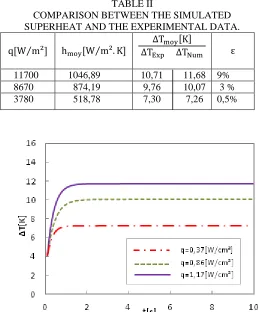
Fig .16 shows the numerical evolution of superheat ∆T in natural convection area on the contact surface between the liquid nitrogen and the ribbon for different flux densities imposed in experience. We find the same superheat profile than that obtained experimentally. In fact, the superheat evolution is done well in two times: First, the superheat increases during all the first 2 seconds, and then it takes a constant value. Moreover, we note that the temperature increases when the flux density increases.
VII. COMPARISONBETWEENNUMERICALAND
EXPERIMENTALRESULTS
Fig.17 illustrates a qualitative comparison between the evol- ution of the superheat ∆T measured experimentally (solid line) in the natural convection area and that obtained numerically. The numerical profiles are in good agreement with the experimental ones, with the presence of relative errors for different flux densities. Table II provides a comparison between the simulated and the experimental data for different heat flux densities and different heat transfer coefficient. We can observe that the discrepancies increase with the heat flux density. Discrepancies could come from the fact that the code fails to predict the superheat by using an averaged convective heat transfer coefficient obtained experimentally. They could come also from the accuracy and the precision of measurements.
Fig.16.The superheat versus time in the natural convection area.
Fig.17.Numerical distribution of superheat versus time: comparison between numerical and experimental results.
VIII. CONCLUSION
The work described in this article is articulated around two steps. In one hand, an experimental setup which gives specific measures coupled with rapid visualizations has been carried out in liquid nitrogen with a brass ribbon. This study was able to investigate the different configurations of transient nucleate boiling. Then, a series of measures have been realized and analyzed in order to improve the knowledge of the heat TABLE I
NUMERICAL VALUES USED IN THE MODEL.
Parameter value unit
Cp 377 J.kg-1.K-1
121 W.m-1.K-1
L 0.002 m
l 0.1 m
Tsat 77.15 K
8386 Kg.m-3
(6)
TABLE II
COMPARISON BETWEEN THE SIMULATED SUPERHEAT AND THE EXPERIMENTAL DATA.
q[W m²⁄ ] hmoy[W m². K]⁄
∆Tmoy[K]
∆TExp ∆TNum ε
11700 1046,89 10,71 11,68 9% 8670 874,19 9,76 10,07 3 % 3780 518,78 7,30 7,26 0,5%
transfer mechanisms especially in natural convection area and to propose an adapted modeling for this area.
The study shows that the single-phase exchanges before the triggering of boiling were made by convection and conduction. At the boiling time, the temperature is strongly linked to the speed and the mode of heating. Once the boiling triggered, the bubbles are mainly responsible for the heat transfer from the wall toward the liquid. Therefore, the detachment frequency and the nucleation sites density are important.
Similarly, the experiments carried out on the transient boiling have shown that, for very fast heating conditions, the beginning temperature of boiling may be higher than that in stationary conditions, in spite of the existence of the vapor trapped in the nucleation sites. This shows that the existence of vapor-liquid inside the cavities plays a key role in the boiling process.
In transient state, the boiling begins with a certain delay which generates considerable parietal superheat. The boiling triggering is brutal and before the boiling stabilizes at the surface, a transition to the partial film boiling regime can be observed.
In addition, for the short transient state regime, we see that the time of the nucleate boiling regime is very short, which make possible direct transition from the conduction regime to the film boiling regime.
To validate the experimental transient results, we realized a numerical study on the natural convection area. The results obtained are in a good agreement with experimentation. Further studies need to be carried out in order to improve both experimental and numerical approaches and understand the whole physical phenomena of the nucleate boiling.
NOMENCLATURE
𝛼 thermal diffusivity, m2 s-1
Cp specific heat,KJ. Kg-1 °K-1 h heat transfer coefficient, Wm-2K-1
I electric current, A
L ribbon length, m
l heat flux, Wm-2
q ribbon transverse surface, m2 t
S emissive surface, m2
e
S time, s
t temperature, K
T saturation temperature, K
sat
T Wall maximum superheat at boiling incipience, K
Max
T
wall superheat at boiling incipience, K
U voltage, V
Greek symbols
electrical resistivity ,.m
thermal conductivity, W.m-1K-10
electrical resistivity of the ribbon at 0°C, .m
0
temperature coefficient
Subscripts
CHF critical heat flux
OB onset boiling
sat Saturation
w wall
REFERENCES
[1] S .Nukiyama, “The maximum and minimum values of the heat transmitted from metal to boiling water under atmospheric” pressre.J.Soc. Mec Engng.Japan, 37, 367-374, 1934 ;Int.J.Heat and Mass Transfer,27,7 ,970-959 (1984)
[2] M.C.Duluc, X.Francois, “Steady-state transition boiling on thin wires in liquid nitrogen. The role of Taylor wavelength”, Cryogenics38 (1998) 631-638.
[3] T.Jomard, U.Eckes, E.Touvier,M. Lallemand ”Modelling of the tow-phase cooling of a power superconductor and its evaporator”, Proceeding of the Eighth Annual IEEE SEMI-THERM, Austin, Texas,1992. [4] M.Rosenthal, R.L. Miller: “An experimental study of transient boiling”,
ORNL-2294,(1957).
[5] Y.Iida, K.Okuyama, K.Sakurai, “Boiling nucleation on a very small film heater subjected to extremely rapid heating”. Int. J. Heat Mass Transfer, 1994, Vol. 37, N° 17, p. 2771-2780.
[6] V.Drach, J.Fricke, “Transient heat transfer from smooth surfaces into liquid nitrogen”. Cryogénies, 1996, Vol. 36, p. 263-269.
[7] A.Sakurai,M. Shiotsu, K.Hata,” Boiling phenomenon due to quasi-steadily and rapidly increasing heat inputs in LN2 and LHe I”. Cryogénies, 1996, Vol. 36, p. 189-196.
[8] M.C.Duluc, X.Francois, G.Defrsne, “Régimes transitoires d’ébullition sur un fil, Congrès de la société française de Thermique “, Arcachon, 17-19 Mai 1999, P.473-478.
[9] S.Héas, S.Launay, M.Raynaud, M.Lallemand,”Transient nucleate boiling heat transfer from a thick flat sample. Proceedings of the second International Symposium on Two-Phase Flow modeling and experimentation”, Pise, Ed. : E.T.S., 1998, Vol. l,pp. 205-210.
[10] S.Héas, H. Robidou, M. Raynaud, M.Lallemand,” Onset of transient nucleate boiling from a thick flat sample”. International Journal of Heat and Mass Transfer 46 (2003) 355-365.
[11] R.Hohl, H. Auracher, J.Blum,W.Marquardt, “Pool boiling heat transfer experiments with controlled wall temperature transients”. 2nd European Thermal Sciences and 14th UIT National Heat Transfer Conference, Rome, Ed. ETS, 1996, p. 1647-1652.
[12] R.Hohl, H. Auracher, J.Blum, W.Marquardt,” Characteristics of liquid-vapor fluctuations in pool boiling at small distances from the heater”. Heat Transfer, Proceedings of llth IHTC, Kyongju, Korea, 1998, Vol. 2, p. 383-388.
[13] R.Hohl, J.Blum, M.Buchholz,T. Luttich,H. Auracher,W. Marquardt,”Model-based experimental analysis of pool boiling heat transfer with controlled wall temperature transients”. Int. J. Heat Mass Transfer, 2001, Vol. 44, p. 2225-2238.
[14] F.L.Owens,L.W. Florshuetz,”Transient versus steady-state nucleate boiling”. Journal of Heat Transfer, 1972, August, p. 331-333.
[15] W.Peyayopanakul,J.W. Westwater,”Evaluation of the unsteady-state quenching method for determining boiling curves”. Int. J. Heat Mass Transfer, 1978, Vol. 21, p. 1437-1445.
[16] J.W. Westwater ,J.J. Hwalek, M.E.Irving,”Suggested standard method for obtaining boiling curves by quenching”. Ind. Eng. Chem. Fundam., 1986, Vol. 25,p. 685-692.
[17] C.Casadessus, ”Étude expérimentale de l’ébullition convective en mélange d'eau et d'éthylène-glycol”. Thèse de doctorat : Université Pierre et Marie Curie (Paris VI), 1997,161p.
[18] H.Kawamura,F. Tachibana,M. Akiyama,” Heat transfer and DNB heat flux in transient boiling”. 4th International Heat Transfer Conf, Versailles, 1970, B 3.3, 11 p.
[20] A.Sakurai, M. Shiotsu, K.Hata,”Boiling heat transfer characteristics for heat inputs with various increasing rates in liquid nitrogen”, Cryogenics, 1992, Vol. 32, N° 5, p. 421-429.
[21] H.Auracher, W.Marquardt,”Experimental stadies of boiling mechanisms in all boiling regime under steady-state end transient state conditions”, Int.J. Thermal Sci. 41 (2002) 586-598.
[22] K.Okyama,Y. Iida,”Transient boiling heat transfer characteristic of nitrogen bubble behavior and heat transfer rat at stepwise heat generation”,Int.J.Heat Mass transfer 33(1990) 2065-2071.
[23] M.Duluc, B.Stutz, M. Lallemand,”Transient nucleate boiling under stepwise heat generation for highly witting fluids”,Int.J. Heat Mass transfer 47(2004) 5541-5553.
[24] S. Heas, ”Etude expérimentale des transferts thermiques en ebullition libre et regime transitoire” . These de Doctorat, INSA, Lyon, 2001. [25] A.Sakurai,K. Mizukami,K. Hata,”boiling heat transfer characteristics for
heat inputs with various increasing rates in liquid nitrogen”, Cryogenics, 1992, Vol. 32, N 5, p.421-429
[26] A.Sakurai, K. Mizukami,M. Shiotsu,”Experimental studies on transientboiling heat transfer and burnout”.4th International Heat Transfer Conf, Versailles, 1970,B 3.4, 11p.
[27] V.Drach,N.Sack,J. Fricke,”Transient heat transfer from surfaces of defined roughness into liquid nitrogen”, Int J Heat Mass Transfer, Vol 39 No 9 pp 1953 1961 1996.
[28] Y.Haramura,Y. Katto,” A new hydrodynamic model of critical heat flux, applicable widely to both pool and forced convection boiling on submerged bodies in saturated liquids”. Int. J. Heat Mass Transfer, 1983, Vol. 26, N° 3, p. 389-399.
[29] A.H.Howard, I.Mudawar,”orientation effects on pool boiling critical heat flux (CHF) and modeling of CHF for near-vertical surfaces”. Int. J. Heat Mass Transfer 42 (1998) 1665-1688.
[30] G.Son,V.K.Dhir,“Numerical Simulation of FilmBoiling Near Critical Pressures with a Level Set Method,” J. Heat Transfer 120, 183-192, 1998. [31] H.Ying,S.Masahiro,M.Shigeo,”Numeracle study of high heat flux pool
boiling heat transfer”. Int. J. Heat Mass Transfer 44(2001)2357-2373. [32] G.Son,V.K. Dhir,“Numerical simulation of nucleate boiling on a
horizontalsurface at high heat fluxes”.Int. J. Heat Mass Transfer 51( 2008)2566-2582.
[33] H.Punekar,S.Das, “Numecal simulation of subcooled nucleateboiling in cooling jaket of IC engine”.SATInternational 10.4271/2013-01-1651. [34] A.Sanna,C.Hutter,D.B.R.Kenning ,T.G. Karayiannis , K. Sefiane , R.A.
Nelson,“Numerical investigation of nucleate boiling heat transferon thin substrates”.Int. J. Heat Mass Transfer 762014)45-64.
[35] T.Jin, J.p Hong, H. Zheng, K.Tang, Z. Gan,“Measurement of boiling heat coefficient in liquid nitrogen bath by inverse heat conduction method”,J Zhejiang Univ Sci A 2009 10(5):691-696.
[36] M. Miyamoto, Y. Katoh, J. Kurima, S. Kurihara and K. Yamashita, “Free convection heat transfer from vertical and horizontal short plates”, ht. J. Hear Maw Transfer. Vol. 28, No. 9, pp. 1733-1745, 1985.
[37] R.Agounoun, ” Etude expérimentale de l’ébullition libre de l’azote liquide en régime transitoire sur des rubans en laiton”, Thèse de doctorat, Université Henri Poincaré, Nancy, 2004.
[38] M.Buffat, ”Méthode numériques pour les EDP en Mécanique”, UFR de Mécanique, Université Claude Bernard, Lyon I 2008.
[39] E.Goncalves, ”Méthodes, analyse et calcules”, Institut national polytechnique de Grenoble, septembre 2005.