Digital Divide: Exploring National and
International Approaches to Bridge the
Digital Divide in the Perception of Developing
Countries especially in the context of Nepal
Prof. Dr. Sudan Jha1 and Sunil Pandey2
I. INTRODUCTION
Problem Statement
There are many challenges faced by governments, people, and business entrepreneurs all over the world. Governments, industries, non-government organizations and policy makers have made slight progress in increasing Internet connectivity and developing IT infrastructures. Those who support the technologies power as a medium individually suited to building open
1Department of Computer Engineering Campus Kalinga Institute of Industrial Technology, KIIT University Bhubaneswar – 751024, Odisha, India
2Department of Computer Science and Engineering Nepal College of Information Technology, Kathmandu, Nepal
Vol.(7)Issue(3), pp. 368-383
DOI:http://dx.doi.org/10.21172/1.73.549
ABSTRACT: - Nowadays, Information Society policies have been paying a lot of attention in bridging “Digital Divide” in our country. The gap between people from different socio-economic backgrounds with regard to their opportunity and ability to access and make use of Information and Communication Technologies (ICT) is commonly regarded as a potential barrier for participation in the information society. ICT continues to have a significant impact on the life of people and the global economy and also gives rise to a host of important issues. One major unanswered question at the national and international level is whether the use of information technologies leads to increasing digital disparities within and among developing countries. This research will suggest methods for bridging the Digital Divide and address the issues related to it. The research will focus on finding some modern approaches at the national as well as international level to address the issues of digital divide. The research will prepare a model that discusses and recommends possible strategies that can be implemented in developing countries like Nepal to reduce the gap of the Digital Divide.
societies must study what can be done to make Internet access and use of ICT widely available and affordable to the most needy communities and individuals worldwide.
The nature of the digital divide is complex and doubtful, therefore, an accurate judgment of its causes is imperative in order to differentiate and implement the proper solutions. The digital divide is wide. There is a connection between the digital divide and poverty. Around 40-45 % of the total world population lives in less income countries. Nearly one billion people have no chance of access to computer and internet. Similarly, the digital divide comes in many forms. Studies show that regardless of how many info-devices or telecommunication centers are established in a low-income society or developing country, the chance of internet use is ten times higher for a person in a developed country than for a person in a developing country. This shows that education and changing mentalities are key factors in bridging the digital divide. Governments should work by developing and using e-government tools to improve e-readiness, support and educate the usage of ICT, and maintain the development of ICT skills in a non-discriminative manner.
This leads to the question of what can be done to bridge this digital divide, and let developing countries benefit from the opportunities that ICT can provide. Should ICT in developing countries be applied in the same way as in developed countries? Or should we look at the specific needs of these countries and ask ourselves how these needs can be facilitated by ICT? Also, how can ICT be facilitated in developing countries? In order for these countries not to become dependent on developed countries to provide them with ICT they will have to produce their own (affordable) ICT products. The necessary infrastructure to facilitate new ICT will also be necessary, but what infrastructure is needed and how can this be realized? For ICT to succeed and to be sustainable the government should be supportive of this development. But what should governments contribute to create a sustainable ICT environment? These questions are the ones that will be researched in this thesis. The main question is:
How can ICT successfully be put to bridge Digital Divide in a developing country? In order to find a gratifying answer to this question the other points posed in the previous paragraph must be addressed. This leads to the following four sub questions.
In what form should ICT be applied to bridge Digital Divide in a developing country? How should education be used to create a sustainable ICT environment and how can this
be achieved?
What infrastructure is necessary to create a sustainable ICT environment and how can this be achieved?
What should governments contribute to create a sustainable ICT environment? What should be the Role of e-Governance in Bridging the Digital Divide?
II. RESEARCH OBJECTIVES
age, education and household income. In addition, there appeared to be a “lost opportunity” Digital Divide for career advancement and health care.
Beyond the availability of high-speed Internet service, there were other signs of a Digital Divide that separated citizens in the computer age. About 64.3% of Nepalese citizens did not use the Internet at all, according to a MIS report of January 2015 by Nepal Telecommunication Authority (NTA)[1]. They included senior citizens, those less skilled in the English language, people who had not graduated from high school and households with less income. About half of those who did not use the Internet said that it was not important to them. People with disabilities also were sometimes victims of the Digital Divide.
So the main objectives of the research will focus on how to narrow down the gap of Digital Divide and to find out suitable approaches which will help towards bridging the Digital Divide. With this research, we can also focus on how to increase connectivity among people and communities.
A. Main Objective
To look for solution for bridging digital divide problem in Nepal
B. Sub-Objective
To examine at the micro level how the differences associated with the dimensions of geographical areas, income and workplace are influencing individuals to use ICT – that is the differences is based on the urban and rural areas, level of monthly income earned by the individual, and the different nature of job in the workplace. Then, the research is to prove empirically, using a statistical approach, the significance of the three dimensions in influencing the use of ICT in the mass population.
• To propose socio-economic model and programs to be implemented that could address the problem of digital divide in developing countries based on the dimensions of geographical difference, income and workplace.
• To propose recommendation for handling Inefficiency Usage of Infrastructure
• To analyze problem on IT Literacy
• To analyze problem on expensive price for internet transmission
The research addresses the following questions:
What are the factors that will help to bridge the digital divide?
What kind of inter-relationship exists between the dimensions of income, education and geographical differences that helps to bridge the digital divide?
extent has the problem of digital divide affected the different segments of the Nepalese population?
By proving statistically that a digital divide exists between urban and rural Nepal, as well as between different income and cultural groups, reliable evidence will have been produced that digital divide is a “real” issue within Nepalese society. This research goes one step further by investigating the extent of digital divide, since this makes it possible to explain the degree of differences in digital gap among various segments of the population. As a consequence of addressing this research question, specific actions plan can be formulated and applied to the different segments of the population in order to reduce the digital gap.
III. METHODOLOGY
In order to explore National and International Approaches to Bridge the Digital Divide in the perception of Developing Countries, an Ethnographic Futures Research (EFR) method of qualitative inquiry will be employed. Data will collected through interviews of participants selected based on their expertise in the field of IT, their knowledge of IT education, and their position to address the future direction of Bridge the Digital Divide.
Besides this, different data mining and data storming tools will be use for knowledge discovery which will support in decision making process for the proposed module.
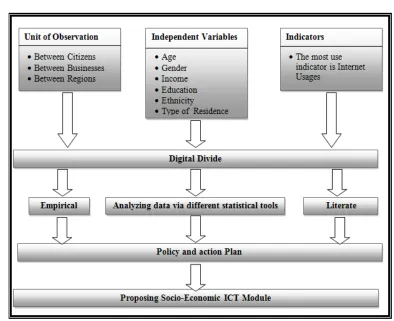
For measuring the Digital Divide we have to specify the scope of what is actually measured by taking decisions on at least three levels:
The unit of observation needs to be defined: There are different types of digital divides,
e.g. between citizens, between businesses or between regions.
The independent variables need to be specified by which the Digital Divide among the
unit of observation is assumed to be dependent. The set of variables will be different depending on the unit of observation. For instance, if citizens are the unit of observation, the independent variables could be age, gender, income, education, ethnicity or type of residence.
The indicators, i.e. the operationalization of the term “Digital Divide” needs to be
i. Framework of Working Methodology
Figure 1 Framework of Working Methodology
ii. Reliability Analysis with Cronbach’s Alpha
Cronbach’s Alpha (α) is one of the most widely used measures of internal consistency. It measure of internal consistency denotes how closely related a set of items are as a group. We obtain a ‘high’ value for the alpha it does not imply that the measure is uni-dimensional. The extent to which all questions contribute positively towards measuring the same concept is known as internal consistency. This is a key element for evaluating the quality of the overall score.
Mathematically Chronbach alpha can be defined as:
Where,
K is the total number of items,
Si2 is the variance associated with item I
Normally, the coefficient alpha (α) ranges in the value from 0 to 1 and may be used to describe the reliability of factors extracted from multi-point formatted questionnaires or scales.
Cronbach’s alpha Internal Consistency
α ≥ 0.9 Excellent (High-Stakes testing)
0.7 ≤ α < 0.9 Good (Low-Stakes testing)
0.6 ≤ α < 0.7 Acceptable
0.5 ≤ α < 0.6 Poor
α < 0.5 Unacceptable
IV. WORK DETAIL
Socio-economic Factors
A.ECONOMIC
The most significant factor that adds to the digital divide is Nepal’s economic value. Nepal’s diverse economy focuses on traditional village farming, modem agriculture, handicrafts, tourism and services that are the major source of economic growth. About 7 percent of Nepal’s work-force is in industry and another 18 percent is in services. The rest 75 percent is in agriculture. That 75 percent are focused around agriculture means that the government can introduce an economic reform program that includes developing basic infrastructure to improve the lives of the rural poor and boost economic performance. To bridge the digital divide in Nepal this is exactly what is necessary since the majority of Nepal’s population live in rural parts where there is limited or no access to the Web, and not enough telephone lines to offer everyone equal access.
2.6 caror. In this case it is surprising that only 7 percent of the population own computers. Reasons for this are a variety of factors discussed in this research.
B. CULTURAL FACTORS LANGUAGE
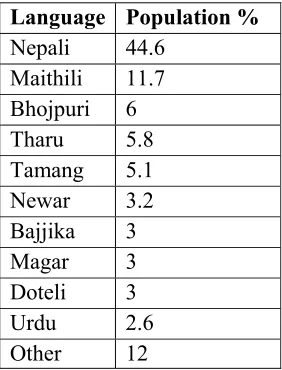
Nepal has 123 languages including Nepali that is the national language and the mother tongue of 44.6 percent of the people, followed by Maithili (11.7% 3,092,530), Bhojpuri (6.0%; 1,584,958), Tharu (5.8%; 1,529,875), Tamang (5.1%; 1,353,311), Newar (3.2%; 846,557), Bajjika (3.0%; 793,418), Magar (3.0%; 788,530), Doteli (3.0%; 787,827), Urdu (2.6%; 691,546). Each language has its own alphabet and sometimes you find similar words with similar meanings in different languages. However, what seems to be a unique feature of Nepalese culture is actually what increases the gap of digital divide. Apart from the problem of poverty the fact that even within Nepali people do not speak the same language means that language prevents many of the educated or literate people from using computers because for one most of its content is written in English and only an estimated 2 to 10 percent of the population speaks fluent English. Such statistics demonstrate how the medium can create two kinds of linguistic divides: a divide between English and non-English populations and a divide within non-English-speaking communities where understandable content is available only to those who have knowledge of English.
Table 1 : Language use in Nepal
Language Population %
Nepali 44.6
Maithili 11.7 Bhojpuri 6
Tharu 5.8
Tamang 5.1
Newar 3.2
Bajjika 3
Magar 3
Doteli 3
Urdu 2.6
Figure 2 Language use in Nepal
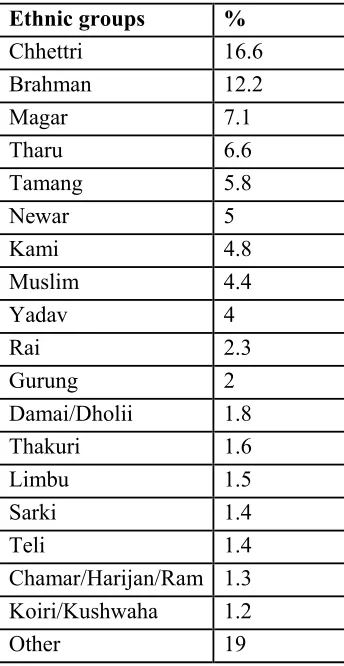
Table 2 : Ethnic groups in percentage
Ethnic groups %
Chhettri 16.6
Brahman 12.2
Magar 7.1
Tharu 6.6
Tamang 5.8
Newar 5
Kami 4.8
Muslim 4.4
Yadav 4
Rai 2.3
Gurung 2
Damai/Dholii 1.8
Thakuri 1.6
Limbu 1.5
Sarki 1.4
Teli 1.4
Chamar/Harijan/Ram 1.3
Koiri/Kushwaha 1.2
Figure 3 Ethnic groups in percentage
C. Education
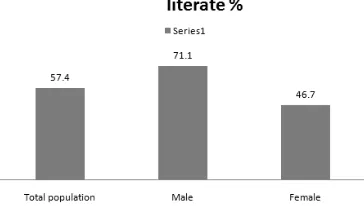
In our opinion if we emphasis the role of education we can solve many problems associated with illiteracy and access. The main idea is that schools search for ways to make the best use of computers since a serious digital divide exists between those with and those without computer skills. A great relief is that not all skill-development requires the user to be literate. Such an idea greatly benefits the rest of Nepal’s 43 percent of illiterate people who because they cannot read and write are automatically physically prevented from using computers. One must consider that although these people are illiterate, many work and earn money even if this means growing crops. However, children who do not acquire basic computer skills will be at a disadvantage when they try to find a job and the human cost in joblessness, wasted potential, and poverty will remain high.
The next generation of the World Wide Web, referred to as Internet 2.0, emphasizes the need to go beyond text to give users a sensory experience of the web. In addition governments are exploring the use of cell phones and applications like voice recognition technology or the use of visual icons on various devices to bridge this problem. The way people think in general shows that you must be able to read and write in order to operate such machines. But in fact there are many new ways that the poor can be helped by new technologies even with without them becoming literate.
D. Telecom Infrastructure
Although computers became cheaper the majority of Nepalese nevertheless do not have access to the Internet because the quality of Internet access available to individuals and schemes varies with the quality, availability and price of access, the existing telecom infrastructure, and so on. Unfortunately telecom networks are designed for people who can afford to pay around RS 1000/ monthly. However, only few people living in rural areas can afford this. To bridge the digital divide NTA (Nepal Telecommunication Authority, a regulating body of telecommunication of Nepal play vital role in increasing access in communication in rural area.
Figure 5 Market share of telephone service
E. Geographical
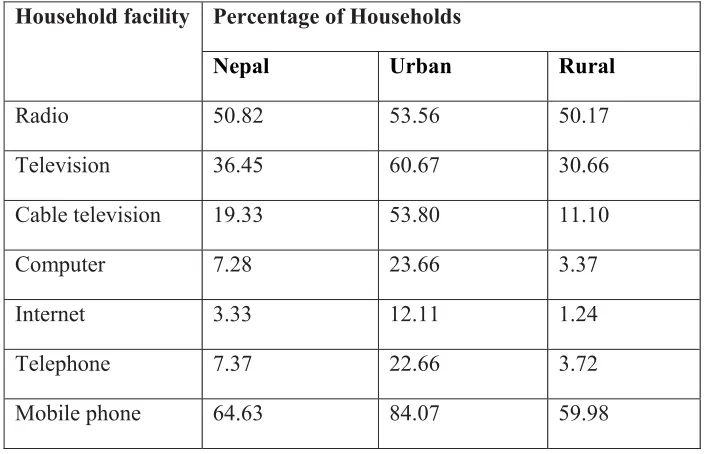
There are a wide range of social factors, such as economic, language, education, telecom infrastructure and geographical contributing to the current digital divide in Nepal. Chiefly all factors are interrelated with another and to resolve the problem of digital divide means having to take a universal approach to resolve all factors. However, this is only part of the argument. Ethical factors must also be considered to present the current situation better and these will be discussed now. The percentages of households having various kinds of household facilities which play vital role in Digital Divide are tabulated as of National Population and Housing Census 2011(National Report) Nepal.
Table 3: Facilities which play vital role in digital divide in urban and rural area of Nepal
Household facility Percentage of Households
Nepal Urban Rural
Radio 50.82 53.56 50.17
Television 36.45 60.67 30.66
Cable television 19.33 53.80 11.10
Computer 7.28 23.66 3.37
Internet 3.33 12.11 1.24
Telephone 7.37 22.66 3.72
Figure 6 Facilities which play vital role in digital divide in urban and rural area of Nepal
V. RESULTS AND DISCUSSION
Presentation of the Findings
Information technologies should be introduced when (and only when) they constitute the most effective available way of meeting basic human needs and fulfilling fundamental human rights. ICT's can have a positive role in development. But ICT's are neither a solution nor necessarily the first line of attack in combating poverty, misery, and injustice. The utility of ICT's must always be judged against the role they can play in meeting core human needs.
The most creative uses of ICT's in development may not involve computers, e-mail, or Internet access, but rather the use of other computer-based technologies, including embedded chips, satellite based information, etc. in order better to meet local needs. Modern information technologies should not be simply equated with text manipulation, Web page construction, sending e-mail, e-commerce, or surfing the Net. Increasingly, ICTs have a variety of other uses and embodiments.
ICT projects must build on an assessment of local needs, as locally defined by local people. There is a frequent tendency of well-wishing government officials, officers of international aid agencies, and workers in NGOs to assume that they know what is needed at the grassroots.
Local language and local content are essential. The interventions discussed above underline another point often neglected in schemes that propose "wiring the masses" -- namely, the critical importance of local language and local content.
Projects must be (or soon become) economically self-sustaining. Too many projects -- in Nepal -- have failed because they lack a self-sustaining economic base.
Do not simply assume that a flourishing IT sector will trickle down to the rest of the people. The connection between a flourishing IT industry and bridging the digital divide is complex and problematic.
In fact, however, the opposite could be true. The experience of developing nations like Brazil suggests that without active steps to prevent a widening gap between the rich and poor, rapid development of technology sectors may increase that gap. Training software engineers and programmers is of course desirable. But it bears no necessary relationship to bridging the digital divide within Nepal. The only certain fact is that such steps increase the numbers of individuals on the top of the divide, growing the ranks of the digerati but without necessarily affecting the mass of the population.
Be sure that ICT programs actually really reach and benefit their intended beneficiaries. A central problem for many projects is actually reaching their intended beneficiaries.
ICT for development efforts need to share experiences within and between nations, especially about actual successes and failures at the grass roots level.
The voices and interests of the disadvantaged need to be represented in bodies that make ICT policy concerning regulation and infrastructure.
This study also relies on the “Access Rainbow Model”. This model is a 7-layer conceptual model of access to the information / communication infrastructure as shown below:
Access Rainbow model aims to provide basis for universal access to the new technologies and point to concrete steps that need to be considered for achieving this objective and aiming to bridge the digital divide. The main element is the content / services layer in the middle. However, it is important to point out that all the other layers in this model are also necessary in order to enjoy content / service access. It is also necessary to note that in this model of information infrastructure, what is vital to achieving success is the careful articulation of the relationships between the seven layers. Starting with the lower layer, the following layers build upon each other and should be carefully considered towards bridging the digital divide and to ensure access to information and technologies.
VI. SOLUTIONS
The first solution is to build cheaper computers using cheaper hardware. A cheap hand-held computer that allows users to handle sound files and e-mail through icons on a touch-sensitive screen, overcoming the language and literacy barrier should be developed.
The second solution suggests creating a multilingual operating systems and other application to resolve the language problem. This type of system will enable research on Nepalese language computing technologies and will help accelerate IT literacy once the people have the possibility to independently explore the ends of computers and the Internet through an ICT based learning. Both solutions suggest a scope for improvement to close the existing gap but they are not perfect.
VII. CONCLUSIONS
When the results from the data analysis and the literature survey are considered, the following conclusions can be drawn:-
Geographical differences, income and culture are proven empirically to influence the diffusion of ICT to the mass population.
There is a digital divide based on differences in income, in term of affordability. A digital gap also exists based on competence in using ICT which positively correlates with income.
There is also a digital divide based on the nature of job, notably upon the differences in competency or skill in using ICT.
There exists a digital divide between the urban and rural populations, with the urban population valuing access to, and use of, ICT more highly than the rural population.
from contacting any of the “underprivileged.” For a better insight on the current digital divide in Nepal I find it necessary to interview both the advantage and disadvantaged. Since no contact exists between both classes, personal engagement is attempted in the Background section.
VIII. PROPOSED STRATEGIC MODEL
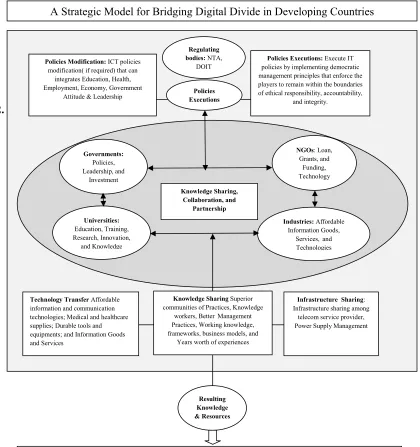
A Strategic Model for Bridging Digital Divide in Developing Countries with reference to the survey on key factors of digital divides(Ref. Sec 4.5) will be proposed as following.
2.
Figure 7 A Strategic Model for Bridging Digital Divide in Developing Countries A Strategic Model for Bridging Digital Divide in Developing Countries
Policies Executions: Execute IT policies by implementing democratic management principles that enforce the players to remain within the boundaries of ethical responsibility, accountability,
and integrity.
Policies Modification: ICT policies modification( if required) that can
integrates Education, Health, Employment, Economy, Government
Attitude & Leadership
Governments:
Policies, Leadership, and
Investment
NGOs: Loan, Grants, and Funding, Technology Universities: Education, Training, Research, Innovation, and Knowledge
Industries: Affordable Information Goods, Services,and Technologies Knowledge Sharing, Collaboration, and Partnership
Technology Transfer Affordable information and communication technologies; Medical and healthcare supplies; Durable tools and equipments; and Information Goods and Services
A collaborative and Partnership efforts is the critical success factor to bridge the divide by focusing on education, sustainable development, productivity, competition, technology innovation, healthcare systems, poverty alleviation, and restoration of democracy and e-leadership,
and ICT
Infrastructure Sharing: Infrastructure sharing among
telecom service provider, Power Supply Management
Policies Executions
Resulting Knowledge & Resources Knowledge Sharing Superior communities of Practices, Knowledge
workers, BetterManagement Practices, Working knowledge, frameworks, business models, and
Years worth of experiences
Regulating bodies: NTA,
REFERENCES
[1] NTA;" MIS report 2014". (http://nta.gov.np/), 2015.
[2] M. Pun;"Bridging the Digital Divide: the Case of Nepal Wireless". ( UN-APCICT) 2013.
[3] E. Amalie; "How to Bridge the Digital Divide". (Roskilde University Digital Archive) 2011
[4] R. Rice; "Primary Issues in Internet Use: Access, Civic and Community Involvement, and Social Interaction and Expression", (London: In L. Lievrouw & S. Livingstone) 2002.
[5] L. Chamberlain;"Gender review of ICT projects. Digital Divide Network" (http://www.digitaldividenetwork.org/content/stories/index.cfm) 2002.
[6] Norris, Pippa, "Digital Divide: Civic Engagement, Information Poverty, and the
Internet Worldwide, The Press Syndicate of University of Cambridge, USA"2001.
[7] V.H. Carr Jr., " Technology Adoption and Diffusion"
(http://www.au.af.mil./au/awc/awcgate/innovation/adoptiondiffusion.htm) 2004. [8] The Global Information Report 2014: Readiness for the Networked World (GITR),
2014
[9] National Population and Housing Census 2011 (National Report), 2011.
[10] Measuring the Information Society: International Telecommunication
Union(ITU),2013
[11] Fuchs, C., & Horak, E., "Informational capitalism and the digital divide in Africa. Masaryk University of Law and Technology"; 2013
[12] J Giri "Exploring National and International Approaches to Bridge the Digital Divide and Formulating a Strategic Model That Can Be Implemented in Developing Countries", 2002
[13] https://en.wikipedia.org/wiki/Digital_divide, last access Tuesday, June 23, 2015
[14] http://www.indexmundi.com/nepal/demographics_profile.html last access Tuesday, June 23, 2015