An Opportunistic VANET Data Offloading using LTE /
LTE-A Networks
Gopi.R
1, Dr.A.Rajesh
2, Sumathi.A
3Research Scholar St.Peter’s University,Chennai,India
1HOD/CSE, C.Abdul Hakeem college of Engineering and Technology, Vellore, Tamilnadu, India
2Dept of CSE Dhanalakshmi Srinivasan Engineering College Perambalur, Tamilnadu, India
3[email protected]
1,[email protected]
2,[email protected]
3Abstract— Vehicular Ad-hoc Network (VANET) is a rapid growing wireless ad-hoc model where the vehicles play the nodes in a network. Vehicular Networks are expected to employ variety of advanced wireless technologies such as Dedicated Short Range Communications (DSRC), which is an enhanced version of the Wi-Fi technology suitable for Vehicular Ad-hoc Network (VANET) environments. Here proposed an opportunistic Vehicular Ad-hoc Network data offloading for heterogeneous network selection of the best available wireless network during data transfer based on a set of predefined user preferences. Here Define a new system-wise entity that is activated when a user is in area with overlapping access technologies and needs to decide the best technology to be used, where the entity performs technology selection in order to optimize the overall system performance metrics in terms of throughput and capacity limitation. The proposed method is capable of selecting the best available wireless network with a reasonable performance rate. The overall approach is based on combining some other metrics for decision model of data offloading, when ad hoc model is applied to Long Term Evolution (LTE) / Long Term Evolution- Advanced (LTE-A) wireless data networks.
Keywords- Wi-Fi, data offloading, Long Term Evolution, Long Term Evolution- Advanced.
I. INTRODUCTION
The improvement of the network technologies has provided the use of them in several different fields. One of the most emergent applications of them is the development of the Vehicular Adhoc Networks (VANETs), one special kind of Mobile Adhoc Network in which the communication are among the nearby vehicles. Vehicular Adhoc Networks (VANETs) are composed for a set of communicating vehicles equipped with wireless network devices that are able to interconnect each other without any pre-existing infrastructure. The exchange of information among the vehicles provides a great opportunity for the development of new driver assistance systems. These systems will be able to disseminate and to gather real time information about the other vehicles and the road traffic and environmental conditions. Such data will be processed and analyzed to facilitate the driving by providing the user with useful information. Network among the moving vehicle is known as Vehicular Adhoc Network (VANET). Vehicular Adhoc Network (VANET) is to provide efficient vehicle-to-vehicle (V2V) and vehicle-to-Road Side Unit (V2R) communications. Based on these two kinds of communications, Vehicular Adhoc Networks (VANETs) can support many applications in safety, entertainment, and vehicle traffic optimization. Mobility is the most important feature of wireless networking system. Mobility can be attained by handoff mechanisms in wireless networks. Handoff is the process of changing the channel (frequency, time slot, spreading code, or combination of them) associated with the current connection while a call is in progress. It is evidenced that the demand for high-speed mobile Internet services has increased dramatically. A recent survey reveals that Internet access is predicted to become a standard feature of future motor vehicles. Not surprisingly, cellular-based access technologies, such as / Long Term Evolution (LTE) / Long Term Evolution-advanced (LTE-A) play a vital role in providing reliable and ubiquitous Internet access to vehicles, as the cellular infrastructure is well planned and widely available. However, the cellular network nowadays is straining to meet the current mobile data demand, and on the other hand, the explosive growth of mobile data traffic is no end in sight, resulting in an increasingly severe overload problem.
quality of service. This rise can be attributed to a number of factors: 1) with the incoming of high-end devices such as laptops, tablets, and smart phones, which can multiply traffic. 2) The growth in average traffic per device, particularly due to increasing mobile network connection speeds and improvement in the features of mobile devices. Both these factors give rise to an individual’s contact time with the network creating traffic problem. 3) The increase in mobile video content, which has much higher bit rates than other mobile content types, which enhance the users’ viewing experience, large screen sizes and optimization of video for mobile devices contribute to the growth of video traffic. 4) The availability of mobile broadband services at prices and speeds which is comparable to those of fixed broadband, taking together with the increasing trend toward ubiquitous mobility is other contributing factors in growth of data traffic on mobile networks. Now a day’s cost reduction, improving customer experience and new business opportunities gives rise to mobile data offloading. So, because of this reasons, most mobile operators have introduced and started to implement a mobile data offloading strategy. So far, Wi-Fi and femtocells have emerged as the preferred offloading technologies. In addition, there are number of optimization approaches to relieve congestion on their networks.Mostly, the data traffic patterns depend upon the type of device, its form factor, time of the day, type of application and a particular location of users.The rest of the paper is organized as follows: Section 2 explains related work of offloading. Section 3 depicts the classification of offload. Section 4 discusses the system model which should be considered during offload decision making. Finally, section 5 concludes the survey.
II. EASE OF USE
A. Drive- thru Internet
Drive-thru Internet can provide Internet access to moving vehicle via APs. Different from non-vehicular users accessing networks, drive-thru Internet has some unique characteristics, such as short and intermittent connectivity, unreliable transmission, fluctuating channels, etc. The network takes the average connection period (vehicle is being connected to an AP) is about several to tens of seconds, and the average inter-connection period (vehicle is not connected to any AP) is about tens of seconds.
B. Mobile Data Offloading
Many factors go into choosing the mobile data offloading, including existing infrastructure, bandwidth usage, customer requirements and policy and charging mechanisms, quality of service (QoS) and more. Data offloading helps decrease the data on radio/core networks by routing selected traffic through alternate channels Installing Wi-Fi in dense environments is the most cost effective short term solution. Wi-Fi offload are not only solving the short term immediate capacity needs of the network but are also ensuring a much easier transition to small cell Long Term Evolution (LTE).
III. METHODS
Data Offload Approaches for Mobile Operators evaluate different data offload options- Wi-Fi for 3G/4G Offload, Small Cell, Small cell Gateway, Wi-Fi Offload, LTE Offloading, WiMAX Wi-Fi Offloading Finally, complete content and organizational editing before formatting. Please take note of the following items when proofreading spelling and grammar:
A. Wi-Fi for 3G/4G Offload
Mobile network operators (MNOs) the world over are facing a common structural problem in their businesses. Traffic growth is outstripping the capacity of 3G network deployments in urban ―hot zones‖, making it difficult in some cases even to hold an uninterrupted mobile phone conversation during rush hour. In turn, operators are under pressure to offer faster data speeds to keep up with their customers’ insatiable demand for data intensive applications. A smarter approach to Wi-Fi that employs advanced interference rejection techniques and adaptive signal controls is required to provide the range and predictable performance expected by mobile operators. In addition, a seamless subscriber roaming experience, clean integration into the 3GPP network and a complete range of Wi-Fi solution for mobile operators.
B. Small Cell
C. Small cell Gateway
A home Node gateway can be deployed to provide an alternate data path that bypasses the core network to help reduce congestion. Small cells can ease congestion not just in the core network but also in the macro radio access network.
D. Wi-Fi Offload
Wi-Fi is an inexpensive and widely available technology that makes Wi-Fi offloading an extremely attractive option. It is deployed to support un trusted/trusted Wi-Fi networks where UE needs to establish a secure IPSec tunnel with the Wi-Fi access.
E. Long Term Evolution (LTE) Offloading
Long Term Evolution (LTE) is the global technology of choice for catering to high-bandwidth applications and devices. There are multiple ways to implement Long Term Evolution (LTE) Data Offloading, including:
F.WiMAX Offloading
WiMAX is a mature technology that has been deployed globally in various markets. Data offloading for WiMAX can be implemented though WiMAX Gateways and Wi-Fi offloading. WiMAX data offloading can be implemented through WiMAX Gateway Solutions and WiMAX Wi-Fi Offloading.
G. WiMAX Wi-Fi Offloading
Wi-Fi is an inexpensive and widely available technology that makes Wi-Fi offloading an extremely attractive option. A Wi-Fi Gateway is used to provide WiMAX Wi-Fi offloading for both trusted and un trusted Wi-Fi networks. This solution provides multiple High Availability support and is compatible with the latest WiMAX standards.
IV. SYSTEM MODEL
In this section, we present the system model, including network formation, finding location information, data transfer.
A
.Network Formation
Vehicular Adhoc Network (VANET) is a self-configuring network that is formed automatically by a collection of node without the help of a fixed infrastructure or centralized management. Each node is equipped with a wireless transmitter and receiver, which allow it to communicate with other nodes in its radio communication range. In a rural area every vehicle acts as a router because of coverage area problem. Using vehicle to vehicle communication beacon messages transmitted to another vehicle which is involve in the communication. Based on this beacon messages calculate the velocity of all transmitting vehicles ahead.
B.Finding Location Information
C. Figures
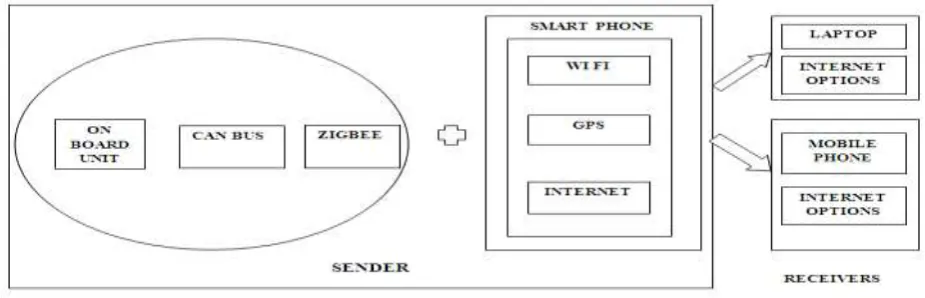
Figure 1. System model diagram
D. Data Transfer
Using Smartphone remotely transmits the data which is to be transmitted according to the data lifetime, the available network coverage and radio interfaces. It implements the offloading strategy. Here involve 3 steps.
a. Select the data
Data is selected which is wish to transfer by the user. This module involve in the work of collecting, merging and temporarily storing data. It is implemented in a dedicated USB-enabled microcontroller board receiving data inputs from a variety of vehicles, on board vehicle and in its near vehicles. The Smartphone is also responsible for delivering the retrieved data to remote processing centers, through its built-in cellular or Wi-Fi radio interfaces. In order to offload the cellular network, the Smartphone is augmented with a software module (Data Store & Transfer) that chooses the interface to transmit the collected data.
b. Visualization of data
It is implemented in the Smartphone. It is independent from the data collected by the vehicle and network details. It hides to the end-users details about implementation and sensing devices. Using graphical user interface (GUI) of the Smartphone application we can retrieves data from the on board Unit and shows the details about the network which all are possible to transmit data with network parameters. Data collected by the vehicles are separately queued, based on the priority and lifetime set by the application, and then transmitted to a remote server. Cellular and Wi-Fi interfaces are alternatively used to this purpose. In network available connectivity options are regularly monitored. Since the Smartphone is powered by the vehicle’s battery. The decision on the network interface to be used for the remote delivery is based on opportunistic offloading principles. Uploading Data are always exchanged via Wi-Fi whenever an access point (AP) is detected. Otherwise, when the cellular connection is only available, the decision whether to transmit data or not based on the life time of the packet. In data packet having three types: high-priority, medium priority, and low-priority data. High-priority data means report the emergency information. So, it has a lifetime in the order of milliseconds and is immediately transmitted over the most reliable and lowest-latency radio inter-face. The lifetime for medium priority data may vary according to the application. For instance, it can range from a few seconds. Moreover, the Time To Live (TTL) can vary according to the time of the day and the vehicle speed. In rush hours, the Time To Live (TTL) should be short.
c. Processing the Data
dedicated to offloading. By doing so, the smart-phone will not be engaged in polling/receiving data through Bluetooth/Wi-Fi, and its energy will be further saved.
V.CONCLUSION
This article describes about the Vehicular Ad-hoc Network data offloading. It is projected that Vehicular Ad-hoc Network data offloading techniques are using when data traffic is increasing on variable networks. Data offloading provides traffic management solutions in an effective way based on the user selection. But we necessary to know about the available offloading options such as Wi-Fi offload, Long Term Evolution (LTE), etc already using in the mobile networks. Nowadays the data traffic is raise and to handle this development powerfully. Therefore user needs awareness to evaluate each of these options and their basic requirements. Vehicular Ad-hoc Network data offloading is a successful offload strategy will helps to minimize user’s cost and also improve the provider’s quality of service.
VI.REFERENCES
[1] ―KPMG’s global automotive executive survey.‖ [Online]. Available: http:// www. kpmg. com/ GE/en/IssuesAndInsights/ArticlesPublications/Documents/Global-automotive-executive-survey.pdf
[2] Cisco, ―Cisco visual networking index: Global mobile data traffic forecast update.‖ [Online].Available:http://www.cisco.com/en/US/solutions/ collateral/ ns341/ ns525/ ns537/ ns705/ ns827/white paper c11-520862.html [3] V. Bychkovsky, B. Hull, A. Miu, H. Balakrishnan, and S.Madden,―A measurement study of vehicular internet access using in situ Wi-Fi networks,‖ in Proc. of ACM MobiCom, USA, September 2006.
[4] J. Ott and D. Kutscher, ―Drive-thru Internet: IEEE 802.11 b for Automobile,‖in Proc. of IEEE INFOCOM, China, March 2004.
[5]―Seemless wi-fi offload: From vision to reality.‖
[Online].Available:http://www.enterprisechannelsmea.com/FileManagerImages/12047.pdf
[6] A. Aijaz, H. Aghvami, and M. Amani, ―A survey on mobile dataoffloading: technical and business perspectives,‖ IEEE Wireless Communications,vol. 20, no. 2, pp. 104–112, 2013.
[7] K. Lee, J. Lee, Y. Yi, I. Rhee, and S. Chong, ―Mobile Data Offloading: How Much Can WiFi Deliver?‖ IEEE/ACM Trans. on Networking,vol. 21, no. 2, pp. 536–550, 2013.
[8] N. Cheng, N. Lu, N. Zhang, X. Shen, and J. W. Mark, ―Vehicular WiFi offloading: challenges and solutions,‖ Elsevier Vehicular Communications,vol. 1, no. 1, pp. 13–21, 2014.
[9] A. Balasubramanian, R. Mahajan, and A. Venkataramani, ―Augmenting mobile 3G using WiFi,‖ in Proc. of ACM MobiSys, USA, June 2010.
[10] X. Hou, P. Deshpande, and S. R. Das, ―Moving bits from 3G to metroscale WiFi for vehicular network access: An integrated transport layer solution,‖ in Proc. of IEEE ICNP, Canada, October 2011.
[11] W. L. Tan, W. C. Lau, O. Yue, and T. H. Hui, ―Analytical models and performance evaluation of drive-thru internet systems,‖ IEEE J. Selected Areas in Comm., vol. 29, no. 1, pp. 207–222, 2011.
[12] T. Luan, L. Cai, J. Chen, X. Shen, and F. Bai, ―Engineering a distributed infrastructure for large-scale cost-effective content dissemination over urban vehicular networks,‖ IEEE Trans. on Vehicular Technology,vol. 63, no. 3, pp. 1419–1435, 2014.
[13] D. Fiems, T. Maertens, and H. Bruneel, ―Queueing systems with different types of server interruptions,‖ European Journal of Operational Research, vol. 188, no. 3, pp. 838–845, 2008.
[14] J. Abate, G. L. Choudhury, and W. Whitt, ―An introduction to numerical transform inversion and its application to probability models,‖ in Computational Probability. Springer, 2000, pp. 257–323.
[15] S. K. Bose, An introduction to queueing systems. Springer, 2001.
[16] J. H¨arri, F. Filali, C. Bonnet, and M. Fiore, ―VanetMobiSim: Generating Realistic Mobility Patterns for VANETs,‖ in Proc. of ACM VANET, USA, September 2006.