Abstract—In Oman there are still large remaining oil reserves that require implementation of Enhanced Oil Recovery processes such as CO2injection, for light oil.
CO2-Oil Minimum Miscibility Pressure (MMP) is the key
parameter for the design and operations of successful CO2 flood.
This study is based on developing a method of calculating the MMP for Omani oil reservoirs. Part-1 of the studyis the experimental work based on the Rising Bubble Apparatus (RBA) measurement of MMP and part-2 is the examination of the existing models for MMP predictions and the adjustment of parameters for obtaining the most accurate predictions by the equation of state fluid PVT modeling simulator PVTPro5.2.1software.
The RBA system set-up was successfully developed for the first time at Sultan Qaboos University. CO2 MMP
measurements were carried out for three different oil samples using the RBA. For the RBA experiments, the PVTPro5.2.1 simulator was used to adjust the best setting parameters for CO2 MMP predictions. Very good agreement between the
experimental MMP and the software predictions were achieved within the range of 2.27% error maximum. Moreover, some existing well-known models have been examined for CO2–Oil
MMP predictions with the observed errors of up to 43.55%.
Index Terms—CO2 injection, Equation of state simulator
software, Minimum Miscibility Pressure, and Rising Bubble Apparatus
I. INTRODUCTION
Oil reservoirs in the Sultanate of Oman; have currently been developed mostly by either primary or secondary recovery methods. However, there are still large remaining oil reserves that require implementation of the technically more challenging applications such as Enhanced Oil Recovery (EOR) processes. One EOR method, for light oil, that has proven success in different parts of the world is CO2 injection.
Determining CO2-Oil Minimum Miscibility Pressure (MMP) is the key parameter for the design and operations of successful CO2miscible flood project. This research study is based on developing a method of calculating the CO2-Oil MMP for different Omani oil reservoirs. The study involves experimentalwork by using the Rising Bubble Apparatus (RBA) to measure the CO2-Oil MMP for different Omani Oils and determining, from the existing literature, a mathematical model for predicting
CO2-Oil MMP based on the obtained CO2-Oil MMP experimental results.
Manuscript received July 24, 2013;revised September 18, 2013. Khalid Al-Hinai is with the Department of Petroleum & Chemical Engineering, Sultan Qaboos University (e-mail: [email protected]).
II. LITERATURE REVIEW
Enhanced Oil Recovery is the oil recovery method at which stage is applied to the depleted oil reservoir after secondary recovery that either involves waterflooding or gas injection [1]. The EOR methods can be classified by three main categories chemical, thermal, and Miscible.
Given Oman challenges of increasing oil production levels, CO2injection could be a plausible solution providing sources of additional oil production. CO2 injection is intended to reduce residual oil saturations after all secondary oil displacement processes have been exhausted. Miscible CO2 injection would contribute towards more oil reserves and maintain production levels for years to come.
The first CO2-EOR application was patented in 1952 for Whorton, Brownscombe, and Dyes of Atlantis Refining Company [2]. The field application was first tested in 1964 at the Mead Strawn Field in the U.S.A [2]. The results showed that 53% to 82% of incremental oil was produced by CO2 flooding. The main reasons behind the high ultimate oil recovery are the low CO2-oil single phase viscosity and low surface tension of miscible CO2-Oil fluids that are more easily displaced.
In 1986, Christiansen and Kim [3] invented the rising bubble apparatus (RBA). The Minimum miscibility pressure is determined by observing the configuration of the gas bubble as it rises through an oil column at different pressure levels at a given temperature. The bubble rises through the oil column confined in a glass tube.
In the literature review CO2-Oil system MMP correlations are available for pure and impure CO2 gas. Those correlations are based on a unique set of oil reservoir conditions. As it is well known that CO2-Oil system MMP greatly depends on the CO2purity, reservoir oil composition, and reservoir temperature and pressure. Thus, using the CO2-Oil system MMP correlations from the literature for the Omani oil reservoirs can lead to an invalid estimate of MMP. Accurate estimation of MMP is vital in the CO2 flooding project. In case of using a high operating CO2 injection pressure based a highly estimated MMP, can lead to over inflated operation or facility costs and HSE (health, safety, and environment) issues.
The first attempt to develop a correlation for reservoir oil fluid and rich gas to predict the MMP, was in 1960 by Benham, A. L. [4]. This correlation was developed by Benham, A. L., Dowden, W. E., and Kunzman, W. J to predict the approximate miscible condition for the displacement of reservoir fluid by rich gas for the pressure range of 3447 kPa to 20684 kPa and temperature range of 70 o
F and 260 oF. This correlation involved using pseudo ternary
Experimental and Theoretical Investigation of the CO
2
Minimum Miscibility Pressurefor the Omani Oils for CO
2
Injection EOR Method
diagrams with limiting tie in lines for various reservoir fluid and rich gas mixtures.
In 1964 R. Simon and D. J. Graue developed correlations for predicting the solubility, swelling and viscosity behavior of CO2-Oil systems [5]. The correlations were based on experimental data obtained by the authors for nine different oils. The experiments conditions for the CO2-Oil mixtures covered the pressure of up to 15858 kPa and a temperature range of 100 oF and 250 oF.
III. CO2GAS PROPERTIES
Carbon Dioxide (CO2) is one of the leading solvents for miscible EOR methods. Other solvents such as; N2, Liquefied petroleum gas (LPG), Natural gas, liquefied Natural Gas (LNG), air, exhaust gas, flue gas, can be used for miscible EOR methods [6]. To reiterate, CO2 miscible flooding is applied to light oil and comes at a later stage after primary and secondary drive mechanisms have recovered oil down to residual oil.
The Carbon Dioxide (CO2) is composed of two Oxygen atoms and one Carbon atom [7]. The CO2can be described as a colorless, odorless, and none combustible gas. The calculated molecular weight of CO2 is 44.01 g/mole. The density of CO2is higher than that of air and it is closer to typical light oil density. At a reservoir pressure of 17237 kPa and temperature of 65.55 oC, the density of CO2is 0.69 g/cm3. It is noted that for typical reservoirs conditions the CO2 viscosity ranges from 0.04 cP to 0.06 cP.
The Thermodynamic behavior of CO2is illustrated in the phase diagram in Fig. 1 [8]. The three different phases of CO2 vapor, liquid and solid are clearly shown in Fig. 1.
The triple point at the pressure of 518 kPa and at a temperatureof -56.6oC is defined as the point at which the three phases exit in equilibrium. The CO2supercritical region exists above the critical point that has a pressure of 7370 kPa and a temperature of 31.0 oC. For most oil reservoirs CO2 will be supercritical fluid.
Fig. 1. CO2phase diagram [8]
IV. CO2INCRUDE OIL PROPERTIES
The CO2 is highly soluble in crude oil and causes the swelling of oil. In addition, it reduces the oil viscosity, increases the oil density and the interfacial tension to be reduced [6]. All these CO2– Oil mixture properties greatly
help to significantly reduce the CO2-Oil Mobility ratio and consequently enhances the volumetric sweep efficiency and allow the oil to flow more easily in the reservoir rock that is beneficial for the CO2flooding in the EOR method.
V. METHODOLOGY
CO2injection in an oil reservoir is an EOR method that is widely known for its higher oil ultimate recovery and for its use in the Carbon Capture and Storage (CCS) that leads to desirable benefits on the environment (reducing CO2content in the atmosphere).
In the CO2 flooding method, favorable conditions of reservoir pressure, temperature, and oil composition are required to achieve the dynamic or multiple-contact miscibility displacement of injected CO2 and oil reservoir. The multiple-contact miscibility can be defined as the thermodynamic equilibrium between the CO2 gas and the reservoir oil fluid [6]. In other words a complete mass transfer of the CO2gas into the reservoir oil fluid, which is a condensing process, and of the components of the reservoir oil to the CO2 gas, which is a vaporizing process. It is worthwhile mentioning that the miscibility with the oil at injection pressure of MMP occurs at CO2 supercritical conditions, which is the optimum condition to become an efficient solvent.
Accurate prediction of CO2-oil MMP is the most important key step required for the design of CO2miscible flood. Therefore, it is advisable to determine the CO2-oil MMP for the correct specific candidate oil field based on the representative reservoir pressure, temperature, and oil composition [6]. In other words, the oil producing company should not rely on the various empirical correlations found in the literature that are not based on the Omani oil reservoirs. This could lead to inaccurate estimate of the MMP.
In this research study the Rising Bubble method is considered for the measurement of the CO2-Oil MMP. The advantages of RBA Apparatus are; visible miscibility, smaller Oil sample volume, bubble results recorded on video camera, less time consuming and more cost effective.
The methodology adopted in this research study involves two parts; part-1, includes the experimental work based on the Rising Bubble experiments to measure CO2-Oil MMP for selected Omani oils from different reservoirs in Oman, and in Part-2, of the research study contains the examination of the existing mathematical correlations for MMP predictions as well as the necessary adjustments on the oil parameters in the simulation software to achieve the most accurate results compared to the experimental MMP values.
VI. CONSTRUCTION OF THE RISING BUBBLE APPARATUS In the start-up of the research project during the initiation process the Gas-Oil Miscibility equipments were not available in the research laboratory. Thus, tremendous effort and engineering thinking was made for the construction of the Rising Bubble Apparatus.
such as the high pressure PVT Cell, the ISCO digital positive
displacement pump and Ruska positive displacement pump. The high pressure PVT Cell was adapted for the purpose of the storage and supply high pressure source of CO2.The ISCO digital positive displacement pump was connected to the high pressure PVT Cell for the CO2 injection to the sapphire cell. The Ruska positive displacement pump was used for the liquids (oil and water) transfer to the sapphire cell. The SQU Rising Bubble Apparatus System is shown in Fig. 2.
Fig. 2. SQU rising bubble apparatus system
An accurate digital pressure and temperature measurements recording devices accompanied by the computer software installed to the RBA system. The constructed RBA system is rated for a maximum pressure and temperature of 40,000 kPa and 200 0C respectively. Successfully assembled and used the RBA system at SQU research laboratory for the CO2-Oil MMP study.
VII. EXPERIMENTAL PROCEDURE
In the SQU laboratory, the RBA system has been constructed and the step by step experimental procedure below is used to perform the CO2-Oil miscibility experiments on the Omani oil samples.
1) Fill the sapphire visual cell with distilled and deionized water until air is removed.
2) Inject reservoir oil downward in the sapphire visual cell and displace the distilled water till the oil-water interface is slightly above the injection point of the CO2bubble. 3) Increase the pressure of the sapphire visual cell to just
lower than the desired reservoir pressure (considering effect of temperature) by adding or removing the water (by using Ruska pump).
4) Increase the oven temperature to the desired reservoir temperature.
5) After the reservoir pressure and temperature are set, inject a bubble of CO2 in the bottom of the sapphire visual cell.
6) Allow the CO2bubbles to rise through the water phase and oil.
7) Record the CO2 bubbles that rise through the water phase and oil by using the video camera.
8) Remove the contaminated oil by the water phase and replace by fresh reservoir oil.
9) Repeat steps 2 to 8 till the MMP (final pressure) is reached.
VIII. PVTPRO5.2.1 SOFTWARE
The PVTPro5.2.1 equation of state (EOS) is the state of
the art fluid PVT modeling behavior simulator software by Schlumberger. The PVTPro5.2.1 software can help predict the Minimum Miscibility Pressure, the First contact miscibility solvent, the Multiple contact Minimum Miscibility, Multiple contact mixing and flashing and the Swelling curve.
For the experimental part, the PVTPro5.2.1 software was used to simulate the mixing of CO2 gas with the oil compositional components and the MMP was calculated. This helped in the planning and designing of the CO2–Oil miscibility experiment and it provided a guide about the expected measured MMP.
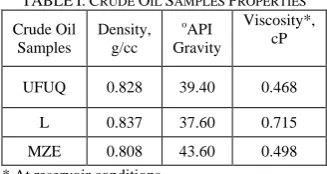
IX. OIL SAMPLES FLUID CHARACTERISATION The crude oil samples that used for this study were collected from different oil fields from Petroleum Development Oman and Daleel Petroleum companies in Oman. The oil fields contain light oil and they are located in the North of Oman. The oil samples were obtained from the test separator and thus they are at surface conditions. A summary of the oil samples properties is shown in the Table I below:
TABLE I: CRUDEOILSAMPLES PROPERTIES Crude Oil
Samples
Density, g/cc
o
API Gravity
Viscosity*, cP
UFUQ 0.828 39.40 0.468
L 0.837 37.60 0.715
MZE 0.808 43.60 0.498
* At reservoir conditions
X. CO2- OIL MMP PREDICTION
The CO2–Oil MMP can be calculated from the existing correlations available in the literature. The most commonly used correlations selected for the calculation of the MMP are; Cronquist [9], Lee [10] and Yellig& Metcalfe [11] and are written in the equations (1),( 2) and (3) respectively;
7.3942 10
1519 2.772
492 1.8
b
R MMP
b
T
(2)
2
4
12.6472 0.015531 1.8 32 716.9427 1.24192 10 1.8 32
1.8 32
R
R
R
MMP T
T
T
(3)
XI. RESULTS AND DISCUSSION
The experimental runs on the oil samples UFUQ, L, and MZE were performed by using the RBA apparatus. Each experimental run included four stages. These stages are pre-experimental clean up, CO2gas and liquid transfer; such as water and oil, to the visual sapphire cell, experimental run
5
0.11027 1.8R 32 y
C T
M MM
W
y Vo
P
l
(1) .0015279
and the post-experimental clean up. All CO2 – Oil MMP
experiments were run at reservoir pressure and temperature and each one lasted for about 5 hours.
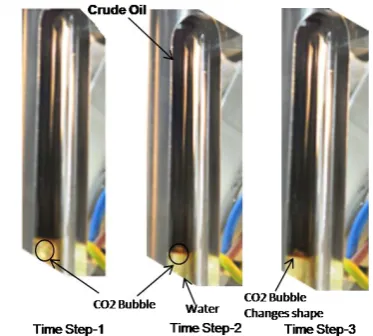
Fig. 3 shows the CO2bubble behavior at or close to MMP. It can be observed at the time-step-3 the CO2 changes its shape, does not rise upward and finally disappears in the crude oil column.
The CO2– Oil MMP was calculated by different methods to compare between the experimental results with the predicted ones. The software PVT Pro 5.2.1 was used to calculate the CO2 – Oil MMP. The input into the software was the reservoir pressure and temperature, oil properties and the oil compositions of the three oil samples. The resultant calculations of the CO2 – Oil MMP values are shown in Table III.
The CO2– Oil MMP correlations mentioned earlier were used to estimate the MMP. The results of the calculation of the CO2– Oil MMP by using the correlations equations 1, 2 and 3 for the three oil samples are shown in Table III.
TABLE III: PREDICTED MMP Oil
Samples PVTPro 5.2.1
Cronquist Lee Yellig&
Metcalfe
MMP MMP MMP MMP
kPa kPa kPa kPa
UFUQ 14121.84 9000.00 17887.00 15154.10
L 14230.09 8043.50 13546.00 12600.10
MZE 14259.05 9702.60 16688.00 14500.70
In Table III, it can be seen that the calculated CO2– Oil MMP values from the PVT Pro 5.2.1 and the literature correlations. This is done for comparison between the different methods and consequently to be able to determine the method that best estimates the CO2– Oil MMP based on the three oil samples experimental results.
The % differences between the experimental and the calculated MMP values from the different methods are summarized in Table IV.
TABLE IV: % DIFFERENCES BETWEEN EXPERIMENTAL AND PREDICTED MMP
Oil Samples
PVT Pro 5.2.1
Cronquist Lee Yellig&
Metcalfe %
Difference
% Difference
% Difference
% Difference
UFUQ 2.27 37.72 -23.79 -4.87
L 0.14 43.55 4.94 11.58
MZE 2.00 33.32 -14.69 0.34
It can be deduced from Table IV that CO2– Oil MMP values obtained by PVT Pro 5.2.1 are the ones that are the closest to the experimental results for all the pressure and temperature ranges of the crude Omani oil samples. Thus, PVT Pro 5.2.1 software provides the most accurate calculations of the CO2– Oil MMP compared to the literature correlations. This is due to the fact that there are more detailed oil properties and oil composition data that are inputted in the PVT Pro 5.2.1 software to better simulate the oil sample phase behavior.
XII. CONCLUSIONS
The technical contributions of the CO2-Oil MMP study are concluded below:
1) Developing and constructing successfully the first RBA system in Oman in the most cost effective way.
2) The newly constructed RBA Apparatus allowed visible miscibility, consumed smaller Oil sample volumes and was less time consuming for the experimental runs. 3) PVT Pro 5.2.1 software provides the most accurate
model prediction of CO2 – Oil MMP for Omani light Oil reservoirs.
4) Using the PVT Pro 5.2.1 software Provide a cost effective and less time consuming method for the oil companies to predict CO2 - Oil MMP.
5) This study helps oil companies to evaluate the economic viability of the potential CO2flooding for effective EOR method in Oman in a fast and less time consuming technique.
It is recommended to extend this study for further experimental runs on more oil samples to cover more Omani light oil reservoirs.
NOMENCLATURE
EOR: Enhanced Oil Recovery EOS: Equation of State
MMP: Minimum Miscibility Pressure MWC5+: Molecular Weight of C5+fractions RBA: Rising Bubble Apparatus
TR: Reservoir Temperature, 0C Fig. 3. CO2Bubble behavior at MMP
The RBA experimental results of the measured CO2– Oil MMP for the oil samples used for the research study are summarized in Table II:
TABLE II: EXPERIMENTAL RESULTS OFMMP
Oil Samples Reservoir Reservoir RBA System
Pressure Temperature MMP*
kPa 0C kPa
UFUQ 14700.31 80.00 14450.03
L 13779.86 63.00 14250.01
MZE 15058.15 75.60 14550.01
VIT: Vanishing Interfacial Tension
Vol.: Volatiles (C1and N2) mole percentage, %
ACKNOWLEDGMENT
Petroleum and Chemical Engineering Department at Sultan Qaboos University acknowledges and appreciates all who helped in the construction of the Rising Bubble Apparatus system, in the collection of the oil samples from the Omani fields, in the Oil PVT compositional data gathering and in the experimental work. Their cooperation and support was greatly beneficial.
REFERENCES
[1] M. Trujillo, D. Mercado, G. Maya, R. Castro, C. Soto, H. Pérez, V. Gómez, and Ecopetrol, “Selection methodology for screening evaluation of enhanced oil recovery methods,” in Proc. of SPE
139222-MS, Lima, Peru, December 2010.
[2] Meyer and James,“Summary of carbon dioxide enhances oil recovery (CO2EOR) injection well technology,” prepared for the American
Petroleum Institute, November 24, 2004.
[3] R. L. Christiansen et al., “Rapid measurement of minimum miscibility pressure using the rising bubble apparatus,” inProc. SPE 13114, Sep. 1984.
[4] Benham, A. L. Aime Dowden, W. E. Kunzman, and W. J.Aime, “Miscible fluid displacement--prediction of miscibility miscible,” in
Proc. SPE 1484-G, The Ohio Oil co. Littleton, Colo.-USA, March 17,
1960.
[5] R.Simonand D. J.Graue, “Generalized correlations for predicting solubility, swelling and viscosity behavior of CO2-crude oil systems,”
in Proc. SPE 39th Annual Fall Meeting, SPE 00917, California
Research Corp., LA Habra, Calif., Houston, Texas, 1964.
[6] L. W. Lake,Enhanced Oil Recovery, ISBN: 0-13-281601-6,1989, pp. 234-235.
[7] J. Kim, H. Hamish, H. Kaare, K. S. Ole, and D. N. Veritas, “Mapping of potential HSE issues related to large-scale caputre, transport and storage of CO2,” January 2009.
[8] B. Z. Shakhashiri, “General Chemistry Courses,” University of Wisconsin, February 6, 2008.
[9] C.Cronquist, “Carbon dioxide dynamic displacement with light reservoir oils,”Fourth U.S. DOE Symposium, Tulsa, USA, pp. 18-23, Aug. 1978.
[10] J. I. Lee, “Effectiveness of carbon dioxide displacement under miscible and immiscible conditions”, Report RR-40, Petroleum Institute, Calgary, March 1979.
[11] W. F. Yellig and R. S. Metcalfe, “Determination and prediction of CO2minimum miscibility pressures,”JPT, pp. 160-168, June 1980.
Khalid Al-Hinaiis a Ph. D. student at Sultan Qaboos University. He holds a B. Sc. of petroleum engineering from University of Tulsa, Oklahoma, USA, and M. Sc.
of petroleum engineering from Imperial
College-London-UK. He worked for PDO as a senior reservoir engineer. His experience includes formation wire line testing, well testing, reservoir simulation, oil and gas reserves estimation, field development planning and miscible EOR method. His 25 – years experience was locally in Oman in PDO, regionally in the Middle East and internationally in South East Asia in Brunei Shell (BSP). He was Baker Atlas Middle East reservoir engineer specialist for wire line pressure testing. Khalid is a member of Society of Petroleum Engineers.
Ali bin Soud bin Ali Al-Bemani is an associate professor and Vice Chancellor of Sultan Qaboos University (SQU). He holds a B. Sc. of etroleum engineering from University of Texas at Austin, Texas, USA, and M. Sc. of Petroleum Engineering from University of Southern California, Los Angeles, California, USA, and a Ph. D. of petroleum engineering from University of Southern California, Los Angeles, California, USA. He worked for PDO as an operation petroleum engineer and as a production technologist before joining SQU in August-1986. Dr. Ali conducted petroleum engineering short courses and was a consultant for the industry. His publications include 27 Journal papers and 23 conference papers in the fields of EOR and Improved oil Recovery. His research interest is reservoir simulation studies, EOR and improved oil recovery.
![Fig. 1. CO2 phase diagram [8]](https://thumb-us.123doks.com/thumbv2/123dok_us/1384790.1649256/2.595.48.286.525.688/fig-co-phase-diagram.webp)