Application of Different ANN Methods to Provide Electrical Safety in High Voltage
Underground Cable Lines
Bahadir Akbal
Department of Electric and Electronic Engineering, Selçuk University, Konya, Turkey.
Article Received: 19 August 2017 Article Accepted: 30 September 2017 Article Published: 14 December 2017
1. INTRODUCTION
Power loss is an important issue for electrical networks, so voltage level of transmission line is raised to decrease
power loss of long transmission and distribution lines. Transmission and distribution of high voltage are made by
using overhead and underground cable lines. High voltage creates some insulation problems, and these problems
affect electrical safety. Especially, providing of electrical safety of overhead lines is major problem in cities or
crowded areas. Hence, underground cable lines are used instead of overhead lines in indoor, indoor areas, city
centre, the crowded neighbourhoods and between buildings because high voltage underground cable has an
insulation layer, so electrical insulation level of underground cable line is more than overhead line in narrow
spaces. Also, insulation layer is cowered by metallic sheath to protect insulation layer against to environmental
damages. In Fig. 1, a high voltage underground cable is shown [1].
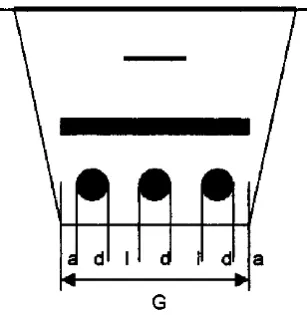
Fig. 1. High voltage underground cable Fig. 2. Standard high voltage underground cable
A B S T R A C T
High voltage underground cables has an insulation layer, so high voltage underground cables are preferred instead of overhead lines in indoor, indoor areas, city center, crowded neighborhoods and between buildings. However, cable faults are very important problem, and the sheath current is one of the most important factors for cable faults and electroshock risk. Thus, metallic sheath is grounded to prevent the sheath current effects in high voltage underground cables. In literature, single point bonding, solid bonding and cross bonding methods are used to ground metallic sheath of cable, but primarily the sheath current must be determined to select the most suitable bonding method. In this study, the sheath current of high voltage cable line is forecasted by using different type artificial neural networks (ANN) and hybrid ANN methods. Hybrid ANN methods are developed by using PSO (particle swarm optimization), DEA (differential evolution algorithm) and iPSO (inertia weight PSO). It is seen that training and forecasting errors of hybrid ANN methods are lower than the other ANN network types. Hybrid ANN methods are iPSO-ANN, PSO-ANN and DEA-ANN methods. Also, training and forecasting errors of iPSO-ANN are lower than the other hybrid ANN methods.
3 2 2
G d l a (1)
High voltage underground cable is protected by the cable channel, and insulation layer is protected by metallic
sheath, but the sheath current generates on metallic sheath.
Fig. 3. Multiple high voltage underground cable channel
The sheath current increases cable temperature, so cable insulation life and performance are reduced by the sheath
current. Also the sheath voltage increases due to the sheath current, and electroshock risk occurs due to high sheath
voltage. It is seen that the sheath current must be reduced to provide electrical safety.
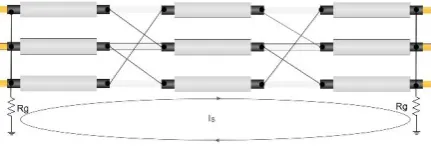
Thus, bonding methods are used to reduce sheath voltage and current [2,5]. Single point bonding, solid bonding and
cross bonding methods are used as bonding methods in IEEE 575-1988 standard. These bonding methods are
shown in Fig. 4, Fig. 5 and FiG. 6.
Fig 6. Cross bonding
If cable line length is short, single point bonding is used. If cable length is long, solid bonding or cross bonding are
used. Also amount of the sheath current has important role to determine bonding method type. Namely, if the
sheath current of high voltage cable line is known, the most suitable bonding type can be determined, so cable faults
and electroshock risks can be prevented. Especially, if the sheath current of high voltage cable line which will be
installed as a new line is known at the project phase of high voltage underground cable line, the most suitable
bonding method and the required precautions can be determined before high voltage underground line is installed.
Hence, cable faults and electroshock risks are prevented during electric transmission or distribution. Forecasting
methods can be used to determine the sheath current of high voltage underground line. Artificial neural network
(ANN) can be used for forecasting studies because ANN is very useful method for forecasting studies, also ANN is
used to solve many engineering problems. However, inputs are necessary for ANN to forecast the sheath current.
Therefore knowing of the sheath current forming factors are very important for forecasting of the sheath current.
Three phase systems is generally accepted as balanced, and total magnetic field is accepted as zero because
vectorial sum is zero in the balanced three phase system. However, total magnetic field is not zero in unbalanced
three phase systems. Thus the sheath current occurs on metallic sheath. Namely, the most important factor is
unbalanced phase current for forming of the sheath current [6]. Underground cable lines are installed according to
certain cable configuration. These cable configurations are trefoil and flat formations. The sheath current of trefoil
configuration is lower than flat formation, but flat formation is generally used [7,8] in high voltage underground
cable lines. These formations are shown in Fig. 7.
Fig. 7. Trefoil and flat formations
In this study, different high voltage cable line is generated in PSCAD/EMTDC simulation program, and the sheath
currents of these high voltage lines are obtained after many simulation studies. It is seen at the end of simulation
studies that cable length (L), distance of between phases (d), unbalanced phase current (IUB), cable formation and
grounding resistance (Rg) are the most important factors for formation of the sheath current in high voltage
d d d
Simulation of high voltage underground cable is made by using electromagnetic transient program [14,15]. In this
study, simulation studies for high voltage underground cable lines are used PSCAD/EMTDC as electromagnetic
transient program. In simulation studies of high voltage cable, primarily high voltage cable is modelled. In this
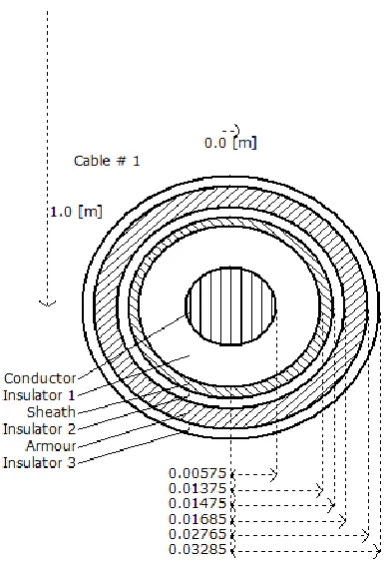
study, the modelled cable is shown in Fig. 8.
Fig. 8. The modeled high voltage underground cable
Cable length, distance of between phases, unbalanced phase current and grounding resistance are the most effective
factors in formation of the sheath current of the high voltage underground cable lines. These factors are used to
generate different high voltage cable lines, and simulations of these cable lines are made in PSCAD/EMTDC to
obtain sheath currents of these lines. Hence, these factors and the real values of sheath current of different lines are
used for training process of ANN.
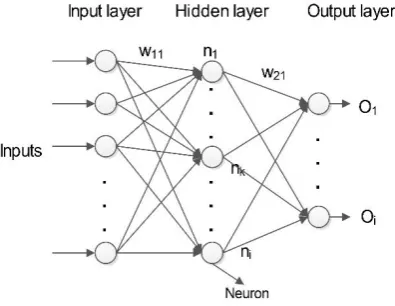
Working principle of ANN is based on mathematical model of human learning, and the basic element of ANN is
neuron. Also ANN occurs from input layer, hidden layer and output layer [16,18]. The basic schema of ANN is
Fig. 9. The basic schema of ANN
Neurons work as a transfer function. This transfer function is shown in Equation (2), and a neuron working schema
is shown in Fig. 10.
(2)
Where, xj is input, wij is weight, bi is bias, fi is transfer function, and yi is output of the neuron.
Fig. 10. Neuron working schema
Activation functions can be sorted as step function, linear function, log-sigmoid function, tan-sigmoid function,
softmax function, and gaussian function. Primarily, training process is implemented in ANN, and training error is
calculated. Mean square error (MSE) method is used in calculation of training error. MSE is shown in Equation
(3).
(3)
Where, E(t) is estimation error at tth iteration, p(i) is the desired value for ith output, o(i) is the actual value for ith
output. Weights of ANN should be updated to reduce training error, so Equation (4) is used to update weights in
classic ANN.
1
( )
n i i ij j i
j
y f w x b
2
1
1
( ) ( ( ) ( )) n
i
E t p i o i n
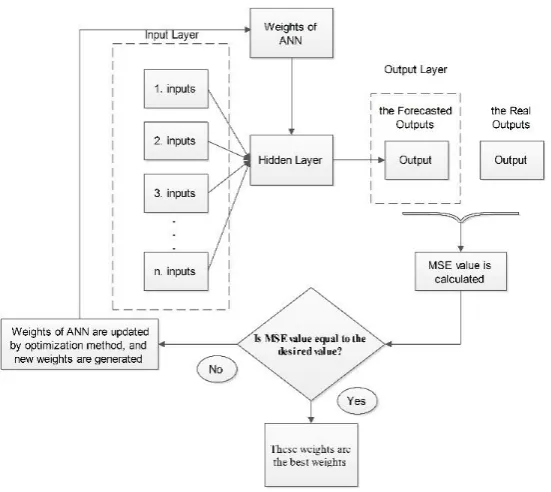
obtain the most accurate results. In hybrid ANN method, weights of ANN are optimized with optimization methods
according to training and forecasting errors. In this study, differential evolution algorithm (DEA), particle swarm
optimization (PSO) and inertia weight particle swarm optimization (iPSO) are used as optimization method to
determine the most suitable weights. Namely, in classic ANN, weights are updated by Equation (4), but in hybrid
ANN, weights are updated by optimization methods. Flow chart of hybrid ANN method is shown in Fig. 11.
Fig. 11. Hybrid ANN flow chart
3. EXPERIMENTAL STUDIES
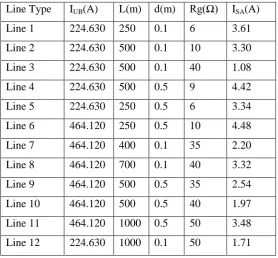
59x5 data matrix is used for training of ANN and 12x5 data matrix are used for test of ANN. In these matrices,
unbalanced phase current (IUB), cable length (L), distance of between phases (d), grounding resistance (Rg) and the
sheath current are used as variables. Values of these variables are obtained in PSCAD/EMTDC.
This 12x5 data matrices is shown in Table 1. In Tables, ISA is defined as real value of the sheath current. ISA is
obtained from simulation studies in PSCAD/EMTDC. ISA is used in training and test studies to obtain errors. In
Table 1. Test matrices
Line Type IUB(A) L(m) d(m) Rg(Ω) ISA(A)
Line 1 224.630 250 0.1 6 3.61
Line 2 224.630 500 0.1 10 3.30
Line 3 224.630 500 0.1 40 1.08
Line 4 224.630 500 0.5 9 4.42
Line 5 224.630 250 0.5 6 3.34
Line 6 464.120 250 0.5 10 4.48
Line 7 464.120 400 0.1 35 2.20
Line 8 464.120 700 0.1 40 3.32
Line 9 464.120 500 0.5 35 2.54
Line 10 464.120 500 0.5 40 1.97
Line 11 464.120 1000 0.5 50 3.48
Line 12 224.630 1000 0.1 50 1.71
Table 2. the Forecasted Sheath Current of Different Type ANN Models
L ISA (A) ISF (A)
FFBP LR EBP iPSO PSO DEA
1 3.61 3.49 2.33 2.56 3.63 3.22 3.62
2 3.30 3.49 1.19 1.22 4.45 3.67 4.45
3 1.08 3.49 3.76 3.80 0.90 3.66 0.91
4 4.42 3.49 2.71 2.66 4.55 3.66 4.59
5 3.34 3.49 1.90 1.81 3.62 3.22 3.64
6 4.48 3.49 1.35 1.26 4.35 1.87 4.39
7 2.20 3.49 0.81 0.75 2.18 2.13 2.20
8 3.32 3.49 4.33 5.45 3.12 2.67 3.17
9 2.54 3.49 2.26 2.97 2.68 2.32 2.74
10 1.97 1.35 3.92 5.48 2.08 2.31 2.15
11 3.48 1.35 2.00 3.00 3.47 3.20 3.58
12 1.71 1.35 1.055 1.41 2.28 4.54 2.34
Table 3. Training and Forecasting Errors of Different Type ANN Models
ANN type Training
Errors
Forecasting
Errors
Feedforward backpropagation 1.1493 0.7732
Layer recurrent 0.5380 0.6877
network types. Also errors of iPSO-ANN is lower than the other hybrid ANN methods. Thus, iPSO-ANN method is
proposed for the sheath current forecasting studies. After the sheath current of high voltage underground cable line
is accurately forecasted, the most suitable bonding method can be selected. If cable length is shorter than 200 m,
generally single point bonding method can be used. However, if ground resistance is very small, the sheath current
value can be high. If the sheath current value is high, cross bonding should be used even if cable length is short (less
than 200m). If the sheath voltage value is high, solid bonding should be used even if cable length is short (less than
200m). Thus, determination of the sheath current is very important before installation of high voltage cable line.
4. CONCLUSION
If the sheath current of high voltage underground cable line which will be installed as a new line can be determined
at project phase before installation of this line, the required precautions and the most suitable bonding method can
be detected. This way is economic and reliable. Thus, in this study, different ANN networks and hybrid ANN
methods are used to forecast the sheath current. It is seen according to the results that iPSO-ANN method will be
very useful to forecast the sheath current of a new high voltage underground cable line. Hence, the most suitable
bonding method is selected, and cable faults and electroshock risks can be prevented as economically and reliably.
REFERENCES
[1] A.D. Tziouvaras, Protection of High-Voltage AC Cables, in 59th Annual Conference for Protective Relay
Engineers (2006), 48-61.
[2] R. Benato, Multiconductor analysis of underground power transmission systems: EHV AC cables, Electric
Power Systems Research, 79 (2009), 27-38.
[3] J.R. Ruiz, A. Garcia, X.A. Morera, Circulating sheath currents in flat formation underground power lines”, in
International Conference on Renewable Energies and Power Quality (2007), 1-5.
[4] L. Zhonglei, B.X. Du, L. Wang, C. Yang, H.J. Liu, The calculation of circulating current for the single-core
cables in smart grid, in IEEE Innovative Smart Grid Technologies – Asia (2012), 1-4
[5] S. Czapp, K. Dobrzynski, J. Klucznik, Z. Lubosny, Calculation of induced sheath voltages in power cables –
single circuit system versus double circuit system, Journal of Information, Control and Management Systems, 12
[6] C.K. Jung, J.B. Lee, J.W. Kang, Sheath circulating current analysis of a cross-bonded power cable systems, J
Electr Eng &Technol, 2 (2007), 320-328.
[7] O.E. Gouda, A.A. Farag, Factors affecting the sheath losses in single-core underground power cables with
two-points bonding method, Int J Electr & Comp Eng, 7 (2012), 7-16.
[8] J.R. Ruiz, X.A. Morera, Effects of the circulating sheath currents in the magnetic field generated by an
underground power line, in International Conference on Renewable Energies and Power Quality (2006), 1-5.
[9] C.K. Jung, J.B. Lee, J.W. Kang, Sheath circulating current analysis of a cross-bonded power cable systems,
Journal of Electrical Engineering & Technology, 2(2007), 320-328.
[10] O.E Gouda, A.A Farag, Factors affecting the sheath losses in single-core underground power cables with
two-points bonding method, International Journal of Electrical and Computer Engineering, 2(2012), 7-16.
[11] J.R. Ruiz, X.A. Morera, Effects of the circulating sheath currents in the magnetic field generated by an
underground power line, in International Conference on Renewable Energies and Power Quality (2006), 1-5.
[12] W. Moutassem, G.J. Anders, Calculation of the eddy current and hysteresis losses in sheathed cables inside a
steel pipe, IEEE Transactions on Power Delivery, 25(2010), 2054 – 2063.
[13] B. Akbal, Neural-Network-Based Current Forecasting On High-Voltage Underground Cables, Electronics
World, 122 (2016), 30-34.
[14] U.S. Gudmundsdottir, B. Gustavsen, C.L. Bak, W. Wiechowski, Field test and simulation of a 400-kV
cross-bonded cable system, IEEE T Power Deliver, 26(2011),1403-1410.
[15] B. Akbal, Determination of the Sheath Current of High Voltage Underground Cable Line by Using Statistical
Methods, International Journal of Engineering Science and Computing, 6(2016), 2188-2192.
[16] W. Charytoniuk, M.S. Chen, Very short-term load forecasting using artificial neural networks, IEEE
Transactions on Power Systems, 15(200), 263-268.
[17] R. Achanta, Long term electric load forecasting using neural networks and support vector machines,
International Journal of Computer Science and Technology, 3(2012), 266-269.
[18] T. Weigerta, Q. Tianb, Q. Lianb, State-of-charge prediction of batteries and battery–supercapacitor hybrids