A Study on Use of Artificial Intelligence in Wireless Communications
D.Banupriya1, Pandi2, S.Preetha3, R.Raj Prathisha4
1Assistant Professor, Department of Electronics and Communication Engineering, Sasurie Academy of Engineering, Coimbatore, India. 2,3,4Department of Electronics and Communication Engineering, Sasurie Academy of Engineering, Coimbatore, India.
Article Received: 27 November 2017 Article Accepted: 24 January 2018 Article Published: 30 March 2018
1.INTRODUCTION
The rapid development of mobile Internet generates tremendous amount of traffic, consequently requires more
bandwidth and better quality of experience. To satisfy the growing demand for data traffic, the wireless networks
are emerging towards a heterogeneous paradigm. In the future5G mobile communication system, the network
consists of multiple layers of cells like macro, femto, pico, relays, etc. The radio resources are reused more
efficiently to improve the network coverage and capacity. The dense deployed nodes and mobile equipment will
pose new challenges to the networks. First, the densification and heterogeneity makes the network management
more complex than ever before. The traffic dense will increase up to 1000 times in 5G because of the growing of
user data speed and the growing of end user terminals. The traditional network control and management activities
are no longer available. A promising method is to introduce artificial intelligence (AI) into the network control and
management, instead of manual optimization processes. With artificial intelligence, the networks are managed
more autonomously and efficiently, and the performance is enhanced. In this paper, we investigate the usage of
artificial intelligence in wireless communication systems. First, we give a brief description of the state of-the-art of
the wireless communication techniques, and further discuss the opportunities to exploit AI technique to built
intelligent future mobile networks. Then we introduction several classic artificial intelligence techniques: fuzzy
logic, machine learning, and neural network. We investigate the recent academic research status on the application
of these techniques in varies wireless communication scenarios, mainly including the radio resource management,
the power control, the interference management, the mobile management, etc.
2.STATE OF THE ART OF WIRELESS COMMUNICATION AND NEED FOR AUTOMATIC
In the past three decades, the wireless mobile communication network has experienced three generations. The
first-generation (1G) was debuted in the 1980s. 1G system uses analog technology and provides voice service only.
The second-generation (2G) network is the first digital mobile communication system, and utilizes the
A B S T R A C T
In recent years, the wireless mobile communication technology growth is rapidly increasing and instead of the results the wireless information explosion is enormously. The network infrastructure is more and more complicate. It is inefficient and expansive to use the traditional operation and management methods which mainly relies on humans in the future wireless networks. It is promising to make the network self-operation, self-configuration, self-management. Fortunately, the Artificial Intelligence (AI) technique is a promising way to realize the radio network automation. In this paper, we give a general description of the state-of-the-art of the wireless communication systems and the need for intelligence functionalities. Then, we investigate the recent advances on the application of artificial intelligence technique in wireless communication domains. We believe that AI-empowered future network will accelerate the development of the ICT industry.
Time-Division Multiple Access (TDMA) scheme to support more users.2G provides voice services and low rate
data services (only14.4Kbps). The third-generation (3G) system is characterized by the Code Division Multiple
Access (CDMA) technique. 3G is able to support mobile internet services with data rate up to 384Kbps. Today, the
4th generation cellular network is deployed all over the world and provides all-IP broadband mobile access to end
users. With the tide of IOT (Internet of Things), more and more mobile smart devices besides smart phones will
access to the mobile Internet.
The next generation mobile communication system, which is also known as the 5th generation (5G) offers three
types of scenarios: First, the enhanced mobile broadband (eMBB) aims to provide broadband multimedia to
human-centric use cases. Second, the ultra-reliable low latency service (URLLC) with strict requirements in terms
of latency (ms level) and reliability (five nines and beyond). URLLC is used for Remote control of robots or tactile
Internet applications. Third, Massive machine type communications (mMTC), mainly used to connect a very large
number of devices and transmitting a low volume of non-delay-sensitive information.
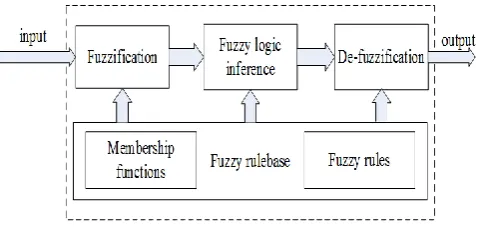
Figure 1: Fuzzy logic controller structure
It is believed that the total throughput will grow 1000 times from 2014 to 2020. The number of devices will grow to
500 billion. In order to achieve the capacity grows, 5G cells have to be densely deployed, about 40x to50x times as
many as 4G networks. Because of the application of new air interface techniques, varied services and terminals, a
typical 5G node has about2000 parameters to be configured. According to estimation in, there will be 53 to 67 times
increase in operational complexity in 5G compared to 4G. It is challenging and time-consuming for 5G operators to
operate and configure the network all by humans. It is necessary increase automation to wireless mobile networks.
Although the self-operation-network (SON) paradigm have already evolved in2G, 3G and 4G, the automation is
realized by predefined policies, rather than interact with the environment and smart decisions. In 5G, it is promising
to apply AI to the mobile network and make it smarter than the past.
2.1 THE APPLICATION OF AI IN WIRELESSCOMMUNICATION
Artificial intelligence is the technique that makes machines solving problems with intelligence like human beings.
With artificial intelligence, the machine mimics human minds and “learning” from the environment, then solve
tools. In this paper, we will introduce 3 most general tools, and investigate the application of these tools in the
wireless communication field.
2.2 Fuzzy Logic
Fuzzy logic (FL) theory was proposed in 1965 by Lotfi Zadeh [6]. In the classic computer logic, all variables follow
the Boolean logic, in which variables are limited to only two values (True or False). Fuzzy logic is a multi-valued
logic in which variables can be any values between completely true and completely false. The real world is a system
full of uncertainty, ambiguity, imprecision and vagueness, fuzzy logic is used to imitate the uncertain inference
process of human mind. A fuzzy logic controller is composed of the fuzzifier, the inference engine and the
defuzzifier (Fig. 1). The input variables are fuzzified according to the membership functions. Then, the inference
engine combines the inputs with a series of “IF...THEN...” rules to get the output. Finally, the output is defuzzified
into the final “crisp” output values. In wireless communication Fuzzy logic is mainly used to solve the
multi-criteria decision making problems, such as network selection, handover management, etc.
The authors present a handover scheme in LTE network. In contrast to the traditional handover scheme based only
on received signal strength (RSS), the proposed algorithm also takes the data rate and network coverage area into
consideration. It is proved that the packet delivery ratio (PDR) is improved and the packet loss is decreased. The
ping-pong movement is one of the most crucial problems in handover. In fuzzy logic is applied to reduce the
ping-pong effects of handover. The algorithm considers the current signal-to-noise ratio (SNR), detected SNR,
bandwidth of serving eNB, bandwidth of target eNB, and remaining energy of the underlying user’s device. In use
fuzzy logic to detect ping pong effect attack in low rate wireless personal area networks. The network is
self-organized to clusters, and the master/controller selection for each cluster is realized by fuzzy logic. Network
selection, also known as radio access technology (RAT) selection is one of the most challenging task in wireless
heterogeneous networks. Deciding which network is the most suitable relies on many factors, such as the network
status, channel status, and the user satisfactoriness, etc.. In a parallel fuzzy system (PFS) is applied to determine the
probability of RAT selection. The probability is further combined with a non-homogenous bio-geography based
optimization to select the best network, which can maximize the user satisfaction. The author of presents a fuzzy
logic based network selection mechanism for 5G cellular networks. The inputs of the fuzzy inference controller are
RSRQ, the service sensitivity to latency, the load of the (H)eNB or AP, the backhaul load, and the UE mobility
status. Every input parameter is fuzzified to low, medium and high membership functions. Three FL controllers are
employed, each for one network, i.e., macro cell, femto cell and WiFi. In fuzzy logic isused to deal with the lack of
information at the user side and the radio environment randomness. The network selection is realized by two steps:
in the first step, the out-of-context suitability of each RAT to a the delay-sensitive applications and best-effort
applications are estimated by fuzzy logic. In the second step, the estimation results of the first step is combined with
the terminal capabilities, user preference and operator policies to derive the in-context suitability of each RAT. The
decision is made according to a fuzzy multiple attribute decision making methodology. In proposed a network
considered as the input of fuzzy logic controller: the received signal strength, the speed of mobile, the mobile
battery level, the user classification and the type of service. The output is represented by for linguistic variables: not
acceptable, probably not acceptable, probably acceptable and acceptable.
2.3 Reinforcement Learning
Reinforcement learning is an area of machine learning that makes computers to learn by itself, instead of being
precisely programmed.
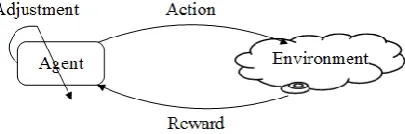
Figure 2: Reinforcement learning
A basic reinforcement learning model consists of a set of learners, which is also known as “agents”, and the
environment (Fig. 2). In a reinforcement learning circuit, the agent chooses an action according to the environment
state, then the environment respond to the agent with a reward. The purpose of the agent is to maximize the
cumulative reward over time by adjust its actions through learning. There are mainly two categories of RL
approaches: the model-based RL and the model-free RL. The first approach requires known reword and transition
functions and is usually optimized through dynamic programming or value iteration.
In the second approach, the reward and transition functions are unknown, and the agent interacts with the
environment to get the optimal policy. The second approach is more applicable in complex environments.
Temporal Difference, Monte Carlo, and Q-Learning are the most popular model-free RL techniques.
Reinforcement learning is mainly used in wireless communication in self-organized networks, power control, radio
resource management, interference management, etc. In this presented a reinforcement learning based self-healing
method for the cell outage compensation. Considering the complexity of the wireless cellular environment, a
temporal difference learning approach is chosen to adjust the downlink transmission power level and the antenna
tilt value, in order to fulfill the coverage and capacity gap produced by network fault. The environment state is
represented by the resource allocation and the corresponding CQI, and the reward is defined as the Signal to
Interference and Noise Ratio (SINR). Which is presented a decentralized Q-learning power control method for
LTE? In the method, the concept of fractional power control (FPC) is applied into Q-learning. Accordingly, the UE
find the optimal transmit power in decentralized way with respect to uplink path loss. Paper presents a the
reinforcement learning based radio resource management scheme for a two-tier network composed of the macro
cells and small cells (SCs). The SCs determine when to switch ON and OFF according to the energy harvesting
pattern and traffic demand. The optimization purpose is to, in order to. The reinforcement learning is realized
through a decentralized multi-agent Q-learning model. The rewards are the system drop rate, the throughput and the
Through intelligent slot selection, collisions and retransmissions can be avoided. In the proposed scheme, each slot
is assigned a weight which is updated by successful transmissions or failures. Reinforcement learning is used to
select the optimal slots for nodes. Finally, the throughput and delay performance is improved. Paper [18] deals with
the interference control problem in cognitive radios (CR) networks with a decentralized Q-learning method. The
secondary base stations (BS) are modeled as distributed agents. The Q-learning agent consider the system state
composed of the current interference level, the distance between the secondary user and the protection contour, and
he secondary user transmitting power. The possible actions are the power levels that secondary BSs can take. The
cost function is defined as the SINR gap from the target level. Both situations of complete and partial environment
information are considered.
In the first case, the Q-learning algorithm can converge to the optimal solution. In the second case, a good
suboptimal solution can also achieve. The co-channel interference between macro-cells and femto-cells severely
limit the overall capacity of LTE network. In that proposes a distributed RL framework for femto-cells sharing
spectrum with the macro-cells. The state is defined as the aggregated interference generated by femto-cells and the
total transmitting power. The femto BSs take actions of power allocation policies in order to make sure that the total
transmission power of a femto-cell below a certain threshold and the SINR at the macro UE below a target level. A
decentralized Q-learning algorithm is presented to solve the problem. In order to accelerate the convergence speed,
a smart initialization method is used. Use reinforcement learning for secondary user power control in cognitive
radio networks. The power control problem is modeled as mixed-strategy repeated power control game, and solved
through Bush-Mosteller reinforcement learning. With this method, the power control of CR users is done in a
distributed way and don’t need complete information. Therefore, the information exchange overhead is cut down.
The anti-jamming problem in cognitive radio networks is investigated. In cognitive radio networks, the spectrum
occupation varies from time to time, and the channel changes rapidly. The secondary users which access the unused
licensed spectrum temporarily usually face the attack of jammers. In, this proposed the QV and the
State-Action-Reward-State-Action (SARSA) RL algorithm to solve the random jammer problem. Because the QV
and SARSA learning are the on-policy and non-greedy algorithms, they have faster learning rate. Which is
investigate the anti-jamming power allocation strategy for secondary users based on reinforcement learning
algorithms, including Q-learning and WoLF-Q. With this method, the secondary users are able to achieve the
optional transmission power and channel allocation without channel knowledge.
2.4 Neural Networks
Neural networks (NN) is an AI technique which analogous the behavior of the biological brain’s axons. An
artificial neural network composes a large collection of artificial neurons. The neurons are connected with each
other to form a network. Each individual neuron gets information from adjoining neurons and computes output
according to summation function. The purpose of NN is to make machines self-learning and solve problems in the
same way as human brain. In wireless communication systems, NN isused to learn from the environment and
Experience Estimation, etc. In a trust based intelligent routing algorithm for Delay Tolerant Networks (DTNs). The
algorithm utilizes the artificial neural network to learn from the call data record and calculate the trust value, and
then the results are shared among network devices. The data flow will be more likely to transmit to nodes with
higher trust values. As a result, the energy consumption, computation time and space overheads are decreased. The
Article introduces a self-management architecture for the cellular and ad hoc multi-hop hybrid network. Neural
network is applied to realize self-configuration and self-optimization for both the radio resource and routing. The
inter-cell interference (ICI) in orthogonal frequency division multiple access (OFDMA) systems is investigated and
reduced through a random neural network based cognitive engine (CE). The CE embedded in the NodeB learns the
ICI impact on the communication reliability, and then determines the optimal transmission power for both the
serving users and the users in adjacent cells using the same resource blocks. Through long-term learning, the CE is
able to make fast decision with low computational complexity. Therefore, this method is practical in real-time
communication systems. Quality of Experience (QoE) is a parameter that reflects the user’s satisfaction level to a
particular service, not only from the objective aspects, but also from the subjective aspects. In neural network is
adopted to estimate QoE for different types of services. Analyze the correlation of different key performance
indicators (KPI) with QoE for mobile internet services. The Neural network is used to automatically classify the
KPIs. QoE estimation model for video streaming service over wireless networks is proposed based on a
feed-forward artificial neural network, named radial basis function networks. The proposed model is trained with
cross-layer parameters, so the impact of different wireless communication protocol layers, including the
application layer, the network layer, as well as the terminal equipment characteristics are considered in the
estimation. It also use neural network for QoE estimation of real time video service. With a random neural network
framework, the impact of different MAC-level parameters on video QoE in IEEE 802.11nenabled networks is
investigated. A subjective test is compared with the estimated QoE value and verifies the validity of the proposed
method. In this author proposed a modified Kennedy-Chua neural network, based on theHopfield model, for
adaptive blind multiuser detection in the Universal Mobile Telecommunications System. With this method, the
convergence time is reduced, particularly under multipath-fading conditions.
3.CONCLUSION
In this article, we investigate the recent advances on the application of artificial intelligence techniques in wireless
communication networks. We first introduce the development history of the mobile communication systems,
from1G to 4G. Though this work focuses on the Artificial Intelligence, such a framework can be further extended to
multimodal fusion scenarios. We highlight the necessity for a smart and automatic future 5Gnetwork. In the
majority of this article, we give a survey of the utilization of several classic AI techniques, including fuzzy logic,
reinforcement learning, neural networks, in the wireless communication field.
REFERENCES
[1] L. C. I, S. Han, Z. Xu, et al, New paradigm of 5G wireless internet [J], IEEE Journal on Selected Areas in
[2] R. Li, Z. Zhao, X. Zhou, et al, Intelligent 5G: when cellular networks meet artificial intelligence[J], IEEE
Wireless Communications, PP(99) ,2-10,2017.
[3] D. Soldani, A. Manzalini, Horizon 2020 and beyond: on the5G operating system for a true digital society
[J], IEEE Vehicular Technology Magazine, Vol.10, No.1, 32-42,2015.
[4] Russell, Stuart J., Norvig, Peter (2003), Artificial intelligence: a modern approach (2nd ed.), Upper Saddle
River, New Jersey: Prentice Hall, 1-5.
[5] L.A. Zadeh, (1965), “Fuzzy sets”, Information and Control, Vol.8, No.3, 338-353.
[6] P. Datta, S. Kaushal, Fuzzy logic-based handover in 3GPPLTE network [M], Intelligent computing and
applications, Springer India,213-222,2015.
[7] K.L. Tsai, H.Y. Liu, Y.W. Liu, Using fuzzy logic to reducing-pong handover effects in LTE networks [J],
Soft Computing,Vol.20, No5,1683-1694,2016.
[8] C. Balarengadurai, S. Saraswathi, A fuzzy logic system for detecting ping pong effect attack in IEEE
802.15.4 low rate wireless personal area network [M], Intelligent Informatics, 405-416, 2013.
[9] S. Sangeetha, A.V.T. Aruldoss, Radio access technology selection in heterogeneous wireless networks
using a hybrid fuzzy-biogeography based optimization technique [J], Wireless Personal Communications,
Vol.87, No.2, 399-417, 2016.
[10] F. BoualiK. MoessnerM. Fitch. A context-aware user-driven framework for network selection in 5G
multi-RAT environments, 2016.
[11] B.Z. Aymen, M. Ayadi, S. Tabbane, A fuzzy logic algorithm for RATs selection procedures[C],
International Symposium on Networks, Computers and Communications, 15, 2014.
[12] J. Moysen, L. Giupponi, A reinforcement learning based solution for self-healing in LTE networks[C],
Vehicular Technology Conference, IEEE, 1-6, 2014.
[13] S. Dzulkifly, L. Giupponi, F. Sai, et al, Decentralized Q learning for uplink power control[C], IEEE,
International Workshop on Computer Aided Modelling and Design of Communication Links and