Open Access
Research article
Gender sensitivity among general practitioners: Results of a
training programme
Halime H Celik*
1, Ineke I Klinge
1, Trudy T van der Weijden
2,
Guy GAM Widdershoven
1and Toine ALM Lagro-Janssen
3Address: 1Department of Health, Ethics and Society, School for Public Health and Primary Care (CAPHRI), Faculty of Health Medicine and Life Sciences, Maastricht University, The Netherlands, 2Department of General Practice/Centre for Quality of Care Research, School for Public Health and Primary Care (CAPHRI), Faculty of Health Medicine and Life Sciences, Maastricht University, The Netherlands and 3Women's Studies Medical Sciences/General Practice, Radboud University Nijmegen, The Netherlands
Email: Halime H Celik* - [email protected]; Ineke I Klinge - [email protected]; Trudy T van
der Weijden - [email protected]; Guy GAM Widdershoven - [email protected]; Toine ALM Lagro-Janssen - [email protected]
* Corresponding author
Abstract
Background: Gender differences contribute to patients' health and illness. However in current healthcare practices attention to gender differences is still underdeveloped. Recognizing these differences and taking them into account can improve the quality of care. In this study we aimed to investigate whether GPs' gender sensitivity can be stimulated by a training programme. The focus was on three diseases: angina pectoris, depression and urinary incontinence.
Methods: This study had a quantitative, explorative and descriptive design. By means of a training programme 18 GPs were trained to focus on gender-sensitive recommendations for the three diseases. With standardised registration forms, data were collected during a 6-month period. During the registration period, the GPs were visited by the study team to discuss the process of data collection.
Results: The GPs filled in registration forms for 100 patients: 39 with angina pectoris (31 women and 8 men), 40 with depression (26 women and 14 men), and 21 with urinary incontinence (20 women and 1 man). The results show that gender sensitivity can be stimulated among trained professionals. The combination of the training programme, clear and practical recommendations, daily discussion of relevant cases between the GP couples, feedback and support during registration by the study team probably contributed to the outcome.
Conclusion: GPs' gender sensitivity was stimulated by the training programme and the supporting visits. Ideally, structural attention could be realised by embedding gender issues in existing organisational structures of general practices.
Background
Differences between men and women in health depend on the interaction of biological, psychological,
socio-eco-nomic, and cultural factors [1-5]. Gender includes mascu-linity and femininity and refers to the array of socially constructed roles, behaviours and values that society
Published: 26 June 2008
BMC Medical Education 2008, 8:36 doi:10.1186/1472-6920-8-36
Received: 18 February 2008 Accepted: 26 June 2008
This article is available from: http://www.biomedcentral.com/1472-6920/8/36
© 2008 Celik et al; licensee BioMed Central Ltd.
ascribes to the two sexes on a differential basis. Recogni-tion of gender differences can prevent inequity in caregiv-ing. As a result the health of women and men can be improved [6,7]. In conventional medicine, a patient's ill-ness is usually reduced to a set of signs and symptoms within a biomedical framework [8]. In this framework attention to gender issues is underdeveloped as evidenced by the clinical practice guidelines, which are widely used for decision-making in healthcare. To date, most guide-lines do not cover gender issues [9]. Moreover, medical training and General Practitioner (GP) specialist training is gender neutral, as little or no attention is paid to sex and gender differences in medical education [10]. Therefore, it is not surprising that much about gender differences remains unknown and unaddressed in the provision of healthcare.
For adequate care the approach of health professionals should be more attuned to gender issues. Gender sensitiv-ity of health professionals can be defined as showing sen-sitivity to gender issues in clinical decision-making. Optimizing this requires an awareness that gender (1) has an impact on health, and (2) affects the presentation of health complaints. This sensitivity allows health profes-sionals to deal effectively with gender which will have positive effects on men as well as women.
We developed and implemented a training programme that focused on gender-sensitive recommendations. Dur-ing the programme GPs were trained to take gender into consideration for three prevalent diseases in which gender is an important factor for the quality of care: angina pec-toris, depression and urinary incontinence. The central question in this study is whether the training programme actually contributed to GPs' gender sensitivity.
Methods
Study design
A quantitative, explorative and descriptive research design was used as basis for our study. This study was part of a larger research project conducted by Maastricht University in collaboration with partners from the Academic Medical Centre of the University of Amsterdam and Radboud Uni-versity Nijmegen Medical Centre. The study reported here, investigates the gender sensitivity of trained GPs in rela-tion to suggested gender sensitive recommendarela-tions.
Study population
The study population consisted of 9 experienced GPs (8 men and 1 woman) and 9 GPs in third year of training (2 men and 7 women). According to the standard training for general practitioners each GP trainee was coupled with another GP teacher, the academic instructor for the spe-cialist training. They participated as volunteers in this study as a team from the same practice.
Disease selection
Three important public health diseases were chosen: angina pectoris, depression, and urinary incontinence. These fulfilled the following selection criteria: availability of clinical practice guidelines, highly prevalent, and proven link with gender differences, the disease should be initially treated by GPs.
Recommendations
A structured literature review using a previously described search strategy on the three diseases was performed by researchers at the University of Amsterdam, in scientific databases including Pubmed, Embase, and Psychinfo [9]. Articles were selected according to quality assessment (Cochrane), clinical relevance of gender aspects and pres-ence of additional information compared to the existing guidelines of the Dutch College of General Practitioners (DCGP-guidelines). From the selected articles we formu-lated several recommendations with regard to these three diseases [11]. In this study we present these gender sensi-tive recommendations.
Training programme
Based on the results of the literature review, an interactive training programme consisting of two modules was devel-oped and executed by the coordinator of the programme (Toine Lagro-Janssen). For the programme description see [12]. The training programme focused on the recommen-dations (see boxes below) for a gender sensitive approach to the three diseases in the general practice. The modules included a general introduction in to gender-related issues and interactive lectures. Audio visual materials related to gender issues were used for discussion purposes with the participants by the coordinator of the programme. GPs were trained to put the recommendations into practice. The programme ended with instructions on how to use the designed registration forms containing the gender sen-sitive recommendations and how to discuss the contents for educational and research purposes.
Gender sensitive recommendations for angina pectoris
1. With chest pain attention should be paid to diabetes as a risk factor in women also when atypical symptoms for chest pain are present. The reason is that due to diabetes mellitus the risk for cardiovascular disease will increase double for men and triple for women [13].
3. Symptoms which do not immediately disappear in women during rest, should not be ignored, since there can be an underlying angina pectoris [16]. Typical symptoms for angina pectoris will present during physical activity and rapidly disappear with rest.
Gender sensitive recommendations for depression
1. The GP should ask whether there are sexual problems in depressed patients, since they do not often mention this spontaneously. In depressed patients there is gener-ally a decrease of sexual functioning.
Specifically for women
1. GP's should know that depression in women can be masked by anxiety, since women with depression suffer from anxiety [17]. Furthermore, women report more symptoms consistent with anxiety than men [18].
2. GP's should ask depressed women about their past sex-ual experiences, since a history of sexsex-ual abuse is strongly associated with depression in women [19].
Specifically for men
1. The GP should know that depression in men could be masked by alcohol abuse [20], since depressed men show significantly more alcohol abuse [17,21].
2. In depressed male patients there is generally a decrease in libido, and erectile dysfunction. Men frequently experi-ence loss of libido, and erectile dysfunction as a serious disability. The GP should ask whether the patient suffers from these symptoms, since men do not often mention this spontaneously [22].
Gender sensitive recommendations for urinary incontinence
1. Recommending the use of a diary in men and women can be an instrument for improving the quality of care.
2. GPs should consider sexual issues in the management of patients with incontinence, since incontinence is a risk factor for sexual dysfunction in men and women [23].
Specifically for women
1. GP's should promptly provide active treatment for women who consult their GP with incontinence which exists for a long period.
Specifically for men
1. The GP need to attend to the emotional well-being, since most men do not report distress spontaneously [24]. Men consulting a GP may not minimize the extent of their incontinence compared to women, due to their fear of prostate cancer or impotence. These underlying concerns may cause distress which negatively impacts on their well-being.
Registrations
The GPs were asked to fill out standardised registration forms for patients seen for the first time for one of the three aforementioned diseases, immediately after the con-sultation. The purpose of the registration forms was to support and increase GPs' gender sensitivity toward patients. These quantitative data were collected during a 6-month period. Informed consent was obtained to use these data for scientific publications. If the GP did not fol-low a particular recommendation, the GP had to explain the reason for this on the form. At the end of the day all of the completed forms in the practice were discussed with each GP couple. The routine of daily conversations about their experiences and their difficult cases constituted a standard aspect of this gender- sensitivity training. During the 6-month period the study team visited the GP prac-tices twice to discuss the process of data collection.
Data analysis
To score gender sensitivity, all registration forms were coded. If GPs followed the recommendations, we assumed that they were more gender sensitive. Each rec-ommendation was assigned a code 1 when the GP's adherence to the recommendation was gender sensitivity and 0 if the adherence was not gender sensitivity. Hence, not gender sensitive means non-adherence to the gender-sensitive recommendation. Take for example, the first rec-ommendation for angina pectoris. In the event of chest pain attention should be paid to diabetes as a risk factor in women also when atypical symptoms are present. If attention was paid to diabetes as a risk factor in women with typical and atypical symptoms, the adherence was expected to be gender sensitive, and we assigned this result a code 1. If diabetes was not considered as a risk fac-tor, this was not expected to be gender sensitive, and we gave this a code 0. Data were analysed with descriptive sta-tistics, using SPSS 13.
Results
In total 100 registration forms for patients were com-pleted (39 patients with angina pectoris, 40 patients with depression, and 21 patients with urinary incontinence).
Angina Pectoris
sta-tus of women were: prior knowledge of this (N = 1), for-getting, or considering the symptoms as unproblematic.
Depression
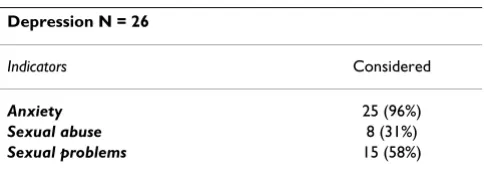
Registration forms were filled out for 40 patients with depression (26 women and 14 men). For female patients suffering form depression, the GPs acted according to the recommendation regarding anxiety in the case of 25 patients (96%) (Table 2). The recommendation regarding sexual abuse was followed for 8 female patients (31%). Reasons given for not asking depressed women about their sexual history were: the GP did not find an appropri-ate opportunity to ask about it, it was difficult to ask dur-ing the first consultation due to the sensitive nature of the question, the patients related their sexual history sponta-neously, or the GP already knew the sexual history. Sexual problems were addressed in the case of 15 (58%) female patients. Alcohol abuse was discussed with all male patients, while sexual problems in men were discussed with 4 (29%) patients (Table 3).
Urinary incontinence
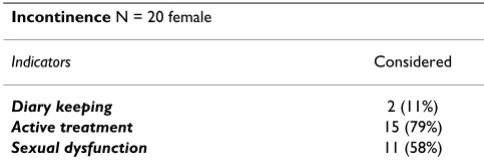
Of 21 patients with urinary incontinence were 20 women and 1 man registered. The results suggest that the presen-tation of urinary incontinence complaints to the GP was low, particularly among male patients. During the regis-tration period GPs reported that this could be because patients do not schedule a consultation, but just ask the GP assistant by phone to prescribe incontinence pads for them. The recommendation to advise the patient to keep a diary for urinary incontinence was followed by the GPs for 2 (11%) of the female patients. The recommendation for active treatment and addressing sexual dysfunction was followed for 15 (79%) and 11 (58%) of the female
patients, respectively, as shown in Table 4. Since, there was only one male patient; the result was not included.
Gender sensitivity
GPs mean gender sensitivity for all patients was 1.84 (SD:.79). That means that on average, the GPs applied two out of three recommendations to all patients.
Discussion
To our knowledge this is the first study that investigates gender sensitivity of GPs which extends beyond the exist-ing guidelines. The results show that gender sensitivity can be stimulated among trained professionals for non-rou-tine patient cases. The combination of the training pro-gramme, clear and practical recommendations, daily discussion of relevant cases by the GP couples, as well as feedback and support from the study team probably all contributed to the outcome.
During the registration period, the GPs were visited by the study team to discuss the process of data collection. These visits served as a reminder to fill out the registration forms and were aimed at working out the practical difficulties of applying the recommendations in the GP practice. During the visits we found that GP teams did not fill out a form for all first visits of patients suffering from angina pectoris, depression and urinary incontinence. Interestingly, the GPs did not register the routine cases, but selected patients with expected gender-related problems to register and dis-cuss with each other for educational purposes.
Our data show that more registration forms were com-pleted for female than for male patients for the three con-ditions. An explanation could be that women have more contact with their GPs than men [25,26]. For angina
pec-Table 1: Indicators for angina pectoris
Angina Pectoris N = 39
N = 31 female; N = 8 male
Indicators Considered in women Considered in men
Diabetes 30 (97%) 8 (100%)
Socioeconomic status 10 (34%) 4 (50%)
Complaints during rest 18 (58%) 6 (75%)
Table 2: Indicators for women with depression
Depression N = 26
Indicators Considered
Anxiety 25 (96%)
Sexual abuse 8 (31%)
Sexual problems 15 (58%)
Table 3: Indicators for men with depression
Depression N = 14
Indicators Considered
Alcohol abuse 14 (100%)
toris in particular special attention to women was deemed urgently warranted during the training programme. This was in reaction to the tendency to the focus on typical symptoms and a masculine presentation style [27]. This focus was not to minimize the gender effects on the health of men with angina pectoris, but rather to correct existing imbalances in the general practice. Even though attention should be paid to atypical symptoms in women, attention to typical symptoms is still required for both sexes. Con-cerning depression and urinary incontinence, the number of registration forms completed for female patients can be explained by higher prevalence of these conditions in women in the general practice [28]. In line with earlier studies, it is also possible that an increasing awareness of gender issues in medical education and practice has resulted in an increased focus on women [29].
In general, GPs adherence to the gender sensitive recom-mendations in this study was relatively high. We did not find differences in gender sensitivity towards women and men. Recommendations regarding the socioeconomic sta-tus of patients with angina pectoris, sexual abuse in women with depression, sexual problems in men with depression, and diary keeping in women with urinary incontinence, were followed less frequently. In instances when the GP already knew the socioeconomic status or the patient related the sexual history spontaneously, these recommendations were obviously irrelevant. Neverthe-less, in the majority of the cases the reasons for not follow-ing these recommendations -e.g. forgettfollow-ing to ask or reluctance to discuss sexual history during first consulta-tion- leave room for improvement.
This study can be regarded exploratory in character. To determine the effects of the programme a study with before-after measurement and/or a concurrent control group is necessary. The effect of the training programme may have been boosted by the practice visits during the study period. The samples per professional were too small to detect a trend in the GPs' sensitivity over the 6-months period. For a large-scale and long-term effect, it should be kept in mind that a training programme for general prac-titioners is just one of the sources to improve the position of gender issues in medical decision-making. Ideally, progress could be realised by embedding gender issues
into existing organisational structures of the general prac-tice. This is in agreement with findings in our earlier study [30]. Organizational constraints can be a barrier to incor-porating and maintaining gender issues into healthcare practices. Therefore it is important to explore ways of effectively addressing gender issues in the organisation of the family practice by developing tailored recommenda-tions. Further qualitative research of GPs' impressions and feedback on this subject is recommended as it will com-plement gender-related research and practice.
Competing interests
The authors declare that they have no competing interests.
Authors' contributions
HHC: substantial contributions to research design, the acquisition, analysis and interpretation of data; drafting the paper; approval of the submitted and final versions.
IIK: substantial contributions to the acquisition of data; revising the paper critically; approval of the submitted and final versions. TvdW: substantial contributions to the interpretation of data; revising the paper critically; approval of the submitted and final versions. GGAMW: substantial contributions to the interpretation of data; revising the paper critically; approval of the submitted and final versions. TALML-J: substantial contributions to research design, the acquisition, and interpretation of data; drafting the paper and revising it critically; approval of the submitted and final versions.
Acknowledgements
The present study was funded by a grant from the Netherlands Organisa-tion for Health Research and Development (ZonMw). We thank the gen-eral practitioners for their participation in this study, and Wim van der Minne for his contribution during data collection. In addition we would like to express our thanks to dr. Petra Verdonk en dr. Frans Tan for their sta-tistical support.
References
1. Danielsson U, Johansson EE: Beyond weeping and crying: a gen-der analysis of expression of depression. Scan J Prim Health 2005, 23:171-177.
2. Pears E, Hannaford PC, Taylor MW: Gender, age and deprivation differences in the primary care management of hyperten-sion in Scotland: a cross-sectional database study. Fam Pract 2003, 20:22-31.
3. Verloo M: Multiple inequalities, intersectionality and the European Union. European Journal of Women's Studies 2006,
13:211-228.
4. Yuval-Davis N: Intersectionality and Feminist Politics. European Journal Women's Studies 2006, 13:93-209.
5. Risberg G: I'm just a civil; servant – neutral and sexless'. About the resistance against the gender perspective and the risk of gender bias in medicine. Lakartdningen 2005, 102:2852-2854. 6. Bird E, Rieker PP: Gender matters: integrated model for
understanding men's and women's health. Soc Sci Med 1999,
48:745-755.
7. Doyal L: Gender Equity in Health: Debates and Dilemmas. Soc Sci Med 2000, 51:931-939.
8. Mead N, Bower P: Patient centredness: a conceptual frame-work and review of the empirical literature. Soc Sci Med 2000,
51:1087-1110.
Table 4: Indicators for women with urinary incontinence
Incontinence N = 20 female
Indicators Considered
Diary keeping 2 (11%)
Active treatment 15 (79%)
Publish with BioMed Central and every scientist can read your work free of charge "BioMed Central will be the most significant development for disseminating the results of biomedical researc h in our lifetime."
Sir Paul Nurse, Cancer Research UK
Your research papers will be:
available free of charge to the entire biomedical community
peer reviewed and published immediately upon acceptance
cited in PubMed and archived on PubMed Central
yours — you keep the copyright
Submit your manuscript here:
http://www.biomedcentral.com/info/publishing_adv.asp
BioMedcentral 9. Keuken DG, Haafkens JA, Moerman CJ, Klazinga NS, ter Riet G:
Attention to sex-related factors in the development of clini-cal practice guidelines. J Womens Health 2007, 6:82-92. 10. Verdonk P, Benschop YWM, de Haes JCJM, Lagro-Janssen ALM:
From gender bias to gender awareness in medical education.
In Gender matters in medical education: integrating a gender perspective in medical curricula Edited by: Verdonk P. Harderwijk: Drukkerij Wed-ding; 2007:11-25.
11. Lagro-Janssen A, Minne W van der: Gender specific recommen-dations to three NHG guidelines. Nijmegen University Medical Centre 2006.
12. Lagro-Janssen A, Botden M: Training gender specific medicine in post graduate general practitioners. Nijmegen University Medical Centre 2006.
13. Bebbington PE, Dunn G, Jenkins R, Lewis G, Brugha T, Farrell M, Melt-zer H: The influence of age and sex on the prevalence of depressive conditions: report from the National Survey of Psychiatric Morbidity. Psychol Medicine 1998, 28:9-19.
14. Richards H, McConnachie A, Morrison C, Murray K, Watt G: Social and gender variation in the prevalence, presentation and general practitioner provisional diagnosis of chest pain. J Epi-demiol Community Health 2000, 54:714-718.
15. Vogels EA, Lagro-Janssen ALM, Van Weel C: Sex differences in cardiovascular disease: are women with low socioeconomic status at high risk. Br J Gen Pract 1999, 49:963-966.
16. McSweeney JC, Cody M, O'Sullivan P, Elberson K, Moser DK, Garvin BJ: Women's early warning symptoms of acute myocardial infarction. Circulation 2003, 108:2619-2623.
17. Have ten M, Schoemaker C, Vollebergh W: Genderverschillen in psychische stoornissen, consequenties en zorggebruik [Gen-der differences in psychiatric disor[Gen-ders, conseqences and consumption of care]. Resuls form the Netherlands Mental Health Survey and Incidence Study (NEMESIS). Tijdschrift voor Psychiatrie [Journal for Psychiatry] 2002, 44:.
18. Breslau N, Schultz L, Peterson E: Sex differences in depression: a role for preexisting anxiety. Psychiatry Res 1995, 58:1-12. 19. Hegarty K, Gunn J, Chondros P, Small R: Association between
depression and abuse by partners of women attending gen-eral practice: descriptive, cross sectional survey. Br Med J 2004, 328:621-624.
20. Roeloffs CA, Fink A, Unutzer J, Tang L, Wells K: Problematic sub-stance use, depressive symptoms, and gender in primary care. Psychiatr Serv 2001, 52:1251-1253.
21. Kessler RC, Crum RM, Warner LA, Nelson CB, Schulenberg J, Anthony JC: Lifetime co-occurrence of DSMIII-R alcohol abuse and dependence with other psychiatric disorders in the National Comorbidity Survey. Arch Gen Psychiatry 1997,
54(4):313-321.
22. American Psychiatric Association: Practice Guideline for the Treatment of Patients With Major Depressive Disorder.
2000.
23. Hansen BL: Lower urinary tract symptoms (LUTS) and sexual function in both sexes. Eur Urol 2004, 46:229-234.
24. Teunissen D, Lagro-Janssen T: Urinary incontinence in commu-nity dwelling elderly: are there sex differences in help-seek-ing behaviour? Scand J Primary Health 2004, 22:209-216. 25. Briscoe ME: Sex differences in the correlates of GP
consulta-tion. Soc Sci Med 1987, 25:507-513.
26. Waldron I: Sex differences in illness incidence, prognosis and mortality: issues and evidence. Soc Sci Med 1983, 17:1107-1023. 27. Wenger NK: Coronary heart disease: the female heart is
vul-nerable. Progress in cardiovascular disease 2003, 46:199-229. 28. Lisdonk EH van de, Bosch WJHM, Huygen FJA van den, Lagro-Janssen
ALM: Ziekten in de huisartspraktijk. Utrecht: Bunge; 2003. 29. Zelek B, Phillips SP, Lefebre Y: Gender sensitivity in medical
cur-ricula. Can Med Assoc J 1997, 156:1297-1300.
30. Celik H, Abma TA, Widdershoven GA, van Wijmen FCB, Klinge I:
Implementation of diversity in healthcare practices: Barriers and opportunities. Patient Educ Couns 2008, 71:65-71.
Pre-publication history
The pre-publication history for this paper can be accessed here: