R E S E A R C H
Open Access
Associating expression and genomic data
using co-occurrence measures
Maarten Larmuseau
1, Lieven P. C. Verbeke
2and Kathleen Marchal
2*Abstract:Recent technological evolutions have led to an exponential increase in data in all the omics fields. It is expected that integration of these different data sources, will drastically enhance our knowledge of the biological mechanisms behind genomic diseases such as cancer. However, the integration of different omics data still remains a challenge. In this work we propose an intuitive workflow for the integrative analysis of expression, mutation and copy number data taken from the METABRIC study on breast cancer. First, we present evidence that the expression profile of many important breast cancer genes consists of two modes or‘regimes’, which contain important clinical information. Then, we show how the co-occurrence of these expression regimes can be used as an association measure between genes and validate our findings on the TCGA-BRCA study. Finally, we demonstrate how these co-occurrence measures can also be applied to link expression regimes to genomic aberrations, providing a more complete, integrative view on breast cancer. As a case study, an integrative analysis of the identifiedMLPH-FOXA1 association is performed, illustrating that the obtained expression associations are intimately linked to the underlying genomic changes.
Reviewers:This article was reviewed by Dirk Walther, Francisco Garcia and Isabel Nepomuceno.
Keywords:Expression data, Co-expression, Data integration, Breast cancer
Background
Systems genetics approaches that collect genomic informa-tion with matching transcript informainforma-tion from phenotyp-ically well characterized individuals provide a powerful way to study the molecular mechanisms underlying complex phenotypes. For this reason systems genetics approaches have become increasingly popular in the domain of cancer
genomics [1–3]. However, the analysis and integration of
these different data sources is non-trivial. Indeed, although many integrative or multi-omics models have been pro-posed [4–6], the relation between genetic variants and sub-sequent changes in gene expression remains poorly
understood [7, 8]. A fundamental problem when
integrat-ing expression data with genomic information lies in the different nature of both datasets. While expression data is quantitative, consisting of continuous values that indicate the degree to which a gene in a sample is being transcribed, genomic data is essentially qualitative. A common way to deal with this problem is to convert the continuous expres-sion measurements into more qualitative, discrete values.
Two strategies exist for this conversion: the identification of a set of differentially expressed genes [5] and the direct binning of expression data into discrete categories [6]. The focus of this work will be on the second strategy, where expression data is binned or discretized as a pre-processing step. This discretization is non-trivial and many different techniques exist, as reviewed in the work of Gallo et al. [9] in the context of single-source expres-sion analysis. The advantages of discretization in single-source expression analysis are mainly related to mathematical convenience [10] and reduction of noise in the data [11–13]. However, in the context of data integra-tion for cancer research there are some other arguments for the discretization of expression data.
First, many continuous methods rely on mutual infor-mation or correlation based measures to define whether the expression of two genes is related or not [14]. While these measures are suited to describe co-expression, they might not be the measure of choice, if the expression of two genes is related only under a specific set of condi-tions. For cancer this might be a very relevant concern as a cohort of samples often contains several subtypes and/or network rewiring due to genomic changes that
© The Author(s). 2019Open AccessThis article is distributed under the terms of the Creative Commons Attribution 4.0 International License (http://creativecommons.org/licenses/by/4.0/), which permits unrestricted use, distribution, and reproduction in any medium, provided you give appropriate credit to the original author(s) and the source, provide a link to the Creative Commons license, and indicate if changes were made. The Creative Commons Public Domain Dedication waiver (http://creativecommons.org/publicdomain/zero/1.0/) applies to the data made available in this article, unless otherwise stated. * Correspondence:[email protected]
2Department of Plant Biotechnology and Bioinformatics, Ghent University– Imec, Technologiepark-Zwijnaarde 126, 9052 Ghent, Belgium
affect local gene expression behavior [15,16]. The recon-struction of these condition-specific modules or subnetworks from expression data has been a research question for over 20 years [17–19] and some methods indeed rely on data discretization as a preprocessing step [20]. The problem find-ing condition-specific modules is in essence a bi-clusterfind-ing problem, where one tries to find modules of genes that show similar behavior in a subset of the samples [21,22].
Second, the use of correlations for the identification of co-expressed genes assumes that an increase in one gene (e.g. transcription factor) will trigger a proportional in-crease or dein-crease in another gene (target) [23]. However, this assumption is often a simplification of reality as many examples of complex feedback mechanisms in the human body exist, where definite changes only take place once a
certain threshold is crossed [24, 25]. It therefore makes
sense to describe the expression of a gene in terms of discrete regimes and to model the gene interaction net-work as a complex nonlinear system, consisting of many discrete states. These networks are perturbed by an exter-nal trigger, such as the occurrence of a somatic mutation, that affects many genes in the network and causes them to undergo a shift in expression.
In this work we want to show that the discretization of expression data into expression‘regimes’also yields an im-portant third benefit, related specifically to the integration of expression data with genomic information. The discretization of expression data essentially converts the quantitative transcriptome measurements into qualitative data, that indicate in which expression regime a gene is found to be. Because genomic information is in essence qualitative, integration of transcriptome and genomic data sources can now be done by simply counting how many times a given genomic aberration co-occurs with an expres-sion regime. In the same way, phenotypes and clinical sub-groups can be analyzed by counting how many times they co-occur with aberrations and/or regimes, and identifying the most overrepresented aberrations and regimes using a suitable association measure. To this end, we propose the use of‘co-occurrence measures’that are calculated between subgroups of a cohort, rather than over the whole cohort.
In this work we present evidence that the expression profile of many important genes in breast cancer, actu-ally follows a bimodal distribution, where the mode or ‘regime’ of a gene contains important clinical informa-tion. The presence of these regimes allows for a drastic simplification of the subsequent analysis, as expression data can be discretized in a biologically sound way with-out much loss in information content. Using a breast cancer dataset, we demonstrate that measures that count the co-occurrence of these expression regimes between different genes (‘co-occurrence measures’) are a suitable association measure for the analysis of expression data. We compare the co-occurrence measures with two
commonly used measures, the Pearson correlation coef-ficient and Mutual Information [26]. The genetic associa-tions obtained when using these co-occurrence measures seem to closely reflect the underlying genomic changes and are complementary to what is found using the conventional association measures. Finally, we demonstrate how these co-occurrence measures can also be used to associate mu-tation and copy number information with expression re-gimes, obtaining a more complete, integrative picture of
the different elements that constitute a particular
phenotype or clinical subgroup. As a case study we analyze
the relation betweenMLPHandFOXA1in breast cancer.
Results
Many clinically important genes in breast cancer, e.g. ESR1 [27] and ERBB2 [28], appear to follow a bimodal expression distribution across the samples of a cohort. We hypothe-sized that these regimes reflected the underlying genomic changes. For instance, in the case of ERBB2, a gene that is known to be amplified in breast cancer [28], we could ob-serve that many samples in regime 1 indeed have an ampli-fication in ERBB2. To be able to perform a large-scale analysis of these expression regimes, we used a Gaussian Mixture Model (GMM) to assign samples to a cluster/re-gime (see Fig.1) and repeated this procedure for every gene
in the METABRIC [29, 30] study (see methods). Because
there is no a priori reason why expression profile would bi-modal, we select for each gene the number of regimes based on the Bayesian Information Criterion (BIC) [31]. The only parameter in the discretization procedure is the maximum number of regimes that a gene profile can con-sist of. Using this approach we verified whether the genes from the KEGG pathway [32] associated with breast cancer showed this multimodal behavior (see methods). We ob-served that all genes in the breast cancer pathway indeed displayed this multimodal behavior. In total, we found that about 60% of the genes in the METABRIC study (114,652 out of 24,630 different transcripts measured), displayed a multimodal behavior. In this work, we show that these
modes or ‘regimes’ of a gene actually convey important
clinical information and can be associated to underlying genomic changes.
Information content of expression regimes
supervised fashion. Consequently, the classification per-formance reflects how the unsupervised discretization of the expression data compares to a supervised thresholding. We also compare to a naive binarization strategy, in which the expression is normalized to unit variance and zero
mean and then binned into three categories (]-∞, −1.5σ[,
[−1.5σ, 1.5σ],]1.5σ,∞[; whereσis the standard deviation).
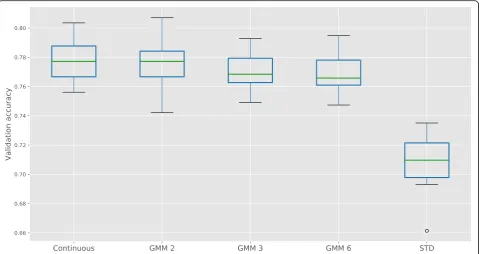
Figure 2 shows a Boxplot of the validation accuracy
when training classifiers to predict the PAM50 subtype. It shows that the validation accuracy on the GMM discre-tized data is only slightly worse than the continuous data, in line with what was found in Ding et al. [12]. Conversely, a naive discretization strategy leads to a worse perform-ance. Surprisingly, the model trained on the binary data achieves a slightly higher average accuracy, at the cost of a larger standard deviation, compared to models trained on
data that consist of more regimes (GMM 3 and GMM 6). In the remainder of this work we will limit to the number of regimes to 2, resulting in binary expression data, and show that this still allows to find many important associations between gene expression and the underlying genomic alterations. For other cancer types, this assump-tion may not hold, but the presented framework (and ac-companying implementation) supports the general case of
nregimes. In the remainder of this work, we will use the
convention that regime ‘0’ denotes the low expression
regime of a gene and‘1’the high expression regime, in ac-cordance with Fig.1.
Clinical relevance of the expression regimes
The results in Fig.2indicate that, for the PAM50 classifica-tion, not much information is lost in the GMM discretization step, even if we restrict the discretization to only two values (the GMM 2 scenario). However, if these binary expression regimes are truly informative, they should also convey important information about the prognosis. For each gene that has two different expression regimes in the METABRIC study, we calculated the age-corrected
haz-ard ratio between samples that are in regime ‘0’ and ‘1’.
Table1shows the 5 genes that have the highest hazard
ra-tio, as well as the regime (‘0’/‘1‘) and the number of samples in which this regime is present (see methods). Here the
hazard ratio of 2.31 forSPATA4implies that samples where
SPATA4is in regime ‘1’ decease at a 2.31 faster rate than
the group whereSPATA4is in regime‘0’.
Out of these five genes, onlySPATA4 has not been
re-ported in breast cancer literature [36–39]. Figure3shows
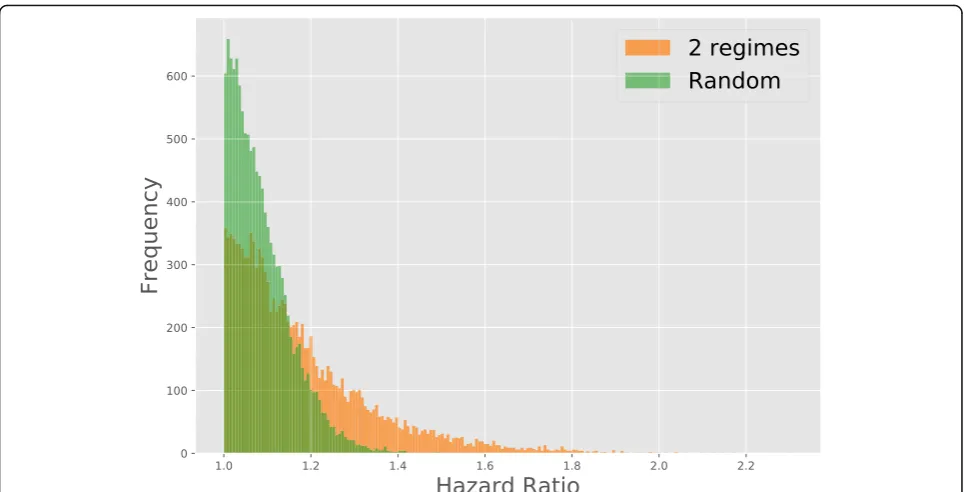
the distribution of hazard ratios, comparing to a random permutation of samples across each gene, illustrating that the hazard ratios found are not generated by chance.
Co-occurrence of expression regimes as an association measure
Our previous results seem to suggest the existence of clin-ically relevant regimes in the expression profile of a gene. A perturbation, e.g. a genomic aberration, can trigger a re-gime shift. Even if the trigger of this rere-gime shift is un-known, it is still possible to identify pairs of genes that often co-occur in their regimes. To find such pairs of
genes, thep-value under the assumption of independence
is calculated between all genes (see methods). Unsurpris-ingly, many pairs of genes are found that co-occur signifi-cantly more than expected by random. 1,342,459 gene pairs are significant at a conservatively corrected 0.001 level (see methods), illustrating that the expression of genes is tightly connected and that co-occurrence of these regimes can indeed be used as an association measure. To get an idea of how consistent this association measure is, we compare the associations to those found using Pearson correlation coefficient on the continuous data and Mutual
a
b
Fig. 1The expression profile for the notorious breast cancer gene
ERBB2/HER2 across the METABRIC (a) and TCGA (b) cohort. In both
Information (MI) on the discretized data (see methods). In addition, we compared all associations found on the METABRIC to another breast cancer study (TCGA-BRCA, see methods). For both studies we thus obtain 3 ranked lists of associations, one for each association measure. Each line
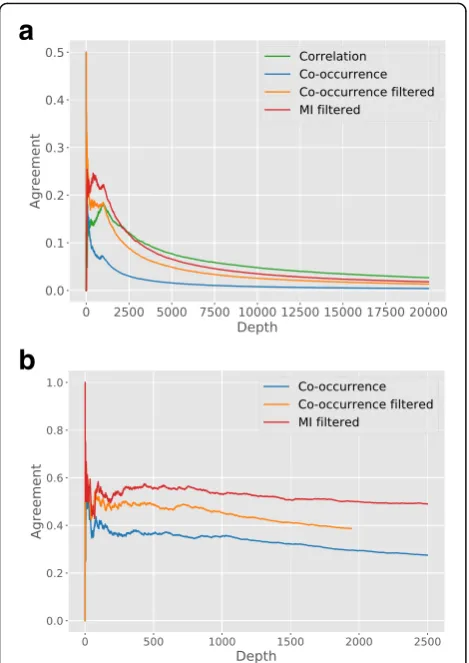
in Fig. 4a is obtained by simultaneously going down the
TCGA-BRCA and METABRIC ranked lists for the same measure, at each depth calculating the relative overlap or agreement between the two lists [40]. In case of two identi-cal lists, the result would be a perfect agreement of 1, for each depth. The small peak at depth 2 for the co-occurrence
measure is due to the strong association between MLPH
andFOXA1, that is found in both datasets (cf. infra). Note that the measures that rely on discretized data, i.e. the co-occurrence measure and the MI, are at a dis-advantage. Indeed, if a gene is multimodal in one dataset and unimodal in the other dataset, then all associations found in the first dataset cannot be found back in the second dataset. To be able to compare the performance
of the association measures, both datasets are filtered, keeping only genes that are bi-modal in both datasets.
The impact of this can be seen in Fig. 3a by comparing
the blue line (co-occurrence on the unfiltered datasets) to the orange line (Co-occurrence filtered). On the filtered datasets it can be seen that both MI and co-occurrence lead to higher consistency between the top ranked associa-tions. At larger depth the correlation measure is slightly more consistent, but note that the two datasets show a ra-ther poor overlap for each of the measures. Possible rea-sons for this poor overlap are the differences in technology and cohort composition (see methods).
Interestingly, we note that the overlap between the asso-ciations is rather small for the different methods (see
Add-itional file 1: Figure S1), indicating that the different
association measures provide complementary information. Among the most significant gene pairs we see that many genes occur several times, such that small cliques
of co-occurring genes are formed (see Additional file 2:
Figure S2 and Additional file6: Table S1). An important
point is that these subnetworks are in fact bi-clusters, as the samples in which these regimes are present together are also known.
Data integration using co-occurrence
By discretizing the expression data, we have essentially converted the quantitative measurements into qualitative data, indicating the regime to which a gene belongs.
Fig. 2Accuracy on the validation set for PAM50 subtype classification, comparing training on continuous microarray data to training on GMM discretized data and a naive discretization strategy (STD). For the GMM discretization, we allowed the maximum number of regimes to be 2 (GMM 2), 3 (GMM 3) and 6 (GMM 6). Cross-validation was repeated 20 times, with a 0.7/0.3 training/validation ratio using a Random Forest classifier with 1500 trees [49]
Table 1Top 5 genes with the highest hazard ratio
Gene Hazard ratio N samples Regime
1 SPATA4 2.31 306 0
2 UCP1 2.24 159 0
3 AURKA 2.17 796 1
4 GLA 2.14 243 0
Based on the results from the previous section, measures such as MI and co-occurrence can be used to identify associations between this qualitative data. Because genomic information is mostly qualitative, these measures can also be applied to calculate the co-occurrence or MI between mutations and expression. Here too, we assessed how well the associations in METABRIC agree with TCGA. The
re-sults are shown in Fig.4b and can be compared to Fig.4a.
It can be seen that associations between mutation and ex-pression data are more consistent between the two datasets, for both the MI and the co-occurrence. Because the
co-occurrence measure used here represents a p-value,
pairs can be selected based on a chosen significance level. Aiming for a significance level of 0.001 and taking into ac-count multiple hypothesis testing (see methods), we obtain 1876 significant pairs for METABRIC and 802 for TCGA. The discrepancy in number of significant pairs is due to the different sample size for the two datasets. In general we see that a higher significance level does indeed lead to a better overlap between the datasets (see Additional file 3: Figure S3). Also, we observe that from the top 1000 associations, 682 overlap between MI and Co-occurrence, which more
than what was found for expression (see Additional file 1:
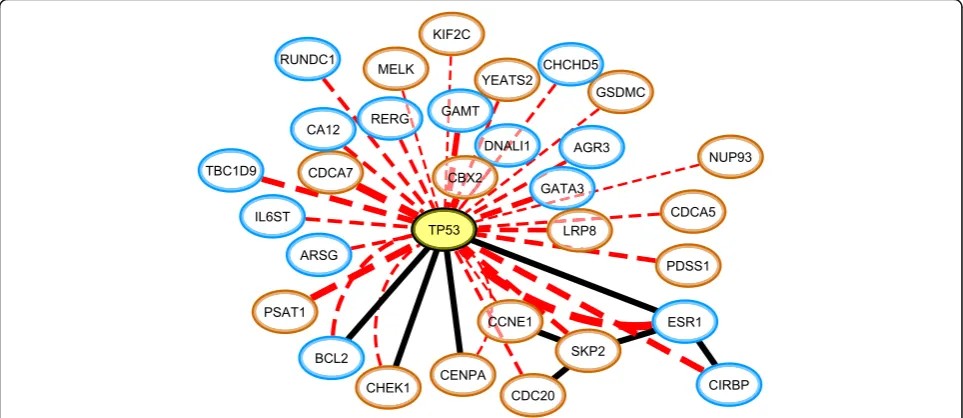
Figure S1). More than 97% of the associations involve mu-tations inTP53in both studies, whereTP53is the strongest associated with low expression inESR1.
As an illustration Fig.5 graphically shows the 30 genes
that co-occur most significantly with mutations inTP53in
the METABRIC study. The association betweenTP53 and
ESR1, which was found in both datasets, has been reported
in literature [41,42]. Additionally, the presence of a
muta-tion inTP53and subsequent loss of activity inESR1is an
indicator of a poor prognosis (Additional file4: Figure S4). Note that from the 30 most significantly co-occurring
genes, only 4 are directly interacting withTP53 according
to BioGRID [43, 44]. For instance, CDCA7 is the second
most significantly co-occurring gene, but does not interact withTP53. By lowering the threshold on the significance of
the association level betweenTP53and expressed genes, an
increasing number of genes are added to the subnetwork, revealing that indeed many of the genes are indirectly
con-nected to the mutations in TP53. We also observed that
out of the 30 genes displayed in Fig. 5, 21 genes have a
shortest path distance of 2 toTP53 on the BioGRID
net-work, while 4 genes have a distance of 3. This shows that the effect of a genomic aberration can propagate far down an interaction network, obviating the detection of such re-lations by local network methods.
Figure5illustrates how mutation data can be integrated
with expression data. However, it is also possible to inte-grate all data sources, including the copy number data that is available. We therefore developed a query-based workflow that allows to perform a focused analysis of a particular phenotype, condition or relation that is relevant only to a subgroup of a cohort. As an example, we
investi-gated theMLPH-FOXA1relation, that was among the top
two most significant expression associations in both
TCGA and METABRIC. For all samples with low MLPH
and lowFOXA1expression, additional genes with
signifi-cantly co-occurring expression regimes, copy number
changes and/or mutations were identified. The identified genes were mapped on the BioGRID network and the dir-ection of the interaction was deduced using conditional probabilities (see materials and methods). The resulting network is shown in Fig.6.
The network consists of three hubs (TP53, EGFR,
FOXA1), but note thatMLPHis not connected toFOXA1.
Indeed, this association has not yet been reported in
litera-ture. The genomic changes associated with the
MLPH-FOXA1 association, are amplifications in GATA3
and deletions inFOXA1,KRT18andREEP5, alongside
mu-tations inTP53.
In total we identified 113 genes that are strongly
asso-ciated with MLPH-FOXA1 (see methods), but only 38
genes could be mapped onto known interactions from
BioGRID (Additional file 5: Figure S5). Lowering the
significance threshold to include more associations in-creases the fraction of genes that can be connected. For instance, if we use a conservative lower bound on the significance level (see methods) we find known interac-tions between 902 out of 1728 associated genes.
Using this workflow we analyzed the top 1000 strongest associations that were found when analyzing the expression data. Interestingly, we found that for the METABRIC study 695 associations co-occurred signifi-cantly with mutations or copy number alterations. For TCGA this number was lower, here 365 associations could be linked to an underlying genomic change. These results clearly show that co-occurrence measures on ex-pression regimes indeed allow for the discovery of asso-ciations that are condition specific.
Discussion
In this work a straightforward and intuitive workflow has been proposed to integrate expression data genomic information. The expression data is first discretized into expression regimes, using a GMM clustering based on the BIC criterion. In breast cancer, we observed that import-ant breast cancer genes actually follow a bimodal distribu-tion, such that it suffices to discretize the data into only two expression regimes. This is confirmed when training a Random Forest on the discretized data to predict the PAM50 subtype, resulting in a slightly better classification performance on the binarized data compared to data that allowed for more than two regimes. The binarized model also scored on par with a classifier trained on the continuous data, showing that the binarized data retains important clinical information. This is confirmed when we calculate the hazard ratio for each gene, comparing the survival chances of patients that are in the low expression regime to those in the high expression regime. We find that 4 out of 5 genes have been reported in literature and that the hazard ratios are higher than expected by chance.
By calculating thep-value under independence
assump-tion, many significant associations were found in the ex-pression data, showing that this co-occurrence measure can indeed be used to identify important relations from
expression data. We compared the p-values against two
other association measures, the Mutual Information and the Pearson correlation coefficient and compared our findings on the METABRIC study to TCGA-BRCA. In general all measures demonstrated a rather poor overlap, which is presumably caused by the intrinsic differences between the two studies. Nevertheless, we found some
im-portant overlap such as the association between MLPH
andFOXA1. In general the association measures seem to
prioritize different associations, showing that association studies can greatly benefit from the inclusion of different association measures.
We’ve also demonstrated that the discretized data is consistent with the genomic information, in the sense that many expression regimes co-occur significantly with mu-tations and copy number changes. Here again, we obtain p-values that are so low that these occurrences are ex-tremely unlikely to have occurred by chance. Remarkably,
a
b
Fig. 4aAgreement between the associations found on TCGA-BRCA
with METABRIC, for three different assocation measures (see text).b
the two datasets show a better agreement when associat-ing genomic information with expression data. This result aptly illustrates the relevance of data-integration, where in our case genomic information is used to unravel the many signals present in expression data. This increase in consistency is also noted when comparing the top associa-tions found using MI to those found with co-occurrence.
The biggest advantage of using co-occurrence mea-sures such as correlation or MI lies in the fact that the samples for which the association holds are also known.
By taking the MLPH-FOXA1 association as an example,
a query-based workflow was presented to integrate gen-omic information such as mutation and copy number data in an interpretable way. The proposed workflow al-lows to quickly mine associations between different data sources and discover important relations. It is also very flexible, allowing for the integration of expression data with many different data sources, provided that the data is qualitative. However, confronting our findings with known interactions in BioGRID showed that many of
Fig. 5The 30 genes of which the expression regime co-occurs most significantly with mutations in TP53 (indicated in yellow). The red lines connect TP53 to all genes with which it displays a co-occurrence relation, with thickness indicating the association strength (all log10(p-value) <− 35, far below our conservative lower bound on the significance level). The black lines denote interactions that are present in BioGRID. The expression regimes of the co-occurring genes are indicated with border colors, where orange and blue respectively denote the regimes of high and low expression
these associations cannot yet be explained. Indeed, many of the associations found using the co-occurrence meas-ure are actually strongly related to mutations or copy number changes, such that these some associations might represent cases of genetic rewiring that are not yet well understood.
Our results show that the GMM discretization of expres-sion data is a viable strategy for performing data integra-tion, and our results indicate that the found expression regimes have both a clinical and biological meaning. This il-lustrates again that there are more reasons than merely mathematical convenience to discretize expression data [9]. Nevertheless, every sample that is mislabeled in this discretization step, is irreversibly lost in downstream ana-lysis. Moreover, it has to be further investigated how differ-ent preprocessing of the data influences the quality of the proposed discretization approach. Additional work is also required to improve the consistency between the micro-array and RNA-seq data. In this work, the same discretization scheme was applied to both datasets, but a better overlap might be obtained if the data is processed in a more technology-specific manner.
Materials and methods
Dataset
The data was taken from the METABRIC study [29, 30]
and TCGA-BRCA. METABRIC consists of whole-genome microarray data (1904 samples), whole-genome aCGH data (2173 samples) and targeted mutation data (2394 samples) for a panel of 174 genes. The aCGH data and expression data have been preprocessed as described in Margolin et al. [29]. The aCGH data has hereby been processed to contain 5 discrete values indicating whether many gains/deletions, some gains/deletions or no gains or deletions exist in a sample. The TCGA-BRCA data consists of whole genome RNA-seq data (Illumina HiSeq 2000 RNA Sequencing plat-form, 1218 samples), copy number data (Affymetrix Genome-Wide Human SNP Array 6.0 platform, 1080 sam-ples) and mutation data (1057 samsam-ples). The expression
data was normalized using FPKM-UQ and then
log-transformed. The copy number data was processed using GISTIC2 [45] from the TCGA FIREHOSE pipeline and binned into the same five categories as the METABRIC study. The somatic mutations were called using MuTect 2 [46]. Table2shows the clinical subtypes for both datasets, where the clinical information for TCGA-BRCA was taken from Berger et al. [47]. To visualize the interactions
be-tween genes, we used the BioGRID interaction database–
version 3.4.161 [43,44] and Cytoscape [48].
Preprocessing
For many genes it can be observed that expression follows a bimodal distribution, as is illustrated in Fig.1forERBB2. The expression profile can be divided into different
‘regimes’, that can be described by a Gaussian Mixture Model (GMM) [49]. Essentially, the expression profile of
each gene is clustered into n clusters or regimes, where
the Bayesian Information Criterion (BIC) is used to deter-mine the optimal number of clusters [31]. This idea is similar to using k-means for the clustering of expression profiles [9, 50], but here the number of clusters (i.e. re-gimes) is derived from the data and can thus vary between genes. An important parameter for the discretization is the maximum number of regimes that an expression pro-file can consist of. For most of the results shown in this work, the maximum number of regimes was set to 2 (see results section). For this value, bimodal expression profiles will be clustered into 2 regimes, and the data is binarized by replacing the continuous expression measurement by a ‘0’and‘1’ indicating the cluster or regime the expression measurement belongs to. In total 14,341 out of 24,630 transcripts are bimodal, for the METABRIC study, while 49,184 out of 56,861 transcripts were found to be bimodal in the TCGA study. The copy number data was binned into three categories: deletions, unchanged and amplifica-tions. Between METABRIC and TCGA-BRCA 15864 tran-scripts had an identical gene symbol, the correlation and
unfiltered co-occurrence from Fig.3a were calculated on
this dataset. From these 15,864 genes only 7022 were bi-modal in this both datasets. This smaller dataset was used to calculate the MI filtered and co-occurrence filtered.
Clinical information
To check that important breast cancer genes have a multimodal expression profile, we downloaded the KEGG breast cancer pathway, which consists of 15 highly curated genes related to breast cancer [32]. We only considered the genes that were over- or underex-pressed or amplified/deleted, resulting in a list of ten
genes (ESR1, FGFR1, CCND1, EGFR, KIT, Notch1,
Notch4,FZD7,LRP6, ERBB2).
To calculate the hazard ratios we used the lifelines module [51] in Python to fit a Cox proportional hazard model to the patient survival data, for each gene. To correct for patient age the model had two covariates, pa-tient age and a binary variable indicating the regime of the gene. The hazard ratio for each gene was then calcu-lated as max(exp(γ), exp(−γ)), where γ is the coefficient Table 2The percentage of patients in each PAM50 subtype, comparing METABRIC and TCGA-BRCA
Subtype METABRIC TCGA-BRCA
LumA 35.46 51.80
LumB 24.06 19.26
Her2 11.35 7.56
claudin-low 11.04 NC
belonging to the binary variable in the Cox proportional hazard model. The resulting ratio represents the hazard ratio for the regime with the poorest prognosis and is al-ways larger than 1. Hazard ratios were only calculated when both regimes of a gene occurred in at least 10% of the samples, this to assure that the obtained ratios were representative. To obtain the random hazard ratios, we permuted the samples and calculated the hazard ratio in the same way.
Co-occurrence measures
To analyze the relations between genes two different measures were used that define how closely two genes are related, conditional on their status (which can be an expression or mutational status). A first measure can be
interpreted as thep-value of co-occurrence under
inde-pendence assumption. The second measure is an esti-mate of the conditional probability that a gene will be in a certain regime, given the regime of another gene. Both measures will be illustrated using the expression status of the genes involved in the association.
The first measure is a p-value under the hypothesis that two genes are independent, i.e. the expression re-gime of one gene is independent from the other. Under this independence assumption, we can approximate the probability that gene A is in regime i while gene B is in regime j:
PðAi∩BjjH0Þ ¼PðAiÞPðBjÞ
≈ jAijjBjj N2
samples
The expected number of co-occurrences is compared to the observed number, under a binomial distribution. This work focuses on finding regimes that co-occur more than expected by chance, as such one sided testing suffices. The resulting quantity can be interpreted as a p-value under the independence assumption, i.e. a meas-ure that expresses how much more the expression re-gimes of two genes co-occur than expected by chance.
The second measure can be interpreted as the condi-tional probability that a gene will be in a certain expres-sion regime, given the regime of another gene. Using the same example as above, we have:
PðAijBjÞ ¼PðAi∩BjÞ PðBjÞ
≈ jAij∩jBjj jBjj
With |Ai|∩|Bj| the number of samples in which gene A
is in regime‘i’and gene B in regime‘j’, i.e. the number of
times Ai and Bj co-occur. Remark, that the conditional
probability has the undesirable property that it can still be close to one, when both ∣Ai | and ∣Bj∣ are small. This
makes it unsuited for identifying associations in large datasets. However, as the conditional probability is a di-rected measure, i.e. in general P(Ai|Bj)≠P(Bj|Ai), it can
be used to deduce a direction between associated genes (cf. Figure6).
The measures can be extended in a trivial way to assess re-lations between genes that involve a genomic status (muta-tion, amplifica(muta-tion, deletion) e.g. by counting the number of times an aberration co-occurs in both genes or by counting the number of times an aberration in one gene co-occurs with a specific expression regime of another gene.
Mutual information (MI)
Mutual information is an association measure that can is often used in the field of information theory to express
the dependence of two random variables [26, 52]. In the
continuous case, the MI between two random variables X and Y is defined as:
MI X;ð YÞ ¼∬P x;ð yÞ log P x;ð yÞ
P xð ÞP yð Þ
dx dy
In our case X and Y both correspond to the expression measurements of a gene in different samples. Because the underlying distributions p(x), p(y) and p(x, y) are un-known, the MI cannot readily be calculated. However, there exist methods to estimate the MI directly from the continuous expression measurements [53]. In this work, however, we calculate the MI between the discretized ex-pression profiles of gene A and gene B as:
MIðA;BÞ ¼X i
X
j
PðAi∩BjÞ log
PðAi∩BjÞ PðAiÞPðBjÞ
¼X
jXj
i
XjYj
j
jAi∩Bjj
Nsamples
log jAi∩BjjNsamples
jAijjBjj
Where we see that the MI is actually closely related to the concept of co-occurrence from the previous para-graph. Indeed, each term in the summation is a co-occurrence measure, as it described how well regime Aioverlaps with regimeBj. The big difference is that MI
quantifies the association between two genes based on the sum over all possible regimes, whereas a co-occurrence measure only depends on one regime per gene.
Correction for multiple hypothesis testing
Using the p-value under independence as an association
with this problem is to rely on the False Discovery Rate
(FDR) [54, 55], as classical measures such as Bonferroni
are deemed too conservative [56]. However, the scope of this work is not to present an extensive list of significant associations, and we leave the significance level as a model parameter such that the user can decide. Whenever we mention the number of significant pairs, we use the Bon-ferroni correction as a conservative lower bound. Aiming for a significance levelα, the corrected thresholdθfor all associations between two datasets is computed as:
ϑ¼ α
N nreg M mreg
Where nreg and N are the number of regimes and
number of genes in the first dataset andmregandMthat
for the second dataset. In this work we setα= 0.001, i.e. we work at a 0.001 significance level, which for the METABRIC expression dataset results in a threshold of
0:001
ð143412Þ2 ≈1:2610−12.
Data integration using co-occurrence
To create Fig. 5 and Additional file 5: Figure S5, all
ex-pression regimes, mutations, deletions and amplifications that significantly co-occur with the subgroup of samples
that have a low expression inMLPHandFOXA1are
cal-culated. To keep the size of the network small enough for displaying it, only expression regimes with ap-value < 10−
50
were kept (154 genes in total). For the copy number
and mutations a threshold p-value < 10−20 was taken,
retaining only TP53 as significant mutation, 2243
dele-tions and 390 amplificadele-tions. All expression regimes that
significantly co-occurred with the TP53-ESR1 relation
were mapped onto the BioGRID network [43,44],
retain-ing 38 interactions between only 38 of the 113 genes. All links were filtered by imposing that between every link Ai
– Bj, either P(Ai| Bj) > 0.5 or P(Bj|Ai) > 0.5 for their
rele-vant regimes, as not all genes that co-occur with
MLPH-FOXA1 are necessarily co-occurring with each
other. However, for these parameter settings all found in-teractions passed the filtering criterion. The direction from the interaction was deduced from the expression re-gimes using the simple heuristic that if P(Ai| Bj) > P(Bj
|Ai), then Bj→Ai. For copy numbers changes, it was
veri-fied that the changes co-occurred significantly with the ex-pression regimes in the same gene, using the same threshold that was used to select the copy numbers (p-value < 10−20). Finally, all genes and their attributes (i.e. genomic status) were visualized using Cytoscape [48].
Reviewers’comments
Reviewer’s report 1: Dirk Walther
Review comment: My two main questions/ concerns relate
to the statistical methodology: When establishing
correlations between discrete variables, the first metric that comes to (my) mind is mutual information (MI) - or some-thing similar (Jaccard distance). In fact, MI has been used to correlate genes before (Steuer et al. 2002, Bioinformatics, “The mutual information:…”- I think, you should also cite this paper). Instead, binomial testing of co-occurrence of states is used. However, there are four possible states for two-state variables (++,--,+−,−+), which need to be consid-ered. But they are not independent. So why not used MI, which does everything in one go and automatically ac-counts for number of different states per gene?
Author’s response: We would like to thank the reviewer
for this important point. Indeed, Mutual information would be the first choice for the discretized data and
we’ve added a comparison between mutual information
and the binomial testing procedure. The results seem to indicate that these two associations measures find (or at least rank) different associations. This is indeed due to the fact that the Mutual information considers all states of a gene at once, which make MI a robust and reliable association measure. However, because MI is calculated over all states at once (and thus all samples), the found associations can no longer be related to a subgroup of samples. This is different for the proposed co-occurrence measures. For instance, in the case of the MLPH-FOXA1 association that we found, we know that this association is present in all samples where both MLPH and FOXA1 are in a low regime (information that is lost in MI by ag-gregating over all the states). This allows us to obtain not only the association, but also the subgroup of patients in which the association is present. Because, we exactly know in which samples the association MLPH-FOXA1 is present we can again calculate the co-occurrence between this associations and expression regimes/mutation data/
copy number data of other genes. We’ve used this simple
concept to perform data integration.
Review comment: You can also establish significance by using randomized data. - Multiple testing correction:
142,827 gene pairs with co-occurring regimes with p<
1E-30, are being reported. The authors do not mention any performed testing for multiple testing. This MUST be done. And if not done so, authors should introduce proper correction. Actually, throughout the manuscript. Though, one way to do it, is to compare to random data as done by the authors in the paragraph above (91 vs. none).
Author’s response: Another very important remark.
interpretation of being a p-value, there exist statistically sound ways to determine a threshold, finding a delicate balance between sensitivity and specificity, such as FDR. The fact that this interpretation exists could be consid-ered an advantage of the co-occurrence over other
associ-ation measures such as correlassoci-ation or MI. We’ve
considered and tried random data for testing, but it turns out to be very hard to accurately estimate the tail of the distribution. However, the results obtained with this random testing procedure are in line with the conser-vative lower bound used throughout the work.
Review comment: The GMM approach should be ex-plained in more detail. Perhaps, it would even make sense to treat it as part of results. When reading the art-icle start-to-finish, it is not clear upon first encounter (l106), what GMM actually is and that, in fact, it is the heart of the study.
Author’s response: We completely agree with the
com-ment and have modified the manuscript such that this should be more clear to the reader.
Review comment: Please provide some overview statis-tic: for the dataset(s) used, how many genes were found to be unimodal, bimodal, > 2 states etc.. The used ex-perimental dataset should be explained more. How many different subtypes have been described (is 5 (l264) the relevant number? unclear).
Author’s response: We have included additional
infor-mation on this in the methods section.
Review comment: The term“regime”is a bit nebulous.
At least the authors should provide a sentence or two as to what they if in mind when talking about regimes.
Author’s response: Again a very valid comment. We
have added additional clarification in results section.
Review comment: Frequently, the term “binarization”
is used. Even though the methodology would also allow
for more than two states. Either the authors mean
“bin-ning”or indeed, a two-state (binary) situation. Please ex-plain/ make unambiguous.
Author’s response: We would like to thank the reviewer
for the many relevant comments, which will really im-prove the quality of this work. Indeed, the proposed work-flow can be extended to the general case of n regimes. There is one slight caveat, as a high number of regimes might imply that some regimes contain a low number of samples. For these regimes it will be impossible to achieve high p-values. As a part of our results we show that
working with 2 regimes, i.e. binarizing the expression
data, is actually sufficient to recover many of the signals in the data. We have elaborated these results a bit more in the results section.
Reviewer’s report 2: Francisco Garcia
Review comment: Is the code available in any repository? Reproducibility is a good and necessary value.
Author’s response: The code will soon be made
avail-able on Github. Everything is written in Python and builds upon pandas and numpy.
Review comment: Did you try your strategy in more real or simulated datasets?
Author’s response: We’ve added a comparative
ana-lysis, that validates our results on another large breast cancer dataset (TCGA-BRCA). Our results probably underestimate the overlap between the datasets, as we
didn’t take any platform bias into account (METABRIC
uses microarray expression and TCGA RNA-seq). Never-theless, we observe that significant pairs found on METABRIC can often be recovered in the TCGA dataset.
Review comment: Did you compare your results with other methods for the same dataset? Maybe it would be a good proof to demonstrate the power of this new approach. Author’s response: This is a very good point, and some-thing that was indeed missing in the first version of this
work. In the new version we’ve compared the
co-occurrence measures to two other measures, Pearson correlation coefficient and Mutual Information.
Reviewer’s report 3: Isabel Nepomuceno
Review comment: Authors propose a straightforward and intuitive workflow to integrate genomic information with expression data. Furthermore, they claim that they developed a query-based workflow that allows perform-ing a focused analysis of a particular phenotype, condi-tion or relacondi-tion that is relevant to a subgroup of the samples. For this assertion, I expected a stand-alone software or web to reproduce the analysis. Authors should provide at least the script to reproduce the study and explain the tools used to implement it.
Author’s response: The Python code for performing the
analysis will be made available on Github, such that people can reproduce our results and run their own analyses.
Review comment: Authors claim that co-expression mea-sures might not be the measure of choice if the expression of two genes is related only under a specific set of condi-tions. In this case, it should be mentioned some methods based on local search strategy, which try to extract the simi-larities under a subset of samples using biclustering as [1] or other methods that partition the search space as [2]. ( [1]
Mitra, Sushmita, et al.“Gene interaction–An evolutionary
biclustering approach.” Information Fusion 10.3 (2009):
242–249. [2] Nepomuceno-Chamorro, Isabel A., Jesus S.
Aguilar-Ruiz, and Jose C. Riquelme. “Inferring gene
re-gression networks with model trees.”BMC bioinformatics
11.1 (2010): 517).
Author’s response: We thank the reviewer for pointing
and other local search approaches were not properly re-ferred to, this is now added.
Review comment: General structure of the paper is clear, but there are several confusing details. I endorse the publi-cation, but I strongly suggest the authors to revise next
comments: In subsection“Clinical relevance of the
expres-sion regimes”the PGAP3 gene is ranked on the 10th place
in the list, do the authors refer to the list of genes in Table 1? This list only shows the first 5 genes. - In Table1, the hazard ratio is shown, how is it calculated? This is not men-tioned on the section materials and methods. Figure refer-ences should be checked carefully. On page 3 first
paragraph authors mentioned that Fig.2 shows a boxplot,
but the boxplot is Fig. 1. On page 4, the Fig. 3b is refer-enced instead of Fig.2b, I guess. And in the last paragraph of this section authors claim that“the resulting network is shown in Fig.5”and this figure shows a distribution of re-gimes. Throughout the results section it is not clear which co-occurrence measure is used from the two explained in the subsection“Co-occurrence measures”. I guess it is both of them, but it is confusing when it is used one or the other. The datasets used are not explained in detail. The micro-array is described by the number of samples, but the num-ber of attributes and the numnum-ber of subtypes are not mentioned. The equations of the two co-occurrence mea-sures use the intersection symbol instead of the logical op-erator conjunction“and”.
Author’s response: We have revised these comments and
would like to thank the reviewer for pointing them out.
Additional files
Additional file 1:Figure S1.Overlap between the 1000 strongest associations found in the METABRIC expression data using different association measures. The largest overlap can be observed between both discrete measures (Mutual Information and Co-occurrence). (PDF 12 kb)
Additional file 2:Figure S2.the subnetworks that are present in Additional file6: Table S1, where the red dotted lines connect significantly co-occurring genes pairs. The expression regime of the gene is indicated with a blue and orange border color, for low and high expression respectively. Remark that for every subnetwork, the corresponding samples are known such that each subnetwork corresponds to a small bi-cluster. (PDF 3 kb)
Additional file 3:Figure S3.Fraction of associations from TCGA-BRCA that are found back in METABRIC for different significance levels. (PDF 29 kb)
Additional file 4:Figure S4.Survival characteristics of the patients that have a mutation in TP53 and low expression in ESR1 (TP53-ESR1, green). The survival curve is compared against a group that has no mutation in TP53 and high expression in ESR1 (Baseline, blue), a group that has only mutations in TP53 but no low expression in ESR1 (only TP53, orange), and a group that has only low expression in ESR1 (only ESR1, red). It can be observed that low expression in ESR1 is associated with a poor prognosis, irrespective of the mutation status of TP53, but that the co-occurrence of a mutation in TP53 and low expression in ESR1 seems to be less aggressive compared to the independent occurrence of either. (PDF 24 kb)
Additional file 5:Figure S5.all 154 genes that are found to be co-occurring with the MLPH-FOXA1 association, where the red dotted lines connect all genes with a clinical subgroup or phenotype of interest (in
this example the subgroup corresponds to all patients that have are in the low expression regime of both MLPH and FOXA1). The black edges correspond to interactions that are found in BioGrid and represent the subnetwork that is depicted in Fig.6. The arrows indicate the estimated direction of the interaction. For each gene, the expression regime that is found to significantly co-occur with the MLPH-FOXA1 association is indicated with an orange (high expression regime) or a blue (low expression regime) border color. Colors are used to indicate mutations (yellow), amplifications (purple) and deletions (green) that co-occur significantly with the MLPH-FOXA1 relation. (PDF 22 kb)
Additional file 6:Table S1.The thirty most co-occurring expression regimes. (DOCX 18 kb)
Acknowledgements
ML acknowledges the FWO for the funding received.
Funding
ML is funded by a Ph. D. fellowship of the Research Foundation–Flanders
(FWO).
Fonds Wetenschappelijk Onderzoek-Vlaanderen (FWO) [3G046318, G.0371.06]; Agentschap voor Innovatie door Wetenschap en Technologie (IWT) [NEMOA].
Availability of data and materials
All data is publicly available. The code for this project is available at:https:// github.com/mlarmuse/co-occ-analysis.
Authors’contributions
LV designed the data discretization strategy, ML developed and implemented the co-occurrence measures, ML performed the analysis, KM and ML wrote the manuscript, LV reviewed the manuscript. All authors read and approved the final manuscript.
Ethics approval and consent to participate
Not applicable.
Consent for publication
Not applicable.
Competing interests
The authors declare that they have no competing interests.
Publisher’s Note
Springer Nature remains neutral with regard to jurisdictional claims in published maps and institutional affiliations.
Author details
1Department of Information Technology, Ghent University–Imec, Technologiepark-Zwijnaarde 126, 9052 Ghent, Belgium.2Department of Plant Biotechnology and Bioinformatics, Ghent University–Imec,
Technologiepark-Zwijnaarde 126, 9052 Ghent, Belgium.
Received: 16 October 2018 Accepted: 10 April 2019
References
1. Laubenbacher R, Hower V, Jarrah A, et al. A systems biology view of cancer. Biochim Biophys Acta. 2009;1796(2):129–39.https://doi.org/10.1016/j.bbcan.2009.06.001. 2. Creixell P, Reimand J, Haider S, et al. Pathway and network analysis of cancer
genomes. Nat Methods. 2015;12(7):615–21.https://doi.org/10.1038/nmeth.3440.
3. Dimitrakopoulos CM, Beerenwinkel N. Computational approaches for the
identification of cancer genes and pathways. Wiley Interdiscip Rev Syst Biol Med. 2017;9(1):e1364.https://doi.org/10.1002/wsbm.1364.
4. Ng S, Collisson EA, Sokolov A, et al. PARADIGM-SHIFT predicts the function of mutations in multiple cancers using pathway impact analysis. Bioinformatics. 2012;28(18):i640–6.https://doi.org/10.1093/bioinformatics/bts402.
6. Verbeke LPC, Van den Eynden J, Fierro AC, Demeester P, Fostier J, Marchal K. Pathway relevance ranking for tumor samples through network-based data integration. Patnaik S, ed. PLoS One 2015;10(7):e0133503. doi:https:// doi.org/10.1371/journal.pone.0133503.
7. Ding J, McConechy MK, Horlings HM, et al. Systematic analysis of somatic mutations impacting gene expression in 12 tumour types. Nat Commun. 2015;6(1):8554.https://doi.org/10.1038/ncomms9554.
8. Jia P, Zhao Z. Impacts of somatic mutations on gene expression: an association perspective. Brief Bioinform. 2016;18(3):bbw037.https://doi.org/ 10.1093/bib/bbw037.
9. Gallo CA, Cecchini RL, Carballido JA, Micheletto S, Ponzoni I. Discretization of gene expression data revised. Brief Bioinform. 2016;17(5):758–70.https:// doi.org/10.1093/bib/bbv074.
10. Karlebach G, Shamir R. Modelling and analysis of gene regulatory networks. Nat Rev Mol Cell Biol. 2008;9(10):770–80.https://doi.org/10.1038/nrm2503. 11. Gallo CA, Carballido JA, Ponzoni I. Discovering time-lagged rules from
microarray data using gene profile classifiers. BMC Bioinformatics. 2011;12(1): 123.https://doi.org/10.1186/1471-2105-12-123.
12. DING C, PENG H. Minimum redundancy feature selection from microarray
gene expression data. J Bioinforma Comput Biol. 2005;3(2):185–205.https:// doi.org/10.1142/S0219720005001004.
13. Dimitrova ES, Licona MPV, McGee J, Laubenbacher R. Discretization of time series data. J Comput Biol. 2010;17(6):853–68.https://doi.org/10.1089/cmb.2008.0023. 14. Bourdakou MM, Athanasiadis EI, Spyrou GM. Discovering gene re-ranking efficiency and conserved gene-gene relationships derived from gene co-expression network analysis on breast cancer data. Sci Rep. 2016;6(1):20518. https://doi.org/10.1038/srep20518.
15. Creixell P, Schoof EM, Simpson CD, et al. Kinome-wide decoding of network-attacking mutations rewiring Cancer signaling. Cell. 2015;163(1): 202–17.https://doi.org/10.1016/J.CELL.2015.08.056.
16. Erler JT, Linding R. Network medicine strikes a blow against breast Cancer. Cell. 2012;149(4):731–3.https://doi.org/10.1016/J.CELL.2012.04.014.
17. Lemmens K, De Bie T, Dhollander T, et al. DISTILLER: a data
integration framework to reveal condition dependency of complex regulons in Escherichia coli. Genome Biol. 2009;10(3):R27.https://doi. org/10.1186/gb-2009-10-3-r27.
18. Lemmens K, Dhollander T, De Bie T, et al. Inferring transcriptional modules from ChIP-chip, motif and microarray data. Genome Biol. 2006;7(5):R37. https://doi.org/10.1186/gb-2006-7-5-r37.
19. Marbach D, Costello JC, Küffner R, et al. Wisdom of crowds for robust
gene network inference. Nat Methods. 2012;9(8):796–804.https://doi. org/10.1038/nmeth.2016.
20. Friedman N, Linial M, Nachman I, Pe’er D. Using Bayesian Networks to Analyze Expression Data. 2000;7:601–20.https://doi.org/10.1089/ 106652700750050961.
21. Nepomuceno-Chamorro IA, Aguilar-Ruiz JS, Riquelme JC. Inferring gene regression networks with model trees. BMC Bioinformatics. 2010;11(1):517. https://doi.org/10.1186/1471-2105-11-517.
22. Das R, Banka H, Mukhopadhyay S. Gene interaction–an evolutionary biclustering approach. Inf Fusion. 2009;10(3):242–9.https://doi.org/10.1016/J. INFFUS.2008.11.006.
23. De Smet R, Marchal K. Advantages and limitations of current network
inference methods. Nat Rev Microbiol. 2010;8(10):717–29.https://doi. org/10.1038/nrmicro2419.
24. Markovic VM, Cupic Z, Vukojevic V, Kolar-Anic L. Predictive modeling of the hypothalamic-pituitary-adrenal (HPA) axis response to acute and chronic stress. Endocr J. 2011;58(10):889–904.https://doi.org/10.1507/endocrj.ej11-0037. 25. Barfred M, Mosekilde E, Holstein-Rathlou N. Bifurcation analysis of nephron
pressure and flow regulation. Chaos An Interdiscip J Nonlinear Sci. 1996;6(3): 280–7.https://doi.org/10.1063/1.166175.
26. Steuer R, Kurths J, Daub CO, Weise J, Selbig J. The mutual information: detecting and evaluating dependencies between variables. Bioinformatics. 2002;18(Suppl 2): S231–40.https://doi.org/10.1093/bioinformatics/18.suppl_2.S231.
27. Rhodes A, Jasani B, Balaton AJ, Barnes DM, Miller KD. Frequency of oestrogen and progesterone receptor positivity by immunohistochemical analysis in 7016 breast carcinomas: correlation with patient age, assay sensitivity, threshold value, and mammographic screening. J Clin Pathol. 2000;53(9):688–96.https://doi.org/10.1136/JCP.53.9.688.
28. Harari D, Yarden Y. Molecular mechanisms underlying ErbB2/HER2
action in breast cancer. Oncogene. 2000;19(53):6102–14.https://doi.org/ 10.1038/sj.onc.1203973.
29. Margolin AA, Bilal E, Huang E, et al. Systematic analysis of challenge-driven improvements in molecular prognostic models for breast cancer. Sci Transl Med. 2013;5(181):181re1.https://doi.org/10.1126/scitranslmed.3006112. 30. Curtis C, Shah SP, Chin S-F, et al. The genomic and transcriptomic
architecture of 2,000 breast tumours reveals novel subgroups. Nature. 2012; 486(7403):346–52.https://doi.org/10.1038/nature10983.
31. Schwarz G. Estimating the dimension of a model. Ann Stat. 1978;6(2):461–4. https://doi.org/10.1214/aos/1176344136.
32. Kanehisa M, Sato Y, Kawashima M, Furumichi M, Tanabe M. KEGG as a
reference resource for gene and protein annotation. Nucleic Acids Res. 2016;44(D1):D457–62.https://doi.org/10.1093/nar/gkv1070.
33. Parker JS, Mullins M, Cheang MCU, et al. Supervised risk predictor of breast cancer based on intrinsic subtypes. J Clin Oncol. 2009;27(8):1160–7.https:// doi.org/10.1200/JCO.2008.18.1370.
34. Prat A, Parker JS, Karginova O, et al. Phenotypic and molecular
characterization of the claudin-low intrinsic subtype of breast cancer. Breast Cancer Res. 2010;12(5):R68.https://doi.org/10.1186/bcr2635.
35. Sørlie T, Tibshirani R, Parker J, et al. Repeated Observation of Breast Tumor Subtypes in Independent Gene Expression Data Sets. 2003;100:8418–23. https://doi.org/10.1073/pnas.0932692100.
36. Staff S, Isola J, Jumppanen M, Tanner M. Aurora-a gene is frequently amplified in basal-like breast cancer. Oncol Rep. 2009;23(2):307–12.https:// doi.org/10.3892/or_00000637.
37. Miki K, Takeuchi K, Nagasaki K, et al. Prognostic value of matrix Gla protein in breast cancer. Mol Med Rep. 2009;2(4):549–53.https://doi.org/10.3892/ mmr_00000135.
38. Wang F, Gao S, Chen F, et al. Mammary fat of breast Cancer: gene
expression profiling and functional characterization. Coleman WB, ed PLoS One 2014;9(10):e109742. doi:https://doi.org/10.1371/journal.pone. 0109742.
39. Luoh S-W, Ramsey B, Hanlon Newell A, et al. HER-2 gene amplification in human breast cancer without concurrent HER-2 over-expression. Springerplus. 2013;2(1):386.https://doi.org/10.1186/2193-1801-2-386. 40. Webber W, Moffat A, Zobel J. A similarity measure for indefinite
rankings. ACM Trans Inf Syst. 2010;28(4):1–38.https://doi.org/10.1145/ 1852102.1852106.
41. Rasti M, Arabsolghar R, Khatooni Z, Mostafavi-Pour Z. p53 binds to estrogen receptor 1 promoter in human breast Cancer cells. Pathol Oncol Res. 2012; 18(2):169–75.https://doi.org/10.1007/s12253-011-9423-6.
42. Arabsolghar R, Azimi T, Rasti M. Mutant p53 binds to estrogen receptor negative promoter via DNMT1 and HDAC1 in MDA-MB-468 breast cancer cells.https://doi.org/10.1007/s11033-012-2348-7.
43. Chatr-Aryamontri A, Oughtred R, Boucher L, et al. The BioGRID interaction database: 2017 update. Nucleic Acids Res. 2017;45(D1):D369–79.https://doi. org/10.1093/nar/gkw1102.
44. Stark C, Breitkreutz B-J, Reguly T, Boucher L, Breitkreutz A, Tyers M. BioGRID: a general repository for interaction datasets. Nucleic Acids Res. 2006; 34(Database issue):D535–9.https://doi.org/10.1093/nar/gkj109. 45. Mermel CH, Schumacher SE, Hill B, Meyerson ML, Beroukhim R, Getz G.
GISTIC2.0 facilitates sensitive and confident localization of the targets of focal somatic copy-number alteration in human cancers. Genome Biol. 2011;12(4):R41.https://doi.org/10.1186/gb-2011-12-4-r41.
46. Cibulskis K, Lawrence MS, Carter SL, et al. Sensitive detection of somatic point mutations in impure and heterogeneous cancer samples. Nat Biotechnol. 2013;31(3):213–9.https://doi.org/10.1038/nbt.2514. 47. Berger AC, Korkut A, Kanchi RS, et al. A comprehensive pan-Cancer
molecular study of gynecologic and breast cancers. Cancer Cell. 2018;33(4): 690–705.e9.https://doi.org/10.1016/J.CCELL.2018.03.014.
48. Shannon P, Markiel A, Ozier O, et al. Cytoscape: a software environment for integrated models of biomolecular interaction networks. Genome Res. 2003; 13(11):2498–504.https://doi.org/10.1101/gr.1239303.
49. Pedregosa Fabian MV, Grisel OLIVIER, et al. Scikit-learn: machine learning in Python. J Mach Learn Res. 2011;12:2825–30.https://doi.org/10.1007/ s13398-014-0173-7.2.
50. Mahanta P, Ahmed HA, Kalita JK, Bhattacharyya DK. Discretization in gene expression data analysis. In: Proceedings of the Second International Conference on Computational Science, Engineering and Information Technology - CCSEIT’12. New York: ACM Press; 2012. p. 69–75.https://doi. org/10.1145/2393216.2393229.
52. MacKay DJC. Information theory, Inference & Learning Algorithms. New York: Cambridge University Press; 2002.
53. Daub CO, Steuer R, Selbig J, Kloska S. Estimating mutual information using B-spline functions--an improved similarity measure for analysing gene expression data. BMC Bioinformatics. 2004;5:118.https://doi.org/10.1186/ 1471-2105-5-118.
54. Benjamini Y, Hochberg Y. Controlling the false discovery rate: a practical and powerful approach to multiple testing. J R Stat Soc Ser B. 1995;57(1): 289–300http://www.jstor.org/stable/2346101.
55. Storey JD, Tibshirani R. Statistical significance for genomewide studies. Proc Natl Acad Sci. 2003;100(16):9440–5.https://doi.org/10.1073/pnas. 1530509100.
56. Narum SR. Beyond Bonferroni: less conservative analyses for