www.atmos-meas-tech.net/3/1569/2010/ doi:10.5194/amt-3-1569-2010
© Author(s) 2010. CC Attribution 3.0 License.
Measurement
Techniques
Dynamic Solution Injection: a new method for preparing pptv–ppbv
standard atmospheres of volatile organic compounds
K. J. Jardine1, W. M. Henderson1, T. E. Huxman2, and L. Abrell3
1University of Arizona-Biosphere 2, 32540 S. Biosphere Road, Oracle, AZ 85623, USA
2University of Arizona, Department of Ecology and Evolutionary Biology, P.O. Box 210088, Tucson, Arizona, 85721, USA 3University of Arizona, Departments of Chemistry & Biochemistry and Soil, Water & Environmental Science,
P.O. Box 210038, Tucson, Arizona, 85721-0038, USA
Received: 22 June 2010 – Published in Atmos. Meas. Tech. Discuss.: 21 July 2010
Revised: 3 November 2010 – Accepted: 5 November 2010 – Published: 16 November 2010
Abstract. Proton Transfer Reaction-Mass Spectrometry (PTR-MS) and thermal desorption Gas Chromatography-Mass Spectrometry (GC-MS) allow for absolute quantifica-tion of a wide range of atmospheric volatile organic com-pounds (VOCs) with concentrations in the ppbv to pptv range. Although often neglected, routine calibration is nec-essary for accurate quantification of VOCs by PTR-MS and GC-MS. Several gas calibration methods currently exist, in-cluding compressed gas cylinders, permeation tubes, diffu-sion tubes, and liquid injection. While each method has its advantages and limitations, no single technique has emerged that is capable of dynamically generating known concen-trations of complex mixtures of VOCs over a large con-centration range (ppbv to pptv) and is technically simple, field portable, and affordable. We present the development of a new VOC calibration technique based on liquid injec-tion with these features termed Dynamic Soluinjec-tion Injecinjec-tion (DSI). This method consists of injecting VOCs (0.1–0.5 mM) dissolved in cyclohexane (PTR-MS) or methanol (GC-MS) into a 1.0 slpm flow of purified dilution gas in an unheated 25 ml glass vial. Upon changes in the injection flow rate (0.5– 4.0 µl min−1), new VOC concentrations are reached within seconds to minutes, depending on the compound, with a liq-uid injection flow rate accuracy and precision of better than 7% and 4% respectively. We demonstrate the utility of the DSI technique by calibrating a PTR-MS to seven different cyclohexane solutions containing a total of 34 different bio-genic compounds including volatile isoprenoids, oxygenated VOCs, fatty acid oxidation products, aromatics, and dimethyl sulfide. We conclude that because of its small size, low cost,
Correspondence to: K. J. Jardine ([email protected])
and simplicity, the Dynamic Solution Injection method will be of great use to both laboratory and field VOC studies.
1 Introduction
Measurements of gas-phase volatile organic compound (VOC) concentrations are critical for studying fundamental physical, chemical, and biological processes occurring in the atmosphere. However, this poses a technical challenge be-cause the species of interest are usually present in very trace quantities and an extremely sensitive instrument is required to directly measure them. While a few high sensitivity VOC sensors are currently available, the number of recognized im-portant atmospheric species continues to increase (Goldstein and Galbally, 2009). With current calibration techniques, our ability to accurately identify and quantify these species is limited, especially during remote field campaigns where a small portable calibration system is needed.
Standard gas mixtures can be made by two fundamental methods; static and dynamic (Barratt, 1981). Preparation of static ppbv concentrations of gas-phase VOCs has been achieved volumetrically by evaporating small volumes (5– 10 µL) of dilute VOC solutions in a gas sample bag filled with a known volume of clean air (Bouvier-Brown et al., 2007) and gravimetrically by evaporating known masses of VOCs and diluting to desired concentration with a known mass of N2 in gas cylinders (Apel et al., 1998). The static
1570 K. J. Jardine et al.: A new method for preparing pptv–ppbv standard atmospheres of volatile organic compounds on surfaces like bags and gas cylinder walls. This loss is
difficult to account for.
In the dynamic mode of VOC standard generation, com-pounds are continuously introduced into purified dilution gas and the mixture is then homogenized. Pure dynamic methods minimize wall effects, allow rapid variations in concentration, and enable the generation of standards when needed. VOC standards prepared dynamically have been achieved by passing a dilution gas flow over permeation (Spinhirne and Koziel, 2003; Mitchell, 2000; Cardoso et al., 1996; Jakoubkova et al., 1986; Teckentrup and Klockow, 1978; Godin and Boudene, 1978) or diffusion (Thompson and Perry, 2009; Helmig et al., 2003; Komenda et al., 2001) tubes in temperature-controlled ovens. However, these meth-ods often suffer from long and tedious gravimetric calibra-tion periods where permeacalibra-tion rates are determined by a change in mass over time (weeks for diffusion tubes, months for permeation tubes), the limited commercial availability of compounds (permeation tubes), and their associated high prices (typically $200–$1000 for a single permeation tube). Other disadvantages are the need to accurately and precisely control the permeation chamber temperature, degradation of reactive VOCs with time (hydrolysis, hydration, oxida-tion, polymerizaoxida-tion, etc.), changes in the permeation char-acteristics of the diffusion membranes over time (permeation tubes), and difficulties preparing complex mixtures of VOCs (each permeation tube is often certified at a different temper-ature).
To avoid some of these disadvantages, liquid injection techniques have been developed for the generation of VOC standard atmospheres. In this technique, liquid VOC stan-dards are directly injected at a known rate into a dilution air or N2stream. The key assumption of this approach is that the
evaporation of the liquid standard into the air stream is com-plete, which is then homogenized in a mixing chamber. Pre-vious configurations have suffered from complicated designs with liquid VOCs sprayed into heated air warmed by air/gas combustion (Jaouen et al., 1995). Improvements to this tech-nique were made when a stepper-motor driven syringe was used to inject pure liquids into a dilution gas flow (Rosen-berg et al., 2001). While simpler than previous designs, this system lacks the ability of continuous operation (due to the need of a syringe-fill cycle) and requires a heated liquid in-jection manifold (to promote evaporation of liquid standard) and a separate mixing chamber. More recently, a PTR-MS was calibrated by manually injecting 1.0 µL of dilute VOC solutions in dodecane into a glass vial continuously flushed with clean air (Hanson et al., 2009). Calibration factors for the PTR-MS were determined using the air flow rate through the chamber and the integrated signal peaks corresponding to the evaporation of each VOC. However, due to the rapid injection of a single volume of VOC solution, this method is unable to produce constant VOC concentrations that can be dynamically changed.
In this paper, we present the development of a new sim-plified calibration system termed dynamic solution injec-tion (DSI) based on a stepper motor controlled syringe-less pump capable of delivering continuous liquid flow rates with values spanning six orders of magnitude (nL/min to mL/min). This system combines the injection and mixing chamber into a single glass vial, eliminates the need for heating the injection manifold by utilizing VOC solutions in solvents with high vapor pressure (methanol or cyclohex-ane), and expands the calibration of PTR-MS and GC-MS to a much larger range of VOCs.
2 Materials and methods
2.1 Dynamic Solution Injection (DSI) system
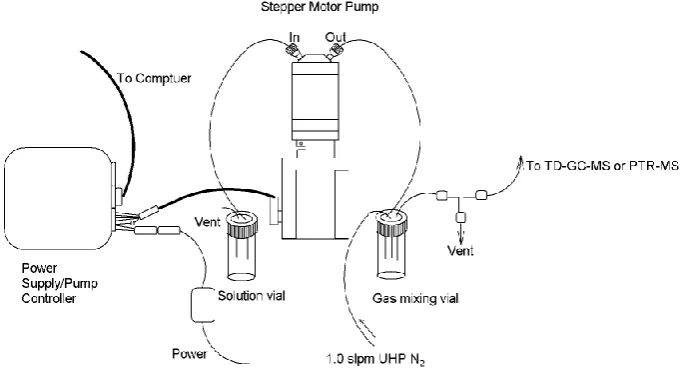
The experimental setup of the Dynamic Solution Injection system (DSI) is shown in Figure 1 and consists of a liq-uid pump, a calibration solution vial, a mixing vial, and Teflon (PFA) tubing and fittings. A syringe-free stepper mo-tor driven pump (M6 liquid handling pump, Valco Instru-ments Co., Inc) was used to control the injection flow rate of a calibration liquid solution into a mixing vial. The M6 pump was controlled with the included PC software (M6-LHS). While not employed here, this software also provides the capability of controlling a liquid sampling valve for the automated selection of one of multiple calibration solutions as well as allowing for the development of a liquid flow rate method in which flow rates can be automatically changed over time. Approximately 20 ml of a liquid standard cali-bration solution was placed in a 25 ml glass vial fitted with a Teflon sealed cap and one end of a 1/16 in O.D.×1 ft tube was submerged in the liquid calibration solution after pierc-ing through the septum while the other end was connected to the inlet of the M6 pump. An additional tube (1/16 in O.D.×1 in) was inserted through the septum to allow room air to enter the calibration solution vial when liquid solu-tion was pumped out. From the pump outlet, another 1/16 in O.D.×1 ft tube was pierced through the septum of a mixing glass vial (empty) while 1.0 slpm of ultra high pu-rity (UHP) N2flowed into the mixing vial via a separate 1/16
in O.D. tube that was also pierced through the septum. The flow rate of the UHP N2was controlled with a mass flow
Figure 1: Diagram of the Dynamic Solution Injection (DSI) system. A calibration solution vial is connected to the inlet of a liquid stepper motor pump that injects a known flow of liquid into a gas mixing vial where 1.0 slpm of dilution gas (UHP nitrogen or air) is added.
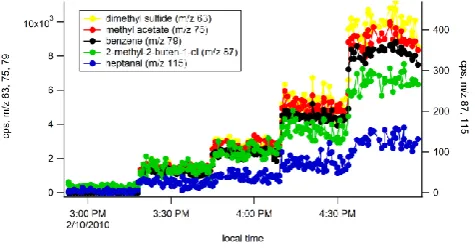
Figure 2: Example time series of PTR-MS signals (counts per second, cps) during dynamic injections of solution 1 into a 1.0 slpm UHP N2 flow. Solution flow rates were injected at 0.0, 0.5, 1.0, 2.0, and 4.0 µL min-1 sequentially.
Fig. 1. Diagram of the Dynamic Solution Injection (DSI) system. A calibration solution vial is connected to the inlet of a liquid stepper
motor pump that injects a known flow of liquid into a gas mixing vial where 1.0 slpm of dilution gas (UHP nitrogen or air) is added.
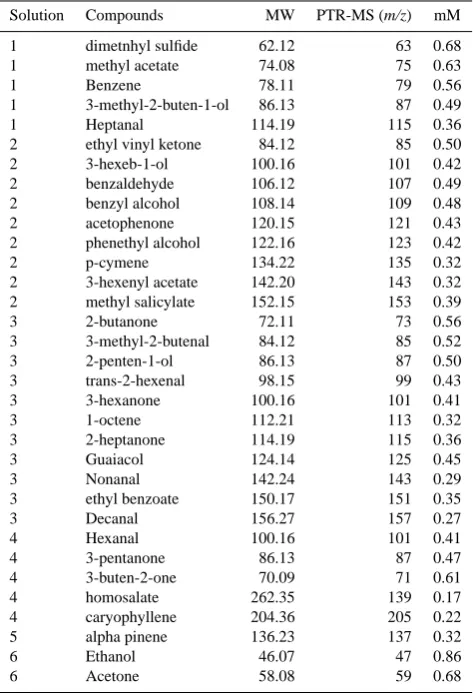
For the purposes of calibration, dilute VOC solutions 1– 6 were made as shown in Table 1 with either cyclohexane (PTR-MS) or methanol (GC-MS) as the solvent. For the PTR-MS calibrations, the six solutions were chosen so that in a given solution, no two compounds had the same molecular weight. Using a 10 µL GC syringe and a 100 mL volumetric flask, each solution was prepared by diluting 5,µL each of an authentic, neat liquid standard (Sigma-Aldrich) in 100 ml of the appropriate solvent to produce concentrations in the range of 0.22 to 0.89 mM. Once a liquid calibration solution was added to a new sample vial, the M6 pump was purged at 100 µL min−1for 15 min (<100 µL internal volume). Dur-ing this time, the liquid output was collected in a separate vial (flush). During liquid injection in the mixing vial, the M6 pump was set to deliver a flow rate of 4.0 µL min−1 or less to ensure a complete evaporation of solvent and VOC solutes into the UHP N2. For solutions in methanol,
injec-tion flow rates were kept below 2.0 µL min−1to ensure
com-plete evaporation. Gas-phase VOC concentrations produced by the DSI system ranged between 0.5–40 ppbv.
2.2 Permeation tube standards
A comparison was made between VOC calibration slopes (GC-MS and PTR-MS) obtained with the DSI technique and permeation tubes for ethanol, acetone, and α-pinene. Gravimetrically certified permeation tubes (KIN-TEK Lab-oratories, Inc.) placed in a temperature controlled per-meation chamber (VICI Valco Instruments Co. Inc.) with 100 sccm of UHP nitrogen flowing through were used to gen-erate known concentrations of acetone (456 ppbv), ethanol (579 ppbv), andα-pinene (313 ppbv). Upon dilution with UHP zero air (15.0, 10.4, 5.3, 3.0, and 1.5 slpm), the result-ing concentrations ranged between 3–35 ppbv. All flow rates
were controlled with mass flow controllers (Cole-Parmer and Omega Engineering) and calibrated using a primary flow me-ter (Defender 220, Bios Inme-ternational).
2.3 Proton Transfer Reaction – Mass Spectrometry (PTR-MS)
VOC calibration gas samples produced from the two cali-bration systems (DSI and permeation tubes) were measured using proton transfer reaction-mass spectrometry (PTR-MS). PTR-MS has been used extensively to measure the concen-trations of atmospheric volatile organic compounds (VOCs) with proton affinity greater than water. The technical details of the PTR-MS have been previously described (Lindinger and Hansel, 1997; de Gouw and Warneke, 2007). A commer-cial high sensitivity PTR-MS instrument (IONICON, Aus-tria, with a QMZ 422 quadrupole, Balzers, Switzerland) was used for this study. The PTR-MS was operated under stan-dard conditions with a drift tube voltage of 600 V and drift tube pressure of 2.1 mb. During each PTR-MS measure-ment cycle, the mass to charge ratios m/z 21 (H183 O+) and m/z 32 (O+2) were sequentially monitored with a dwell time of 20 ms. From these, the primary ion signal (H3O+) was
calculated to be between 1.5–2.0×10⁷cps. For calibration solutions 1–4, the complete list of mass to charge ratios cor-responding to the protonated VOCs shown in Table 1 were sequentially measured, each with a dwell time of 0.5 s. The total PTR-MS cycle time (each mass to charge ratio mea-sured once) was 30.3 s. In order to determine the time re-quired for gas-phase concentrations to stabilize once the liq-uid injection flow is changed, a reduced set of mass to charge ratios were monitored for solutions 5 and 6. In addition to m/z 21 and m/z 32 (H30+ and O+2), mass to charge ratios
1572 K. J. Jardine et al.: A new method for preparing pptv–ppbv standard atmospheres of volatile organic compounds
Table 1. Six cyclohexane solutions used to calibrate a PTR-MS
using the DSI technique. Solutions 5–6 (α-pinene, ethanol, and acetone) were also prepared in both cyclohexane and methanol for PTR-MS and GC-MS calibrations.
Solution Compounds MW PTR-MS (m/z) mM
1 dimetnhyl sulfide 62.12 63 0.68
1 methyl acetate 74.08 75 0.63
1 Benzene 78.11 79 0.56
1 3-methyl-2-buten-1-ol 86.13 87 0.49
1 Heptanal 114.19 115 0.36
2 ethyl vinyl ketone 84.12 85 0.50
2 3-hexeb-1-ol 100.16 101 0.42
2 benzaldehyde 106.12 107 0.49
2 benzyl alcohol 108.14 109 0.48
2 acetophenone 120.15 121 0.43
2 phenethyl alcohol 122.16 123 0.42
2 p-cymene 134.22 135 0.32
2 3-hexenyl acetate 142.20 143 0.32
2 methyl salicylate 152.15 153 0.39
3 2-butanone 72.11 73 0.56
3 3-methyl-2-butenal 84.12 85 0.52
3 2-penten-1-ol 86.13 87 0.50
3 trans-2-hexenal 98.15 99 0.43
3 3-hexanone 100.16 101 0.41
3 1-octene 112.21 113 0.32
3 2-heptanone 114.19 115 0.36
3 Guaiacol 124.14 125 0.45
3 Nonanal 142.24 143 0.29
3 ethyl benzoate 150.17 151 0.35
3 Decanal 156.27 157 0.27
4 Hexanal 100.16 101 0.41
4 3-pentanone 86.13 87 0.47
4 3-buten-2-one 70.09 71 0.61
4 homosalate 262.35 139 0.17
4 caryophyllene 204.36 205 0.22
5 alpha pinene 136.23 137 0.32
6 Ethanol 46.07 47 0.86
6 Acetone 58.08 59 0.68
Solution 6: m/z 47, 59. This resulted in a decreased PTR-MS cycle time of 1-5 seconds. The PTR-PTR-MS was calibrated to each solution by measuring the calibration gas generated from the DSI system with liquid injection flow rates of 0.5, 1.0, 2.0, and 4.0 µl min−1. Each flow rate was measured for at least 30 min and UHP N2flowing through a separate line
was also measured for background signals.
Due to fragmentation when operated in standard condi-tions with a high drift tube voltage (600 V, 111 E/N), the PTR-MS is known to have a low sensitivity to ethanol (Apel et al., 2008). However, with a high sensitivity PTR-MS (pri-mary ion intensity>2×10⁷cps), it is possible to still mea-sure a significant signal for ethanol at m/z 47 (the unfrag-mented parent ion) (Rottenberger et al., 2008; Jardine et al., 2010). With previous lower sensitivity versions of PTR-MS, the only chance was to reduce fragmentation by lowering the drift tube voltage. Although a higher yield of m/z 47 would result in better sensitivity at lower E/N, lower E/N causes a
higher degree of water clustering, which complicates analy-sis of other VOCs due to a complex interplay between clus-ter formation (RH+(H
2O)n) and proton transfer reactions (de
Gouw and Warneke, 2007; Hewitt et al., 2003). In general, E/N of 120–130 Td is recommended as a good compromise between minimizing the interference of water clusters and maximizing the sensitivity for ambient VOC measurements (Kim et al., 2009). At E/N 117 Td (our typical standard oper-ational conditions of 2.1 mbar and 600 V), we found the first water cluster (m/z 37) to be less than 4% of H3O+, at 100%
humidity (at 23◦C).
2.4 Thermal Desorption Gas Chromatography –
Mass Spectrometry
Identification and quantification of VOCs produced from the two calibration systems (DSI and permeation tubes) was made with a Series 2 Air ServerTMconnected to a UNITY 2 thermal desorption system (MARKES International) inter-faced with a 5975C series gas chromatograph/electron im-pact ionization mass spectrometer with a triple-axis detec-tor (GC-MS, Agilent Technologies). The GC-MS was cal-ibrated with solutions 5 (alpha pinene) and 6 (ethanol and acetone) by measuring the gas generated from the DSI sys-tem with liquid injection flows of 0.5 µl min−1, 1.0 µl min−1, and 2.0 µl min−1. To access the precision of the entire analyt-ical system (DSI, TD-GC-MS), this calibration was repeated five times. The GC-MS was also calibrated by measuring the gas generated from the dilution of alpha pinene, ethanol, and acetone permeation tubes with UHP zero air (see Sect. 2.2). Calibrated air samples were collected at 50 sccm for 10 min (0.5 L) on an internal sorbent tube (water management cold trap, MARKES International) held at 30◦C and purged with UHP helium at 30 sccm for 5 min. During injection, the trap was heated to 300◦C for three minutes while backflushing
with carrier gas at a flow of 6.5 sccm. In order to improve peak shape, 5 sccm of this flow was vented through the split while the remaining 1.5 sccm was directed to the column (Agilent DB624 60 m×0.32 mm×1.8 µm) temperature pro-grammed with an initial hold of 3 min at 40◦C followed by an increase to 230◦C at 5◦C min−1. The mass spectrome-ter (Agilent 5975C) was configured for scan mode (m/z 40– 300) with a 5.5 min solvent delay (methanol). Identifica-tion of VOCs was made by comparison of mass spectra with the National Institute of Standards and Technologies (NIST) database. Quantification of VOCs was performed from peak areas of m/z 45 (ethanol), m/z 43 (acetone), and m/z 93 (α -pinene). An assessment of the UHP N2results demonstrated
that peak areas for VOC blanks were negligible.
3 Results and discussion
and precision of the analytical procedure. To access the accuracy and precision of the pump, we measured the liq-uid mass acquired by a glass collection vial after dispensing 50 µL of methanol with the M6 pump at flow rates of 0.5, 1.0, and 2.0 µL min−1 (three repeat mass flow calibrations each). Assuming a methanol density of 0.79 g ml−1, the ac-curacy of the nine individual flow settings was found to be within +0.3% to−6.8% of the expected mass (39.6 mg) with an average of−2%. The flow rate precision was found to be 3.9% RSD (nine flows). To access the precision of the en-tire analytical system (DSI, GC-MS), a full calibration was performed five times with a liquid injection flow rate of 0.5, 1.0, and 2.0 µL min−1. For all flow rates, the compound spe-cific (acetone, ethanol,α-pinene) peak area precision ranged between 9 and 15% RSD. This analytical precision range therefore includes the variability in liquid injection, gas mix-ing, sampling and analysis and falls within those found by other studies employing similar GC-MS systems. For ex-ample, during an intercomparison of oxygenated VOC mea-surements in the SAPHIR atmospheric simulation chamber, the stated analytical precision was 3–15% RSD for a Perkin Elmer GC-MS (Apel et al., 2008). Our observations suggest that in the range of flow rates used in this study, the M6 pump offers a repeatable and accurate method for liquid standard injections.
After flushing the fresh liquid calibration solution through the M6 pump and tubing, regardless of the liquid flow (0.5– 4.0 µl min−1), the liquid calibration solution did not produce visible liquid drops at the end of liquid injection tube in the mixing vial, suggesting that that the liquid delivery rate determines the evaporation rate for both cyclohexane and methanol solutions. We also conclude from these results that the evaporation process is complete without the need for heating.
PTR-MS measurements demonstrate that upon switching from measurement of UHP N2(background signals) to
mea-surement of the DSI system running with cyclohexane so-lution #1 at a liquid injection rate of 0.5 µL min−1, a rapid increase in signals corresponding to the presence of the pro-tonated compounds (MW + 1) occurred (Fig. 2). Due to the lower proton affinity of cyclohexane than water, the presence of high cyclohexane concentrations in the drift tube of the PTR-MS did not affect the primary ion intensity or the pro-ton transfer reactions between the primary ion (H3O+) and
VOCs. These signals remained stable for the 30-min mea-surement period indicating establishment of a steady state evaporation process controlled by a constant liquid deliv-ery rate. Upon increasing the liquid injection flow rate to 1.0, 2.0, and 4.0 µL min−1, the PTR-MS signals increased in a step wise fashion and stabilized after a few minutes. Upon decreasing the solution #1 flow rate from the high (4.0 µL min−1) to the low (0.5 µL min−1) setting, the PTR-MS signals returned rapidly to the original values (data not shown). This result suggests that in the flow rates used, steady state conditions rapidly form and that an accumulation
liquid stepper motor pump that injects a known flow of liquid into a gas mixing vial where 1.0 slpm of dilution gas (UHP nitrogen or air) is added.
Figure 2: Example time series of PTR-MS signals (counts per second, cps) during dynamic injections of solution 1 into a 1.0 slpm UHP N2 flow. Solution flow rates were injected at 0.0, 0.5, 1.0, 2.0, and 4.0 µL min-1 sequentially.
Fig. 2. Example time series of PTR-MS signals (counts per second,
cps) during dynamic injections of solution 1 into a 1.0 slpm UHP N2
flow. Solution flow rates were injected at 0.0, 0.5, 1.0, 2.0, and 4.0 µL min−1sequentially.
of unevaporated calibration solution in the mixing vial did not occur.
To demonstrate the feasibility of calibrating the PTR-MS for a variety of compounds using the DSI system, solutions 1–6 were analyzed. These solutions contained a va-riety of structural classes including isoprenoids, oxygenated VOCs, fatty acid oxidation products, aromatics, and dimethyl sulfide. Care was taken to avoid using compounds with lim-ited solubility in cyclohexane such as organic acids. The re-sults show that linear calibration plots for large mixtures of compounds can be produced with the DSI technique (Fig. 3). Different calibration curve slopes represent different sensi-tivities of the PTR-MS to each compound. Sensisensi-tivities are influenced by differences in transmission efficiencies, frag-mentation channels, and proton transfer reaction rate con-stants.
When both GC-MS and PTR-MS calibration slopes were obtained using the DSI and permeation tube methods, rea-sonable agreement was found for acetone (within 24% of each other) (Fig. 4). However, when calibration slopes for ethanol andα-pinene permeation tubes were compared with the DSI results, the DSI slopes were greater than those from the permeation tubes on both the PTR-MS and GC-MS by a factor of 1.5–2.3 (Fig. 4). To quantitatively validate the DSI method, additional comparisons with other compounds known to be stable in standard techniques like permeation tubes and compressed gas cylinders are needed.
4 Conclusions
Despite drawbacks including low accuracy for polar com-pounds and hydrocarbons beyond C10–C11 like
1574 K. J. Jardine et al.: A new method for preparing pptv–ppbv standard atmospheres of volatile organic compounds
Figure 3: Calibration of the PTR-MS to 30 different compounds in 4 different cyclohexane solutions using the DSI technique. VOC concentrations generated by the DSI system are plotted versus normalized counts per second (ncps).
Figure 3: Calibration of the PTR-MS to 30 different compounds in 4 different cyclohexane solutions using the DSI technique. VOC concentrations generated by the DSI system are plotted versus normalized counts per second (ncps).
Figure 3: Calibration of the PTR-MS to 30 different compounds in 4 different cyclohexane solutions using the DSI technique. VOC concentrations generated by the DSI system are plotted versus normalized counts per second (ncps).
Figure 3: Calibration of the PTR-MS to 30 different compounds in 4 different cyclohexane solutions using the DSI technique. VOC concentrations generated by the DSI system are plotted versus normalized counts per second (ncps).
Fig. 3. Calibration of the PTR-MS to 30 different compounds in
4 different cyclohexane solutions using the DSI technique. VOC concentrations generated by the DSI system are plotted versus nor-malized counts per second (ncps).
Figure 4: Quantitative comparison of calibration slopes using DSI and permeation tube methods for ethanol, acetone, and α-pinene. PTR-MS measurements are shown in the first column and GC-MS measurements are shown in the second column.
References
Apel, E. C., Calvert, J. G., Greenberg, J. P., Riemer, D., Zika, R., Kleindienst, T. E., Lonneman, W. A., Fung, K., and Fujita, E.: Generation and validation of oxygenated volatile organic carbon standards for the 1995 Southern Oxidants Study Nashville Intensive, Journal of Geophysical Research-Atmospheres, 103, 22281-22294, 1998.
Apel, E. C., Brauers, T., Koppmann, R., Bandowe, B., Bossmeyer, J., Holzke, C., Tillmann, R., Wahner, A., Wegener, R., Brunner, A., Jocher, M., Ruuskanen, T., Spirig, C., Steigner, D., Steinbrecher, R., Alvarez, E.
Figure 4: Quantitative comparison of calibration slopes using DSI and permeation tube methods for ethanol, acetone, and α-pinene. PTR-MS measurements are shown in the first column and GC-MS measurements are shown in the second column.
References
Apel, E. C., Calvert, J. G., Greenberg, J. P., Riemer, D., Zika, R., Kleindienst, T. E., Lonneman, W. A., Fung, K., and Fujita, E.: Generation and validation of oxygenated volatile organic carbon standards for the 1995 Southern Oxidants Study Nashville Intensive, Journal of Geophysical Research-Atmospheres, 103, 22281-22294, 1998.
Apel, E. C., Brauers, T., Koppmann, R., Bandowe, B., Bossmeyer, J., Holzke, C., Tillmann, R., Wahner, A., Wegener, R., Brunner, A., Jocher, M., Ruuskanen, T., Spirig, C., Steigner, D., Steinbrecher, R., Alvarez, E.
Figure 4: Quantitative comparison of calibration slopes using DSI and permeation tube methods for ethanol, acetone, and α-pinene. PTR-MS measurements are shown in the first column and GC-MS measurements are shown in the second column.
References
Apel, E. C., Calvert, J. G., Greenberg, J. P., Riemer, D., Zika, R., Kleindienst, T. E., Lonneman, W. A., Fung, K., and Fujita, E.: Generation and validation of oxygenated volatile organic carbon standards for the 1995 Southern Oxidants Study Nashville Intensive, Journal of Geophysical Research-Atmospheres, 103, 22281-22294, 1998.
Apel, E. C., Brauers, T., Koppmann, R., Bandowe, B., Bossmeyer, J., Holzke, C., Tillmann, R., Wahner, A., Wegener, R., Brunner, A., Jocher, M., Ruuskanen, T., Spirig, C., Steigner, D., Steinbrecher, R., Alvarez, E.
Figure 4: Quantitative comparison of calibration slopes using DSI and permeation tube methods for ethanol, acetone, and α-pinene. PTR-MS measurements are shown in the first column and GC-MS measurements are shown in the second column.
References
Apel, E. C., Calvert, J. G., Greenberg, J. P., Riemer, D., Zika, R., Kleindienst, T. E., Lonneman, W. A., Fung, K., and Fujita, E.: Generation and validation of oxygenated volatile organic carbon standards for the 1995 Southern Oxidants Study Nashville Intensive, Journal of Geophysical Research-Atmospheres, 103, 22281-22294, 1998.
Apel, E. C., Brauers, T., Koppmann, R., Bandowe, B., Bossmeyer, J., Holzke, C., Tillmann, R., Wahner, A., Wegener, R., Brunner, A., Jocher, M., Ruuskanen, T., Spirig, C., Steigner, D., Steinbrecher, R., Alvarez, E.
Figure 4: Quantitative comparison of calibration slopes using DSI and permeation tube methods for ethanol, acetone, and α-pinene. PTR-MS measurements are shown in the first column and GC-MS measurements are shown in the second column.
References
Apel, E. C., Calvert, J. G., Greenberg, J. P., Riemer, D., Zika, R., Kleindienst, T. E., Lonneman, W. A., Fung, K., and Fujita, E.: Generation and validation of oxygenated volatile organic carbon standards for the 1995 Southern Oxidants Study Nashville Intensive, Journal of Geophysical Research-Atmospheres, 103, 22281-22294, 1998.
Apel, E. C., Brauers, T., Koppmann, R., Bandowe, B., Bossmeyer, J., Holzke, C., Tillmann, R., Wahner, A., Wegener, R., Brunner, A., Jocher, M., Ruuskanen, T., Spirig, C., Steigner, D., Steinbrecher, R., Alvarez, E.
Figure 4: Quantitative comparison of calibration slopes using DSI and permeation tube methods for ethanol, acetone, and α-pinene. PTR-MS measurements are shown in the first column and GC-MS measurements are shown in the second column.
References
Apel, E. C., Calvert, J. G., Greenberg, J. P., Riemer, D., Zika, R., Kleindienst, T. E., Lonneman, W. A., Fung, K., and Fujita, E.: Generation and validation of oxygenated volatile organic carbon standards for the 1995 Southern Oxidants Study Nashville Intensive, Journal of Geophysical Research-Atmospheres, 103, 22281-22294, 1998.
Fig. 4. Quantitative comparison of PTR-MS and GC-MS
Dynamic methods for the generation of low concentration gas standards have advantages for polar and low vapor pres-sure species due to the minimization of wall effects, but the current techniques (permeation and diffusion tubes) can suf-fer from long calibration times, high costs, low compound availability, and difficulties preparing complex mixtures. The DSI method overcomes these limitations and may provide an alternative to dangerous and non-portable compressed gas cylinders and expensive permeation tubes in most cases. The flexibility and versatility of the DSI system stems from the fact that liquid calibration solutions containing complex mix-tures of VOCs can be used to dynamically generate a wide range of gas-phase concentrations. Instead of changing the solution injection rates used in this study, we recommend that lower or higher gas-phase concentrations be generated by preparing lower or higher concentrations of VOCs in so-lution. This would avoid the potentially lower accuracy and precision of solution delivery from the M6 pump at low flow rates (5 nl min−1) and incomplete evaporation at higher flow rates.
The DSI system is more field portable relative to other cal-ibration techniques due to its small size (pump: 2.0 in×2.3 in×7.1 in) and weight (1.7 kg with all components other than the mass flow controller used for the dilution gas). It eliminates the need for bulky temperature controlled perme-ation/diffusion tube ovens and compressed gas VOC cylin-ders and regulators. Like conventional methods, the DSI method requires a dilution gas, but the flow rate is low (1.0 slpm) and could easily be generated in the field from ambient air using a small catalytic converter/pump system. Therefore, the DSI calibration method could potentially op-erate free of compressed gas cylinders. Since our DSI method does not involve addition of heat, this technique may be very useful for the calibration of labile and reactive VOCs as well as “sticky” VOCs like oxygenated VOCs and semi-volatile organic compounds. Because of its small size, low cost, and simplicity, we conclude that the dynamic solu-tion injecsolu-tion method will be useful as a semi-quantitative field calibration system. Future tests will hopefully further demonstrate its quantitative capability.
Acknowledgements. This research was supported by the University
of Arizona-Biosphere 2 Earth Science division. Instrumentation support is acknowledged from NSF (CHE 0216226). We would like to thank Thomas Karl and Alex Guenther at the National Center for Atmospheric Research for their encouragement to develop a liquid injection calibration technique.
Edited by: E. C. Apel
References
Apel, E. C., Calvert, J. G., Greenberg, J. P., Riemer, D., Zika, R., Kleindienst, T. E., Lonneman, W. A., Fung, K., and Fujita, E.: Generation and validation of oxygenated volatile organic carbon standards for the 1995 Southern Oxidants Study Nashville Inten-sive, J.Geophys. Res.-Atmos., 103, 22281–22294, 1998. Apel, E. C., Brauers, T., Koppmann, R., Bandowe, B., Bossmeyer,
J., Holzke, C., Tillmann, R., Wahner, A., Wegener, R., Brunner, A., Jocher, M., Ruuskanen, T., Spirig, C., Steigner, D., Stein-brecher, R., Alvarez, E. G., Muller, K., Burrows, J. P., Schade, G., Solomon, S. J., Ladstatter-Weissenmayer, A., Simmonds, P., Young, D., Hopkins, J. R., Lewis, A. C., Legreid, G., Reimann, S., Hansel, A., Wisthaler, A., Blake, R. S., Ellis, A. M., Monks, P. S., and Wyche, K. P.: Intercomparison of oxygenated volatile organic compound measurements at the SAPHIR atmosphere simulation chamber, J. Geophys. Res.-Atmos., 113, D20307, doi:10.1029/2008jd009865, 2008.
Barratt, R. S.: The Preparation of Standard Gas-Mixtures – a Re-view, Analyst, 106, 817–849, 1981.
Bouvier-Brown, N. C., Holzinger, R., Palitzsch, K., and Gold-stein, A. H.: Quantifying sesquiterpene and oxygenated terpene emissions from live vegetation using solid-phase microextraction fibers, J. Chromatogr. A, 1161, 113–120, doi:10.1016/j.chroma.2007.05.094, 2007.
Cardoso, A. A., Locateli, A. F., Carloni, J., and Franco, R.: Con-struction and calibration of permeation tubes, Ecletica Quimica, 21, 111–117, 1996.
de Gouw, J. and Warneke, C.: Measurements of volatile or-ganic compounds in the earths atmosphere using proton-transfer-reaction mass spectrometry, Mass Spectrom. Rev. 26, 223–257, doi:10.1002/mas.20119, 2007.
Godin, J. and Boudene, C.: New Method for Preparation of Perme-ation Tubes, Anal. Chim. Acta, 96, 221–223, 1978.
Goldstein, A. H. and Galbally, I. E.: Known and unexplored organic constituents in the Earth’s atmosphere, Geochim. Cosmochim. Acta, 73, A449, 2009.
Hanson, D. R., Koppes, M., Stoffers, A., Harsdorf, R., and Edelen, K.: Proton transfer mass spectrometry at 11 hPa with a circular glow discharge: Sensitivities and applications, Int. J. Mass Spec-trom., 282, 28–37, doi:10.1016/j.ijms.2009.01.021, 2009. Helmig, D., Revermann, T., Pollmann, J., Kaltschmidt, O.,
Her-nandez, A. J., Bocquet, F., and David, D.: Calibration sys-tem and analytical considerations for quantitative sesquiter-pene measurements in air, J. Chromatogr. A, 1002, 193–211, doi:10.1016/S0021-9673(03)00619-8, 2003.
Hewitt, C. N., Hayward, S., and Tani, A.: The application of proton transfer reaction-mass spectrometry (PTR-MS) to the monitoring and analysis of volatile organic compounds in the atmosphere, J. Environ. Monitor., 5, 1–7, doi:10.1039/B204712h, 2003. Jakoubkova, M., Engst, P., and Zelinger, Z.: Continuous
Genera-tion of Trace Amounts of Gases by Means of PermeaGenera-tion Tubes, Chemicke Listy, 80, 1191–1195, 1986.
1576 K. J. Jardine et al.: A new method for preparing pptv–ppbv standard atmospheres of volatile organic compounds
Jardine, K. J., Sommer, E. D., Saleska, S. R., Huxman, T. E., Harley, P. C., and Abrell, L.: Gas phase measurements of pyruvic Acid and its volatile metabolites, Environ. Sci. Technol., 44, 2454– 2460, doi:10.1021/es903544p, 2010.
Jayanty, R. K. M., Albritton, J. R., Straley, Y. H., and Vonlehmden, D. J.: Stability of Ppb and Ppm Organic Cylinder Gases Used for Calibration and Audits, J. Air Waste Manage. Assoc., 42, 1198– 1204, 1992.
Kim, S., Karl, T., Helmig, D., Daly, R., Rasmussen, R., and Guen-ther, A.: Measurement of atmospheric sesquiterpenes by proton transfer reaction-mass spectrometry (PTR-MS), Atmos. Meas. Tech., 2, 99–112, doi:10.5194/amt-2-99-2009, 2009.
Komenda, M., Parusel, E., Wedel, A., and Koppmann, R.: Mea-surements of biogenic VOC emissions: sampling, analysis and calibration, Atmos. Environ., 35, 2069–2080, 2001.
Lindinger, W. and Hansel, A.: Analysis of trace gases at ppb lev-els by proton transfer reaction mass spectrometry (PTR-MS), Plasma Sci. Technol., 6, 111–117, 1997.
Mitchell, G. D.: A review of permeation tubes and permeators, Separ. Purif. Method., 29, 119–128, 2000.
Rappengluck, B., Apel, E., Bauerfeind, M., Bottenheim, J., Brick-ell, P., Cavolka, P., Cech, J., Gatti, L., Hakola, H., Honzak, J., Junek, R., Martin, D., Noone, C., Plass-Dulmer, C., Travers, D., and Wang, D.: The first VOC intercomparison exercise within the Global Atmosphere Watch (GAW), Atmos. Environ., 40, 7508–7527, doi:10.1016/j.atmosenv.2006.07.016, 2006.
Rosenberg, E., Hallama, R. A., and Grasserbauer, M.: Development and evaluation of a calibration gas generator for the analysis of volatile organic compounds in air based on the injection method, Fresen. J. Anal. Chem., 371, 798–805, 2001.
Rottenberger, S., Kleiss, B., Kuhn, U., Wolf, A., Piedade, M. T. F., Junk, W., and Kesselmeier, J.: The effect of flooding on the exchange of the volatile C2-compounds ethanol,
acetalde-hyde and acetic acid between leaves of Amazonian floodplain tree species and the atmosphere, Biogeosciences, 5, 1085–1100, doi:10.5194/bg-5-1085-2008, 2008.
Spinhirne, J. P. and Koziel, J. A.: Generation and calibration of standard gas mixtures for volatile fatty acids using permeation tubes and solid-phase microextraction, T. Asae, 46, 1639–1646, 2003.
Teckentrup, A. and Klockow, D.: Preparation of Refillable Perme-ation Tubes, Anal. Chem., 50, 1728, 1978.