R E S E A R C H A R T I C L E
Open Access
Temporal stability of the rumen microbiota
in beef cattle, and response to diet and
supplements
Timothy J. Snelling
1*, Marc D. Auffret
2, Carol-Anne Duthie
2, Robert D. Stewart
3, Mick Watson
3,
Richard J. Dewhurst
2, Rainer Roehe
2and Alan W. Walker
1*Abstract
Background:Dietary intake is known to be a driver of microbial community dynamics in ruminants. Beef cattle go through a finishing phase that typically includes very high concentrate ratios in their feed, with consequent effects on rumen metabolism including methane production. This longitudinal study was designed to measure dynamics of the rumen microbial community in response to the introduction of high concentrate diets fed to beef cattle during the finishing period.
A cohort of 50 beef steers were fed either of two basal diet formulations consisting of approximately 10:90 or 50:50 forage:concentrate ratios respectively. Nitrate and oil rich supplements were also added either individually or in combination. Digesta samples were taken at time points over ~ 200 days during the finishing period of the cattle to measure the adaptation to the basal diet and long-term stability of the rumen microbiota.
Results:16S rRNA gene amplicon libraries were prepared from 313 rumen digesta samples and analysed at a depth of 20,000 sequences per library. Bray Curtis dissimilarity with analysis of molecular variance (AMOVA) revealed highly significant (p< 0.001) differences in microbiota composition between cattle fed different basal diets, largely driven by reduction of fibre degrading microbial groups and increased relative abundance of an unclassified
GammaproteobacteriaOTU in the high concentrate fed animals. Conversely, the forage-based diet was significantly associated with methanogenic archaea. Within basal diet groups, addition of the nitrate and combined
supplements had lesser, although still significant, impacts on microbiota dissimilarity compared to pre-treatment time points and controls. Measurements of the response and stability of the microbial community over the time course of the experiment showed continuing adaptation up to 25 days in the high concentrate groups. After this time point, however, no significant variability was detected.
Conclusions:High concentrate diets that are typically fed to finishing beef cattle can have a significant effect on the microbial community in the rumen. Inferred metabolic activity of the different microbial communities associated with each of the respective basal diets explained differences in methane and short chain fatty acid production between cattle. Longitudinal sampling revealed that once adapted to a change in diet, the rumen microbial community remains in a relatively stable alternate state.
Keywords:Rumen, Microbiota, Concentrate diet, Forage diet, Nitrate supplementation, Oil supplementation, Temporal stability
© The Author(s). 2019Open AccessThis article is distributed under the terms of the Creative Commons Attribution 4.0 International License (http://creativecommons.org/licenses/by/4.0/), which permits unrestricted use, distribution, and reproduction in any medium, provided you give appropriate credit to the original author(s) and the source, provide a link to the Creative Commons license, and indicate if changes were made. The Creative Commons Public Domain Dedication waiver (http://creativecommons.org/publicdomain/zero/1.0/) applies to the data made available in this article, unless otherwise stated. * Correspondence:[email protected];[email protected]
1Rowett Institute, University of Aberdeen, Aberdeen AB25 2ZD, UK
Background
As a result of increasing demand for meat and milk, par-ticularly in developing countries, ruminant livestock pro-duction is becoming one of the fastest growing agricultural sectors [1]. This trend has led to concerns regarding environmental impact, where livestock farm-ing currently accounts for 44% of the total anthropo-genic sources of the greenhouse gas methane (CH4) [2].
Ruminant recovery of energy from the diet, as well as the production of CH4and N2O, is due to the activity of
the rumen microbial community. Therefore, manipula-tion of the microbiota has the potential to improve the efficiency of animal production, and mitigate greenhouse gas emissions [3]. A practical approach to achieve this is by management of the dietary intake.
The components making up a typical basal diet fed to beef cattle can be categorised into two major feed types. Plant fibre, including straw, hay, and grass or cereal crop silage are classified as forage. A variety of feeds, typically pelleted, and composed of nutrient-rich grains, starch, sugars or protein are classified as concentrates. The dif-ferent ratios of the two feed types can influence the composition of the rumen microbial community both as a response to the different carbohydrate sources in the diet [4] and as a result of the changes in interactions be-tween microbial groups [5]. In turn this alters the pro-duction rates of microbial metabolic products including short chain fatty acids (SCFA) and methane [6,7].
Supplements are added to the diet to improve per-formance or reduce methane production according to key principles. Firstly, they can directly influence growth of key members of the microbial community, either pro-moting growth of beneficial microbes or inhibiting growth of detrimental microbes. For example, addition of oils can have a defaunating effect, and at high doses can reduce or eliminate ciliate protozoa in the rumen [8], and vegetable oils and fish oils at doses as low as 1–2% have been found to directly affect the growth of key bacterial species [9]. Nitrate is added as a theoretical ‘sink’ for hydrogen (H2)
where it is reduced, typically by Selenomonas spp., to nitrite and ultimately to ammonia [10]. Reduction of ruminal hydrogen in theory limits substrate availabil-ity for growth of the methanogenic archaea [11]. Sec-ondly, the supplement can have an effect on metabolite production by inhibiting the activity of key enzymes involved in certain metabolism pathways. Ex-amples are the nitrooxy compounds that inhibit ca-talysis of the final step of the methanogenesis pathway [12].
The effect of nitrate and oil/fatty acid supplements on ruminal methane production has not always been reflected by associated changes in the microbial commu-nity [13–16]. The outcomes of these studies are highly
dependent on the dose and the chemical composition of the nitrate salt [10], as well as the choice of method-ology, sensitivity of the measurements, the power of the statistical analysis and factoring of variability of re-sponses between individual experimental animals. In studies involving larger cohorts of experimental animals, combined with the appropriate discriminant analysis of metagenome datasets, it has been possible to identify rumen microbe functional biomarkers and inferred taxo-nomic groups for methane emissions in response to both basal diets and supplements [17].
Longitudinal experiments have been carried out previ-ously to monitor the development of rumen microbiota during early life [18, 19], to measure the temporal dy-namics of the microbiota during colonisation and break-down of dietary fibre [20–22] and the diurnal variability [23]. However, there is a lack of knowledge on the long-term stability and repeatability of measurements of the microbial community during the finishing phase of ma-ture livestock animals.
The aim of the current study was to characterise the rumen microbial community of beef cattle in response to two basal diets comprising different forage:concen-trate ratios with addition of high oil and niforage:concen-trate supple-ments over the course of the finishing stage of production. Longitudinal sampling enabled the measure-ment of the temporal dynamics and stability of the mi-crobial community over this period. The most significant discriminant groups of microorganisms re-sponsible for driving changes as a response to diet over time were identified.
Results
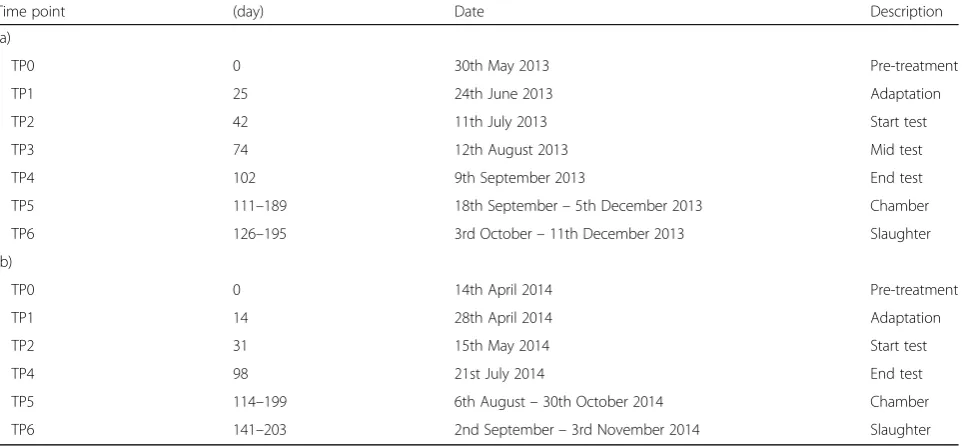
16S rRNA gene sequencing of rumen digesta samples was used to assess potential links between basal diet, rumen microbiota composition, and host animal mea-sures such as methane emission and feed efficiency. In total, 313 16S rRNA gene amplicon libraries were se-quenced using rumen samples collected during two feed trials carried out over consecutive years (2013 and 2014). 50 finishing beef steers (32 in 2013 and 18 in 2014) were sampled periodically at time points covering the seven-month finishing period when the animals are fed to gain weight and optimise meat and fat compos-ition prior to slaughter. Sampling time points were evenly distributed (approximately one month apart) and covered critical time points listed in Table1.
(Fig. 1), as well as lower molar proportions of acetate (P< 0.001) and butyrate (P< 0.01) and higher molar pro-portions of propionate (P< 0.001) and valerate (P< 0.05) [7]. Within basal diets, only the combined nitrate and oil supplementation significantly reduced methane produc-tion compared to control in the forage fed cattle (Fig.1). Average residual feed intake (RFI) was lower, (i.e. higher efficiency) in the high concentrate fed animals. However, this was not considered statistically significant.
After quality control and subsampling, 16S rRNA gene sequencing resulted in a total of 6.26 million sequences (randomly subsampled to 20,000 per library) for further analysis, providing > 97% species coverage (Good’s Coverage Index) for each sample. A total of 12,361 OTUs were identified, with over 99% of the sequences contained in the top 2000 OTUs. SILVA 128 SEED ref-erence taxonomy assigned the majority of sequences (39%) to the Bacteroidetes, 30% to Firmicutes, 16% to
Gammaproteobacteria, 6% to the Euryarchaeota, 2%
Actinobacteria, 2%Spirochaetes1%Verrucomicrobiaand 1% Fibrobacteres, with 3% unclassified phyla (Add-itional file 1: OTU Table). Mean proportional composi-tions at the family level for both forage and concentrate-fed animals are shown in Additional file2: Figure S1.
Average microbial diversity as assessed by calculating the Shannon index for each sample, was significantly lower (p< 0.001) in the cattle fed a high concentrate
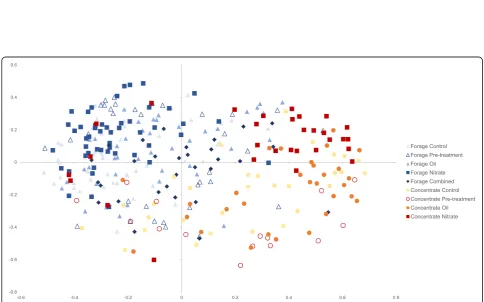
basal diet (Additional File 2: Figure S2). Furthermore, analysis of molecular variance (AMOVA) applied to the distance matrix used for the non-metric multidimen-sional scaling plot (NMDS) revealed highly significant clustering of microbial communities by basal diet (p< 0.001) (Fig.2). Within each of the two basal diet groups, the microbial communities clustered significantly (p< 0.001) following nitrate supplementation compared to all other treatment and control groups. In the forage basal diet groups, combined oil/nitrate supplement samples (2013) clustered separately from the control group only (p< 0.001). In the concentrate fed animals, the oil sup-plement samples separated from the pre-treatment sam-ples (p< 0.001). There was no significant microbial community dissimilarity between control animals and pre-treatment groups (Additional file2: Table S3).
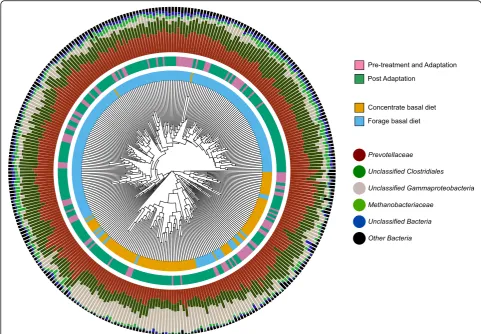
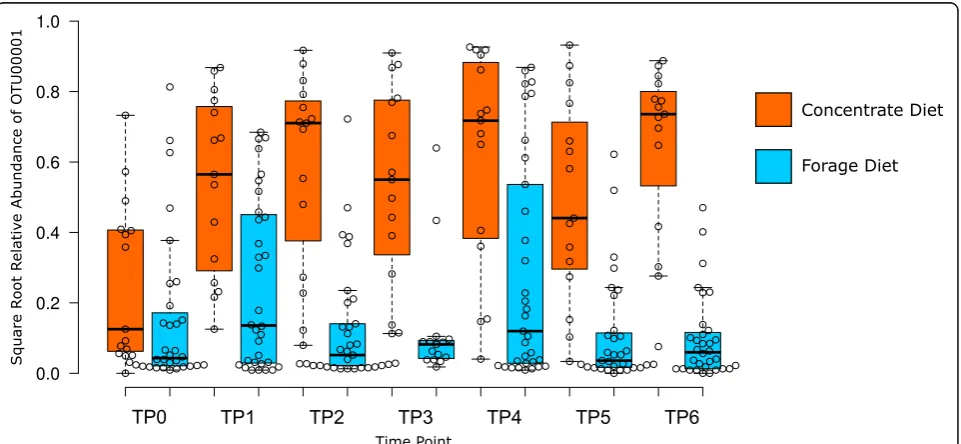
Supporting the AMOVA results, significant clustering of the microbial communities of forage and concentrate fed animals were also observed when using parsimony analysis of the microbial community dendrogram (Fig.3). This clustering was largely driven by an increase in rela-tive abundance of a single species-level operational taxo-nomic unit (OTU) (OTU00001, assigned to
Gammaproteobacteria) in concentrate fed animals, which was also particularly associated with the later time points following the pre-treatment and adaptation periods.
Table 1Sampling timetable for (a) NutriBeef 2013 and (b) NutriBeef 2014 diet and supplement trials
Time point (day) Date Description
(a)
TP0 0 30th May 2013 Pre-treatment
TP1 25 24th June 2013 Adaptation
TP2 42 11th July 2013 Start test
TP3 74 12th August 2013 Mid test
TP4 102 9th September 2013 End test
TP5 111–189 18th September–5th December 2013 Chamber
TP6 126–195 3rd October–11th December 2013 Slaughter
(b)
TP0 0 14th April 2014 Pre-treatment
TP1 14 28th April 2014 Adaptation
TP2 31 15th May 2014 Start test
TP4 98 21st July 2014 End test
TP5 114–199 6th August–30th October 2014 Chamber
TP6 141–203 2nd September–3rd November 2014 Slaughter
TP0: Pre-treatment: After transition to the Forage and Concentrate diets but before introduction of Nitrate and Lipid treatments
TP1: Adaptation: Seven days after introduction to Nitrate and Lipid treatments when cattle were being offered 25% of the maximum dose of Nitrate TP2: Start test: At the start of the 56 day performance test period
TP3: Mid test: At the mid-point of the 56 day performance test period (2013 samples only) TP4: End test: At the end of the 56 day performance test period
TP5: Chamber: After completion of the 56 day performance test period, when each animal left the respiration chambers over a period of 13 weeks (six animals/week)
Fig. 2NMDS plot (Stress value 0.21) based on Bray Curtis dissimilarity matrix showing significant clustering of samples by basal diet (p< 0.001, AMOVA calculated using mothur software)
Analysis of similarities (ANOSIM) confirmed the AMOVA results with highest R values associated with com-parisons between animals fed different basal diets (p< 0.001). Nitrate (2013 and 2014) and oil (2013 and 2014) sup-plementation appeared to have relatively lower R values, but nonetheless significant, effects (p< 0.001). The only non-significant treatment was the oil in conjunction with the for-age diet when compared to pre-treatment time points. No significant effects or interactions were found as a result of breed or trial year within treatments.
Linear discriminant analysis (LDA) using LEfSe software [25] identified highly significant OTU bio-markers associated with basal diet groups. With minimum linear discriminant analysis (LDA) effect size set at threshold > 4.0, species level OTUs were assigned to the lowest taxonomic level (using SILVA 128 classification at 100% confidence), with Gamma-proteobacteria (class), Prevotella (genus) and Phasco-larctobacterium (genus) significantly associated with high concentrate basal diets. OTUs assigned to
Methanobrevibacter (genus), Ruminococcacaeae
Fig. 3Dendrogram based on Bray Curtis dissimilarity matrix showing strong clustering between animals fed concentrate and forage basal diets. Clustering was largely driven by increased relative abundance of UnclassifiedGammaproteobacteriafollowing pre-treatment/adaptation time points. Inner Ring: Basal Diet. Middle Ring: Timepoints, including Pre-treatment and Adaptation (TP0–TP1) and Post Adaptation (TP3 to Slaughter). Outer Ring: Taxon proportional abundance (Family)
Table 2OTU level taxonomic biomarkers for (a) concentrate basal diets and (b) forage basal diets (Linear discriminant analysis effect size > 4.0)
(a)
Concentrate % Seq SILVA 128 Taxonomy (Mixed Rank)
OTU00001 10.5 UnclassifiedGammaproteobacteria(Class)
OTU00004 2.6 Prevotella(Genus)
OTU00017 1.0 Phascolarctobacterium(Genus)
OTU00019 0.9 Prevotella(Genus)
(b)
Forage % Seq SILVA 128 Taxonomy (Mixed Rank)
OTU00003 2.9 Methanobrevibacter(Genus)
OTU00006 2.3 Ruminococcaceae(Family)
OTU00005 2.4 Proteobacteria(Phylum)
OTU00009 1.9 Lachnospiraceae(Family)
(family), Proteobacteria (phylum) and Lachnospira-ceae (family) were significantly associated with forage basal diets (Table 2).
Taxonomic biomarkers were also found to be associ-ated with the animals in the upper quartile of feed effi-ciency RFI at less stringent effect sizes (LDA > 2.0). These OTUs were low proportional abundance (typically 0.1–0.3% of the total microbial population), however, and were identified as species from the Prevotellaceae,
RikenellaceaeandAcidaminococcaceaefamilies.
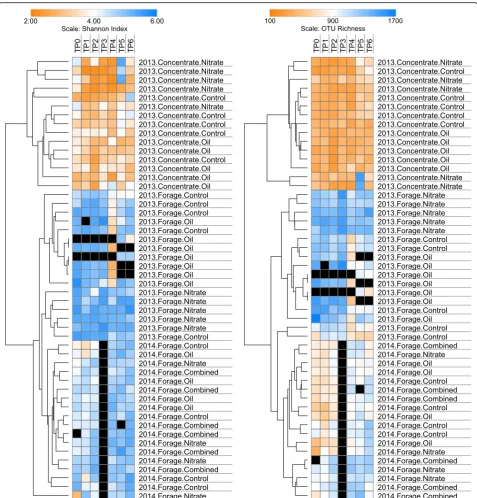
Next, we carried out a longitudinal analysis, in order to assess the temporal stability of the rumen microbiota. Microbial community alpha diversity appeared to be relatively stable across sampling times during the ~ 200 days from Pre-treatment (TP0) to Slaughter (TP6), with the concentrate fed animals again showing consistently lower rumen microbiota diversity than those on the for-age diet (Additional file 2: Figure S3). Clustering by Eu-clidean distance of average values of observed species richness (SOBS) and Shannon diversity index (H′) across the total time course separated samples by basal diet, with lower microbial community diversity in the high concentrate fed animals compared to the forage group. Within the forage fed animals, average alpha diversity was strongly influenced by trial year, with most animals from 2013 containing significantly lower average species richness and average microbial diversity (Shannon index) from those in the 2014 trial (p< 0.001) (Fig. 4, Add-itional file 2: Figure S4). However, discriminant analysis (LDA effect size > 4.0) did not reveal any significant OTUs between the 2013 and 2014 forage fed groups.)
Response and adaptation of the microbial community to the basal diets/supplements was measured using the Bray Curtis metric, which measured community dissimi-larity relative from the pre-treatment time point as a baseline. Repeated measures ANOVA on these data showed significant community dissimilarity only occur-ring between Pre-treatment (TP0) and Adaptation (TP1) time points in high concentrate fed cattle. Forage fed cattle from both 2013 and 2014 animal trials did not show significant variability in microbial community composition regardless of additional supplement (Fig.5). Pairwise Spearman correlations of Bray Curtis values between these time points were all highly significant (p< 0.001) (Additional file 2: Figure S6). Furthermore, the higher average dissimilarity values associated with concentrate diets compared to forage diets in both trial years indicated that the initial addition of con-centrates to the diet preceded sweeping changes in microbiota composition. There was no further subse-quent significant change in dissimilarity over time points TP1-TP6, however, indicating that the rumen microbiota remained relatively stable after adaptation to a given diet.
Of the OTU biomarkers associated with basal diets (LDA effect size > 4.0), only OTU00001 (derived from an uncultured Gammaproteobacteria lineage) showed significant temporal response to the introduction of the high concentrate diet. The relative abundance of this OTU increased upon addition of concentrates to the diet, and its dominance was maintained throughout the remainder of the experimental period while concentrates were being continually fed to the animals (Fig.6).
Discussion
The effects on the rumen microbial community of basal diet, and addition of nitrate and high-oil supplements, was determined with 50 experimental animals consisting of mature beef cattle during the seven-month finishing period.
High concentrate diets were significantly associated with lower methane emissions (g/kg DMI), decrease in acetate and an increase in propionate production. The change in metabolite production was in turn associated with better feed efficiency/lower residual feed intake (RFI). This supported the theory that energy stored in metabolites such as methane may represent a loss to the animal.
The Shannon diversity and species richness of the mi-crobial communities was significantly lower in the con-centrate fed compared to the forage fed groups. The effect of microbial community diversity on feed effi-ciency was previously investigated by Kruger Ben Shabat et al., (2016) [26], who reported that decreased microbial diversity was associated with a decrease in energy re-quirements needed for the production of non-relevant metabolites.
The cohort including the forage fed animals were split over two trial years (2013 and 2014), and some apparent differences in microbial diversity were revealed between these two groups, driven in part by a difference in the OTU richness. Analysis of the temporal stability of the microbial community accounted for the difference in baseline diversity as part of the statistical model and re-vealed a highly significant response over time of the rumen microbial community to the introduction of high concentrate diets compared to the forage fed groups from both trials. This response was followed by relative stability and illustrated in real time the perturbation, and re-stabilisation of the rumen microbial community after a given period of adaptation. Moreover, discriminant analysis provided compelling evidence of the most im-portant microbial groups driving these changes.
Clostridiales order (29%) and Gammaproteobacteria
class (16%), and the archaeal family Methanobacteria-ceae (6%). Changes in the relative abundance of these groups likely reflected their substrate preferences and/or tolerance of the environmental conditions [27] as a re-sult of the different diets provided to the cattle.
Interestingly, the proportional abundance of the family Prevotellaceae relative to the total community
did not change in the high concentrate animals. In contrast, the Methanobacteriaceae decreased in favour of increased relative abundance of unclassified Gam-maproteobacteria (Additional file 2: Figure S1). This suggests that the growth of the unclassified Clostri-diales was less competitive in a low fibre environ-ment, whereas the Prevotellaceae have a greater degree of adaptability to gut conditions [28].
HydrogenotrophicMethanobrevibacterspp. were asso-ciated with the forage fed animals, and this was reflected in significantly higher methane production (g CH4 /kg
DMI) in this group. Reduction of methane emissions relative to dry matter intake (g/kg DMI) is a widely re-ported effect of increasing percentage of concentrate in the diet formulation, particularly at levels exceeding 80–
90% concentrate:forage ratios [29]. This is typically asso-ciated with a shift from acetate toward propionate pro-duction, as was the case in the present study and previously reported in Troy et al., (2015) [7] and Duthie et al., (2018) [24].
A singleProteobacteriaOTU (OTU00005) was associ-ated with forage diets. SILVA 128 taxonomy was unable
Fig. 5Temporal stability of microbial community beta diversity (Bray Curtis dissimilarity) over time (Days). Comparison of basal diets (all supplements and control treatments). Significant microbial community dissimilarity (*ANOVAp< 0.001) was only observed between time point TP0 (Day 0) and TP1 (Day 25: 2013 Animal trial)
to classify this uncultivated species in more detail. How-ever, an NCBI BLASTn type search and the RDP classi-fier most closely aligned the representative sequence to a member of the Pasteurellaceae. This family includes rumen isolates Basfia succiniciproducens [30] and Acti-nobacillus succinogenes [31], both characterised as suc-cinate producers with the ability to reduce nitrate. It is possible that the uncharacterised OTUs detected here might have similar functionality. In support of this, LEfSe analysis within diet groups confirmed its associ-ation with the nitrate treatment.
The single most abundant OTU, comprising over 10% of total sequence counts, was significantly associated with the high concentrate basal diet. The representative sequence was assigned to the Gammaproteobacteria
class using SILVA 128 reference taxonomy, but was not identified as any known cultured isolate. Using the Greengenes reference database, the sequence was mapped toSuccinivibrionaceae(71% bootstrap support), while the RDP classifier and an NCBI BLAST type search to mapped it to the genus Frischella (65% boot-strap support and 89% sequence identity respectively) [32]. Phylogenetic analysis (Additional file2: Figure S5) placed it in a group containing the novel Orbales order isolated from the gut of insects [33]. Examples of rumen
Gammaproteobacteria isolates Actinobacillus succino-genes, Basfia succiniciproducensandMannheimia succi-niciproducens[30,31, 34] are all known for their ability to produce succinate.
Isolates of the succinate-producing Succinivibriona-ceae family of microbes have also been characterised from the foregut of the Tammar wallaby, a herbivore known for its unusually low methane emissions [35]. In a previous metagenomic analysis, Succinivibrionaceae
were associated with low methane emitting phenotypes in beef cattle [36]. In the present study, detailed taxo-nomic classification of the Proteobacteria OTU se-quences beyond class level was limited by the lack of available references. However, an NCBI BLASTn search of the representative sequences against the total current nucleotide database found many hundreds of highly similar sequences previously recovered from ruminants but not identified. This indicates that this species is likely to be an important and widespread rumen micro-biota constituent, and highlights the importance of con-tinuing efforts to culture, isolate and better characterise the rumen microbiota [37]. Cumulatively, the sequence-based data suggest that there are important groups of unclassified Proteobacteria, possibly containing novel taxa that may have a significant role in rumen methane emissions.
Following discriminant analysis, two OTU biomarkers assigned toPrevotellaspp. were strongly associated with the high concentrate diet group. Isolates from this genus
are known to produce propionate via the succinate path-way [38], although with low pH conditions some species of Prevotella can be associated with accumulation of succinate [39]. In response to these conditions, a prom-inent succinate consumer would be expected to thrive. In this study, an uncultured Firmicutes organism strongly associated with the concentrate diets was identi-fied as Phascolarctobacterium (SILVA) or Succiniclasti-cum (Greengenes/RDP/BLASTn). The type species of this genus, Succiniclasticum ruminis, is known to pro-duce propionate from succinate as the sole mechanism of energy production [40]. Short chain fatty acid analysis, carried out previously, confirmed significantly lower acetate to propionate ratio in concentrate fed animals [7,
24].
No archaea were associated with high concentrate di-ets above our arbitrarily high LEfSe-based linear discrim-inant analysis threshold. However, at lower LDA effect size settings, OTUs classified as Methanobrevibacter boviskoreani, a methanogenic archaeal species recently isolated from the rumen of Korean cattle [41] and
Methanomassiliicoccaceae, a methylotrophic methano-gen group previously associated with low methane emis-sions in the rumen [42], were both significantly associated with high concentrate diets/low methane emissions in the cattle.
Previous comparable analyses of the human gut micro-biota have established that, in the absence of major per-turbations, the most abundant groups of the microbial community remain in a largely stable state [43, 44]. In contrast, previous longitudinal studies of the rumen microbiota indicate that it can vary significantly over long term seasonal time scales, probably as a result of the changes in grazing quality throughout the year [45]. In the short term, the diurnal variability of the rumen microbial community can overpower both individual and diet effects. The latter effect is typically seen when high concentrate containing rations are provided to the animal once per day [23]. The principle of short-term variability as a result of dietary effect, followed by long term stability was broadly supported in this study. Fol-lowing the period of adaptation and change, an alterna-tive stable microbial community state was established for the duration of the feed trial. This type of response and single alternative state is one of the models used to describe the variability of community types in response to a change in environment. Other models such as multi-stability or selection of local communities de-scribed in the human gut have not been dede-scribed in the rumen [46].
concentrate to forage (90:10) typically provided as a beef cattle finishing diet, reduction of key fibre degraders would be expected [47]. In agreement with this expect-ation, in the current study LEfSe-based linear discrimin-ant analysis of taxa revealed key fibre-degrading
Clostridiales species were most negatively impacted by the dietary change, whereas more generalist taxonomic groups such as Prevotella spp. appeared to be relatively unaffected.
Another mechanism by which dietary changes might change the rumen microbiota is a niche modification ef-fect, whereby the bacteria themselves alter their environ-ment, affecting growth of functionally associated groups [45]. A possible niche modification following dietary change is indicated by the significant increase in propor-tional abundance ofSucciniclasticum, possibly as a result of accumulation of its preferred growth substrate succin-ate, and a significant decrease in Methanobrevibacter, likely as a result of reduced availability of hydrogen. The dramatic increase of concentrates favoured a single un-classified species (OTU) of Gammaproteobacteria. Lin-ear discriminant analysis identified this OTU as the only taxon significantly associated with the change of the microbiota between TP0 and TP1. As this organism is currently uncultured, it is unknown whether its propor-tional increase was driven directly by diet effects, or in-directly via niche modification.
Conclusions
Our results build on existing studies emphasizing the importance of diet, and in particular the ratio of concen-trate to forage, in driving the composition of the rumen microbiota [4–6,17,23]. Changes in the ruminal micro-biota composition following addition of high concentrate diets and supplements explained many of the phenotypic changes previously reported in the rumen, including me-thane emissions and SCFA production [24]. Microbial community changes were largely driven by a small number of highly proportionally abundant OTUs, with one identified as an uncultured member of the Gam-maproteobacteria of particular significance. As assessed by longitudinal sampling, the change in rela-tive abundance of this and other corresponding taxa was observed during the initial response and the adaptation period. This was followed by a period of relative stability, in respective alternative states corre-sponding to either the forage or high concentrate di-ets. This result is reassuring for cross-sectional studies as our results suggest that, once adapted to a dietary intervention, a single sample may be consid-ered reasonably representative of the microbial com-munity during the time course of a typical trial where the animals are fed a consistent diet.
Materials and methods
Sampling
Digesta samples were taken from a selection of 50 ex-perimental animals that were part of two related trials carried out in consecutive years. The trials investigated the long-term effect of different diets and feed additives on CH4 emissions, performance and feed efficiency in
different breeds of beef cattle during the seven-month finishing phase of production.
The first animal trial, carried out between May 2013 and December 2013 and reported in Troy et al., (2015) [7], involved 32 beef cattle comprising two breeds: cross-bred 17 Charolais (CH) and 15 purecross-bred Luing (LU). Over an adaptation period of four weeks, a selection of animals was introduced to the respective diets: 15 to the concentrate-straw based (Concentrate) and 17 to the silage-based (Forage). Individual groups were then allo-cated to one of three treatments: Control (n= 10), Ni-trate (n= 10), or a high oil (Oil) (n= 12) supplement.
The second animal trial, carried out from March 2014 to November 2014 and reported in Duthie et al., (2018) [24] involved 18 beef cattle comprising two breeds: 10 crossbred Aberdeen Angus (AA) and eight crossbred Li-mousin (LIM). In this case all animals were given a Sil-age based diet (ForSil-age) and allocated to one of four treatment groups: Control (n= 4), Nitrate (n= 4), high oil (Oil) (n= 4), or combined nitrate and high oil supple-ments (n= 6).
Both studies took place at the Beef and Sheep Re-search Centre, SRUC, Edinburgh, UK. The experimental work was approved by the Animal Experiment Commit-tee of SRUC and was conducted in accordance with the requirements of the UK Animals (Scientific Procedures) Act 1986. Details on the experimental animals, diet for-mulation, allocation and sampling time points through-out the course of the experiments including sampling timetables can be found in Table1and Additional file2: Tables S1–2.
At each sampling, approximately 50 mL of rumen li-quid were taken by inserting a stomach tube (16 × 2700 mm Equivet Stomach Tube, Jørgen Kruuse A/S, Langes-kov, Denmark) nasally and aspirating manually. This li-quid was filtered through two layers of muslin and 5 mL strained rumen fluid were mixed with 10 ml phosphate buffered saline containing glycerol (30% v/v). These samples were stored at −20 °C between collection and analysis.
For short chain fatty acid (SCFA) analysis, a 5 ml sam-ple of the filtered liquid was deproteinised by adding 1 mL metaphosphoric acid (215 g/L) and 0.5 mL methylva-leric acid (10 g/L). Measurements were made using HPLC [48] and expressed as mmol/mol total SCFA.
in closed respiration chambers following adaptation in an open training pen. CH4 concentrations were
mea-sured for each chamber by a multi-gas analyser. CH4
production was calculated as the difference between in-let and exhaust gas concentration multiplied by volumet-ric dry air flow, corrected to standard temperature and pressure (25 °C and 1013 Mbar). Daily CH4 production
was calculated as the average of individual values and converted to a mass basis. Feed intake was monitored during this phase and methane emissions calculated per day (g/day) and relative to kg dry matter intake (g/kg DMI).
Feed efficiency was calculated using two metrics: Feed conversion ratio (FCR) was calculated as average dry matter intake (DMI) per day (kg/d)/ average daily gain (ADG).
Residual feed intake (RFI) [49] was calculated as devi-ation of actual DMI (kg/d) from DMI predicted based on linear regression of actual DMI on ADG, mid-metabolic body weight (MBW = BW0.75) and FD1 (fat depth at the 12/13th rib at the end of TP4) [50].
16S rRNA gene amplicon library preparation
DNA was extracted following the protocol based on Yu and Morrison (2004) [51] by repeated bead-beating followed by precipitation, elution and purification using columns from the QIAamp® DNA Stool Mini Kit, (QIA-GEN Ltd., Manchester, UK).
PCR amplification (20 cycles) was carried out in quad-ruplicate 25μL reactions using Q5® High-Fidelity DNA polymerase (New England Biolabs Inc.,Hitchin, UK) with universal prokaryotic primers targeting the V4 region of the 16S rRNA gene [52]. Individual samples were identi-fied using unique 12 nucleotide barcodes built into the forward primer. PCR products were cleaned and quanti-tated using the Qubit high sensitivity dsDNA assay kit (Fisher Scientific UK Ltd., Loughborough, UK). The samples were pooled in equimolar quantities and 80μL run on a 1% w/v agarose/TBE gel to separate residual primers and dNTPs. The band at the expected size con-taining the amplicons was cut and purified using a Pro-mega Wizard® SV Gel purification kit (ProPro-mega UK, Southampton, UK).
The libraries were quality assessed using an Agilent 2100 Bioanalyzer System (Agilent Technologies. Santa Clara, CA, US) and sequenced by Edinburgh Genomics using Illumina MiSeq v2 250 paired end reagent kits (Illumina UK, Cambridge, UK.). Raw sequence data was uploaded to the European Nucleotide Archive under study accession numbers PRJEB31107 and PRJEB31085.
Sequence analysis
Sequence data was analysed using mothur 1.39.0 [53] with steps to assemble paired end sequences, remove
low quality sequences using both quality control metrics and chimera removal using UCHIME 4.2.40 [54]. Se-quence counts in each library were normalised by sub-sampling to 20,000 sequences per sample.
An operational taxonomic unit (OTU) based approach was selected over phylotyping. This approach better de-scribed the microbial community diversity irrespective of whether a taxonomic label could be applied to the representative sequence [55]. This was also important for determination of discriminant taxa where the same phylotype (for example, Prevotella) can be associated with opposing treatment or phenotypic groups [56].
Sequences were clustered into OTUs using OptiClust [57] at 97% identity, singletons removed and taxonomic classification of the representative sequences initially using the SILVA 128 SEED reference database [58]. For verification purposes, classifications were subsequently also carried out using the Greengenes (gg_13_8_99) [59] and Ribosomal Database Project (version 16) reference databases [60], and NCBI BLASTn against the complete NCBI reference database. OTUs assigned to theArchaea
domain were reclassified using the RIM DB taxonomic framework for methanogenic archaea [61].
Statistical analysis
Sequence counts in each library were normalised by sub-sampling to 20,000 sequences per sample prior to statis-tical analysis. Microbial community data was tested for coverage per sample using Good’s statistic [62]. Micro-bial community species richness and diversity was sum-marised using the number of observed OTUs and Shannon diversity index (H′), respectively. Beta diversity was calculated using the Bray Curtis dissimilarity metric. Significance differences of the beta diversity compari-sons were given at values of p< 0.001. The Parsimony test in mothur was used to assess significance in the dendrogram, and analysis of molecular variance (AMOVA) for the distance matrix used to create the nonlinear multidimensional scaling (NMDS) plot of the total sample data.
Taxonomic biomarkers associated with respective treatment groups were determined using Linear Dis-criminant Analysis (LEfSe) [63] with a cut off of effect size set at values > 4.0. This was applied to diet, groups, supplement groups and highest and lowest quartile re-sidual feed intake groups.
over time. The Tukey HSD post hoc test was used to compare multiple treatments. In cases where OTU se-quence counts were used for statistical comparison, the data were transformed using square root relative abun-dance. Correlations were determined using Spearman rank correlation. Significance was given at values ofp< 0.05 in the case of phenotype data andp< 0.001 for se-quence data.
Supplementary information
Supplementary informationaccompanies this paper athttps://doi.org/10. 1186/s42523-019-0018-y.
Additional file 1.Table of operational taxonomic units with animal metadata and taxonomic classification.
Additional file 2.Supporting figures, tables and statistical analyses not included in the manuscipt.
Abbreviations
16S rRNA:16 Svedberg ribosomal ribonucleic acid; ADG: Average daily gain; AMOVA: Analysis of molecular variance; ANOVA: Analysis of variance; BLAST: Basic local alignment search tool; bp: Base pair; DMI: Dry matter intake; DNA: Deoxyribonucleic acid; dNTP: Deoxynucleotide Triphosphate; FCR: Feed conversion ratio; LDA: Linear discriminant analysis; LEfSe: Linear discriminant analysis effect size; NCBI: National center for biotechnology Information; NMDS: Nonlinear multidimensional scaling; nt: Nucleotide; OTU: Operational taxonomic unit; PCR: Polymerase chain reaction; RDP: Ribosomal database project; RFI: Residual feed intake; RIM DB: Rumen and intestinal methanogen-data base; SCFA: Short chain fatty acid; TBE: Tris borate ethylenediaminetetraacetic acid; TP: Time point
Acknowledgements
Sampling of ruminal digesta was carried out at Scotland’s Rural College (SRUC) by Laura Nicoll, Lesley Deans and Claire Broadbent.
Sequencing using Illumina MiSeq was carried out by Edinburgh Genomics, The University of Edinburgh. Edinburgh Genomics is partly supported through core grants from NERC (R8/H10/56), MRC (MR/K001744/1) and BBSRC (BB/J004243/1).
Data were processed using the Maxwell High Performance Computing Cluster of the University of Aberdeen IT Service (www.abdn.ac.uk/staffnet/ research/hpc.php), provided by Dell Inc. and supported by Alces Software.
Authors’contributions
Experimental design by RR, RJD and AWW. Experimental work by TJS, CAD, MW, Data analysis by TJS, AWW, manuscript written by TJS, AWW, MDA, RR, RJD, RDS, MW, CAD. All authors read and approved the final manuscript.
Funding
This work was funded by the Rural and Environment Science and Analytical Services Division (RESAS) of the Scottish Government as a collaborative HEI project between The University of Aberdeen, The Roslin Institute, and Scotland’s Rural College (SRUC). The funding body had no role in the design of the study or collection, analysis, or interpretation of data or in writing the manuscript.
Availability of data and materials
Sequence data for the 2013 study samples is available from the European Nucleotide Archive under study accession number PRJEB31107, and the data from the 2014 samples under study accession number PRJEB31085.
Ethics approval and consent to participate
Digesta sampling was conducted at Scotland’s Rural College (SRUC) Beef and Sheep Research Centre in Edinburgh in 2013 and in 2014. The experimental protocol was approved by SRUC’s Animal Welfare and Ethical Review Body, the Animal Experiments Committee, and was conducted in accordance with the requirements of the United Kingdom Animals (Scientific Procedures) Act, 1986.
Consent for publication Not applicable.
Competing interests
The authors declare that they have no competing interests.
Author details
1
Rowett Institute, University of Aberdeen, Aberdeen AB25 2ZD, UK.2SRUC, Kings Buildings, Edinburgh EH9 3JG, UK.3The Roslin Institute and R(D)SVS, University of Edinburgh, Edinburgh EH25 9RG, UK.
Received: 15 July 2019 Accepted: 28 October 2019
References
1. Delgado C. Rising demand for meat and milk in developing countries: implications for grasslands–based livestock production. In: McGilloway DA, editor. Grassland: a global resource. The Netherlands: Wageningen Academic Publishers; 2005. p. 29–39.
2. Gerber PJ, Steinfeld H, Henderson B, Mottet A, Opio C, Dijkman J, Falcucci A, Tempio G. Tackling climate change through livestock–A global assessment of emissions and mitigation opportunities. Rome, Italy: Food and Agriculture Organization of the United Nations (FAO); 2013.
3. Cottle DJ, Nolan JV, Wiedemann SG. Ruminant enteric methane mitigation: a review. Anim Prod Sci. 2011;51:491–514.
4. Belanche A, Doreau M, Edwards JE, Moorby JM, Pinloche E, Newbold CJ. Shifts in the rumen microbiota due to the type of carbohydrate and level of protein ingested by dairy cattle are associated with changes in rumen fermentation. J Nutr. 2012;142(9):1684–92.
5. Tapio I, Fischer D, Blasco L, Tapio M, Wallace RJ, Bayat AR, Ventto L, Kahala M, Negussie E, Shingfield KJ, Vilkki J. Taxon abundance, diversity, co-occurrence and network analysis of the ruminal microbiota in response to dietary changes in dairy cows. PLoS One. 2017;12(7):e0180260.
6. Popova M, Martin C, Eugène M, Mialon MM, Doreau M, Morgavi DP. Effect of fibre-and starch-rich finishing diets on methanogenic Archaea diversity and activity in the rumen of feedlot bulls. Anim Feed Sci Technol. 2011;166: 113–21.
7. Troy SM, Duthie CA, Hyslop JJ, Roehe R, Ross DW, Wallace RJ, Waterhouse A, Rooke JA. Effectiveness of nitrate addition and increased oil content as methane mitigation strategies for beef cattle fed two contrasting basal diets. J Anim Sci. 2015;93(4):1815–23.
8. Newbold CJ, Chamberlain DG. Lipids as rumen defaunating agents. Proc Nutr Soc. 1988;47:154A.
9. Vargas JE, Andrés S, Snelling TJ, López-Ferreras L, Yáñez-Ruíz DR, García-Estrada C, López S. Effect of Sunflower and Marine Oils on Ruminal Microbiota, In vitro Fermentation and Digesta Fatty Acid Profile. Front Microbiol. 2017;8:1124.
10. Latham EA, Anderson RC, Pinchak WE, Nisbet DJ. Insights on Alterations to the Rumen Ecosystem by Nitrate and Nitrocompounds. Front Microbiol. 2016;7:228.
11. Yang C, Rooke JA, Cabeza I, Wallace RJ. Nitrate and Inhibition of Ruminal Methanogenesis: Microbial Ecology, Obstacles, and Opportunities for Lowering Methane Emissions from Ruminant Livestock. Front Microbiol. 2016;7:132.
12. Duin EC, Wagner T, Shima S, Prakash D, Cronin B, Yáñez-Ruiz DR, Duval S, Rümbeli R, Stemmler RT, Thauer RK, Kindermann M. Mode of action uncovered for the specific reduction of methane emissions from ruminants by the small molecule 3-nitrooxypropanol. Proc Natl Acad Sci U S A. 2016; 113(22):6172–7.
13. Patra AK. The effect of dietary fats on methane emissions, and its other effects on digestibility, rumen fermentation and lactation performance in cattle: A meta-analysis. Livestock Sci. 2013;155:244–54.
14. Veneman JB, Muetzel S, Hart KJ, Faulkner CL, Moorby JM, Perdok HB, Newbold CJ. Does Dietary Mitigation of Enteric Methane Production Affect Rumen Function and Animal Productivity in Dairy Cows? PLoS One. 2015; 10(10):e0140282.
16. Bayat AR, Tapio I, Vilkki J, Shingfield KJ, Leskinen H. Plant oil supplements reduce methane emissions and improve milk fatty acid composition in dairy cows fed grass silage-based diets without affecting milk yield. J Dairy Sci. 2018;101(2):1136–51.
17. Auffret MD, Stewart R, Dewhurst RJ, Duthie C-A, Rooke JA, Wallace RJ, Freeman TC, Snelling TJ, Watson M, Roehe R. Identification, comparison and validation of robust rumen microbial biomarkers for methane emissions using diverseBos taurusbreeds and basal diets. Front. Microbiol. 2018;8: 2642.
18. Abecia L, Jiménez E, Martínez-Fernandez G, Martín-García AI, Ramos-Morales E, Pinloche E, Denman SE, Newbold CJ, Yáñez-Ruiz DR. Natural and artificial feeding management before weaning promote different rumen microbial colonization but not differences in gene expression levels at the rumen epithelium of newborn goats. PLoS One. 2017;12(8):e0182235.
19. Yáñez-Ruiz DR, Abecia L, Newbold CJ. Manipulating rumen microbiome and fermentation through interventions during early life: a review. Front Microbiol. 2015;6:1133.
20. Huws SA, Edwards JE, Creevey CJ, Rees Stevens P, Lin W, Girdwood SE, et al. Temporal dynamics of the metabolically active rumen bacteria colonising fresh perennial ryegrass. FEMS Microbiol. Ecol. 2016;92:e0149095. 21. Piao H, Lachman M, Malfatti S, Sczyrba A, Knierim B, Auer M, Tringe SG,
Mackie RI, Yeoman CJ, Hess M. Temporal dynamics of fibrolytic and methanogenic rumen microorganisms during in situ incubation of switchgrass determined by 16S rRNA gene profiling. Front Microbiol. 2014;5: 307.
22. Huws SA, Mayorga OL, Theodorou MK, Onime LA, Kim EJ, Cookson AH, Newbold CJ, Kingston-Smith AH. Successional colonization of perennial ryegrass by rumen bacteria. Lett Appl Microbiol. 2013;56(3):186–96. 23. Shaani Y, Zehavi T, Eyal S, Miron J, Mizrahi I. Microbiome niche modification
drives diurnal rumen community assembly, overpowering individual variability and diet effects. ISME J. 2018;12:2446–57.
24. Duthie CA, Troy SM, Hyslop JJ, Ross DW, Roehe R, Rooke JA. The effect of dietary addition of nitrate or increase in lipid concentrations, alone or in combination, on performance and methane emissions of beef cattle. Animal. 2018;12(2):280–7.
25. Hothorn T, Bretz F, Westfall P. Simultaneous Inference in General Parametric Models. Biometrical J. 2008;50(3):346–63.
26. Kruger Ben Shabat SK, Sasson G, Doron-Faigenboim A, Durman T, Yaacoby S, Berg Miller ME, White BA, Shterzer N, Mizrahi I. Specific microbiome dependent mechanisms underlie the energy harvest efficiency of ruminants. ISME J. 2016;10:2958–72.
27. Henderson G, Cox F, Ganesh S, Jonker A, Young W, RMG Collaborators, Janssen PH. Rumen microbial community composition varies with diet and host, but a core microbiome is found across a wide geographical range. Sci Rep. 2015;5:14567.
28. Duncan SH, Louis P, Thomson JM, Flint HJ. The role of pH in determining the species composition of the human colonic microbiota. Environ Microbiol. 2009;11(8):2112–22.
29. Martin C, Morgavi DP, Doreau M. Methane mitigation in ruminants: from microbe to the farm scale. Animal. 2010;4(3):351–65.
30. Kuhnert P, Scholten E, Haefner S, Mayor D, Frey J.Basfia succiniciproducens gen. Nov., sp. nov., a new member of the familyPasteurellaceaeisolated from bovine rumen. Int J Syst Evol Microbiol. 2010;60(Pt 1):44–50. 31. Guettler MV, Rumler D, Jain MK.Actinobacillus succinogenessp. nov., a novel
succinic-acid-producing strain from the bovine rumen. Int J Syst Bacteriol. 1999;49:207–16.
32. Engel P, Kwong WK, Moran NA.Frischella perraragen. Nov., sp. nov., a gammaproteobacterium isolated from the gut of the honeybee,Apis mellifera. Int J Syst Evol Microbiol. 2013;63(Pt 10):3646–51. 33. Kwong WK, Moran NA. Cultivation and characterization of the gut
symbionts of honey bees and bumble bees: description ofSnodgrassella alvi gen. Nov., sp. nov., a member of the familyNeisseriaceaeof the
Betaproteobacteria, andGilliamella apicolagen. Nov., sp. nov., a member of Orbaceae fam. Nov.,Orbalesord. Nov., a sister taxon to the order
‘Enterobacteriales’of theGammaproteobacteria. Int J Syst Evol Microbiol. 2013;63(Pt 6):2008–18.
34. Lee PC, Lee SY, Hong SH, Chang HN. Isolation and characterization of a new succinic acid-producing bacterium,Mannheimia succiniciproducensMBEL55E, from bovine rumen. Appl Microbiol Biotechnol. 2002;58:663–8.
35. Pope PB, Smith W, Denman SE, Tringe SG, Barry K, Hugenholtz P, McSweeney CS, McHardy AC, Morrison M. Isolation of Succinivibrionaceae
implicated in low methane emissions from Tammar wallabies. Science. 2011;333(6042):646–8.
36. Wallace RJ, Rooke J, McKain N, Duthie C-A, Hyslop JJ, Ross DW, et al. The rumen microbial metagenome associated with high methane production in cattle. BMC Genomics. 2015;16:839.
37. Seshadri R, Leahy SC, Attwood GT, Teh KH, Lambie SC, Cookson AL, Eloe-Fadrosh EA, Pavlopoulos GA, Hadjithomas M, Varghese NJ, Paez-Espino D, Hungate1000 project collaborators, Perry R, Henderson G, Creevey CJ, Terrapon N, Lapebie P, Drula E, Lombard V, Rubin E, Kyrpides NC, Henrissat B, Woyke T, Ivanova NN, Kelly WJ. Cultivation and sequencing of rumen microbiome members from the Hungate1000 Collection. Nat Biotechnol. 2018;36(4):359–67.
38. Reichardt N, Duncan SH, Young P, Belenguer A, McWilliam Leitch C, Scott KP, et al. Phylogenetic distribution of three pathways for propionate production within the human gut microbiota. ISME J. 2014;8:1323–35. 39. Louis P, Flint HJ. (2017) Formation of propionate and butyrate by the
human colonic microbiota. Environ Microbiol. 2017;19(1):29–41. 40. van Gylswyk NO.Succiniclasticum ruminisgen. Nov., sp. nov., a ruminal
bacterium converting succinate to propionate as the sole energy-yielding mechanism. Int J Syst Bacteriol. 1995;45(2):297–300.
41. Lee JH, Kumar S, Lee GH, Chang DH, Rhee MS, Yoon MH, Kim BC. Methanobrevibacter boviskoreanisp. nov., isolated from the rumen of Korean native cattle. Int J Syst Evol Microbiol. 2013;63(Pt 11):4196–201.
42. Poulsen M, Schwab C, Jensen BB, Engberg RM, Spang A, Canibe N, Højberg O, Milinovich G, Fragner L, Schleper C, Weckwerth W, Lund P, Schramm A, Urich T. Methylotrophic methanogenicThermoplasmataimplicated in reduced methane emissions from bovine rumen. Nat Commun. 2013;4:1428. 43. Schloissnig S, Arumugam M, Sunagawa S, Mitreva M, Tap J, Zhu A, Waller A,
Mende DR, Kultima JR, Martin J, et al. Genomic variation landscape of the human gut microbiome. Nature. 2013;493:45–50.
44. Faith JJ, Guruge JL, Charbonneau M, Subramanian S, Seedorf H, Goodman AL, Clemente JC, Knight R, Heath AC, Leibel RL, et al. The long-term stability of the human gut microbiota. Science. 2013;341:1237439.
45. Noel SJ, Attwood GT, Rakonjac J, Moon CD, Waghorn GC, Janssen PH. Seasonal changes in the digesta-adherent rumen bacterial communities of dairy cattle grazing pasture. PLOS ONE. 2017;12(3):e0173819.
46. Gonze D, Lahti L, Raes J, Faust K. (2017) Multi-stability and the origin of microbial community types. ISME J. 2017;11(10):2159–66.
47. Fernando SC, Purvis HT 2nd, Najar FZ, Sukharnikov LO, Krehbiel CR, Nagaraja TG, Roe BA, Desilva U. Rumen microbial population dynamics during adaptation to a high-grain diet. Appl Environ Microbiol. 2010;76(22):7482–90. 48. Rooke JA, Borman AJ, Armstrong DG. The effect of inoculation with
Lactobacillus plantarumon fermentation in laboratory silos of herbage low in water-soluble carbohydrate. Grass and Forage Science. 1990;45:143–52. 49. Koch RM, Swiger LA, Chambers D, Gregory KE. Efficiency of feed use in beef
cattle. J Anim Sci. 1963;22:486–94.
50. Basarab JA, Price MA, Aalhus JL, Okine EK, Snelling WM, Lyle KL. Residual feed intake and body composition in young growing cattle. Canadian Journal of Animal Science. 2003;83:189–204.
51. Yu Z, Morrison M. Improved extraction of PCR-quality community DNA from digesta and fecal samples. Biotechniques. 2004;36(5):808–12.
52. Thompson LR, Sanders JG, McDonald D, Amir A, Ladau J, Locey KJ, Prill RJ, Tripathi A, Gibbons SM, Ackermann G, Navas-Molina JA, Janssen S, Kopylova E, Vázquez-Baeza Y, González A, Morton JT, Mirarab S, Zech Xu Z, Jiang L, Haroon MF, Kanbar J, Zhu Q, Jin Song S, Kosciolek T, Bokulich NA, Lefler J, Brislawn CJ, Humphrey G, Owens SM, Hampton-Marcell J, Berg-Lyons D, McKenzie V, Fierer N, Fuhrman JA, Clauset A, Stevens RL, Shade A, Pollard KS, Goodwin KD, Jansson JK, Gilbert JA, Knight R. Earth Microbiome Project Consortium.. A communal catalogue reveals Earth’s multiscale microbial diversity. Nature. 2017;551:457–63.
53. Schloss PD, Westcott SL, Ryabin T, Hall JR, Hartmann M, Hollister EB, Lesniewski RA, Oakley BB, Parks DH, Robinson CJ, Sahl JW, Stres B, Thallinger GG, Van Horn DJ, Weber CF. Introducing mothur: Open-source, platform-independent, community-supported software for describing and comparing microbial communities. Appl Environ Microbiol. 2009;75(23):7537–41. 54. Edgar RC, Haas BJ, Clemente JC, Quince C. Knight R UCHIME improves
sensitivity and speed of chimera detection. Bioinformatics. 2011;27(16): 2194–200.
56. Tapio I, Snelling TJ, Strozzi F, Wallace RJ. The ruminal microbiome associated with methane emissions from ruminant livestock. J. Anim. Sci. Biotechnol. 2017;8:7.
57. Westcott SL, Schloss PD. OptiClust, an Improved Method for Assigning Amplicon-Based Sequence Data to Operational Taxonomic Units. mSphere. 2017;2(2):e00073–17.
58. Yilmaz P, Parfrey LW, Yarza P, Gerken J, Pruesse E, Quast C, Schweer T, Peplies J, Ludwig W, Glöckner FO. The SILVA and“All-species Living Tree Project (LTP)”taxonomic frameworks. Nucl Acids Res. 2014;42:D643–8. 59. DeSantis TZ, Hugenholtz P, Larsen N, Rojas M, Brodie EL, Keller K, Huber T,
Dalevi D, Hu P, Andersen GL. Greengenes, a chimera-checked 16S rRNA gene database and workbench compatible with ARB. Appl Environ Microbiol. 2006;72(7):5069–72.
60. Cole JR, Wang Q, Fish JA, Chai B, McGarrell DM, Sun Y, Brown CT, Porras-Alfaro A, Kuske CR, Tiedje JM. Ribosomal Database Project: data and tools for high throughput rRNA analysis. Nucl Acids Res. 2014;42:D633–42. 61. Seedorf H, Kittelmann S, Henderson G, Janssen PH. RIM-DB: a taxonomic
framework for community structure analysis of methanogenic archaea from the rumen and other intestinal environments. Peer J. 2014;2:e494. 62. Good IJ. The Population Frequencies of Species and the Estimation of
Population Parameters. Biometrika. 1953;40(3–4):237–64. 63. Segata N, Izard J, Waldron L, Gevers D, Miropolsky L, Garrett WS,
Huttenhower C. Metagenomic biomarker discovery and explanation. Genome Biol. 2011;12(6):R60.
64. R Core Team (2018). R: A language and environment for statistical computing. R Foundation for Statistical Computing, Vienna, Austria. URL https://www.R-project.org/.
Publisher’s Note