Characterization of Recycled Coarse Aggregate (RCA) via a Surface
Coating Method
J. S. Ryou, and Y. S. Lee*
(Received March 5, 2013, Accepted January 1, 2014)
Abstract: Recycled coarse aggregate (RCA) made from waste concrete is not a suitable structural material as it has high absorption of cement mortar, which adheres on the aggregate surface and on the tiny cracks thereon. Therefore, when using RCA made from waste concrete, much water must be added with the concrete, and slump loss occurs when transporting. Hence, its workability is significantly worse than that of other materials. In this study, surface of RCA was coated with water-soluble polycarboxylate (PC) dispersant so that its characteristics improved. Each possibility was evaluated: whether its slump loss can be controlled, by measuring its workability based on the elapsed time; and whether it can be used as a structural material, by measuring its strength. Moreover, the carbonation due to cement mortar adhesion was measured through a carbonation test. As a result, RCA coated with PC dispersant was found to be better than crushed coarse aggregate and RCA when the physical properties of the fresh concrete and the mechanical, durability of the hardened concrete were tested.
Keywords:recycled coarse aggregate (RCA), polycarboxylate (PC) dispersant, coated RCA (CRCA), water reduction ratio, workability.
1. Introduction
When deteriorated structures are demolished and rebuilt, construction waste is produced, and some of which is ille-gally used as landfill materials that cause serious environ-mental pollution, thus becoming a social problem (Oikonomou2004; Hendriks et al.2000). On the other hand, crushed coarse aggregate (CCA) is generally used as a replacement for natural aggregate for environmental reasons and due to the limited or erratic supply of natural aggregate. According to infrastructure’s demand, however, the use of recycled coarse aggregate (RCA) as a replacement for nat-ural aggregate and CCA is beneficial to the environment as it decreases the environmental pollution and recycles con-struction waste (Symonds 1999; Akash et al. 2007). Recently, RCA was recommended for use in pavement construction (sub-base, anti-freeze layer, and sub-grade) and regular construction (as concrete, precast, and backfill) as well as for raising the ground level and for covering with soil. It is rarely used for concrete, however, because its physical characteristics and strength are worse than those of natural aggregate and CCA (Rahal 2007; Park and Sim 2006; FongWinston et al.2002). In particular it has a higher absorption rate than normal aggregate, needs much more
water for mixing, and has a high slump loss rate depending on the elapsed time. These characteristics of RCA account for its low workability, strength, and durability (Tabsh and Abdelfatah 2009; Katz 2003; Levy Salomon et al. 2004; Eguchi et al. 2007). In this study, to improve the perfor-mance of RCA and to reduce its absorption, its surface was coated with polycarboxylate (PC) dispersant. To verify the efficacy of such technique, the slump and air content losses of fresh concrete in this study were evaluated based on the elapsed time. In addition, the water reduction ratios of the mixtures’ water contents were analyzed, and the compres-sive strength, tensile strength, and carbonation of the hard-ened concrete were evaluated to determine if it can be used as a structural material.
2. The Mechanism of Coated RCA (CRCA)
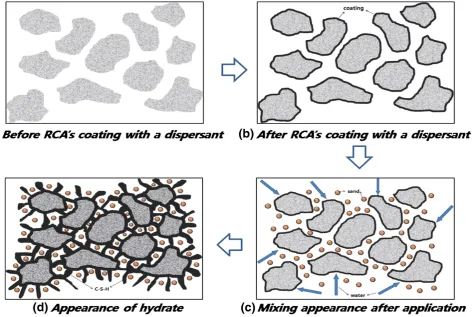
For the PC-dispersant-coated RCA, early absorption was prevented at mixing, and the water contents needed for mixing was reduced because the PC dispersant dispersed the cement particles (Yamada et al. 2001; Khalil and Word 1980). Moreover, after mixing, the water-soluble dispersant slowly may be controlled the slump loss over time. The mechanism of the PC-dispersant-coated RCA is shown in Fig.1.
Figure1shows the reaction mechanism of CRCA, where (a) is the RCA prior to coating. After coating, a film was formed on RCA’s surface, as shown in (b). To make con-crete, CRCA was mixed with other materials (cement, water, etc.), as in (c), and RCA’s water absorption was restrained by Department of Civil and Environmental Engineering,
Hanyang University, Seoul 133-791, Korea.
*Corresponding Author; E-mail: [email protected] CopyrightÓThe Author(s) 2014. This article is published with open access at Springerlink.com
International Journal of Concrete Structures and Materials Vol.8, No.2, pp.165–172, June 2014
the film that had been formed on the surface of the RCA. Finally, when the dispersant on surface of RCA slowly reacted, C–S–H hydrate was formed around the aggregate, as in (d). Therefore, CRCA may be prevented over-absorp-tion water during mixing so that performance of concrete improved.
3. Experimental
CCA and RCA were used in this study, and their test results are shown in Table1. It shows in the test results that the density of RCA was lower than that of CCA, and that the absorption rate of RCA was almost triple that of CCA (Mindess2003).
PC dispersant, which is used to make concrete, was applied to the surface of RCA to form a film. It was placed
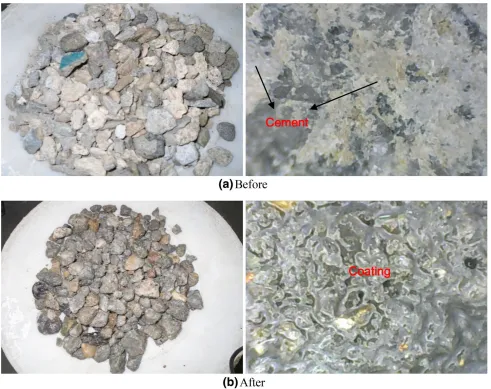
inside a rotary drum and was sprayed onto the aggregate at a ratio of 1 % of RCA’s wt % so that 0.1–0.3 mm film is formed commonly (Kim et al.2005; Jiusu et al.2009). The images of RCA before and after coating with the PC dis-persant are shown in Fig.2 (The right images in the figure are close-up images.). Each image shows that cement mortar was attached on surface of RCA and film was formed.
In the pilot test, the concrete mixtures were found to have the following properties: W/C=49.9 %; S/a=48.2 %; target slump=150 mm; and target strength=24 MPa. RCA was then replaced with CRCA in five steps (0, 25, 50, 75, and 100 %) and was used in the experimental. The properties of the fresh and hardened RCA and CRCA were investigated according to ASTM tests, and the properties of CRCA were compared with those of CCA. The type and replacement ratio of each mixture and the mix proportion to form CRCA’s film are shown in Table2.
Fig. 1 Reaction mechanism of the coated RCA.
Table 1 CCA’s and RCA’s properties.
CCA RCA
Gmax(mm) 25 Gmax(mm) 25
Density (g/cm3) 2.62 Density (g/cm3) 2.55
Absorption rate (%) 0.72 Absorption rate (%) 2.35
FM 6.91 FM 6.49
Abrasion rate (%) 25.1 Abrasion rate (%) 36.6
The slump and air content were measured at half an hour and 1 h to determine if the workability was improved by RCA’s surface coating and was within the margin of error (150±25 mm, 4.5±1.5 %). The unit water content was also measured to determine if it satisfied the 150 mm target slump and if the partial of PC dispersant of CRCA was reacted at the initial mixing stage. The unit water content was gained by comparison with the control within target slump 150(±25 mm) at initial stage.
To evaluate the compressive and tensile-strength proper-ties, three specimens each of RCA, CCA, and CRCA were prepared according to ASTM C 192. Ø1009200-mm specimens were used when the compressive and tensile strengths were measured according to ASTM C 39 and ASTM C 496, respectively, at days 7 and 28, after 20±2 °C water curing. Moreover, the carbonation was
investigated through accelerated carbonation test because concrete has highly alkaline via hydration reaction since mortars were attached to the RCA’s surface (Sim and Park 2011). The carbonation velocity coefficients were repre-sented using the following equation:
Xc¼K ffiffi
t p
;
whereXcis the carbonation depth (mm),Kis the carbonation velocity coefficient (mm/pffiffiffiffiffiffiffiffiffiffiffiweekÞ, and t is the carbonation period (week).
4. Results and Discussion
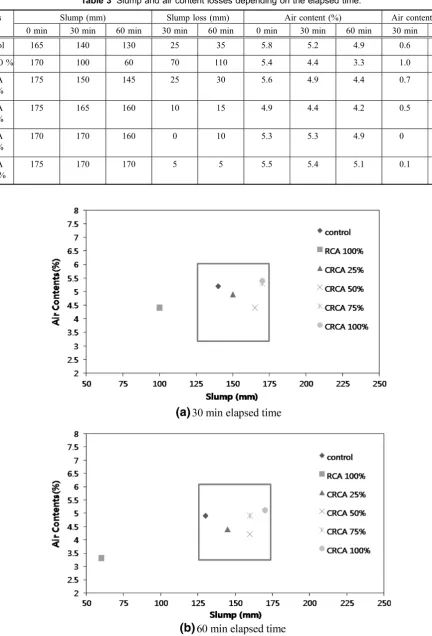
The slump and air content loss depending on the elapsed time are listed in Table3.
Fig. 2 Before and after RCA coating with PC dispersant.
Table 2 Mix proportion by replacement and CRCA fabrication.
Type Remarks
W/C=49.9 %; S/a=48.2 % (binder: 347 kg/m3)
Superplasticizers=0.5 % of cement wt%
Control (CCA 100 %) RCA 100 %
CRCA (25, 50, 75, and 100 %)
In Table3, the slump and slump loss of all the mixtures, except those of RCA 100 %, changed within the margin of error (150±25 mm), depending on the elapsed time, and
the greater the percentage of CRCA replacement was, the lesser change in the amount of slump loss. These results think that water absorption of RCA, which has high Table 3 Slump and air content losses depending on the elapsed time.
Types Slump (mm) Slump loss (mm) Air content (%) Air content loss (%)
0 min 30 min 60 min 30 min 60 min 0 min 30 min 60 min 30 min 60 min
Control 165 140 130 25 35 5.8 5.2 4.9 0.6 0.9
RCA 100 % 170 100 60 70 110 5.4 4.4 3.3 1.0 2.1
CRCA 25 %
175 150 145 25 30 5.6 4.9 4.4 0.7 1.2
CRCA 50 %
175 165 160 10 15 4.9 4.4 4.2 0.5 0.7
CRCA 75 %
170 170 160 0 10 5.3 5.3 4.9 0 0.4
CRCA 100 %
175 170 170 5 5 5.5 5.4 5.1 0.1 0.4
absorption, was mitigated by the PC dispersant film, which acted slowly.
In the case of RCA 100 %, however, it showed the largest change in the slump due to the high absorption of RCA. At more than 75 % CRCA replacement, because the dispersant excessively reacted, slight bleeding appeared. All the mix-tures’ air content loss did not change considerably within the margin of error (4.5±1.5 %), except that of RCA 100 %, because CRCA reduced the absorption of entrained air (Ryu 2002). Also, due to the CRCA replacement, the air content did not change considerably. The relation between slump
and air content is shown in Fig.3, and all the mixtures were within the allowable range at the 30 and 60 min elapsed times, except for RCA 100 %. The box in Fig.3 indicates margin of error on slump and air contents, and mixture of RCA 100 % was not included in box.
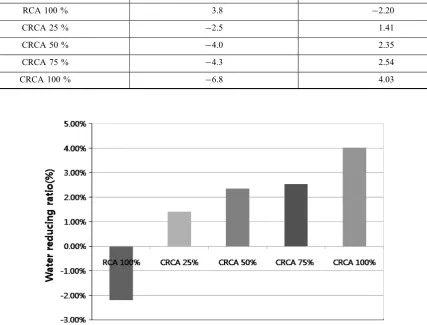
By comparison with the control, each mixing water con-tents was gained within target slump 150 mm(±25 mm) at initial stage. The water reduction ratios, which were con-verted to unit water contents, are shown in Table4 and Fig.4. The difference of unit water content and water reduction ratio showed -6.8–3.8 kg/m3, -2.20–4.03 %, Table 4 Difference of unit water content and the water reduction ratio.
Type Difference of unit water content (kg/m3) Water reduction ratio (%)
Control 0 0
RCA 100 % 3.8 -2.20
CRCA 25 % -2.5 1.41
CRCA 50 % -4.0 2.35
CRCA 75 % -4.3 2.54
CRCA 100 % -6.8 4.03
Fig. 4 Water reduction ratio compared to that of the control.
Table 5 Compressive and tensile strength values.
Type Compressive strength (MPa) Comparison with
the control (day 28)
Tensile strength (MPa) Comparison with
the control (day 28)
Day 7 Day 28 Day 7 Day 28
Control 19.0 27.1 1.00 1.5 2.3 1.00
RCA 100 % 17.5 25.5 0.94 1.3 1.9 0.83
CRCA 25 % 26.5 32.4 1.20 1.7 2.4 1.04
CRCA 50 % 23.4 30.8 1.14 1.6 2.3 1.00
CRCA 75 % 27.5 31.9 1.18 1.8 2.5 1.09
respectively. Especially, with increasing of CRCA replace-ment, the unit water content decreased and the water reduction ratio increased. RCA 100 %’s unit water content
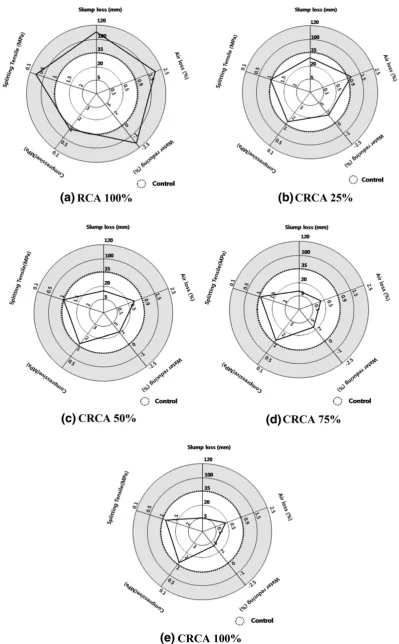
increased, however, due to the high absorption. In the case of CRCA, because the coating that was formed by the water-soluble PC dispersant on RCA’s surface was partially Fig. 5 Analysis of the physical characteristics and compressive and tensile strengths of the mixtures through comparison with
dissolved, the water reduction ratio improved at the initial stage (Ramachandran1995; Yang et al.2006).
The compressive and tensile strengths of all the mixtures are shown in Table5. The ratio of compressive and tensile strength by comparison to the control showed 0.94–1.20, 0.83–1.09, respectively. Especially, the mixtures (including CRCA) were stronger than the control on day 7 and had similar compressive strength values on day 28, and tensile strength is similar to control. In the case of RCA 100 %, however, the compressive and tensile strengths were lower than those of the control, as in the previous studies Tabsh and Abdelfatah (2009). As the concrete with CRCA had low water content due to the PC dispersant that was mixed with it, the concrete that was blended with CRCA was stronger than the control.
The physical characteristics and compressive and tensile strengths of all the mixtures were compared with those of the control, as shown in Fig.5. The control circle indicates values of test results of control mixture on slump and air contents loss, compressive and tensile strength, water reduction. The shapes of mixture with CRCA show within control circle so that it was indicated the degree of satis-faction. On the other hand, that of mixtures with RCA was deviated control circle significantly. Therefore, the values of
all the mixtures, except for RCA 100 %, were found to be similar to or even better than those of the control.
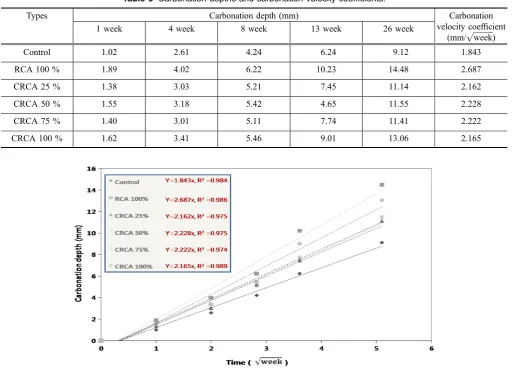
The carbonation depths and carbonation velocity coeffi-cients are shown in Table6. Based on test results, data were fitted using the above equation, and then the regression analysis results are presented in Fig.6. The carbonation depth at 26 week and the carbonation velocity coefficient showed 9.12–14.48 mm, 1.843–2.687 mm/pffiffiffiffiffiffiffiffiffiffiffiweek. Also, because correlation coefficient of the carbonation velocity coefficient by regression analysis indicates 0.95 over, it shows high reliability. The results show that the control had the highest penetration resistance and that RCA 100 % had the lowest. It was also shown that RCA had lower pene-tration resistance than normal aggregate, and that the mix-tures with CRCA had similar carbonation depths regardless of the replacement.
5. Summary
In this study, the surface of RCA was coated with water-soluble PC dispersant, and whether the concrete perfor-mance improved was determined through a test. The con-clusions are listed below.
Table 6 Carbonation depths and carbonation velocity coefficients.
Types Carbonation depth (mm) Carbonation
velocity coefficient (mm/pffiffiffiffiffiffiffiffiffiffiffiweek)
1 week 4 week 8 week 13 week 26 week
Control 1.02 2.61 4.24 6.24 9.12 1.843
RCA 100 % 1.89 4.02 6.22 10.23 14.48 2.687
CRCA 25 % 1.38 3.03 5.21 7.45 11.14 2.162
CRCA 50 % 1.55 3.18 5.42 4.65 11.55 2.228
CRCA 75 % 1.40 3.01 5.11 7.74 11.41 2.222
CRCA 100 % 1.62 3.41 5.46 9.01 13.06 2.165
(1) The slumps of all the mixtures, except that of RCA 100 %, did not significantly change within the margin of error with the elapsed time, and the greater the increase in the CRCA replacement was, the lesser the changes.
(2) With increasing the CRCA replacement, it showed the lower the unit water content and the higher the water reduction ratio due to the PC dispersant coating of CRCA.
(3) All the mixtures, except for RCA 100 %, had similar or higher compressive and tensile strengths compared to the control. The carbonation penetration resistance values were also similar.
Therefore, all the test results of the concrete with CRCA were satisfactory compared to the control. That with more than 75 % CRCA replacement, however, showed slight bleeding. Thus, the use of CRCA needs attention, and its supplementary points will be examined in future studies. Also, for large-scale engineering application, further study may be conducted by a spray process during RCA manufacture.
Open Access
This article is distributed under the terms of the Creative Commons Attribution License which permits any use, distribution, and reproduction in any medium, provided the original author(s) and the source are credited.
References
Eguchi, K., Teranishi, K., Nakagome, A., Kishimoto, H., Shinozaki, K., & Narikawa, M. (2007). Application of recycled coarse aggregate by mixture to concrete con-struction. Construction and Building Materials, 21, 1542–1551.
Fong, W. F. K., Jaime, Y. S. K., & Poon C. S. (2002). Expe-rience of using recycled aggregates from construction and demolition materials in ready mix concrete. International Workshop on Sustainable Development and Concrete Technology (pp. 267–275).
Hendriks, C. F., Pietersen. H. S., & Fraay, A. F. A. (2000). Recycling of building and demolition waste, an integrated approach. In Proceedings of the International Symposium on ‘Sustainable Construction: Use of Recycled Concrete Aggregate, London, UK (pp. 419–431).
Katz, A. (2003). Properties of concrete made with recycled aggregate from partially hydrated old concrete.Cement and Concrete Research, 33, 703–711.
Khalil, S. M., & Word, M. A. (1980). Effect of sulfate content of cement on slump loss of concrete containing high-range water reducers (superplasticizers). Magazine of Concrete Research, 32, 28–38.
Kim, N. W., Lee, S. N., Kang, S. H., & Bae, J. S. (2005). A study on the mechanical properties of concrete using the recycled aggregate by surface coating. Journal of KSCE, 25(2), 387–393.
Levy, S. M., & Helene, P. (2004). Durability of recycled aggregates concrete: A safeway to sustainable develop-ment.Cement and Concrete Research, 34(11), 175–180. Li, J., Xiao, H., & Zhou, Y. (2009). Influence of coating
recy-cled aggregate surface with pozzolanic powder on proper-ties of recycled aggregate concrete. Construction and Building Materials, 23, 1287–1291.
Mindess, S., Young, J. F., & Darwin, D. (2003).Concrete(pp. 121–163). Upper Saddle River, NJ, USA: Prentice Hall. Oikonomou, N. D. (2004). Recycled concrete aggregates.
Cement and Concrete Composites, 1–4.
Park, C., & Sim, J. (2006).Fundamental properties of concrete using recycled concrete aggregate produced through advanced recycling process. In Proceedings of 85th TRB Annual Meeting. Washington DC, USA.
Rahal, K. (2007). Mechanical properties of concrete with recycled coarse aggregate.Building and Environment, 42, 407–415.
Ramachandran, V. S. (1995). Concrete admixtures handbook: Properties, science, and technology (pp. 410–506). Park Ridge, NJ, USA: Noyes Publications.
Rao, A., Jha, K. N., & Misra, S. (2007). Use of aggregates from recycled construction and demolition waste in concrete. Resources, Conservation and Recycling, 50, 81–91. Ryu, J. S. (2002). An experimental study on the effect of
recycled aggregate on concrete properties. Magazine of Concrete Research, 54(1), 7–12.
Sim, J. S., & Park, C. W. (2011). Compressive strength and resistance to chloride ion penetration and carbonation of recycled aggregate concrete with varying amount of fly ash and fine recycled aggregate. Waste Management, 31, 2352–2360.
Symonds. (1999). Construction and demolition waste manage-ment practices and their economics impacts. Report to DGXI, European Commission.
Tabsh, S. W., & Abdelfatah, S. A. (2009a). Influence of recy-cled concrete aggregates on strength properties of concrete. Construction and Building Materials, 23(2), 1163–1167. Tabsh, S. W., & Abdelfatah, A. S. (2009b). Influence of
recy-cled concrete aggregates on strength properties of concrete. Construction and Building Materials, 23, 1163–1167. Yamada, K., Ogawa, S., & Hanehara, S. (2001). Controlling of
the adsorption and dispersing force of polycarboxylate-type superplasticizer by sulfate ion concentration in aqueous phase.Cement and Concrete Research, 31, 375–383. Yang, K. H., Sim, J. I., Lee, J. S., & Chung, H. S. (2006).