
Volume 2007, Article ID 48757,12pages doi:10.1155/2007/48757
Research Article
Multispace Behavioral Model for Face-Based
Affective Social Agents
Ali Arya1and Steve DiPaola2
1Carleton School of Information Technology, Carleton University, Ottawa, ON, Canada K1S5B6 2School of Interactive Arts & Technology, Simon Fraser University, Surrey, BC, Canada V3TOA3
Received 26 April 2006; Revised 4 October 2006; Accepted 22 December 2006
Recommended by Tim Cootes
This paper describes a behavioral model for affective social agents based on three independent but interacting parameter spaces: knowledge, personality, and mood. These spaces control a lower-level geometry space that provides parameters at the facial feature level. Personality and mood use findings in behavioral psychology to relate the perception of personality types and emotional states to the facial actions and expressions through two-dimensional models for personality and emotion. Knowledge encapsulates the tasks to be performed and the decision-making process using a specially designed XML-based language. While the geometry space provides an MPEG-4 compatible set of parameters for low-level control, the behavioral extensions available through the triple spaces provide flexible means of designing complicated personality types, facial expression, and dynamic interactive scenar-ios.
Copyright © 2007 A. Arya and S. DiPaola. This is an open access article distributed under the Creative Commons Attribution License, which permits unrestricted use, distribution, and reproduction in any medium, provided the original work is properly cited.
1. INTRODUCTION
Chuck Jones, the cocreator of such legendary animated char-acters as Bugs Bunny, Daffy Duck, and the Road Runner, once said [22]: “Believability. That is what we were striv-ing for.” The history of animation, traditional or computer-generated, has shown that the most successful animated characters are not necessarily those who have been geometri-cally realistic, but those that are believable in behavior. As many researchers in the area of social agents have noticed [4,5,29], this believability of characters (i.e., acting in a re-alistic and “natural” way) is a key element in allowing view-ers/users to relate to the agent. In our opinion, such believ-ability depends, mainly, on proper behavioral modeling. An-other aspect of behavioral modeling is the creation of non-scripted actions. A strong behavioral model allows an ani-mated character such as a social agent to follow certain rules or high-level scripts, and define and create proper details of actions based on any dynamic situation with no need to de-sign those details in advance.
Although many researchers have proposed behavioral models for social agents [4,5,17,19,26,33,36], the fol-lowing essential features seem to require further improve-ments.
(1) Theoretical base in behavioral psychology.
(2) Proper parameterization to simplify the model config-uration.
(3) Scripting language specially designed for agents. (4) Independence of behavioral components such as tasks,
personality, and mood.
External event Knowledge
Geometry
Personality Mood
Figure1: behavioral model parameter spaces.
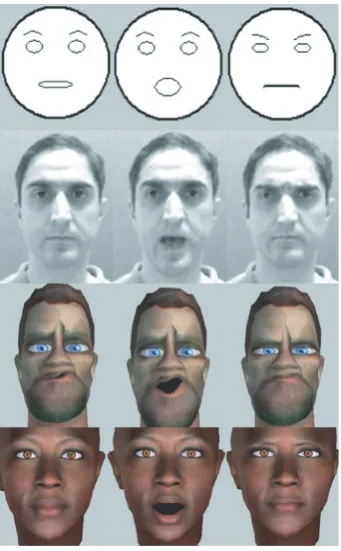
Figure2: Sample animated heads from iFACE, featuring neutral, talking, and frowning states (columns 1 to 3, resp.) of 2D cartoon-ish, 2D photorealistic, 3D cartooncartoon-ish, and 3D realistic faces (rows 1 to 4, resp.).
independent of the 2D or 3D head data type, as shown in
Figure 2.
Knowledge encapsulates the tasks to be performed and general rules of behavior that are independent of the char-acter. A specially designed XML-based language is used for knowledge space. Personality and mood are based on param-eterized models in behavioral psychology and represent the characteristics and emotional state of a specific individual. Personality is related to the long-term traits such as typical head movements and mood controls short-term emotional states visualized by facial expressions.
The principal concept in our research is that parameteri-zation allows animators and designers to create new geome-tries, personality types, and emotional states without being involved in technical details. For example, changing the affi l-iation and dominance [40] parameters can easily create new personalities, and since the parameters are associated to facial
actions, this new personality type already has proper facial actions. The existing systems either do not use well-defined and scientifically accepted parameters or have not associated the parameters to facial actions properly (e.g., random or ad-hoc selection of actions compared to our system that is based on user studies with the aid of behavioral psychologists). So our main contributions, compared to the existing research that we will review later, are the following.
(1) The only XML-based face-specific language compati-ble with MPEG-4 with dynamic decision-making and temporal constructs.
(2) Associating facial actions to the perceived personality based on user studies. Facial actions have been exten-sively studied with regards to emotions but not per-sonality.
(3) Linking facial actions to personality and emotion pa-rameters rather than “personality types” and “emo-tional states” themselves. As we will see, this will cause facial actions that are more “perceptually valid” when creating new and combined types and states.
(4) A layered geometry model that allows animation pa-rameters and design files to be applied to a variety of data types (seeFigure 2) due to abstraction and hiding details.
(5) A unified model encapsulating all required features in one framework.
InSection 2, we review some of the related research in the
area of behavioral modeling for social agents. Sections3to7
discuss our proposed behavioral model in detail. Two exam-ple applications of iFACE system and its behavioral model are the subject ofSection 8, and some concluding remarks are presented inSection 9.
2. RELATED WORK
2.1. Agent and multimedia languages
<vhml>
<person disposition=‘‘angry’’> <p>
First I speak with an angry voice, <surprised intensity=‘‘50’’> then I change to look surprised. </surprised>
</p></person> </vhml>
Figure3: An example of VHML script.
animation. There have also been different languages in the fields of virtual reality and computer graphics for modeling computer-generated scenes. Examples are virtual reality modeling language (VRML,http://www.vrml.org) and pro-gramming libraries like OpenGL (http://www.opengl.org).
These languages are not customized for face animation, and do not provide any explicit support for it. The absence of a dedicated language for face animation, as an abstrac-tion on top of FACS AUs or MPEG-4 FAPs has drawn at-tention to the development of markup languages for vir-tual characters [1,15,30,35]. Virtual human markup lan-guage (VHML) [30] is an XML-based language for the rep-resentation of different aspects of “virtual humans,” that is, avatars, such as speech production, facial and body anima-tion, emotional representaanima-tion, dialogue management, and hyper and multimedia information (http://www.vhml.org). It comprises a number of special-purpose languages for emo-tion and facial and body animaemo-tion. In VHML, timing of animation elements in relation to each other and in rela-tion to the realizarela-tion of text is achieved via the attributes
“duration” and “wait.” A simple VHML document is
shown inFigure 3.
Multimodal presentation markup language (MPML) [35] is another XML-based markup language developed to enable the description of multimodal presentation in a web browser, based on animated characters (http://www.
miv.t.u-tokyo.ac.jp/MPML/en). It offers functionalities for
synchronizing media presentation (reusing parts of the synchronized multimedia integration language, SMIL) and new XML elements such as <listen> (basic interactiv-ity),<test>(decision making),<speak>(spoken by a TTS system), <move> (to a certain point at the screen), and
<emotion> (for standard facial expressions). MPML
ad-dresses the interactivity and decision making not directly covered by VHML/FAML, but both suffer from a lack of ex-plicit compatibility with MPEG-4 (XMT, FAPs, etc.).
2.2. Personality and perception
behavioral psychologists have studied human personality and its models and parameters for quite a while. Many personality models have been proposed, and one of the most notable examples is the big five or five-factor model [21,39]. The big-5 model considers five major personality
dimensions: openness, conscientiousness, extraversion, agr-eeableness, and neuroticism (OCEAN). Modeling personal-ity as anN-dimensional space allows for navigating through the personality space by changing one parameter along each independent dimension. Although successful in many as-pects, the five dimensions in the Big-5 model are (1) not independent enough and (2) hard to visualize. This results in the model being hard to use for animated characters needing user-friendly and controllable personality parame-ters. Wiggins et al. [40] have proposed another personality model based on two dimensions: affiliation and dominance
(Figure 4). They show that different personality types can
be considered points around a circular structure formed in two-dimensional space. The smaller number of dimensions allows them to be controlled more effectively and indepen-dently. Two parameters are also easier to visualize, perceive, and understand.
The perception of personality type and traits based on observation has long been a subject of research in behavioral psychology [8–10,25]. Unfortunately, this research has not focused on facial actions, and has primarily considered the observation of full-body behaviors. Also, mainly due to lo-gistical reasons, the observations have been mostly limited to photographs or few dynamic actions. High-quality and controllable animated characters have not been available to psychology researchers. As Borkenau et al. [9,10] have illus-trated, viewers can achieve relatively stable perceptions using short videos. Creating videos of live actors playing many dif-ferent and configurable actions, however, can be expensive and difficult.
Among facial actions, the universal facial expressions of emotions (joy, sadness, anger, fear, surprise, and disgust, as described by Ekman [18]) is the only group whose effect on the perception of personality has been investigated. Knutson [25] reported on the effect of facial expression of emotions on interpersonal trait inference based on Wiggins’ model. He concludes that viewers attribute high dominance and affi lia-tion to individuals with happy expressions, high dominance, and low affiliation to those with angry or disgusted sions, and low dominance to those with fearful or sad expres-sions. Borkenau and Liebler [10] have reported one of the few studies which explicitly associated body gestures and behav-iors as visual cues to the perception of personality. They have also considered audio and visual (static and dynamic) cues but facial actions were not a major focus.
2.3. Believable social agents
Hayes-Roth [36] define behavior as a combination of person-ality, mood, and attitude. The idea of separating independent components of behavior can be very helpful in designing au-tonomous agents. Funge et al. [20], on the other hand, pro-pose the idea of hierarchical modeling, which includes be-havioral and cognitive modeling layers at the top.
Another approach in behavioral modeling for agents in-cludes associating different facial actions with certain states and events. Cassell et al.[13] propose a method for automat-ically suggesting and generating facial expressions and some other gestures based on the contents of the speech. In a later work, Cassell et al. [14] propose a comprehensive toolkit with a dedicated language for generating movements based on speech, through certain configurable rules. King et al. [24] and Smid et al. [38] (among others) provide more recent ex-amples of the automatic generation of facial actions (primar-ily expressions) based on speech. The main weakness of all these works is that the facial actions are (1) usually limited to the expressions, and (2) speech, and not a personality model, is the base for facial actions. A system to suggest facial actions based on personality settings has not been fully investigated. Associating facial actions with personality requires a rea-sonably adequate personality model for the agent, and a thorough study of the effect of facial actions on the percep-tion of personality. The latter, as menpercep-tioned before, has not been done properly yet, but the former has been the subject of some recent works. Kshirsagar and Magnenat-Thalmann [26] propose a multilayer personality model. It is, more pre-cisely, a multilayer behavioral model that includes layers of personality, mood, and emotions on top of each other. Ev-ery layer controls the one below it, with the facial actions and expressions at the bottom. The model allows definition of parameters at each level to individualize the agent. At the personality level, it utilizes the Big-5 model with five param-eters. The following observations can be made regarding this system.
(i) The general issues with Big-5.
(ii) Hierarchical dependence of emotional states to per-sonality. The likelihood of transition between emo-tions can be a personality parameter, but emotional state should be also independently controllable regard-less of personality.
(iii) Lack of direct link between facial actions and person-ality. Speech content or a probabilistic belief networks are used to control facial actions, which may not be enough. Ideally, the facial actions (e.g., the way an agent moves his/her head or raises eye brows and how frequently he/she does it) need to be controlled by a well-defined personality type, entirely or together with speech and likelihood settings (seeSection 5for more details).
(iv) Unnecessary separation of moods and emotions (see
Section 6for a more detailed discussion of moods and
emotions).
Models proposed by Egges et al. [17] and Pelachaud and Bilvi [33] follow similar ideas. The latter uses a two-dimensional model similar to Wiggins et al. [40] for personality (called
performatives) and also separates them from emotions as two independent components activating facial actions through a belief network. The high-level personality parame-ters are associated to facial actions based on limited observa-tion and arbitrary settings, rather than a well-performed user study. On the other hand, the facial actions are not limited to speech and can occur even when the agent is not talking, but they have to be set explicitly where desired, while the ideal situation is to define them as part of a personality to be acti-vated autonomously.
2.4. Facial expression of emotions
Russell [37] has mapped emotional states onto a two-dimensional space controlled by arousal and valence. The de-tailed study of facial actions involved in the expression of the six universal emotions [18] has helped the computer graph-ics community to develop realistic facial animations. Yet the rules by which these facial expressions are combined to con-vey more subtle information remain less well understood by behavioral psychologists and animators. This lack of a strong theoretical basis for combining facial actions has resulted in the use of ad-hoc methods for blending facial expression in animations [27,31,32,34]. These methods are usually based on a “weighted average” of facial actions caused by each ex-pression. They are therefore computationally tractable, but the question of their “perceptual” and “psychological” valid-ity has not yet been answered.
3. MULTISPACE BEHAVIORAL MODEL
In the previous section, we reviewed some of the related works in the area of behavioral modeling. Considering the strengths and weaknesses of these approaches, the authors have concluded that the following features are required for a comprehensive agent behavior model. It appears that none of the existing approaches provides a complete collection of them.
(i) A behavioral model needs to be based on scientific findings and models in behavioral psychology. (ii) The model should have easy-to-visualize parameters
for character design.
(iii) The model should consist of separate modules for dif-ferent behavioral aspects such as knowledge, personal-ity traits, and emotions.
(iv) These behavioral modules should be independent but able to interact with each other and with the underly-ing geometry.
(v) The parameter spaces and the scripting language should be MPEG-4 compatible.
(vi) The language has to support dynamic actions and in-teractive scenarios through proper decision making and event handling.
personality, and mood. We replace Rousseau and Hayes-Roth’s attitude component with knowledge which includes tasks to be performed and rules of behavior and can provide a better control over agent actions. We also define these four components as parameter spaces formed with specific easily adjustable parameters. These parameter spaces are used in our comprehensive facial animation system, iFACE [2].
iFACE geometry is a hierarchical model that isolates de-tails such as vertex/pixel information from higher-level con-structs such as feature and head component, so that anima-tion can be designed and controlled independent of the un-derlying geometry type. The main advantages of our knowl-edge space are specially designed language for facial anima-tion, support for decision making and dynamic actions, and high-level timing control. The personality and mood spaces use current findings in behavioral psychology to relate per-sonality traits and emotional states to facial actions, to cause the perception of intended personality type or create the per-ceptually valid expression. Unlike Kshirsagar and Magnenat-Thalmann’s model [26], they perform in total independence from each other (i.e., parameters set separately), but the per-sonality parameters can also define some mood-related as-pects of behavior such as the likelihood of transition between emotional states which is in fact a personality based issue (al-though mood settings can override personality settings tem-porarily). The mood space does not have any direct effect on personality settings which is again based on “real world” re-lationships between personality and mood. These spaces are explained in the following sections.
4. HIERARCHICAL GEOMETRY SPACE
Head/face components and regions allow grouping of head data into parts that perform specific actions together (e.g., resizing the ears or closing the eye), which results in isolating details from higher-level commands. This is a key concept in designing an efficient head model. By defining different layers of abstraction on top of actual head data (2D pixels or 3D vertices), each exposing proper interfaces for possible commands, we allow programmers/animators to access only the desired level of details, as illustrated inFigure 5. At the same time, this hierarchy allows changes in lower-level mod-ules (e.g., the way movement of lip corner affects neighbour-ing points) without any change in the general behavior of higher-level parameters (e.g., an expression can still result in lip corner stretching without a need to know how that hap-pens). Possibility of working with different types of 2D and 3D head data, using the same parameters, is another advan-tage of such isolation.
Features are special lines/areas that lead facial actions, and feature points (corresponding to MPEG-4 parameters) are control points located on features. Only the lowest level (physical point) depends on the actual (2D or 3D) data. iFACE geometry object model corresponds to this hierar-chy and exposes proper interfaces and parameters for client programs to access only the required details for each action. iFACE authoring tool (iFaceStudio) allows users to select fea-ture points and regions-of-influence for them. Each level of
geometry accesses the lower levels internally, hiding the de-tails from users and programmers. Eventually, all the facial actions are performed by applying MPEG-4 FAPs to the face.
5. PARAMETERIZED PERSONALITY SPACE
The primary objective of personality modeling is to make it possible for the agent to perform facial actions that cause the viewer to perceive certain personality types, as intended by the character designer. As discussed in Section 2, Wig-gins’ circumplex model provides an effective parameterized framework for modeling and defining personality types. On the other hand, the effect of dynamic facial actions on per-sonality perception has not been studied properly, partly due to difficulty of hiring actors to record variety of head and face movements [3,8–10]. Using a realistic facial animation system can help researchers to perform a wider range of ex-periments.
In order to design a perceptually valid personality model (i.e., one that initiates actions that most likely cause the in-tended personality perception in viewers), we performed a four-step process.
(1) Define sets of facial actions and expressions that may affect personality perception (visual cues).
(2) Run experiments with a large enough user base to study the effect of these visual cues on personality per-ception.
(3) Associate visual cues to personality parameters, affi lia-tion and dominance.
(4) Create a model that defines parameterized personal-ity profiles and initiates proper facial actions based on that.
Table 1shows the visual cues selected at step 1 and the results of our experiments with 31 undergraduate students at the Department of Psychology, University of British Columbia, Vancouver, Canada. Details of experiments have been pub-lished in an earlier paper [3].
The personality model controls strength and the timing of initiating facial actions based on personality settings. We give each personality parameter three linguistic values: low, medium, and high. For example, for parameter dominance these correspond to dominant, neutral, and submissive, as shown inFigure 4. After performing the experiments, visual cues are associated with each one of these parameter values, to form sets like the following:Ci,j= {ci,j,n}, whereci,j,nis the
nth visual cue associated with thejth value ofith parameter. Each visual cue is defined as an individual MPEG-4 FAP [6] or a combination of them. If pi is the value ofith
per-sonality parameter (i=0or1),vi,j(the strength of the jth
linguistic values of that parameter) will be calculated using a fuzzy membership function based onpi. These strengths are
then used to activate the visual cues to certain levels:
ai,j,n=vi,j×mi,j,n (1)
ai,j,nandmi,j,nare activation level of the visual cue (or the
Table1: Affiliation and dominance scores for facial actions (min= −5, max=5).
Facial action Affiliation Dominance
Joy 4.7 2
Sadness 0.2 −0.2
Anger −2.6 0.6
Fear 2 −0.8
Disgust 0.9 1
Surprise 2.9 −1
Contempt −5.7 1.4
Neutral 0.8 −0.8
Slow turn 1.7 1.2
Slow tilt 0.9 0.2
Slow nod −0.5 −3.1
Slow blink 2.5 −0.7
Slow avert 0.1 −0.7
Slow one brow −0.1 0
Slow two brows 4.2 −0.9
Fast turn 2.5 1.7
Fast tilt 2.1 1.9
Fast nod −0.6 −2.8
Fast blink 2.7 −0.8
Fast avert −0.2 −2.9
Fast one brow −1.6 3.3
Fast two brows 3.8 0.9
Head rest down −0.1 −1.4
Head rest side 0.4 −3.4
1- Dominant
2- Competitor
3- Cold
4- Shy
5- Submissive
6- Helper 7- Warm 8- Exhibitionist
Dominanc
e
Affiliation
Figure4: Wiggins’ personality circumplex.
The timing for activating visual cues is also set in the personality profile. It can be random, periodic, or based on speech energy level. The content of the speech can also be used as suggested by other researchers [38]. Some measures of speech energy can be calculated by analyzing the speech signal. Two strength thresholds of impulse and emphasis can be defined for this energy. Different visual cues (or different versions of them with varied maximum values) can be as-sociated with these thresholds. Once a threshold is reached,
Head Components
Head
Forehead Cheek Chin Hair Ear Neck
Eye Nose Mouth
Eye Nose Mouth
Features
Feature points
Physical points
MPEG-4, FACS, plus extensions
Mesh vertices or image pixels @ different resolutions Brow,
lid, iris, pupil
Lip, tooth, tongue
Figure5: Hierarchical facial geometry.
one of the associated cues that matches the agent personality is randomly selected and activated based on the value ofai,j,n.
6. PARAMETERIZED MOOD SPACE
The distinction between moods and emotions has been dis-cussed by many researchers. The major differences seem to be duration and cause, and the emotions are believed to be more external and visible [7]. Due to complicated relation between moods and emotions, and between moods and vi-sual appearance, it is hard to create mood parameters (inde-pendent of emotions) that can effectively and clearly control the facial actions. Some researchers [26] have tried to define such parameters for an agent’s mood in which the result is simply three types of moods (bad, normal, and good) which only change the likelihood of transition between emotions and have no extra functionality (e.g., direct effect on facial actions).
In our model, we consider emotions and mood part of one parameter space called mood. This space controls the emotional state through two parameters (seeFigure 6), and also includes probability settings for random or event-based transition between emotions. With better understanding of how moods affect emotions and other visual aspects, we hope to separate moods and emotions into two parameter spaces, but at this time a simple “likelihood setting” does not seem enough for such separation.
The emotional state of the agent can be set in three dif-ferent ways.
(1) Explicitly in the course of an action (see FML scripts). (2) Randomly/periodically as configured in the
Frustrated•
Annoyed•Angry•
Afraid•
Alarmed• •Aroused •Astonished
•Excited
•Delighted
•Happy
•Pleased
Content• •Calm
Tired•
Bored•
Sad•
Miserable•
Ar
o
u
sa
l
Valence
Figure6: Parameterized mood space [37].
(3) Randomly/periodically as configured in the mood space which overrides personality setting.
In either case, the mood (or emotional state) is set by speci-fying a universal emotion and its level of activation, or by set-ting the values of two mood parameters: valence and arousal
(seeFigure 6). Ekman has described the facial actions
associ-ated with the expression of universal emotions in detail [18]. For example, the expression of joy involves tightening of eye-lids, raising cheeks, lowering eyebrows slightly, and wrinkles around the eyes especially the corners. For single universal emotions, we activate the associated actions based on the level of emotional state. For blending two expressions, we differentiate between two cases: transition from one expres-sion to another, and activation of two expresexpres-sions at the same time, that is, a combined expression.
The facial actions for transitions are simply the weighted average of the source and destination expressions:
ai=k×ai,s+ (1−k)×ai,d,
k=N−f
N .
(2)
N is the number of frames to create for the transition, f is the current frame,aiis the activation ofith action at frame
f, andai,sandai,dare the activation of that action in source
and destination expressions.
The combined expressions are created by either selecting two universal expressions, or by setting arousal and valence parameters. In the first case, the activation levels of two ex-pressions are first mapped into a pair of arousal-valence pa-rameters. The resulting values of arousal and valence are then used to activate facial actions associated with each parameter as shown inTable 2. These facial actions are selected by an-alyzing the Ekman’s description of universal expressions and their facial actions, and by clustering similar actions based on arousal and valence parameters.
These two cases are illustrated inFigure 7. In this figure, (a) and (b) show surprise and anger expressions. The middle frame for transition (c) is between (a) and (b). We see that
due to the raised mid lower lip in anger (target of linear in-terpolation), the middle of the mouth closes while the sides are not closed yet. This may be acceptable for a transition but in case of a combined expression like aroused, it is better to locate the source and target on arousal-valence map, and then find the proper (perceptually valid) facial actions for a point between them. This is shown in (d) where the jaw is slightly dropped, upper and lower eyelids are raised a little, and brows are slightly lowered and drawn together. The ef-fectiveness of the parameter-based expression blending com-pared to the simple weighted average method is the subject of an extensive user study in the University of British Columbia. The details of this study will be presented in a separate paper.
7. FACE MODELING LANGUAGE
7.1. Design ideas
To describe the tasks to be performed, the timing, and event handling mechanism, a special-purpose language for facial animation has been designed for iFACE that performs proper configuration and controls the main sequence of actions. The need for such a high-level language, as opposed to low-level parameters such as those in MPEG-4, can be shown using an example. Figure 8illustrates a series of facial actions. A “wink” (closing eye lid and lowering eyebrow), a “head rota-tion,” and a “smile” (only stretching lip corners, for simplic-ity). These actions can be described by the following MPEG-4 FAPs.
Wink: FAP-31 (raise-l-i-eyebrow), FAP-33 (raise-l-m-eyebrow), FAP-35 (raise-l-o-eyebrow), FAP-19 (close-t-l-eyelid). Head rotation:
FAP-49 (head rotation -yaw). Smile: FAP-6 (stretch-l-lipcorner),
FAP-6 (stretch-r-lipcorner). Although simple and powerful, the use of MPEG-4 FAPs for behavioral description lacks the following features.
(1) Parameters at facial component level (e.g., one eye wink instead of four FAPs).
(2) Proper timing mechanism (e.g., duration and depen-dencies).
(3) Event handling and decision-making.
Face modeling language (FML) [2] is an XML-based lan-guage designed for facial animation. It combines MPEG-4 compatibility with higher-level features such as those men-tioned above. Also, FML is independent of the underlying animation system. The actions ofFigure 8can be done by an FML script such as lines shown inFigure 9(elements are dis-cussed later).
Table2: Sample facial actions and the expressions that include them.
Action Expressions Valence Arousal
Brows drawn together Fear, anger Low High
Brows lowered Joy, anger, disgust — High
Brows raised Fear, surprise — High
Brows-inner raised Sadness Low Medium
Eye-corner wrinkled Joy High —
Eye-lid-lower raised Joy, sadness — Medium/low
Eye-lid-lower tensed and raised Fear, anger Low High
Eye-lid-upper lowered Joy, sadness — Medium/low
Eye-lid-upper raised Fear, anger, surprise — High
Jaw dropped Surprise Medium High
Jaw thrusted forward Anger Low High
Lip-corners lowered Sadness Low Low
Lip-corners raised Joy High Medium
Lip-lower raised Sadness Low Low
Lips pressed and narrowed Anger Low High
Lips stretched Joy, fear, anger — Medium
(a) (b) (c) (d)
Figure7: Samples of expression blending: (a) surprise, (b) anger, (c) transition between surprise and anger, and (d) blending based on valence and arousal and their associated facial actions.
done through time containers which are XML tags borrowed from SMIL (other language elements are FML specific). Since a face animation might be used in an interactive environ-ment, such a timeline may be altered/determined by a user. So another functionality of FML is to allow user interaction and in general event handling (decision making based on ex-ternal events and dynamic generation of scenarios).
7.2. FML document structure
An FML document consists, at the higher level, of two types of elements: model andstory. A model element is used for defining face capabilities, parameters, and initial config-uration. This element groups other FML elements (model items) such as configuration data and predefined actions. A
storyelement, on the other hand, represents the timeline of
events in face animation in terms of individual actions (FML
actionelements). The face animation timeline consists of
facial activities and their temporal relations. These activities are themselves sets of simple “moves.” Sets of these moves are grouped together within “time containers,” that is, spe-cial XML tags that define the temporal relationships of the elements inside them. FML includes three SMIL time con-tainers:excl,seq, andparrepresenting exclusive, sequen-tial and parallel move sets. Other XML tags are specifically designed for FML.
(a) (b) (c) (d)
Figure8: Series of facial actions: (a) start, (b) wink, (c) head rotation, (d) smile.
<seq>
<param type=‘‘comp’’ name=‘‘eye-wink’’ duration=‘‘1s’’/>
<hdmv type=‘‘yaw’’ value=‘‘20’’ duration=‘‘1s’’/>
<expr type=‘‘smile’’ value =‘‘50’’ duration=‘‘1s’’/>
</seq>
Figure9: FML script for actions inFigure 8.
Story Action Moves
Time
Figure10: FML timeline and temporal relation of face activities.
parallel activities. The former contains moves that start one after another, and the latter contains moves that begin at the same time. Time containers include primitive moves and also other time containers in a nested way. Therepeatattribute of the time container elements allows iteration in FML doc-uments as illustrated later in sample applications.
Similar to SMIL, FML also has a third type of time con-tainers,excl, used for implementing exclusive activities and decision making as discussed later. Allstoryelements have four timing attributes:repeat,begin,duration, andend. In a sequential time container,beginis relative to start time of the previous move, and in a parallel container it is relative to the start time of the container. In case of a conflict, du-ration of moves is set according to their own settings rather than the container. Therepeat attribute is considered for defining definite (when having an explicit value) or indefi-nite loops (associated with events). FML time containers and basic moves are illustrated inFigure 11.
<action>
<seq begin=‘‘0’’> <talk>Hello</talk>
<hdmv end=‘‘5s’’ type=‘‘0’’ val=‘‘30’’ />
</seq>
<par begin =‘‘0’’> <talk>Hello</talk>
<expr end=‘‘3s’’ type =‘‘3’’ val=‘‘50’’ />
</par> </action>
Figure11: Time containers and basic moves.
<!-- in model part -->
<event name=‘‘user’’ val=‘‘-1’’ />
<!-- in story part --> <excl ev_name=‘‘user’’>
<talk ev_val=‘‘0’’>Hello</talk> <talk ev_val=‘‘1’’>Bye</talk> </excl>
Figure12: Decision making and event handling.
7.3. Event handling and decision making
<!-- in model part -->
<event name=‘‘userChoice’’ val=‘‘-1’’ /> <param name=‘‘dominance’’ val=‘‘60’’ /> <param name=‘‘affiliation’’ val=‘‘90’’ /> <data name=‘‘reply-1’’ val=‘‘Hello’’ /> <data name=‘‘reply-2’’ val=‘‘Fine’’ />
<!-- in story part --> <excl ev_name=‘‘userChoice’’
repeat=‘‘userChoice;4’’>
<talk ev_val=‘‘1’’ name=‘‘reply-1’’> </talk>
<talk ev_val=‘‘2’’ name=‘‘reply-2’’> </talk>
<talk ev_val=‘‘3’’ name=‘‘reply-3’’> </talk>
</excl>
Figure13: FML script for interactive agent.
8. SAMPLE APPLICATIONS
In this section, we review sample application using iFACE system and our proposed behavioral model. For more infor-mation, sample applications, and videos please see our re-search web sitehttp://ivizlab.sfu.ca/research.
8.1. Interactive agent
Typical examples of an interactive agent are game charac-ters and online customer service representatives. In such cases, the agent needs to follow a main scenario, allow non-linear sequences of events (e.g., making a decision based on a user input and going through different paths as the result), show emotions, and have a certain personality.
Figure 13 demonstrates a sample FML script for such an
agent.
This script creates a character that waits for user ques-tions and replies to them. The user interface is controlled by the GUI application. It provides four options: “Hello,” “How are you?” a user-typed question, and “Bye.” The reply to op-tions 1 and 2 are hard coded in the script (data elements in model). The reply to the third (user-typed) question will be provided by the background application (i.e., the intel-ligence behind the script). The fourth user option ends the script.
In the model part of the script, the personality param-eters are set, a user event has been declared and set to−1 (default value, meaning not defined), and finally two data items have been set for user options 1 and 2. The main actions are controlled in the exclelement. The repeat at-tribute defines the ending condition. Theexcloptions look for the appropriate reply, either in the script or from the background application (through the iFACE API not shown here).
Table3: Example relations between music features and emotions [11,23,28].
Emotion Feature Value
Fear
Tempo Irregular
Sound level Low
Articulation Mostly nonlegato
Anger
Tempo Very rapid
Sound level Load
Articulation Mostly nonlegato
Happiness
Tempo Fast
Sound level Moderate or load Articulation Airy
Figure14: Sample animated heads from MusicFace.
8.2. MusicFace
Music-driven emotionally expressive face (MusicFace) [16] is a multimedia application based on iFACE to demonstrate the concept of affective communication remapping, that is, transforming affective information from one communica-tion medium to another. Affective information is extracted from a piece of music by analyzing musical features such as rhythm, energy, timbre, articulation, and melody (see
Table 3).
After setting general personality type and parameters based on the music, the emotional state is determined and updated continuously using the following algorithm (sample animation frames inFigure 14).
(1) Select high or low arousal emotions based on music power level.
(2) Select positive or negative valence emotions based on timbre and rhythm.
(3) Fine tune emotional state based on other musical fea-tures.
9. CONCLUSION
compatible with the MPEG-4 standard. Associating facial actions to parameters (affective or personality dimensions) rather than “basic emotions” or “personality types” allows a designer to easily change the parameters and create new personality types and combined expressions that are percep-tually valid. Further research is needed to study the effect of cultural background on such perception.
REFERENCES
[1] Y. Arafa, K. Kamyab, E. Mamdani, et al., “Two approaches to scripting character animation,” inProceedings of the 1st Inter-national Conference on Autonomous Agents & Multi-Agent Sys-tems, Workshop on Embodied Conversational Agents, Bologna, Italy, July 2002.
[2] A. Arya, S. DiPaola, L. Jefferies, and J. T. Enns, “Socially com-municative characters for interactive applications,” in Pro-ceedings of the 14th International Conference in Central Eu-rope on Computer Graphics, Visualization and Computer Vision (WSCG ’06), Plzen-Bory, Czech Republic, January-February 2006.
[3] A. Arya, L. N. Jefferies, J. T. Enns, and S. DiPaola, “Facial ac-tions as visual cues for personality,”Computer Animation and Virtual Worlds, vol. 17, no. 3-4, pp. 371–382, 2006.
[4] N. Badler, B. D. Reich, and B. L. Webber, “Towards person-alities for animated agents with reactive and planning behav-iors,” inCreating Personalities for Synthetic Actors: Towards Au-tonomous Personality Agents, R. Trappl and P. Petta, Eds., pp. 43–57, Springer, New York, NY, USA, 1997.
[5] J. Bates, “The role of emotion in believable agents,” Commu-nications of the ACM, vol. 37, no. 7, pp. 122–125, 1994. [6] S. Battista, F. Casalino, and C. Lande, “MPEG-4: a multimedia
standard for the third millennium—part 1,”IEEE Multimedia, vol. 6, no. 4, pp. 74–83, 1999.
[7] C. J. Beedie, P. C. Terry, and A. M. Lane, “Distinctions between emotion and mood,”Cognition and Emotion, vol. 19, no. 6, pp. 847–878, 2005.
[8] D. S. Berry, “Accuracy in social perception: contributions of facial and vocal information,”Journal of Personality and Social Psychology, vol. 61, no. 2, pp. 298–307, 1991.
[9] P. Borkenau, N. Mauer, R. Riemann, F. M. Spinath, and A. An-gleitner, “Thin slices of behavior as cues of personality and in-telligence,”Journal of Personality and Social Psychology, vol. 86, no. 4, pp. 599–614, 2004.
[10] P. Borkenau and A. Liebler, “Trait inferences: sources of va-lidity at zero acquaintance,”Journal of Personality and Social Psychology, vol. 62, no. 4, pp. 645–657, 1992.
[11] R. Bresin and A. Friberg, “Synthesis and decoding of emo-tionally expressive music performance,” inProceedings of the IEEE International Conference on Systems, Man, and Cybernet-ics, vol. 4, pp. 317–322, Tokyo, Japan, October 1999.
[12] D. C. A. Bulterman, “SMIL 2.0—part 1: overview, concepts, and structure,”IEEE Multimedia, vol. 8, no. 4, pp. 82–88, 2001. [13] J. Cassell, C. Pelachaud, N. Badler, et al., “Animated conver-sation: rule-based generation of facial expression, gesture and spoken intonation for multiple conversational agents,” in Pro-ceedings of the 21st Annual Conference on Computer Graph-ics and Interactive Techniques (SIGGRAPH ’94), pp. 413–420, New York, NY, USA, July 1994.
[14] J. Cassell, H. H. Vilhj´almsson, and T. Bickmore, “BEAT: the behaviour expression animation toolkit,” inProceedings of the
28th Annual Conference on Computer Graphics and Interactive Techniques (SIGGRAPH ’01), pp. 477–486, Los Angeles, Calif, USA, August 2001.
[15] B. De Carolis, C. Pelachaud, I. Poggi, and M. Steedman, “APML, a markup language for believable behaviour genera-tion,” inProceedings of the 1st International Conference on Au-tonomous Agents & Multi-Agent Systems, Workshop on Embod-ied Conversational Agents, Bologna, Italy, July 2002.
[16] S. DiPaola and A. Arya, “Affective communication remapping in musicface system,” inProceedings of the 10th European Con-ference on Electronic Imaging and the Visual Arts (EVA ’04), London, UK, July 2004.
[17] A. Egges, S. Kshirsagar, and N. Magnenat-Thalmann, “A model for personality and emotion simulation,” inProceedings of the 7th International Conference on Knowledge-Based Intelli-gent Information & Engineering Systems (KES ’03), pp. 453– 461, Oxford, UK, September 2003.
[18] P. Ekman,Emotions Revealed, Consulting Psychologists Press, San Francisco, Calif, USA, 1978.
[19] P. Ekman and W. V. Friesen,Facial Action Coding System, Con-sulting Psychologists Press, San Francisco, Calif, USA, 1978. [20] J. Funge, X. Tu, and D. Terzopoulos, “Cognitive modeling:
knowledge, reasoning and planning for intelligent characters,” in Proceedings of the 26th Annual Conference on Computer Graphics and Interactive Techniques (SIGGRAPH ’99), pp. 29– 38, Los Angeles, Calif, USA, August 1999.
[21] L. R. Goldberg, “An alternative “description of personality”: the big-five factor structure,”Journal of Personality and Social Psychology, vol. 59, no. 6, pp. 1216–1229, 1990.
[22] C. Jones,Chuck Amuck : The Life and Times of Animated Car-toonist, Farrar, Straus, and Giroux, New York, NY, USA, 1989. [23] P. N. Juslin, “Cue utilization in communication of emotion in music performance: relating performance to perception,” Journal of Experimental Psychology: Human Perception and Per-formance, vol. 26, no. 6, pp. 1797–1813, 2000.
[24] S. A. King, A. Knott, and B. McCane, “Language-driven non-verbal communication in a bilingual conversational agent,” in Proceedings of the 16th International Conference on Computer Animation and Social Agents (CASA ’03), pp. 17–22, New-Brunswick, NJ, USA, May 2003.
[25] B. Knutson, “Facial expressions of emotion influence interper-sonal trait inferences,”Journal of Nonverbal Behavior, vol. 20, no. 3, pp. 165–181, 1996.
[26] S. Kshirsagar and N. Magnenat-Thalmann, “A multilayer per-sonality model,” inProceedings of the 2nd International Sym-posium on Smart Graphics, pp. 107–115, Hawthorne, NY, USA, June 2002.
[27] W.-S. Lee, M. Escher, G. Sannier, and N. Magnenat-Thalmann, “MPEG-4 compatible faces from orthogonal photos,” in Pro-ceedings of Computer Animation (CA ’99), pp. 186–194, Geneva, Switzerland, May 1999.
[28] D. Liu, L. Lu, and H.-J. Zhang, “Automatic mood detection from acoustic music data,” inProceedings of the 4th Interna-tional Symposium on Music Information Retrieval (ISMIR ’03), Baltimore, Md, USA, October 2003.
[29] A. B. Loyall and J. B. Bates, “Personality-rich believable agents that use language,” inProceedings of the 1st International Con-ference on Autonomous Agents, pp. 106–113, Marina del Rey, Calif, USA, February 1997.
on Autonomous Agents & Multi-Agent Systems, Workshop on Embodied Conversational Agents, Bologna, Italy, July 2002. [31] J.-Y. Noh and U. Neumann, “Expression cloning,” in
Proceed-ings of the 28th Annual Conference on Computer Graphics and Interactive Techniques (SIGGRAPH ’01), pp. 277–288, Los An-geles, Calif, USA, August 2001.
[32] A. Paradiso, “An algebra of facial expressions,” inProceedings of the 27th Annual Conference on Computer Graphics and In-teractive Techniques (SIGGRAPH ’00), New Orleans, La, USA, July 2000.
[33] C. Pelachaud and M. Bilvi, “Computational model of believ-able conversational agents,” inCommunication in Multiagent Systems: Background, Current Trends and Future, M.-P. Huget, Ed., pp. 300–317, Springer, New York, NY, USA, 2003. [34] K. Perlin, “Layered compositing of facial expression,” in
Pro-ceedings of the 24th Annual Conference on Computer Graph-ics and Interactive Techniques (SIGGRAPH ’97), Los Angeles, Calif, USA, August 1997.
[35] H. Prendinger, S. Descamps, and M. Ishizuka, “Scripting aff ec-tive communication with life-like characters in web-based in-teraction systems,”Applied Artificial Intelligence, vol. 16, no. 7-8, pp. 519–553, 2002.
[36] D. Rousseau and B. Hayes-Roth, “Interacting with personality-rich characters,” Report KSL 97-06, Knowl-edge Systems Laboratory, Stanford University, Stanford, Calif, USA, 1997.
[37] J. A. Russell, “A circumplex model of affect,”Journal of Person-ality and Social Psychology, vol. 39, no. 6, pp. 1161–1178, 1980. [38] K. Smid, I. Pandzic, and V. Radman, “Autonomous speaker agent,” inProceedings of Computer Animation and Social Agents Conference (CASA ’04), Geneva, Switzerland, July 2004. [39] D. Watson, “Strangers’ ratings of the five robust personality
factors: evidence of a surprising convergence with self-report,” Journal of Personality and Social Psychology, vol. 57, no. 1, pp. 120–128, 1989.
![Table 3: Example relations between music features and emotions[11, 23, 28].](https://thumb-us.123doks.com/thumbv2/123dok_us/890877.1586520/10.600.309.554.96.323/table-example-relations-music-features-emotions.webp)
