The use of geoscience methods for terrestrial forensic searches
Pringle, J.K.1*, Ruffell, A.2, Jervis, J.R.1, Donnelly, L.3, McKinley, J.2, Hansen, J.1, Morgan, R.4, Pirrie, D.5 & Harrison, M.6,7
1School of Physical Sciences & Geography, Keele University, Keele, Staffs., ST5 5BG, UK.
2School of Geography, Archaeology and Palaeoecology, Queen’s University, Belfast, BT7 1NN, UK.
3Wardell Armstrong LLP, 2, The Avenue, Leigh, Greater Manchester, WN7 1ES, UK. 4Department of Security and Crime Science and UCL JDI Centre for the Forensic Sciences, University College London, 35, Tavistock Square, London, WC1H 9EZ, UK.
5Helford Geoscience LLP, Menallack Farm, Treverva, Penryn, Cornwall, TR10 9BP, UK.
6Commander Forensic Operations, Australian Federal Police, GPO Box 401, Canberra, ACT 2601, Australia.
7Faculty of Applied Science, Building 3, University of Canberrra, ACT 2601, Australia.
Corresponding author: Jamie Pringle.
Abstract
Geoscience methods are increasingly being utilised in criminal, environmental and humanitarian forensic investigations, and the use of such methods is supported by a growing body of experimental and theoretical research. Geoscience search techniques can complement traditional methodologies in the search for buried objects, including clandestine graves, weapons, explosives, drugs, illegal weapons, hazardous waste and vehicles. This paper details recent advances in search and detection methods
conducted at a macro-scale (kilometres to metres), with case studies and reviews. Relevant examples are given, together with a generalised workflow for search and suggested detection technique(s) table. Forensic geoscience techniques are continuing to rapidly evolve to assist search investigators to detect hitherto difficult to locate forensic targets.
1. Introduction
Pye and Croft (2004) define forensic geoscience as “the application of geoscience and wider environmental science techniques to investigations that could potentially be brought before a court of law”. As such, it encompasses a number of sub-disciplines, such as forensic geology, forensic geophysics, forensic soil science, environmental forensics, forensic mapping, geomatics and remote sensing. There is also an overlap with related disciplines, such as forensic archaeology, forensic engineering and forensic botany (Ruffell and McKinley, 2008), which has driven recent discussions on defining these varied scientific terms for clarification purposes (Ruffell, 2010).
Various geoscience investigative methods are increasingly being used as a search tool by law and environmental enforcement agencies, as evidenced by the recent
Ruffell and McKinley (2005) reviewed the early history of forensic geoscience and the main sub-disciplines with relevant case studies. Traditionally, forensic geoscience methods involved the analysis of soil and materials as trace evidence to determine if there was an association between a suspect or other object or item and a scene of crime. The quest for associative evidence was replaced by the legally-robust
exclusionary principle (Chisum and Turvey, 2007; Morgan and Bull, 2007a), an ethos that has its place in the context of this article and forensic searches, whereby all areas without a buried target are excluded, leaving only those with possible targets. The traditional use of soil or sediment analysis was expanded in the 1990s when geoscience methods started to become applied for forensic searches for buried or concealed objects, largely because of the widespread use of remotely-sensed data and increasing ease of use and good quality outputs from shallow geophysical methods. Since the turn of the millennium, there has been an increased use of forensic
geoscience methods in law enforcement, environmental and humanitarian search investigations which have correspondingly led to an increased number of published articles, along with more academic papers on a range of experimental and theoretical research projects as are detailed in this paper.
Geoscientific methods are being increasingly utilised and reported upon by forensic search teams for the detection and location of clandestinely buried material. In these situations, burials are usually shallow (less than 3 m below ground level or bgl). The forensic objects being searched for vary from illegally buried weapons and
issue (Ruffell and Dawson, 2009). Water-based forensic geoscience surveys have been undertaken to assist police and environmental divers, especially in water with poor visibility or large search areas, but these will not be covered in this review. Parker et al. (2010) provide a comprehensive review of forensic geophysical searches within freshwater bodies, which includes seismic, side-scan sonar, magnetics and water penetrating radar (WPR). For marine forensic geophysics searches we would refer the reader to Missiaen and Feller (2008), Leighton and Evans (2008), Missiaen et al. (2010) and Reynolds (2011) for case studies.
2. Overview of current police and environmental search practices
2.1 Criminal law enforcement context
There are four core functions that can describe all law enforcement activity, namely
investigation, interview, search and recovery (Harrison and Donnelly, 2009; Larson et al. 2011). Without locating the evidence (e.g. a victim’s body), obtaining a successful conviction can be very difficult. A UK law enforcement definition of search is “the application and management of systematic procedures and appropriate detection equipment to locate specific targets” (Harrison and Donnelly, 2009). Traditional law enforcement search methods have involved large-scale searches of areas with
personnel ‘finger-tip/line searches’ and often conducting trial-and error excavations of suspect areas. These methods are still used and can prove very effective; however, law enforcement planning searches now have many more methods to assist their work.
Currently in the UK, a search strategist is involved at an early stage during a case investigation for target detection. They will decide upon ‘the most cost effective way to achieve the minimum standard (resolution) required for a high probability of search success’ (p.201, Harrison and Donnelly, 2009). In other countries a search may not be as methodical, investigations may not be standardised and a variety of techniques, experts and scientific rigour are undertaken, depending upon local experience (see Larson et al. 2011). Usually forensic search investigators will use a host of proven methods for detecting targets, which can include scenario-based, feature focused,
Scenario-based will use available case intelligence and psychological profiling.
Feature focused will identify physical landmarks that may have been used by the
offender to relocate a burial site. Intelligence-led will be based on available case information (including covert surveillance) and lastly SOPs will provide a proven search strategy. These aspects are discussed in more detail by Harrison and Donnelly (2009) and Larson et al. (2011) with law enforcement investigation processes
comprehensively described by Walton (2006) and Geberth (2006).
2.2 Environmental law enforcement context
The illegal burial of waste is becoming an increasing problem globally as costs of legitimate disposal and recycling have dramatically increased. For this reason, various geoscience methods have been used in the detection of buried waste and later prosecution of suspects. Ruffell and Dawson (2009) document various environmental forensic investigations of illegal waste in Northern Ireland. Illegal disposal of waste has to ‘be detected and characterized, before a criminal charge can be brought against the perpetrators’ as Ruffell and Kulessa (2009) state. Ruffell and Kulessa (2009) detail the successful searches and characterization of illegally buried foot-and-mouth animal mass graves and illegal conductive and non-conductive waste deposits. Suggs et al. (2002) provide comprehensive guidelines and resources for conducting
3. Identification of the search area(s)
Before detailed physical investigations commence, it is first necessary to identify the limits of the search area or areas. This may be undertaken by conducting a ‘desktop study’, combined with a reconnaissance site visit to the search area(s). Usually a site visit should involve the forensic geoscientist, the civil, criminal or environmental investigator depending upon the search type and potentially a behavioural profiler if applicable. A common misconception by non-geoscientists is that there exists one piece of geoscientific equipment that is successful in all search environments for all target types. In our view this mistake can be costly – beginning a search with no prior knowledge of the target size, shape or makeup, or of the local geology, soils and history of the site will inevitably mean that the wrong equipment and approach is adopted and the search will be compromised. There are a variety of geoscientific methods that can be utilised to provide critical background information to implement a satisfactory search strategy. These are now briefly reviewed.
3.1 Remote sensing
Brilis et al. (2000a,b) and Grip et al. (2000) provided a comprehensive overview of remote sensing methods in forensic investigations, which includes aerial photography, topographic mapping, satellite imagery and global positioning systems (GPS)
Aerial photographs can be used to identify unusual features and/or patches of vegetation (France et al. 1992; 1997; Hunter and Cox, 2005), especially when taken when the sun is at a low angle, which can accentuate more subtle features (France et al. 1992; 1997; Hunter and Cox, 2005). Historical photographs are also a useful resource when they can be compared to recently acquired imagery to determine both potential locations of burials and the time when the burial had taken place (Ruffell and McKinley, 2008). Other forensic-relevant features may also be identified, e.g. sediment plumes caused by the dumping of a body and associated objects in a lake (Ruffell and McKinley, 2008) and to identify access points from roads to a suspect location (e.g. Ruffell and McKinley, 2008). Access points are prime search locations as heavy objects are rarely carried more than 150 metres before being buried (Killam, 2004). The time of day and year when the photograph was taken is obviously key for some searches and in certain environments (for instance in woodlands), the technique may not be that helpful due to vegetation cover. Brilis et al. (2000b) detail an
environmental forensics case study, using photographs to detail the damage and extent of environmental damage caused by lead-zinc mining in Missouri, USA, which, when combined with historical lease and ownership information, determined the cleanup liability by respective site-owning companies. Abbott (2005) used historical photographs to show that a mining fraud case defendant could not have improved a road as it was eroded before it was alleged to have been used. Ruffell and McKinley (2008) detail the use of photographs in three case studies of discovering and
Ultraviolet (UV) photography is increasingly being used in forensic investigations to map the maturity of vegetation - on the premise that any vegetation growing over recently buried material will be younger than the surrounding plants (Ruffell and McKinley, 2008). Localised vegetation growing over a burial may also have different characteristics to background areas; containing different species and with more or stunted growth for example (Dupras, 2006; Killam, 2004) that Larson et al. (2011) attributes to both localised pH changes. Ruffell and McKinley (2008) document a case study in Northern Ireland where illegal toxic waste positions were identified using infra-red imagery (IR), even when the perpetrators were aware of this method and had tried to hide the heat emission from these deposits by covering them with peat and soil. IR and UV photography are also often undertaken to non-intrusively
and Kelizer, 1996; Bennett et al. 2009). Thermal imaging equipment may be aircraft mounted (e.g. Dickinson, 1976), vehicle mounted or hand-held (Davenport, 2001; Statheropoulos et al. 2011). Hand-held devices have been used for landmine detection, and objects can be detected even if temperature differences between the target and background levels are less than 1° C (Deans et al. 2006). Rotary and fixed wing unmanned air vehicles (UAV’s) are now becoming mainstream with UK and international Police Service personnel enabling “real time” remote sensing to be conducted over a search area with the added ability of being flown in a covert manner. For both clandestine burials (e.g. Dickinson, 1976) and illegal waste deposits (e.g. Ruffell and McKinley, 2008), the optimum time to conduct a thermal imaging survey is just before sunrise or just after sunset, and this is thought to be due to localised increases in temperatures and different rates of heat gains/losses of disturbed soil compared to the surrounding environment (Davenport, 2001; Larson et al. 2011). Clandestine graves are thought to be most easily detected with thermal techniques during the first few weeks of burial (Dickinson, 1976, found buried animal was detectable for up to 17 days post-burial), although this time frame will be influenced by the local geology, ground water level and soil type(s); after this time, it gets progressively more difficult to pinpoint burial locations using this technique (Larson et al. 2011). Silvestri et al. (2008) document how a combination of thermal imaging and recognition of stressed plant communities identified illegal waste deposit
3.2 Geomorphology
Geomorphological mapping has been developed in a forensic context through the use of a combination of topographic and hydrological maps to sub-divide and prioritise potential search sub-area(s). This technique has proven useful for locating clandestine graves of murder victims. Ruffell and McKinley (2008) detail a missing person search in Northern Ireland in which the search area was divided into ten different sub-areas, based on a landform mapping approach, visibility from roads and paths, etc. Chainey and Ratcliffe (2008) provide a useful review of GIS and crime mapping, with case studies using map information to aid forensic investigations, often coupled with mobile telephone record locations. Historical maps may provide useful information for assessing what could be present on a site prior to a search. For example, areas that now have buildings may have been agricultural land and visa versa. Brownfield (disused urban land) sites can prove particularly challenging with numerous buried objects. Similarly, records of land use, held in Public Records offices or with local history societies can be used. Ruffell et al. (2009) document how historical maps and photographs were used to identify the search area of 19th Century pauper graves in Northern Ireland.
3.3 Geology and soil mapping
Knowledge of the local geology and soil types can be critical in forensic
destruction of a domestic house in 1986 seriously injuring three occupants. Lee (2004) also described a house explosion in 2004, where on investigation it was found that rather than a local gas leak or malicious damage, methane from underlying coal seams were the cause of the explosion. Geology can determine where objects can and cannot be buried and should, therefore, be considered prior to forensic searches (see Section 4.4). In some cases geological and soil trace evidence may be available and can help, to identify potential search areas and also, potentially as significantly, to exclude areas (Fitzpatrick et al. 2009). As such available geological trace evidence can aid an intelligence led search. Over the last decade national and regional ground and remotely sensed surveys have generated large-scale spatial digital databases and maps of solid and superficial geology, soil properties and soil geochemistry. These have been used for a range of applications including geological and soil resource and baseline quality mapping, economic prospecting, environmental studies as well as prediction of the soil provenance for forensic purposes. As well as global soil
Geological mapping combined with expert knowledge was used by Ruffell and Dawson (2009) in an environmental forensic case of illegal waste movement and burial in N. Ireland. Trace evidence of bauxites and laterites associated with a small geological outcrop indicated the location of an illegal dump. The use of soil databases for forensic applications has been questioned because of the lack of comparability of forensic specimens (in terms of sample support and quantity of material) with those collected for generating databases (e.g. Rawlins et al. 2006; Lark and Rawlins 2008; Pye and Blott 2009), but discussion of this as trace evidence is beyond the scope of this paper.
3.4 Metal detectors
Metal detector search teams are used during either initial search investigations or as part of a phased programme, for example, when looking for shallow (i.e. <0.5 m bgl) buried metallic material in appropriate environments, confirmed by control studies (Davenport, 2001; Rezos et al. 2010). Example clandestine burial search case studies using metal detectors are also detailed in Nobes (2000) and Pringle and Jervis (2010). There are also magnetic object detection devices that can be used in water as well as diver-operated submersible metal detectors.
3.5 Search dogs
4. Reconnaissance
4.1 Assessing the search area(s)
A reconnaissance visit to the search area(s) should include an assessment of any features and obstacles that may influence the choice of areas to be searched, the potential search methods that could be utilised and their importance (Killam, 2004; Harrison and Donnelly, 2009). For example, a relatively small search area surrounded by metal fences may mask any targets resolved by a ground conductivity survey. Experienced field geomorphologists and intrusive probers, forensic botanists, search investigators, profilers and soil analysis experts can be involved at this stage (see Sections 3 and 5 for details). Analysis of the main soil types within the search area is important as some types may preclude certain search methods to be utilised, for example (see Discussion), and the importance of characterising the search area soil for archaeology is shown by Walkington (2010).
4.2 Conceptual geological model, Diggability and RAG maps
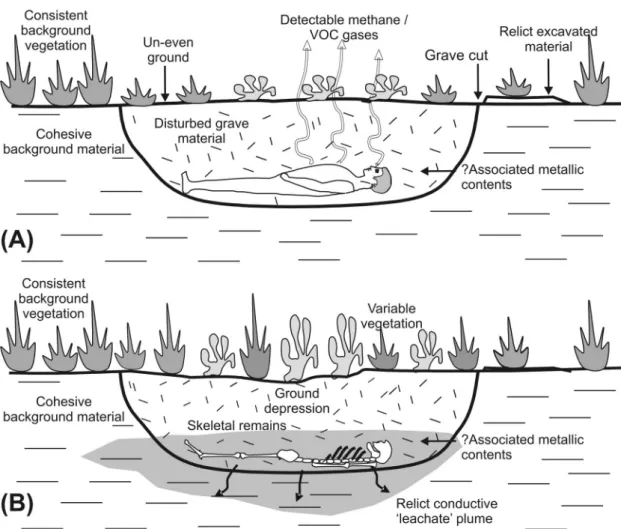
Search models for mineral exploration were adapted for forensic purposes during the 1990s for clandestine grave searches of the Pennines in the UK (see Harrison and Donnelly, 2009). These conceptual geological models (CGMs) provide information of the expected target(s) size, age, geometry, depth and surrounding ground
and hydro-geological regimes (see Harrison and Donnelly, 2009). CGMs should facilitate and partly pre-determine the optimum choice(s) of the investigative search technique(s). Obviously as the investigation progresses and new information is gathered, the initial model will need continual refining. Figure 1 is shown as a generalised example, although see Harrison and Donnelly (2009) and Killam (2004) for detail. Related to the CGM is a diggability survey, a qualitative assessment of the ease by which soils and superficial deposits may be excavated and reinstated. This can provide information on the difficulty of excavation (which may rule out an area), the achievable burial depth and time taken to undertake such an exercise. It can also provide information on the local subsurface, aid the identification of any resulting features remaining after burial and refine the initial conceptual burial model. This approach has been used in other forensic areas, for example, in environmental
forensic investigations after a mass disaster such as the Hurricane Katrina devastation in New Orleans, US, where geotechnical assessment of the catastrophic canal bank collapse was undertaken to determine the likely causes (Seed et al. 2008).
5. Phased site investigations
Once the identified search area and site reconnaissance stages have been completed, the forensic search investigator(s) will normally then review available case and site data and decide upon the optimum search technique(s). These technique(s) will be case and survey site specific (see Discussion) and may well be a combination of techniques – with perhaps an early survey phase rapidly covering the survey area and identifying anomalous areas before a further phase of surveys are undertaken focused on the identified anomalous areas. For example, Nobes (2000) undertook a bulk ground conductivity survey within woodland before later Ground Penetrating Radar (GPR) surveys over the conductivity identified anomalous areas led to success at identifying a clandestine grave position. There are an ever-expanding number of search techniques that could be utilised as Ruffell and McKinley (2008) document and some that have already been discussed in the site reconnaissance section. Other forensic search techniques will now be reviewed; near-surface geophysics in a law enforcement, environmental and humanitarian context is referred to here as the top 10 m bgl as the maximum depth of search although more usually it is the top 1 m bgl (Fenning and Donnelly, 2004).
5.1 Seismology
crash (Redmayne and Turbitt, 1990), the Oklahoma City (US) bombing (Holzer et al., 1996) and the Nairobi US Embassy bombing (Koper et al. 2001; Koper, 2003). Seismology could also potentially be useful for investigating covert underground tests of nuclear weapons (Douglas et al., 1999). Seismo-acoustic methods are showing promise to detect Improvised Explosive Devices (IEDs), mine and Un-eXploded Ordnance (UXO) locations (see Xiang and Sabatier, 2003; Donskoy et al. 2005; Sutin et al. 2009). These methods utilise differences between the elastic, acoustic and reflective properties of buried objects and the surrounding soil (see Reynolds, 2011 for background). A major advantage of this technique is that it works well for non-magnetic material, e.g. for detection of plastic mines, and can discriminate mines from smaller, metallic non-target material. However, the data can take a relatively long time to analyse compared to other techniques, and it is currently difficult to detect deeply buried material (see Sutin et al. 2009). Hildebrand et al. (2002)
documented that high resolution seismic reflection surveys were effective in locating a dead pig in a wooden coffin at 2 m bgl in an unmarked grave, if closely-spaced geophones were utilised. However, they also note that GPR surveys were as effective in detecting the graves and could be completed much faster. Multi-channel analysis of surface waves (MASW) is showing forensic potential; for example, Tallavó et al. (2009) detail how this method could detect 2 m bgl buried wooden trestles that supported Canadian railway embankments. A micro-seismic approach has been shown by Arosio (2010) to have the potential to be used to locate earthquake survivors trapped under rubble if sensors are placed around the site and
sites or locate buried toxic waste material. Case studies of seismic methods used to characterise contaminated land sites and illegally buried solid waste are given by Cardarelli and Di Filippo (2006) and Grandjean (2006) respectively. Reynolds (2002) detailed an environmental forensic survey of a polluted pond in North Wales, UK, where a seismic reflection survey was utilised to characterise the thickness of toxic tar waste at the bottom of the pond.
5.2 Bulk ground conductivity
conducted a controlled experiment in a UK urban garden environment and found that a Geonics™ EM-38 instrument, which is designed to be placed on the ground and therefore should be less susceptible to above-ground interference, did not resolve the target ‘grave’. This was attributed to the local urban environment and ‘made ground’ nature of the burial site. Nobes (1999) also found difficulty using EM methods to locate unmarked graves in a cemetery in New Zealand, due to differentiating
anomalies from significant background effects caused by fence boundaries and local topography. Interestingly Nobes (1999) found that the ‘head’ ends of unmarked graves were easier to identify than the ‘foot’ ends.
characterising different source sites. As conductivity surveys using conventional instruments (such as the Geonics™ EM31 or EM38 [Geonics Ltd., Mississauga, Canada]) are directional, they can focus on either the top 5-8 m bgl (using the horizontal model component or HMD) or up to 15 m bgl (using the vertical mode component data or VMD), depending upon the suggested depth of burial bgl and the local site ground conditions.
5.3 Electrical methods (resistivity)
Resistivity is the reciprocal of conductivity, with resistivity surveys actively measuring the bulk ground resistivity of a volume of material below the sample position (see Reynolds, 2011 and Milsom and Eriksen, 2011 for background and operation). Typically, fixed-offset resistivity surveys are utilised for searches, due to their relatively rapid coverage of the ground, although Electrical Resistivity
Resistivity has been successfully used to locate unmarked burials in cemeteries (e.g. Buck, 2003) and ancient tombs (e.g. Persson and Olofsson, 2004; Powell, 2004; Matias et al. 2006) although local variations in soil moisture content, particularly in heterogeneous ground in relatively dry conditions, can affect survey success by masking target location(s) (Ellwood et al. 1994) and/or result in numerous non-target anomalies being imaged (see Pringle et al. 2012a). Resistivity datasets can also be highly affected by coarse-grained and larger (e.g. cobble) soil types, as well as saline conditions (e.g. Pringle et al. 2012b). Milsom and Eriksen (2011), however, point out that obtaining data from the area surrounding graves can be problematic due to the inability for probes to penetrate concrete, tarmac or other hard surface. Resistivity surveys have been successful in locating clandestine graves; for example Ellwood et al. (1994) imaged three anomalies when searching for the hanged Texan gunfighter William Preston Longley. Scott and Hunter (2004) and Pringle and Jervis (2010) both detail the use of resistivity surveys in rural Welsh fields in their respective
unsuccessful missing person searches. Pringle and Jervis (2010) used
semi-quantitative analysis of resistivity data to identify anomaly locations, and compared the results to simulated study results. Published control studies over simulated burials (e.g. Cheetham, 2005; Jervis et al. 2009) have therefore proved useful for forensic investigators for comparison with active search data; these studies typically used a small grid survey pattern (0.25- to 0.5-m-spaced data point samples) so that targets could be resolved. Low resistivity anomalies with respect to background values would be expected to occur over clandestine burials of murder victims, due to
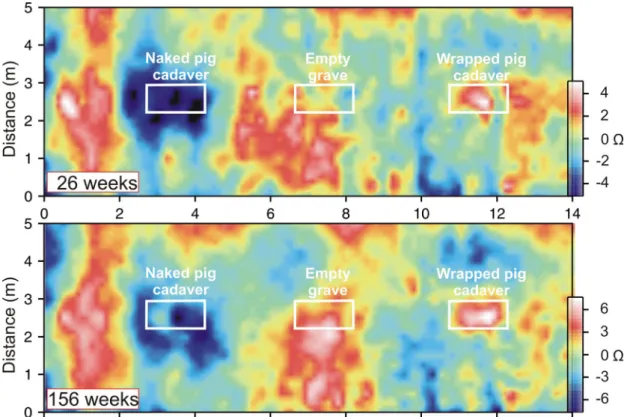
were observed over clandestine burials with a wrapped pig cadaver, and concluded that the wrapping prevented decomposition fluids being released into the ground and the wrapped cadaver presented a barrier to electrical currents. This temporal study has been continued and found resistivity anomalies to be present at least three years post-burial (see Figure 2 and Pringle et al. 2012a). Decompositional fluid
conductivity has been documented to change markedly over time since burial, rapidly increasing in year one and slowly increasing in year two, before decreasing by the end of year three post-burial (see Pringle et al. 2010). These variations will undoubtedly be different in different soil types and in different regions and environments in the world. Juerges et al. (2010) documented that decompositional fluid may be detectable below surface pig remains, even when no physical evidence of the cadaver remained.
Resistivity methods (particularly ERT) are a standard investigatory tool for
environmental forensic investigations. Environmental applications of the technique include looking for leachate leaking from landfills (see Reynolds, 2011) and
contaminant plumes from urban sites (see Vaudelet et al. 2011), identifying where illegally buried solid waste may be located (Cardarelli and Di Filippo, 2004; Ruffell and Kulessa, 2009) and studying potential aquifer contamination by graveyards (Matias et al. 2006). Ruffell and Kulessa (2009) also document a Northern Ireland case study where a combination of ERT and GPR surveys were used to locate animal mass graves from the 2001 foot-and-mouth cattle epidemic.
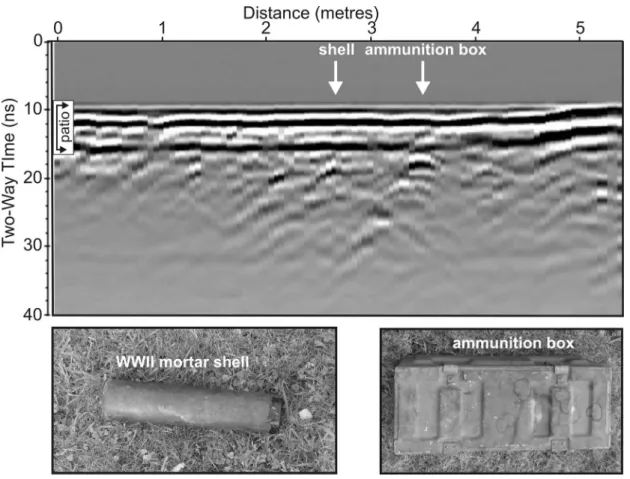
Ground penetrating radar (or GPR) is a commonly used near-surface geophysical technique for the detection of unmarked grave locations, clandestine graves and various other buried materials, with radar reflections caused by contrasts in dielectric permittivity (Figure 4). Successive 1D radar traces are collected to build up vertical 2D profiles of the sub-surface, with 3D datasets being collected if time permits (see Jol, 2009 for background theory and operational detail). Commonly bi-static, fixed-offset transmitter-receiver antennae with fixed frequencies are used to acquire a series of 2D profiles. GPR has arguably one of the highest resolutions of near-surface geophysical survey techniques and data can be obtained relatively quickly, depending upon the equipment, antennae frequency and trace sampling spacing utilised. It is one of the most commonly used techniques for near-surface target detection and widely used in the geotechnical industry for buried utilities (see, for example, Metje et al. 2007). GPR has also been shown to work successfully to locate snow avalanche survivors (see Instanes et al. 2004). However the method does not work well in saline environments due to poor penetration (see Pringle et al. 2012b). There have also been studies showing reduced penetration in damp clay-rich soils although if this is homogenous it is not a big problem (see Nobes, 1999); more of an issue is
heterogeneous ground as is discussed later in this paper.
age of burial is important with associated variability in burial styles and
decomposition causing target detection and signature to very considerably, even within the same burial site. Historical graves can often be difficult (though not impossible) to detect due to the limited skeletal remains and the process of soil compaction (e.g. Vaughan, 1986). Published clandestine grave searches using GPR include Mellet (1992), Calkin et al. (1995), Davenport (2001) and Billinger (2009). Nobes (2000) detailed a GPR survey which followed up on anomalous areas
identified in an EM survey looking for a clandestine grave in woodland. Novo et al. (2011) also detail a difficult GPR search for a grave in a mountainous area. The use of legal cemetery graves as a proxy for covert burials is dubious due to the different burial depths (typically 2 m bgl for graves and 0.5 m bgl for clandestine graves). However, some rapid legal burials may provide suitable approximations for clandestine graves. For example, Davis et al. (2000) document a GPR survey for unmarked and shallowly buried, Spanish Influenza victims from 1918 in Svalbard, Norway. Ruffell et al. (2009a) showed a GPR case study of mass graves from the Irish ‘Potato Famine’ in the 19th Century. Ruffell and McKinley (2008) also point out that the additional material in legal graves (coffin, clothes, lime, disinfectant,
embalming fluid, etc.) that may prevent results from being comparable to clandestine burials.
Miller (1996) also documents control studies and shows how historical graves can be utilised as comparisons. More recent control study examples include sequential GPR monitoring over large (Schultz et al. 2006) and small (Schultz 2008) pig cadavers and a simulated clandestine grave with accompanying GPR time-slices (Pringle et al. 2008). There are currently differing views amongst researchers on which set frequency GPR antennae should be utilised for forensic searches. GPR antennae commonly range from 50 MHz to 2000 MHz; Ruffell et al. (2009a) suggest 200 MHz was optimal to detect shallow buried unmarked historical graves, and used 400MHz to image an individual burial, and Schultz and Martin (2011) showed both 250 and 500 MHz antennae could be utilised to detect simulated clandestine graves, whilst others suggest higher frequencies (e.g. Buck, 2003 used 800 MHz frequency GPR antennae to locate unmarked graves). The general consensus seems to be that optimum detection frequency will depend on target size, depth bgl, geology and soil type. Ruffell (2005b) gives a good review of some of these parameters, showing sandy soils are optimum for GPR surveys; this was also supported by France et al. (1992);
although note surveys will always be site specific and depend upon depositional processes. For example, Nobes (2007) detailed five burial sites in New Zealand with different soil types and found sandy soil did not show targets, as depositional
numerical modelling methods for a variety of buried targets. Millington et al. (2011) go further and invert synthetic GPR data from a simulated clandestine grave for automatic target location purposes although this is currently still being developed. Solla et al. (in press) used a different approach using finite-difference time-domain (FDTD) modelling of GPR data acquired over simulated buried forensic objects and used ground-based photogrammetric methods to calibrate the modelling.
Acheroy (2007) reviewed both remote and field detection of anti-personnel mines using GPR methods, EM sensors and remote sensing. He also documented the main current police and military search forensic geophysical detection equipment which are a combination of GPR and metal detectors, with Bruschini et al. (1998) showing a case study of these combined methods. Lopera et al. (2007) showed how numerical filtering of GPR signals can reduce non-target cluttering of GPR datasets when looking for shallow buried landmines, using an example from Colombia. Lopera and Milisavljević (2007) documented how important the knowledge of soil type is to predict the GPR responses from metallic and non-metallic landmines. Furthermore Sato et al. (2004) provided information on the potential for using GPR antennae arrays to obtain common mid-point (CMP) multi-fold datasets for landmine detection, a significant improvement than the typical fixed-offset 2D profiles commonly
dielectric permittivity contrasts, although note geophysical detection can be temporally variable depending upon contaminant size, concentration and dispersal rates (see Greenhouse et al. 1993; Sauck et al. 1998).
5.5 Magnetometry
Highly sensitive magnetometers have had varied success in forensic applications. Ancient archaeological graves have been shown to have high magnetic susceptibility (Linford, 2004), proposed as due to being long term mineral changes caused by bacterial action. However magnetic results over simulated recent clandestine burials in a variety of depositional environments have proved to be not that useful (see Juerges et al. 2010). Ellwood (1994) and Witten et al. (2000) encountered difficulties in locating 19th Century graves in cemeteries and a mass grave from 1921,
respectively, using magnetic methods. Magnetic susceptibility analysis was undertaken on illegally dumped soil on a motorway in China that caused multiple fatalities and successfully identified its origin (Manrong et al. 2009). Pringle et al. (2008) pointed out that magnetic susceptibility datasets can also be used for quality control checking of magnetic gradiometry datasets: e.g. for assisting with the removal of magnetic data spikes. Recent field trials by the authors have shown magnetic susceptibility methods are optimum to detect buried metallic targets beneath a
multi-sensor 3-axis magnetometers (Munschy et al. 2007), quad-sensor arrays (Billings and Youmans, 2007) and borehole magnetometry (Zhang et al. 2007). However, Butler (2003) details the importance of understanding the background magnetic susceptibility for identifying and locating UXOs and uses case examples from Indiana and Hawaii, USA. In environmental forensic applications, Marchetti et al. (2002) detail how magnetic methods identified where over 160 illegally buried solid metal drums were located, with a recent paper showing how test sites can aid magnetic data interpretation (Marchetti and Settimi, 2011).
5.6 Forensic geomorphology
5.7 Intrusive probing
Owsley (1995) suggests that suspected burial areas be intrusively probed, allowing the operator to `feel’ whether disturbed soil or even a buried cadaver is present, although this may compromise forensic evidence. To quantify this process, suggestions have used a spring gauge mounted on a probe to obtain quantitative measurements of soil strength (Ruffell, 2005a) or a penetrometer (Killam, 2004); the resulting data points can then be gridded, contoured and analysed to pinpoint anomalous areas with low soil strength with respect to background values. Both methods are essentially using the concept of ‘diggability’ applied to ground searches (see Section 4.2), in that a perpetrator cannot bury an object where ground is hard or the soil is too thin. Fiedler et al. (2008) detailed a successful intrusive probing case study pinpointing World War Two mass graves in dense woodland in Germany that precluded the use of other search methods. Note however the potential for damage to buried material and hence potentially crucial forensic evidence.
5.8 Soil analysis
associated with buried animal remains can be detected using resistivity (Jervis et al. 2009), with fluid analysis showing them to be highly conductive when compared to background soil water values (Pringle et al. 2010). McKinley et al. (2008) detail a ‘no body’ forensic search case in Western Ireland using chemical analysis as one potential search tool. Decomposition fluids and Volatile Organic Compounds (VOCs) have also been shown to vary in elemental concentrations over time (see Juerges et al., 2010 and Vass et al. 2004; 2008 respectively).
Electronic gas detectors (referred to as methane probes), which are able to analyse gas drawn through metal probes inserted into the ground, have also shown promise for grave detection (Killam, 2004; Hädrich et. al, 2010) although results should be used with caution in case values are due to other emitting sources (e.g. from peat). Buried sampler modules collecting gases over time have also been suggested as an alternative detection method (Ruffell, 2002). It has also been suggested that decomposition gases can be detected by laser spectroscopy (Ruffell, 2002), and GC-MS analysis of human specific VOCs by headspace sampling methods (see e.g. Hoffman et al. 2009;
Lovestead and Bruno, 2011).
5.9 X-ray techniques
A continuous operating scanning X-ray source for landmine detection using
the depth to which signals can penetrate in soil. A field portable X-ray fluorescence spectrometer has been developed; Bergslien et al. (2008) discuss forensic geoscience search applications, including location of cremated human remains, and identifying both the environmental polluting source of illegal waste and tracking its movement through the local environment.
5.10 Nuclear Quadrupole Resonance
Nuclear Quadrupole Resonance (NQR) is a solid state radio frequency technique which has proven highly effective for the detection of explosives. It works by inducing a radio frequency pulse into the ground through a coil, which causes the explosive nuclei to resonate and an electrical potential to be recorded (see Anferova and Grechishkin, 2005). NQR can distinguish between different forms of the same compounds, e.g. TNT polymorphs, and has been shown by Somasundaram et al. (2008) to be relatively unaffected by different soil conditions. However, the
technique has low signal to noise ratios indicating further data processing research is required to make this technique usable in the field and the technique cannot penetrate metallic material.
5.11 Radiometrics
Commonly used to locate radioactive rocks for exploration, few environmental forensic searches using these techniques have been published. Ketterer and
6. Post-search
Once the fieldwork has been concluded and the data has been processed and
interpreted, a report should be written, detailing the survey’s findings and providing a prioritised list of area(s) for intrusive investigation, if any (see Harrison and Donnelly, 2009 for more detail). These will obviously be target specific which may vary
considerably, depending on whether the target is a clandestine grave, explosive material or contaminated land. All data may be questioned in a court of law, so original and processed information, interpretations, samples, etc must be time and date stamped and held in a secure, tamper-proof manner. All such items must adhere to the state rules of chain of custody (see Chisem and Turvey, 2007). The civil, criminal or environmental investigating officer will then decide on the next investigative steps. This may or may not involve the geoscientist, depending on whether further geoscientific investigations are required or not. Follow-up law enforcement or environment agency options will correspondingly vary, from excavation and identification of illegally buried material, mine/object clearance, recovery of human remains or land remediation respectively. For the readers’ information, when a physical excavation is unsuccessful, there is generally an
effective exit strategy in place so that excessive use of manpower and resources is not used (Harrison and Donnelly, 2009). This does not usually have any input from the geoscientist so will only be briefly discussed.
Topsoil removal is a relatively straightforward method that is appropriate for buried body searches once the search area has been narrowed down to a relatively small area or when other search methods have failed (Killam, 2004). This involves the repeated removal of thin soil surface layers, either until evidence of disturbance is encountered or a depth is reached such that the area can be ruled out (Hunter and Cox, 2005). This can be performed using machinery (e.g. Killam, 2004) or by hand-held digging implements (e.g. Dupras et al., 2006). After enough soil has been removed, disturbed areas can usually be identified by different coloured soil (see Dupras et al., 2006). Note however the potential for damage to buried material and hence potentially crucial forensic evidence. In potential crime scenes it is at this stage of the operation that the forensic geoscientist will have handed responsibility on to an appropriately qualified forensic archaeologist (Hunter and Cox, 2005).
6.2 Exploratory trenches and excavations
7. Discussion
Every forensic search of the subsurface will be unique, with different target(s) sizes (e.g. child to adult clandestine burials), burial depth(s) below ground level (typically the deeper buried the forensic target, the harder it may be to locate), style(s) of burial (e.g. for discovered clandestine graves they are commonly wrapped, clothed or naked), time since burial with its accompanying target variables (see Figure 1), background soil type(s) (see below), local bedrock (which often affects overlying soil type(s)), depositional environment (e.g. urban, rural, woodland, moorland, etc.), vegetation type(s) (e.g. grasses, woods, urban gardens, etc.), local climate (e.g. arid to humid), water table depth bgl, and many other specific variables. Each of these target(s) and background site variables will have a limited to very important effect on optimum search technique(s) and their subsequent target detection success or failure, so it is very difficult to produce specific guidelines for forensic searches for all eventualities. However, a generalised table to indicate the potential for search technique(s) success for relatively common buried forensic target(s) has been
Forensic target(s) in Table 1 are deliberately generalised; it would obviously be more difficult to successfully locate (using magnetic methods) a buried single weapon than a collection of them. Similarly illegally buried waste would obviously be easier to detect if it was of significant size and had a high contrast from background materials, for example buried metallic waste in a rural environment, than relatively small non-magnetic material in heterogeneous ground. A mass grave may be easier to locate using remote sensing methods whereas single clandestine graves are much harder to detect remotely, and very often difficult to detect within a suspect site (see Hunter et al. 2001).
The generalised search table differentiates between sand and clay site soil type end-members, although, of course, this is also simplistic as most soils will lie between these two, normally be heterogeneous and the end members ignore coarser grain-sized soil types (e.g. river gravels, etc.). Soil type is, however, important to consider for forensic searches for a variety of reasons. Firstly certain soil types (generally clay-rich types) result in poor GPR penetration depths, the success rate of element analysis detection (generally better in sandy soils) and decomposition rates with accompanying fluid plumes (generally faster and larger respectively in sandy and coarser grain-sized soils compared to clay-rich types). The search table also tries to judge the influence of the local search generalised environment, covering the main depositional settings that include woodland, rural, urban, coastal and underwater environments
objects) and potentially have many non-target objects buried within the survey site (see Drahor, 2011). However, environments are also deliberately general in the table, for example, a GPR survey in woodland with widely-spaced deciduous trees may be successful (see Nobes, 2000), however, it may be difficult to differentiate buried forensic targets from tree roots in coniferous woodland with closely-spaced trees. Exactly where the search site is in the search environment may also have potentially large variations in potential target detection success, for example, in coastal
environments, technique(s) target detection success may vary widely depending on whether it is in sand dunes versus the actual foreshore environment (see Pringle et al. 2012b). Similarly a concrete surface may preclude certain search technologies (e.g. resistivity) from being utilised due to not being able to insert probes into the ground; however, GPR methods may be optimal in this urban environment (see Billinger, 2009).
The generalised table also assumes optimum search technologies are available and optimum data sampling strategies are chosen for the respective search target(s) within their specified local environment(s). Small forensic target(s) would normally require closely-spaced sampling points but this may depend upon target contrast with
they choose appropriate search detection equipment and sample data spacing, an experienced forensic GPR team, for example, would undertake soil sampling and trial 2D profiles using all set antennae frequencies to determine the optimum frequency for a site before a full forensic search survey is initiated. GPR data processors may then use relatively advanced processing techniques, for example, to remove any above-ground interference effects (see Pringle et al. 2009) or remove average backabove-ground radar responses to reveal target anomalies (see Nobes, 1999).
Combinations of search techniques are considered best practice which would normally increase the chances of detection success; this is relatively common in geotechnical (see Sloan et al. 2007) and archaeological investigations (see Arciniega-Ceballos et al. 2009) for examples. Published forensic examples include multi-disciplinary searches for the hanged Texan Gunfighter William Preston Longley (Ellwood et al. 1994), the Nobes (1999) EM and GPR study to locate unmarked graves and a three year monitoring study of buried pig cadavers showing both GPR and bulk ground resistivity surveys should be collected if the style of burial (e.g. wrapped or naked) is unknown (Pringle et al. 2012a). Multi-technique environmental forensic case studies are provided by Cardarelli and Di Filippo (2004), who used electrical and seismic methods to characterise illegal landfills, and Boudreault et al. (2010), who used electrical, magnetic and GPR surveys to characterise a contaminated urban site.
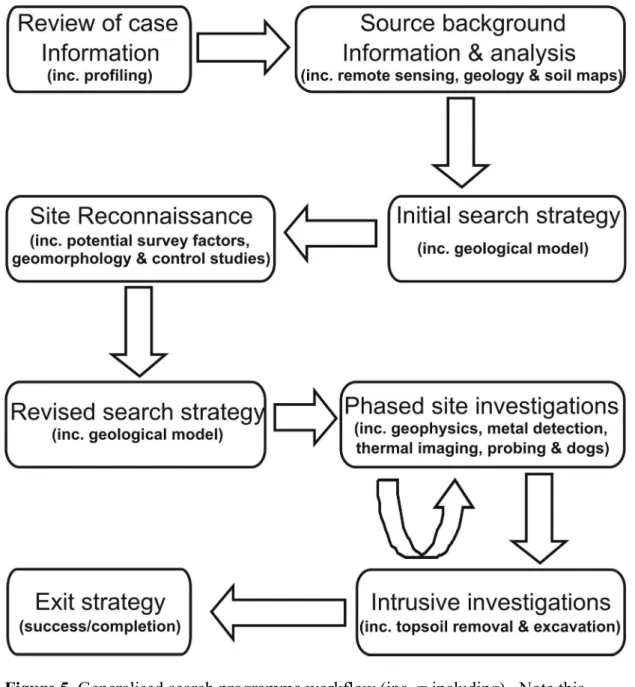
summer months, concluded due to soil moisture content variations. Combining techniques also allow the efficient use of time and resources for the best chances of detection success. A workflow of a forensic search investigation has been generated that again has been deliberately generalised (Figure 5). Of course the workflow will need to be altered for each search and refined when further case information becomes available. A major part of the search effort is undertaken prior to any field
investigations; this has benefits in time, manpower and obviously cost. This review also strongly recommends that site reconnaissance, including visual inspection, a diggability survey and perhaps limited trial surveys should be undertaken prior to more comprehensive site survey work (see Harrison and Donnelly, 2009 and Larson et al. 2011 for more information). Forensic searches normally do, of course,
8. Conclusions
From this review it is clear that forensic geoscience methods aid terrestrial searches in many and varied ways; their applications and recently published case studies are ever expanding, even since the publication of the Ruffell and McKinley (2005) review; search methods thus require standardisation and protocols to maximise the chances of target detection success. Whilst certain countries, such as the UK, are attempting to standardise methods, other countries globally are just starting to see the potential (see, for example, Mazari 2010) and applying geoscientific search methods differently and with subsequent varied success rates as other authors point out (see Larson et al. 2011). Many of the case studies, site investigations and research papers reviewed in this paper indicate the benefits of multi-disciplinary investigations with integration of historical and modern information, remote sensing and multiple phases of site work, to make efficient time savings and to use appropriate equipment and technologies to focus on search targets. Creating a conceptual target model and continually refining this when new information becomes available will assist forensic search teams in developing a detailed and focussed search plan. Key considerations when deciding on optimum geoscience search techniques and methodologies can be exhaustive and case specific but should be as a minimum: target type (composition), expected target size, time since burial, likely depth below present ground level, the local burial
geoscience methods for ever more effective search operations can be refined. It is hoped that both researchers and practitioners will continue to evolve in synergy and to further develop knowledge and research, be quantitative in approach and publish more research and case study articles to further disseminate current developments.
Acknowledgements
The authors (other than John Jervis, Jamie Hansen and Mark Harrison) are committee members of the Forensic Geoscience Group, a specialist sub-group of the Geological Society of London, whose stated mission is to promote the study and understanding of forensic geoscience nationally and internationally, promoting good practise for academics and practitioners alike. The International Union of Geological Sciences (IUGS), Initiative on Forensic Geology (IFG) is also acknowledged for its
contributions to this paper. Mike Ferguson and Sarah Corrigan of the Home Office Centre for Applied Science and Technology (CAST) are acknowledged for magnetic and metal detection equipment advice. Emily Giddings is thanked for providing some burial statistics and Leigh Noble is thanked for UXO/IED detection information. Three anonymous reviewers have significantly improved the manuscript.
Role of the funding source
The respective author research funders had no involvement in any studies shown, writing or decisions regarding submitting this paper for publication.
References
Abbott, D.M., 2005. Investigating mining fraud. Geotimes January, 30-32.
Acheroy, M., 2007. Mine action: status of sensor technology for close-in and remote detection of anti-personnel mines. Near Surface Geophysics 5, 43-56.
Amendt, J., Campobasso, C.P., Gaudry, E, Reiter, C., LeBlanc, H.N., Hall, M.J.R. 2007. Best practice in forensic entomology: standards and guidelines. International Journal of Legal Medicine 121, 90-104.
Anferova, L.V., Grechishkin, V.S., 2005. Physics of magnetic phenomena—use of the Bohr principle for detecting NQR signals from mines. Russian Physical Journal 48, 148–155.
Arciniega-Ceballos, A., Hernandez-Quintero, E., Cabral-Cano, E., Morett-Alatorre, L., Diaz-Molina, O., Soler-Arechalde, A., Chavez-Segura, R., 2009. Shallow
geophysical survey at the archaeological site of San Miguel Tocuila, Basin of Mexico. Journal of Archaeological Science 36, 1199-1205.
Bavusi, M., Rizzo, E., Lapenna, V., 2006. Electromagnetic methods to characterize the Savoia di Lucania waste dump in southern Italy. Environmental Geology 51, 301-308.
Bennett, M.R., Huddart, D., Gonzalez, S., 2009. Preservation and analysis of three-dimensional footwear evidence in soils: the application of optical laser scanning. In: Ritz, K., Dawson, L., Miller, D. (Eds.), Criminal and Environmental Soil Forensics, Springer Publishing, pp. 445-461.
Benninger, L.A., Carter, D.O., Forbes, S.L., 2008. The biochemical alteration of soil beneath a decomposing carcass. Forensic Science International 180, 70–75.
Bergslien, E., Bush, M., Bush, P., 2008. Identification of cremains using x-ray diffraction analysis and a comparison to trace element analysis. Forensic Science International 175, 218-226.
Bermejo, J.L., Sauck, W.A., Atekwana, E.A., 2007. Geophysical Discovery of a New LNAPL Plume at the Former Wurtsmith AFB, Oscoda, Michigan. Ground Water Monitoring & Remediation 17, 131-137.
Bevan, B.W., 1991. The search for graves. Geophysics 56, 1310-1319.
Billinger, M.S., 2009. Utilizing ground penetrating radar for the location of a
Billings, S., Wright, D., 2010. Interpretation of high-resolution low-altitude helicopter magnetometer surveys over sites contaminated with unexploded ordnance. Journal of Applied Geophysics 72, 225-231.
Billings, S., Youmans, C., 2007. Experiences with unexploded ordnance
discrimination using magnetometry at a live-site in Montana. Journal of Applied Geophysics 61, 194-205.
Boudreault, J-P., Dubé, J-S., Chouteau, M., Winiarski, T., Hardy, É. 2010.
Geophysical characterization of contaminated urban fills. Engineering Geology 116, 196-206.
Brewster, M.L., Annan, A.P., 1994. Ground-penetrating radar monitoring of a controlled DNAPL release: 200 MHz radar. Geophysics 59, 1211-1221.
Brilis, G.M., Gerlach, C.L., van Waasbergen, R.J., 2000a. Remote sensing tools assist in environmental forensics: Part I. Digital tools - traditional methods. Environmental Forensics 1, 63–67.
Bruschini, C., Gros, B., Guerne, F., Pièce, P.Y., Carmona, O., 1998. Ground
penetrating radar and imaging metal detector for antipersonnel mine detection. Journal of Applied Geophysics 40, 59–71.
Buck, S.C., 2003. Searching for graves using geophysical technology: field tests with ground penetrating radar, magnetometry and electrical resistivity. Journal of Forensic Sciences 48, 5–11.
Bull, I.D., Berstan, R., Vass, A., Evershed, R.P., 2009. Identification of a disinterred grave by molecular and stable isotope analysis. Science and Justice 49, 142-149.
Butler, D.K., 2003. Implications of magnetic backgrounds for unexploded ordnance detection. Journal of Applied Geophysics 54, 111-125.
Caccianiga M., Bottacin, S., Cattaneo, C., 2012. Vegetation dynamics as a tool for detecting clandestine graves. Journal of Forensic Sciences DOI: 10.1111/j.1556-4029.2012.02071.x.
Calkin S.F., Allen, R.P., Harriman, M.P., 1995. Buried in the basement – geophysics role in a forensic investigation. Proceedings of the symposium on the application of geophysics to engineering and environmental problems; Denver: Environmental Engineering Geophysical Society, 397–403.
Cassidy, N.J., 2007a. A review of practical numerical modelling methods for the advanced interpretation of ground-penetrating radar in near-surface environments. Near Surface Geophysics 5, 5-21.
Cassidy, N.J., 2007b. Evaluating LNAPL contamination using GPR signal attenuation analysis and dielectric property measurements: practical implications for hydrological studies. Journal of Contaminant Hydrology 94, 49-75.
Macdonald, C.A., Ang, R., Cordiner, S.J., Horswell, J., 2011. Discrimination of soils at regional and local levels using bacterial and fungal T-RFLP profiling. Journal of Forensic Sciences 56, 61-69.
Cardarelli, E., Di Filippo, G. 2004. Integrated geophysical surveys on waste dumps: Evaluation of physical parameters to characterize an urban waste dump, four cases in Italy. Waste Management and Research 22, 390–402.
Chainey, S., Ratcliffe, J., 2008. GIS and crime mapping. John Wiley and Sons Ltd., Chichester, UK, 428 pp.
Chisem, W.J., Turvey, B.E., 2007. Crime reconstruction. Elsevier Academic Press, London, UK, 599 pp.
Combrinck, M., 2001. Transient electromagnetic exploration techniques: can they be applied to the landmine discrimination problem? African Earth Sciences 33, 693-698.
Conyers, L.B., 2006. Ground penetrating radar techniques to discover and map historic graves. Historical Archaeology 40, 64-73.
Curran, A.M., Prada, P.A., Furton, K.G., 2010. Canine human scent identifications with post-blast debris collected from improvised explosive devices. Forensic Science International 199, 103-108.
Davenport, G.C., 2001. Remote sensing applications in forensic investigations. Historical Archaeology 35, 87–100.
Davis, J.L., Heginbottom, J.A., Annan, A.P., Daniels, R.S., Berdal, B.P., Bergan, T., Duncan, K.E., Lewin, P.K., Oxford, J.S., Roberts, N., Skehel, J.J., 2000. Ground penetrating radar surveys to locate 1918 Spanish Flu victims in permafrost. Journal of Forensic Sciences 45, 68-76.
Deans, J., Gerhard, J., Carter, L.J., 2006. Analysis of a thermal imaging method for landmine detection, using infrared heating of the sand surface. Infrared Physical Technology 48, 202–216.
Dekeirsschieter, J., Verheggen, F.J., Gohy, M., Hubrecht, F., Bourguignon, L., Lognay, E., Haubruge, E., 2009. Cadaveric volatile organic compounds released by decaying pig carcasses (Sus domesticus) in different biotopes. Forensic Science International 189, 46–53.
Dickinson, D.J., 1976. The aerial use of an infrared camera in a police search for the body of a missing person in New Zealand. Journal of the Forensic Science Society 16, 205–211.
Dionne, C.A., Schultz, J.J., Murdock II, R.A, Smith, S.A., 2011. Detecting buried metallic weapons in a controlled setting using a conductivity meter. Forensic Science International 208, 18-24.
Donskoy, D., Reznick, A. Zagrai, A., Ekimic, A., 2005. Nonlinear vibrations of buried landmines. Journal of the Acoustic Society of America 117, 690-700.
Drahor, M.G., 2011. A review of integrated geophysical investigations from archaeological and cultural sites under encroaching urbanisation in Izmir, Turkey. Physics and Chemistry of the Earth 36, 1294-1309.
Dupras, T.L., Schultz, J.J., Wheeler, S.M., Williams, L.J., 2006. Forensic recovery of human remains. CRC Press, 232 pp.
Ellwood, B.B., Owsley, D.W., Ellwood, S.H., Mercado-Allinger, P.A., 1994. Search for the grave of the hanged Texas gunfighter, William Preston Longley. Historical Archaeology 28, 94–112.
Ellwood, B.B., 1990. Electrical resistivity surveys in two historical cemeteries in northeast Texas: a method for delineating unidentified burial shafts. Historical Archaeology 24, 91–98.
Equitas, 2010. Methodological proposals for documenting and searching for missing persons in Columbia. Equitas. Web: http://www.equitas.org.co/docs/45.pdf Accessed 25/01/2012/
Fiedler, S., Illich, B., Berger, J., Graw, M., 2009a. The effectiveness of ground-penetrating radar surveys in the location of unmarked burial sites in modern cemeteries. Journal of Applied Geophysics 68, 380-385.
Fiedler, S., Berger, J., Stahr, K., Graw, M., 2009b. Localisation of a mass grave from the Nazi era – a case study. In: Ritz, K., Dawson, L., Miller, D. (Eds.), Criminal and Environmental Soil Forensics, Springer Publishing, pp. 303-314.
Fitzpatrick, R.W, Raven, M.D., Forrester S.T., 2009. A systematic approach to soil forensics: Criminal case studies involving transference from crime scene to forensic evidence. In: Ritz, K., Dawson, L., Miller, D. (Eds.), Criminal and Environmental Soil Forensics, Springer Publishing, pp. 105-127.
France, D.L., Griffin, T.J., Swanburg, J.G., Lindemann, J.W., Davenport, G.C., Trammell, V., Travis, C.T., Kondratieff, B., Nelson, A., Castellano, K., Hopkins, D., Adair, T., 1997. Necrosearch revisited: further multidisciplinary approaches to the detection of clandestine graves. In: Haglund, W.D., Sorg, M.H., (Eds.), Forensic taphonomy: the postmortem fate of human remains, CRC Press, pp. 497–509.
Freeland, R.S., Miller, M.L., Yoder, R.E., Koppenjan, S.K., 2003. Forensic applications of FMCW and pulse radar. Journal of Environmental Engineering in Geophysics 8, 97–103.
Frohlich, B., Lancaster, W.J., 1986. Electromagnetic surveying in current Middle Eastern archaeology – application and evaluation. Geophysics 51, 1414-1425.
Geberth, V.J., 2006. Practical homicide investigation: Tactics, procedures, and forensic techniques. Boca Raton, Florida, CRC/Taylor & Francis.
Geradts, Z., Kelizer, J., 1996. The image database REBEZO for shoeprints with developments on automatic classification of shoe outsole designs. Forensic Science International 82, 21-31.
Grandjean, G. 2006. A seismic multi-approach method for characterizing contaminated sites. Journal of Applied Geophysics 58, 87-98.
Greenhouse, J., Brewster, M., Schneider, G., Redman, D., Annan, P., Olhoeft, G., Lucius, J.E., Sander, K., Mazzella, A. 1993. Geophysics and solvents; the Borden experiment. The Leading Edge 12, 261-267.
Hädrich, C., Ortman, C., Reisch, R., Leibing, G., Ahlers, H., Mall, G., 2010. An electronic body tracking dog? International Journal of Legal Medicine 124, 43–47.
Hammon, W.S. III, McMechan, G.A., Zeng, X., 2000. Forensic GPR:
finite-difference simulations of responses from buried human remains. Journal of Applied Geophysics 115, 191-204.
Hannam, J.A., Dearing, J.A., 2008. Mapping soil magnetic properties in Bosnia and Herzegovina for landmine clearance operations. Earth and Planetary Science Letters 274, 285–294.
Harrison, M., Donnelly, L.J., 2009. Locating concealed homicide victims: developing the role of geoforensics. In: Ritz, K., Dawson, L., Miller, D. (Eds.), Criminal and Environmental Soil Forensics, Springer Publishing, pp. 197-219.
Hildebrand, J.A., Wiggins, S.M., Henkart, P.C., Conyers, L.B., 2002. Comparison of seismic reflection and ground-penetrating radar imaging at the controlled
archaeological test site, Champaign, Illinois. Archaeological Prospection 9, 9-21.
Holzer, T.L., Fletcher, J.B., Fuis, G.S., Ryerg, T., Brocher, T.M., Dietel, C.M., 1996. Seismograms offer insight into Oklahoma City bombing. Eos Transactions, American Geophysical Union 77:393, 398–399.
Hunter, J., Cox, M., 2005. Forensic archaeology: advances in theory and practice. Routledge Publishers, 256 pp.
Hunter, R., Brickley, M.B., Bourgeois, J., Bouts, W., Bourguignon, L., Hubrecht, F., de Winne, J., Van Haaster, H., Hakbijl, T., Jong, H. de, Smits, L., Van Wijngaarden, L.H., Luschen, M., 2001. Forensic archaeology, forensic anthropology and Human Rights in Europe. Science and Justice 41, 173–178.
Instanes A., Lønne A., Sandaker K., 2004. Location of avalanche victims with ground-penetrating radar. Cold Regions Science and Technology 38, 55-61.
Jervis, J.R., Pringle, J.K., Tuckwell, G.W., 2009. Time-lapse resistivity surveys over simulated clandestine graves. Forensic Science International 192, 7-13.
Jol, H.M., 2009. Ground penetrating radar: theory and applications. Elsevier
Publications, Amsterdam, The Netherlands, 524 pp.
Kenyon, J.L., 1977. Ground-penetrating radar and its application to a historical archaeological site. Historical Archaeology 11, 48–55.
Ketterer, M.E., Czechenyi, S.C., 2008. Determination of plutonium and other transuranic elements by inductively coupled plasma mass spectrometry: a historical perspective and new frontiers in the environmental sciences. Spectrochimica Acta Part B: Atomic Spectroscopy 63, 719-737.
Killam, E.W., 2004. The detection of human remains. Charles C Thomas Publishers, Springfield, Illinois, USA, 268 pp.
King, J.A., Bevan, B.W., Hurry, R.J., 1993. The reliability of geophysical surveys at historic period cemeteries: an example from the Plains Cemetery, Mechanicsville, Maryland. Historical Archaeology 27, 4-16.
Komar, D.A., 1999. The use of cadaver dogs in locating scattered, scavenged human remains: preliminary field test results. Journal of Forensic Sciences 44, 405–408.
Koper, K., 2003. http://geology.about.com/od/seismo_forensics/a/kursk.htm Accessed: 25/01/2012/.
Lark, R.M., Rawlins, B., 2008. Can we predict the provenance of a soil sample for forensic purposes by reference to a spatial database? European Journal of Soil Science 59, 1000-1006.
Larson, D.O., Vass, A.A., Wise, M., 2011. Advanced scientific methods and procedures in the forensic investigation of clandestine graves. Journal of Contemporary Criminal Justice 27(2), 149-182.
Lasseter, A, Jacobi, K.P., Farley, R., Hensel, L., 2003. Cadaver dog and handler team capabilities in the recovery of buried human remains in the Southeastern United States. Journal of Forensic Sciences 48, 1–5.
Lee, C.W., 2004. The nature of, and approaches to, teaching forensic geoscience on forensic and earth science courses. In: Pye, K., Croft, D.J. (Eds.), Forensic
Geoscience: Principles, Techniques and Applications. Special Publication of the Geological Society of London 232, 301-333.
Leighton, T.G., Evans, R.C.P., 2008. The detection by sonar of difficult targets (including centimetre-scale plastic objects and optical fibres) buried in saturated sediment. Applied Acoustics 69, 438-463.
Linford, N., 2004. Magnetic ghosts: Mineral magnetic measurements on Roman and Anglo-Saxon graves. Archaeological Prospection 11, 167–180.
Lopera, O., Milisavljević, N., 2007. Prediction of the effects of soil and target
properties on the antipersonnel landmine detection performance of ground-penetrating radar: A Colombian study. Journal of Applied Geophysics 63, 13-23.
Lopera, O., Milisavljević, N., Lambot, S., 2007. Clutter reduction in GPR
measurements for detecting shallow buried landmines: a Colombian case study. Near Surface Geophysics 5, 57-64.
Lovestead, T.M., Bruno, T.J., 2011. Detecting gravesoil with headspace analysis methods with adsorption on short porous layer open tubular (PLOT) columns. Forensic Science International 204, 156-161.
Manrong, C., Lizhong, Y., Xiangfeng, N., Bin, C. 2009. Application of environmental magnetism on crime detection in a highway traffic accident from Yangzhou to
Guazhou, Jiansu Province, China. Forensic Science International 187, 29-33.
Marchetti, M., Settimi, A., 2011. Integrated geophysical measurements on a test site for detection of buried steel drums. Annals of Geophysics, 54, 105-114.
Marchetti, M., Cafarella, L., Di Mauro, D., Zirizzotti, A., 2002. Ground
Matias, H.C., Monteiro Santos, F.A., Rodruiges Ferreira, F.E., Machado, C., Luzio, R., 2006. Detection of graves using the micro-resistivity method. Annals of
Geophysics 49, 1235-1244.
Matias, M.J., Marques da Silva, M., Goncalves, L., Peralta, C., Grangeia, C.,
Martinho, E., 2004. An investigation into the use of geophysical methods in the study of aquifer contamination by graveyards. Near Surface Geophysics 2, 131–136.
Mazhari, S.A., 2010. An introduction to forensic geosciences and its potential for Iran. Journal of Geography and Geology 2(1), 77-82.
McKinley, J.M., Ruffell, A., Harrison, M., Meier-Augenstein, W., Kemp, H., Graham, C., Barry, L. 2008. Spatial thinking in search methodology: a case study of the ‘no body’ murder enquiry, West of Ireland. . In: Ritz, K., Dawson, L., Miller, D. (Eds.), Criminal and Environmental Soil Forensics, Springer Publishing, pp. 285-302.
Mellet, J.S., 1992. Location of human remains with ground penetrating radar. In: Hanninen, P., Autio S., (Editors), Proceedings of the Fourth International Conference on Ground Penetrating Radar, June 8-13; Rovaniemi, Geological Survey of Finland Special Paper 16, 359–65.
Miller, P.S., 1996. Disturbances in the soil: finding buried bodies and other evidence using ground penetrating radar. Journal of Forensic Sciences 41, 648-652.
Millington, T.M., Cassidy, N.J., Nuzzo, L., Crocco, L., Solovieri, F., Pringle, J.K., 2011. Interpreting complex, three-dimensional, near-surface GPR surveys: an integrated modelling and inversion approach. Near Surface Geophysics 9, 297-304.
Milsom, J., Eriksen, A. 2011. Field Geophysics. 4th review edition. The Geological Field Guide Series, Wiley Publishers, Chichester, 304 pp.
Missiaen, T., Söderström, M., Popescu, I., Vanninen, P., 2010. Evaluation of a chemical munition dumpsite in the Baltic Sea based on geophysical and chemical investigations. Science of the Total Environment 408, 3536-3553.
Missiaen, T., Feller, P. 2008. Very-high-resolution seismic and magnetic
investigations of a chemical munition dumpsite in the Baltic Sea. Journal of Applied Geophysics 65, 142-154.
Morgan, R.M., Robertson, J., Lennard, C., Hubbard, K., Bull, P.A., 2010. Quartz grain textures of soils and sediments from Canberra, Australia: a forensic
reconstruction tool. Australian Journal of Forensic Sciences 42(3), 169-179.
Morgan, R.M., Bull, P.A., 2007a. The philosophy, nature and pra