O R I G I N A L P A P E R
Open Access
Nonlinear pre and post-buckled analysis of
curved beams using differential quadrature
element method
M. Zare
1and A. Asnafi
2*Abstract
This paper studied the in-plane elastic stability including pre and post-buckling analysis of curved beams considering the effects of shear deformations, rotary inertia, and the geometric nonlinearity due to large deformations. Firstly, the governing nonlinear equations of motion were derived. The problem was solved performing both the static and dynamic analysis using the numerical method of differential quadrature element method (DQEM) which is a new and efficient numerical method for rapidly solving linear and nonlinear differential equations. Firstly, the method was applied to the equilibrium equations, leading to a nonlinear algebraic system of equations that would be solved utilizing an arc length strategy. Secondly, the results of the static part were employed to linearize the dynamic differential equations of motion and their corresponding boundary and continuity conditions. Without any loss of generality, a clamped-clamped curved beam under a concentrated load was considered to obtain the buckling loads, natural frequencies, and mode shapes of the beam throughout the method. To validate the proposed method, the beam was modeled using a finite element simulation. A great agreement between the results was seen that showed the accuracy of the proposed method in predicting the pre and post-buckling behavior of the beam. The investigation also included an examination of the curvature parameter influencing the dynamic behavior of the problem. It was shown that the values of buckling loads were completely influenced by the curvature of the beam; also, due to the sharp change of longitudinal stiffness after bucking, the symmetric mode shapes changed more than it was expected.
Keywords:Differential quadrature element method (DQEM), Curved beam vibration, Post-buckling, Buckling load, Arc length method, Non-linear analysis
Introduction
Curved beams have been a noticeable element in differ-ent applications and industries. The techniques involved in designing and constructing them have developed into many structural forms, such as mechanical devices, building arches, and bridges. As a result, it is important to have a better understanding of the dynamic stability of the subject to external loadings for the purpose of preventing possible accidents.
Many researches have been done in the field of stabil-ity of beam structures. Hummer (Hummer,2013) inves-tigated the buckling and post-buckling of beams taking into account both the influence of axial compressibility
and shear deformation on the basis of Reissner’s rela-tions. Bradford et al. (Bradford, Uy, & Pai,2002) studied the in-plane elastic stability of arches under a central concentrated load analytically. A systematic method for the post-buckling analysis showing the importance of nonlinear terms of curved beams was established by Fan et al. (Fan et al.,2017). Addessi et al. (Addessi, Lacarbo-nara, & Paolone,2005) obtained the natural frequencies and mode shapes of beams around their curved pre-stressed post-buckling configurations.
An investigation of the nonlinear buckling behavior of cir-cular arches was done by Jianbei et al. (Jianbei, Mario, & David,2014) by using the trapezoid method with Richardson extrapolation enhancement. Pi et al. (Pi, Bradford, & Tin-Loi, 2007) investigated the analytical solutions for in-plane non-linear elastic behavior and the stability of elastically sup-ported shallow circular arches. Their model was subjected to
© The Author(s). 2019Open AccessThis article is distributed under the terms of the Creative Commons Attribution 4.0 International License (http://creativecommons.org/licenses/by/4.0/), which permits unrestricted use, distribution, and reproduction in any medium, provided you give appropriate credit to the original author(s) and the source, provide a link to the Creative Commons license, and indicate if changes were made.
* Correspondence:[email protected]
2Hydro-Aeronautical Research Center, Shiraz University, Shiraz 71348-51154, Iran
a radial load uniformly distributed around the arch axis. A geometrically nonlinear finite element model of a composite curved beam was presented by Fraternali et al. (Fraternali, Spadea, & Ascione,2013). They considered moderately large rotations, shear strains, as well as small axial strains.
Torabi et al. (Torabi, Afshari, & Aboutalebi, 2014) studied the free vibration of a Timoshenko beam with multiple cracks using DQEM. In order to check the accuracy of the proposed method, a comparison be-tween obtained natural frequencies and those calcu-lated by some other authors was done. In addition, they revealed that crack parameters influenced natural frequencies. Huynh et al. (Huynh, Luu, & Lee, 2017) studied the bending, buckling, and free vibration of curved beams, having variable curvature along the beam length by applying iso-geometric analysis. In their research, in addition to the impact of varying curvature, the effects of material distribution, aspect ratio, and slenderness ratio on the behavior of beams considering different boundary conditions were stud-ied. Natural frequencies and buckling loads of a sim-ply supported shallow circular arch subjected to initial axial force were investigated by Matsunaga (Matsunaga, 1995). In his research, the method of power series expansion of displacement components was applied to derive the equations. Liu et al. (Liu, Lu, Fu, et al., 2017) studied the out-of-plane dynamic instability of elastic shallow circular arches under an in-plane central concentrated periodic load. They de-rived the equations applying the Hamilton principle by considering the effects of geometric nonlinearity, additional concentrated weights, and damping. Pi et al. (Pi & Bradford, 2008) studied the dynamic in-plane buckling of a shallow pin-ended circular arch. In their study, a central radial load was considered to be exerted suddenly. They applied the method of con-servation of energy as the criterion for dynamic buck-ling and analytical solutions of dynamic buckbuck-ling loads. The first well-known governing vibration equa-tions of preloaded, shear-deformable circular arches were derived by Huang et al. (Huang, Nieh, & Yang, 2003). They solved the governing equations using a static, closed-form solution, and an analytical dynamic series solution and dynamic stiffness matrices. Kouna-dis et al. (KounaKouna-dis, Gantes, & Bolotin, 1999) investi-gated the nonlinear dynamic buckling of structural systems qualitatively and quantitatively. In their study, multi-degree freedom structures which are sensitive to imperfection were investigated. A flexural-torsional buckling theory for circular arches was represented by Papangelis et al. (Papangelis & Trahair, 1986). In their method, the nonlinear expressions were derived and then substituted into the second variation of the total potential to obtain the buckling equation. In a study
done by Quan et al. (Quan, Cuong, & Duc, 2019), the nonlinear buckling and post-buckling of eccentrically oblique stiffened sandwich functionally graded double curved shallow shells resting on elastic foundations in the thermal environment was investigated. In their study, the shells were reinforced by functionally graded eccentrically oblique stiffeners with deviation angles. The stability of structures made of functionally graded material (FGM) has also been investigated in the literature (Anh, Bich, & Duc, 2015; Duc, 2014; Duc, Khoa, Nguyen, & Duc, 2019; Duc, Nguyen, & Khoa, 2017; Kim, Duc, Nam, & Van, 2019). In a study done by Duc (Minh & Duc, 2019), the effect of a central crack on the stability of a rectangular (FGM) plate was investigated. In that study, they applied the new third-order shear deformation plate theory (TSDT) and the finite element method (FEM) to ob-tain the results. Doan et al. (Doan, Van Do, Pham, & Duc, 2019) used the phase-field method to simulate the free vibration and buckling of cracked plates. They validated their results by numerically investigat-ing free vibration and bucklinvestigat-ing of the aforementioned structure. There is a vast literature in domain discretization techniques and methods of continuous media; for example, see some other types in (Marin, Baleanu, & Vlase, 2017; Marin & Craciun, 2017; Marin & Nicaise, 2016).
In the previous studies, neglecting the rotary inertia ef-fects, the buckling of non-shallow curved beams has been investigated. Moreover, in many studies, the ap-proximated perturbation method has been used. In the present study, the pre- and post-buckling state of a gen-erally curved beam with a radial concentrated force at the middle point of the beam is investigated. The prob-lem is solved by performing both the static and dynamic analysis using the numerical method of the differential quadrature element method. In static analysis, the solu-tion of the nonlinear equasolu-tions is obtained applying the arc-length method. The buckling load is obtained con-sidering the displacement of the middle point as a known parameter of the arc length method in the static analysis. Finally, the linearized dynamic differential equa-tions of motion and their corresponding boundary and continuity conditions are transformed into an eigenvalue problem and the natural frequencies and mode shapes are evaluated.
Materials and methods
Governing equation of motion for a curved beam
N 1 R−
∂φ
∂S
−∂Q∂S ¼−γAU€ ð1Þ
Q 1
R− ∂φ
∂S
þ∂N∂S ¼γAW€ ð2Þ
∂M
∂S −NkAGQ þQ N EAþ1
¼γAφ€ ð3Þ
N EA¼
∂U ∂Sþ
W R þ1
cosð Þ þφ ∂W
∂S − U
R
sinð Þφ−1
ð4Þ
Q kAG¼ −
∂U ∂Sþ
W R þ1
sinð Þ þφ ∂W ∂S −
U R
cosð Þφ
ð5Þ
M¼EI∂∂Sφ; ð6Þ
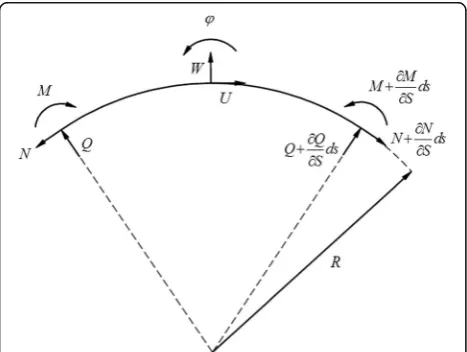
where dot means the derivative with respect to time. As shown in Fig.1, which represents an element of a curved beam, W, U, andφdenote the radial and tangential dis-placements, and the angle of rotation. ParametersM, N, and Q show the bending moment, normal and shear forces respectively. Moreover,A,I,γ,G,E, andkare the cross-section area of the beam, area moment of inertia of the cross-section, mass density per unit volume of the beam material, shear and Young’s modulus of elasticity, and shear factor of the cross-section, respectively.
In what follows, the equations of motion are solved by the DQE method which is one of the efficient numerical methods for fast solving linear and nonlinear differential equations.
DQEM
The differential quadrature element method (DQEM) is a new and efficient numerical method for rapidly solving linear and nonlinear differential equations. The method is based on the differential quadrature (DQ) method which is an approximate method for expressing partial derivatives of a function at a point located in the domain of the function, as the weighted linear sum of the values of the variable function at all the defined precision points in the derivation direction. Equation (7) is the mathematical representation of the DQ expansion (Chen,2005):
df dx
x¼xi
¼XN
j¼1
Cð Þij1 fj;i;j¼1;2;3;…;N ð7Þ
wherefis the desired function,Nis the number of preci-sion points, xi is the precision associated with the ith
point of the function domain and also represents the weighting coefficients used to find the first derivative of the function at the ith precision point of the function domain.
In our case study, the beam is discretized to m ele-ments and each element itself is divided into N nodes (see Fig. 2). These nodes are the aforementioned preci-sion points. In order to use Eq. (7), the physical coor-dinateθ is transformed to the natural coordinate x with such the following relation (Chen,2005):
θ¼ð1−xÞθ1þxθN ð8Þ
Where θ1 and θN are the angular coordinates of the first and Nth nodes of the element respectively. Note that x is a value in [0, 1] domain, i.e., (0 <x<1). In fact, applying this relation, the differentiation with respect to angular coordinate θ can be obtained using Eq. (8). Ac-cording to Eqs. (7) and (8), there are two important
Fig 1.Displacement and load components of a schematic curved element
factors in applying the DQ method; firstly, calculation of DQ weighting coefficients and, secondly, selection of the precision points. In this article, the Lagrangian functions were used to compute the weighted coefficients, and the Gauss–Lobatto Chebyshev polynomial was used to select the precision points. Finally, it is to be noted that to reach overall consistency, the continuity conditions at inter-element boundaries of two adjacent elements and the boundary conditions of the whole beam, as well as the governing equations on each element, must be satisfied.
As indicated previously, the beam is discretized to m elements and each element itself is divided intoNnodes (see Fig. 2). Assuming a harmonic excitation of ω fre-quency for U, W, and φ in Eqs. (1–3), i.e., U€ ¼−ω2U,
€
W ¼−ω2W , and φ€¼−ω2φ, then applying the DQ discretization to the equations of motion at an interior nodemiof the elementi, anybody can reach to such the following discrete equations (Jianbei et al.,2014):
Nimi 1 R−
∂φi mi
∂S
−∂Qimi
∂S ¼ω2γiAiUimi; ð9Þ
Qimi 1 R−
∂φi mi
∂S
þ∂Nimi
∂S ¼−ω2γiAiWimi; ð10Þ
∂Mi mi
∂S −Nimi
Qimi
KAGþQ
i mi
Nimi
EA þ1
¼−ω2γiAiφi
mi; ð11Þ
Ni mi¼EA
∂Ui mi ∂S þ
Wi mi
R þ1
cosφi mi
þ ∂Wimi ∂S −
Ui mi
R
sinφi mi
−1
;
ð12Þ
Qimi¼kAG −
∂Ui mi
∂S þ Wi
mi
R þ1
sinφimi
þ ∂Wimi
∂S − Ui
mi
R
cosφimi
;
ð13Þ
Mimi ¼EIi
∂φi mi
∂S : ð14Þ
To solve the nonlinear vibration of the post-buckled curved beam (Eqs. (9–14)), first, the system of equations is solved statically to determine what the equilibrium shape is. As a result, considering small harmonic varia-tions around the post-buckled equilibrium configuration, the solution can be written as the sum of the equilib-rium and harmonic parts in the following form:
Uimi ¼ Uimi
eþ U
i mi
d sinð Þωt ; ð15Þ
Wimi¼ Wimi
eþ W
i mi
d sinð Þωt ; ð16Þ
φi
mi¼ φimi
eþ φ i mi
d sinð Þωt ; ð17Þ
Nimi ¼ Nimi
eþ N
i mi
d sinð Þωt ; ð18Þ
Qimi¼ Qimi
eþ Q
i mi
d sinð Þωt ; ð19Þ
Mimi ¼ Mimi
eþ Mimi
d sinð Þωt : ð20Þ
Eliminating the time-dependent terms in Eqs. (9–11), the following equilibrium equations are obtained:
Nimi
e 1 R−
∂ φi mi
e ∂S
!
−∂ Qimi
e
∂S ¼0; ð21Þ
Qimi
e 1 R−
∂ φi mi
e ∂S
!
þ∂ Nimi
e
∂S ¼0; ð22Þ
∂ Mimi
e ∂S − Nimi
e Qimi
e KAG
þ Qimi
e Ni mi e
EA þ1
!
¼0; ð23Þ
Nimi
e
EA −
∂ Uimi
e
∂S þ
Wimi
e
R þ1
!
cos φimi
e
þ ∂ Wimi
e
∂S −
Uimi
e
R
!
sin φi
mi
e
−1Þ ¼0;
ð24Þ
Qimi
e
kAG − −
∂ Ui mi e ∂S þ Wi mi e
R þ1
!
sin φimi
e
þ ∂ Wimi
e ∂S −
Uimi
e R
!
cos φimi
e
Þ ¼0;
ð25Þ
Mimi
e−EIi ∂ φi
mi
e
∂S ¼0: ð26Þ
Now, small harmonic variations are considered around the post-buckled static equilibrium state. Substituting Eqs. (15–20) into (9–14), and removing the nonlinear terms, the linear dynamic equations of motion can be obtained as
Nimi
e −
∂ φi mi
ð Þd
∂S
þ Nimi
d 1 R−
∂ φi mi
ð Þe
∂S
−∂ Qimi
d
¼−ω2γiIi Ui mi
d; ð27Þ
Qi mi
e −
∂ φi mi
d ∂S
!
þ Qimi
d 1 R−
∂ φi mi
e ∂S
!
þ∂ Nimi
d ∂S
¼ω2γiIi Wi mi
d; ð28Þ
∂Mi mi
d ∂S þ Q
i mi dN i mi e 1 EA− 1 KAG
þ Ni mi dQ i mi e 1 EA− 1 KAG
þ Qi mi
d ¼ω
2γiIiφi mi
d; ð29Þ
Ni mi
d EA − φ
i mi d Qi mi e kAG !
− ∂ Wimi
d ∂S −
Ui mi d R !
sin φi
mi
e
− ∂Uimi
d ∂S þ
Wi mi d R ! cos φimi
e
¼0;
ð30Þ
Qi mi
d
kAG þ φ
i mi d Ni mi e
EA þ1 !
þ ∂Uimi
d
∂S þ Wi mi d R !
sin φi mi
e
− ∂Wimi
d
∂S − Ui mi d R !
cos φi mi
e
¼0;
ð31Þ
Mimi
d−EIi ∂ φi
mi
d
∂S ¼0: ð32Þ
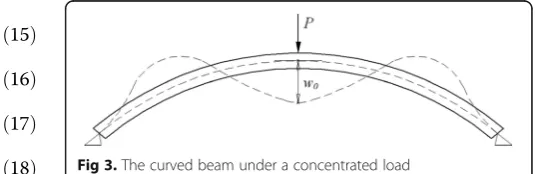
Continuity conditions must also be applied at the interface of the beam segments. To have a better look at the equilibrium condition and the corresponding vari-ation, the beam under a concentrated load (P), and its deformed centerline is shown in Fig.3. In this figure, the solid arc is the initial shape of the beam and the dotted curve is the deformed shape of the centerline.
The radial and tangential displacements and the angu-lar rotation continuity conditions at the inter-element boundaries of two adjacent elementsi and i +1, except for the peak of the beam, are expressed as
WiNi¼Wi1þ1; UiNi¼U1iþ1; φiNi¼φi1þ1 ð33Þ
Based on the action-reaction rule, to satisfy the con-tinuity conditions at the inter-elements boundary of two adjacent elements, the normal and shear forces and the bending moment of the last node of segment imust be equal to corresponding loads of the first node of seg-ment i + 1. In fact, with reference to Eqs. (12–14), the normal and shear forces and the bending moment con-tinuity conditions at the inter-element boundary of two Fig. 4aFinite element model of the beam in an FE solver.bThe element used for meshing the model
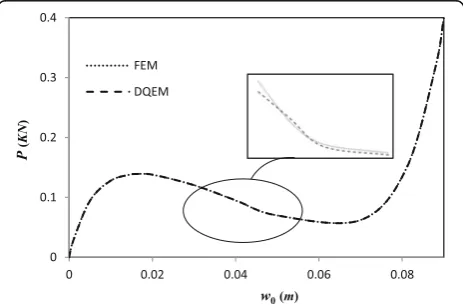
Fig. 5The value of the concentrated buckling load versus the peak value of the radial displacement
Table 1Mechanical properties of the curved beam
Property Notation Value
Radius of the beam axis R 83 cm
Opening angle of the beam θ 40°
Height of the cross-section h 0.5 cm
Base of the cross-section b 2 cm
Young’s modulus E 11 GPa
Poisson’s ratio v 0.3
adjacent elementsiandi +1, can be expressed, respect-ively, as
EiAi ∂u i Ni
∂S þ wi
Ni
R þ1 !
cosφi Ni
þ ∂wiNi
∂S − ui
Ni
R !
sinφi Ni
−1 !
¼
Eiþ1Aiþ1 ∂u iþ1 1
∂S þ wiþ1
1
R þ1
cosφi1þ1
þ ∂wi1þ1
∂S − uiþ1
1
R
sinφi1þ1
−1
;
ð34Þ
kiAiGi − ∂uiNi ∂S þ
wi Ni
R þ1 !
sinφi Ni
þ ∂wiNi ∂S −
ui Ni
R !
cosφi Ni !
¼
kiþ1Aiþ1Giþ1 − ∂ui1þ1 ∂S þ
wiþ1 1
R þ1
sinφiþ1 1
þ ∂wi1þ1 ∂S −
uiþ1 1
R
cosφiþ1 1
;
ð35Þ
EiIi∂φ i Ni
∂Si Ni
¼Eiþ1Iiþ1∂φ iþ1 1
∂Si
1
: ð36Þ
The continuity conditions at the peak of the arch in the static state are
UiNi ¼Ui1þ1;φiNi¼φ1iþ1;WiNi ¼w0; Wi1þ1¼w0
∂ui Ni
∂S ¼ ∂uiþ1
1
∂S ; ∂φi
Ni
∂S ¼ ∂φiþ1
1
∂S ; i¼ m
2;
ð37Þ
where w0is the radial displacement of the middle point
of the beam (see Fig.3).
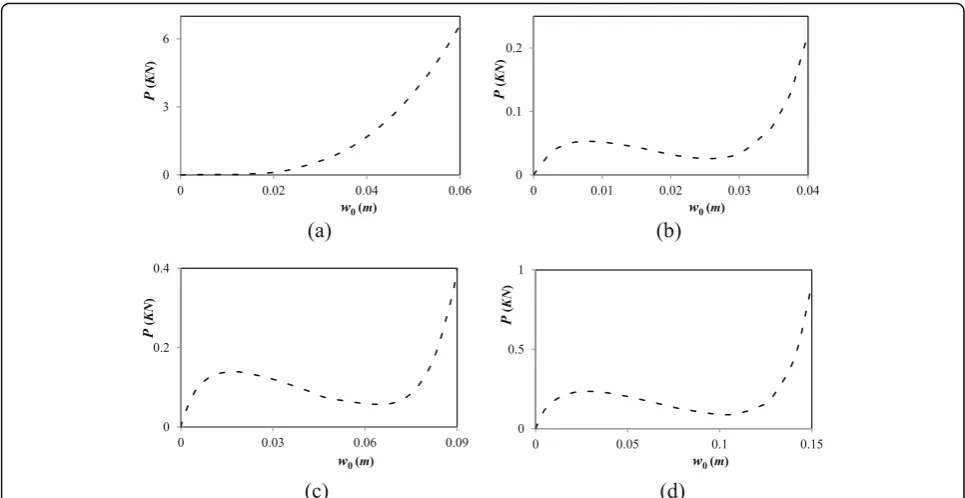
Fig. 6The value of the concentrated buckling load versus the peak value of the radial displacement for the beam at different curvatures.a0.2,b 0.5,c1.2,d2.
The continuity conditions at the peak for the dynamic state are similar to Eq. (37) except forw0which is considered to
be 0.
To make the system of equations solvable, three boundary conditions must be considered at each end-point of the beam. Boundary conditions for a beam clamped at both ends in static and dynamic states are
W11¼0 φ 1
1¼0 U 1
1¼0; ð38Þ
WmNi ¼0 φmNi¼0 UmNi ¼0 : ð39Þ
Noting that for a perfect circular arch without any imper-fection, the arch only deforms under a fully symmetric mode, so the beam is assumed to have some geometrical imperfec-tions. In this study, the geometric imperfection functions are represented in terms of the first modal shape of the beam with an arbitrary amplitude of 0.001.
Applying the differential quadrature element method to the equations of motion of the beam, as well as, the continu-ity and boundary conditions, they are transformed into an al-gebraic system of eigenvalue problem that must be solved in terms of natural frequencies and mode shapes.
Formula for the buckling load
Regarding Fig.3, if the loadPis increased to a point which makes the beam unstable (the buckling load), the beam as a part of a detailed structure undergoes a large displacement with a small excitation. Since this phenomenon can fail the whole structure, predicting this force is an important part of a design in this respect. To model the application of buckling load, the radial displacement of the peak of the beam (w0) is
defined as the input of the arc length strategy meeting the converge criterion; so, the buckling load (Pc) is obtained as
(Jianbei et al.,2014)
F1¼NiN sin φNi þQiN cos φiN ; F2¼Ni1þ1 sin φi1þ1
þQi1þ1 cos φi1þ1
;
Pc¼j F1−F2j; i¼m
2:
ð40Þ
In the static analysis, this force can be equalized to the radial displacement in the continuity conditions at the peak of the arch as
UiNi¼Ui1þ1;φiNi¼φi1þ1;WiNi¼Wi1þ1
∂ui Ni
∂S ¼
∂uiþ1 1
∂S ;
∂φi Ni
∂S ¼
∂φiþ1 1
∂S
F1¼NiN sin φiN þQiN cosφiN ;F2¼Ni1þ1sin φiþ 1 1
þQiþ1 1 cosφiþ
1 1
P¼jF1−F2j; i¼m
2
ð41Þ
Results and discussion
In this section, the results of our simulations in terms of the buckling load and the natural frequencies are ob-tained and interpreted.
Validation of the method by a finite element simulation
In the aforementioned sections, the formulas of buckling load, as well as natural frequencies, have been derived using the proposed DQEM. With the purpose of valid-ation of the accuracy of the proposed method, the beam is modeled in a finite element software (see Fig.4), and the results obtained via DQE method are compared to those attained throughout the FE simulator. To analyze the nonlinear buckling behavior of the beam, the 3-node element BEAM189 was used in the FE simulation. In the analysis, 100 elements were used to have accurate results.
The buckling load
To ensure the validity and accuracy of the proposed methods, as an example, a clamped-clamped beam with
Fig. 8The values of the first three natural frequencies versus the concentrated buckling load (F FEM; D DQEM)
Fig. 9The first five natural frequencies classified according to the symmetry of the mode shape (S symmetric modes, N
the properties listed in Table 1 and without any loss of generality is considered.
The magnitude of the concentrated load can be calcu-lated using Eq. (40), which is plotted versus the radial displacement of the middle point (w0) in Fig. 5. The
re-sults are also compared to ones obtained throughout a finite element simulator.
In this study, the results of the differential quadrature element method are obtained using a mesh composed of a series of four elements with 12 nodes in each element and adopting Gauss–Lobatto Chebyshev polynomials.
As shown in Fig.5, the results of the current nonlinear analysis are in very good agreement with the corre-sponding finite element results which shows the high ac-curacy of the proposed method.
To investigate the effect of beam curvature on the buckling load, by assuming a constant value for the length of the beam specified in Table 1 and allowable changing in the opening angle of it, the value of
concentrated buckling load versus the radial displace-ment is drawn in Fig.6.
Relative to Fig. 6, the curvature of the beam and the buckling load are proportional to each other which means a sufficient decrease in the curvature may prevent the buckling phenomenon. In addition, the beams with lower curvatures undergo buckling at a smaller peak value of the radial displacement. In other words, they show a lower deformation in the post-buckling state (see qualitative Fig.7).
The natural frequencies
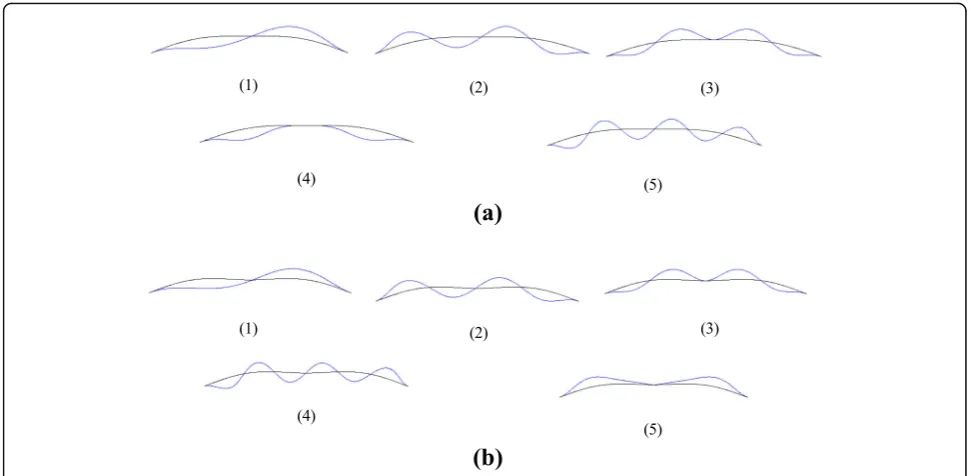
Solving the aforementioned eigenvalue problem, the nat-ural frequencies can also be obtained. To show the ac-curacy of the results, a comparison between the DQEM natural frequencies and those obtained by the finite element method is done in Fig. 8 for the three lowest natural frequencies in the pre and post-buckling ranges. Fig. 10The first five-mode shapes of the pre-buckled beam whenaP/Pc= 0.5,bP/Pc r= 0.9
In this diagram, F and D show the FEM and DQEM re-sults respectively.
In the above figure, it is worth noting that the agree-ment between the results obtained with the FE and DQE methods are very good up to the pre-buckling state; thereafter, a deviation is observed due to a little differ-ence between the buckling loads obtained by these two methods. On the other hand, in the post-buckling state, the natural frequencies are more sensitive to the pre-stress effects, especially for the first and second natural frequencies.
In order to study the effect of buckling on the sym-metry of the mode shapes, in Fig.9, the first five natural frequencies are classified according to the symmetry of the corresponding mode shapes. In this diagram, the let-ters S and N denote the symmetric and asymmetric modes respectively.
As seen from the above figure, the first, the second and the third asymmetric modes are flexural modes, whereas the first and the second symmetric modes are longitudinal-flexural. The figure shows that as the applied concentrated load increases from zero to the buckling load, the first three asymmetric natural fre-quencies decrease smoothly due to the reduction in beam bending stiffness. Just after buckling occurs, a jump in the frequencies is seen that is due to a sud-den increase of beam stiffness at this condition. After buckling, all the asymmetric frequencies increase with a much smaller rate owing to the increase in the bending stiffness caused by the change in the beam curvature.
Regarding Fig. 9, the behavior of the symmetric mode shapes is different. In the range under the crit-ical buckling load, the natural frequencies of the first symmetric mode decreases smoothly due to the re-duction in the total stiffness; however, the second symmetric natural frequency in which the longitudinal stiffness is dominant with respect to the flexural stiff-ness, increases rapidly up to the buckling value. In this range, it crosses the third asymmetric mode curve and therefore the mode transition phenomenon occurs (see also about this phenomenon in ref. (Tar-nopolskaya & De Hoog, 1999)). In the post-buckling state, the dynamic longitudinal-induced stiffness sup-presses the elastic flexural stiffness in both of the symmetric natural frequencies due to the large de-formation of the beam; so, the second symmetric fre-quency shows a sharp decrease while the first one completely vanishes (Figs. 10 and 11).
In order to have a better understanding of the cross-over of the frequency curves, in Figs. 10 and 11 the mode shapes corresponding to the pre-buckling state and those corresponding to the post-buckling state are shown, respectively:
Conclusion
In this study, the DQE and FE methods were imple-mented to investigate the behavior of a curved beam in the pre- and post-buckled state, taking into account the effects of shear deformation, rotary inertia, the extension of the neutral axis, the geometric nonlinearity due to the large deformation, and the beam imperfection.
The solution of the non-linear differential equations was performed including the static and dynamic parts. The differential quadrature element method along with an arc length strategy was used to solve the static part. Utilizing the results of this part, the DQEM was used to solve the linearized dynamic part. A clamped-clamped beam was considered under a concentrated load; how-ever, the method could be used for other types of load-ings and boundary conditions by changing the boundary conditions as well as the continuity conditions at the point of exerting load (Eqs. (37–39)). The effect of curvature on the buckling load was examined. In addition, increasing the concentrated load on the top-ology of the mode shapes and the values of the natural frequencies of the beam were studied. The results were validated by comparing to the corresponding same con-ditions FEM results. It was shown that for clamped– clamped beam, the asymmetric flexural frequencies de-creased up to buckling and then inde-creased smoothly after that point. However, the longitudinal-flexural sym-metric frequencies showed a different behavior due to overcoming the longitudinal stiffness to the flexural one. Before buckling, the first natural frequency decreased smoothly while the second one experienced a sharp in-crease. After buckling, due to a severe drop in the longi-tudinal stiffness, the first symmetric frequency vanished, but the second one declined considerably.
Finally, it was concluded that firstly, the buckling phenomenon and the values of buckling loads were completely influenced by the curvature of the beam. Sec-ondly, due to the sharp change of longitudinal stiffness after bucking, the symmetric mode shapes changed more than it was expected.
Abbreviations
A:The cross-section area of the beam;b: The width of the cross-section;
E: The elastic modulus;G: The shear modulus of elasticity;h: The height of the cross-section;I: The moment of inertia of the cross-section about the neutral axis;i: The number of element;k: The shear factor of the cross-section;M: The bending moment acting on an element of the curved beam;
N: The normal force acting on an element of the curved beam;P: The lateral concentrated load;Pc: The buckling load;Q: Theshear force acting on an
element of the curved beam;R: Radius of the beam axis;U: The tangential displacement of the curved beam;v: The Poisson’s ratio;W: The radial displacement of the curved beam;w0: The radial displacement of the peak
of the beam;γ: Mass density per unit volume;θ: Opening angle of the beam; φ: The angle of rotation of an element of the curved beam;ω: The frequency of the harmonic excitation
Authors’contributions
MZ surveyed the history of the research, derived, and solved the equations and drew the figures in corresponding software and wrote the first draft of the article. AA interpreted the results and wrote the final abstract and conclusion of the article. All authors read and approved the final manuscript.
Authors’information
M. Zare is an alumni of MSc. of mechanical engineering at the Shahid Chamran University of Ahvaz, Ahvaz, Iran. A. Asnafi is an associate professor of mechanical engineering at Shiraz University, Shiraz Iran.
Funding
This research did not receive any specific grant from funding agencies in the public, commercial, or not-for-profit sectors.
Availability of data and materials
Data sharing not applicable to this article as no datasets were generated or analyzed during the current study.
Competing interests
The authors declare that they have no competing interests.
Author details 1
Department of Mechanical Engineering, Shahid Chamran University, Ahvaz 61355, Iran.2Hydro-Aeronautical Research Center, Shiraz University, Shiraz 71348-51154, Iran.
Received: 6 October 2019 Accepted: 27 November 2019
References
Addessi, D., Lacarbonara, W., & Paolone, A. (2005). On the linear normal modes of planar pre-stressed.Journal of Sound and Vibration, 284, 1075–1097. Anh, V. T. T., Bich, D. H., & Duc, N. D. (2015). Nonlinear stability analysis of thin
FGM annular spherical shells on elastic foundations under external pressure and thermal loads.European Journal of Mechanics - A/Solids, 50, 28–38. Bradford, M. A., Uy, B., & Pai, Y. L. (2002). In-plane elastic stability of arches under
a central concentrated load.Journal of Engineering Mechanics, 128, 710–719. Chen, C. N. (2005). DQEM analysis of in-plane vibration of curved beam
structures.Advances in Engineering Software, 36, 412–424.
Doan, D. H., Van Do, T., Pham, P. M., & Duc, N. D. (2019). Validation simulation for free vibration and buckling of cracked Mindlin plates using phase-field method.Mechanics of Advanced Materials and Structures, 26, 1018–1027. Duc, N. D. (2014).Nonlinear static and dynamic stability of functionally graded
plates and shells.Hanoi:Vietnam National University Press.
Duc, N. D., Khoa, N. D., Nguyen, P. D., & Duc, N. D. (2019). An analytical solution for nonlinear dynamic response and vibration of FG-CNT reinforced nanocomposite elliptical cylindrical shells resting on elastic foundations.
ZAMM-Journal of Applied Mathematics and Mechanics, 1–20.
Duc, N. D., Nguyen, P. D., & Khoa, N. D. (2017). Nonlinear dynamic analysis and vibration of eccentrically stiffened S-FGM elliptical cylindrical shells surrounded on elastic foundations in thermal environments.Thin-Walled Structures, 117, 178–189.
Fan, Z., Wu, J., Ma, Q., Liu, Y., Su, Y., & Hwang, K. C. (2017). Post-Buckling Analysis of Curved Beams foundations.Journal of Applied Mechanics, 84, 1–15. Fraternali, F., Spadea, S., & Ascione, L. (2013). Buckling behavior of curved
composite beams with different elastic response in tension and compression.Composite Structures, 100, 280–289.
Huang, C. S., Nieh, K. Y., & Yang, M. C. (2003). In-plane free vibration and stability of loaded and shear-deformable circular arches.International Journal of Solids and Structures, 40, 5865–5886.
Hummer, A. (2013). Exact solutions for the buckling and postbuckling of shear-deformable beams.Acta Mechanica, 224, 1493–1525.
Huynh, T. A., Luu, A. T., & Lee, J. (2017). Bending, buckling and free vibration analyses of functionally graded curved beams with variable curvatures using isogeometric approach.Meccanica, 1–20.
Jianbei, Z., Mario, M. A., & David, C. K. (2014). In-plane nonlinear buckling of circular arches including shear deformations.Archive of Applied Mechanics, 84, 1841–1860.
Kim, S. E., Duc, N. D., Nam, V. H., & Van, N. (2019). Nonlinear vibration and dynamic buckling of eccentrically oblique stiffened FGM plates resting
on elastic foundations in thermal environment.Thin-Walled Structures, 142, 287–296.
Kounadis, A. N., Gantes, C. J., & Bolotin, V. V. (1999). Dynamic buckling loads of autonomous potential systems based on the geometry of the energy surface.International Journal of Engineering Science, 37, 1611–1628. Liu, A., Lu, H., Fu, J., et al. (2017). Analytical and experimental studies on
out-of-plane dynamic instability of shallow circular arch based on parametric resonance.Nonlinear Dynamics, 87, 87–677.
Marin, M., & Nicaise, S. (2016). Existence and stability results for thermoelastic dipolar bodies with double porosity.Continuum Mechanics and Thermodynamics, 28(6), 1645–1657.
Marin, M., Baleanu, D., & Vlase, S. (2017). Effect of microtemperatures for micropolar thermoelastic bodies.Structural Engineering and Mechanics, 61(3), 381–387. Marin, M., & Craciun, E. M. (2017). Uniqueness results for a boundary value
problem in dipolar thermoelasticity to model composite materials.
Composites Part B: Engineering, 126, 27–37.
Matsunaga, H. (1995). In-plane vibration and stability of shallow circular arches subjected to axial forces.International Journal of Solids and Structures, 13, 469–482.
Minh, P. P., & Duc, N. D. (2019). The effect of cracks on the stability of the functionally graded plates with variable-thickness using HSDT and phase-field theory.Composites Part B: Engineering, 175, 1–9.
Papangelis, J. P., & Trahair, N. S. (1986). Flexural-torsional buckling of arches.
Journal of Structural Engineering, 112, 889–906.
Pi, Y. L., & Bradford, M. A. (2008). Dynamic buckling of shallow pin-ended arches under a sudden central concentrated load.Journal of Sound and Vibration, 317, 898–917.
Pi, Y. L., Bradford, M. A., & Tin-Loi, F. (2007). Nonlinear analysis and buckling of elastically supported circular shallow arches.International Journal of Solids and Structures, 44, 2401–2425.
Quan, T. Q., Cuong, N. H., & Duc, N. D. (2019). Nonlinear buckling and post-buckling of eccentrically oblique stiffened sandwich functionally graded double curved shallow shells.Aerospace Science and Technology, 90, 169–180. Tarnopolskaya, T., & De Hoog, F. R. (1999). Low-frequency mode transition in
the free in-plane vibration of curved beams.Journal of Sound and Vibration, 228, 69–90.
Torabi, K., Afshari, H., & Aboutalebi, F. H. (2014). A DQEM for transverse vibration analysis of multiple cracked non-uniform Timoshenko beams with general boundary conditions.Computers & Mathematics with Applications, 67, 527–541.
Publisher’s Note