R E S E A R C H
Open Access
Morphogenetic traits of the egg parasitoid
Trichogramma
for controlling certain date
palms lepidopteran insect pests in the New
Valley Governorate
Farouk A. Abdel-Galil
1*, Sara E. Mousa
1, Moustafa M. A. Rizk
1, Gaber H. Abo El- Hagag
1and Abd El-Latif Hesham
2Abstract
Egg parasitoid Trichogramma strain (TNV) received from Kharga Oasis, New Valley Governorate, Egypt, is used in controlling certain date palm lepidopteran insect pests. The morphological features of adult wasps and genetically identification of the strain was carried out. Scanning electron microscopy (SEM) and light
microscope were used for studying morphology of male and female adults and measurements. Data revealed that body length of male was shorter than female. However, adult parasitoid body length of TNV was longer than the species, Trichogramma evanescens West. studied by several authors. In addition, external morphology of antennae, wings, and male genitalia were differed in TNV Trichogramma. The strain TNV identification was based on the molecular genetic techniques using PCR amplification and sequencing of the internal
transcribed spacer two (ITS2) region of the rDNA. The BLAST result and phylogenetic analysis of the ITS2 region of rDNA sequence revealed that the strain TNV is closely related to Trichogramma turkestanica.
Obtained results confirmed that theTrichogramma sp., used as a biological control in the New Valley, is T. turkestanica and not T. evanescens.
Keywords: Trichogramma turkestanica, T. evanescens, Date palm, SEM, Phylogenetic analysis, Morphological and molecular identification
Background
In Egypt, date palm (Phoenix dactylifera L.) plantations markedly increased all over the different governorates, especially in the desert new reclaimed lands (El-Assal
2004). Dates are strategic product for Egypt, which is
the world’s top producer of the crop, outranking Iran
and Saudi Arabia. Egypt produces 1,465,030 tons of dates annually, or 17.7% of the global production of 7.5 million tons, according to the 2014 statistics of the Ministry of Agriculture and Land Reclamation (FAO 2017).
The New Valley in the western part of Egypt, from the Nile to the Libyan frontier ,is occupied by a vast
desert plateau. In this “valley”, various oases are
located that are, from the North to the South: Siwa, Baharia, Farafra, Dakla, Kharga, and Fayoum. The total number of productive date palms is estimated around 700,000 trees. A large amount of them (about 50%) is grown from seeds. These date palms are very heterogeneous and, in average, of low quality. Beside the palms from seeds, mainly, one variety, “Saidi,” has been propagated. It could represent nearly 50% of the total number of palms of this area. Because of its excellent quality and of the importance of its produc-tion, it was transferred to the Nile valley (Riad 1993).
Many arthropod species are known as pests of the date palm throughout the World. Around 50 species of insects and mites are reported as pests of date palms worldwide,
* Correspondence:[email protected]
1Plant Protection Department, Faculty of Agriculture, Assiut University, Assiut 71526, Egypt
Full list of author information is available at the end of the article
from which, approximately 25% are insects and mites that considered serious pests (Haldhar et al.2017).
The palm trees in Egypt are exposed to many insects
and mites’ attacks. The loss in date crops may reach
about 25%. Insect pests can attack florescence and date, leaves, roots, trunk and storage date (Alhudaib2007).
Previously, methyl bromide was used to control insect pests in stored dates as fumigant because it was effective in killing most insect stages; but this fumigant appeared
to be ozone-depleting agents (Marcotte 1993).
There-fore, it was prohibited since 2005 in developing countries and by 2015 in under developed countries
ac-cording to Montreal Protocol (Al-Taweel et al. 2014).
Therefore, alternative safe control methods are needed. One of these methods is using biological control agents
specifically the egg parasitoid, Trichogramma
evanes-cens West. (Hymenoptera: Trichogrammatidae) in date
orchards to minimize the percentage of dates infest-ation with lepidopteran insect pests as the Greater date
moth (Arenipses sabella Hampsm), Almond moth
(Cadra cautella Walk), Indian meal moth Plodia interpunctella Hub., and pomegranate fruit butterfly (Virachola liviaKlug).
The Trichogrammatidae is a family of tiny wasps in the superfamily Chalcidoidea that include some of the smallest of all insects, ranging in size from 0.2 to
1.5 mm within the genus Trichogramma (Pinto 2006
and Ghoneim 2014). All members of this family attack
eggs of insects belonging to 11 orders, e.g.,
Hymenop-tera, NeuropHymenop-tera, DipHymenop-tera, ColeopHymenop-tera, and Hemiptera
especially Lepidoptera (Flanders and Quednau 1960and
Ghoneim2014).
Despite the advances made in their taxonomy,
Trichogramma spp. remain notoriously difficult to identify because of their tiny size and the relatively low interspecific morphological diversity (Ksentini et
al. 2010). Recently, egg parasitoid Trichogramma is
used for controlling the serious lepidopteran insect pests of date in the New Valley governorate.
The present work was conducted to lighten the mor-phological features of the adult wasps received for appli-cation in the field, with the purpose to determine the precise morphological and molecular identification of this strain.
Materials and methods
Trichogrammacollection and rearing
Egg parasitoidTrichogrammawas supplied from
Tricho-gramma Mass Rearing Lab., Kharga Oasis, New Valley
Governorate, Egypt. Eggs of Sitotroga cerealella Oliv.,
were used as host to produce sufficient numbers of the egg parasitoid for two generations under (23 ± 2°c, 75 ± 5% RH, L 16: D 8) at the Biological Control Lab., Plant Protection Department, Assiut University, Assiut, Northern Upper Egypt.
Morphological and molecular identification of
Trichogramma
Morphological identification
For light microscope Mounted Trichogramma adults on microscope slides were used as permanent specimens for species identification. Identification relies upon microscopic examination of male genitalia and other morphological characters. Dr. John Pinto, University of California at Riverside provided us with the method of
Knutson (1998) for this purpose. Measurement was done
using HDMI MULTI -OUTPUT HD (Toup Cam_120) CAMERA.
For scanning electron microscopy (SEM) The material was fixed in FAE (formaldehyde, acetic acid, and ethanol) and stored in 70% ethanol. Skeletal structures studied using a Jeol JSM-5400 LV scanning electron microscope following critical drying point (Hitachi HCP-2) and sputter coating of samples with gold (Giko IB-3) (Polilov2017).
Measurements morphological characters The special-ized terminology for the male genitalia was followed according to the modification Polaszek et al. (2012) to that of Pinto (1999). Linear measurements are reported as a mean ± standard deviation (SD). Species were ini-tially identified based on morphology, using a combin-ation of the following published taxonomic accounts:
Nagarkatti and Nagaraja (1971), Pintureau and Babault
(1988), Pinto (1999), Pintureau (2008), and Del Pino et al. (2013).
Molecular genetic identification
Isolation of genomic DNA Total genomic DNA was extracted as described by Stouthamer et al. (1999).
PCR amplification of theTrichogrammaITS2 region of rDNA For identification, the ITS2 region of Tricho-gramma ribosomal DNA was amplified using the
spe-cific primers as the following: forward, 5–TGTGAACTG
CAGGACACATG–3, located in the 5.8S rDNA, and
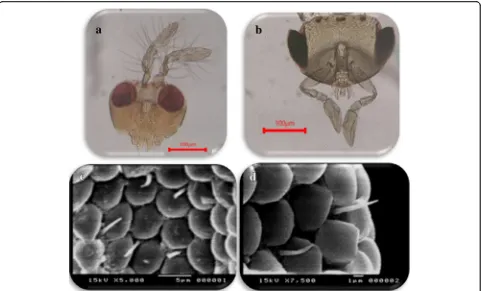
Fig. 2The head capsule of male and female of TNV:a,blight micrograph;c,dSEM of male and female: interfacial hair in a corner between three facets
reverse, 5–GTCTTGCCTGCTCTGAG–3, located in the 28S rDNA closer to the 3 ends of the ITS2 (Stouthamer et al. 1999). The PCR reaction was performed in a final
volume of 50μL containing GoTaq (Promega, Madison,
WI, USA) Green Master Mix, 1μL of DNA sample, and
1μL of each primer (at a concentration of 0.5 mM). The PCR conditions were as follows: initial denaturation at 95 °C for 5 min, then followed by 36 cycles at 94 °C for 1 min, 55 °C for 1 min, and 72 °C for 1 min, with a final extension at 72 °C for 10 min and holding at 4 °C.
PCR products purification and sequence determination
To verify the presence of appropriate sized amplicons,
the PCR product for Trichogramma strain TNV was
subjected to electroph oresis using 1% agarose gel in
TAE buffer according to the standard method. Product of the correct size was purified using a TaKaRa agarose Gel DNA Purification Kit Ver.2.0 and sequenced in both directions using an ABI 3730 automated sequencer.
Alignment and phylogenetic analysis The ITS2
sequences ofTrichogrammastrain TNV were aligned with
known ITS2 sequencesTrichogrammaspp. of rDNA in the
GenBank database using the basic local alignment search tool (BLAST) at the National Center for Biotechnology Information (https://blast.ncbi.nlm.nih.gov/Blast.cgi?PRO GRAM=blastn&PAGE_TYPE=BlastSearch&LINK_LOC= blasthome), and the percent homology scores were gener-ated to identify theTrichogrammastrain TNV.
Phylogenetic analysis The phylogenetic tree was con-structed with MEGA version 4.0 using a neighbor-joining algorithm, and the Jukes-Cantor distance estimation method was performed with bootstrap analyses for 1000 replicates (Hesham et al.2012).
GenBank accession number The partial of the ITS2 region of rDNA sequence of the strain TNV reported in this paper is deposited in the DDBJ (www.ddbj.nig.ac.jp/),
EMBL (www.embl.de/), and GenBank nucleotide sequence
databases (http://www.ncbi.nlm.nih.gov) under accession number MH432649.
Table 1Measured characters (μm) ofTrichogrammastrain TNV male antenna
Criteria (N= 10)
Measured characters (μm)
Flagellar length FL
Flagellar width FW
Scape length ScL
Longest seta LS
Min. 149.96 28.09 75.55 70.99
Max. 171.60 36.83 96.05 82.76
Average 162.95 33.11 82.27 75.63
±SD 6.72 2.90 5.94 3.59
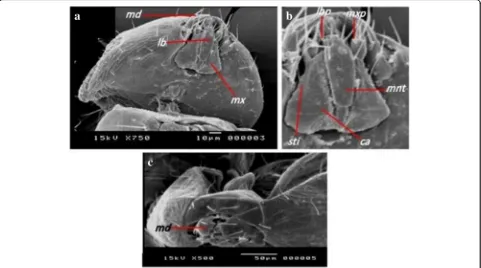
Fig. 4The mouth parts:a, bSEM of strain TNV ventral view of head capsule with hypognathous type and chewing mouthparts.cMandibles with undulate margin and spines on internal surface (mxmaxilla,mdmandible,mxpmaxillary palp,lbplabial palp,cacardo,gagalea, li ligula,
Data processing
Measurements of morphological data were statistically analyzed by using SAS 9.1 2008 software program.
Results and discussion
Morphological identification
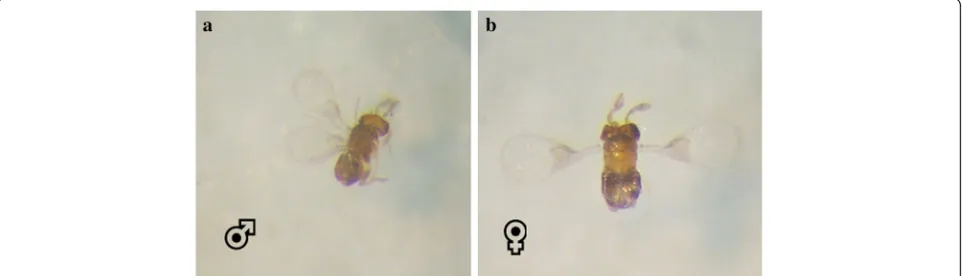
Using scanning electron microscopy (SEM), some mor-phological structures of male and female parasitoid were illustrated. By light microscopy, collected parasitoid is an extremely tiny wasp with pale yellow to brown color (Fig.1).
Body length
Body length of adult Trichogramma strain TNV female
was 472.37–608.63 μm with an average of 539.44 ±
64.34μm. However, male measurements reviled an
aver-age of 518.85 ± 57.97 μm and ranged from 456.47 to
576.84 μm. Thus, the male body length is shorter than
female. Statistical analysis of the differences between the female and male body length are non-significant (Tcalculated value = 0.609421 with n= 5 each). Fig. 5Trichogrammastrain TNV wings by light micrograph:a
forewing (sv stigmal vein, mv marginal vein,smvsubmarginal vein,
shsmall hairs andlhlonger hairs) andbhindwing (lslong setae)
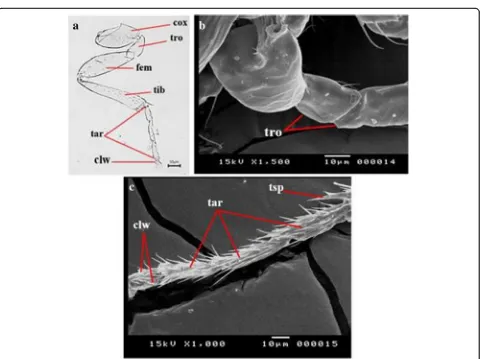
Fig. 6alight micrographTrichogrammastrain TNV leg (coxcoxa,trotrochanter,femfemur,tibtibia,tartarsus andclwclaw).bSEMtro
The head
Compound eyes The compound eyes cover a large
amount of the head (Fig. 2a). Detail of one compound
eye showed interfacetal hairs distributed all across the eye (Fig. 2b). Detail of an interfacetal hair in a corner between three facets is shown (Fig.2c).
Antennae Antenna of the strain TNV is of geniculate type, consisting of scape, pedicel, and flagellum. As shown in (Fig.3a and b), the male hairs were more con-densed and elongated than female hairs. Also, in male, segment of flagellum fused with club.
Male antennal measurements Antennal trichiation one of the morphological characters have been used to iden-tify Trichogramma (Dang et al. 2005 and Ksentini et al.
2010). Measurements of male antennae include flagellar
length (FL), flagellar width (FW), scape length (ScL), and
longest seta (LS). Data presented in Table1based on 10
male’s antennae of TNVTrichogrammastrain.
Mouthparts SEM photographs of TNV indicated that the mouthparts structure is typical of chewing type. Mouthparts consist of well-developed mandibles,
maxil-lae, and labium (Fig. 4a and b). However, labrum was
weakly developed. Mandibles with undulate margin and spines on internal surface are shown (Fig. 4c). Maxillae connected with labium by membranous septum into
labiomaxillary complex (Fig. 4b). Maxillae consist of
cardo, stipes, fused galea and lacinia, and maxillary palp. Maxillary palp 1-segmented strongly reduced.
The thorax
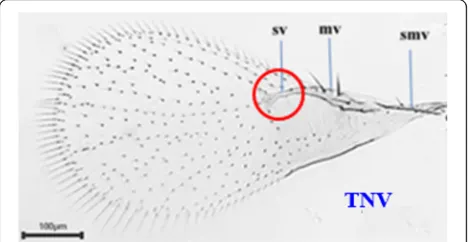
Wings As shown in light micrograph forTrichogramma
strain TNV, wings with strongly depleted venation (Fig. 5). Three veins preserved in forewing: submarginal, marginal, and stigmal, fused into one arch near anterior
wing margin (Fig.5a). Hindwing narrower than forewing
(Fig.5b). Forewing rather wide, covered with small hairs, with longer hairs forming fringe on perimeter of wing. Hindwing bearing fringe of long setae along posterior margin.
Legs
Legs in Trichogramma strain TNV are slender and
ambulatorial. Each leg consists of coxa, 2 segmented tro-chanter, femur, tibia, and 3 segmented tarsi. Tibiae of legs apically bear well-developed branched spurs. Apical tarsomere bears two claws and well-developed arolium (Fig.6a).
The abdomen
The lateral view of abdomen in TNV strain was
illus-trated (Fig. 7). The petiole not pronounced, mesosoma
Fig. 7SEM female abdomen metasoma lateral view (tertergite)
and metasoma broadly joined. Metasoma consists of six or seven visible tergites.
Measurements of female abdomen Length of female
abdomen in Trichogramma strain TNV from the frons
to the tip of the abdomen measured 247.086 ±
10.682 μm (231.59–258.55 μm). The average abdominal
area reached 42,923.65 ± 5381.776 μm2 (35,365.42–
50,411.75μm2).
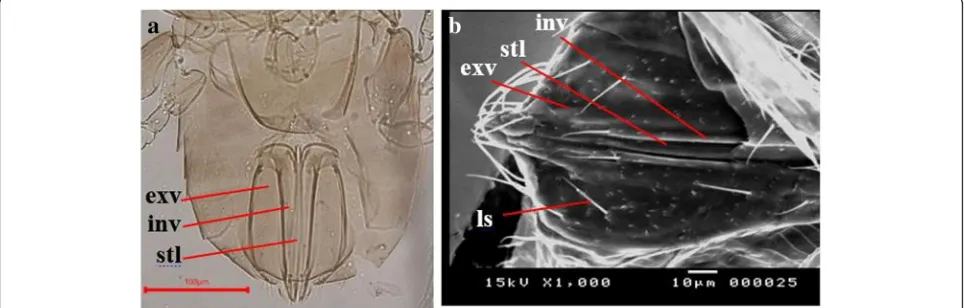
Ovipositor Trichogramma strain TNV female ventral view (Fig.8a) illustrates the ovipositor plates and stylet. SEM of TNV ovipositor showed its external and internal valves with long setae and stylet (Fig.8b).
External male genitalia Male genitalia in strain TNV is represented by simple aedeagus, phallobase, and
para-meres as shown in Fig.9a and b. Measurements of male
genitalia include general length (GL), general width (GW), apical distance (AD), basal distance (BD), and
ap-ical width (AW), which are presented in Table 2 based
on 10 male genitalia of TNVTrichogrammastrain.
Molecular identification ofTrichogrammastrain TNV using ITS-2 region of rDNA sequencing and phylogenetic analysis
To identify and determine the correct phylogenetic
position of the Trichogramma strain TNV, molecular
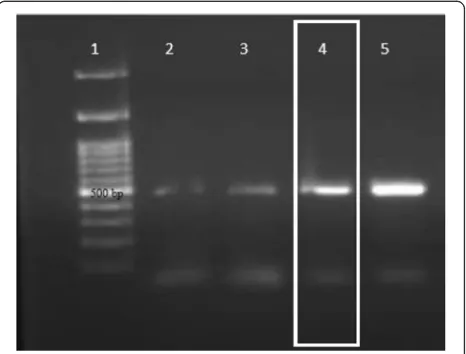
genetic identifications were performed. As shown in (Fig. 10), the size of the amplified ITS2 region of rDNA was approximately 500 bp, which is the expected size of
ITS2 region of rDNA forTrichogrammaspecies.
The alignment and comparisons of the ITS2 sequences of rDNA of the strain TNV, to the published ITS2 se-quences of rDNA in the GenBank database by BLAST search, were determined. The sequence results of the ITS2 region of rDNA of the TNV are shown to be highly
homologous to Trichogramma turkestanica with 100%
similarity. To confirm the position of TNV strain in the
phylogeny, several sequences representing
Tricho-gramma spp. were selected from the GenBank database to construct a phylogenetic tree. The phylogenetic ana-lysis was performed for the TNV sequence and 10
refer-ence sequrefer-ences. As shown in Fig. 11, the phylogenetic
tree indicated that TNV strain and Trichogramma
tur-kestanica shared one clade. Therefore, the TNV strain
was identified as T. turkestanica. Recently, molecular
Fig. 9Male genitalia:alight micrograph of TNV male genitalia with measurements inμm andbSEM of TNV male genitalia with setae and hairs
Table 2Measured characters (μm) of TNV male genitalia
Criteria (N= 10)
Measured characters (μm)
General length GL
General width GW
Apical distance AD
Basal distance BD
Apical width AW
Min. 124.9 44.8 25.44 85.42 25.44
Max. 138.19 58.85 44.42 101.75 34.55
Average 126.46 50.31 33.94 92.64 30.23
± SD 5.94 4.45 6.28 6.11 2.64
Fig. 10Amplified DNA of the ITS-2 region of rDNA with specific primers: lane 1, 100-bp DNA markers; lane 2 to lane 5,Trichogramma
genetic tools including PCR amplification and the se-quencing of the internally transcribed spacer 2 (ITS-2) of the rRNA gene were applied for the accurate
identifi-cation of many Trichogramma species (Ksentini et al.
2010; Sayed et al. 2011; Polaszek et al.2012; Pino et al. 2013; Nasir et al. 2013; Almeida and Stouthamer 2015; Wu et al.2016and Liu et al.2017).
The wildly use of egg parasitoid Trichogramma
en-couraged biological control specialists to give exten-sive and intenexten-sive attention for selecting the adequate
species of the parasitoid. Egg parasitoid
Tricho-gramma (strain TNV) released in Kharga Oasis, New Valley Governorate Egypt for controlling certain date palm lepidopteran insect pests is usually recognized as Trichogramma evanescens. Results in this work discussed and supported by literature serve as good informative background. Our morphological data was
compared with other author’s data for T. evanescens,
i.e., Fischer et al. (2011), Polaszek et al. (2012) and Polilov (2016).
Concerning body length of adult TNV female, data
showed an average of 539.44 ± 64.34μm and male
mea-surements reviled an average of 518.85 ± 57.97 μm with
an average length of both adult sex of 529.145 ±
58.75 μm (n= 10). However, the average body length of
adult T. evanescens was 390 μm (n= 10) as mentioned
by Polilov (2016).
Comparing finds of TNV male antennae with T.
eva-nescens, results of Polaszek et al. (2012) indicated merely adequate measurements FL/FW (not including setae). In addition, as shown in Table3, it was inadequate for FL/ ScL and LS/FW. Polaszek et al.2012 and Polilov (2016)
described the morphological features of T. evanescens
wings. TNV differed in stigmal vein than T. evanescens
(Fig.12).
Several authors reported that male genitalia can be
used to differentiate between egg parasitoid
Tricho-gramma spp. (Polaszek et al. 2012 and Del Pino et al.
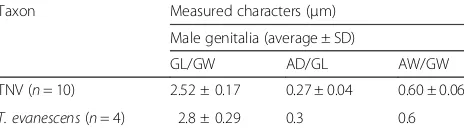
2013). Comparing TNV male genitalia with that of T.
evanescens, results of Polaszek et al. (2012) indicated merely adequate measurements AW/GW. Also, as
shown in Table 4, it was inadequate for GL/GW and
AD/GL.
Fig. 11Phylogenetic analysis of ITS2 region of rDNA of TNV and other relatedTrichogrammaspp.by neighbor-joining method. In the phylogenetic tree, TNV andTrichogramma turkestanicaclustered together as one clade. The scale bar indicates 0.1 nucleotide substitutions per nucleotide position. Numbers at the nodes indicate bootstrap support (%) based on 1000 replicates. GenBank accession numbers given in parentheses
Table 3Measured characters (μm) of strain TNV andT. evanescensmale antennae
Taxon Measured characters (μm)
Male antennal (average ± SD)
FL/FW FL/ScL LS/FW
TNV (n= 10) 4.95 ± 0.396 1.987 ± 0.12 2.299 ± 0.22
T. evanescens 5.6 ± 0.1 (n= 4) 2.1 ± 0.1 (n= 3) 3.1 ± 0.2 (n= 4)
Conclusion
In conclusion, it is evident that theTrichogrammastrain
TNV was differed morphologically than T. evanescens,
which is in use for biological control of lepidopteran date palm insect pests in the Egyptian New Valley Oasis. Also, molecular identification of the strain TNV, using ITS-2 region of rDNA and phylogenetic analysis, showed
that it is highly homologous to T. turkestanica with
100% similarity.
Acknowledgements
We are grateful to Assiut University president and vice-president for the financial support. Also, grateful thanks for the Dean of Faculty of Agriculture for supporting in developing the Biological Control Unit at the Plant Protection Department, which was established since 2004 by F. A. Abdel-Galil.
Funding No fund.
Availability of data and materials Applicable.
Authors’contributions
All authors read and approved the final manuscript.
Ethics approval and consent to participate Not applicable.
Consent for publication Not applicable.
Competing interests
The authors declare that they have no competing interests.
Publisher’s Note
Springer Nature remains neutral with regard to jurisdictional claims in published maps and institutional affiliations.
Author details
1Plant Protection Department, Faculty of Agriculture, Assiut University, Assiut 71526, Egypt.2Genetics Department, Faculty of Agriculture, Assiut University, Assiut 71526, Egypt.
Received: 4 July 2018 Accepted: 31 October 2018
References
Alhudaib, K. A. 2007. Taxonomic list of insects attacking date palm. (http://www. redpalmweevil.com/Diseases/insleaves.htm)
Almeida RP, Stouthamer R (2015) ITS-2 sequences-based identification of
Trichogrammaspecies in South America. Braz J Biol 75(4):974–982 Al-Taweel AA, AlJboory IJ, Hameed AA, Balasem HS, Al-Gharbawi ZA, Eass AJ,
Eliewi RK, Raja FA, Hussain HA (2014) Using egg parasitoidTrichogramma evanescensand pheromone traps in date palm orchards and in date warehouses to controlEphestiaspp. In: Proceedings of the Fifth International Date Palm Conference, pp 321–327
Dang XL, Wen SY, He XF, Pang XF (2005) M-PCR: a powerful method for rapid molecular identification ofTrichogrammawasps (Hymenoptera: Trichogrammatidae). Insect Sci 12:77–85
Del Pino M, Hernández-Suárez E, Cabello T, Rugman-Jones P, Stouthamer R, Polaszek A (2013)Trichogramma canariensis(Insecta: Hymenoptera: Trichogrammatidae) a parasitoid of eggs of the twin spot mothChrysodeixis chalcites(Lepidoptera: Noctuidae) in the Canary Islands. Arthropod Syst Phylogeny 71(3):169–179
El-Assal, M. M. A. 2004. Studies on the most important pests of date palm trees in Egypt.http://www.eulc.edu.eg/eulc_v5/Libraries/Thesis/BrowseThesisPages. aspx?fn=PublicDrawThesis&BibID=10812269
FAO (2017) Workshop on dates value chain development in Egypt, Cairohttp:// www.fao.org/neareast/news/view/en/c/465781/
Fischer S, Mueller CH, Meyer-Rochow VB (2011) How small can small be: the compound eye of the parasitoid waspTrichogramma evanescens(Westwood, 1833) (Hymenoptera, Hexapoda), an insect of 0.3-to 0.4-mm total body size. Vis Neurosci 28(4):295–308
Flanders S, Quednau W (1960) Taxonomy of the genusTrichogramma
(Hymenoptera: Chalcidoidea, Trichogrammatidae). BioControl 5:285–294 Ghoneim K (2014) Parasitic insects and mites as potential biocontrol agents for a
devastative pest of tomato,Tuta absolutaMeyrick (Lepidoptera: Gelechiidae) in the world: a review. Int J Adv Res 2:81–115
Haldhar SM, Maheshwari SK, Muralidharan CM (2017) Pest status of date palm (Phoenix dactylifera) in arid regions of India: a review. J Agric Ecol 3:1–11 Hesham A, Nadia H, Mady I, Ahmed Shoriet A (2012) 16S rRNA gene sequences
analysis ofFicus elasticarubber latex degrading thermophilicBacillusstrain ASU7 isolated from Egypt. Biodegradation 23(5):717–724
Knutson A (1998) A guide to the use ofTrichogrammafor biological control with special reference to augmentative releases for control of bollworm and budworm in cotton. Texas Agric Ext Serv B-6071:5–98
Ksentini I, Monje JC, Jardak T, Zeghal N (2010) Naturally occurring egg parasitoids of the genusTrichogramma(Hymenoptera: Trichogrammatidae) in a pomegranate orchard in Tunisia. Entomol Sci 13(1):99–106
Liu YD, Hou ML, Song K (2017) Molecular identification ofTrichogrammaspecies from South and South-East Asia and natural Wolbachia infection. Entomol Fennica 28:57–66
Marcotte, M. 1993. United Nations Environmental Program-methyl bromide technical options committee, Food Irrad. Newsl, 17 (2): 27
Nagarkatti S, Nagaraja H (1971) Redescriptions of some known species of
Trichogramma(Hym.: Trichogrammatidae), showing the importance of the male genitalia as a diagnostic character. Bull Entomol Res 61:13–31 Nasir MF, Hagedorn G, Büttner C, Reichmuth C, Schöller M (2013) Molecular
identification ofTrichogrammaspecies from Pakistan, using ITS-2 region of rDNA. Biol Control 58:483–491
Pino MD, Rugman-Jones P, Herna’ndez-Sua’rez E, Polaszek A, Stouthamer R (2013) Rapid molecular identification of five species ofTrichogrammaoccurring in the Canary Islands with notes on their distribution in banana groves. Biol Control 58:515–524
Pinto JD (1999) Systematics of the North American species ofTrichogrammaWestwood (Hymenoptera: Trichogrammatidae). Mem Entomol Soc Wash 22:1–287 Pinto JD (2006) A review of the new world genera of Trichogrammatidae
(Hymenoptera). J Hym Res 15:38–163
Pintureau B (2008) Les espe’ces europe’ennes des trichogrammes. Libro Veritas, Cergy- Pontoise, pp 1–95
Pintureau B, Babault M (1988) Syste’matique des espe’ces africaines des genres
TrichogrammaWestwood etTrichogrammatoideaGirault (Hym.: Trichogrammatidae).Trichogrammaand other egg parasites. In: Voegele´ J, Waage J, van Lenteren JC (eds) Second international symposium, Guangzhou, China, November 10–15, 1986, pp 97–120
Polaszek A, Rugman-Jones PF, Stouthamer R, Hernandez-Suarez E, Cabello T, del Pino Pérez M (2012) Molecular and morphological diagnoses of five species ofTrichogramma: biological control agents ofChrysodeixis chalcites
(Lepidoptera: Noctuidae) andTuta absoluta(Lepidoptera: Gelechiidae) in the Canary Islands. BioControl 57:21–35
Polilov AA (2016) At the size limit-effects of miniaturization in insects. Springer International Publishing, Switzerland. https://doi.org/10.1007/978-3-319-39499-2_8
Polilov AA (2017) Anatomy of adultMegaphragma(Hymenoptera:
Trichogrammatidae), one of the smallest insects and new insight into insect miniaturization. PLoS One 12(5):e0175566.https://doi.org/10.1371/journal. pone.0175566
Table 4Measured characters (μm) of TNV andT. evanescens
male genitalia
Taxon Measured characters (μm)
Male genitalia (average ± SD)
GL/GW AD/GL AW/GW
TNV (n= 10) 2.52 ± 0.17 0.27 ± 0.04 0.60 ± 0.06
Riad M (1993) The date palm sector in Egypt. In: Ferry M. (ed.), Greiner D. (ed.). Le palmier dattier dans l'agriculture d'oasis des pays méditerranéens. Zaragoza: CIHEAM, 1993. p. 45-53 (Options Méditerranéennes: Série A. Séminaires Méditerranéens; n. 28)http://om.ciheam.org/article.php?IDPDF=96605879 Sayed SM, El-Shehawi AM, Al-Otaibi SA (2011) Molecular and biological
characterization ofTrichogramma turkestanica(Hymenoptera:
Trichogrammatidae) which inhabits Taif governorate at the west of Saudi Arabia. Afr J Biotechnol 10(46):9467–9472
Stouthamer R, Hu J, Van Kan FJ, Platner GR, Pinto JD (1999) The utility of internally transcribed spacer 2 DNA sequences of the nuclear ribosomal gene for distinguishing sibling species ofTrichogramma. BioControl 43:421–440 Wu LH, Hoffmann AA, Thomson LJ (2016) TaiwaneseTrichogrammaof Asian corn