Donna M. MacDougall, PhD, RN Associate Professor, School of Nursing
St. Francis Xavier University Clinical Investigator, Canadian Center for Vaccinology
Scott A. Halperin, MD
Professor of Pediatrics and Microbiology & Immunology Head, Pediatric Infectious Diseases
Director, Canadian Center for Vaccinology Dalhousie University, IWK Health Centre
Scott A. Halperin,
MD11 Canadian Center for Vaccinology, Dalhousie University, IWK Health Centre, and Nova Scotia Health Authority, Halifax, Nova Scotia, Canada 2 School of Nursing, St. Francis Xavier University, Antigonish, Nova Scotia, Canada
Corresponding author:
Donna M. MacDougall, PhD, RN
St. Francis Xavier University, PO Box 5000, Antigonish, Nova Scotia B2G 2W5 Tel: (902) 867-3392
Email: [email protected] © JCCA 2016
(JCCA. 2016;60(1): 1-12)
k e y w o r d s : immunization, vaccination,
Introduction
In our first immunization update in 2003,1 we briefly de-scribed the clinical and epidemiological features of vac-cine-preventable diseases and outlined the routine, pub-licly funded immunization programs in Canada. At that time, children were immunized with vaccines to prevent 9 infectious diseases (diphtheria, tetanus, pertussis, polio,
Haemophilus influenzae type b, measles, mumps, rubella,
and hepatitis B). Vaccination was also recommended to prevent pneumococcal infection (7-valent pneumococ-cal conjugate), meningococpneumococ-cal infection (meningococpneumococ-cal C conjugate vaccine), pertussis in adolescents, and vari-cella, but publicly funded programs were not available in most provinces/territories. Publicly funded vaccination programs were also available for older adults to prevent influenza and pneumococcal infection (pneumococcal polysaccharide vaccine). In that commentary, we also dis-cussed the risk-benefit of vaccination and described the safety surveillance system in place in Canada that mon-itors the safety of our publicly funded vaccination pro-grams.
In our 2009/2010 update,2 we described the seven new vaccines that had been introduced into the Canadian immunization schedule. The four vaccines that were previously recommended but not funded (varicella vac-cine, Tdap for adolescents, meningococcal C conjugate, 7-valent pneumococcal conjugate) had been incorpor-ated into the publicly funded programs in all provinces/ territories. Influenza vaccine was also recommended and funded for all children 6–23 months of age and for pregnant women. Quadrivalent meningococcal conjugate vaccine was available as an option where its use was sup-ported by local epidemiology; three provinces had incor-porated it into their publicly funded programs. Human papillomavirus (HPV) vaccine was also recommended and funded for all pre-adolescent girls in Canada. In the 2009/2010 commentary we also described the new Can-adian Immunization Committee (CIC), its relationship to the longstanding National Advisory Committee on Im-munization (NACI), and CIC’s use of the Erickson–De Wals framework3 for assessing whether a new vaccine should be incorporated into the publicly funded vaccine programs in Canada.
In this 2015 immunization update, we will review new immunization recommendations that have been intro-duced in the last 5–6 years. We will group these into new
uses of “old vaccines” and new vaccines that have been introduced into Canada. We will also look at new vac-cines that are on the horizon in the next 5–6 years. Finally, we will review some recent changes to the immunization infrastructure in Canada, emphasizing Canadian capabil-ities for research and evaluation of existing and new vac-cination programs.
Old Vaccines, New Uses
A number of programmatic changes have been imple-mented by provinces/territories to vaccine programs that are already funded publicly.4,5 Based on the proven effectiveness of a two-dose priming regimen in the first year of life with a booster in the second year,6 pneumo-coccal conjugate vaccine is now being given at 2, 4, and 12 months of age rather than at 2, 4, 6, and 12–18 months of age in all provinces/territories except the Northwest Territories and Nunavut, thereby saving substantially on vaccine purchase and administrative costs. High-risk in-dividuals are still provided with the six-month dose. Sim-ilarly, some provinces/territories have moved to a two-dose HPV vaccination schedule based on satisfactory immunogenicity compared to the three-dose regimen.7 An increasing number of jurisdictions have substituted the quadrivalent meningococcal conjugate vaccine for the meningococcal C conjugate vaccine for the pre-ado-lescent/adolescent booster dose.4 A single dose of Tdap vaccine is now recommended and publicly funded for all adults not previously immunized with Tdap.5 The annual influenza vaccine is now recommended more broadly; NACI now recommends universal influenza vaccination for the entire population, and many provinces/territories have joined Ontario in implementing this recommenda-tion.4 Because of ongoing outbreaks of varicella,8 near-ly all provinces/territories have moved to a two-dose varicella vaccine schedule.4 Finally, in keeping with the NACI recommendation for a universal HPV vaccination program for pre-adolescents using a quadrivalent HPV vaccine, Alberta, PEI, and Nova Scotia have extended their programs to include pre-adolescent boys.4
New Vaccines, New Recommendations
zoster vaccine, and adjuvanted and high-dose influenza vaccines. NACI and CIC recommend universal infant immunization against rotavirus, the major cause of hos-pitalization for diarrhea and dehydration among Canadian infants.9 Two vaccines are available in Canada for pre-vention of severe disease caused by rotavirus: RotaTeq® (Merck Canada Inc.) and Rotarix® (GlaxoSmithKline Inc.). Both vaccines are live virus oral vaccines given at 2 and 4 months (Rotarix®) or 2, 4, and 6 months (Ro-taTeq®). Both have been demonstrated to be highly effi-cacious against severe diarrhea causing hospitalization in studies done in low and middle income countries which have substantial morbidity and mortality related to rota-virus infection.10,11 While deaths caused by rotavirus infection are uncommon in Canada, rotavirus gastro-enteritis severe enough to require hospitalization is not. Rotavirus vaccine has been shown to be cost effective in the Canadian context12 and effective when implemented in universal vaccination programs.13 Presently, universal rotavirus vaccination is provided in all provinces/territor-ies except Nova Scotia, New Brunswick, Newfoundland and Labrador, and Nunavut.
A combination MMRV vaccine is now available in Can-ada which facilitates the implementation of the two-dose varicella recommendation discussed previously. MMRV is associated with higher rates of fever and subsequent febrile seizures when used at 12–18 months of age than MMR and varicella vaccine given separately;14 therefore, individual risk factors and preferences can be considered when deciding whether or not to use the combination vac-cine product or the MMR and varicella vacvac-cine given as separate injections.15
All Canadian provinces and territories are now using the 13-valent pneumococcal conjugate vaccine for im-munization of infants in the first year of life with a booster dose at 12 months of age.4 The 13-valent vaccine contains all of the pneumococcal serotypes in the 7-valent vaccine with the addition of serotypes 1, 3, 5, 6A, 7F, and 19A. This is particularly important given several outbreaks of invasive pneumococcal disease caused by serotype 5 in Canada and the frequency of penicillin resistance in sero-type 19A.16,17
A meningococcal B vaccine (4CMenB) is now avail-able in Canada for use in infants, children, and adoles-cents. Based on cost-effectiveness data, the vaccine has not been recommended for universal use but rather
dur-ing outbreaks of invasive mendur-ingococcal disease. The vaccine has been used for universal immunization in the Saguenay–Lac-Saint-Jean region of Quebec which was experiencing high rates of invasive meningococcal B dis-ease and at Acadia University in Nova Scotia to control a meningococcal B outbreak.
Since the last immunization update, there have also been several advances in the immunization of adults. In addition to the universal recommendation for Tdap in adults discussed previously, the 13-valent pneumococcal conjugate vaccine has been demonstrated to be effective in the prevention of community-acquired pneumonia caused by S. pneumoniae in adults 50 years of age and older.18 As a result, pneumococcal conjugate vaccine is now rec-ommended in some provinces/territories for the immun-ization of adults with immunocompromising conditions;5 no recommendation has been made yet for universal im-munization of adults with the pneumococcal conjugate vaccine. With increasing age, as a result of immunose-nescence, antibody response to the seasonal influenza vaccine diminishes. Indeed, immunogenicity is severely compromised in those older than 85 years of age.19 New influenza vaccines with greater immunogenicity and ef-ficacy in the elderly are now available in Canada;20 one vaccine uses an adjuvant to boost immunogenicity while the other uses higher antigen content. In some provinces, these vaccines are being used selectively for older adults who are at the highest risk of influenza mortality.21 Final-ly, zoster vaccine is now recommended by NACI for all adults 60 years of age or older.22 The incidence of zos-ter increases substantially with age, again as a result of increasing immunosenescence. Zoster vaccine has been demonstrated to be effective in reducing the incidence of zoster and its most debilitating complication, postherpetic neuralgia.23 Although recommended by NACI, no prov-ince/territory has included zoster vaccine in its publicly funded immunization program yet. While some private insurance companies cover the cost of zoster vaccine, many Canadians must purchase the vaccine themselves in order to protect themselves. The lack of uniform access to these recommended but unfunded vaccines across the country is problematic.24
recommendations in the next 5–6 years. Although there is currently a permissive NACI recommendation to ad-minister Tdap during pregnancy in periods of increased pertussis activity, routine administration of Tdap during pregnancy may need to be considered.25 Currently, the US and the UK recommend that Tdap be given to all preg-nant women to prevent pertussis in the first months of life,26,27 and the UK has reported on the effectiveness of the policy.28 Other vaccines that are under development to be part of a maternal immunization strategy to protect the newborn and young infant include vaccines against group B streptococcus,29 respiratory syncytial virus (RSV),30 and cytomegalovirus (CMV).31 All of these pathogens adversely affect the fetus or newborn, and immunization during pregnancy may provide benefit to the woman, the fetus, and the newborn, similar to what is achieved through maternal immunization with influenza vaccine.32 A vaccine to prevent diarrhea and dehydration from noro-virus infection is also in clinical trials33 and could provide an additional benefit to that achieved by rotavirus vaccine
in the prevention of severe gastroenteritis. A new zoster vaccine with higher reported efficacy and duration of pro-tection is undergoing clinical trials.34 Finally, although not of direct benefit to Canadians but with substantial “Canadian content,” a vaccine to prevent Ebola virus may be available within the next few years to prevent future devastating outbreaks of this deadly virus. A vesicular stomatitis virus (VSV)-vectored Ebola virus vaccine was developed at the Canadian National Microbiology Lab-oratory,35 underwent phase 1 clinical trials in Canada and elsewhere,36,37 and looks promising in phase 3 studies in West Africa.38
Changes to the Canadian Immunization Research Infrastructure
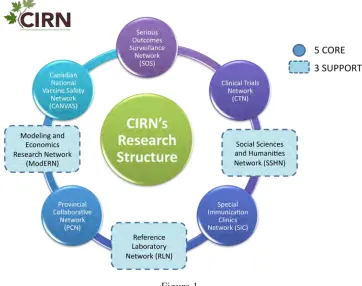
In the last six years, there has been a concerted effort by the Public Health Agency of Canada (PHAC) to coordin-ate and fund evaluative research to support public health decision making.39 This effort was catalyzed by pandemic influenza planning, when PHAC and the Canadian Insti-Figure 1.
tutes of Health Research (CIHR) funded the PHAC/CIHR Influenza Research Network (PCIRN) in 2009. Although initially intended to be part of the pandemic planning ex-ercise, PCIRN was created and funded just after the 2009 H1N1 pandemic was declared. Over six years, PCIRN undertook a broad range of research of high public health priority, addressing issues such as rapid clinical trials to inform vaccine utilization and issues related to vaccine coverage, effectiveness, safety, and delivery in the face of outbreaks. PCIRN was created as a network of net-works, linking academic-institution-based and public-health-based investigators across Canada and ensuring that multidirectional communication between decision makers, front-line public health staff, and researchers was established and maintained so that research findings could be translated into practice rapidly. The PCIRN model was felt to be sufficiently successful in meeting public health goals that, in 2015, PCIRN was transitioned to a new network named the Canadian Immunization Network (CIRN) which would have as its mandate all vaccine search of public health importance, not just research re-lated to influenza. CIRN is also designed as a network of networks (Figure 1) and includes a Clinical Trials Net-work, an ambulatory Canadian National Vaccine Safety Network, the Serious Outcomes Surveillance Network (SOS) which is an adult inpatient, hospital-based net-work, the Provincial Collaborative Network which brings together research expertise located in provincial public health agencies and Departments of Health, a Research Laboratory Network, a Social Sciences and Humanities Network, a Special Immunization Clinics Network for evaluation of serious adverse events following immuniz-ation, and the Modeling and Economic Research Network (ModERN). These networks will increasingly be used to provide the data needed for program implementation de-cisions and for evaluating the effectiveness of Canada’s immunization programs.
Conclusion
Given the nature of infectious diseases, what we describe in this update can only be viewed as a snapshot in time in an ever-changing environment. Canada’s immunization programs continue to evolve in response to the changing epidemiology of infectious diseases and the availability of new vaccines. Decisions to implement new programs and evaluations of existing and new programs are
increas-ingly becoming evidence-based. In an era of competing demands for shrinking health care funding, vaccines con-tinue to be one of the most cost-effective health interven-tions and compare favorably with any other preventive or therapeutic intervention.
References:
1. Halperin SA, Pless R. Immunization in Canada: a success to build on. J Can Chiropr Assoc. 2003; 47(3):153–160. 2. Halperin SA, Pianosi K. Immunization in Canada: a 6 year
update. J Can Chiropr Assoc. 2010;55(2): 85–91. 3. Erickson LJ, De Wals P, Farand L. An analytical framework for immunization programs in Canada. Vaccine. 2005; 23(19):2470–2476.
4. Public Health Agency of Canada. Canada’s provincial and territorial routine (and catch-up) vaccination programs for infants and children. Available from: http://healthycanadians.gc.ca/healthy-living-vie-saine/ immunization-immunisation/children-enfants/schedule-calendrier-table-1-eng.php. Accessed on 6 November 2015.
5. Public Health Agency of Canada. Canada’s provincial and territorial routine vaccination programs for healthy, previously immunized adults (aged 18 years and older). Available from: http://healthycanadians.gc.ca/healthy- living-vie-saine/immunization-immunisation/children-enfants/schedule-calendrier-table-3-eng.php. Accessed on 6 November 2015.
6. De Wals P, Lefebvre B, Markowski F, Deceuninck G, Defay F, Douville-Fradet M, et al. Impact of 2+1 pneumococcal conjugate vaccine program in the province of Quebec, Canada. Vaccine. 2014; 32(13):1501–1506. 7. Dobson SR, McNeil S, Dionne M, Dawar M, Ogilvie
G, Krajden M, et al. Immunogenicity of 2 doses of HPV vaccine in younger adolescents vs 3 doses in young women: A randomized clinical trial. JAMA. 2013; 309(17):1793–1802.
8. Hoey J. Varicella vaccine update: need for a booster? CMAJ. 2003; 168(5):589.
9. National Advisory Committee on Immunization. Updated statement on the use of rotavirus vaccines. http://www. phac-aspc.gc.ca/publicat/ccdr-rmtc/10vol36/acs-4/index-eng.php. Accessed 11 December 2015.
10. Vesikari T, Matson DO, Dennehy P, Van Damme P, Santosham M, Rodriguez Z, et al.; Rotavirus Efficacy and Safety Trial (REST) Study Team. Safety and efficacy of a pentavalent human-bovine (WC3) reassortant rotavirus vaccine. N Engl J Med. 2006; 354(1):23–33.
12. Coyle D, Coyle K, Bettinger JA, Halperin SA, Vaudry W, Scheifele DW, et al. Cost effectiveness of infant vaccination for rotavirus in Canada. Can J Infect Dis Med Microbiol. 2012; 23(2):71–77.
13. Sanford C, Langley JM, Halperin SA, Zelman M; MURVP. A universal infant rotavirus vaccine program in two delivery models: Effectiveness and adverse events following immunization. Hum Vaccin Immunother. 2015; 11(4):870–874.
14. Schink T, Holstiege J, Kowalzik F, Zepp F, Garbe E. Risk of febrile convulsions after MMRV vaccination in comparison to MMR or MMR+V vaccination. Vaccine. 2014; 32(6):645–650.
15. National Advisory Committee on Immunization. Statement on measles, mumps, rubella and varicella vaccine. Can Commun Dis Rep. 2010; 36 (ACS-9.) Available from http://www.phac-aspc.gc.ca/publicat/ccdr-rmtc/10vol36/ acs-9/index-eng.php. Accessed 11 August 2015.
16. Romney MG, Hull MW, Gustafson R, Sandhu J,
Champagne S, Wong T, et al. Large community outbreak of Streptococcus pneumoniae serotype 5 invasive infection in an impoverished, urban population. Clin Infect Dis. 2008; 47(6):768–774.
17. Schillberg E, Isaac M, Deng X, Peirano G, Wylie JL, Van Caeseele P, et al. Outbreak of invasive Streptococcus
pneumoniae serotype 12F among a marginalized inner-city
population in Winnipeg, Canada, 2009–2011. Clin Infect Dis. 2014; 59(5):651–657.
18. Isturiz R, Webber C. Prevention of adult pneumococcal pneumonia with the 13-valent pneumococcal conjugate vaccine: CAPiTA, the community-acquired pneumonia immunization trial in adults. Hum Vaccin Immunother. 2015; 11(7):1825–1827.
19. Cao W, Kim JH, Chirkova T, Reber AJ, Biber R, Shay DK, et al. Improving immunogenicity and effectiveness of influenza vaccine in older adults. Expert Rev Vaccines. 2011; 10(11):1529–1537.
20. National Advisory Committee on Immunization. Statement on seasonal influenza vaccine for 2014–2015. Ottawa, ON: Public Health Agency of Canada; 2014. Available from: http://www.phac-aspc.gc.ca/naci-ccni/flu-grippe-eng.php. Accessed 11 August 2015.
21. Van Buynder PG, Konrad S, Van Buynder JL, Brodkin E, Krajden M, Ramler G, et al. The comparative effectiveness of adjuvanted and unadjuvanted trivalent inactivated influenza vaccine (TIV) in the elderly. Vaccine. 2013; 31(51):6122–6128.
22. National Advisory Committee on Immunization. Statement on the recommended use of Herpes Zoster vaccine. Can Commun Dis Rep. 2010;36(ACS-1):1–19. 23. Langan SM, Smeeth L, Margolis DJ, Thomas SL. Herpes
zoster vaccine effectiveness against incident herpes zoster and post-herpetic neuralgia in an older US population: a cohort study. PLoS Med. 2013;10(4):e1001420.
24. Scheifele DW, Ward BJ, Halperin SA, McNeil SA, Crowcroft NS, Bjornson G. Approved but non-funded vaccines: accessing individual protection. Vaccine. 2014; 32(7):766–770.
25. National Advisory Committee on Immunization. Pertussis vaccine. In: Canadian Immunization Guide. Ottawa, ON: Public Health Agency of Canada; 2014. Available from: http://www.phac-aspc.gc.ca/publicat/cig-gci/p04-pert-coqu-eng.php. Accessed 11 August 2015.
26. Centers for Disease Control and Prevention. Updated recommendations for use of tetanus toxoid, reduced diphtheria toxoid, and acellular pertussis vaccine (Tdap) in pregnant women – Advisory Committee on Immunization Practices (ACIP), 2012. MMWR Morb Mortal Wkly Rep. 2013; 62(7):131–135.
27. National Health Service. Whooping cough vaccination in pregnancy. http://www.nhs.uk/conditions/pregnancy-and-baby/pages/whooping-cough-vaccination-pregnant.aspx. Accessed 11 August 2015.
28. Amirthalingam G, Andrews N, Campbell H, Ribeiro S, Kara E, Donegan K, et al. Effectiveness of maternal pertussis vaccination in England: an observational study. Lancet. 2014; 384(9953):1521–1528.
29. Madhi SA, Dangor Z, Heath PT, Schrag S, Izu A, Sobanjo-Ter Meulen A, et al. Considerations for a phase-III trial to evaluate a group B Streptococcus polysaccharide-protein conjugate vaccine in pregnant women for the prevention of early- and late-onset invasive disease in young-infants. Vaccine. 2013;31 Suppl 4:D52–D57.
30. Munoz FM. Respiratory syncytial virus in infants: is maternal vaccination a realistic strategy? Curr Opin Infect Dis. 2015; 28(3):221–224.
31. Kirchmeier M, Fluckiger AC, Soare C, Bozic J, Ontsouka B, Ahmed T, et al. Enveloped virus-like particle expression of human cytomegalovirus glycoprotein B antigen induces antibodies with potent and broad neutralizing activity. Clin Vaccine Immunol. 2014; 21(2):174–180.
32. Zaman K, Roy E, Arifeen SE, Rahman M, Raqib R, Wilson E, et al. Effectiveness of maternal influenza immunization in mothers and infants. N Engl J Med. 2008; 359(15):1555–1564.
33. Bernstein DI, Atmar RL, Lyon GM, Treanor JJ, Chen WH, Jiang X, et al. Norovirus vaccine against experimental human GII.4 virus illness: a challenge study in healthy adults. J Infect Dis. 2015; 211(6):870–878.
34. Lal H, Cunningham AL, Godeaux O, Chlibek R, Diez-Domingo J, Hwang SJ, et al.; ZOE-50 Study Group. Efficacy of an adjuvanted herpes zoster subunit vaccine in older adults. N Engl J Med. 2015; 372:2087–2096. 35. Richardson JS, Dekker JD, Croyle MA, Kobinger GP.
Recent advances in Ebolavirus vaccine development. Hum Vaccin. 2010; 6(6):439–449.
of dose on the safety and immunogenicity of the VSV Ebola candidate vaccine: a randomised double-blind, placebo-controlled phase 1/2 trial. Lancet Infect Dis. 2015;15(10):1156–1166.
37. Regules JA, Beigel JH, Paolino KM, Voell J, Castellano AR, Muñoz P, et al.; rVSVΔG-ZEBOV-GP Study Group. A recombinant vesicular stomatitis virus Ebola vaccine – Preliminary Report. N Engl J Med. 2015 Apr 1. Epub ahead of print.
38. World Health Organization. World on the verge of an effective Ebola vaccine. Available from: http://www. who.int/mediacentre/news/releases/2015/effective-ebola-vaccine/en/. Accessed on August 12, 2015.
39. McCarthy J, Halperin SA, Bettinger JA, Langley JM, Crowcroft NS, Deeks S, et al.; Canadian Immunization Research Network (CIRN) Investigators. Canadian vaccine research networks: Vaccine safety resources for Canada. Can Commun Dis Rep. 2015;41 Suppl 1:18–23.