R E V I E W
Open Access
Knowledge in process? Exploring barriers
between epidemiological research and local
health policy development
Joyce de Goede
1*, Kim Putters
2†, Tom van der Grinten
2†, Hans AM van Oers
1,3†Abstract
Background:In the Netherlands municipalities are legally required to draw up a Local Health Policy Memorandum every four years. This policy memorandum should be based on (local) epidemiological research as performed by the Regional Health Services. However, it is largely unknown if and in what way epidemiological research is used during local policy development. As part of a larger study on knowledge utilization at the local level in The Netherlands, an analytical framework on the use of epidemiological research in local health policy development in the Netherlands is presented here.
Method:Based on a literature search and a short inventory on experiences from Regional Health Services, we made a description of existing research utilization models and concepts about research utilization. Subsequently we mapped different barriers in research transmission.
Results:The interaction model is regarded as the main explanatory model. It acknowledges the interactive and incremental nature of policy development, which takes place in a context and includes diversity within the groups of researchers and policymakers. This fits well in the dynamic and complex setting of local Dutch health policy. For the conceptual framework we propose a network approach, in which we“extend” the interaction model. We not only focus on the one-to-one relation between an individual researcher and policymaker but include interac-tions between several actors participating in the research and policy process.
In this model interaction between actors in the research and the policy network is expected to improve research utilization. Interaction can obstruct or promote four clusters of barriers between research and policy: expectations, transfer issues, acceptance, and interpretation. These elements of interactions and barriers provide an actual expla-nation of research utilization. Research utilization itself can be measured on the individual level of actors and on a policy process level.
Conclusion:The developed framework has added value on existing models on research utilization because it emphasizes on the‘logic’of the context of the research and policy networks. The framework will contribute to a better understanding of the impact of epidemiological research in local health policy development, however further operationalisation of the concepts mentioned in the framework remains necessary.
Background
In the Netherlands in 1989 a new law on collective pre-vention was approved by parliament: the Public Health Preventive Measures Act (in Dutch abbreviated to WCPV) [1]. This law made the municipalities
responsible to protect and promote the health of their population. In 2003 all municipalities became legally required by an amendment of the WCPV to draw up a Local Health Policy Memorandum every four years. To encourage evidence-based policy development, this law required that local health policy should be based upon epidemiological research. Although the WCPV tried to reinforce a renewed collaboration between policy and research, this was not always successful [1,2]. It is lar-gely unknown if and in what way epidemiological
* Correspondence: [email protected] †Contributed equally
1
Academic Collaborative Centre of Public Health Brabant, Tilburg University, Tilburg, the Netherlands
Full list of author information is available at the end of the article
research is used during policy development at the local level. Furthermore it is not clear what the reasons are behind (not) using this research.
Context of Dutch local health policy development
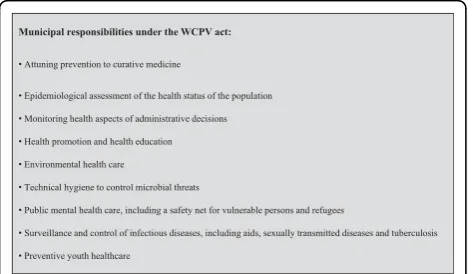
Dutch municipalities are responsible for a range of pub-lic health tasks, of which“epidemiological assessment of the health status of the population” is one. In figure 1 all WCPV-tasks are presented. Municipalities delegate their public health tasks to a Regional Health Service (RHS).
In total 29 RHSs are active in the Netherlands, cover-ing all Dutch municipalities. The tasks of a RHS are per-formed by professionals from social medicine, nursing, epidemiology and health promotion. Although the RHS-epidemiologists are assembled in a National Association there is still a large variation in research methods and reporting styles in assessing and reporting the health status of the local population. These differences depend on academic background, personal preferences and organizational structures of the RHS. In past years, most RHS-epidemiologists primarily assess the population health status by describing the public health condition and linking it to preventable risk factors. This popula-tion health assessment generally ends with the conclu-sion that “something must be done” [3]. Research concerning“what should be done” has less attention in the RHS research setting.
In 2003 an amendment of the WCPV required muni-cipalities to develop and implement a Local Health Pol-icy Memorandum every four years. How this should be done was not pronounced, but three requirements were given: (1) it should be integrated health policy con-nected with other local policy domains, (2) it should be developed and implemented with actors in the local public health field and (3) it should be based on epide-miological research. As a result of this amendment, the development of a Local Health Policy Memorandum
became a complex multi-actor process: decisions in this process had to be made in different settings, by different actors, using different resources [1,2,4-9]. This amend-ment directed RHS-epidemiologists to delivermore
com-parable data for municipalities and, also to deliver
more usable knowledge for specific municipalities.
Furthermore, a new discipline rose in RHSs: local health policy-advisers who support municipalities with the development of local health policy [2]. Simultaneously on the national level, the ministry of Health, Welfare and Sports drew up a new National Memorandum for prevention [10]. This memorandum was largely based on the public health report from the National Institute of Public Health and the Environment (RIVM), pub-lished every four years. These reports and accompanying websites [11] describe the current health status of the Dutch population.
There are three aspects that make the relation between municipalities and their RHS a complex one. First of all, municipalities are the principal funders of the RHS. Dutch RHSs in general serve multiple munici-palities, and therefore are directed by more than one. This implies that a RHS performs the same tasks for all municipalities in its region. But these regional tasks have to fit also the specific needs of the individual municipality [2]. The second aspect refers to the range of duties and roles that a municipality expects from the RHS. This can vary from an executive role - carrying out necessary tasks of the WCPV - to an advising role in drafting local health policies. A potential role conflict can appear when, within the RHS, different divisions take different attitudes toward municipalities [2]. The third aspect refers to the communication within and between regional health service and municipalities. There are many (inter)organizational connections, on various management levels. There is an extensive infor-mation flow within and between organizations, so a good regulation is necessary in order to avoid misunderstandings.
To summarize the above-mentioned, we can state that the context for the development of local health policy in The Netherlands is a complex one. On the one hand, many actors are involved - and the RHS is one of them - and these actors are also related to and dependent upon each other. On the other hand, national develop-ments influence the local policy processes and outcomes.
Aim of this study
In recent years growing attention on research utilization in policy processes was seen in Dutch [1,4,6,7,9,12] and international literature [13-15]. However, empirical stu-dies are still scarce and largely outnumbered by theore-tically oriented articles. Also in The Netherlands there is
hardly any empirical study on the use and impact of epi-demiological research on local health policymaking. Therefore an in-depth study on knowledge utilization at the local level in The Netherlands was setup. As part of this study, an analytical framework on the use of epide-miological research in local health policy development in the Netherlands is presented in this article, to be used for further empirical studies in the remainder of the project. To develop the framework, we first provide an overview of explanatory models for research utiliza-tion, based on national and international literature. Sec-ondly, we describe barriers between policymakers and researchers, based on national and international litera-ture, and on an inventory of the experiences of Regional Health Service (RHS) epidemiologists in the Nether-lands. Thirdly, we discuss the two most appropriate the-oretical concepts of research utilization and research impact. Based on these findings we conclude this article with the proposal of an analytical framework for further empirical studies concerning research utilization in local public health policy.
Methods Literature review
We used different search strategies in order to find rele-vant literature. Firstly we used selected known Dutch studies and dissertations, and international books [1,2,4-6,9,12,13,16,17] on this topic. The Dutch studies and dissertations were mainly used in order to make an analysis of the context of local health policy making. Secondly we searched in different national and interna-tional websites http://www.odi.org.uk/RAPID/, http:// www.ruru.ac.uk/, http://www.idrc.ca/, http://www.chsrf. ca/home_e.php, http://www.who.int/topics/health_po-licy/en/, http://www.evipnet.org/php/index.php concern-ing research utilization and health policy development. Thirdly specific literature was searched using Pubmed and Google Scholar, using the key words “evidenced based policy”, “research utilization”,“epidemiology”and
“local government”. Articles and books published between 1975 and 2006 were included in the study. In addition the snowball method was used in order to identify other relevant articles not thrown up by the initial search. After 2006 we followed up the literature by regularly reviewing international websites and rele-vant international scientific journals (including using RSS feeds). The materials selected for inclusion repre-sent the most relevant dealing with the topics (context of local Dutch health policy, utilization of local epide-miological health research) covered in this article.
Narratives
To ensure we missed no aspects of research utilization that were not mentioned in literature we conducted an
inventory among epidemiologists working in RHSs. By means of the National Association of RHS-epidemiolo-gists, representing 33 RHSs, we asked them by mail to give narratives of (the lack of) research-utilization from their own experience.
We asked them to take a particular case in mind, in which it was irrelevant whether it was an example of
“good”, “bad”or “non” use of epidemiological research. We asked the epidemiologists about four topics:
•Research context: aim, persons who give the assign-ment, financiers, collaborative partners, research method;
•Main outcomes of the research, considered impor-tant by epidemiologists;
•Follow up given to the results;
•Explanation of this follows up.
We received 25 reactions from 15 RHSs. The narra-tives were coded by hand based on the overview of bar-riers found in the literature. We found no barbar-riers, which were not mentioned in literature.
The construction of the framework
policy advisors from the National Association RHSs, all working in public health field in the Netherlands.
Findings
This section contains three sections. The first sub-section gives a summary of models for explaining research utilization in policymaking found in the litera-ture. The second sub-section gives an overview of possi-ble barriers in research utilization. The third sub-section describes different possibilities to describe research utili-zation or research impact itself.
Theoretical explanations for research utilization
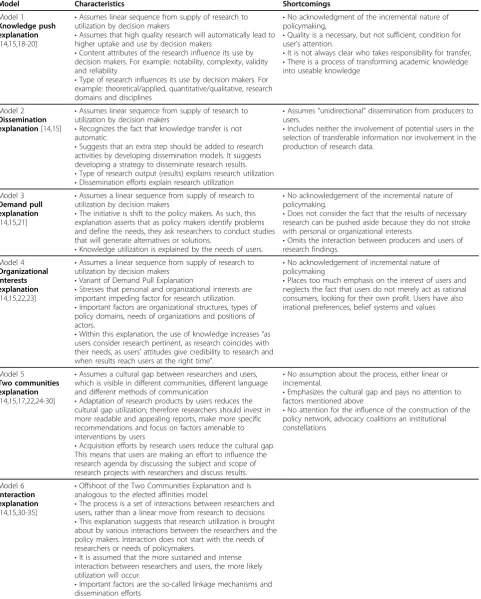
Various researchers have created research utilization models or frameworks. In general, these models share the common goal of explaining the apparent gap between research and policy. In general six types of research utilization models can be distinguished. Table 1 shows the main characteristics and shortcomings of each of these models.
There are two main rational explanation models of research utilization: knowledge push [14,15,18-20] (model 1) and demand pull [14,15,21] (model 3). Both assume a linear sequence from supply of research to uti-lization by policy makers. This assumption is a weak point of the explanations because of the incremental nature of the policy development process. The initiative for use lies either with producers (researchers) or with users (policy makers).
Two other explanations are complementary to the aforementioned explanations: the dissemination explana-tion [14,15] (model 2) elaborates on the science push explanation, as the organizational interests’explanation [14,15,22,23] (model 4) elaborates on the demand pull explanation. Caplan’s‘two communities’explanation [14,15,17,22,24-30] (model 5) takes a different approach. It emphasizes the cultural gap between researchers and policymakers, which Jansen refers to as“niches” [1]. Caplan argues that it is necessary to frame research out-comes in such a way that these fit in the niche of policy-makers. Furthermore, Caplan’s explanation model suggests that it is also necessary for policymakers to be involved with research agendas and design [24]. However, there is also a critique of this explanation. Lin and Gib-son argue that“the two communities alone is an inade-quate basis for attempts to change the way research and policy relate to each other”[17]. They question whether the model captures important determinants like the rejection or acceptance of research by advocacy coalitions during policy development based on their core values and beliefs, the influence of institutional structures within policy networks and the perspective that researchers already make part of the policy makers domain and that the so called‘gap’does not exists.
The final explanation model focuses on the interaction between researchers and policymakers [14,15,30-35] (model 6). Interaction can be defined as the reciprocal actions of two or more people who work together, negotiate on opinions, values and norms and find con-sensus. The explanation assumes that the presence of interaction and how interaction takes place, explains the way research is utilized during policy development.
Identifying specific barriers between policymakers and researchers
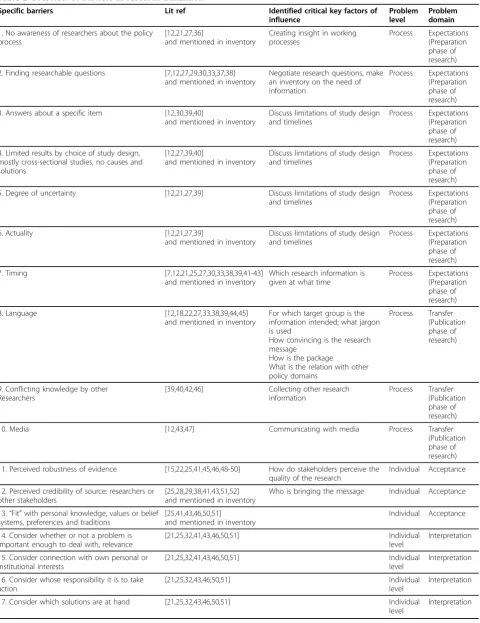
To elaborate on these six types of explanatory models, table 2 provides an overview of the seventeen barriers found in the literature and the inventory of RHSs. In the third column of table 2, critical key factors of influ-ence derived from the barriers are shown. Based on the findings we made a distinction between barriers at the
process level and at the individual level. The process
level refers to barriers related to the different steps and phases in the research process. The individual level refers to barriers related to characteristics of (policy) receivers of research information.
The process related barriers were classified in two domains: theexpectationdomain and thetransferdomain. In theexpectationdomain [12,21,25,27,29,30,33,36-42] we classified barriers that can be acted upon during the pre-paration phase of research. This domain addresses the issue of awareness among researchers and policymakers of each other’s ‘niches’. The second domain of transfer [12,18,22,27,33,38-40,42-47] addresses how research is communicated and the involvement of the media. This domain refers to the publication phase of the research cycle. Also the barriers at the individual level were classi-fied in two domains: theacceptancedomain and the
inter-pretationdomain. Barriers classified underacceptance
[15,22,25,28,29,41,43,45,46,48-52] refer to the degree to which a person believes the research outcome to be true; not about the scientific validity or credibility, but the per-ception of these by researchers and policymakers. Barriers classified underinterpretation [21,25,32,41,43,46,50,51] deal with the value people give to research outcomes, in this case local health problems. In other words“is the pro-blem important enough to act?”The value of research out-comes depends on personal experiences and interests, organizational interests and possibilities of (policy) solutions.
Concepts of research utilization or research impact
The extent of research utilization or research impact can be assessed in different areas, like in the scientific area, policy area, health services and organizational area and societal area [53].
Table 1 Overview of explanatory models of research utilization
Model Characteristics Shortcomings
Model 1
Knowledge push explanation
[14,15,18-20]
•Assumes linear sequence from supply of research to utilization by decision makers
•Assumes that high quality research will automatically lead to higher uptake and use by decision makers
•Content attributes of the research influence its use by decision makers. For example: notability, complexity, validity and reliability
•Type of research influences its use by decision makers. For example: theoretical/applied, quantitative/qualitative, research domains and disciplines
•No acknowledgment of the incremental nature of policymaking,
•Quality is a necessary, but not sufficient, condition for user’s attention.
•It is not always clear who takes responsibility for transfer, •There is a process of transforming academic knowledge into useable knowledge
Model 2
Dissemination explanation[14,15]
•Assumes linear sequence from supply of research to utilization by decision makers
•Recognizes the fact that knowledge transfer is not automatic.
•Suggests that an extra step should be added to research activities by developing dissemination models. It suggests developing a strategy to disseminate research results. •Type of research output (results) explains research utilization •Dissemination efforts explain research utilization
•Assumes“unidirectional”dissemination from producers to users.
•Includes neither the involvement of potential users in the selection of transferable information nor involvement in the production of research data.
Model 3
Demand pull explanation
[14,15,21]
•Assumes a linear sequence from supply of research to utilization by decision makers
•The initiative is shift to the policy makers. As such, this explanation asserts that as policy makers identify problems and define the needs, they ask researchers to conduct studies that will generate alternatives or solutions.
•Knowledge utilization is explained by the needs of users.
•No acknowledgement of the incremental nature of policymaking.
•Does not consider the fact that the results of necessary research can be pushed aside because they do not stroke with personal or organizational interests
•Omits the interaction between producers and users of research findings.
Model 4
Organizational interests explanation
[14,15,22,23]
•Assumes a linear sequence from supply of research to utilization by decision makers
•Variant of Demand Pull Explanation
•Stresses that personal and organizational interests are important impeding factor for research utilization. •Important factors are organizational structures, types of policy domains, needs of organizations and positions of actors.
•Within this explanation, the use of knowledge increases“as users consider research pertinent, as research coincides with their needs, as users’attitudes give credibility to research and when results reach users at the right time”.
•No acknowledgement of incremental nature of policymaking
•Places too much emphasis on the interest of users and neglects the fact that users do not merely act as rational consumers, looking for their own profit. Users have also irrational preferences, belief systems and values
Model 5
Two communities explanation
[14,15,17,22,24-30]
•Assumes a cultural gap between researchers and users, which is visible in different communities, different language and different methods of communication
•Adaptation of research products by users reduces the cultural gap utilization; therefore researchers should invest in more readable and appealing reports, make more specific recommendations and focus on factors amenable to interventions by users
•Acquisition efforts by research users reduce the cultural gap. This means that users are making an effort to influence the research agenda by discussing the subject and scope of research projects with researchers and discuss results.
•No assumption about the process, either linear or incremental.
•Emphasizes the cultural gap and pays no attention to factors mentioned above
•No attention for the influence of the construction of the policy network, advocacy coalitions an institutional constellations
Model 6
Interaction explanation
[14,15,30-35]
•Offshoot of the Two Communities Explanation and is analogous to the elected affinities model.
•The process is a set of interactions between researchers and users, rather than a linear move from research to decisions •This explanation suggests that research utilization is brought about by various interactions between the researchers and the policy makers. Interaction does not start with the needs of researchers or needs of policymakers.
•It is assumed that the more sustained and intense interaction between researchers and users, the more likely utilization will occur.
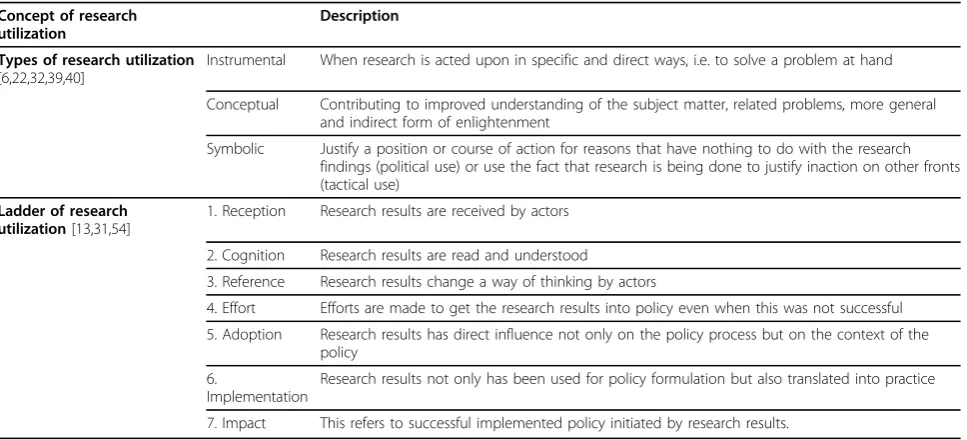
impact. The characteristics of the concepts are stated in table 3. The first concept is derived from Amara et. al. [22] and is partly based on the earlier work of Weiss [39]. They distinguish three types of research utilization models: instrumental, conceptual and symbolic. Other authors accepted these three types of use and have even delineated subtypes [2,6,32,53]. The second concept stems from Knott and Wildavsky in 1980 [54] and is called“the ladder of research utilization’. As shown in table 3, it distinguishes seven stages and suggests a nor-mative degree of research utilization - the higher the step, the better [13,31]. If we compare the two concepts, Amara et.al. on the one hand and Knott and Wildavsky on the other, it seems that the “instrumental use” of Amara et.al. overlaps with the highest stages of imple-mentation and impact from Knott and Wildavsky. The
“conceptual use”overlaps with “reference” stage of the research utilization ladder. The last type of use defined by Amara et.al., “symbolic use”, does not seem to fit directly into the research utilization ladder.
Towards a conceptual analytical framework The purpose of this article is to identify a useful analyti-cal framework for research utilization in the Dutch set-ting of local health policy development, and to use it for further empirical studies in this field.
In the literature we see the interaction model is inter-nationally regarded as the main explanatory model [13,30,32,53]. It acknowledges the interactive and incre-mental nature of policy development, which takes place in a context that includes diversity within the groups of researchers and policymakers regardless how they are organized. The elected affinity theory of Short is related to the interaction explanation. This theory assumes that the extent of contact and timing of interaction between researchers and policymakers and the fit with personal values and beliefs will improve a positive reception from the policy audience [35]. Also the linking and exchange model developed by Lomas [19] focuses on mutual exchange and the joint creation of knowledge between policy makers and researchers. Here we see a link between interaction and the overview of barriers we pre-sented. The theory of Short and the model of Lomas presume that interaction can avoid barriers and in this way improve research utilization. So assuming a network of policy stakeholders, different barriers can occur with different stakeholders. Then it becomes interesting to study when and with whom interaction takes place, in what way and with what result.
In addition, de Leeuw et al provide useful theoretical models in which they describe the different ways the
“barriers”between research and policy can be overcome [55]. They distinguish between seven models which can be ordered in three groups. First of all there is a
theoretical model regarding changing the rules and games within the structure of the research and policy networks called“the institutional re-design”model. Sec-ondly there are four theoretical models about the ways interaction takes place and the nature of the evidence: the “Blurring the boundaries”model which is about the reciprocal participation of researchers in the policy pro-cess and of policymakers in the research propro-cess; the
“Utilitarian Evidence” model in which research out-comes are articulated in a way that reflects current poli-tical agendas; the “Conduit” model about the role intermediaries play between research and policy; and the
“Alternative evidence”model which is about the impor-tance of more supporting evidence so that the research outcomes can no be longer ignored even if the issues is not on the policy agenda. Thirdly, two theoretical mod-els about the ways of communication are distinguished: the“Research narratives”model in which research out-comes are made personal and the “Resonance” model where interaction is intended to connect with underly-ing belief systems of policymakers [55].
The interaction models above are related to domains in our conceptual framework. For example“Utilitarian evidence” and“Research narratives” are related to the
transferdomain, while the“Resonance”model relates to
theacceptancedomain.
In the background section we explained the dynamic and complexity of context of Dutch local health policy. Researchers and policymakers are influenced by the cul-ture of the institutions they work in. Researchers act and make decisions in the research process in keeping with the norms of a specific research institute. This implies that researchers working in the RHS setting are influenced by their fellow researchers and other local public health professionals. Policymakers on the other hand must consider multiple actors in the policy pro-cess. These actors can, for example, be civil servants or local administrators, members of the city council (politi-cians), professionals of public services from related pol-icy domains or representatives from interest groups.
In the conceptual framework, not only interactions between a specific researcher and a specific policymaker must be considered, but also interaction between other actors within and between the research and policy pro-cess. Therefore we propose for our conceptual frame-work a netframe-work approach, in which we “extend” the interaction model. We not only focus on the one-to-one relationships between an individual researcher and pol-icymaker but include interactions between several actors participating in the research and policy process.
Table 2 Overview of barriers in research utilization
Specific barriers Lit ref Identified critical key factors of
influence
Problem level
Problem domain
1. No awareness of researchers about the policy process
[12,21,27,36]
and mentioned in inventory
Creating insight in working processes
Process Expectations (Preparation phase of research)
2. Finding researchable questions [7,12,27,29,30,33,37,38] and mentioned in inventory
Negotiate research questions, make an inventory on the need of information
Process Expectations (Preparation phase of research)
3. Answers about a specific item [12,30,39,40]
and mentioned in inventory
Discuss limitations of study design and timelines
Process Expectations (Preparation phase of research)
4. Limited results by choice of study design, mostly cross-sectional studies, no causes and solutions
[12,27,39,40]
and mentioned in inventory
Discuss limitations of study design and timelines
Process Expectations (Preparation phase of research)
5. Degree of uncertainty [12,21,27,39] Discuss limitations of study design and timelines
Process Expectations (Preparation phase of research)
6. Actuality [12,21,27,39]
and mentioned in inventory
Discuss limitations of study design and timelines
Process Expectations (Preparation phase of research)
7. Timing [7,12,21,25,27,30,33,38,39,41-43] and mentioned in inventory
Which research information is given at what time
Process Expectations (Preparation phase of research)
8. Language [12,18,22,27,33,38,39,44,45] and mentioned in inventory
For which target group is the information intended; what jargon is used
How convincing is the research message
How is the package
What is the relation with other policy domains
Process Transfer (Publication phase of research)
9. Conflicting knowledge by other Researchers
[39,40,42,46] Collecting other research information
Process Transfer (Publication phase of research)
10. Media [12,43,47] Communicating with media Process Transfer
(Publication phase of research)
11. Perceived robustness of evidence [15,22,25,41,45,46,48-50] How do stakeholders perceive the quality of the research
Individual Acceptance
12. Perceived credibility of source: researchers or other stakeholders
[25,28,29,38,41,43,51,52] and mentioned in inventory
Who is bringing the message Individual Acceptance
13.“Fit”with personal knowledge, values or belief systems, preferences and traditions
[25,41,43,46,50,51]
and mentioned in inventory
Individual Acceptance
14. Consider whether or not a problem is important enough to deal with, relevance
[21,25,32,41,43,46,50,51] Individual
level
Interpretation
15. Consider connection with own personal or institutional interests
[21,25,32,41,43,46,50,51] Individual
level
Interpretation
16. Consider whose responsibility it is to take action
[21,25,32,43,46,50,51] Individual
level
Interpretation
17. Consider which solutions are at hand [21,25,32,43,46,50,51] Individual level
assessing complex processes of problem solving in net-work settings and the roles that perceptions, interactions and institutions play in this [56]. Policy networks have a number of characteristics [2,57-59]:
• Variety of actors in terms of size, interests, power and perception of problems;
• Reservations on the part of individual actors, the willingness to cooperate and their strive for autonomy;
• Mutual dependencies between the actors on each other’s resources and decisions;
• Fragmented problem solving ability where actors also depend on each other’s resources and;
• Coordination by bargaining where decisions are a result of consultation and bargaining processes.
Stone [44] suggests that research can play a key role in the policy process when researchers are network par-ticipants. Also Nutley agrees that concepts of policy net-works provide a useful framework to study the context of policymaking and research utilization [60]. They even say that the looser the policy network, the more diver-gent are the views represented and the wider the range of different types of research that are likely to be used by those advocating different policy lines. However there is also substantial critique on the network theory [61]. It is argued that it is only a way of describing the policy process, but it explains little about how the net-work actually influences the policy process itself.
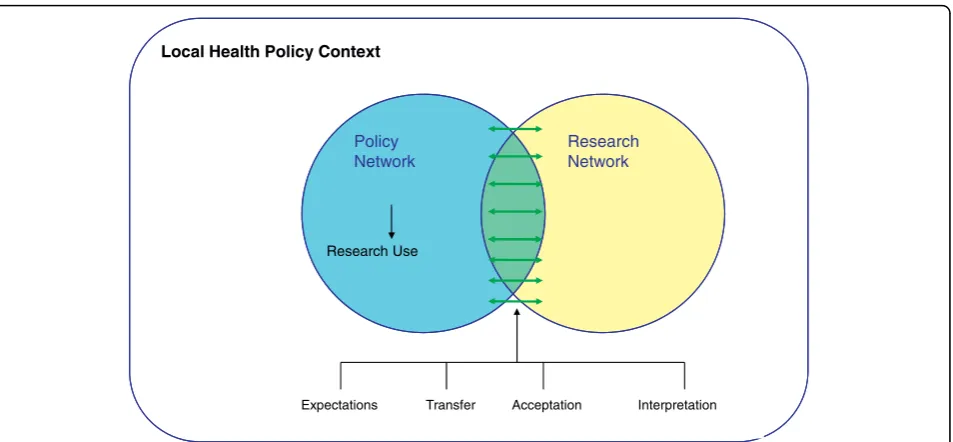
To conclude, in our conceptual framework the network approach offers a frame to describe the policy process and respectively research utilization. It will show us how the arena is shaped and whether this influences the pre-sence or abpre-sence of interaction between actors and exist-ing barriers. Subsequently the elements of interaction
and barriers have to provide an actual explanation of research utilization. We think it is of interest not only to take a network perspective on the policy process but also on the research process. In figure 2, the proposed analyti-cal framework is presented. We visualize the research and the policy networks both as circles. In the research network actors are researchers or health professionals, working together on a research project, discussing ques-tions, design, analytic strategies or papers. In the policy network actors discuss and negotiate on the importance of public health problems and the possible solutions at hand. Here we also find different actors, some in power over others, some with financial resources and others with specific knowledge and expertise. Actors may exchange information or choose not to do so. There is a possibility of overlap between the networks. This hap-pens when policymakers get involved in the research pro-cess, for example when formulating research questions, or researchers are participating and communicating their results in the policy process. Notably this type of interac-tion relates to the model,“Blurring the boundaries”of de Leeuw et al [55]. How these processes of research and policy are organized, the constellation of the research and policy networks and the way interactions between actors both within and between these networks appear, are empirical questions.
To understand research utilization it is important to study the presence of the aforementioned factors in the policy context, barriers in communication, the constella-tion of the network and the behaviour of actors and the interaction between them. From this point of view it seems evident to differentiate between research utiliza-tion of an individual actor and utilizautiliza-tion within the
Table 3 Two main concepts of research use
Concept of research utilization
Description
Types of research utilization
[6,22,32,39,40]
Instrumental When research is acted upon in specific and direct ways, i.e. to solve a problem at hand
Conceptual Contributing to improved understanding of the subject matter, related problems, more general and indirect form of enlightenment
Symbolic Justify a position or course of action for reasons that have nothing to do with the research findings (political use) or use the fact that research is being done to justify inaction on other fronts (tactical use)
Ladder of research utilization[13,31,54]
1. Reception Research results are received by actors
2. Cognition Research results are read and understood
3. Reference Research results change a way of thinking by actors
4. Effort Efforts are made to get the research results into policy even when this was not successful
5. Adoption Research results has direct influence not only on the policy process but on the context of the policy
6.
Implementation
Research results not only has been used for policy formulation but also translated into practice
policymaking process [4]. The first would mean that individual actors within the policy network use research information in the policy-making process. The three types of research utilization as proposed by Amara et.al. [22] could be a good indicator for this. Utilization on the process level would mean the impact of the research information within the policy process. An adapted and more elaborated ladder of research utilization [54] could be the base for a feasible instrument for this purpose. Impact can be measured whether information is disse-minated, read and discussed by policy actors up to suc-cessful influence of it on policy itself.
Conclusions and Future work
This article shows a substantial number of critical key factors that contribute to or impede the use of epide-miological research in local health policy making in the Dutch political context.
The developed framework has added value on existing analytical frameworks and models like Landry [14] and Hanney [15] because it emphasizes more on the‘logic’of the context and the existing networks within this specific public health policy domain. By‘logic’we mean the aims, duties and responsibilities of actors from participating organizations and relations between them in the Dutch context of local health policy. The choice for this approach is internationally mentioned before and recom-mended [62]. The framework gives the opportunity to take the possible effect of this logic on the use and impact of research for local health policy development into account. Recent Dutch studies showed that, on the national policy level, the different interactions between
researchers and policymakers during the research and policy processes provides useful insights [9,63].
As stated at the beginning of this article the proposed conceptual framework is to be used in empirical studies about how epidemiological research progresses within the policymaking process. The primary research ques-tion in these studies is whether or not interacques-tions will contribute to the use epidemiological research in local health policy development. To obtain more insight into this, we will first conduct in-depth case-studies in three municipalities and their RHS, using social network ana-lyses. Secondly, we will make a national description of the impact of epidemiological research on local health policy making within Dutch municipalities and the interaction between them and their RHS.
Further operationalisation of the concepts mentioned in the framework is necessary. Different contextual and key factors have to be transformed into relevant ques-tions for actors about their position in the networks, their relations, their involvement in research, their atti-tude towards it and their perception and judgment on the way research was transferred. On the one hand we will study existing barriers described in the conceptual framework, on the other hand we intend to elaborate on the theoretical models of de Leeuw et al, and how the barriers are overcome in the empirical situation [55,64]. Also the way impact and use of research is measured needs further elaboration in questions. Therefore we intend to adapt and translate earlier used questionnaires by Amara [22], Landry [31], and Kothari [26].
We expect the results of these studies will contribute to a better understanding of the use or impact of
local epidemiological research in local health policy development and the role of researchers within this development.
Acknowledgements
This study was financed by ZonMW, the Netherlands organization for health research and development. We also like to thank the reviewers of this article for their valuable recommendations.
Author details 1
Academic Collaborative Centre of Public Health Brabant, Tilburg University, Tilburg, the Netherlands.2Institute of Health Policy and Management,
Erasmus University, Rotterdam, the Netherlands.3Department of Public
Health Status and Forecasts, National Institute of Public Health and the Environment, Bilthoven, the Netherlands.
Authors’contributions
JDG has drafted the manuscript and designed the study, acquisited the data and analyzed and interpreted the data. KP, TVDG and HVO have revised the manuscript critically for important intellectual content. All authors have given final approval of the version to be published.
Competing interests
The authors declare that they have no competing interests.
Received: 1 October 2009 Accepted: 16 September 2010 Published: 16 September 2010
References
1. Jansen MWJ:Mind the Gap: Collaboration Between Practice, Policy and Research in Local Public Health.PhD thesisMaastricht University, The Netherlands 2007.
2. Hoeijmakers M:Local Health Policy Development Processes. Health promotion and network perspectives on local health policy-making in the Netherlands.PhD thesisMaastricht University, The Netherlands 2005. 3. Brownson RC, Gurney JG, Land GH:Evidence-based decision making in public health.Journal Public Health Management Practice1999,5(5):86-97. 4. Gorissen WHM, Schulpen TWJ, Kerkhoff AHM, van Heffen O:Bridging the
Gap Between Doctors and Policy Makers.European Journal of Public Health2005,15(2):133-9.
5. Akkerman A:Prevention Policy: an exploring background study.’ s-Gravenhage: Raad voor Maatschappelijke Wikkeling, The Netherlands2005, (report in Dutch).
6. Bekkers V, Fenger M, Homburg V, Putters K:The impact of Strategic policy advice. Erasmus Universiteit Rotterdam.Universiteit van Tilburg, The Netherlands2004, (report in Dutch).
7. Edelenbos J, Hoorn TTM, Verbeeten TCM:Seas of information, the role of information during policy development.Bestuurswetenschappen2000,
54:355-374, (In Dutch).
8. Teisman GR:Models for research into decision making processes: on phases, streams and decision making rounds.Public Administration2000,
78:937-956.
9. Bekker M:The politics of healthy policies: redesigning health impact assessment to integrate health in public policy.PhD thesisErasmus University, The Netherlands 2007.
10. Ministry for Public Health, Welfare and Sports. Choose for Healthy Living, National Memorandum for prevention. Dutch Ministry for Public Health, Welfare and Sports, The Netherlands2006, (in Dutch).
11. de Hollander AEM, Hoeymans N, Melse JM, van Oers JAM, Polder JJ, editors:
Care for Health: the 2006 Dutch Public Health Status and Forecasts Report
Bilthoven: National Institute for Public Health and the Environment, The Netherlands 2006.
12. Keijsers JFEM, Paulussen TGWM, Peters LWH, Fleuren MAH, Lammers F:
Better use of knowledge: Information behaviour of national policy makers.Woerden: NIGZ, TNO, The Netherlands2005, (report in Dutch). 13. Nutley SM, Walter I, Davies HTO:Using Evidence. How research can inform
public servicesBristol, UK.: The Policy Press, University of Bristol 2007.
14. Landry R, Amara N, Pablos-Mendes A, Shademani R, Gold I:The Knowledge-Value Chain: A Conceptual Framework for Knowledge Translation in Health.Bull World Health Organ2006,84(8):597-602. 15. Hanney SR, Gonzales-Block MA, Buxton MJ, Kogan M:The Utilization of
Health Research in Policy-Making: Concepts, Examples, and Methods of Assessment.Health Research Policy and Systems2003,1:2.
16. Davies HTO, Nutley SM, Smith PC, (editors):What Works? Evidence-based policy and practice in public servicesBristol, UK.: The Policy Press, University of Bristol 2000.
17. Lin V, Gibson B, (editors):Evidence-based health policy: Problems and possibilitiesMelbourne, Australia: Oxford University Press 2003.
18. Beyer JM, Trice HM:The Utilization Process: A Conceptual Framework and Synthesis of Empirical Findings.American Science Quarterl1982,
27:591-622.
19. Lomas J:Connecting Research and Policy.Isuma Canadian Journal of Policy Research2000, 140-144.
20. Bekker M, Putters K, van der Grinten TED:Exploring the relation between evidence and decision-making. A political-administrative approach to health impact assessment.Environmental Impact Assessment Review2004,
24:139-149.
21. Edelenbos J, van Buuren MW, Teisman G, editors:By-passing Barriers in Sustainable Knowledge Production.Proceedings of the 2002 Berlin Conference on the Human Dimensions of Global Environmental Change
“Knowledge for the Sustainability Transition The Challenge for SOcial Science”, Global Governance Project: Amsterdam, Berlin, Potsdam and Oldenburg2004. 22. Amara N, Quimet M, Landry R:New Evidence on Instrumental,
Conceptual, and Symbolic Utilization of University Research in Government Agencies.Science Communication2004,26(1):75-105. 23. Sabatier PA, ed:Theories of Policy ProcessesWestview Press 2007. 24. Caplan N:The two-Communities Theory and Knowledge Utilization.The
American Behavioral Scientist1979,22(3):459-70.
25. Rich RF, Oh CH:Rationality and Use of Information in Policy Decisions.
Science Communication2000,22(2):173-211.
26. Oh CH:Explaining the Impact of Information on Problem Definition: An Integrated Model.Policy Studies Review1998,15:109-136.
27. Lomas J:Improving Research Dissemination and Uptake in the Health Sector: Beyond the Sound of One Hand Clapping.McMaster University Centre for Health Economics and Policy Analysis, Policy Commentary. C97-1 1997.
28. Beyer JM:Research Utilization. Bridging a Cultural Gap Between Communities.Journal of Management Inquiry1997,6(1):17-22. 29. Elliott H, Popay J:How Are Policy Makers Using Evidence? Models of
Research Utilization and Local NHS Policy Making.J Epidemiol Community Health2000,54:461-8.
30. Innvaer S, Vist G, Trommald M, Oxman A:Health Policy-makers’ Perceptions of Their Use of Evidence: A Systematic Review.J Health Serv Res Policy2002,7(4):239-44.
31. Landry R, Amara N, Lamari M:Climbing the Ladder of Research Utilization: Evidence from Social Science Research.Science Communication2001,22:396-422.
32. Kothari A, Birch S, Charles C:“Interaction”and Research Utilization in Health Policies and Programs: Does it Work?Health Policy2005,
71:117-25.
33. Awazu Y:Informal Network Players, Knowledge Integration, and Competitive Advantage.Journal of Knowledge Management2004,
8(3):62-70.
34. Albaek E:Between Knowledge and Power: Utilization of Social Science in Public Policy Making.Policy Sciences1995,28:79-100.
35. Short S:Elective affinities: Research and health policy development.In
Health policy in Australia.Edited by: Gardner H. Oxford University Press, Melbourne; .
36. Lewis JM:Being around and knowing the players: Networks of influence in health policy.Soc Sci Med2006,62:2125-36.
37. Davis D, Evans M, Jadad a, Perrier L, Rath D, Ryan D, Sibbald G, Straus S, Rappolt S, Wowk M, Zwarenstein M:The Case of Knowledge Translation: Shortening the Journey from Evidence to Effect.Br Med J2003,
327:33-35.
39. Weiss CH:The Many Meanings of Research Utilization.Public Adm Rev
1979,39(5):426.
40. Lavis JN, Roberston D, Woddside JM, McLeod CB, Abelson J:How Can Research Organizations More Effectively Transfer Knowledge to Decision Makers.The Millbank Quarterly2003,81(2):221-47.
41. Bowen S, Zwi AB:Pathways to“evidence-informed”policy and practice: A framework for action.PLoS Med2005,2(7):e166.
42. Dobrow MJ, Goel V, Upshur REG:Evidence-based Health Policy: Context and Utilization.Soc Sci Med2004,58:207-17.
43. Mitton C, Patten S:Evidence-based Priority Setting: What do the Decision-makers think?J Health Serv Res Policy2004,9(3):146-52. 44. Stone D, Maxwell S, Keating M:Bridging Research and Policy.International
Workshop funded by the Department for International Development. Radcliffe House, Warwick University, UK 2001.
45. Nutley S, Walter I, Davies H:From Knowing to Doing: A Framework for Understanding the Evidence-Into-Practice Agenda.Evaluation2003,
9:125-148.
46. Van Buuren MW, Edelenbos J:Conflicting Knowledge: Why is joint knowledge production such a problem?Science and Public Policy2004,
31(4):289-99.
47. Dearing JW, Rogers EM:Agenda-SettingThousand Oaks: SAGE publications inc 1996.
48. Abelson J:Understanding the role of contextual influences on local health-care decision making: case study results from Ontario Canada.
Soc Sci Med2001,53:777-93.
49. Shaxson L:Is Your Evidence Robust Enough? Questions for Policy Makers and Practitioners.Evidence & Policy2005,1(1):101-11.
50. Collins PA, Abelson J, Eyles JD:Knowledge in action? Understanding ideological barriers to adresssing health inequalities at the local level.
Health Policy2007,80(1):158-71.
51. Rogers EM:Diffusions of InnovationsNew York: Free Press, 5 2003. 52. Levin DZ:The Strength of Weak Ties You Can Trust: The Mediating Role
of Trust in Effective Knowledge Transfer.Management Science2004,
50(11):1477-1490.
53. Kuruvilla SMN, Walt G:Describing the impact of health services and policy research.J Health Serv Res Polic2007,12(S1):23-3.
54. Knott J, Wildavsky A:If dissemination is the solution, what is the problem?Knowledge: Creation, Diffusion, Utilization1980,1(4):537-78. 55. De Leeuw E, McNess A, Crisp B, Stagnitti K:Theoretical reflections on the
nexus between research, policy and practice.Critical Public Health2008,
18(1):5-20.
56. Koppenjan JFM, Kleijn EH:Managing uncertainties in networks: a network approach to problem solving and decision makingLondon UK, Routledge Publishers 2004, 9.
57. Hufen JAM, Ringeling AB:Policy networks: government, semigovernment -en private organisations’s Gravenhage, Nederland, VUGO1990, (report in Dutch).
58. Kenis P, Schneider V:Policy networks and policy analysis, scrutinizing a new analytical toolbox.InPolicy networks: empirical evidence and theoretical considerations.Edited by: Martin B, Mayntz R. Frankfurt am Main, New York, Campus West View; 1991:.
59. De Bruijn H, ten Heuvelhof E:Networks and decision makingUtrecht, the Netherlands, Lemma Publishers 2000.
60. Nutley S, Webb J:Evidence and the policy process.InWhat Works? Evidence-based policy and practice in public services.Edited by: Davies HTO, Nutley SM, Smith PC. Bristol, UK.: The Policy Press, University of Bristol; 2000:13-41.
61. Hill MJ:The Public Policy Process. Fourth Edition.Pearson Educated Limited, Essex UK2005, 74-76.
62. Leeuw , Evelyne de :Investigating policy networks for health: theory and method in a larger organizational perspective.InEvaluation in health promotion - Principles and perspectives.Edited by: Rootman I, Goodstadt M, Hyndman B, MacQueen DV, Potvin L, Springett J, Ziglio E. WHO Regional Publications, European Series, No. 92. WHO/EURO, Health Canada 2001:
Chapter 9:185-208 [http://www.euro.who.int/en/what-we-publish/abstracts/ evaluation-in-health-promotion.-principles-and-perspectives].
63. van Egmond S, Bekker M, Bal R, van der Grinten T:The Public Health Status and Forecasts Report as an infrastructure for evidence-based health policy. A game between distance en involvement.TSG2007,
7:399-406, (in Dutch).
64. De Leeuw, Andrew McNess, Karen Stagnitti, Beth Crisp:It’s research, Jim, but not as we know it. Acting at the Nexus.Integration of research, policy and practice. Final report, August 2007, VicHealth/Deakin University, Melbourne Australia2007.
doi:10.1186/1478-4505-8-26
Cite this article as:de Goedeet al.:Knowledge in process? Exploring barriers between epidemiological research and local health policy development.Health Research Policy and Systems20108:26.
Submit your next manuscript to BioMed Central and take full advantage of:
• Convenient online submission
• Thorough peer review
• No space constraints or color figure charges
• Immediate publication on acceptance
• Inclusion in PubMed, CAS, Scopus and Google Scholar
• Research which is freely available for redistribution