19
The usage of a simulaTion To
sTudy inTermolecular forces:
some findings
Claudia Ayres, Celeste Ferreira, Agnaldo Arroio university of são Paulo, são Paulo, Brazil e-mail: [email protected], [email protected], [email protected]
Abstract
The purpose of this research was to discuss and reflect about the use of a computer simulation in the learning of intermolecular forces. Simulations are dynamic representations of chemical processes or systems, and allow users to select values for input variables from within suitable ranges and observe the results on output variables. In this study we used free software named “Ligações Intermoleculares”, from http://nautilus.fis.uc.pt/molecularium/pt/ligintermol/index.html. The goal of this activity was to help stu -dents build internal representations (mental models) for course content. The research is qualitative. We applied a pre-test and a post-test to a class of students (n=30) from a secondary school trying to find what these internal representations are like. The research indicates that students’ pictographic representations of intermolecular forces improved substantially. These findings suggest that the use of this visual tool helped students to make a better connection between the chemical representations and the macroscopic phenomena presented during a mini-course about solubility.
Key words: visualization, computer, simulation, chemistry.
Introduction
The use of visualizations in chemistry education became a new field of research. In the
last years, four very different groups of people (computer software specialists, scientists, educa-tionalists and cognitive scientists) have promoted the development, the discussion and the use of visual tools in sciences instruction (Gilbert, 2007), nevertheless research evidences are only in the beginning. there are more questions than answers. the role of models and visualization in science and science education has been discussed in the last years in several studies: what to study, how to do so, what constitutes good practices, or how to evaluate the outcomes of that practice are some of the challenges that researchers have faced and will continue to face in the next years.
There is a central topic that often crosses these studies which is the definition of the term
“visualization”. according to Gilbert, reiner and nakleh (2008) there are two conventions, in convention 1, visualization is a verb (to visualize something is to mentally act on it), in con-vention 2 visualization is a noun (visualization is something in the public realm). inevitably, there are also studies that cross the two conventions, for instance, studies about “visuospatial thinking”.
Volume 24, 2010
20 with questions such as: how is a visual representation turned into knowledge? What are the
mental processes that are involved in attaching a meaning to a representation? What mental and brain processes are involved in “seeing”? (reiner, 2008). other authors (Gilbert, 2007; rapp & Kurby, 2008) also present their ideas about these concerns. Gilbert refers the importance of
developing “metavisual capability” or “metavisualization”, the acquisition of fluency in visual -ization and the making of meaning for any representation (Gilbert, 2008). this author suggests that this development could be done by general good practice in the use of representations by
teachers and in textbooks and by the specific cultivation of the skills involved (Gilbert, 2007).
like has been mentioned before, there is another trend of research that uses the term visualization in the sense of convention 2, a noun, something that has been placed in the public realm in either a material object, visual, verbal or symbolic form. here has been found several studies (Wu, Krajcik & soloway, 2001; santos & Greca, 2005; tasker & dalton, 2006; Kozma & russel, 2007; arroio & honório, 2008) that by using a different approach try to evaluate the use of different kinds of visualizations in chemical instruction. most parts of these studies are
only quantitative and through a series of specific tests they try to evaluate the pupil’s appren -ticeship and indirectly the effectiveness of the visualization used.
Problem of Research
therefore, it began to encounter some studies where a component of qualitative research is introduced. the aim of this introduction is to obtain rich information of how pupils develop an understanding of chemical concepts while using visualizations as helping tools in learning. a great part of these tested visualizations are software with virtual 2d and 3d images and in a few cases animations and simulations or combinations of various representations (e.g. concrete three-dimensional models, virtual computer models, static two-dimensional computer models, stereo-chemical formulas). so, in this work we try to contribute with some insights of how stu-dents build internal representations from external representations (visualizations). this qualita-tive approach was used to get more information about what do students glean from external representations and how they internalize and express that information.
Simulation was chose to discuss the intermolecular force’s concepts. Like has been men -tioned before, simulations are dynamic representations of chemical processes or systems, and allow students to interact with this by changing input variables from within suitable ranges and observe the results on output variables. it is recognized their limitations, a simulation
incorpo-rates one or more rules to define a model. These rules are applied within some limited condi -tions, but when introduced carefully, a simulation is a good tool for exploration and learning.
Kozma and Russell (2007), present an interesting investigation using five chemistry multimedia visualization projects using different approaches. The authors concluded that all five projects show an improvement in the learning of chemistry concepts and development of scientific in -vestigative process skills.
ardac and akaygun (2004), also present a study that evaluates the effectiveness of
multi-media-based instruction on students’ understanding of chemical change. The authors concluded
that students who received multimedia-based instruction outperformed students from regular instruction group in terms of the resulting test scores and the ease which they could represent matter at the molecular level. they also mentioned that, results relating to the long-term effects suggest that the effectiveness of this type of instruction can be improved if instruction includes additional prompting to help students to do the correspondence between different representa-tions of the same phenomena.
in-Volume 24, 2010 21
dicate the importance of multiple symbol systems in enhancing learning. allan paivio (1986), presents dual coding theory (dct), that provides the basis for using multiple representational systems in instruction. this theory suggests that information presented by way of verbal and imagery channels are processed separately, and it has been tested in several multimedia stud-ies to explain how information presented as text and animated sequences interact to produce learning. most part of these studies was conducted by r. mayer and his collaborators (mayer, 2001). these studies have shown that, as in a dual coding model, the combined use of text and animated graphics made the information more memorable, and that problem solving was
improved when using software that paired animations with narration. These findings are also
supported by cognitive load theory (clt) proposed by John sweller (2003). cognitive load is a term that refersto the load on working memory during instruction. this theory differenti-ates between three types of cognitive load: intrinsic cognitive load, germane cognitive load, and extraneous cognitive load. this theory has broad implications for instructional design, because it allows instructional designers to control the conditions of learning, within an environment, or more generally within most instructional materials.
in another study, tasker and dalton (2006), discuss the use of animations and present a multimedia information-processing model for learning from audiovisual information. once
again, it’s based on the theoretical models depicts above (DCT and CLT), and they concluded
that animations and simulations can communicate many keys about the molecular level effec-tively, which is considered to be very important in chemistry apprenticeship. these authors also
point out the need to build mental models, and that many student difficulties and misconcep -tions in chemistry result from inadequate or inaccurate mental models at the molecular level. on their research, they use the Vischem Project, which was founded to produce a suite of mo-lecular animations depicting the structures of substances and selected chemical and physical changes that in contrast to textbook illustrations can show the dynamic, interactive, and multi-particulate nature of chemical reactions explicitly.
Research Focus
the understanding of the particulate nature of the substance is one of the central top-ics of sciences, in particular of chemistry, and, in accordance with adadan, irving and trundle (2009), it involves the following aspects: the nature of particles for same them, the relative distance and the arrangement between them, the existence of electrostatic forces between parti-cles (intermolecular forces) and the intrinsic movement of partiparti-cles. being this concept, for its nature, linked with the submicroscopic level of representation, it is opportune that if available to the student tools that the same facilitate the understanding of this concept, according others authors (Kozma, chin, russell & marx, 2000; Wu, Krajcik & soloway, 2001).
Methodology of Research
The purpose showed to the school’s master was a mini-course about solubility. It was
organized with the application of a structured experimental activity on the concepts of polarity and solubility of the substances and the usage of multimedia resources.
Participants of Research
this work was conducted with a class of 30 pupils, from the second year of a public secondary school in são paulo city. this school has an informatics laboratory with 12 comput-ers with broad band internet access. the majority of students had regular chemistry classes
Volume 24, 2010
22 students were organized in four groups, female and male.
leaving from the planning, a prior informal surveying was done with the pupils with the
purpose of find out what they knew about atoms, molecules, simple and compound substances,
homogeneous and heterogeneous mixtures and solubility.
Instrument of Research
in this study, it was considered opportune to apply a questionnaire before the experimen-tal activity and after the activity with the multimedia resource, so that the pupil has the chance to make registers, through the writing and drawing of its representations for the situations in study. in such a way, it will be possible to analyze which is its understanding on the macroscopic and submicroscopic levels, before the practical activity and the use of the multimedia resource, as well as later, promoting a scene where we wait to be able to evidence the occurrence or not of changes in its representations, what it will imply in possible changes in its mental models.
the questionnaire before the experimental activity, had six open questions where the intention was to survey which was the previous ideas of the pupils on models, the relation be-tween model and reality, which idea they brought on animation and computational simulation, on the union between atoms and molecules, which the importance of this subject, what are the chemical bonds and if the atoms and its bonds are statics or dynamics. it also had one seventh question where was asked the pupil to represented, through drawings, the visual aspect and the organization of particles of the participant substances of the mixtures water/kitchen salt, wa-ter/copper sulphate ii (cuso4), water/cleaning fluid, water/alcohol and water/kitchen oil. The
questionnaire after the activity with the multimedia resource, had four open questions where the pupil would have a new possibility to register their ideas on the chemical bonds, if they are statics or dynamics, if the use of the simulation/animation made some difference in their learning on bonds and which was this difference, which the opinion of it on the mini-course,
indicating positive and negative points and their suggestions. It also had a fifth question, that
it was the same one of the previous questionnaire, where the pupil was asked to represented, through drawings, the visual aspect and the organization of particles of participant substances of the studied mixtures.
the multimedia resource together with the use of the technology was used to expand the meaning of the chemical phenomena, for the systems in submicroscopic scale and for the outside world. in accordance with russel et al (1997),
‘Visualizations of chemical phenomena and concepts linked to microscopic-level animations and to examples from the students’ everyday life may aid the more visual learner and stimulate more students to achieve mastery-level understanding of chemical concepts.’
some researchers, in its articles, refer the use of tools of visualization with the objective to facilitate the understanding of the particulate nature of the substance or to promote
concep-tual changes in the students on the particles’ behavior (Snir, Raz & Smith, 2003; Kozma, Chin,
russell & marx, 2000; adadan, irving & trundle, 2009; bowen, 1998; yezierski and birk, 2006; sanger, campbell, felker & spencer, 2007). research involving the visual representa-tions showed that the use of visual tools, such as livened up or static computerized molecular
Volume 24, 2010 23
Data Analysis
during the conceptual survey with the pupils, they had been organized in four groups, with approximately seven pupils in each.
the pre-questionnaire was supplied to the pupils. this questionnaire involving open questions and graphical register, took 10 minutes approximately to be answered by the pupils.
After that, it was made the survey of the pupils’ conceptions and the development of the experi -mental activity. on the ending of the experi-mental activity, the pupils had been directed for the informatics laboratory, in order to use the multimedia resource on intermolecular interactions and during this usage the pupils had a script structuralized with opened questions on the situa-tions simulated for by the resource.
As the groups finished the activity in the informatics laboratory, a questionnaire after ac -tivity was given to them to being answered. in this, the question involving the macroscopic and submicroscopic visualization was repeated in order to create the chance of the pupils to modify or to complement its representations, in case that they wanted.
Results of Research
Previous Questionnaire
In the first question, the answers of the pupils identified the model as a drawing, a proj -ect, an idea that still schematizes an experience or a theory, being then a base for new
experi-ences and/or theories. Some affirmed to be a representation of an idea, a suggestion, of theory
or an experience, if thus becoming base for new experiences. it was explicitly replied that the model “is a form to demonstrate something”, without leaving clearly what it would be this dem-onstration; if it would be a exemplifying or a representation of something.
the model understanding is in fact, for some pupils, as being an example, something
specific, that it identifies a prompt situation; others as if the model were the proper reality, expe -rience or theory and not a representation. however, it is important to detach that the expression “representation of theories” appears in some answers.
in the second question, some had strengthened the idea of that model represents the
real-ity, that explains the reality. Others had affirmed that the model is an attempt to explain the real
-ity, however that the same one is more complex. In this affirmation we perceive that pupil con -siders the distant model of the reality, as being a simplifying of the reality. in this context, the model has its value attributed to an incomplete, simplistic base, which it does not have the level of detailing and complexity that the reality brings in them. in such a way, it is a starting point,
but it does not support, does not explain the reality. One of the answers affirms that “Model
serves person to understand it as it would be…, the reality is more complex.” one of the pupils
affirms that “reality is what it is happening and the model is something that demonstrates what
it can occur.” showing that the model would have the function to predict facts or situations. in the third question, the understanding about animation is about images in movement, with acceleration, as some answers. some compare the computational animation with a liv-ened up drawing, movements and speak, passing the idea of separation of the reality, as if the animation did not have linking with the real. already the simulation, “tries to imitate” a situa-tion, represents or interacts with the reality through the computer, transmitting the perception
to that the simulation is next to the reality, has an aggregate value of fidelity with the reality
Volume 24, 2010
24 its interpretation. the animation does not allow the interaction as the simulation, the alteration
of variable, with intention to understand and/or to foresee a behavior.
in the fourth question, where the pupil was asked to explain the union between atoms, the interaction between molecules and which the degree of importance of this topic, some pupils had not answered, leaving a blank space, or had written “do not know” or “we forget”. others, had answered on an evasion form, as “the union is very important, therefore help to create things” or “a thing leads to another one, believing that everything is on, forming some-thing. the importance is our survival, to understand our formation…” they had explanation attempts where the pupil displays the union between atoms as “junction between particles of positive and negative components,…” probably a allusion to protons and electrons or that “the union between atoms and the interaction between molecules if must the electron union, protons
and neutrons”, demonstrating difficulty in the approach of more specific concepts to chemistry,
without distinction between which the responsible particles for the bonds between atoms and as the same ones interfere with the interaction between the molecules. still it had had answers
where do not appear explanation attempts but the direct affirmation of that “union between at -oms molecule”, demonstrating to a possible difficulty of interpretation of the question or an
attempt to answer to show the pertinent knowledge of something to the subject or not to leave the question without reply.
The same it happens in the fifth question, with regard to the absence of answers. Some pupils, when answering, had affirmed that the chemical bonds are substances, that if mixing,
can become another substance or that it is the mixture of two substances. these answers show the absence of the understanding of the concept and the confusion with regard to the formation of mixtures and the occurrence of chemical reactions.
In the sixth question, the majority of the pupils affirmed that the atoms and its bonds
are dynamic and the explanation was that “they are moved, if mixes and if they transform” or
something into this direction. It’s possible to verify that the pupils explain the dynamism for the
perception of the mixture and the transformation here, for the action to mix materials and the involved action in this situation, the agitation of the materials.
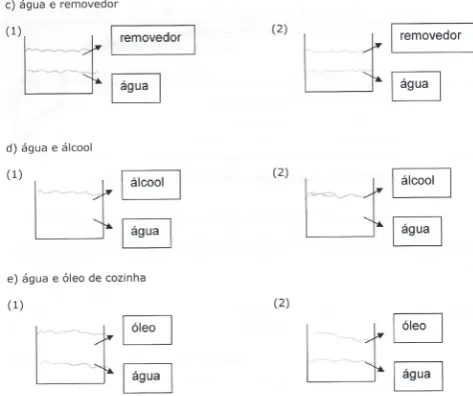
in the seventh question, the drawings of the pupils, with regard to the visual aspect, differentiate the homogeneous mixtures of the heterogeneous ones, however the same it does not happen in the representation of the organization of particles. in the mixtures water/salt of kitchen and water/copper sulphate ii, only two pupils represent the systems in the same way that in the visual aspect (figure 1). the remains, when drawing these two systems, if concern in representing, as much the kitchen salt how much the copper sulphate ii, as points in watery
way and consider the water as a continuous substance (Figure 2). The difficulty in visualizing the water particulate’s nature is perceived there, assuming that the same one is a continuous
Volume 24, 2010 25
Figure 1. Representation of the visual aspect (1) and the organization of particles (2) of the mixtures water/salt of kitchen and water/ copper sulphate II.
Figure 2. Representation of the visual aspect (1) and the organization of particles (2) of the mixtures water/salt of kitchen and water/ copper sulphate II.
Volume 24, 2010
26 Post Questionnaire
In the first question, the pupils had pointed the chemical bonds as dynamic, being that some had not justified the affirmation. Between that, they had justified that they had stories as
“therefore they are always interacting with other elements.”, “therefore they put into motion themselves and if they transform” or “because she has movement in particles when interacting
two similar substances”. These justifications show that the pupils had not differentiated atoms
and molecules, from the existing bonds between the same ones, attributing pertinents
character-istic’s bonds to particles. That is confirmed from the justification of two pupils who tell “They are dynamic. Always the molecules’ movement.” Still in this question, two groups formed by three pupils each, had affirmed that the chemical bonds are static, because they involve the statics, if relating the electricity static. We perceive here the difficulty of understanding of the
meaning of the used concept, therefore the same word possess distinct meanings, in accordance with the context that the same one is used.
In the second question, some pupils affirm that, with the multimedia tool they had been
able “to see” what really he happens with loads gifts in objects, probably an allusion to the
ex-perimentation with the pen and water thread. Others had affirmed that “it was more clearly the
comments made in laboratory” or despite “we can have a notion of how the alterations occurs”.
However, these affirmations are vacant, not being possible to affirm if really it had a change in
the elaboration of the concept of bonds.
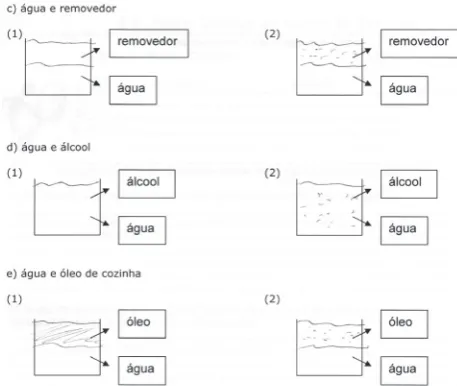
the third question was the same one of the previous questionnaire, which requested to the pupils the representations of the visual aspect and the organization of particles. the draw-ings made for the pupils show that great conceptual changes in the particulate representation of the substance had not occurred. in the referring drawings to the visual aspect, the representa-tions were very seemed the facts in the previous questionnaire. however, in the referring
draw-ings to the organization of particles, the mixtures water/cleaning fluid and water/kitchen oil had had its represented substances as points, restricted the phase identified for the substance, being
the represented water still of continuous form (figure 4). this occurred in 4 of the 11 scripts answered in group. in the mixture water/alcohol, 4 answered scripts of the 11, being 3 of the pu-pils of the cited situation previously, had presented drawings of this mixture where the alcohol was represented by points spread in the water, being this also represented of continuous form (figure 4). moreover, in 3 answered scripts of the 11, the water was represented of hybrid form,
with points and also as continuous substance, disclosing the difficulty of the pupils in accept -ing the representation particulate for the water (figure 5). it had change in the representation
of substances, in submicroscopic level, identified through the done registers that indicate the
Volume 24, 2010 27
Figure 4. Representation of the visual aspect (1) and the organization of particles (2) of the mixtures water/cleaning fluid, water/alcohol and water/kitchen oil, being cleaning fluid, oil and
alcohol with particles.
Figure 5. Representation of the visual aspect (1) and the organization of particles (2) of the mixtures water/cleaning fluid, water/alcohol and water/kitchen oil, with differentiation between (1) and (2) in all substances.
Discussion
Previous Questionnaire
the pertinent questions to the submicroscopic level had been the ones that the pupils had
presented greater difficulty in answering, therefore do not know what to write, as to describe particles that are not part of its sensorial repertoire. This difficulty is evidenced by the repre -sentations of the organization of particles, where the representation of these practically does
not appear. This difficulty to describe what it is not tangible for the directions is observed by
Volume 24, 2010
28 Post Questionnaire
In the first question we perceive as the fact of the pupil not to share of the language of a scientific community can implicate it difficulties in the conceptual elaboration. The words can
have diverse meanings in accordance with the way where they are used and this absence of proximity with the one meanings determined area, they can take to a very different elaboration of concepts of what it was intended in the action, as the ideas of lemke (1997).
Conclusions
comparing the images of the representations of the pupils, before and after the use of the resource, it has indication of improvement in the representation of the particulate nature of
the substance, what it can be reflected of a development in the mental model of the pupils on
the worked systems.
These findings suggest that the use of this visual tool helped students to make a better
connection between the chemical representations and the macroscopic phenomena presented during a mini-course about solubility
Acknowledgements
We acknowledge the scholarship from capes, brazil.
References
adadan, e., irving, K. e., trundle, K. c. (2009). impacts of multi-representational instruction on high School Students’ Conceptual Understandings of the Particulate Nature of Matter. International Journal of Science Education, 31:13, 1743–1775.
ardac, d., akaygun, s. (2004). effectiveness of multimedia instruction that emphasizes molecular repre-sentations on students’ understanding of chemical change. Journal of Research in Science Teaching, 41 (4), 317-337.
arroio, a., honório, K. m. (2008). images and computational methods in molecular modeling educa-tion. Problems of Education in the 21st Century, Vol. 9, p. 17–23.
ben-Zvi, r., eylon, b., & silberstein, J. (1986). is an atom of copper malleable? Journal of Chemical Education, 63, 64-66.
bowen, c. W. (1998). item design considerations for computer-based testing of student learning in chemistry. Journal of Chemical Education, Vol. 75 (9), p. 1172.
Gilbert, J. K. (2007). Visualization: a metacognitive skill in science and science education. in J. K. Gilbert (eds.) Visualization in Science Education. holanda: springer, 9–27.
Gilbert, J. K., reiner, m., nakhleh, m. (2008). introduction. in J. K. Gilbert, m. reiner, m. nakhleh (eds.) Visualization: Theory and Practice in Science Education. holanda: springer, 1–2.
Gilbert, J. K. (2008). Visualization: an emergent field of practice and enquiry in science education. in J. K. Gilbert, m. reiner, m. nakhleh (eds.) Visualization: Theory and Practice in Science Education. holanda: springer, 3-24.
Kozma, r., chin, e., russell, J., & marx, n. (2000). the roles of representations and tools in the chem-istry laboratory and their implications for chemchem-istry learning. The Journal of the Learning Sciences, 9(2), 105-143.
Volume 24, 2010 29
lemke, J. l. (1997). Aprender a hablar ciencia: Lenguaje, aprendizaje y valores. barcelo: ediciones paidós ibérica.
mayer, r. (2001). Multimedia learning. new york: cambridge university press.
paivio, a. (1986). Mental representations: a dual-coding approach. new york, usa: oxford uni press rapp, d. n., Kurby, c. a. (2008). the ins and outs of learning: internal representations and external visu-alizations. in: J. K. Gilbert, m. reiner, m. nakhleh (eds.) Visualization: Theory and Practice in Science Education. springer, p. 29–52.
reiner, m. (2008). the nature and development of Visualization: a review of what is known. in: J. K. Gilbert, m. reiner, m. nakhleh (eds.) Visualization: Theory and Practice in Science Education. springer, p. 25–27.
russel, W. J., Kozma, r. b., Jones, t., Wykoff, J., marx, n., davis, J. (1997). use of simultaneous-synchronized macroscopic, microscopic, and symbolic representations to enhance the teaching and learning of chemical concepts. Journal of Chemical Education,Vol. 74, no. 3, p. 330–334.
sanger, m. J., campbell, e., felker, J., spencer, c. (2007). “concept learning versus problem solving”: does particle motion have an effect? Journal of Chemical Education, Vol. 84 (5), p. 875.
santos, f., Greca, i. (2005). promovendo aprendizagem de conceitos e de representações pictóricas em Química com uma ferramenta de simulação computacional. Revista Electrónica de Enseñanza de las Ciencias, Vol. 4, no. 1.
snir, J., raz, G., smith, c. l. (2003). linking phenomena with competing underlying models: a software tool for introducing students to the particulate model of matter. Science Education, 87(6), 794–830. sweller, J. (2003). Cognitive Load Theory: A Special Issue of Educational Psychologist. lea, inc. lon-don, 38 (1).
tasker, r., dalton, r. (2006). research into practice: visualization of the molecular world using anima-tions. Chemistry Education Research and Practice, 7(2), 141–159.
Wu, h., Krajcik, J. s., soloway, e. (2001). promoting understanding of chemical representations: stu-dents´ use of visualization tool in the classroom.Journal of Research in Science Teaching, Vol. 38 (7), p. 821-842.
yezierski, e J., birk, J. p. (2006). misconceptions about the particulate nature of matter. using anima-tions to close the Gender Gap. Journal of Chemical Education, Vol. 83 (6), p. 954.
Adviced by Vincentas Lamanauskas, University of Šiauliai, Lithuania
Claudia Ayres Lecturer, University of São Paulo, São Paulo, Brazil. E-mail: [email protected]
Website: http://www.fe.usp.br
Celeste Ferreira Lecturer, University of São Paulo, São Paulo, Brazil. E-mail: [email protected]
Website: http://www.fe.usp.br
Agnaldo Arroio Professor, University of São Paulo, Av. Da Universidade, 308, São Paulo, Brazil. Phone: + 55 11 30918297.