EFFECTS OF DIFFERENT KINDS OF SEWAGE SLUDGE AMENDMENT
ON URBAN LAWN GRASSES
Elżbieta Wołejko1, Andrzej Butarewicz1, Urszula Wydro1, Tadeusz Łoboda1
1 Division of Sanitary Biology and Biotechnology, Faculty of Civil and Environmental Engineering, Bialystok
University of Technology, 45d Wiejska Str., 15–351 Białystok, Poland, e-mail: [email protected]
INTRODUCTION
Sewage sludge is an essential product of wastewater treatment processes. Sludge extracted from wastewater is a complex organic-mineral substance, composed mainly of carbon, hydro-gen, oxyhydro-gen, nitrohydro-gen, sulfur, and chlorine [Wilk, Wolańczyk 2008].
Most of the sludge produced in municipal sewage treatment plants in Poland should be de-signed for natural use, including use in ture. The only obstacle to use sludge in agricul-ture on a large scale may be the presence of heavy metals and pathogenic organisms in it. Therefore, the preferred direction of the management of sed-iment should be the use of such processes, which would allow for the inactivation of pathogenic microorganisms and heavy metals [Butarewicz 2013]. If this condition is met, settlements are an excellent product to be used in nature, which makes it possible to recycle valuable components, such as organic matter, nitrogen, phosphorus and other nutrients for plants. Fertilization with sta-bilized sludge helps to increase humus in soil, as
Volume 16, Issue 1, Jan. 2015, pages 164–170
DOI: 10.12911/22998993/603 Research Article
ABSTRACT
The paper presents the results of research on the use of sewage sludge from the
mu-nicipal sewage treatment plant in Białystok for fertilization of urban lawns. To fertil
-ize the ground two types of deposits were used: stabil-ized sludge after the dewatering
process in the press and granular sludge after drying in the sludge dryer. Two doses
of sludge were used – 5 and 10 kg/m2. Effective microorganisms (EM) were added
to the test plots. Both doses of the applied sewage sludge contributed significantly to the growth of grass biomass. Aboveground biomass of the plants was significantly
correlated with the concentration of Cd, Cu, Pb and Zn in the surface layer of the soil. The addition of EM to soil containing the dewatered sludge from the press reduced
significantly the content of heavy metals in the soil, as opposed to the sludge in a form
of granules with addition of EM, which contributed to the increase of their concentra-tion in the soil.
Keywords: sewage sludge, soil, heavy metals, effective microorganisms.
Received: 2014.08.14 Accepted: 2014.10.17 Published: 2015.01.02
well as to improve its quality. Fertilization depos-its may help to increase the yield of various crops, such as cereals, vegetables, trees and shrubs, thus influencing the landscape [Pathak et al. 2009]. However, the potential benefits of adding sewage sludge to soils are balanced by the risk of increas-ing the content of heavy metals in soil. The con-ditions for the application of sewage sludge into soil are regulated by EC Directive 86/278/EEC and are based on heavy metal content in both soil and sludge [Paz-Ferreiro et al. 2012].
Matthews 2003; Skoczko, Piekutin 2014]. The in-tensity and magnitude of soil and plants contami-nation with heavy metals often depend not only on local factors. A major source of trace elements deposited on the surface of the soil and plants is the spread of pollutants over long distances [Ka-bata-Pendias, Pendias 1999].
Green city areas, including lawns, have vari-ous kinds of functions. On the one hand, well cared lawns enhance the aesthetic value of the city, on the other hand, they play a phytoremedia-tion role, both for air and soil [Gawroński 2009]. For the effective phytoremediation plants should be characterized by high resistance to difficult environmental conditions, to have the ability to accumulate xenobiotics from the soil as well as to rapid growth and high dry mass production. Grasses are characterized by high phytoremedia-tion potential [Singh et al. 2009]. According to Gawroński [2009], grasses in urban areas can ful-fill the above requirements when they have good conditions for rapid growth and high dry mass production. For this purpose, sewage sludge may be used as a substitute for fertilizers, and at the same time effective microorganisms (EM) could be used to stimulate the growth of grasses. EM has a wide application in the field of agriculture, natu-ral farming, livestock, gardening, composting and bioremediation. This consortium of microorgan-isms accelerates breakdown of proteins, sugars, fats and fibers, and thus, promotes rapid organic matter decomposition. EM works in two primary ways: competitive exclusion of harmful micro-organisms and production of beneficial products such as enzymes, organic acids, amino acids, hor-mones and antioxidants that improve conditions of the environment [Khaliq et al. 2006].
The aim of this study was to examine the ap-plicability of two different types of sewage sludge from the Municipal Wastewater Treatment Plant in Bialystok: dehydrated sludge from the press and dried in the form of granules to the turf lawns. At the same time the possibility of using EM to stimulate the decomposition of sludge and grass growth was also examined.
MATERIALS AND METHODS
The study was conducted on the campus of the Białystok University of Technology (Białystok, Wiejska Str. 45). The experiment was established in April 2012 in a randomized block design (on
plots of 2 m2). The plots were located in the green belt along the internal road. The surface of the re-search was divided into three blocks with an area of 20 m2 each, constituting replicates. To fertil-ize the studied soil two different types of sew-age sludge from the sewsew-age treatment plant in Białystok were used: dewatered sludge after press and dried in the form of pellets. Prior to the use of sludge both types of sludge were tested accord-ing to the Regulation of the Minister of Environ-ment of 13 July 2010 on municipal sewage sludge (Journal of Laws of 2010 No 137 item. 924). The analyses of Salmonella genus were carried out on EPA Method 1682: Salmonella in Sewage Sludge (Biosolids) by Modified Semisolid Rappaport-Vassiliadis (MSRV) Medium. The parasitological tests were carried out in accordance with Polish Standard PN-Z-19000–4 and recommended by US EPA.
Two doses of dehydrated sludge 5 and 10 kg/m2 and two doses of the granular sludge, 1.5 and 3 kg/m2, with or without 5 l EM per square meter were used on each experimental field. EM were from Greenland Technology EM, currently the only licensed manufacturer of EM in Poland. There were also experimental fields without sew-age sludge (control).
In the experiment grass mixture Roadside from Barenbrug was used, which contains 32% of Lolium perenne cv. Barmedia, 5% of Poa pra-tensis cv. Baron, 52% of Festuca rubrarubra cv. Barustic, 5% of Festuca rubra commutata cv. Bardiva (BE) and 6% of Festuca rubra commu-tata cv. Bardiva (NL).
Due to adverse weather conditions the grass mixture was sown in an amount of 30 g per plot on 29 April 2012. On 4 June 2012, the first har-vest was done. The second harhar-vest was on 1 July 2012. In September 2012 samples of soil (0–20 cm) were collected. Heavy metals concentra-tions in soils fertilized with sewage sludge and in plant material were determined using Atomic Absorption Spectrometry AAS. The samples of soil were mineralized in temperature at about 450°C and remains were dissolved in aqua regia (3:1 mixture HCl and HNO3) according to PN-ISO 11047:2001. The samples of mixtures of grasses were mineralized at the temperature of about 450°C and remains were dissolved in con-centrated HNO3 [Filipek et al. 2003].
75 °C until complete evaporation of water. Bio-concentration factors (BCF) for analyzed heavy metals were determined as quotients of average concentration of a given element in plants with relation to its average concentration in soil. The correlation between heavy metals concentration in above ground of plants and in soil fertilized with different doses of sewage sludge were cal-culated using Spearman’s correlation factor r for p ≤0.05 by using Statistica 10.0.
RESULTS AND DISCUSION
Białystok Wastewater Treatment Plant oper-ates as an important element of the Polish Green Lungs. It is one of the ten largest sewage treat-ment plants in Poland. It was opened in 1994. Designed for the capacity of 176 500 m3/day, it turned out to be receiving a much greater amount of actually sewage than it had been planned. Cur-rently, the actual throughput is about 100 thou-sand m3/d. It is a mechanical-biological treatment plant with sludge treatment and biogas exploita-tion. The treatment plant has a modern sanitary sludge treatment, which comprises a sludge dryer which produces granular sludge. These granules were tested and they are suitable for use on all types of soils. It is especially recommended for weak mineral soils with low organic matter con-tent. It can be used in the cultivation of agricul-tural crops, lawns, squares of green, to fertilize outdoor trees, shrubs and ornamental plants. In the case of the use of dehydrated sludge after the press one must reckon with the possibility of depositing the chemicals in them, and especially
dangerous organisms from a sanitary point of view. Some amount of impurities coming to the wastewater treatment plant is decomposed in the biological treatment processes, some importing impurities accumulate in sludge formed in the pu-rifying processes and some are discharged with wastewater to the receiver. The content of toxic substances, heavy metals and biological contami-nation, depends on the amount and type of waste taken to the municipal sewer system. For the most part of sludge, the amount of these impurities is small and does not pose a serious risk to health and environment [Bernacka, Pawłowska 2000, Fukas-Płonka 2011].
Before the onset of the experiment both sew-age sludge and soil from each combination were analyzed according to the Resolution of Ministry of Environment of July 13th, 2010 concerning
mu-nicipal sewage sludge. The analyses were done by the Regional Chemical and Agricultural Sta-tion in Białystok (Table 1 and 2). Additionally, soil pH in 1M KCl were determined. Biological and parasitological indications were conducted in the Division of Sanitary Biology and Biotech-nology, Białystok University of Technology. The results are shown in Tables 1 and 2. According to the cited Regulation, the tested samples from sewage sludge treatment plant in Białystok and averaged soil samples taken from the top layer of plots met all the criteria set out in the
Regu-Table 1. Selected physical and chemical properties of soils
Properties
The limits of heavy metals in the surface of light soil
layer (0–25 cm) with the application of municipal sewage sludge for land reclamation for non-agri-cultural (Regulation 2010)
pH 7.65 –
Textural class loamy sand –
P2O5 [mg×100 g-1D.M.] 14.43 –
Cd [mg/kg D.M.] <0.50 3
Cu [mg/kg D.M.] 17.35 50
Pb [mg/kg D.M.] 25.2 50
Zn [mg/kg D.M.] 138.95 150
Table 2 Selected properties of municipal sewage sludge
Properties Granular sludge Dehydrated sludge
pH 7.6 7.4
Dry weight (%) 88 19.8
Organic matter (% D.W.) 59.2 58.4
Total P (% D.W.) 3.2 3.0
Total N (% D.W.) 4.6 4.4
Ammonium N (% D.W.) 0.32 0.2
Ca (% D.W.) 4.1 4.6
Mg (% D.W.) 0.7 0.6
Pb (mg×kg D.W.-1) 21.9 20.7
Cd (mg×kg D.W.-1) 1.2 <1.26
Cu (mg×kg D.W.-1) 208 179
Zn (mg×kg D.W.-1) 1109 1208
The number of viable helminth ova of Ascaris sp., Trichris sp., Toxocara sp.
Not detected Not examinated
Bacteria of the genus Salmonella in 100 g of
lation. Dehydrated sludge from the press did not contain Salmonella and invasive nematode ova. In the case of granules, it was not necessary to do biological studies, because sewage sludge was dried at 130 °C.
Basing on the results, it was possible to use both types of deposits in the later part of the ex-periment and the establishment of the experimen-tal plots.
Grassy areas in the passageways are usually established on degraded soils characterized by a mechanical malfunction and poor trophic condi-tions. Before the introduction of plants or at the stage of change of land use, soils often require the enrichment with organic substance to improve the physical and chemical properties, to provide a source of macro- and micronutrients, and to ac-celerate positive biological changes [Karczewska et al. 2012]. However, psychological barrier asso-ciated with the source of their origin, the specific structure of the sediment and usually a high con-tent of certain heavy metals make it very difficult to find a buyer who could reasonably use sewage sludge [Dmochowski et al. 2011].
Heavy metals are not broken down by micro-organisms in the biological treatment of waste-water. The soluble form is especially toxic, as it is generally found in plants and animals and can bioaccumulate in these organisms, as well as in humans. Moreover, heavy metals are involved in many chemical reactions. They can change forms from a soluble to insoluble state and from an ab-sorbed to a free state [Zhu, Zang 2001]. The dy-namics of changes in forms of metals is most in-tense in the top layer of the soil and it depends on diverse populations of microorganisms, content of organic matter, cation exchangeable capacity (CEC) and the biological interaction associated with microorganisms activity of rhizosphere and
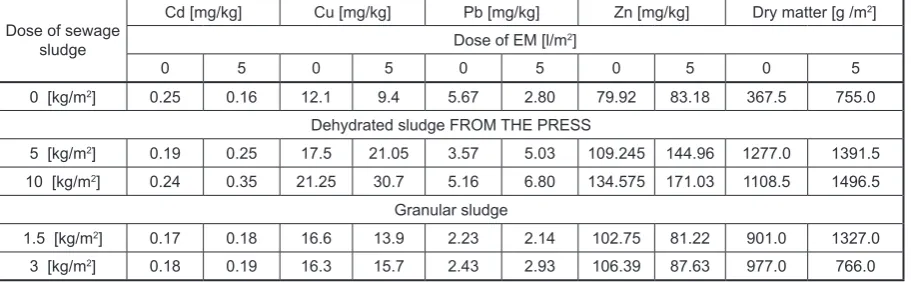
also on the plant itself [Adriano et al. 2004]. In our study, the content of metals was examined in plant, which grew on plots where different kinds and various doses of sewage sludge and sludge with EM were applied. There were significant correlations between concentrations of metals in the soil and the metal content in the aerial parts of lawn grasses. There was a negative correlation between the content of Zn in soil fertilized with sludge from the press and Cu in plants (r = –0.82), while for the plots fertilized with sludge granules there was also a correlation between Zn and Cu in the soil and in plants (r = 0.88). The correla-tion analysis was also done for press sludge and granulated sludge with the addition of EM. There were significant correlations between concentra-tions of metals in the soil and the metal content in plants. There was a positive correlation between high lead content in soil fertilized with sludge from the press and Cd in soil – for these elements at the level of correlation was r = 0.94 at p <0.05. The fertilization sludge from the press in the dose of 10 kg/m2 was used, one observed an increased accumulation of the metals in above ground parts of plants about 70% in the plants with 5 l EM/m2 compared with plots with sludge but without EM. In turn, the fertilization with granular sludge and 5 l EM/m2 resulted in a lower content of heavy metals in above ground parts of plants, which shows that the sediment from the press plants have more phytoremediation proper-ties than sludge granules. In addition, applying EM into the soil with the sludge from the press led to the strengthening of this effect (Table 3).
The differentiation of geochemical back-ground in Poland is mainly related to variable chemical composition of the rocks from which they arise. Against this background a number of regional and local anomalies of geological and
Table 3. Contents of heavy metals and dry matter of grasses fertilized with different doses of sludge with or without EM
Dose of sewage sludge
Cd [mg/kg] Cu [mg/kg] Pb [mg/kg] Zn [mg/kg] Dry matter [g /m2]
Dose of EM [l/m2]
0 5 0 5 0 5 0 5 0 5
0 [kg/m2] 0.25 0.16 12.1 9.4 5.67 2.80 79.92 83.18 367.5 755.0
Dehydrated sludge FROM THE PRESS
5 [kg/m2] 0.19 0.25 17.5 21.05 3.57 5.03 109.245 144.96 1277.0 1391.5
10 [kg/m2] 0.24 0.35 21.25 30.7 5.16 6.80 134.575 171.03 1108.5 1496.5
Granular sludge
1.5 [kg/m2] 0.17 0.18 16.6 13.9 2.23 2.14 102.75 81.22 901.0 1327.0
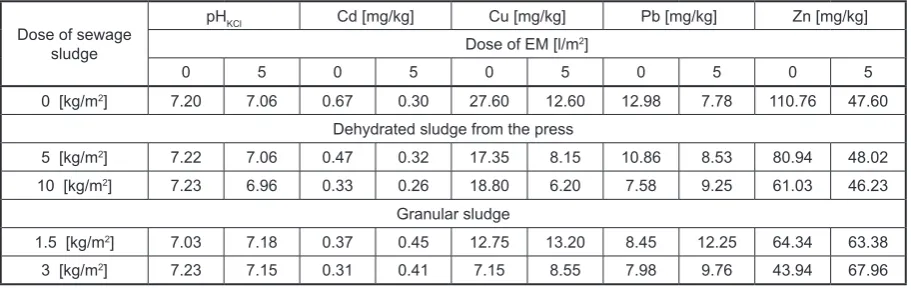
anthropogenic origin can be distinguished [Lis, Pasieczna 1995]. The sequence of heavy metal concentration (mg/kg) in the meadow soils in this research was: Zn>Cu>Pb>Cd. The content of cadmium in the soil on the test plots ranged from 0.26 to 0.67 mg/kg d.m., when the natural values of cadmium specific to Podlasie is Cd <0.5 ppm [Lis, Pasieczna 1995]. The addition of EM reduced the quantity of cadmium in the soil, which may be due to the properties of the sludge and its greater availability to plants. At 5 kg/m2 sludge from the press and with addition of 5 l EM/m2, the amount of Cd decreased from 0.47 to 0.32 mg/kg d.m., whereas at 10 kg/m2 of sedi-ment from the press and with the addition of 5 l EM/m2 it decreased from 0.33 to 0.26 mg/kg d.m. The treatments applied in granular sludge with the addition of 5 l EM/m2 resulted in an increase of cadmium in the soil. The granular sludge de-composed more slowly and metals contained in the sediment were gradually released into the soil, hence their less uptake by plants and higher content in the soil. Fertilizing plots with granular sludge in an amount of 1.5 kg/m2 and a precipitate containing 5 l EM/m2 increased the value respec-tively from 0.37 to 0.45 mg/kg dry matter, and with 3 kg/m2 granular sludge with the addition of 5 l EM/m2 respectively 0.31 to 0.41 mg/kg d.m. (Table 4).
The content of copper in the soils was very diverse (from 6.20 to 27.6 mg/kg d.m.). The aver-age copper content was located within the natural values of this element in soils for Podlasie region in Poland (20–40 ppm) [Lis, Pasieczna 1995]. The content of zinc in soils varied between 47,60 and 110,76 mg/kg d.m. with the natural values set at 25–400 ppm Zn, but the content of lead on the test plots where sludge from the press and granular were applied and EM were added to both kinds,
was below the natural range of 12.5–100 ppm Pb given by Lis and Pasieczna [1995] (Table 4).
The pH is an important factor determining the solubility of heavy metals in soil. It depends on e.g. ion balance – sorption and desorption pro-cesses of hydrogen cations and metal cations. Generally, heavy metals solubility is low in the neutral and alkaline range of pH and increases with decreasing pH [Kabata-Pendias, Pendias 1999]. Rosada’s [2007] studies confirm that the soil pH determines the uptake of metals by plants and their mobility in the soil. There was no sig-nificant correlation between the content of the in-vestigated metals in soil and plants and in soil pH Trace metals are characterized by a very long period of persistence in the environment. Once en-tered, they practically remain in the environment and can cause bioaccumulation in the plants and can enter different biological metabolic pathways. Some heavy metals in trace amounts are essential to life but their excess has a negative impact on the health of plants, animals and humans [Bernac-ka, Pawłowska 2000]. In addition, the mobility of metals plays an important role in the rhizosphere compartment, which corresponds to the whole in-terface between roots and soil, where interactions between the soil microorganisms, roots and soil constituents take place [Kabata-Pendias, Pendias 1999, Lin et al. 2004]. The release of protons, exudates and metabolites into the rhizosphere by the roots and the microorganisms can modify the pH, depending on the available source of nitro-gen nutrients or iron deficiency [Singh et al. 2009, Węglarzy 2007], thus modifying the fixation and mobility of heavy metals in soils [Lin et al. 2004]. The degree of bioaccumulation of a metal is the result of balance between the input rate and the rate of elimination. Bioaccumulation occurs pri-marily due to the inability to excrete necessary
Table 4. Effects of fertilizing with different doses of sewage sludge with or without EM on soil pH and contents
of heavy metals in soil
Dose of sewage sludge
pHKCl Cd [mg/kg] Cu [mg/kg] Pb [mg/kg] Zn [mg/kg]
Dose of EM [l/m2]
0 5 0 5 0 5 0 5 0 5
0 [kg/m2] 7.20 7.06 0.67 0.30 27.60 12.60 12.98 7.78 110.76 47.60
Dehydrated sludge from the press
5 [kg/m2] 7.22 7.06 0.47 0.32 17.35 8.15 10.86 8.53 80.94 48.02
10 [kg/m2] 7.23 6.96 0.33 0.26 18.80 6.20 7.58 9.25 61.03 46.23
Granular sludge
1.5 [kg/m2] 7.03 7.18 0.37 0.45 12.75 13.20 8.45 12.25 64.34 63.38
levels of the contaminant [Kabata-Pendias, Pen-dias 1999, Malik et al. 2010].
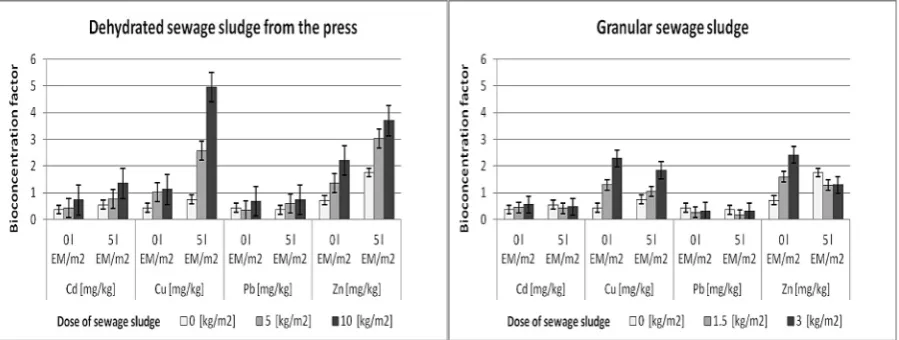
According to Wilk and Gworek [2009], cad-mium has affinity for any components of sewage sludge and is relatively readily soluble, so that plants absorb it proportionally to the concentra-tion of this element in environment regardless of the pH of soil. In our study, BCF for Cd (Figure 1) was the highest (on average of about 1.13) at the highest dose on applied sewage sludge (10 kg/m2) from press with 5 l EM/m2, while the lowest for control plots (0.37). The applied sludge from the press and the granules increased cadmium BCF in the aboveground parts of grass proportionally to the dose of biosolids. The addition of EM to sewage sludge increased the contend of Cd in plants in the plots with sludge from press, while in the plots with granules the BCF of cadmium in aboveground part of grasses was lower (0.42 and 0.47 respectively for plots with 1.5 and 3 kg/ m2 dose of biosolids with 5 l EM/m2). Lead like cadmium is an element which is not required for the growth and development of plants. The BCF of Pb in this study was in the range of 0.17 – 0.74. One observed increased BCF in samples collect-ed from plots where biosolids from the press with 5 l EM/m2 were applied, while in the plots with granular sludge the BCF decreased.
Zinc and copper are microelements that are the most mobile in soil, accumulate in the up-per layers of soil and they are readily soluble and available to plants [Węglarzy 2007]. In our study the BCF of Cu and Zn in the plots fertil-ized with sludge from press and granules sludge were in the range from 1.01 to 2.28 for Cu and from 1.35 to 2.42 for Zn. The addition of EM
Figure 1. BCF of heavy metals (Cd, Cu, Pb and Zn) in lawn grasses depending on the dose and kind of sewage sludge with or without EM
caused an increase of BCF in plots with sewage sludge from press in comparison with a pure sew-age sludge without EM by 150% at dose of 5 kg/ m2, by 330% at dose of 10 kg/m2 for copper, by 120% for single sewage sludge dose and by 60% at double dose of sludge for zinc. According to Węglarzy [2007], copper is hardly released from the soil, plants accumulate it mainly in roots but in contaminated environment its concentration increases in aboveground parts of plant. BCF of Cu and Zn decreased when sewage sludge with EM was used (Figure 1).
CONCLUSION
1. The fertilization of soil with sewage sludge from Municipal Wastewater Treatment Plant in Białystok at 5 and 10 kg/m2 had a positive effect on the growth of lawn grasses biomass. 2. The use of sludge from the press and in a form
of concentrated granules usually did not sig-nificantly affect the content of heavy metals both in the grass and in the soil.
3. The addition of EM to dewatered sludge from the press significantly decreased the content of heavy metals in the soil, and thus contributed to increase their absorption by plants. This re-sulted in the improvement of lawn grass reme-diation capacity for Cd, Cu, Pb and Zn.
5. BCF of heavy metals in plants was character-ized by high variability, depending on the type of sediment and the addition of EM.
Acknowledgments
The research presented was supported finan-cially by the project S/WBiIŚ/3/2011 and W/ WBiIŚ/14/2014.
REFERENCES
1. Adriano D.C., Wenzel W.W., Vangronsveld J., Bolan N.S. 2004. Role of assisted natural remediation in environmental cleanup. Geoderma., 122, 121–142. 2. Alvarez E.A., Mochón M.C., Jiménze Sánchez
J.C., Rodríguez M.T. 2002. Heavy metal extract -able forms in sludge form wastewater treatment
plants. Chemosphere, 47, 765–775
3. Bernacka J., Pawłowska L., 2000. Potentially toxic
substances in sludge from municipal wastewater
treatment. Wyd. IOŚ, Warszawa, 7–9.
4. Butarewicz A. 2013. Pathogenic organisms in sew
-age sludge – the detection and neutralization. The Publishing House of Bialystok University of Tech -nology.
5. Dmochowski D., Gajkowska-Stefańska L., Dmo
-chowska A., Presnarowicz R.K. 2011. Application
of heavy metals speciation in assessing suitability of municipal post-fermentation sludge for
produc-ing roll-out grass. Prz. Nauk. Inż. Kszt. Środ., 53, 207–216.
6. Filipek T.A., Kaczor A., Badora A. 2003. Funda -mentals and effects of chemicals in
agroecosys-tems. Akademia Rolnicza, Lublin.
7. Fukas-Płonka Ł. 2011. Management of sewage sludge. Selected issues. Pol. Zrzeszenie Inżynierów i Techników Sanitarnych. Oddz. Wielkopolski. Poznań.
8. Gawroński S.W. 2009. Fitoremediacja a tereny zieleni. Zieleń Miejska, 10, 31.
9. Kabata-Pendias A., Pendias H. 1999. Biogeochem
-istry of trace elements, Państwowe Wydawnictwo Naukowe, Warszawa.
10. Karczewska A., Gersztyn L., Gałka B. 2012. The ef -fects of various kinds of sewage sludge applied to soil on the amounts of soluble copper forms in
pol-luted soils. Ochr. Środ. i Zasob. Natur., 51, 53–61.
11. Khaliq A, Abbasi MK, Hussain T. 2006. Effects
of integrated use of organic and inorganic nutrient sources with effective microorganisms (EM) on seed
cotton yield in Pakistan. Biores. Tech., 97, 967–972. 12. Lin Q., Chen Y.X., He Y.F., Tian G.M. 2004. Root-induced changes of lead availability in the rhizo
-sphere of Oryza sativa L. Agr. Ecosyst. Environ., 104, 605–610.
13. Lis J., Pasieczna A. 1995. Geochemical atlas of Po
-land. Warszawa.
14. Pathak A., Dastidar M.G., Sreekrishnan T.R. 2009. Bioleaching of heavy metals from sewage sludge: A review. J. Environ Manage., 90(8), 2343–2353.
15. Paz-Ferreiro J., Gascó G., Gutiérrez B., Méndez A. 2012. Soil biochemical activities and the geometric mean of enzyme activities after application of sew -age sludge and sew-age sludge biochar to soil. Biol
Fertil Soils., 48, 511–517.
16. PN-ISO 11047:2001. Soil quality. Determination of Cd, Cr, Co, Cu, Pb, Mn, Ni and Zn in extracts with aqua regia. Methods of flame and electrother -mal atomic absorption spectroscopy.
17. Rosada J. 2007. Ekologiczne aspekty wykorzystan
-ia obszarów objętych oddz-iaływaniem emisji hut miedzi do upraw rolniczych. Postępy w Ochronie Roślin, 47(1), 119–127.
18. Singh A., Kuhad R.C., Ward O.P. 2009. Advanc
-es in applied bioremediation. Soil Biology 17,
Springer-Verlag Berlin Heidelberg.
19. Skoczko I., Piekutin J. 2014. Photo-Fenton method
usage to organic compounds degradation. Desalin.
Water Treat. 52, 19–21.
20. Malik R.N., Husain S.Z., Nazir I. 2010. Heavy
metal contamination and accumulation in soil and
wild plant species from industrial area of Islam
-abad. Pakistan. Pak. J. Bot., 42(1), 291–301. 21. Węglarzy K. 2007. Heavy metals – a source of
contamination and environmental impact. Wiad.
Zootech., 45(3), 31–38.
22. Weiner R.F., Matthews R.A. 2003. Environmential
Engineering, Elsevier Science, Burlington.
23. Wilk J., Wolańczyk F. 2008. Problems of the energy utilization of the waste from the sewage-treatment plant. Polityka Energetyczna, 11(2), 139–149. 24. Wilk M., Gworek B. 2009. Heavy metals in sewage
sludge. Ochr. Środ. i Zasob. Natural., 39, 40–59. 25. Zhu S Q, Zang X P. 2001. On heavy metal pollu